



Abstract
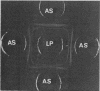
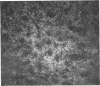
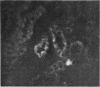
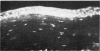
In experimental rabbits heterologous soluble lens proteins consisting of alpha-, beta-, and gamma-crystallins were found to be antigenic; they stimulated a marked antibody response compared to a rather weak T-cell response. The serum antibodies to alpha-crystallins appeared first, to be followed by antibodies to beta- and gamma-crystallins in that order. The rabbits did not respond to heterologous gamma-crystallins unless these were injected with Freund's adjuvant containing mycobacteria. Incomplete Freund's adjuvant (i.e., without mycobacteria) was found to be an inferior immunoaccelerator so far as lens antigens are concerned. The response to lenticular antigens in both magnitude and duration varied in different rabbits, which suggested to us the important role played by a central control mechanism involving the immune response (Ir) genes. Some of the antibodies in potent lens antisera cross-reacted with mitochondria, endoplasmic reticulum (i.e., microsomes), contractile organelles, and cell nuclei. This explains for the first time at least in part the reasons for the widely observed phenomenon of the reactivity of lens antisera with ocular and extraocular structures. Antibodies to soluble lens proteins as detected by immunofluorescence and immunoperoxidase techniques were shown to be of the IgG class. Systemic heterologous immunisation followed by discission of the lens does not lead to the typical changes of phakoallergic endophthalmitis in the rabbit.
Full text
PDF


Images in this article



Selected References
These references are in PubMed. This may not be the complete list of references from this article.
- Armand G., Balazs E. A., Testa M. Separation and partial characterization of two proteins from fraction B of calf lens. Exp Eye Res. 1970 Jul;10(1):143–150. doi: 10.1016/s0014-4835(70)80021-5. [DOI] [PubMed] [Google Scholar]
- BJORK I. Studies on gamma-crystallin from calf lens. I. Isolation by gel filtration. Exp Eye Res. 1961 Dec;1:145–154. doi: 10.1016/s0014-4835(61)80020-1. [DOI] [PubMed] [Google Scholar]
- Bankhurst A. D., Torrigiani G., Allison A. C. Lymphocytes binding human thyroglobulin in healthy people and its relevance to tolerance for autoantigens. Lancet. 1973 Feb 3;1(7797):226–230. doi: 10.1016/s0140-6736(73)90066-4. [DOI] [PubMed] [Google Scholar]
- Bours J., Van Doorenmaalen W. J. Th presence of lens antigens in the intra-ocular tissues of the chick eye. Exp Eye Res. 1972 May;13(3):236–247. doi: 10.1016/0014-4835(72)90105-4. [DOI] [PubMed] [Google Scholar]
- Campbell J. C., Clayton R. M., Truman D. E. Antigens of the lens of Xenopus laevis. Exp Eye Res. 1968 Jan;7(1):4–10. doi: 10.1016/s0014-4835(68)80021-1. [DOI] [PubMed] [Google Scholar]
- Clayton R. M., Campbell J. C., Truman D. E. A re-examination of the organ specificity of lens antigens. Exp Eye Res. 1968 Jan;7(1):11–29. doi: 10.1016/s0014-4835(68)80022-3. [DOI] [PubMed] [Google Scholar]
- Cróft L. R. C-terminal amino acid sequence of bovine -crystallin. Biochem J. 1971 Feb;121(3):557–559. doi: 10.1042/bj1210557. [DOI] [PMC free article] [PubMed] [Google Scholar]
- De Vincentiis M., Bartolucci S., Lancieri M. The distribution of lens antigens in microsomal fractions of chick embryos liver. Boll Soc Ital Biol Sper. 1975 Jun 15;51(11):634–638. [PubMed] [Google Scholar]
- Ellman L., Green I., Martin W. J., Benacerraf B. Linkage between the poly-L-lysine gene and the locus controlling the major histocompatibility antigens in strain 2 guinea pigs. Proc Natl Acad Sci U S A. 1970 Jun;66(2):322–328. doi: 10.1073/pnas.66.2.322. [DOI] [PMC free article] [PubMed] [Google Scholar]
- Fotino M., Merson E. J., Allen F. H., Jr Micromethod for rapid separation of lymphocytes from peripheral blood. Ann Clin Lab Sci. 1971 Sep-Oct;1(2):131–133. [PubMed] [Google Scholar]
- HALBERT S. P., LOCATCHER-KHORAZO D., SWICK L., WITMER R., SEEGAL B., FITZGERALD P. Homologous immunological studies of ocular lens. I. In vitro observations. J Exp Med. 1957 May 1;105(5):439–452. doi: 10.1084/jem.105.5.439. [DOI] [PMC free article] [PubMed] [Google Scholar]
- HALBERT S. P., MANSKI W. Organ specificity with special reference to the lens. Prog Allergy. 1963;7:107–186. [PubMed] [Google Scholar]
- LOWRY O. H., ROSEBROUGH N. J., FARR A. L., RANDALL R. J. Protein measurement with the Folin phenol reagent. J Biol Chem. 1951 Nov;193(1):265–275. [PubMed] [Google Scholar]
- MAISEL H., HARMISON C. AN IMMUNOEMBRYOLOGICAL STUDY OF THE CHICK IRIS. J Embryol Exp Morphol. 1963 Sep;11:483–491. [PubMed] [Google Scholar]
- MANSKI W., AUERBACH T. P., HALBERT S. P. The evolutionary significance of lens organ specificity. Am J Ophthalmol. 1960 Nov;50:985–991. doi: 10.1016/0002-9394(60)90351-2. [DOI] [PubMed] [Google Scholar]
- MARAINI G., DIOTTI G., SANTORI M. RIBONUCLEIC ACID CONTENT AND DISTRIBUTION IN NORMAL HUMAN LENS AND IN SENILE CATARACT. Exp Eye Res. 1964 Jun;3:115–117. doi: 10.1016/s0014-4835(64)80025-7. [DOI] [PubMed] [Google Scholar]
- MEHTA P. D., COOPER S. N., RAO S. S. IDENTIFICATION OF SPECIES-SPECIFIC AND ORGAN-SPECIFIC ANTIGENS IN LENS PROTEINS. Exp Eye Res. 1964 Jun;3:192–197. doi: 10.1016/s0014-4835(64)80035-x. [DOI] [PubMed] [Google Scholar]
- Manski W., Halbert S. P., Javier P. Comparison of rabbit antilens antibodies indused by iso- and heteroimmunization. Ann N Y Acad Sci. 1965 Jun 30;124(1):352–364. doi: 10.1111/j.1749-6632.1965.tb18970.x. [DOI] [PubMed] [Google Scholar]
- NOZAKI M., FOSTER L., SERY T. W. Reaction of eye tissues to heterologous antiglomerular antibodies. Arch Ophthalmol. 1963 Jul;70:86–95. doi: 10.1001/archopht.1963.00960050088014. [DOI] [PubMed] [Google Scholar]
- NOZAKI M., FOSTER L., SERY T. W. UVEAL AND OTHER OCULAR TISSUE REACTIONS TO HETEROLOGOUS ANTILENS CAPSULE ANTIBODIES. Invest Ophthalmol. 1963 Dec;2:641–647. [PubMed] [Google Scholar]
- PERKINS E. S., WOOD R. M. ANTIGENIC COMPONENTS OF GUINEA-PIG TISSUES. Exp Eye Res. 1963 Jul;2:255–264. doi: 10.1016/s0014-4835(63)80044-5. [DOI] [PubMed] [Google Scholar]
- RAO S. S., KULKARNI M. E., COOPER S. N., RADHAKRISHNAN M. R. Analysis of proteins of bovine lens, vitreous, and aqueous by electrophoresis and by Oudin's gel diffusion technique. Br J Ophthalmol. 1955 Mar;39(3):163–169. doi: 10.1136/bjo.39.3.163. [DOI] [PMC free article] [PubMed] [Google Scholar]
- RESNIK R. A., WANKO T., GAVIN M. A. Observations on a cytoplasmic component in lens fibers. J Biophys Biochem Cytol. 1960 Apr;7:403–406. doi: 10.1083/jcb.7.2.403. [DOI] [PMC free article] [PubMed] [Google Scholar]
- Rahi A. H., Chignell A. H. Immunoelectrophoretic analysis of subretinal fluid and its diagnostic significance. Trans Ophthalmol Soc U K. 1975 Apr;95(1):180–183. [PubMed] [Google Scholar]
- Rahi A. H., Holborow E. J., Perkins E. S., Gungen Y. Y., Dinning W. J. Immunological investigations in uveitis. Trans Ophthalmol Soc U K. 1976 Apr;96(1):113–122. [PubMed] [Google Scholar]
- Rathbun W. B., Johnson J. A., Fusaro R. M. Antigenic relationships between lens, epidermis and other bovine tissues. Exp Eye Res. 1971 Nov;12(3):298–303. doi: 10.1016/0014-4835(71)90153-9. [DOI] [PubMed] [Google Scholar]
- SCHEIDEGGER J. J. Une micro-méthode de l'immuno-electrophorèse. Int Arch Allergy Appl Immunol. 1955;7(2):103–110. [PubMed] [Google Scholar]
- Shapiro A. L. Subunit composition of rabbit lens beta crystallins. Invest Ophthalmol. 1968 Oct;7(5):544–550. [PubMed] [Google Scholar]
- Spector A., Li L. K., Augusteyn R. C., Schneider A., Freund T. -Crystallin. The isolation and characterization of distinct macromolecular fractions. Biochem J. 1971 Sep;124(2):337–343. doi: 10.1042/bj1240337. [DOI] [PMC free article] [PubMed] [Google Scholar]
- TAKATA C., ALBRIGHT J. F., YAMADA T. STUDY OF LENS ANTIGENS IN THE DEVELOPING NEWT LENS WITH IMMUNOFLUORESCENCE. Exp Cell Res. 1964 Mar;34:207–210. doi: 10.1016/0014-4827(64)90201-0. [DOI] [PubMed] [Google Scholar]
- TAYLOR K. B., ROITT I. M., DONIACH D., COUCHMAN K. G., SHAPLAND C. Autoimmune phenomena in pernicious anaemia: gastric antibodies. Br Med J. 1962 Nov 24;2(5316):1347–1352. doi: 10.1136/bmj.2.5316.1347. [DOI] [PMC free article] [PubMed] [Google Scholar]
- Wacker W. B., Lipton M. M. The role of two retina antigens in production of experimental allergic uveitis and its suppression by mycobacteria. Int Arch Allergy Appl Immunol. 1971;41(2):370–380. doi: 10.1159/000230532. [DOI] [PubMed] [Google Scholar]
- ZIGMAN S., LERMAN S. PROPERTIES OF A COLD-PRECIPITABLE PROTEIN FRACTION IN THE LENS. Exp Eye Res. 1965 Mar;4:24–30. doi: 10.1016/s0014-4835(65)80005-7. [DOI] [PubMed] [Google Scholar]
- de Vincentiis M., Scippa S., Testa M. Low molecular weight protein of bovine lens. Characterization by isoelectric focusing assay and influence of protein disulfide on lens Na-K ATPase. Boll Soc Ital Biol Sper. 1975 Nov 30;51(22):1679–1683. [PubMed] [Google Scholar]