



Background: CD33 is expressed in most cases of acute myeloid leukemia (AML) and is the target of antibody therapies such as gemtuzumab ozogamicin (GO). However, the efficacy of GO and CD33 expression may depend on CD33 single-nucleotide polymorphisms (SNPs), specifically the rs12459419 located within 4 base pairs of the intron/exon junction in exon 2. When exon 2 is skipped by this CD33 SNP (C>T, Ala14Val), the full-length CD33 (CD33FL), consisting of the IgV and IgC domains, is converted to a short CD33 isoform (CD33D2) lacking the IgV domain. Since GO only recognizes IgV, the CD33 SNP may affect the clinical efficacy of GO.
Aims: We try to elucidate the effect of CD33 SNPs on GO-induced cytotoxicity in a uniform genetic background by using cell lines with specifically modified CD33 SNPs by CRISPR/Cas9 genome editing system.
Methods: Genome editing was performed by co-transfection of guide RNAs targeting CD33 SNPs, Cas9 protein, and with single-stranded oligonucleotides to the OCI-AML3 with the rs12459419 TT genotype. Single cell cloning was performed by limiting dilution to generate single nucleotide-altered cells for the CD33 SNP. OCI-AML3 wild-type (TT type) and the obtained CD33 SNP-modified clones (CC, CT type) were compared for mRNA levels, protein levels, and cell surface expression of CD33FL and CD33D2, and for GO cytotoxicity.
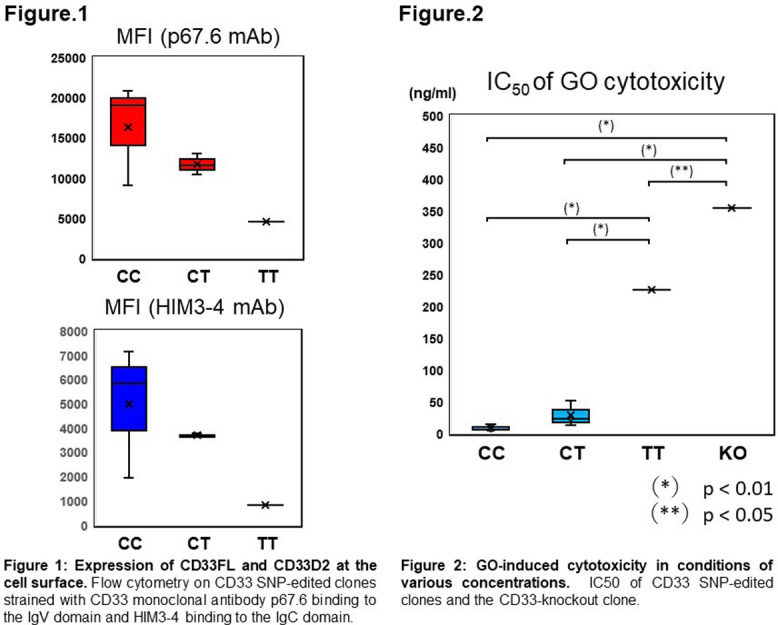
mRNA levels were quantified by RT-qPCR using RNA samples from each clone and specific primers to amplify sequences encoding total CD33, CD33FL, and CD33D2. Mouse monoclonal CD33 antibodies, B-9 and PWS44, were used for immunoprecipitation and CD33 western blot detection. Protein levels were evaluated by the density of the CD33FL band at 67kD or the CD33D2 band at 31kD. Clones were stained with CD33 monoclonal antibody p67.6 binding to the IgV domain and HIM3-4 binding to the IgC domain and sorted by flow cytometry to evaluate median fluorescence intensity (MFI). Cytotoxicity assays were performed on these clones in the range of 0.1 ng/ml to 10,000 ng/ml and IC50 of GO was calculated.
Results: Three clones of each homozygous CC and heterozygous CT type were successfully generated through single nucleotide substitution targeting the CD33 SNP. qPCR indicated the median mRNA levels of total CD33 were comparable among clones (p=0.825), but the median mRNA levels of CD33FL were relatively higher in the CC clones (p=0.620), and the median mRNA levels of CD33D2 were relatively higher in the TT clones (p=0.058).
Western blotting showed that CD33FL expression was higher in CC/CT than in TT (p=0.156), whereas no CD33D2 expression was observed. By flow cytometry, the MFI of p67.6 and HIM3-4 showed similar trends (p=0.129 and p=0.141, respectively) (Figure 1), although we expected them to show different trends when there was a gap in CD33FL and CD33D2 expression. These outcomes suggest that the CD33D2 protein was not detected in any of the clones, despite the corresponding mRNA expression being detected. Cytotoxicity assays demonstrated that the CC/CT clones had significantly lower IC50 than TT (p<0.001), but there was no apparent difference between the CC clones and CT clones (p=0.427) (Figure. 2).
Summary/Conclusion: While mRNA of CD33D2 were present, we found that the CD33D2 was undetectable at the protein level. It was suggested that there is some kind of impairment at the stage of translation from CD33D2 mRNA to protein.
We demonstrated a difference in GO-induced cytotoxicity in the CD33 SNP-edited clones derived from OCI-AML3, clearly indicating that at least one allele of the CD33 SNP rs12459419 C is important for sensitivity to GO.
Keywords: AML, Gemtuzumab ozogamicin, SNP, CD33