



Abstract
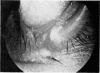
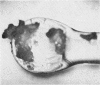
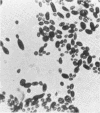
A case of canaliculitis with obstruction of the lacrimal canaliculus and accumulation of conglomerates is described. Pityrosporum pachydermatis was cultured from the conglomerates. To the best of our knowledge this organism has not been previously implicated in such infections. Cure was obtained by treatment with nystatin administered topically and as an irrigation of the lacrimal pathways. The possibility that the pathogenesis of the canaliculitis and obstruction of the lacrimal pathways lies in decreased function of the lacrimal pump is discussed.
Full text
PDF


Images in this article

Selected References
These references are in PubMed. This may not be the complete list of references from this article.
- Huppert M., Harper G., Sun S. H., Delanerolle V. Rapid methods for identification of yeasts. J Clin Microbiol. 1975 Jul;2(1):21–34. doi: 10.1128/jcm.2.1.21-34.1975. [DOI] [PMC free article] [PubMed] [Google Scholar]
- Parunovic A., Halde C. Pityrosporum orbiculare. Its possible role in seborrheic blepharitis. Am J Ophthalmol. 1967 Apr;63(4):815–820. [PubMed] [Google Scholar]
- Segal E., Ajello L. Evaluation of a new system for the rapid identification of clinically important yeasts. J Clin Microbiol. 1976 Aug;4(2):157–159. doi: 10.1128/jcm.4.2.157-159.1976. [DOI] [PMC free article] [PubMed] [Google Scholar]
- WOLTER J. R., DEITZ M. R. Candidiasis of the lacrimal sac. Am J Ophthalmol. 1963 Jan;55:153–155. doi: 10.1016/0002-9394(63)91669-6. [DOI] [PubMed] [Google Scholar]