



ABSTRACT
Thermal burns produce tissue damage, which eliminates the protective role of tissue. Due to the extensive tissue damage from severe burns, an overactive immune response occurs. Furthermore, this raises the possibility of getting sepsis, a condition in which a bacterial infection spreads throughout the body rather than only in the area of the injury or localized infection. To determine the compounds of Ajwa dates have the potential as an anti-inflammatory and antibacterial agent in infectious thermal burns. The research method used the Preferred Reporting Items for Systematic Review and Meta-Analyses guideline. Various references were collected from the online database Google Scholar and PubMed including reports, journals, and all references mostly published no more than the past 10 years. This systematic review revealed 16 research articles that were pertinent. Polyphenolic substances such as flavonoids, glycosides, and phenolic acids were found in ajwa dates. Specified polyphenol chemicals have the ability to interact with one or more immune cell receptors, moving intracellular messages and influencing the host’s immunological response. Ajwa dates’ polyphenol acts as an anti-inflammatory agent in severe burns by inhibiting the expression of pathogen-associated molecular pattern receptors, controlling transcription factors, and changing the phenotype of macrophage cells, among other ways. The bacterial activity and immune response regulation of Ajwa dates, on the other hand, also serve as an antibacterial agent directly. The polyphenol compounds in Ajwa dates have the potential to operate as an anti-inflammatory and antibacterial agent in infected thermal burns.
Keywords: Ajwa dates, antibacterial, anti-inflammatory, polyphenolic, thermal burns
INTRODUCTION
Thermal burns are injuries that occur in tissues because of skin contact with flames, hot solids, hot liquids, radiations, radioactivity, electricity, or chemicals.[1] Burns can cause tissue damage and remove the skin’s protective layer, leaving patients more vulnerable to infection and the development of sepsis. Furthermore, the effects of thermal burn also affected the activity of innate immune cells, leading to hyperresponsive macrophages.
The body reacts to physical damage by mobilizing immune cells to eliminate the source of the harm and begin tissue restoration.[2] The inflammatory process refers to this response. In contrary, the inflammatory reaction in severe burns (depending on size and degree of burntness) not only takes place locally at the site of the injury but also spreads excessively throughout the body. Systemic inflammatory response syndrome (SIRS) is the name given to this illness.[3] According to the two-hit theory, the degree of prior immunological activation affects how quickly macrophage cells become activated.[4]
Severe burns “prime” preexisting macrophage cells in the tissue early on. The protective role of the skin is lost as a result of burns, as was already indicated, rendering the patient susceptible to bacterial infection. The macrophage cells that were previously “primed” by the occurrence of burns will become hyperresponsive to the presence of bacterial infection process with exposure to these bacteria. The proinflammatory cytokine tumor necrosis factor-alpha (TNF-α), interleukin-1 (IL-1), and IL-6 are overproduced by the hyperresponsive macrophages.[5] If these cytokines are released in excess, the results could include organ malfunction, sepsis, which increases the risk of death, and an extension of the inflammatory response.[6]
The balance between immune system activation and inhibition seems to be what defines the optimal immunological response. The immune system has to be stimulated to respond to pathogens and damage brought on by trauma, which will help to reduce infection risk and facilitate the healing process. To avoid further tissue damage brought on by an overactive immune system, the immune response should be immediately impaired and then at baseline levels after the infection has been eliminated.[7] In this phenomena, greater treatment is required to control the excessive macrophage cell activation brought on by severe burns.
Dates are plants belonging to the Araceae family that are monocots.[8] Date fruit is the term for the fruit that the date palm tree produces. The fruit has an oval cylindrical shape and is 3–7 cm in length and 2–3 cm in diameter. Prophet dates also referred to as Ajwa dates are produced in Saudi Arabia. The Prophet Muhammad SAW is reported to have remarked, “Whoever eats seven Ajwa dates in the morning, on that day they will avoid poison and magic,” according to hadiths from Sahih al-Bukhari and Sahih Muslim, which were transmitted by Sa’ad Bin Abi Waqqash.[9]
Ajwa dates have some benefits, especially for different health issues. Ajwa dates have a known for being antioxidant, anti-inflammatory, and antibacterial.[10] It has been established that date palm extract taken orally can modify the immune response by controlling cytokines.[11] Polyphenols act as a mediator between Ajwa dates’ biological effects, which include their flavonoids, glycosides, and phenolic acids.[12] In particular, for burns brought on by infection, it is envisaged that this systematic review would be able to summarize the components of the Ajwa date palm as promising anti-inflammatory and antibacterial agents.
MATERIALS AND METHODS
The Preferred Reporting Items for Systematic Review and Meta-Analyses (PRISMA) guidelines are used in the systematic review’s methodology, which is carried out through Google Scholar and PubMed using keywords such as “thermal burn” and “Ajwa dates” or “polyphenolic” or “anti-inflammatory” or “antibacterial” over the past 10 years. This method increases the credibility of the research. After removing duplicate articles, 139 total articles were generated, leaving 134 items.
Based on the keywords above, the articles collected were selected with several inclusion criteria including studies related to the activities of the Ajwa date; research conducted by testing anti-inflammatory and antioxidant activity; full-text articles with publications within the past 10 years. Articles that did not meet the inclusion criteria were then eliminated, whereas articles that met the criteria were then analyzed to obtain a list of research related to anti-inflammation and antioxidants in various methods. At this final stage, 16 articles can be analyzed further to find the most potent compounds that can be anti-inflammatory and antibacterial agents in burn infections.
RESULTS
Article selection scheme
The article selection scheme is based on the PRISMA guidelines of systematic review using the keywords “thermal burn” and “Ajwa dates” or “polyphenolic” or “anti-inflammatory” or “antibacterial” showed that 16 articles were reviewed out of the 139 articles obtained [Figure 1].
Figure 1.
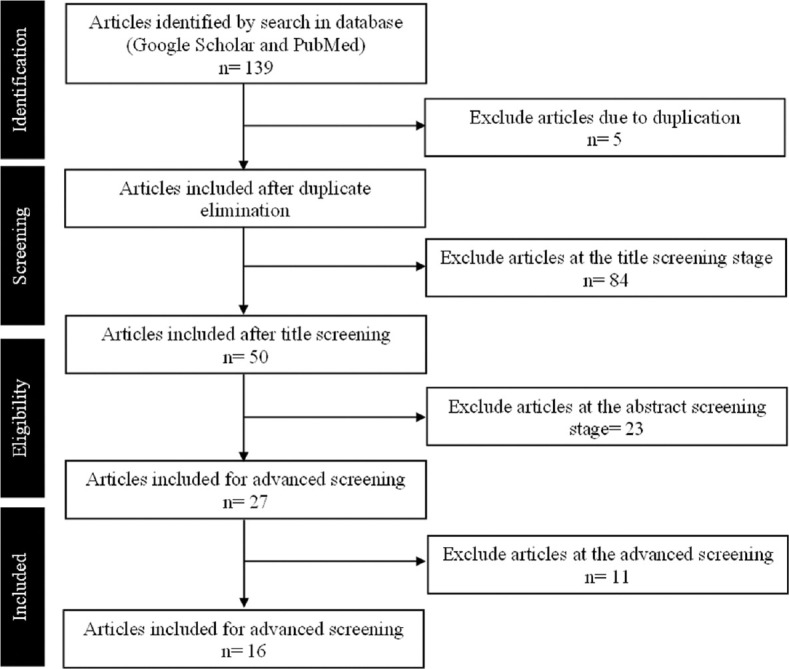
Article selection scheme based on the PRISMA Guideline of Systematic Review using the keyword of “thermal burn or ajwa dates or polyphenolic or anti-inflammatory or antibacterial” showed that 16 articles were reviewed over 139 articles obtained. PRISMA: Preferred Reporting Items for Systematic Review and Meta-Analyses
DISCUSSION
Phytochemical content of Ajwa dates
Plants produce chemical substances known as phytochemicals. The phytochemicals polyphenols, carotenoids, tannins, and sterols are widely present in dates.[13] The ethanol extract of Ajwa dates contains 33 active components, including 19 flavonoid glycosides, 3 phenolic acid derivatives, 9 fatty acids, and 2 miscellaneous compounds (unknown lignans).[12] The quality and quantity of phytochemicals in Ajwa dates have been altered by the extraction procedure, the selection criteria for Ajwa dates (fresh or dried), and the solvent employed at the time of extraction.[14]
Phenolic compounds are one type of secondary metabolite because they have an aromatic mono- or poly-phenol ring with a functional carbon and a hydroxyl group attached.[15] Several research revealed that the total phenolic in Ajwa dates extract ranged from 245 to 455 mg/100 g. This variation happened due to the varied types of solvents during the extraction process. Routine, catechin, and caffeic acid make up the majority of the total phenolic content in Ajwa date palm extract (0.65–0.85 mg/100 g, 0.73 mg/100 g, and 0.57–1.84 mg/100 g, respectively).[16,17,18]
Flavonoid glycosides from quercetin, apigenin, isorhamnetin, luteolin, and chrysoeriol are present in Ajwa dates.[12] Flavonoids can be found in plants in both O- and C-glycoside forms. While apigenin has been made up of C-glycosides (having a saccharide who bind with carbon aglycone of C6 or C8), quercetin and luteolin have O-glycosides groups (containing a saccharide substituent that bonds with hydroxyl aglycone, often found at position 3 or 7). Rhamnose, glucose, galactose, and arabinose are the four most prevalent saccharides.[19]
Polyphenols pharmacokinetics in ajwa dates
Several studies have examined the impact of polyphenols from ajwa dates and other plants on the immune system under different illness circumstances. To generate intracellular signals and play a part in regulating the host immune response, polyphenol chemicals engage one or more receptors.[20] Dietary management is one factor to consider for the best impact on the host. A good pharmacological impact may not necessarily directly correlate with a high intake amount. The body’s rate of absorbing and expelling these active substances has an impact on this. To check if therapies or interventions are effectively absorbed, researchers can use polyphenol concentrations in blood and urine as markers and test them on both humans and experimental animals.[21]
The polyphenol components in a dates extract ingested orally will be swiftly absorbed in the small intestine or migrate to the colon. Flavonoid glycosides will bind intracellular cytoplasmic sugar glucosidase. Nineteen three different forms of glucosidase exist in humans: glucocerebrosidase, lactase–phlorizin hydrolase, and broad-specificity cytosolic β-glucosidase (CBG).[22] Intestinal enzymes hydrolyze polyphenols in the small intestine’s lumen, where they are converted into aglycans. Since epithelial cells are hydrophobic and there is an increase in lipophilicity, passive diffusion is used to absorb the polyphenol aglycans produced by the small intestine. If polyphenols are not absorbed in the small intestine, they migrate to the large intestine where colonic bacteria hydrolyze glycosides to aglycones and reduce them to simple phenolic acids, significantly changing their structural makeup.[23]
Aglycones produced from absorbed polyphenols will bind albumin and deliver it to the liver through the portal vein. For numerous biotransformations, the liver is a crucial organ. Polyphenols are either converted into smaller phenolic molecules or conjugated in the liver through the processes of glucuronate, sulfate, and methylation.[24] This process has a substantial impact on polyphenols’ antioxidant and immunomodulatory abilities.[25] The active chemicals will enter systemic circulation after the liver’s metabolic process, where they go to various organs and tissues. Several receptors are expressed by immune cells, which allow external stimuli to be transmitted to the cell’s in vivo activation process. For example, flavonoid substances can stimulate macrophage cells’ phagocytosis activity by activating estrogen receptors in the cytoplasm and cell nucleus. Immune progenitor cells may undergo epigenetic alterations as a result of ligand and receptor interaction, which will also have an impact on how cells operate.[26]
Anti-inflammatory potential of ajwa date extract in burn
Organ failure and mortality are caused by metabolic abnormalities and SIRS, which are brought on by severe burns. Thus, it is crucial to have procedures in place to stop the inflammatory process following severe burns. Both local and systemic sites had abnormally high amounts of inflammatory mediators such as TNF-α, IL-1, IL-6, IL-8, and IL-10. In mice with complete thickness burns, the high levels of these cytokines prolonged the inflammatory phase.[27]
There are several ways that polyphenols’ anti-inflammatory mechanism works.[28] First, polyphenols reduce intracellular signaling by suppressing the expression of the pathogen-associated molecular pattern receptors like the toll-like receptor family. Second, polyphenols modulate the activity of transcription factors including the mitogen-activated protein kinase family, nuclear factor-kappa B, signal transducers and activators of transcription, and others that control cellular activation, cytokine production, and cell apoptosis. Third, polyphenols transform macrophage cells toward the anti-inflammatory M2 phenotype.
Antibacetrial potential of ajwa date extract in burn infection
Direct bactericidal action and immune system modification are the two potential mechanisms for the antibacterial activity of Ajwa date palm extract. According to an in vitro investigation, Pseudomonas aeruginosa cell walls were damaged by the flavonoid glycosides in date palm extracts because pores started to appear on the cells.[29] According to a different report, flavonoid glycosides influenced the immune response by boosting macrophage cells’ phagocytic activity during the infection phase.[30] The internalization of P. aeruginosa depends heavily on the increase in macrophage phagocytosis activity. As a means of eradicating pathogens, controlling the inflammatory response, preventing the overproduction of the inflammatory response, and averting negative effects, the internalization process of bacteria is crucial.
CONCLUSION
Burns cause loss of the skin’s protective function. This raises the possibility of bacterial infection in burn wounds. In cases of severe burns, immune cells with an overactive reaction, such as macrophage cells, exacerbate the infection process, and cause tissue damage. Consequently, prompt and effective action is required to reduce the excessive activation of macrophage cells brought on by severe burns. Consuming Ajwa dates, which have been shown to be useful in treating health issues, is one of the greatest interventions. The polyphenol content of Ajwa dates, including flavonoid glycosides and phenolic acids, mediates their biological action. Date palm extract can have different effects as an antibacterial and an anti-inflammatory agent when taken orally. It can do this indirectly by regulating cytokines in the immune system or directly by acting as a bactericidal agent.
Financial support and sponsorship
This study was supported funding from Education Fund Management Institution (LPDP dissertation on 2019).
Conflicts of interest
There are no conflicts of interest.
REFERENCES
- 1.Kartal SP, Bayramgürler D. Hot Topics in Burn Injuries. Croatia: IntechOpen; 2018. Burn etiology and pathogenesis; pp. 121–122. Ch. 2. [Google Scholar]
- 2.Cavaillon JM, Eisen D, Annane D. Is boosting the immune system in sepsis appropriate? Crit Care. 2014;18:216. doi: 10.1186/cc13787. [DOI] [PMC free article] [PubMed] [Google Scholar]
- 3.Singer M, Deutschman CS, Seymour CW, Shankar-Hari M, Annane D, Bauer M, et al. The third international consensus definitions for sepsis and septic shock (Sepsis-3) JAMA. 2016;315:801–10. doi: 10.1001/jama.2016.0287. [DOI] [PMC free article] [PubMed] [Google Scholar]
- 4.Leopold Wager CM, Wormley FL., Jr Classical versus alternative macrophage activation:The Ying and the Yang in host defense against pulmonary fungal infections. Mucosal Immunol. 2014;7:1023–35. doi: 10.1038/mi.2014.65. [DOI] [PubMed] [Google Scholar]
- 5.Penatzer JA, Srinivas S, Thakkar RK. The role of macrophages in thermal injury. Int J Burns Trauma. 2022;12:1–12. [PMC free article] [PubMed] [Google Scholar]
- 6.Nichols DP, Caceres S, Caverly L, Fratelli C, Kim SH, Malcolm K, et al. Effects of azithromycin in Pseudomonas aeruginosa burn wound infection. J Surg Res. 2013;183:767–76. doi: 10.1016/j.jss.2013.02.003. [DOI] [PMC free article] [PubMed] [Google Scholar]
- 7.Qin H, Holdbrooks AT, Liu Y, Reynolds SL, Yanagisawa LL, Benveniste EN. SOCS3 deficiency promotes M1 macrophage polarization and inflammation. J Immunol. 2012;189:3439–48. doi: 10.4049/jimmunol.1201168. [DOI] [PMC free article] [PubMed] [Google Scholar]
- 8.Al-Daihan S, Bhat RS. Antibacterial activities of extracts of leaf, fruit, seed and bark of Phoenix dactylifera. Afr J Biotechnol. 2012;11:10021–50. [Google Scholar]
- 9.Rodliyana MD, Rahmatullah S, Gojali D, Ismail E, Apipah RN. MATEC Web of Conferences 2018. Vol. 197. Les Ulis: EDP Sciences; 2018. Ethanol of Ajwa; p. 05001. [Google Scholar]
- 10.Al-Yahya M, Raish M, AlSaid MS, Ahmad A, Mothana RA, Al-Sohaibani M, et al. 'Ajwa'dates (Phoenix dactylifera L.). extract ameliorates isoproterenol-induced cardiomyopathy through downregulation of oxidative, inflammatory and apoptotic molecules in rodent model. Phytomedicine. 2016;23:1240–8. doi: 10.1016/j.phymed.2015.10.019. [DOI] [PubMed] [Google Scholar]
- 11.Boghdadi G, Marei A, Ali A, Lotfy G, Abdulfattah M, Sorour S. Immunological markers in allergic rhinitis patients treated with date palm immunotherapy. Inflamm Res. 2012;61:719–24. doi: 10.1007/s00011-012-0464-4. [DOI] [PubMed] [Google Scholar]
- 12.Nematallah KA, Ayoub NA, Abdelsattar E, Meselhy MR, Elmazar MM, El-Khatib AH, et al. Polyphenols LC-MS2 profile of Ajwa date fruit (Phoenix dactylifera L.) and their microemulsion:Potential impact on hepatic fibrosis. J Funct Foods. 2018;49:401–11. [Google Scholar]
- 13.Martín-Sánchez AM, Cherif S, Ben-Abda J, Barber-Vallés X, Pérez-Álvarez JÁ, Sayas-Barberá E. Phytochemicals in date co-products and their antioxidant activity. Food Chem. 2014;158:513–20. doi: 10.1016/j.foodchem.2014.02.172. [DOI] [PubMed] [Google Scholar]
- 14.Khan F, Ahmed F, Pushparaj PN, Abuzenadah A, Kumosani T, Barbour E, et al. Ajwa date (Phoenix dactylifera L.). extract inhibits human breast adenocarcinoma (MCF7) Cells in vitro by inducing apoptosis and cell cycle arrest. PLoS One. 2016;11:e0158963. doi: 10.1371/journal.pone.0158963. [DOI] [PMC free article] [PubMed] [Google Scholar]
- 15.Khalid S, Khalid N, Khan S, Ahmed H, Ahmad A. A review on chemistry and pharmacology of Ajwa date fruit and pit. Trends Food Sci Technol. 2017;63:60–9. [Google Scholar]
- 16.Ahmed A, Arshad MU, Saeed F, Ahmed RS, Chatha SA. Nutritional probing and HPLC profiling of roasted date pit powder. Pak J Nutr. 2016;15:229. [Google Scholar]
- 17.Hamad I, AbdElgawad H, Al Jaouni S, Zinta G, Asard H, Hassan S, et al. Metabolic analysis of various date Palm Fruit (Phoenix dactylifera L.). cultivars from Saudi Arabia to assess their nutritional quality. Molecules. 2015;20:13620–41. doi: 10.3390/molecules200813620. [DOI] [PMC free article] [PubMed] [Google Scholar]
- 18.Assirey EA. The chemical composition, total phenolic and antioxidant content of four date palm Saudi cultivars. J Taibah Univ Sci. 2021;15:282–7. [Google Scholar]
- 19.Hussain MI, Semreen MH, Shanableh A, Khattak MN, Saadoun I, Ahmady IM, et al. Phenolic composition and antimicrobial activity of different Emirati date (Phoenix dactylifera L.). pits:A comparative study. Plants (Basel) 2019;8:497. doi: 10.3390/plants8110497. [DOI] [PMC free article] [PubMed] [Google Scholar]
- 20.Ding S, Jiang H, Fang J. Regulation of immune function by polyphenols. J Immunol Res. 2018;2018:1–8. doi: 10.1155/2018/1264074. [DOI] [PMC free article] [PubMed] [Google Scholar]
- 21.Liu G, Jiang Q, Chen S, Fang J, Ren W, Yin J, et al. Melatonin alters amino acid metabolism and inflammatory responses in colitis mice. Amino Acids. 2017;49:2065–71. doi: 10.1007/s00726-017-2489-z. [DOI] [PubMed] [Google Scholar]
- 22.Depeint F, Gee JM, Williamson G, Johnson IT. Evidence for consistent patterns between flavonoid structures and cellular activities. Proc Nutr Soc. 2002;61:97–103. doi: 10.1079/pns2001133. [DOI] [PubMed] [Google Scholar]
- 23.Zamora-Ros R, Lujan-Barroso L, Achaintre D, Franceschi S, Kyrø C, Overvad K, et al. Blood polyphenol concentrations and differentiated thyroid carcinoma in women from the European Prospective Investigation into Cancer and Nutrition (EPIC) study. Am J Clin Nutr. 2021;113:162–71. doi: 10.1093/ajcn/nqaa277. [DOI] [PMC free article] [PubMed] [Google Scholar]
- 24.Chen L. Britania Raya: Woodhead Publishing; 2018. Polyphenols: Properties, Recovery, and Applications; pp. 45–67. [Google Scholar]
- 25.Piazzon A, Vrhovsek U, Masuero D, Mattivi F, Mandoj F, Nardini M. Antioxidant activity of phenolic acids and their metabolites:Synthesis and antioxidant properties of the sulfate derivatives of ferulic and caffeic acids and of the acyl glucuronide of ferulic acid. J Agric Food Chem. 2012;60:12312–23. doi: 10.1021/jf304076z. [DOI] [PubMed] [Google Scholar]
- 26.Matsumoto T, Kaneko A, Koseki J, Matsubara Y, Aiba S, Yamasaki K. Pharmacokinetic study of bioactive flavonoids in the traditional Japanese medicine keigairengyoto exerting antibacterial effects against Staphylococcus aureus. Int J Mol Sci. 2018;19:328. doi: 10.3390/ijms19020328. [DOI] [PMC free article] [PubMed] [Google Scholar]
- 27.Zhang Q, Cao X. Epigenetic regulation of the innate immune response to infection. Nat Rev Immunol. 2019;19:417–32. doi: 10.1038/s41577-019-0151-6. [DOI] [PubMed] [Google Scholar]
- 28.da Cunha LR, Muniz-Junqueira MI, Dos Santos Borges TK. Impact of polyphenols in phagocyte functions. J Inflamm Res. 2019;12:205–17. doi: 10.2147/JIR.S193749. [DOI] [PMC free article] [PubMed] [Google Scholar]
- 29.Selim S, Alfy SE, Al-Ruwaili M, Abdo A, Jaouni SA. Susceptibility of imipenem-resistant Pseudomonas aeruginosa to flavonoid glycosides of date palm (Phoenix dactylifera L.). Tamar growing in Al Madinah, Saudi Arabia. Afr J Biotechnol. 2012;11:416–22. [Google Scholar]
- 30.Koseki J, Kaneko A, Matsubara Y, Sekiguchi K, Ebihara S, Aiba S, Yamasaki K. Keigairengyoto, a traditional Japanese medicine, promotes bacterial clearance by activating innate immune cells in mouse cutaneous infection models. Trends Immunol. 2017;1:35–49. [Google Scholar]