



Abstract
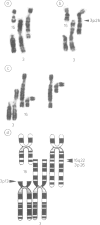
Cytogenetic studies in a 2-year-old boy referred to our laboratory for developmental delay showed an unusual karyotype with a three break rearrangement. R and G banding were both necessary to determine the exact nature of the rearrangement which is described as 46, XY,inv ins(16;3)(q22;p26p13). Several features coincide with the reported description of another patient where 3p26 was missing, and the coincidence is explained as a position effect.
Full text
PDF


Images in this article


Selected References
These references are in PubMed. This may not be the complete list of references from this article.
- Chudley A. E., Bauder F., Ray M., McAlpine P. J., Pena S. D., Hamerton J. L. Familial mental retardation in a family with an inherited chromosome rearrangement. J Med Genet. 1974 Dec;11(4):353–366. doi: 10.1136/jmg.11.4.353. [DOI] [PMC free article] [PubMed] [Google Scholar]
- Rethoré M. O., Lejeune J., Carpentier S., Prieur M., Dutrillaux B., Seringe P., Rossier A., Job J. C. Trisomie pour la partie distale du bras court du chromosome 3 chez trois germains. Premier exemple d'insertion chromosomique: INS (7;3) (q 31; p 21 p 26. Ann Genet. 1972 Sep;15(3):159–165. [PubMed] [Google Scholar]
- Toomey K. E., Mohandas T., Sparkes R. S., Kaback M. M., Rimoin D. L. Segregation of an insertional chromosome rearrangement in 3 generations. J Med Genet. 1978 Oct;15(5):382–387. doi: 10.1136/jmg.15.5.382. [DOI] [PMC free article] [PubMed] [Google Scholar]
- Verjaal M., De Nef M. B. A patient with a partial deletion of the short arm of chromosome 3. Am J Dis Child. 1978 Jan;132(1):43–45. doi: 10.1001/archpedi.1978.02120260045012. [DOI] [PubMed] [Google Scholar]