



Abstract
Two sisters, the children of first cousin Pakistani Moslem parents, have unusual facies, tongue hamartomata, pre- and postaxial polydactyly, severe talipes, and mesomelic limb shortening associated with tibial dysplasia. Homozygosity for a recessive gene defect is probable. The phenotype resembles, but is distinct from, the orofaciodigital syndromes delineated to date. We suggest that this condition be labelled OFD IV.
Full text
PDF


Images in this article
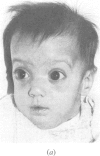
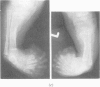
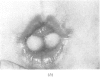
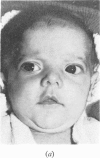
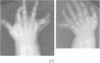
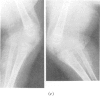

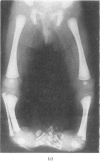
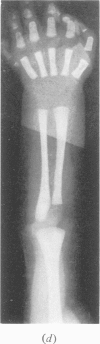
Selected References
These references are in PubMed. This may not be the complete list of references from this article.
- Baraitser M., Burn J., Fixsen J. A female infant with features of Mohr and Majewski syndromes: variable expression, a genetic compound, or a distinct entity? J Med Genet. 1983 Feb;20(1):65–67. doi: 10.1136/jmg.20.1.65. [DOI] [PMC free article] [PubMed] [Google Scholar]
- Goldstein E., Medina J. L. Mohr syndrome or oral-facial-digital II: report of two cases. J Am Dent Assoc. 1974 Aug;89(2):377–382. doi: 10.14219/jada.archive.1974.0381. [DOI] [PubMed] [Google Scholar]
- Rimoin D. L., Edgerton M. T. Genetic and clinical heterogeneity in the oral-facial-digital syndromes. J Pediatr. 1967 Jul;71(1):94–102. doi: 10.1016/s0022-3476(67)80236-1. [DOI] [PubMed] [Google Scholar]
- Sugarman G. I., Katakia M., Menkes J. See-saw winking in a familial oral-facial-digital syndrome. Clin Genet. 1971;2(4):248–254. doi: 10.1111/j.1399-0004.1971.tb00285.x. [DOI] [PubMed] [Google Scholar]