



Abstract
As older adult populations rise in the United States, community-based telehealth programs are gaining momentum because of their ability to provide telehealth services for community-dwelling older adults at a lower cost compared to home-based telehealth services. The success of such community-based telehealth programs heavily depends on end-user engagement and acceptance; however, few studies to date have explored these issues. We conducted an interview study with 14 active and 3 inactive participants of a community-based Telehealth Intervention Program for Seniors (TIPS) to examine older individuals’ perceived benefits and barriers to participating in community-based telehealth programs as well as strategies to improve those programs. We found that older adults had a positive experience toward the use of telehealth services in a community setting, including benefits like monitoring health status and enabling socialization. There were no perceived barriers about the telehealth program. Aspects that can be improved include facilitating the management and sharing of historical physiological data, providing additional assessments of cognitive and/or mental status, supporting self-education, and enabling more comprehensive health status tracking. We conclude this paper by discussing the implications of our results to the improvement of community-based telehealth programs for low-income, vulnerable aging populations.
Keywords: Telehealth, Older adults, Remote patient monitoring, Community Health
Introduction
Older populations are vulnerable to chronic diseases and other age-related health disorders.1,2 The care cost for older adults with chronic disease is significant, accounting for 84% of annual health care spending in the United States.3 As such, the rise in the aging population of the United States and its associated substantial healthcare expenditures have led to an increased focus on their health and wellbeing.4 In particular, telehealth services providing remote patient monitoring (RPM) of older adults’ physiological parameters are considered to be a promising option to identify deteriorating health conditions or adverse events.5 This type of intervention for older adults is expected to increase quality of life, decrease healthcare costs, and support independent living.6,7
Seminal work has focused on home-based telehealth interventions.8–11 However, this approach requires not only installation of equipment in each user’s home but also access to healthcare by a clinical provider (e.g., a physician or nurse to monitor an end-user’s physiological data).4 Therefore, home-based telehealth services are often not an option for many older adults with low socioeconomic status due to the financial burden.4 In recent years, community-based telehealth wellness programs are increasingly being deployed as part of efforts to reduce the burden of health and social care services, to support community-based self-management and promote independence.12–14 This alternative model allows community dwelling older adults to use telehealth services offered in community settings (such as in subsidized congregate housing or at local community centers) with minimal or no cost.
While community-based telehealth wellness programs are expected to provide unprecedented opportunities for low-income, high-risk older adults to play an active role in health-related decision making, a lack of user engagement with those programs is an increasingly salient issue as it results in unsuccessful implementation and adoption of telehealth programs. Compared to home telehealth interventions, community-based telehealth wellness programs face even greater challenges.15,16 For example, some older adults are uncertain about the potential benefits of these interventions and are therefore reluctant to be engaged in them in the long-term. It is therefore critical to examine the issues pertaining to older adults’ engagement with community-based telehealth wellness programs. To that end, we conducted an interview study with 14 active and 3 inactive participants of a community-based intervention entitled, Telehealth Intervention Program for Seniors (TIPS). The purpose of this study was to examine the perceived benefits and challenges of telehealth services by community dwelling older adults, as well as how to improve community-based health care for financially vulnerable older individuals.
Background
TIPS is a community-based health and wellness initiative, combining RPM, wrap-around social services, and care coordination to assist financially vulnerable older adults who live in congregate housing or attend local senior community centers. Since the launch of the first TIPS site in 2014, the TIPS program has recruited more than 2,000 participants at sites throughout New York, New Jersey, Connecticut, Pennsylvania, and Baltimore (Maryland) in the United States. Older adults over 55 years old and registered as a Medicare and/or a Medicaid beneficiary were eligible to enroll in TIPS.
In comparison to other community-based telehealth programs,12 one unique characteristic of TIPS is that it provides staff on site to assist older adults with the assessment (Figure 1). The primary rationale behind this program design is to not only alleviate the challenges faced by older adults in using telehealth technologies but also to provide intergenerational social support to aging participants. For that purpose, local college students from health and technology departments were recruited to work as Telehealth Technician Assistants (TTAs). The TTAs were trained to operate the telehealth devices (e.g., blood pressure cuffs, pulse oximeters, and tablet computers for data entry), and provide or refer to wrap-around social services. They also completed Health Insurance Portability and Accountability Act (HIPAA) training and obtained certification to qualify for the TTA position.
Figure 1.
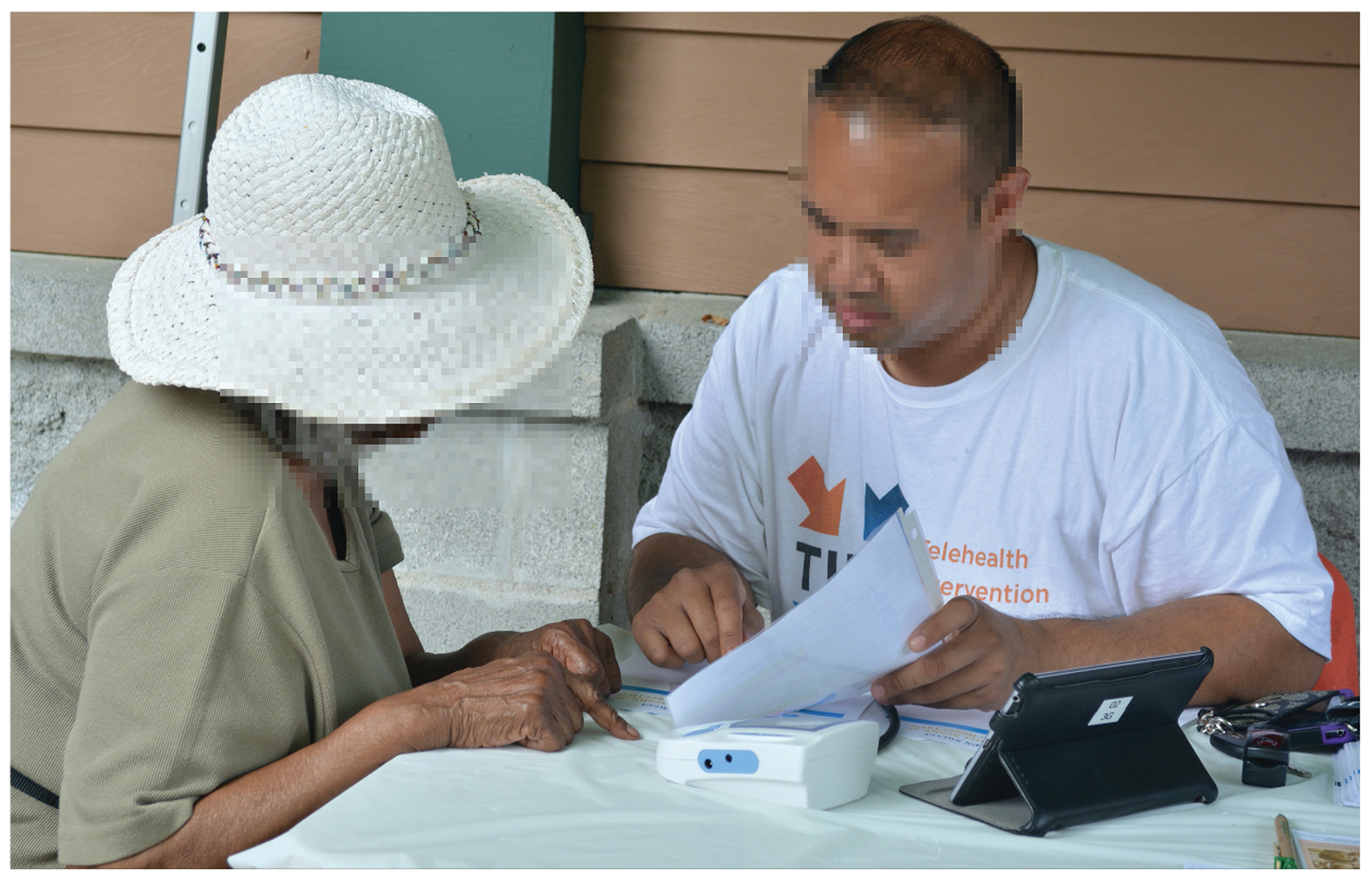
An illustration of the TIPS model. An on-site technician (TTA) helps a participant to use the equipment and service.
TIPS provided participants with twice-weekly screening sessions at participating sites. Participants were encouraged to attend TIPS screening sessions at least once a week. At each visit, objective health biomarkers (e.g., blood pressure, weight, pulse oximetry, etc.) were measured using asynchronous (store and forward) technology-enabled monitoring equipment. In addition, the TTAs recorded details about each participant’s recent medical history (e.g., hospitalization, medication taken, fallen, and overall feeling) through a short self-report wellness questionnaire. These results were transmitted to a secure, HIPAA-compliant data server. The data server was accessed remotely by a team of Registered Nurses (RNs), who reviewed all participant data and triaged any alerts that were automatically triggered by the system during check-in (based on the results of the objective assessment and subjective wellness questionnaire). RNs contact a participant if their health data is deemed as being outside of the normal range (e.g., diastolic is greater than 90 MmHg or SpO2 is less than 90%). RNs also helped participants determine their health status, identify changes in their physiological biomarkers since their last visit, and provide individualized health management advice (e.g., help participants determine the necessity of contacting their primary care physician).
Methods
To understand older adults’ perceptions of a community-based telehealth wellness program, we conducted interviews with 17 TIPS participants from three locations in Westchester County, Ny (two community-based older adult centers and one older adult congregate housing site). Among these 17 participants, 14 of them have stayed active in the program, and 3 became inactive at different times (e.g., unable to commit to attendance expectations or moved away). Subjects were recruited into the study if they were users of the TIPS program, able to speak and write English, and cognitively able to provide informed consent. Table 1 summarizes participant characteristics.
Table 1.
Participant characteristics.
| ID | Status | Gender | Age | Ethnicity | Language Spoken | Length of Participating in TIPS |
|---|---|---|---|---|---|---|
| P1 | Active | Female | 67 | n/a | English | n/a |
| P2 | Active | Female | 71 | Caucasian/White | English | 8 months |
| P3 | Active | Female | 78 | African American | English | 1 year |
| P4 | Active | Female | 70 | Caucasian/White | English | n/a |
| P5 | Active | Female | 81 | n/a | English | n/a |
| P6 | Active | Female | 68 | n/a | English | n/a |
| P7 | Active | Female | 82 | African American | English | 1 year |
| P8 | Active | Female | 89 | Caucasian/White | Italian, English | 3 years |
| P9 | Active | Female | 59 | Caucasian/White | Spanish, English | 3 years |
| P10 | Active | Female | 73 | African American | English | 4 years |
| P11 | Active | Male | 60 | Caucasian/White | English | n/a |
| P12 | Active | Female | 59 | Caucasian/White | Italian, English | 2 years |
| P13 | Active | Female | 71 | African American | English | 3 years |
| P14 | Active | Female | 75 | Caucasian/White | English | 6 years |
| P15 | Inactive | Female | 71 | Caucasian/White | English | 1 year |
| P16 | Inactive | Female | 94 | Caucasian/White | English | n/a |
| P17 | Inactive | Female | 71 | Caucasian/White | English | 6 months |
The interview focused on perceived challenges and benefits of using TIPS and aspects that can be improved. The interview questions (Appendix) were informed by prior work12 and developed iteratively by the researchers. We pilot-tested the interview questionnaire with a few TIPS site coordinators (n = 3) to ensure validity, clarity, appropriateness, and relevance of the questions. The interview questions included overall perceived usefulness and challenges in using the program, management and sharing of personal health data, location preferences, and unmet needs. The interview sessions were audio-recorded and transcribed verbatim for further analysis. Two researchers used an open coding technique17 to review an initial set of transcripts independently (n = 4, 3 with engaged and 1 with dropped participants). Then the initial list of codes was generated and we discussed the codes to determine which codes to keep, merge, or remove. After the list of codes was set, we created a codebook with a data dictionary defining each code to standardize the following coding process. Then the two researchers analyzed the remaining transcripts using the codebook. The two researchers met regularly with the rest of the team to discuss and compare their codes for each transcript. The disagreements were resolved through discussion. The research team discussed any new codes that emerged through the analysis to determine whether they should be kept, discarded, or merged with previous codes. Following a thematic analysis approach,18 the research team iterated over the codes to combine them into high-level categories. During this process, we also consolidated many of the open codes and significantly reduced their number. This step was followed by identifying representative quotes to support the major themes. We followed Strauss and Corbin’s qualitative research framework19 for their approaches on such iterative, interpretive, and collective analysis process.
All study procedures were approved by the Pace University Institutional Review Board (#18-112). Participants received a $10-dollar gift card for their time.
Results
Perceived benefits of TIPS
We found that most participants do not use any tool or service other than TIPS to self-monitor their well-being. Monitoring their health and well-being was the primary reason that motivated all participants to join the program: “Because it helps you to stay in contact with your body if there is anything that is going wrong. They have a nurse that will call you back if anything different shows up on one of the taken vital signs.” [P13] Almost all active participants (13 out of 14) stated that the program is useful in helping them be aware of their physiological well-being and helps them in detecting deterioration in their health status. As one participant described: “Once I was here my blood pressure was 160. I went straight to the doctor office and they found that the medicine I was taking was causing the pressure to be high.” [P3] Participants also stated that they could compare the readings captured during the program with those taken by doctors, and that could help for reassurance purpose, as the story shared by one participant: “I was about to be admitted into the hospital because my weight had dropped too low. But I was able to escape that because I was like ‘no, I get my weight every week.’ So, it turns out that the nurse had done the weight wrong.” [P12]
The participants saw that the program helped them further socialize, and this was perceived as a significant benefit. Through this program, the participants were able to interact with not only their peers (e.g., other senior residents in the community) but also with TTAs of the TIPS program, as one participant explained: “By having this program, there are some seniors in here, that is the only outlet of coming down and interact with others. So it helps you to socialize. Also, [a TTA’s name] is another major reason I am here. I like talking to her and she reminds me of my granddaughter.” [P13]
Compared to home-based self-monitoring, TIPS has regular schedules that could easily become a routine for a participant’s daily life, saving the cognitive load of older adults having to remember to take their vital signs regularly at home: “I prefer coming here. Because we tend to forget to do and ignore the things that we’re asked to do. So I know if I come, it will help me to stay with the program.” [P16]
Unlike in-home telehealth monitoring where older adults need to use computing devices, the current program has TTAs on site to operate the telehealth equipment so that TIPS participants do not have to operate the technology devices, and are therefore unhindered by system usability. This practice was considered as a significant benefit:
“It does seem nice to come and have somebody do it and tell you, [because] sometimes you don’t know what you’re doing even if you learn.” [P08]
“The equipment has to be checked periodically because many factors would impact those numbers. Here I believe what they put in is tested.” [P02]
At each TIPS visit the results of the objective assessment were not only electronically transmitted to the data server but also written down by the TTAs in a one-page report. The report was given to the participant to keep. In addition, participants can request monthly or quarterly printouts which detail the history of their measurements. These paper records and printouts were perceived as useful by the participants because they provided a historical view of their physiological data, which in turn, revealed their health status over time: “I think I would gain awareness if there were changes, if my norm averages were to rise, would make me aware, is the medicine that I take still maintain blood pressure, is that still serving me or something like that.” [P02] Also, these records allowed them to share data with their family and physicians. In particular, a few mentioned that they would bring the paper records when visiting their primary care physician: “I don’t go often to see the doctor, but whenever I go, I bring my copies. So that he knows what’s going on with me.” [P12]
Lastly, it saved them time and efforts to check physiological parameters through TIPS compared to visiting doctors: “I like this program because I didn’t like the waiting and all that to see a doctor to take the blood pressure. Sometimes you just don’t have time to visit your doctor regularly.” [P12]
Given those benefits, all participants expressed the willingness to use the TIPS service long-term (e.g., “as long as I live”). In fact, three of the participants have been actively engaged for regular assessment since the beginning of this program (e.g., “I don’t remember how long I have been in the program. When they started coming here, I started coming here.”)
Concerns
We did not find any major concerns about the program. Only a few participants mentioned three minor issues that needed to be addressed. First, due to unprecedented issues (e.g., weather, schedule, etc.), TTAs were not always present. However, some participants may need to commute just to have their vital signs collected. They expressed the need to be informed in advance of any schedule changes or if TTAs were not able to come: “They should notify us that they are not going to be here at whatever days. They’re supposed to notify us beforehand.” [P03] Also, participants wanted to be reminded about the specific days of TIPS service so that they do not forget to have their biometric measures captured: “Sometimes people maybe on vacation or very often they just simply forget to take their vitals. They (TTAs) can get our numbers and call us beforehand and say ‘hey, this is TIPS and we are downstairs if you’d like to come down’. So that kept people on top of things. If they can give us a reminder, we won’t forget this thing (TIPS) is going on.” [P13] These can be accomplished just by posting a flyer or simply sending a reminder text message to participants.
The system or equipment operated by TTAs may sometimes malfunction, resulting in less accurate readings. This technological barrier may make participants worry or trigger unnecessary calls from RNs: “Sometimes it might give you two different readings and these two could vary a lot. Also, the one [equipment] with the blood pressure doesn’t work sometimes. You may need to start it several times, that could drive us crazy.” [P11]
Inactive participants did not have any concerns about the program. Instead, their reasons for terminating their use of the telehealth service included moving away from the location, and the perception that vital signs were not their primary concern. For example, one participant mentioned she had some health concerns that did not need regular checkups or monitoring: “I have other problems more important than that [taking vital signs]. My knees bother and they need surgery. I have vascular problems in my leg. So, you think I’m going to be thinking about my blood pressure? No.” [P15]
When asked about whether capturing personal health data in a shared space (e.g., community room) that was accessible to other people is a concern, all participants mentioned no privacy concerns related to using TIPS service in a community space. They also trusted the service provider to protect their information and confidentiality: “I don’t think they share information. […] They know the name, but they usually use the [participant] ID and put that down on my report. So, if it gets misplaced or lost, nobody knows who I am or that paper record belongs to me.” [P07]
Despite the preference of many participants to receive their data through printouts or paper records, some stated that they did not know what to do with them and thus failed to use their data in a meaningful way: “I just kept them in the folder on my own. I never looked at it or analyzed the numbers. It was just so many papers.” [P15] Another related challenge is sharing data with physicians, that is, a few participants expressed concerns that their doctors would not accept the data: “I liked it [the data] but my doctor didn’t. He didn’t approve it for whatever reasons.” [P13] This challenge is not surprising since it is a well-recognized issue that physicians usually have doubts about data that were not taken and generated by medical professionals.20
Aspects to improve
Despite a high satisfaction rate reported among all participants for the TIPS program, some stated that the program can be improved from several perspectives. It might be useful to monitor the mood and mental wellness of older adults and provide corresponding interventions (e.g., counseling and social support) because many of them are socially isolated. One participant explained: “I think a lot of us have psychological problems and they get in a lot of fights easily. I’m outgoing so I’m always out doing something and socializing. But if people are always staying here in this environment, they tend to get into fights. So, to get something that would have changed the mood would be very good.” [P13] Similarly, a few participants also agreed that providing additional assessment of their cognitive status could be useful to identify cognitive issues in an early stage.
Several participants also expressed the willingness to use self-tracking devices in combination with TIPS program to more accurately and comprehensively track their well-being, but the cost of owning such applications is a concern. One participant explained: “I would love to have a Fitbit, but it’s been price prohibitive for me. I would love it because I think it gives you motivation. I can do a little more, I can set up exercise goals and reach them. And always achieving a goal has great satisfaction and motivation for the next day. So maybe eventually I’ll get one. It’s not invasive and it’s a marvellous thing to have.” [P02]
It would also be beneficial to provide more informational support to better educate participants regarding how to manage and improve their wellness: “Well, I would like to know more information. For instance, if my blood pressure is high or something like that, I’d like to know a little more about who do you call and how to handle that. Because sometimes you want to ask questions about certain things […] and I think he’s a social worker, but you feel uncomfortable asking if you don’t know what kind of things you can ask.” [P7]
Lastly, since some participants mentioned they didn’t know how to manage and handle the paper records and printouts of the data. When asked about how they would prefer to receive and manage their personal health data, some participants mentioned that e-mail could be a good choice, so they do not have to keep a large pile of paper records. When asked about the willingness of visiting an online portal or web site to retrieve their health information, participants thought it may not be feasible for some: “I don’t know how to use a computer. I am not into all kinds of technology. They gave me a mouse one time and I give it to the cat, and she wouldn’t have it. I didn’t know how to use it.” [P02] Given such conflicting preferences about paper-based versus electronic forms of communication, making both electronic and paper-based information materials available as needed may be helpful.
Discussion
Ongoing patient monitoring is useful for tracking the dynamics of wellness, detecting deterioration of health, and ultimately, reducing hospitalization and emergency room (ER) presentation.7,14 However, ongoing monitoring is often not an option for many older adults due to the prohibitively high cost of accessing quality health care service.21 Given the fact that the existing healthcare system in the U.S. and many other countries does not have sufficient support for older adults who are financially vulnerable, it is therefore vital to design and implement innovative approaches to improve older adults’ quality of life and enhance their independent living. Prior work has suggested that community-based multi-user telehealth can be a pragmatic solution due to its cost-effectiveness nature.13 In this work, we investigated older adults’ perceptions of a community-based telehealth intervention program to inform future research related to how to increase the uptake and effective use of such programs.
Sustaining perceived benefits
The participants explained that the ability of monitoring their physiological well-being is the primary motivator for engaging with the program for a long term. In addition, it is surprising to see that socialization is cited as another major factor that influences their decision of participation. The participants stated that attending TIPS provided them with an opportunity to not only socialize with their peers but also to connect with TTAs for social support. Future community-based telehealth programs should sustain those perceived benefits.
Prior work on telehealth monitoring for older adults has reported on issues of usability, especially regarding the ergonomics of the telehealth devices.12 The reason is that using any computing device (e.g., home-based monitoring systems, or wellness kiosk) can be very challenging for older adults due to problems of low self-efficacy and a lack of knowledge or skills about the use of computing devices.22–24 The TIPS program alleviated this barrier by providing staff (e.g., TTAs) on site to take measurements for participants. As such, the participants explicitly highlighted the usefulness of this practice. Another benefit of taking measures in a community-based setting brought up by the participants is that it fits into their routine (e.g., many TIPS participants commute to a community center to not only take measurements, but also to attend other activities and exercises that are happening there). This finding reveals the importance of embedding telehealth wellness programs into communities and integrating with other community activities.
Facilitating the access, management, and sharing of physiological data
Our study shows that older adults face challenges in accessing, managing, and sharing their personal data. For example, despite participants’ preference for receiving their data through paper forms or printouts, they couldn’t determine how to use them. In addition, a few participants mentioned that they would bring paper records when visiting their primary care physician, who may need to spend quite a lot of time reviewing those documents. As the amount of data for each program participant is increasing, we need to ensure that the plethora of personal health data does not become burdensome to older individuals and their caregivers and/or physicians. Below we propose two approaches to facilitate the management and sharing of physiological data, and ultimately, to empower older adults to take a more active role in their health and wellbeing management.
First, merely providing older adults with access to a large amount of data is not sufficient; instead, it is more important to ensure that they understand the meaning of their data. One way to achieve this is to use visualization tools to present both macro-level (the overall pattern) and micro-level (individual parameters) trends over time. As suggested by prior work, presenting quantitative data in a graphical format could significantly reduce the cognitive load of data interpretation.25 Several studies have attempted to design data visualization tools to demonstrate information of well-being to older adults in an intuitive and easy-to-grasp way.26,27 Future work needs to explore how to visualize objective physiological data and subjective wellness data collected through community-based telehealth programs.
Second, a majority of participants expressed the willingness to share physiological data with their family, caregivers, and physician. However, the current program lacks an effective mechanism for data sharing aside from providing participants with printouts or paper forms. It might be useful to enable direct data sharing via e-mail per request. Another promising approach is to offer an informatics tool for those who are comfortable with technology to access, manage, and review their personal data. This tool can be potentially integrated into a personal health record (PHR) to enable health information sharing and patient-centered care.28 However, it is never easy to design user-friendly tools for older adults.29 Prior work has pointed out that older adults have not been identified extensively as potential beneficiaries of PHR applications and they are faced with difficulties and barriers in the meaningful use of this novel technology.30–32 From this perspective, one key consideration of designing informatics applications for older adults is how to involve them in the design process to address their unique needs.33 Recent work has explored the approach of co-designing technology solutions with older adults and demonstrated its usefulness and effectiveness.34,35
Providing needed supports
Hoyman36 emphasized the need to address the multiple dimensions of wellness, including physical, mental and cognitive, social, and spiritual well-being. Prior work has shown that social isolation affects the health of older people and could lead to health issues, such as depression.37–39 Therefore, their mental health is an essential component of well-being to monitor.40 The current TIPS program is primarily focused on physical and social well-being. To better help older adults remain both physically and mentally healthy, we should consider incorporating new components to monitor, assess, and detect any early signs of mental or cognitive impairments.41 In fact, participants expressed a desire to have such services and we now have the technology capable of achieving these goals. Advances in artificial intelligence (AI) technologies have made approaches for detecting cognitive issues more accessible. For example, Tian et al.42 developed an easy-to-use, non-obtrusive, and accessible mobile application to detect motor impairment in early Parkinson’s disease. Such applications are expected to facilitate the timely and effective assessment of cognitive/neurological impairments. Spiritual wellbeing is another important aspect that needs to be considered. Our participants explained that social isolation experienced by many older individuals could affect their spiritual status (e.g., mood) and cause many problems (e.g., involvement in fights). As such, it is of utmost importance to train TTAs to learn and understand the spiritual needs of older adults, and coordinate with RNs to offer person-centered, spiritual care to them.43
Another interesting observation is that the participants were open to using self-tracking applications (e.g., Fitbit) to augment current twice-weekly remote monitoring for better health management. Research has shown that an increasing number of older individuals have already started to use new technologies for physical activity tracking.44 However, there are many issues to consider when incorporating self-tracking applications to current telehealth intervention program for older adults. First, there is the cost element. Many older adults don’t have the financial ability to purchase these advanced devices. It is therefore important to find a scalable solution to offer self-tracking devices to thousands of users. Secondly, older adults face unique ergonomic issues and they usually have specific requirements when handling mobile technologies.45,46 It has been shown that most self-tracking technology is not designed for older users and that is an important reason for nonuse.47 Therefore, it is necessary to examine which consumer self-tracking applications older individuals are ready to use and how to improve the design of self-tracking technology targeting health management for older adults. Lastly, how to reduce the workload in managing the data generated by self-tracking applications is also an important research question to address as this represents a significant burden for older adults. This can be solved by incorporating self-tracking tools into current telehealth intervention system infrastructure so that data can be automatically transmitted to the TIPS data server and managed by the TIPS technical and medical team.
It is also worth noting that many participants expressed interest in receiving more educational health information from the program, such as how to manage elevated parameters (e.g., blood pressure). Tailored health education for older populations would promote health and encourage them to take a more active role in their health and well-being management. We also believe that providing additional information for health management could significantly augment the telehealth program since only tracking physiological parameters may not be the primary concern for some older individuals, as brought up by one dropped participant during the interview. They may want to know how to cope with the symptoms they are experiencing, what treatment or medication options are available, what health activities are beneficial to take, and so on. Future work needs to look into what information needs older adults have and how best to support them.
Limitations
A few limitations should be noted. First, given the uniqueness of the study setting (e.g., TIPS has staff on site to operate the technology and equipment), our results may not generalize to some other community-based telehealth wellness programs which only provide self-service kiosks in a public space but with no staff on site to help. Different setup and models may influence older adults’ perceptions and opinions. However, based on comparison to other community-based telehealth research,12,14–16 we found that many of our results are applicable to similar programs. Second, we only recruited three dropped participants because many of the inactive participants we reached out to either did not answer the phone or declined to participate in the study. We plan to recruit more dropped participants in our future research to further understand reasons for dropping. Lastly, most of our participants were female (16 out of 17) due to a high ratio of female to male community residents. In our future work, we will balance the group of participants by sex, age, race, and other factors that may affect older adults’ perceptions and attitudes.
Conclusion
In this paper, we report findings from a qualitative study on older adults’ perceptions of a community-based telehealth wellness program. Our findings reveal that older adults perceived that the ability to monitor health status and enable socialization are major benefits of community-based telehealth programs. There were no major concerns or perceived barriers among both active and inactive participants. Aspects that can be improved include the following: improved facilitation of data management and sharing of physiological information, provision of additional interventions for mental and spiritual wellness, support for self-education, and more comprehensive health status tracking (e.g., through self-tracking applications). We conclude this paper by discussing the implications of our results pertaining to how to improve community-based telehealth programs and provide more tailored support for the low-income, vulnerable aging population.
Acknowledgments
We thank the participants for participating in this study. We also thank the Wilson Center for Social Entrepreneurship at Pace University for supporting this research. Lastly, we thank the staff and technicians of the TIPS program for helping us recruit participants and facilitating this study.
Funding
The author(s) reported there is no funding associated with the work featured in this article.
Footnotes
Disclosure statement
No potential conflict of interest was reported by the author(s).
References
- 1.Boyd CM, Ritchie CS, Tipton EF, Studenski SA, Wieland D. From bedside to bench: summary from the American Geriatrics Society/National Institute on Aging Research conference on comorbidity and multiple morbidity in older adults. Aging Clin Exp Res. 2008;20(3):181–88. doi: 10.1007/BF03324775. [DOI] [PMC free article] [PubMed] [Google Scholar]
- 2.Anderson GF. Chronic care: making the case for ongoing care. Robert Wood Johnson Foundation; 2010. [Google Scholar]
- 3.Vogeli C, Shields AE, Lee TA, Gibson TB, Marder WD, Weiss KB, Blumenthal D. Multiple chronic conditions: prevalence, health consequences, and implications for quality, care management, and costs. J Gen Intern Med. 2007;22(S3):391–95. doi: 10.1007/s11606-007-0322-1. [DOI] [PMC free article] [PubMed] [Google Scholar]
- 4.Demiris G, Thompson HJ, Reeder B, Wilamowska K, Zaslavsky O. Using informatics to capture older adults’ wellness. Int J Med Inform. 2013;82(11):e232–e241. doi: 10.1016/j.ijmedinf.2011.03.004. [DOI] [PMC free article] [PubMed] [Google Scholar]
- 5.Schwartz KA, Britton B. Use of telehealth to improve chronic disease management. N C Med J. 2011;72(3):216. doi: 10.18043/ncm.72.3.216. [DOI] [PubMed] [Google Scholar]
- 6.Onor ML, Trevisiol M, Urciuoli O, Misan S, Bertossi F, Tirone G, Aguglia E, Pascolo-Fabrici E. Effectiveness of telecare in elderly populations–a comparison of three settings. Telemed E-Health. 2008;14(2):164–69. doi: 10.1089/tmj.2007.0028. [DOI] [PubMed] [Google Scholar]
- 7.Peretz D, Arnaert A, Ponzoni NN. Determining the cost of implementing and operating a remote patient monitoring programme for the elderly with chronic conditions: a systematic review of economic evaluations. J Telemed Telecare. 2018;24(1):13–21. doi: 10.1177/1357633X16669239. [DOI] [PubMed] [Google Scholar]
- 8.Finkelstein SM, Speedie SM, Potthoff S. Home telehealth improves clinical outcomes at lower cost for home healthcare. Telemedicine and e-Health. 2006;12(2):128–36. doi: 10.1089/tmj.2006.12.128. [DOI] [PubMed] [Google Scholar]
- 9.Cimperman M, Brenčič MM, Trkman P, Stanonik MDL. Older adults’ perceptions of home telehealth services. Telemed E-Health. 2013;19(10):786–90. doi: 10.1089/tmj.2012.0272. [DOI] [PMC free article] [PubMed] [Google Scholar]
- 10.Luptak M, Dailey N, Juretic M, Rupper R, Hill R, Hicken B, Bair B. The Care Coordination Home Telehealth (CCHT) rural demonstration project: a symptom-based approach for serving older veterans in remote geographical settings. Rural and Remote Health. 2010. doi: 10.22605/RRH1375. [DOI] [PubMed] [Google Scholar]
- 11.Takahashi PY, Hanson GJ, Pecina JL, Stroebel RJ, Chaudhry R, Shah ND, Naessens JM. A randomized controlled trial of telemonitoring in older adults with multiple chronic conditions: the Tele-ERA study. BMC Health Serv Res. 2010;10(1):255. doi: 10.1186/1472-6963-10-255. [DOI] [PMC free article] [PubMed] [Google Scholar]
- 12.Demiris G, Thompson H, Boquet J, Le T, Chaudhuri S, Chung J. Older adults’ acceptance of a community-based telehealth wellness system. Inform Health Soc Care. 2013;38(1):27–36. doi: 10.3109/17538157.2011.647938. [DOI] [PMC free article] [PubMed] [Google Scholar]
- 13.Hamilton T, Johnson L, Quinn BT, Coppola J, Sachs D, Migliaccio J, Phipps C, Schwartz J, Capasso M, Carpenter M, et al. Telehealth intervention programs for seniors: an observational study of a community-embedded health monitoring initiative. Telemed E-Health. 2020;26(4):438–45. doi: 10.1089/tmj2018.0248. [DOI] [PubMed] [Google Scholar]
- 14.De San Miguel K, Smith J, Lewin G. Telehealth remote monitoring for community-dwelling older adults with chronic obstructive pulmonary disease. Telemed E-Health. 2013;19(9):652–57. doi: 10.1089/tmj.2012.0244. [DOI] [PubMed] [Google Scholar]
- 15.Hsieh H-L, Tsai C-H, Chih W-H, Lin H-H. Factors affecting success of an integrated community-based telehealth system. Technol Health Care. 2015;23(s2):S189–S196. doi: 10.3233/THC-150953. [DOI] [PubMed] [Google Scholar]
- 16.Hovey L, Kaylor MB, Alwan M, Resnick HE. Community-based telemonitoring for hypertension management: practical challenges and potential solutions. Telemed E-Health. 2011;17(8):645–51. doi: 10.1089/tmj.2011.0027. [DOI] [PubMed] [Google Scholar]
- 17.Holton JA. The coding process and its challenges. In: The sage handbook of grounded theory. 2007;3:265–89. [Google Scholar]
- 18.Fereday J, Muir-Cochrane E. Demonstrating rigor using thematic analysis: a hybrid approach of inductive and deductive coding and theme development. Int J Qual Methods. 2006;5(1):80–92. doi: 10.1177/160940690600500107. [DOI] [Google Scholar]
- 19.Strauss A, Corbin JM. Grounded theory in practice. Sage; 1997. [Google Scholar]
- 20.West P, Van Kleek M, Giordano R, Weal M, Shadbolt N. Information quality challenges of patient-generated data in clinical practice. Public Health Front. 2017;5:284. doi: 10.3389/fpubh.2017.00284. [DOI] [PMC free article] [PubMed] [Google Scholar]
- 21.Fitzpatrick AL, Powe NR, Cooper LS, Ives DG, Robbins JA. Barriers to health care access among the elderly and who perceives them. Am J Public Health. 2004;94(10):1788–94. doi: 10.2105/AJPH.94.10.1788. [DOI] [PMC free article] [PubMed] [Google Scholar]
- 22.Satariano WA, Scharlach AE, Lindeman D. Aging, place, and technology: toward improving access and wellness in older populations. J Aging Health. 2014;26(8):1373–89. doi: 10.1177/0898264314543470. [DOI] [PubMed] [Google Scholar]
- 23.Czaja SJ, Charness N, Fisk AD, Hertzog C, Nair SN, Rogers WA, Sharit J. Factors predicting the use of technology: findings from the center for research and education on aging and technology enhancement (create). Psychol Aging. 2006;21(2):333. doi: 10.1037/0882-7974.21.2.333. [DOI] [PMC free article] [PubMed] [Google Scholar]
- 24.Choi NG, DiNitto DM. The digital divide among low-income homebound older adults: internet use patterns, eHealth literacy, and attitudes toward computer/Internet use. J Med Internet Res. 2013;15(5):e93. doi: 10.2196/jmir.2645. [DOI] [PMC free article] [PubMed] [Google Scholar]
- 25.Curran CR. Data display techniques. Appl Nurs Res. 1999;12(3):153–58. doi: 10.1016/S0897-1897(99)80067-6. [DOI] [PubMed] [Google Scholar]
- 26.Le T, Wilamowska K, Demiris G, Thompson H. Integrated data visualisation: an approach to capture older adults’ wellness. Int J Electron Healthc. 2012;7(2):89–104. doi: 10.1504/IJEH.2012.049872. [DOI] [PMC free article] [PubMed] [Google Scholar]
- 27.Le T, Reeder B, Yoo D, Aziz R, Thompson HJ, Demiris G. An evaluation of wellness assessment visualizations for older adults. Telemed E-Health. 2015;21(1):9–15. doi: 10.1089/tmj.2014.0012. [DOI] [PMC free article] [PubMed] [Google Scholar]
- 28.Kahn JS, Aulakh V, Bosworth A. What it takes: characteristics of the ideal personal health record. Health Aff. 2009;28(2):369–76. doi: 10.1377/hlthaff.28.2.369. [DOI] [PubMed] [Google Scholar]
- 29.Siek KA, Khan DU, Ross SE, Haverhals LM, Meyers J, Cali SR. Designing a personal health application for older adults to manage medications: a comprehensive case study. J Med Syst. 2011;35(5):1099–121. doi: 10.1007/s10916-011-9719-9. [DOI] [PubMed] [Google Scholar]
- 30.Lober WB, Zierler B, Herbaugh A, et al. Barriers to the use of a personal health record by an elderly population. AMIA Annual Symposium Proceedings; American Medical Informatics Association; 2006. p.514. [PMC free article] [PubMed] [Google Scholar]
- 31.Hourcade JP, Chrischilles EA, Gryzlak BM, et al. Design lessons for older adult personal health records software from older adults. International Conference on Universal Access in Human-Computer Interaction; Springer; 2011. pp.176–85. [Google Scholar]
- 32.Kim E-H, Stolyar A, Lober W, Herbaugh AL, Shinstrom SE, Zierler BK, Soh CB, Kim Y. Challenges to using an electronic personal health record by a low-income elderly population. J Med Internet Res. 2009;11(4):e44. doi: 10.2196/jmir.1256. [DOI] [PMC free article] [PubMed] [Google Scholar]
- 33.Logue MD, Effken JA. An exploratory study of the personal health records adoption model in the older adult with chronic illness. J Innov Health Inform. 2013;20:151–69. [DOI] [PubMed] [Google Scholar]
- 34.Wherton J, Sugarhood P, Procter R, Hinder S, Greenhalgh T. Co-production in practice: how people with assisted living needs can help design and evolve technologies and services. Implement Sci. 2015;10(1):1–10. doi: 10.1186/s13012-015-0271-8. [DOI] [PMC free article] [PubMed] [Google Scholar]
- 35.Mcgee-Lennon M, Smeaton A, Brewster S. Designing home care reminder systems: lessons learned through co-design with older users. 2012 6th International Conference on Pervasive Computing Technologies for Healthcare (PervasiveHealth) and Workshops; IEEE; 2012. pp.49–56. [Google Scholar]
- 36.Hoyman HS. Rethinking an ecologic-system model of man’s health, disease, aging, death. J Sch Health. 1975;45 (9):509–18. doi: 10.1111/j.1746-1561.1975.tb04527.x. [DOI] [PubMed] [Google Scholar]
- 37.Blazer I, German D. Depression in late life. CV Mosby Co; 1993. [Google Scholar]
- 38.Uchino BN, Cacioppo JT, Kiecolt-Glaser JK. The relationship between social support and physiological processes: a review with emphasis on underlying mechanisms and implications for health. Psychol Bull. 1996;119(3):488. doi: 10.1037/0033-2909.119.3.488. [DOI] [PubMed] [Google Scholar]
- 39.Loucks EB, Berkman LF, Gruenewald TL, Seeman TE. Social integration is associated with fibrinogen concentration in elderly men. Psychosom Med. 2005;67(3):353–58. doi: 10.1097/01.psy.0000160482.89163.e8. [DOI] [PubMed] [Google Scholar]
- 40.Bondevik M, Skogstad A. The oldest old, ADL, social network, and loneliness. West J Nurs Res. 1998;20 (3):325–43. doi: 10.1177/019394599802000305. [DOI] [PubMed] [Google Scholar]
- 41.Valdes EG, Sadeq NA, Harrison Bush AL, Morgan D, Andel R. Regular cognitive self-monitoring in community-dwelling older adults using an internet-based tool. J Clin Exp Neuropsychol. 2016;38(9):1026–37. doi: 10.1080/13803395.2016.1186155. [DOI] [PubMed] [Google Scholar]
- 42.Tian F, Fan X, Fan J, et al. What can gestures tell? Detecting motor impairment in early Parkinson’s from common touch gestural interactions. Proceedings of the 2019 CHI Conference on Human Factors in Computing Systems; 2019. pp.1–14. [Google Scholar]
- 43.Toivonen K, Charalambous A, Suhonen R. Supporting spirituality in the care of older people living with dementia: a hermeneutic phenomenological inquiry into nurses’ experiences. Scand J Caring Sci. 2018;32 (2):880–88. doi: 10.1111/scs.12519. [DOI] [PubMed] [Google Scholar]
- 44.Seifert A, Schlomann A, Rietz C, Schelling HR. The use of mobile devices for physical activity tracking in older adults’ everyday life. Digit Health. 2017;3:2055207617740088. doi: 10.1177/2055207617740088. [DOI] [PMC free article] [PubMed] [Google Scholar]
- 45.Holzinger A, Searle G, Nischelwitzer A. On some aspects of improving mobile applications for the elderly. International Conference on Universal Access in Human-Computer Interaction; Springer; 2007. pp.923–32. [Google Scholar]
- 46.Fischer SH, David D, Crotty BH, Dierks M, Safran C. Acceptance and use of health information technology by community-dwelling elders. Int J Med Inform. 2014;83(9):624–35. doi: 10.1016/j.ijmedinf.2014.06.005. [DOI] [PMC free article] [PubMed] [Google Scholar]
- 47.Doyle J, Walsh L, Sassu A, et al. Designing a wellness self-management tool for older adults: results from a field trial of YourWellness. Proceedings of the 8th International Conference on Pervasive Computing Technologies for Healthcare; 2014. pp.134–41. [Google Scholar]