



Abstract
The recently discovered ATi3Bi5 (A=Cs, Rb) exhibit intriguing quantum phenomena including superconductivity, electronic nematicity, and abundant topological states. ATi3Bi5 present promising platforms for studying kagome superconductivity, band topology, and charge orders in parallel with AV3Sb5. In this work, we comprehensively analyze various properties of ATi3Bi5 covering superconductivity under pressure and doping, band topology under pressure, thermal conductivity, heat capacity, electrical resistance, and spin Hall conductivity (SHC) using first-principles calculations. Calculated superconducting transition temperature (Tc) of CsTi3Bi5 and RbTi3Bi5 at ambient pressure are about 1.85 and 1.92 K. When subject to pressure, Tc of CsTi3Bi5 exhibits a special valley and dome shape, which arises from quasi-two-dimensional compression to three-dimensional isotropic compression within the context of an overall decreasing trend. Furthermore, Tc of RbTi3Bi5 can be effectively enhanced up to 3.09 K by tuning the kagome van Hove singularities (VHSs) and flat band through doping. Pressures can also induce abundant topological surface states at the Fermi energy (EF) and tune VHSs across EF. Additionally, our transport calculations are in excellent agreement with recent experiments, confirming the absence of charge density wave. Notably, SHC of CsTi3Bi5 can reach up to 226ℏ ·(e· Ω ·cm)–1 at EF. Our work provides a timely and detailed analysis of the rich physical properties for ATi3Bi5, offering valuable insights for further experimental verifications and investigations in this field.
Introduction
The kagome lattice composed of tiled corner-sharing triangles is a well-known two-dimensional (2D) prototype lattice, in which topological magnetism, superconductivity, and frustration have been extensively studied in recent decades [1,2]. The ideal electronic band structure of kagome lattice is characterized by flat bands, Dirac cones, quadratic band touching points, and van Hove singularities (VHSs) (Fig. S1B). The flat bands originating from the destructive interference of wave functions suggest a strong correlation between electrons and can induce special negative magnetism [3], fractional quantum Hall effect [4,5], Wigner crystallization [6], high-temperature superconductivity [7], etc. Moreover, the spin-orbit coupling (SOC) at the massless Dirac points and quadratic band touching points introduces energy gaps, which can give rise to nontrivial Z2 topology akin to topological insulators. These gaps can even exhibit Chern gaps when subjected to magnetization [8,9]. Fermi surface instabilities due to sublattice interference near VHS may cause different long-range charge orders and unconventional superconductivity [10–12]. Additionally, other novel physical properties, including Wely points [13–15], giant anomalous Hall effect [16–18], quantum anomalous Hall effect [19,20], and topological superconductors [21,22], are all intriguing research topics of kagome structure.
The recently discovered AV3Sb5 (A=K, Rb, Cs) kagome family exhibits various attractive properties [23]. As the pioneering examples of quasi-2D kagome superconductors, their superconducting transition temperatures (Tc) are about 1.8 to 2.5 K under ambient pressure [24–27]. Alongside the emergence of 2 × 2 charge density wave (CDW) induced by VHSs with transition temperatures of about 100 K [28–30], AV3Sb5 hosts a variety of unconventional charge orders, including a nematic phase reminiscent of iron-based superconductors [31,32], a pair density wave similar to copper-based superconductors [27], and a 4 × 1 CDW that induces striking phase fluctuation [33,34]. Pressure and doping are two effective ways to manipulate the phase diagram of AV3Sb5. Multiple superconductivity domes simultaneously emerge intertwined with several CDW orders under pressure [30,32,35,36]. Experimental substitution doping with Ti, Nb, Ta, Mo, Mn, Cr, Sn, and As in AV3Sb5 has been achieved, providing control over superconductivity, CDW, and nematicity [37–46]. CsV3Sb5, in particular, possesses both abundant nontrivial Z2 topological surface states (TSS) and superconductivity [25,47] and has been instrumental in resolving possible Majorana zero modes within vortex cores [48].
High-throughput density functional theory calculations have been employed to analyze a range of compounds based on the AV3Sb5 prototype structure, revealing 24 dynamically stable compounds with superconductivity, abundant TSS and CDW [49]. Among them, ATi3Bi5 (A=Rb, Cs) compounds with enhanced Tc of about 4.8 K and electronic nematicity have recently been synthesized [50–53]. Another kagome superconductor family, similar to ATi3Bi5, has also been predicted and awaits experimental verification [54]. The nematic order in CsV3Sb5 is considered as the vestige order of CDW [31]. However, the original lattice structure of ATi3Bi5 has been confirmed to be highly stable and devoid of CDW, as supported by calculations and thermal transport measurements [49–51,55]. The presence of orbital-selective nematic order and intertwined superconductivity in ATi3Bi5 provides a new platform for exploring the multiorbital correlation effect in nematic superconductors. In addition, exotic electronic structures have been observed in ATi3Bi5 using angle-resolved photoemission spectroscopy, including flat band, type II and type III Dirac nodal lines and Z2 TSS [56–61]. These fascinating properties make ATi3Bi5 ideal systems for investigating various kagome-related physics with reference to AV3Sb5. Consequently, further investigations are imperative, particularly in examining the effects of pressure and doping on the properties of superconductivity and topology.
In this paper, we analyze the superconducting and topological properties of ATi3Bi5 under pressure and doping by first-principles calculations. Estimated Tc’s of CsTi3Bi5 and RbTi3Bi5 at ambient pressure are about 1.85 and 1.92 K. We observe the emergence of a special valley and dome in the Tc of CsTi3Bi5 under pressure, which is due to the transition from quasi-2D compression to three-dimensional (3D) isotropic compression within the range of 10 to 20 GPa, accompanied by a decreased background effect across all pressure ranges. Moreover, electron–phonon coupling (EPC) calculations with both a rigid band model and atomic substitution doping confirm the substantial enhancement of superconductivity in RbTi3Bi5 under doping. Additionally, pressure can lead to the presence of abundant TSS near EF. We also discuss properties such as thermal conductivity, heat capacity, and electrical resistance, which are consistent with recent experimental findings, indicating the absence of CDW. We find that CsTi3Bi5 exhibits an intrinsic spin Hall conductivity (SHC) of up to 226ℏ ·(e· Ω ·cm)–1 at the Fermi energy (EF). Our findings indicate that both doping and pressure prove to be effective means of tuning the electronic band structures and superconductivity of kagome ATi3Bi5.
Results and Discussion
Electronic structure of CsTi3Bi5
The ATi3Bi5 compounds exhibit a layered structure with the space group P6/mmm (No. 191) as illustrated in Fig. 1A. The central Ti3Bi layer consists of a Ti-kagome net intertwined with a Bi triangular net, sandwiched between two Bi honeycomb layers. The triangular layers composed of A atoms are loosely bonded with the central Ti–Bi sheets. Bi atoms occupy two distinct Wyckoff positions, designated as Bi1 and Bi2, respectively. The calculated electronic band structures and partial electronic density of states (DOS) with SOC for CsTi3Bi5 are plotted in Fig. 1B. By assigning colors to the bands based on the weights of different Ti atomic orbitals, we can identify a clear kagome flat band at about −0.4eV, VHSs at M and L points (namely, VHS1 and VHS2) at about 0.2 eV and massive Dirac points at K and H points contributed by Ti- orbitals. The VHSs and flat band of Ti- orbitals give rise to two DOS peaks at the corresponding energy levels. Notably, clear saddle features are observed in the 3D band structure near VHS2 as plotted in Fig. 1C.
Fig. 1.

The crystal structure and electronic band structure of CsTi3Bi5. (A) The side view of crystal structure and top views of Ti3Bi kagome layer and Bi hexagonal layer. “dBi2” represents the vertical distance between Bi2 atoms in the adjacent primitive lattices, indicated by the black dotted lines. (B) Calculated electronic band structure projected by different orbitals of Ti atoms and partial DOS with SOC for CsTi3Bi5. Two kagome VHSs near the Fermi level are labeled as “VHS1” and “VHS2”, respectively. (C) 3D band structure near VHS2, with gray curves indicating constant energy contours. (D) Charge density distribution of the electronic state at VHS2 (isovalue: 0.003 e/bohr3).
Two distinct VHSs arise from the general kagome electronic bands, namely, p-type and m-type VHSs, corresponding to pure and mixed sublattice characteristics at the VHS, respectively. The charge density distribution of the electronic state at the VHS2 shows pronounced in-plane d-orbital features and a p-type character as illustrated in Fig. 1D. Unlike CsV3Sb5, where all p-type VHSs are located above corresponding Dirac points, the p-type VHS1 and VHS2 of CsTi3Bi5 lie below Dirac points in Fig. 1B. To clarify this, we construct a tight-binding kagome model with a single orbital on each sublattice and nearest-neighboring (NN) hopping, a three-band Hamiltonian can be written as follows,
| (1) |
where t, dij, and k = (kx, ky, kz) represent the NN hopping parameter, NN space vector of sublattice i and j, and wavevector of reciprocal space, respectively. A, B, and C represent three kagome sublattices. This toy kagome model produces the flat band spanning the entire Brillouin zone, VHSs at , Dirac point at , and quadratic band touching point at as shown in Fig. S1B of the supplemental information. By adjusting t, it becomes apparent that for t > 0, the p-type and m-type VHSs are located above and below the Dirac points, respectively, and the flat band resides at the top of band structure. Conversely, for t < 0, the bands are reversed. This observation indicates that in the kagome sublattice of CsV3Sb5, all the relevant NN hopping parameters are positive, while for the Ti-dx²-y²/xy orbitals in CsTi3Bi5, the NN hopping parameters exhibit negative values. P-type VHSs can induce Fermi surface instabilities [10–12], and further investigations are warranted to explore their connection with the nematic and superconducting properties in CsTi3Bi5.
Transport properties of CsTi3Bi5
To give a reference for the transport properties of ATi3Bi5, we calculate the temperature dependence of heat capacity Cp, thermal conductivity κ, and resistance R for CsTi3Bi5. These results are compared with recent experimental data as plotted in Fig. 2A to C. Part of the calculated results for RbTi3Bi5 are listed in Fig. S3. Overall, our transport calculations are in quantitative agreement with the experimental findings, demonstrating the reliability of our calculations. Obviously, there are no phase transition signatures in any of the transported quantities, suggesting the absence of CDW. In contrast to CsV3Sb5, the total thermal conductivity κtot,cal of CsTi3Bi5 is primarily governed by electronic contributions rather than phonon thermal conductivity κphonon,cal [55]. We choose the results with the highest residual resistance ratios from [51], where the impurity concentration is the lowest in that experiment. The resistance of CsTi3Bi5, as shown in Fig. S3B, is much smaller than that of AV3Sb5 [25]. The calculated R(T)/R(300 K) values align well with the experimental results at high temperatures but underestimate the experimental data below 30 K as shown in Fig. 2C. This discrepancy arises that our resistance calculations solely consider the electron–phonon interaction and do not account for electron–electron interactions. In the experimental resistance–temperature behavior, a quadratic dependence below 30 K and a linear dependence above 50 K can be observed, corresponding to electron–electron and electron–phonon interactions in the normal metal, respectively. It is important to note that our calculations of the transport properties are performed on the normal phase of CsTi3Bi5 and not the superconducting phase. Therefore, our calculations do not capture the information regarding the superconducting phase transition.
Fig. 2.

Heat capacity and transport properties of CsTi3Bi5. Calculated temperature dependences of (A) heat capacity, (B) longitudinal thermal conductivity, and (C) longitudinal electrical resistivity, compared with experimentals [51,52,55]. (D) Calculated three independent components of SHC tensor as a function of the chemical potential.
In addition to the aforementioned transport properties, we also calculate the three independent components of SHC tensor, i.e., , , and , as a function of the chemical potential for CsTi3Bi5 in Fig.2D. The magnitudes of three components can reach up to 226ℏ ·(e· Ω· cm)–1 at EF. The large SHC comes from a narrow band gap opened by large SOC [62]. The large SHC observed in CsTi3Bi5 holds great potential for applications in spintronic devices.
Superconductivity of CsTi3Bi5 under pressure
The superconducting Tc of CsV3Sb5 at pressures above 2 GPa, in the absence of CDW, have been found to be in good agreement between EPC calculations and experimental results [63,64]. Therefore, we can also expect density functional theory calculations to accurately capture the true superconductivity in ATi3Bi5. The estimated Tc’s of CsTi3Bi5 and RbTi3Bi5 at ambient pressure are about 1.85 and 1.92 K, respectively. The superconducting properties of both materials share remarkable similarities, so we select CsTi3Bi5 for a detailed analysis of superconductivity under pressure.
In previous reports on AV3Sb5 (A = K, Rb, Cs) pressurized experiments, the upper pressure limit was typically applied below 50 GPa [28,30,32,35,36,65]. Our calculation results show that some physical quantities related to superconductivity change monotonically with pressure above 20 GPa. Thus, we choose the pressure range of 0 to 50 GPa to investigate superconducting properties in the main text. The additional results at the pressure of 50 to 150 GPa can be found in Fig. S4. Our calculated Tc and EPC constant λ as a function of pressure are shown in Fig. 3A. Both parameters decrease in the ranges of 0 to 10 and 20 to 50 GPa, while they increase within the range of 10 to 20 GPa, forming a unique valley and dome shape under pressure. The corresponding logarithmic average of the phonon frequency ωlog and the electronic DOS at the Fermi energy N(EF) are shown in Fig. 3B. N(EF) shows an almost linear decrease with increasing pressure, while ωlog exhibits an overall increase but with a decreasing trend specifically within the 10 to 20 GPa. It is noted that Tc is explicitly proportional to ωlog as described by McMillan semi-empirical formula [66,67], , whereas the variation of Tc in CsTi3Bi5 shows an opposite trend compared with ωlog in Fig. 3A and B. To address this apparent contradiction, we differentiate McMillan formula with respect to pressure value (P), which gives
| (2) |
Fig. 3.

Superconducting properties of CsTi3Bi5 under pressure in the range of 0 to 50 GPa. (A) Superconducting transition temperature Tc and EPC λ under pressure. (B) Logarithmic average frequency ωlog(K) and electronic DOS per formula unit (f.u.) at the Fermi energy N(EF) under pressure. (C) and under pressure. Phonon spectra colored by EPC strength λqν, projected phDOS, Eliashberg spectral function α2F(ω), and cumulative frequency-dependent EPC λ(ω) at (D) 0, (E) 10, and (F) 20 GPa, respectively. (G) Vibration modes at the lowest acoustic branch near Γ and M points, which both are contributed by the vibrations along the c axis. (H) The average of square of phonon frequency ⟨ω2⟩ under pressure. (I) dBi2 denoted in Fig. 1A and d(dBi2)/dP under pressure. The horizontal dashed line indicates the Bi atomic diameter of 3.2Å.
We calculate two terms in the brackets separately and illustrate them in Fig. 3C. It becomes evident that λ and ωlog make totally opposite contributions to across all pressure ranges. However, is much smaller than . This observation explains the reason why Tc follows the same trend as λ but not ωlog under pressure.
The remaining question is why λ (Tc) displays a unique valley and dome shape under pressure. To shed light on this, we present the phonon spectra, projected phonon DOS (phDOS), Eliashberg spectral function α2F(ω), and cumulative frequency-dependent EPC λ(ω) in Fig. 3D to F. The corresponding results for other pressures can be found in Fig. S5. As pressure increases, the phonon frequencies (ω) within the phonon spectra noticeably increase, which is a common characteristic observed in many materials. This makes the average of the square of phonon frequency ⟨ω2⟩ almost linearly increase under pressure as seen in Fig. 3H. From the definition of λ, we have and ,where ⟨I2⟩ is the mean-square electron-ion matrix element, and M is the ionic mass. It is clear that λ is proportional to N(EF) and inversely proportional to ⟨ω2⟩. The combination of N(EF) and ⟨ω2⟩ results in an overall decrease in λ. This mechanism accounts for the downward trend of λ and Tc within the range of 0 to 10 and 20 to 50 GPa.
Upon conducting a more detailed analysis of the phonon spectra and phDOS, we can find that the phonon spectra under pressure can be well separated into distinct high- and low-frequency regions. Specifically, the high-frequency region is mainly contributed by kagome Ti atoms, displaying clear kagome phonon flat band and VHSs. On the other hand, the low-frequency region primarily corresponds to the vibrational modes of Cs and Bi atoms. By separating λ into two components, namely, λCs+Bi and λTi, we observe that λTi gradually decreases with increasing pressure due to the aforementioned background effect, while λCs+Bi exhibits exactly the same trend as λ, as seen in Fig. S6A. Consequently, our analysis focuses on examining the low-frequency region within the phonon spectra in order to elucidate the trend of λ.
The total EPC λ can be decomposed into the average coupling strengths λqν over the Brillouin zone with λ = ∑q,ν λqν. By coloring the phonon spectra with λqv, we find that the high λqν are mainly concentrated in the lowest acoustic branch. Taking vibration modes of the lowest acoustic branch near Γ and M point as examples in Fig. 3G, we observe that these modes primarily involve vibrations along the c axis. Thus, based on our calculations, we can infer that the anomalous increase of λ within 10 to 20 GPa originates from the contributions of λqν associated with the out-of-plane atomic vibrations.
Next, we analyze superconductivity under pressure from a structural perspective. The vertical distance between Bi2 atoms in adjacent Ti3Bi5 sheets is defined as d Bi2 as illustrated in Fig. 1A. Because of the quasi-2D structural features of CsTi3Bi5, dBi2 is quite large, and interlayer interactions are weak. At low pressures, d(dBi2)/dP exhibits large values and changes dramatically. However, as the pressure exceeds 10 GPa, the rate of change in dBi2 starts to slow down. Furthermore, when P > 20 GPa, it approaches a nearly constant value. This trend is also reflected in the ratio of the out-of-plane and in-of-plane lattice parameters c/a as depicted in Fig. S6B. At 20 GPa, dBi2 becomes approximately equal to the Bi atomic diameter of 3.2Å, indicating the formation of covalent bonds among the Bi2 atoms around this pressure. These results demonstrate that the structure undergoes a quasi-2D compression below 10 GPa. The weak coupling between Cs atoms and Ti3Bi5 sheets leads to a pronounced response of the out-of-plane lattice parameter c to applied pressure. At 10 GPa, the Bi atoms of neighboring Ti3Bi5 sheets start to interact, leading to a dramatic enhancement of λqν associated with out-of-plane vibrations. However, as the pressure exceeds 20 GPa, the structure exhibits a 3D isotropic compression characteristic. The interaction between Bi2 atoms no longer increases but gradually decreases due to the underlying background effect mentioned earlier.
Topological states of CsTi3Bi5 under pressure
Next, we explore the effect of pressure on electronic structures. We illustrate the calculation results at pressures of 5, 25, and 40 GPa in Fig. 4A to C, which depict the electronic band structures of CsTi3Bi5 with SOC. The increased interlayer interaction under pressure profoundly impacts the band structures, leading to notable changes in the energy levels of VHSs and flat band, particularly at higher pressures. With increasing pressure, both VHSs and flat band gradually shift downwards. Remarkably, the VHSs progressively approach the vicinity of the Fermi level under pressure. Exploring the potential nematicity and other phases induced by VHSs through pressure engineering holds substantial interest.
Fig. 4.

Electronic band structures and surface-state spectra under pressure for CsTi3Bi5. Electronic band structures with SOC at (A) 5, (B) 25, and (C) 40 GPa. Surface-state spectra along paths on the (001) plane at (D) 5, (E) 25, and (F) 40 GPa. TSS are indicated with white arrows.
The nontrivial TSS near Γ point of CsTi3Bi5 have been experimentally detected [51,57,58]. However, these TSS are approximately 0.8 eV below the Fermi level, limiting their substantial effects on transport and other related properties. By examining the surface-state spectra of CsTi3Bi5 under pressure in Fig. 4D to F, we observe the emergence of multiple TSS at time-reversal invariant momenta and , many of which are located in proximity to the Fermi level. Under pressure, these TSS undergo slight energy shifts. Importantly, once these TSSs emerge at a specific pressure, further increases in pressure do not eliminate them. The TSS in CsTi3Bi5 exhibits high tunability and sensitivity to pressure, primarily due to the dramatic changes in electronic structures.
Superconductivity of RbTi3Bi5 under doping
RbTi3Bi3 has similar electronic structure and phonon spectrum to CsTi3Bi3 as shown in Fig. S7. Therefore, we can expect RbTi3Bi3 and CsTi3Bi3 to exhibit similar topological, transport, and superconducting properties. As a result, we do not replicate the calculations performed above for RbTi3Bi5. Since the Tc of RbTi3Bi5 is slightly higher than that of CsTi3Bi5 in our calculations, in this section, we focus on a comprehensive investigation of superconductivity under doping using RbTi3Bi5.
Doping is an effective method to tune electronic structures and superconductivity. Extensive studies have successfully achieved doping in AV3Sb5 to manipulate the competition between superconductivity, CDW, and nematicity [37–46]. Notably, the concentration of Sb replacement doping with Sn in AV3Sb5 can reach up to 30% [40]. With reference to AV3Sb5, doping in ATi3Bi5 is highly feasible. We first employ a rigid band model to analyze the effect of electron and hole doping on superconductivity. Figure 5A illustrates the relative changes in λ, Tc, and N(EF) under doping. Both electron and hole doping result in enhancements of N(EF) due to the movement of VHSs and flat band toward the Fermi level. As a consequence, there are dramatic improvements in λ and Tc. Especially under hole doping, the highest N(EF) can be increased by nearly 2.5 times, and Tc can be increased by nearly 5 times.
Fig. 5.
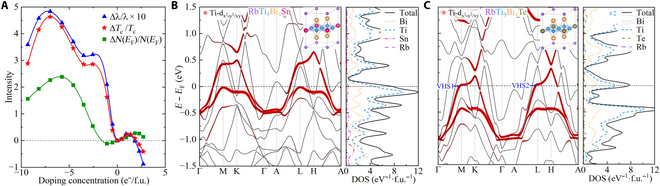
Superconductivity and electronic structures of RbTi3Bi5 under doping. (A) Relative changes of λ, Tc, and N(EF) under doping using the ragid band model: Δλ/λ, ΔTc/Tc, and ΔN(EF)/N(EF). Calculated electronic band structures projected by Ti-d x2−y2/xy orbitals and partial DOS with SOC for (B) RbTi3Bi4Sn and (C) RbTi3Bi4Te, where the insets show the doped structures. Two kagome VHSs near the Fermi level of RbTi3Bi4Te are labeled as “VHS1” and “VHS2”, respectively.
In addition to the rigid band model, we also explore specific element substitution doping. Alkali metal substitutions of ATi3Sb5, including LiTi3Bi5, NaTi3Bi5, and KTi3Bi5, are found to be unstable according to our previous study [49]. Instead, we substitute one Ti or Bi atom in each unit cell of ATi3Bi5, corresponding to 33% Ti or 20% Bi substitution. Ti is replaced by its neighboring elements (Sc, V, Y, Zr, and Nb), while Bi is substituted by Ga, Sn, Sb, Te, Pb, and Bi. As illustrated in Fig. 1A, the Bi atoms occupy two Wyckoff positions that need to be distinguished. Taking Te doping as an example, we denote the substitution of Bi2 as RbTi3TeBi4, and the substitution of Bi1 as RbTi3Bi4Te as shown in Fig. S8A. For all doped structures, we first carry out fully geometric relaxation and self-consistent iterations in nonmagnetic, ferromagnetic, and antiferromagnetic configurations as seen in Fig. S8B and C. The energies of the three magnetic configurations of all structures are listed in Table S1, which determines the ground state magnetic configuration. Among the doped structures with Bi substitution, the energy of the replacement of Bi2 is consistently higher than that of Bi1. This suggests that the impurity prefers to substitute the Wyckoff position of Bi1. In addition, Sc-, Y-, and Ga-doped CsTi3Bi5 and RbTi3Bi5 all exhibit ferromagnetism, which suppresses superconductivity. Therefore, these structures are not considered in the subsequent analysis.
For these doped structures, we calculate their superconductivity as summarized in Table. Several doped structures show varying degrees of improvement compared to the original phase’s Tc. Tc of RbTi3Bi4Sn and RbTi 3Bi4Pb belonging to hole doping can be raised to around 3 K. However, when increasing the doping concentration to 40% for Sn and Pb doping, denoted as RbTi3BiSn2 and RbTi3Bi3Pb2, the results indicate that there is no obvious increase in Tc’s. The electronic bands and DOS of these doped structures are given in Figs. S9 to S24. The kagome VHSs and flat band originating from Ti in-plane orbitals in the band structures are prominent, which undergo dramatic changes upon Ti doping but relatively maintain structural characteristics in the cases of Bi doping. As examples of hole and electron doping, respectively, the electronic energy bands and DOS of RbTi3Bi4Sn and RbTi3Bi4Te are plotted in Fig. 5B and C. The kagome flat band of RbTi3Bi4Sn and the VHSs of RbTi3Bi4Te are shifted close to the Fermi level, and the DOS originating from the flat band and VHSs exhibit pronounced peaks near the Fermi level. This indicates a shift of the Fermi level while maintaining the character of kagome band structures. These results are consistent with the above rigid band model, demonstrating that both electron and hole doping can improve Tc by tuning the kagome electronic structures and increasing the DOS through doping. The effective modulation of superconducting properties and kagome electronic structures by doping highlights the need for further experimental investigations in this system.
Table.
Superconductivity of doped structures for RbTi3Bi5. EPC λ(ω = ∞), logarithmic average frequency ωlog (K), and Tc of doped structures.
| RbTi3Bi5 | RbVTi2Bi5 | RbZrTi2Bi5 | RbNbTi2Bi5 | RbTi3Bi4Te | RbTi3Bi4Sb | RbTi3Bi4Sn | RbTi3Bi4Pb | RbTi3Bi3Sn2 | RbTi3Bi3Pb2 | |
|---|---|---|---|---|---|---|---|---|---|---|
| λ | 0.520 | 0.578 | 0.525 | 0.586 | 0.526 | 0.513 | 0.605 | 0.608 | 0.612 | 0.622 |
| ωlog(K) | 135.8 | 131.3 | 113.7 | 126.5 | 137.7 | 144.9 | 124.6 | 117.8 | 127.6 | 119.1 |
| Tc(K) | 1.92 | 2.67 | 2.49 | 2.69 | 2.04 | 1.94 | 2.92 | 2.81 | 3.09 | 3.03 |
Discussion
The two superconducting domes observed in AV3Sb5 at low pressures are commonly believed to be related to the competition of CDW phases [30,32,36]. However, theoretical analyses of the superconducting dome at around 20 to 40 GPa are limited [65,68,69]. The properties of CsTi3Bi5 and AV3Sb5 at high pressure, in the absence of CDW, are similar, suggesting that our explanations for the superconducting dome and valley in CsTi3Bi5 may also apply to AV3Sb5. Recent research attributes the appearance of high-pressure superconducting dome in AV3Sb5 to transitions from hexagonal to monoclinic structures [70]. In contrast, our work demonstrates that the appearance of a similar dome in CsTi3Bi5 does not rely on structural phase transitions but rather originates from the transition from quasi-2D to 3D compression. Further investigations are needed to explore the similarities and differences in the superconducting properties of ATi3Bi5 and AV3Sb5 under pressure.
Exploring the possible phase transitions associated with structure or electronic orders in CsV3Sb5 is an intriguing topic [30,32,36,70]. Phonon spectra of ATi3Bi5 without imaginary frequencies in the pressure of 0 to 50 GPa in Fig. 3D to F and Figs. S3 and S5B show good dynamic stability, excluding the possibility of structural phase transition under pressure, however, an electronic nematic phase of CsTi3Bi5 at ambient pressure has been experimentally observed [51,53]. This nematic phase may be suppressed and eventually disappears under pressure, similar to the behaviors of CsV3Sb5 in experiment [32]. Consequently, there may be a possible nematic phase transition under pressure, which deserves further experimental study.
It should be noted that while λTi contributes approximately 35% to the total EPC λ as shown in Fig. S6A, the electronic states near the Fermi level are primarily dominated by the kagome Ti atoms, as illustrated in Fig. 1B. Calculated electronic DOS projected on different atoms for CsTi3Bi5 in Fig. S2 indicate that about 64% of the DOS at the Fermi level come from Ti orbitals. In addition, tuning the Fermi level through hole doping can dramatically enhance superconductivity, mainly due to the enhancement of the DOS of Ti atoms as discussed in Superconductivity of RbTi3Bi5 Under Doping. Therefore, kagome lattice composed by Ti atoms plays a crucial role to the superconductivity.
Fu and Kane [71] proposed that the proximity effect between the helical Dirac TSS of a topological insulator and an s-wave superconductor can induce Majorana zero modes, which can be utilized for topological quantum calculations. This effect has been achieved in CsV3Sb5 [48]. Based on our calculations, pressure effectively induces abundant Dirac TSS near the Fermi level, whose combination with superconductivity theoretically gives rise to Majorana zero modes. This opens up another fascinating research topic for ATi3Bi5 and its potential for exploring topological quantum phenomena.
The interlayer van der Waals forces present in ATi3Bi5 facilitate their mechanical exfoliation from the bulk structures. We explore the structural stability and superconducting properties of CsTi3Bi5 in the 2D monolayer limit. Three slab structures, namely, CsTi3Bi5 (slab1), Ti3Bi5 (slab2), and Cs2Ti3Bi5 (slab3), with different combinations of Ti3Bi5 layer and Cs layer are considered as seen in Fig. S25. Phonon calculations show that slab2 has minimal imaginary frequencies, while slab1 and slab3 display good dynamic stability. However, superconducting calculations reveal that their Tc’s are nearly equal to that of the bulk structures.
Conclusion
In summary, we preemptively analyze superconducting and topological properties under pressure and doping for ATi3Bi5, as well as their thermal conductivity, heat capacity, electrical resistance, and SHC using first-principles calculations. The estimated Tc of CsTi3Bi5 presents a special down-up-down trend with increasing pressure. The two decreasing sections can be attributed to the decrease in EPC resulting from reduced electronic DOS and ⟨ω2⟩ with increasing pressure. Within this overall decreasing trend, the abnormally increased part is associated with the sharply enhanced EPC in the low-frequency region induced by vertical vibration modes, which is related to the transition from anisotropic to isotropic compression from a structural perspective. With rigid band model calculations under doping, Tc of RbTi3Bi5 can increase by nearly 5 times accompanied by increased electronic DOS and EPC. Calculations for different atomic substitution structures in RbTi3Bi5 show improvements of Tc from 1.9 to 3.1 K. Furthermore, doping and pressure serve as effective means to tune the kagome VHSs and flat band positions close to EF. Pressure can also induce abundant Dirac-type TSS at EF. Additionally, our transport calculations agree well with recent experimental results, indicating the absence of CDW. The resistance of CsTi3Bi5 shows normal metal behavior, and its thermal transport is predominantly governed by electronic contributions. The SHC of CsTi3Bi5 can reach up to 226ℏ ·(e· Ω ·cm)–1 near the Fermi level. Our comprehensive analysis of the diverse physical properties in ATi3Bi5 underscores the need for further experimental exploration in this field.
Methods
The methods can be found in the Supplementary Materials.
Acknowledgments
Funding: This work is supported in part by the National Key R&D Program of China (Grant No. 2018YFA0305800), the Strategic Priority Research Program of the Chinese Academy of Sciences (Grant No. XDB28000000), the National Natural Science Foundation of China (Grant No.11834014), and the Innovation Program for Quantum Science and Technology (No. 2021ZD0301800). B.G. is supported in part by the National Natural Science Foundation of China (Grant No. 12074378), the Chinese Academy of Sciences (Grant No. YSBR-030 and No. Y929013EA2), the Strategic Priority Research Program of Chinese Academy of Sciences (Grant No. XDB33000000), and the Beijing Natural Science Foundation (Grant No. Z190011). Author contributions: J.-Y.Y., B.G., and G.S. designed and supervised the research. X.-W.Y. performed theoretical calculations. All authors participated in analyzing results. X.-W.Y., J.-Y.Y., B.G., and G.S. prepared the figures and manuscript. Competing interests: The authors declare that there is no conflict of interest regarding the publication of this article.
Data Availability
The data that support the findings of this study are available from the corresponding authors upon reasonable request.
Supplementary Materials
Methods
Figs. S1 to S25
Tables S1 and S2
References [72–80]
References
- 1. Syozi I statistics of kagome lattice. Prog Theor Phys. 1951;6(3):306–308. [Google Scholar]
- 2.Yin JX, Lian B, Hasan MZ. Topological kagome magnets and superconductors. Nature. 2022;612(7941):647–657. [DOI] [PubMed] [Google Scholar]
- 3.Yin JX, Zhang SS, Chang G, Wang Q, Tsirkin SS, Guguchia Z, Lian B, Zhou H, Jiang K, Belopolski I, et al. Negative flat band magnetism in a spin-orbit-coupled correlated kagome magnet. Nat Phys. 2019;15(5):443–448. [Google Scholar]
- 4.Gong SS, Zhu W, Sheng DN. Emergent chiral spin liquid: Fractional quantum Hall effect in a kagome heisenberg model. Sci Rep. 2014;4(1):6317. [DOI] [PMC free article] [PubMed] [Google Scholar]
- 5.Tang E, Mei JW, Wen XG. High-temperature fractional quantum Hall states. Phys Rev Lett. 2011;106(23): 236802. [DOI] [PubMed] [Google Scholar]
- 6.Jiang HC, Devereaux T, Kivelson SA. Wigner crystal in a lightly doped kagome quantum spin liquid. Phys Rev Lett. 2017;119(6): 067002. [DOI] [PubMed] [Google Scholar]
- 7.Miyahara S, Kusuta S, Furukawa N. BCS theory on a flat band lattice. Phys C: Superconduct. 2007;460-462:1145. [Google Scholar]
- 8.Ohgushi K, Murakami S, Nagaosa N. Spin anisotropy and quantum Hall effect in the kagome lattice: Chiral spin state based on a ferromagnet. Phys Rev B. 2000;62(10):R6065. [Google Scholar]
- 9.Guo HM, Franz M. Topological insulator on the kagome lattice. Phys Rev B. 2009;80(11): 113102. [Google Scholar]
- 10.Kiesel ML, Platt C, Thomale R. Unconventional Fermi surface instabilities in the kagome Hubbard model. Phys Rev Lett. 2013;110(12): 126405. [DOI] [PubMed] [Google Scholar]
- 11.Kiesel ML, Thomale R. Sublattice interference in the kagome Hubbard model. Phys Rev B. 2012;86(12): 121105. [Google Scholar]
- 12.Wang WS, Li ZZ, Xiang YY, Wang QH. Competing electronic orders on kagome lattices at van Hove filling. Phys Rev B. 2013;87(11): 115135. [Google Scholar]
- 13.Liu DF, Liang AJ, Liu EK, Xu QN, Li YW, Chen C, Pei D, Shi WJ, Mo SK, Dudin P, et al. Magnetic Weyl semimetal phase in a kagome crystal. Science. 2019;365(6459):1282–1285. [DOI] [PubMed] [Google Scholar]
- 14.Morali N, Batabyal R, Nag PK, Liu E, Xu Q, Sun Y, Yan B, Felser C, Avraham N, Beidenkopf H. Fermi-arc diversity on surface terminations of the magnetic Weyl semimetal Co3Sn2S2. Science. 2019;365(6459):1286–1291. [DOI] [PubMed] [Google Scholar]
- 15.You JY, Feng YP. A two-dimensional kagome magnet with tunable topological phases. Mater Today Chem. 2023;30: 101566. [Google Scholar]
- 16.Liu E, Sun Y, Kumar N, Muechler L, Sun A, Jiao L, Yang SY, Liu D, Liang A, Xu Q, et al. Giant anomalous Hall effect in a ferromagnetic kagome-lattice semimetal. Nat Phys. 2018;14(11):1125. [DOI] [PMC free article] [PubMed] [Google Scholar]
- 17.Nayak AK, Fischer JE, Sun Y, Yan B, Karel J, Komarek AC, Shekhar C, Kumar N, Schnelle W, Kübler J, et al. Large anomalous Hall effect driven by a nonvanishing berry curvature in the noncolinear antiferromagnet Mn3Ge. Sci Adv. 2016;2(4): e1501870. [DOI] [PMC free article] [PubMed] [Google Scholar]
- 18.Nakatsuji S, Kiyohara N, Higo T. Large anomalous hall effect in a non-collinear antiferromagnet at room temperature. Nature. 2015;527(7577):212. [DOI] [PubMed] [Google Scholar]
- 19.Xu G, Lian B, Zhang SC. Intrinsic quantum anomalous Hall effect in the kagome lattice Cs2LiMn3F12. Phys Rev Lett. 2015;115(18): 186802. [DOI] [PubMed] [Google Scholar]
- 20.Zhang Z, You JY, Ma XY, Gu B, Su G. Kagome quantum anomalous Hall effect with high chern number and large band gap. Phys Rev B. 2021;103(1): 014410. [Google Scholar]
- 21.Baidya S, Mallik AV, Bhattacharjee S, Saha-Dasgupta T. Interplay of magnetism and topological superconductivity in bilayer kagome metals. Phys Rev Lett. 2020;125(2): 026401. [DOI] [PubMed] [Google Scholar]
- 22.You JY, Gu B, Su G, Feng YP. Emergent kagome electrides. J Am Chem Soc. 2022;144(12):5527. [DOI] [PubMed] [Google Scholar]
- 23.Ortiz BR, Gomes LC, Morey JR, Winiarski M, Bordelon M, Mangum JS, Oswald IWH, Rodriguez-Rivera JA, Neilson JR, Wilson SD, et al. New kagome prototype materials: Discovery of KV3Sb5, RbV3Sb5, and CsV3Sb5. Phys Rev Mater. 2019;3(9): 094407. [Google Scholar]
- 24.Ortiz BR, Sarte PM, Kenney EM, Graf MJ, Teicher SML, Seshadri R, Wilson SD. Superconductivity in the Z2 kagome metal KV3Sb5. Phys Rev Mater. 2021;5(3): 034801. [Google Scholar]
- 25.Ortiz BR, Teicher SML, Hu Y, Zuo JL, Sarte PM, Schueller EC, Abeykoon AMM, Krogstad MJ, Rosenkranz S, Osborn R, et al. CsV3Sb5: A Z2 topological kagome metal with a superconducting ground state. Phys Rev Lett. 2020;125(24): 247002. [DOI] [PubMed] [Google Scholar]
- 26.Yin Q, Tu Z, Gong C, Fu Y, Yan S, Lei H. Superconductivity and normal-state properties of kagome metal RbV3Sb5 single crystals. Chin Phys Lett. 2021;38(3): 037403. [Google Scholar]
- 27.Chen H, Yang H, Hu B, Zhao Z, Yuan J, Xing Y, Qian G, Huang Z, Li G, Ye Y, et al. Roton pair density wave in a strong-coupling kagome superconductor. Nature. 2021;599(7884):222. [DOI] [PubMed] [Google Scholar]
- 28.Du F, Luo S, Ortiz BR, Chen Y, Duan W, Lu X, Wilson SD, Song Y, Yuan H. Pressure-induced double superconducting domes and charge instability in the kagome metal KV3Sb5. Phys Rev B. 2021;103(22):L220504. [Google Scholar]
- 29.Li H, Zhang TT, Yilmaz T, Pai YY, Marvinney CE, Said A, Yin QW, Gong CS, Tu ZJ, Vescovo E, et al. Observation of unconventional charge density wave without acoustic phonon anomaly in kagome superconductors AV3Sb5 (A=Rb, Cs). Phys Rev X. 2021;11(3): 031050. [Google Scholar]
- 30.Chen KY, Wang NN, Yin QW, Gu YH, Jiang K, Tu ZJ, Gong CS, Uwatoko Y, Sun JP, Lei HC, et al. Double superconducting dome and triple enhancement of Tc in the kagome superconductor CsV3Sb5 under high pressure. Phys Rev Lett. 2021;126(24): 247001. [DOI] [PubMed] [Google Scholar]
- 31.Nie L, Sun K, Ma W, Song D, Zheng L, Liang Z, Wu P, Yu F, Li J, Shan M, et al. Charge-density-wave-driven electronic nematicity in a kagome superconductor. Nature. 2022;604(6904):59–64. [DOI] [PubMed] [Google Scholar]
- 32.Zheng L, Wu Z, Yang Y, Nie L, Shan M, Sun K, Song D, Yu F, Li J, Zhao D, et al. Emergent charge order in pressurized kagome superconductor CsV3Sb5. Nature. 2022;611(7937):682–687. [DOI] [PubMed] [Google Scholar]
- 33.Zhao H, Li H, Ortiz BR, Teicher SML, Park T, Ye M, Wang Z, Balents L, Wilson SD, Zeljkovic I. Cascade of correlated electron states in the kagome superconductor CsV3Sb5. Nature. 2021;599(7884):216–221. [DOI] [PubMed] [Google Scholar]
- 34.Yin JX. Quantum dephasing of kagome superconductivity. Sci Bull. 2023;68(6):568–570. [DOI] [PubMed] [Google Scholar]
- 35.Zhu CC, Yang XF, Xia W, Yin QW, Wang LS, Zhao CC, Dai DZ, Tu CP, Song BQ, Tao ZC, et al. Double-dome superconductivity under pressure in the V-based kagome metals AV3Sb5 (A=Rb and K). Phys Rev B. 2022;105(9): 094507. [Google Scholar]
- 36.Yu FH, Ma DH, Zhuo WZ, Liu SQ, Wen XK, Lei B, Ying JJ, Chen XH. Unusual competition of superconductivity and charge-density-wave state in a compressed topological kagome metal. Nat Commun. 2021;12:3645. [DOI] [PMC free article] [PubMed] [Google Scholar]
- 37.Zhong Y, Liu J, Wu X, Guguchia Z, Yin JX, Mine A, Li Y, Najafzadeh S, das D, Mielke C III, et al. Nodeless electron pairing in CsV3Sb5-derived kagome superconductors. Nature. 2023;617(7961):488–492. [DOI] [PubMed] [Google Scholar]
- 38.Ding G, Wo H, Gu Y, Gu Y, Zhao J. Effect of chromium doping on superconductivity and charge density wave order in the kagome metal Cs(V1–xCrx) 3Sb5. Phys Rev B. 2022;106(23): 235151. [Google Scholar]
- 39.Liu Y, Wang Y, Cai Y. Doping evolution of superconductivity, charge order and band topology in hole-doped topological kagome superconductors Cs(V1–xTix)3Sb5. arXiv. 2021. 10.48550/arXiv.2110.12651 [DOI]
- 40.Wu P, Tu YB, Wang ZY, Yu S, Li H, Ma W, Liang Z, Zhang Y, Zhang X, Li Z, et al. Unidirectional electron-phonon coupling in the nematic state of a kagome superconductor. Nat Phys. 2023;19(8):1143. [Google Scholar]
- 41.Yang H, Huang Z, Zhang Y. Titanium doped kagome superconductor CsV3-xTixSb5 and two distinct phases. Sci Bull. 2022;67:2176-2185. [DOI] [PubMed] [Google Scholar]
- 42.Oey YM, Ortiz BR, Kaboudvand F. Fermi level tuning and double-dome superconductivity in the kagome metal CsV3Sb5–xSnx. Phys Rev Mater. 2022;6(4):L041801. [Google Scholar]
- 43.Oey YM, Kaboudvand F, Ortiz BR, Seshadri R, Wilson SD. Tuning charge density wave order and superconductivity in the kagome metals KV3Sb5–xSnx and RbV3Sb5–xSnx. Phys Rev Mater. 2022;6(7): Article 074802. [Google Scholar]
- 44.Liu M, Han T, Hu X. Evolution of superconductivity and charge density wave through Ta and Mo doping in CsV3Sb5. Phys Rev B. 106(14):L140501. [Google Scholar]
- 45.Liu Y, Liu CC, Zhu QQ, Ji LW, Wu SQ, Sun YL, Bao JK, Jiao WH, Xu XF, Ren Z, et al. Enhancement of superconductivity and suppression of charge-density wave in As-doped CsV3Sb5. Phys Rev Mater. 2022;6(12): 124803. [Google Scholar]
- 46.Zhou X, Li Y, Liu Z, Hao J, Dai Y, Wang Z, Yao Y, Wen HH. Effects of niobium doping on the charge density wave and electronic correlations in the kagome metal Cs(V1–xNbx)3Sb5. Phys Rev B. 2023;107(12): 125124. [Google Scholar]
- 47.Hu Y, Teicher SML, Ortiz BR. Topological surface states and flat bands in the kagome superconductor CsV3Sb5–xSnx. Sci Bull. 2022;67:495. [DOI] [PubMed] [Google Scholar]
- 48.Liang Z, Hou X, Zhang F. Three-dimensional charge density wave and surface-dependent vortex-core states in a kagome superconductor CsV3Sb5. Phys Rev X. 2021;11(5): 031026. [Google Scholar]
- 49.Yi XW, Ma XY, Zhang Z, Liao ZW, You JY, Su G. Large kagome family candidates with topological superconductivity and charge density waves. Phys Rev B. 2022;106(22):L220505. [Google Scholar]
- 50.Yang H, Zhao Z, Yi XW. Titanium-based kagome superconductor CsTi3Bi5 and topological states. arXiv. 2022. 10.48550/arXiv.2209.03840 [DOI]
- 51.Yang H, Ye Y, Zhao Z. Superconductivity and orbital-selective nematic order in a new titanium-based kagome metal CsTi3Bi5. arXiv. 2022. 10.48550/arXiv.2211.12264 [DOI]
- 52.Werhahn D, Ortiz BR, Hay AK, Wilson SD, Seshadri R, Johrendt D. The kagomé metals RbTi3Bi5 and CsTi3Bi5. Zeitschrift für Naturforschung B. 2022;77(11-12):757–764. [Google Scholar]
- 53.Li H, Cheng S, Ortiz BR, Tan H, Werhahn D, Zeng K, Johrendt D, Yan B, Wang Z, Wilson SD, et al. Electronic nematicity without charge density waves in titanium-based kagome metal. Nat. Phys. 2023. 10.1038/s41567-023-02176-3 [DOI] [Google Scholar]
- 54.Yi XW, Liao ZW, You JY, Gu B, Su G. Topological superconductivity and large spin Hall effect in the kagome family Ti6X4 (X = bi, Sb, Pb Tl, and In). iScience. 2023;26(1): 105813. [DOI] [PMC free article] [PubMed] [Google Scholar]
- 55.Chen X, Liu X, Xia W, Mi X, Zhong L, Yang K, Zhang L, Gan Y, Liu Y, Wang G, et al. Electrical and thermal transport properties of the kagome metals ATi3Bi5 (A=Rb,Cs). Phys Rev B. 2023;107(17): 174510. [Google Scholar]
- 56.Yang J, Yi X, Zhao Z, Xie Y, Miao T, Luo H, Chen H, Liang B, Zhu W, Ye Y, et al. Observation of flat band, dirac nodal lines and topological surface states in kagome superconductor CsTi3Bi5. Nat Commun. 2023;14(1):4089. [DOI] [PMC free article] [PubMed] [Google Scholar]
- 57.Hu Y, Le C, Zhao Z. Non-trivial band topology and orbital-selective electronic nematicity in a new titanium-based kagome superconductor. arXiv. 2022. 10.48550/arXiv.2212.07958 [DOI]
- 58.Jiang Z, Liu Z, Ma H, Xia W, Liu Z, Liu J, Cho S, Yang Y, Ding J, Liu J, et al. Flat bands, non-trivial band topology and electronic nematicity in layered kagome-lattice RbTi3Bi5. arXiv. 2022. 10.48550/arXiv.2212.02399 [DOI] [PMC free article] [PubMed]
- 59.Zhou Y, Chen L, Ji X. Physical properties, electronic structure, and strain-tuned monolayer of the weak topological insulator RbTi3Bi5 with kagome lattice. arXiv. 2023. 10.48550/arXiv.2301.01633 [DOI]
- 60.Liu B, Kuang MQ, Luo Y, Li Y, Hu C, Liu J, Xiao Q, Zheng X, Huai L, Peng S, et al. Tunable van Hove singularity without structural instability in kagome metal CsTi3Bi5. Phys Rev Lett. 2023;131(2):026701. [DOI] [PubMed] [Google Scholar]
- 61.Wang Y, Liu Y, Hao Z, Cheng W, Deng J, Wang Y, Gu Y, Ma XM, Rong H, Zhang F, et al. Flat band and Z2 topology of kagome metal CsTi3Bi5. Chin Phys Lett. 2023;40(3): 037102. [Google Scholar]
- 62.You JY, Su G, Feng YP. A versatile model with three-dimensional triangular lattice for unconventional transport and various topological effects. Nat Sci Rev. 2023;nwad114. [DOI] [PMC free article] [PubMed] [Google Scholar]
- 63.Zhang JF, Liu K, Lu ZY. First-principles study of the double-dome superconductivity in the kagome material CsV3Sb5 under pressure. Phys Rev B. 2021;104(19): 195130. [Google Scholar]
- 64.Si J, Lu W, Sun Y, Liu P, Wang B. Charge density wave and pressure-dependent superconductivity in the kagome metal CsV3Sb5: A first-principles study. Phys Rev B. 2022;105(2): 024517. [Google Scholar]
- 65.Zhang Z, Chen Z, Zhou Y, Yuan Y, Wang S, Wang J, Yang H, An C, Zhang L, Zhu X, et al. Pressure-induced reemergence of superconductivity in the topological kagome metal CsV3Sb5. Phys Rev B. 2021;103(22): 224513. [Google Scholar]
- 66.McMillan WL. Transition temperature of strong-coupled superconductors. Phys Rev. 1968;167(2):331. [Google Scholar]
- 67.Allen PB, Dynes RC. Transition temperature of strong-coupled superconductors reanalyzed. Phys Rev B. 1975;12(3):905. [Google Scholar]
- 68.Tsirlin A, Fertey P, Ortiz BR, Klis B, Merkl V, Dressel M, Wilson S, Uykur E. Role of Sb in the superconducting kagome metal CsV3Sb5 revealed by its anisotropic compression. SciPost Physics. 2022;12(2):49. [Google Scholar]
- 69.Yu F, Zhu X, Wen X, Gui Z, Li Z, Han Y, Wu T, Wang Z, Xiang Z, Qiao Z, et al. Pressure-induced dimensional crossover in a kagome superconductor. Phys Rev Lett. 2022;128(7): 077001. [DOI] [PubMed] [Google Scholar]
- 70.Du F, Li R, Luo S. Superconductivity modulated by structural phase transitions in pressurized vanadium-based kagome metals. Phys Rev B. 2022;106(2): 024516. [Google Scholar]
- 71.Fu L, Kane CL. Superconducting proximity effect and Majorana fermions at the surface of a topological insulator. Phys Rev Lett. 2008;100(9): 096407. [DOI] [PubMed] [Google Scholar]
- 72.Kresse G, Furthmuller J. Efficient iterative schemes for ab initio total-energy calculations using a plane-wave basis set. Phys Rev B Condens Matter. 1996;54(16):11169–86. [DOI] [PubMed] [Google Scholar]
- 73.Giannozzi P, Baroni S, Bonini N, Calandra M, Car R, Cavazzoni C, Ceresoli D, Chiarotti GL, Cococcioni M, Dabo I, et al. QUANTUM ESPRESSO: A modular and open-source software project for quantum simulations of materials. J Phys Condens Matter. 2009;21(39): 395502. [DOI] [PubMed] [Google Scholar]
- 74.Mostofi AA, Yates JR, Pizzi G, Lee YS, Souza I, Vanderbilt D, Marzari N. An updated version of wannier90: A tool for obtaining maximally-localised wannier functions. Comput Phys Commun. 2014;185:2309–2310. [Google Scholar]
- 75.Guo GY, Yao Y, Niu Q. Ab initio calculation of the intrinsic spin Hall effect in semiconductors. Phys Rev Lett. 2005;94(22): 226601. [DOI] [PubMed] [Google Scholar]
- 76.Sinova J, Culcer D, Niu Q, Sinitsyn NA, Jungwirth T, MacDonald AH. Universal intrinsic spin Hall effect. Phys Rev Lett. 2004;92(12): 126603. [DOI] [PubMed] [Google Scholar]
- 77.Wu Q, Zhang S, Song HF, Troyer M, Soluyanov AA. Wanniertools An open-source software package for novel topological materials. Comput Phys Commun. 2018;224(5806):405–416. [Google Scholar]
- 78.Madsen GKH, Singh DJ. Boltztrap. A code for calculating band-structure dependent quantities. Comput Phys Commun. 2006;175(1):67–71. [Google Scholar]
- 79.Togo A, Tanaka I. First principles phonon calculations in materials science. Scr Mater. 2015;108:1–5. [Google Scholar]
- 80.Poncé S, Margine ER, Verdi C, Giustino F. EPW: Electron-phonon coupling, transport and superconducting properties using maximally localized wannier functions. Comput Phys Commun. 2016;209:116–133. [Google Scholar]
Associated Data
This section collects any data citations, data availability statements, or supplementary materials included in this article.
Supplementary Materials
Methods
Figs. S1 to S25
Tables S1 and S2
References [72–80]
Data Availability Statement
The data that support the findings of this study are available from the corresponding authors upon reasonable request.