



Abstract
Self-care behaviors are critical to manage the adverse impact of heart failure disease. However, engaging in self-care behaviors such as physical activity or daily weight-monitoring can be difficult due to lack of knowledge or motivation. Digital games can serve as an alternative to traditional patient education to provide information and motivate engagement in critical self-care behaviors. In this paper, we describe a sensor-controlled digital game (SCDG) in which game play is driven by the player’s real life self-care behaviors. We also present the design and development of the next iteration of the SCDG based on playtesting results and behavioral theoretical frameworks.
Keywords: heart failure, self-care, behaviors, physical activity, weight-monitoring, digital game, sensor
I. Introduction
Heart failure (HF) is a debilitating cardiovascular disease characterized by frequent hospitalizations and impaired quality of life [1]. People diagnosed with HF commonly suffer shortness of breath, fatigue, swelling in the lower limbs, irregular heartbeats or persistent cough [1]. More than 26 million adults worldwide are diagnosed with HF [2]. Engaging in critical self-care behaviors such as physical activity and daily weight-monitoring can reduce the impact of HF on quality of life and healthcare outcomes [3]. However, engaging in self-care behaviors regularly can be difficult due to lack of knowledge or inability to make changes to daily routines. Individuals with HF are often physically unable to travel to meet clinicians, attend group education, or participate in exercise classes at healthcare facilities that can reinforce knowledge and ability on self-care behaviors. The current COVID19 pandemic has further exacerbated this situation with severe healthcare provider shortages and restrictions to attend healthcare facilities due to fear of infection. Together, these factors suggest an urgent need for in-home, portable technology resources to inform, support and motivate adults in critical HF self-care behaviors.
While recent digital apps and devices offer portability and scalability, they continue to suffer from low long-term adoption rates [4]. This is where digital games facilitated by widely available personal digital devices such as smartphones and tablets can make a difference by introducing elements of fun and immersion to self-care activities. Digital games can serve as an alternative to traditional patient education by delivering elements that can appeal to intrinsic and extrinsic motivation of an individual to facilitate engagement in self-care behaviors. To address this gap, we developed a prototype of a digital game called ‘Heart Health Mountain’ in which game play is driven by the player’s real life self-care behaviors. In this sensor-controlled digital game (SCDG), the player’s real-time physical activity and weight-monitoring data from sensors are integrated within a mobile gaming app to trigger game progress, rewards, and personalized feedback [5].
In this paper, we present playtesting results of the pilot prototype game app. We also present the enhancements to the next iteration of the SCDG which were informed by playtesting findings and behavioral change mechanisms guided by the Fogg’s Behavioral model and Self-Determination theoretical frameworks. The rest of the paper is organized as follows: Section II presents the Related Work; Section III introduces the Design Goals, Section IV describes the Game Description, Section V describes the Game Art and Design, Section VI presents the Play-testing results, Section VII presents the Game development Iteration, and Section VIII presents the Conclusion and Future Work.
II. Related Work
This section presents work related to serious games that were developed to help adults diagnosed with HF manage their condition. Very few studies have explored serious games as a means to engage individuals with HF in self-care behaviors.
A. Exergames
The Nintendo exergaming platform Wii Sports was examined to increase exercise capacity and self-reported physical activity among individuals with HF in their homes in a large multi-center study across 3 continents (sample size = 605) [6]. Patients were asked to play the exergame for 30 minutes, 5 days a week. The activities available through these platforms included tennis, bowling, baseball, among others. The six-minute walk test, a common test used to assess exercise capacity among people with cardiac disorders was used to measure the main outcome of exercise capacity in the study. The exergames improved exercise capacity by 13% at 3, 6 and 12 months compared to baseline; however, the improvement was not significant when compared with a motivational coaching control group using a linear mixed-effects model. Exergames were found to be safe and appealing as they were (a) convenient to use in-home, (b) used realism through familiar games such as tennis or bowling, (c) introduced enjoyment through competition and inter-generational interactions, (d) encouraged goal setting that could be tweaked upward with higher scores, and (e) encouraged physical activity especially when recovering from health deterioration [7]. At the same time, solitary game-playing, feeling too tired or bored with the same exergame choices, frustration due to game difficulty or the perception that exergames do not increase physical fitness were found to be barriers to the use of exergames.
B. Casual games
A casual casino slot game was used to provide education about self-care, daily self-monitoring, exercise activity, dietary adherence or medication adherence (sample size = 19) on an iPad. This game converted an off-the-shelf casino slot game to deliver information on HF self-care behaviors [8]. The virtual environment setting in the game included four different rooms with different graphical backgrounds in each room to play casino slot games. Game rules included playing the slot game and reading the HF information that was interposed between betting on the slots. Players also answered quiz questions, and reminder questions, to earn coins to continue betting in the casino slot game. While this game significantly improved HF self-care knowledge (p=0.007), the game did not assess exercise or daily self-monitoring behaviors. Another casual game was an Android Tablet-based virtual game for a 2-person team comprised of heart patients and their relatives participating in a telerehabilitation program. ‘The Heart Game’ presented daily challenges and acted as a daily reminder of self-care activities [9]. The game was imbued with gamification principles such as feedback, rewards, leaderboards, badges, and levels.
C. Sensor Games
Sensor-based virtual games using Kinect sensors and avatars have been used with patients diagnosed with cardiac disorders other than HF [10]. Health apps that connect with Bluetooth-enabled weight scale or fitness tracker sensors have been used to motivate self-care behaviors among HF patients however they did not use a game environment [11]. Our digital game is one of the first prototypes to employ behavior-tracking sensors and digital game-based mechanisms to motivate real-life physical activity and weight-monitoring behaviors among individuals diagnosed with HF.
III. Design Goals
One of the goals of this game is to target physical activity behavior to achieve at least 30 minutes of exercise daily. Physical activity helps improve cardiac function and remodeling to improve physical function and reduce depressive symptoms. As individuals with HF tend to suffer from fatigue and weakness, sudden increases in physical activity to optimal levels may not be tolerated. Therefore, the goal of the game is to impart knowledge on safe practices during exercise by recognizing symptoms that may necessitate stopping the physical activities. Another behavioral goal is to target daily weight-monitoring. Weight gain is typically the first sign of crisis in HF patients as their body fills up with fluids due to inability of the heart to pump blood in an optimal manner. If weight gain is treated promptly, clinically significant HF crises can be avoided. As part of their self-care activities, HF individuals are asked to weigh daily to identify weight gains of more than 3 lbs in a day or 5 lbs in a week so they can seek prompt medical intervention. While important self-care behaviors for HF also include salt restriction and medication adherence, we chose to incentivize those real-life behaviors that can be objectively captured by sensors such as activity trackers and a smart weight scale. However, since the game also includes an educational module, we provide tips and best practices to incorporate a low-salt diet and take medications regularly.
IV. Game Description
In our prototype ‘Heart Health Mountain’, the digital game presented a narrative in which an avatar climbs three mountains in a forested area. Each mountain signified a level in the game. The avatar in the game is able to climb the mountain through steps that are earned by the player performing physical activity and weight-monitoring behaviors in real-life. Each day, the player can earn up to 3 steps to climb the mountain, with 1 step earned for monitoring their weight and 2 steps earned for attaining their physical activity step goal. The physical activity step goal was set based on player preference and initial assessment. The step goal that could be set in the game ranged from 3000 to 15000.
The game spans across the users’ Withings sensors to the Withings server. The Heart Health backend server is hosted on Amazon Web Services (AWS) and syncs with the Withings server every 5 minutes to get real time step count data and weight data. The Heart Health backend processes the data, generates a new physical step goal tailored to each user with the Adaptive Goal Algorithm, and saves all the data in a MongoDB. The game gets step and weight data from the Heart Health backend, and sends back game state data, which the Heart Health backend also stores in the MongoDB.
The mountain steps consisted of 4 categories to foster engagement with the game through information and fun (Fig. 2). The first category was information about the need for HF self-care behaviors, which was provided in bite-sized chunks tailored to fifth grade literacy level (Fig. 3). The second category included quiz questions testing the comprehension of the information provided, which were unveiled as the avatar climbed the steps in the mountain.
Fig. 2.
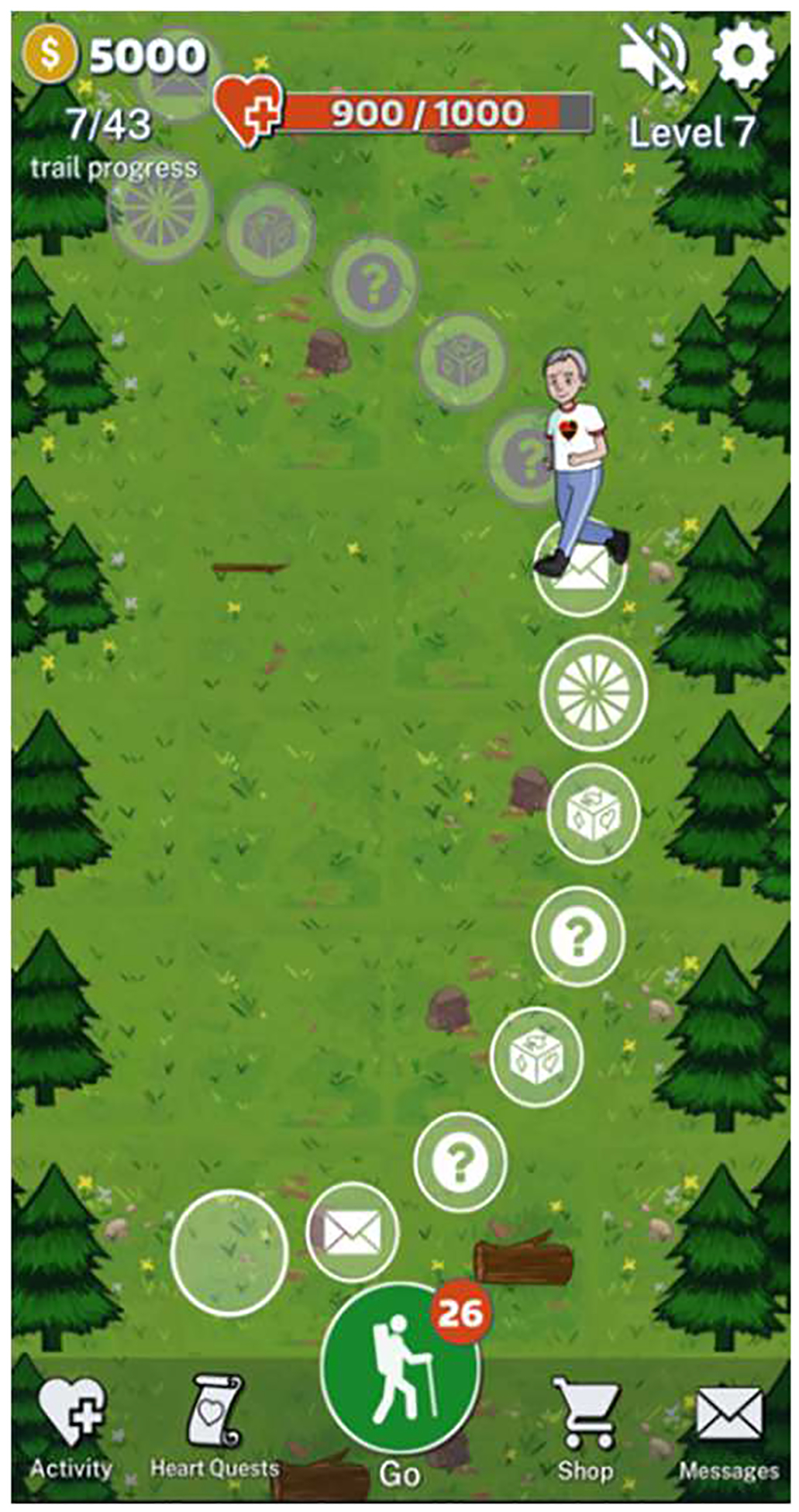
Avatar climbs the mountain
Fig. 3.

Bite-sized information
The final two step categories included casual mini-games of casino slot and heart health-based word jumble, as well as a random wheel spin were the other two mountain step categories. In addition, positive feedback messages to real-life behaviors, competition (e.g., leaderboard), and rewards (e.g., coins to buy low-salt food items or accessories for the avatar) were included as game-based mechanisms to sustain gameplay. The player’s real-life behaviors were objectively measured by Withings activity tracker [12] and smart weight scale [13] sensors. The following software were used in the game development: Unity, Visual Studio, and the C# programming language. Unity is a game engine, and Visual studio and C# are used to write the game scripts, including the game rules, and feedback messages in response to reallife behaviors.
V. Game Art & design
The art and GUI elements for the game were developed using Adobe Photoshop and Illustrator. A mountain path with trees on either side was the background scenery in the game. The avatar was available as a male or female character and in 3 skin tones. The game’s connection with realism was attempted by varying the avatar’s health status in response to the player’s real-life behaviors. An unhappy, bloated looking avatar would be displayed if the player did not engage in their behaviors (Fig. 4). On the other hand, a fit, happy-looking avatar would be displayed when the player engaged in their behaviors consistently (Fig. 4). The sounds of birds chirping in the forest was applied as the background sound in the game and was obtained from freesounds.org.
Fig. 4.

Avatar changes in response to real-life behaviors. Low or high behavior engagement result in unhappy (left) or happy (right) avatar
V. PLAYTESTING
Fifteen participants played the SCDG for 12 weeks (Table I) in a pilot feasibility randomized controlled trial in which outcomes were compared with 17 participants in a control group who used only the sensors for 12 weeks [14]. Eleven (71%) played the SCDG more than 50% of the days (range 7%–96%). Of the 13 who answered the post-game survey inspired by the Intrinsic Motivation Inventory [15], at the end of 12 weeks of game-playing, 85% found the game interesting, enjoyable, and motivating to exercise more and 100% found the game easy to play. At the end of 12 weeks, trends of improvement in both daily weight monitoring and physical activity behaviors were observed among participants who played the SCDG. Further details on the pilot study and results can be obtained from our earlier publication [14]. The pilot study demonstrated that digital games can be an amenable medium to incorporate game mechanisms that foster self-care behavior changes in individuals with HF. However, only 62% were satisfied with using the sensor devices to progress in the game. At the 12th week of players’ using the SCDG, we conducted semi-structured phone interviews pertaining to participants’ overall experience, their input on the SCDG features and their consequential behaviors. We analyzed these interviews through qualitative content analysis using Microsoft Word and Excel. Based on the qualitative findings, we realized that the prototype suffered from limitations mainly related to (1) setting physical activity goals that did not align with players’ physical limitations, (2) low use of game mechanisms to effectuate a gradual shaping of self-care behaviors over an extended duration, (3) lack of player control over the avatar’s age, and (4) technology glitches with a tracker that became outdated during the course of the pilot study. The next section describes the revised design and development of the ‘Heart Health Mountain’ SCDG informed by the SCDG players’ interviews, strategies from behavioral change theoretical frameworks and gaming mechanisms. Mapping gaming mechanisms to strategies from behavioral frameworks could increase the digital game’s effectiveness for achieving behavioral change outcomes.
Table I:
Characteristics of SCDG Participants (N=15)
| Baseline Characteristics | Participants n (%) | |
|---|---|---|
| Age | 55–64 | 9 (60) |
| 65–74 | 5 (33) | |
| > 75 | 1 (7) | |
| Sex | Male | 7 (47) |
| Female | 8 (53) | |
| Ethnicity | Hispanic / Latino | 3 (20) |
| Non-Hispanic / Latino | 12 (80) | |
| Race | White | 12 (80) |
| African American | 2 (13) | |
| Other | 1 (7) | |
| Highest Level of Education | High School / Vocational training | 4 (27) |
| Some College | 4 (27) | |
| Bachelor’s degree | 6 (40) | |
| Graduate degree | 1 (7) | |
| Prior Digital Game Playing | Yes | 14 (93) |
| No | 1 (7) | |
VI. Game development iteration
For the revised version, the goal of the game is to to set behavior goals that are realistic to be achieved by adults with HF and at the same time foster incremental progress in behaviors, week over week. Cardiac function and quality of life of adults with HF could benefit from a gradual increase in physical activity as low as 5-minute increase from week over week. Being motivated to act based on external rewards or benefits is described as extrinsic motivation, while being motivated to act based on internal drive such as the need to gain independence or knowledge is described as intrinsic motivation. According to Self-determination theory [16], intrinsic motivation is driven by the need to gain autonomy, competence or relatedness which can also be described as being connected. The Fogg Behavioral Model [17] posits that for a behavior to occur, motivation, ability and a prompt must converge. Finally, the Behavior Change Techniques Taxonomy [18] offers a reliable method to specify the active ingredients of a behavioral change intervention, which in this case is the SCDG. We then mapped our qualitative playtesting results from the pilot SCDG, with Behavior Change Techniques Taxonomy (BCTT) [18] and behavioral frameworks of Fogg’s Behavior Model [17] and Self-Determination Theory [16] to identify game components that will help us achieve our design goals. For example, a HF individual’s quote of “Steps and physical activity are at unrealistic start levels. I started out at 280 steps, got up to 550 steps a day”, mapped to behavioral change technique of ‘Graded Tasks’ for ‘Ability’ and ‘Autonomy’ behavioral theoretical concepts informed the game mechanism of an adaptive goal algorithm for setting and increasing step goal during game play. The quote, “I was disappointed that it ended so soon. It was motivational for me to continue to pay attention to my HF regimen until it became more of a routine”, was mapped to the behavioral change technique of ‘Habit Formation’ for the ‘Ability’ and ‘Autonomy’ behavioral theoretical concept to inform the game mechanism of ‘Climbing unending number of mountains’ as game play. See Table II for the game components mapped to behavioral change techniques for ‘Ability’ concept for the target behavior of physical activity.
Table II:
Mapping BCTT to Game Component for the “Ability” concept
| Motivation Type | Behavioral Change Technique | Game Component |
|---|---|---|
| Intrinsic-Competence | Feedback on behavior | Game messages on actual behaviors |
| Feedback on behavior | Syncs sensor data shown in the game with backend database | |
| Instructions on how to perform a behavior | Bite-sized knowledge (tips to perform physical activity) | |
| Instructions on how to perform a behavior | Step-by-step instructions on various game elements during the first week | |
| Behavior Substitution | Knowledge on alternative activities to increase steps | |
| Intrinsic-Autonomy | Habit Formation | Climbing indefinite number of mountains |
| Graded tasks | Goal setting using adaptive algorithm | |
| Action Planning | Plan higher physical activity guided by higher intensity heart quests | |
| Intrinsic-Relatedness | Social Support (unspecified) | Highlight content on partnering with a buddy to exercise |
| Extrinsic | Reward Completion | Reward completion of harder heart quests (e.g., (longer duration of step goal attainment) through powerful boosts |
| Reward Approximation | Earn stars and health points for attaining step goal set by the algorithm | |
| Material reward | Earn gold coins by answering quiz questions | |
| Material reward | Earn bonus mountain steps through heart quest boost system | |
| Material reward | Buy items in the game shop using earned coins | |
| Social reward | Congratulatory message at end of each mountain |
To attain our design goals, we proposed the following changes that were informed by the mapping exercise:
A. Stars for Short-term Behavior Goals
Daily behavior goals of attaining physical activity steps and weight-monitoring will be visualized using three stars with two stars granted for achieving physical activity step goal and one star for the weight-monitoring goal. The step goal is set using a rank-ordered adaptive goal algorithm [18] where the step goal for the next week will be the second highest step count from the previous week. This way the step goals are set at levels that are aligned with HF individuals’ physical capacity. There is a risk of players “gaming” the game by intentionally functioning at a lower level in order to easily attain the game rewards. Therefore, to incentivize incremental increases in physical activity to an optimal level we introduced the Heart Quest system to shape behaviors over an extended duration.
B. The Heart Quest System for Long- term Behavior Goals
The Heart Quest system will include three categories. The physical activity Heart Quest will incentivize gradual increases in step goal as well as sustaining achievement of daily step goals by awarding boosts that enable faster climbing up the mountains (Fig. 5). The Weight and Content Heart Quest system will incentivize long-term performance of weight-monitoring behavior and perusing the educational content. Finally, the Adventure Heart Quest will incentivize interaction with different game features such as in-game shopping or playing mini-games.
Fig. 5.

Heart Quest System (left) and example Adventure Heart Quest (right)
C. Other Changes
Numerous levels or mountains will be available to climb in the game, to enable endless game play for the players who would like to sustain their HF self-care behaviors. The leaderboard will be based on the number of mountains climbed by the player reflecting faster progress up the mountains that would be made possible by superior engagement in HF self-care behaviors. Four different mountain landscapes will be presented within the game to increase variety in imagery. Since capacity for physical activity among HF individuals vary widely, the leaderboards will be available within cohorts formed by age or step goal categories. A slider for age and skin tone will be available for the male and female avatar so participants can choose the avatar’s look to be as close to what they identify in age. The visual changes of the avatar’s health status will be compressed between 50 to 100% of the points earned by real-life behaviors to display quicker changes in the avatar’s health status based on real-life behaviors. Finally, we will replace our activity tracker with the latest version in order to resolve issues that we faced in our pilot study with syncing some trackers with the game app’s application programming interface (API).
VII. CONCLUSION AND FUTURE WORK
This paper demonstrates our efforts to utilize player perspectives and behavioral change conceptual mechanisms to inform iterations in game design and development for HF self-care behaviors. For our next step, we will test the improved version of our SCDG in a randomized controlled trial with 200 participants from southern U.S. states that have the highest disparities in HF health outcomes. To test the effect of the revised SCDG, we will compare health and behavioral outcomes of HF adults who receive the SCDG and sensor devices versus HF adults who receive the sensor devices only. Findings from our study will generate insights and guidance for scalable and easy-to-use digital gaming solutions to motivate self-care behaviors and improved health outcomes among individuals with HF.
Fig. 1.

System diagram
Acknowledgment
The authors would like to thank Dr Clay Cauthen, cardiologist at Ascension Seton Medical Center and Program Director of Cardiovascular Disease Fellowship at Dell Medical School. The authors would like to acknowledge digital artist services of Ryan Martin, BS in Arts and Entertainment Technologies
This research was supported by the National Institutes of Health through awards R21NR018229 and R01HL160692. The content is the sole responsibility of the authors and does not necessarily represent th official views of the National Institutes of Health.
Contributor Information
Kavita Radhakrishnan, School of Nursing, The University of Texas-Austin, Austin, USA.
Atami Sagna DeMain, School of Nursing, The University of Texas-Austin, Austin, USA.
Christine Julien, Cockrell School of Engineering, The University of Texas-Austin, Austin, USA.
Katelyn Leggio, School of Nursing, The University of Texas-Austin, Austin, USA.
Matthew O’Hair, Good Life Games, Inc, Austin, USA.
Emily T Hebért Arsers, School of Public Health, University of Texas-Health, Science Center, Austin, USA.
Grace Lee, Cockrell School of Engineering, The University of Texas-Austin, Austin, USA.
Tom Baranowski, Pediatrics, Baylor College of Medicine, Houston, USA.
References
- [1].Virani SS et al. , “Heart Disease and Stroke statistics—2020 Update,” Circulation, vol. 141, no. 9, pp. e139–e596, Jan. 2020, doi: 10.1161/cir.0000000000000757. [DOI] [PubMed] [Google Scholar]
- [2].Ponikowski P et al. , “Heart failure: preventing disease and death worldwide,” ESC Heart Failure, vol. 1, no. 1, pp. 4–25, Sep. 2014, doi: 10.1002/ehf2.12005. [DOI] [PubMed] [Google Scholar]
- [3].Jaarsma T et al. , “Self-care of heart failure patients: practical management recommendations from the Heart Failure Association of the European Society of Cardiology,” European Journal of Heart Failure, vol. 23, no. 1, pp. 157–174, Oct. 2020, doi: 10.1002/ejhf.2008. [DOI] [PMC free article] [PubMed] [Google Scholar]
- [4].Herrmann LK and Kim J, “The fitness of apps: a theory-based examination of mobile fitness app usage over 5 months,” mHealth, vol. 3, pp. 2, Jan. 2017, doi: 10.21037/mhealth.2017.01.03. [DOI] [PMC free article] [PubMed] [Google Scholar]
- [5].Radhakrishnan K et al. , “Usability Testing of a Sensor-Controlled Digital Game to Engage Older Adults with Heart Failure in Physical Activity and Weight Monitoring,” Applied Clinical Informatics, vol. 11, no. 05, pp. 873–881, Oct. 2020, doi: 10.1055/s-0040-1721399. [DOI] [PMC free article] [PubMed] [Google Scholar]
- [6].Jaarsma T et al. , “Effects of exergaming on exercise capacity in patients with heart failure: results of an international multicentre randomized controlled trial,” European Journal of Heart Failure, vol. 23, no. 1, pp. 114–124, Mar. 2021, doi: 10.1002/ejhf.1754. [DOI] [PubMed] [Google Scholar]
- [7].Cacciata MC et al. , “Facilitators and Challenges to Exergaming,” Journal of Cardiovascular Nursing, vol. 37, no. 3, pp. 281–288, Jun. 2022, doi: 10.1097/jcn.0000000000000825. [DOI] [PMC free article] [PubMed] [Google Scholar]
- [8].Radhakrishnan K et al. , “Interactive Digital e-Health Game for Heart Failure Self-Management: A Feasibility Study,” Games for Health Journal, vol. 5, no. 6, pp. 366–374, Dec. 2016, doi: 10.1089/g4h.2016.0038. [DOI] [PMC free article] [PubMed] [Google Scholar]
- [9].Dithmer M et al. , “‘The Heart Game’: Using Gamification as Part of a Telerehabilitation Program for Heart Patients,” Games for Health Journal, vol. 5, no. 1, pp. 27–33, Feb. 2016, doi: 10.1089/g4h.2015.0001. [DOI] [PMC free article] [PubMed] [Google Scholar]
- [10].Vieira Á, Gabriel J, Melo C, and Machado J, “Kinect system in home-based cardiovascular rehabilitation,” Proceedings of the Institution of Mechanical Engineers, Part H: Journal of Engineering in Medicine, vol. 231, no. 1, pp. 40–47, Dec. 2016, doi: 10.1177/0954411916679201. [DOI] [PubMed] [Google Scholar]
- [11].Sohn A et al. , “Integrating remote monitoring into heart failure patients’ care regimen: A pilot study,” PLOS ONE, vol. 15, no. 11, p. e0242210, Nov. 2020, doi: 10.1371/journal.pone.0242210. [DOI] [PMC free article] [PubMed] [Google Scholar]
- [12].Withings, Withings Homepage, Withings, Accessed Dec. 31, 2020. [Online]. Available: https://support.withings.com/hc/en-us/categories/202313048-Go [Google Scholar]
- [13].Withings, Body weight and BMI Wi-Fi scale, Withings. Accessed Dec. 31, 2020. [Online]. Available: https://www.withings.com/us/en/body [Google Scholar]
- [14].Radhakrishnan K et al. , “Feasibility of a Sensor-Controlled Digital Game for Heart Failure Self-management: Randomized Controlled Trial,” JMIR Serious Games, vol. 9, no. 4, p. e29044, Nov. 2021, doi: 10.2196/29044. [DOI] [PMC free article] [PubMed] [Google Scholar]
- [15].McAuley E, Duncan T, and Tammen VV, “Psychometric Properties of the Intrinsic Motivation Inventory in a Competitive Sport Setting: A Confirmatory Factor Analysis,” Research Quarterly for Exercise and Sport, vol. 60, no. 1, pp. 48–58, Mar. 1989, doi: 10.1080/02701367.1989.10607413. [DOI] [PubMed] [Google Scholar]
- [16].Deci EL and Ryan RM, “Self-determination theory,” in Handbook of theories of social psychology, Sage Publications Ltd, 2012, pp. 416–436. [Google Scholar]
- [17].Fogg B, “A behavior model for persuasive design,” in Proceedings of the 4th International Conference on Persuasive Technology, Claremont California USA, Apr. 2009. [Google Scholar]
- [18].Michie S et al. , “The Behavior Change Technique Taxonomy (v1) of 93 Hierarchically Clustered Techniques: Building an International Consensus for the Reporting of Behavior Change Interventions,” Annals of Behavioral Medicine, vol. 46, no. 1, pp. 81–95, Mar. 2013, doi: 10.1007/s12160-013-9486-6. [DOI] [PubMed] [Google Scholar]
- [19].Poirier J et al. , “Effectiveness of an Activity Tracker- and Internet-Based Adaptive Walking Program for Adults: A Randomized Controlled Trial,” Journal of Medical Internet Research, vol. 18, no. 2, p. e34, Feb. 2016, doi: 10.2196/jmir.5295. [DOI] [PMC free article] [PubMed] [Google Scholar]