



Abstract
The solubility of an anti-hyperglycemic agent drug, (R)-4-oxo-4-[3-(trifluoromethyl)-5,6-dihydro [1,2,4] triazolo[4,3-a] pyrazin-7(8H)-yl]-1-(2,4,5-trifluorophenyl) butan-2-amine (also known as Sitagliptin phosphate) in supercritical carbon dioxide (scCO2) was determined by ananalytical and dynamic technique at different temperatures (308, 318, 328 and 338 K) and pressure (12–30 MPa) values. The measured solubilities were in the range of 3.02 × 10⁻⁵ to 5.17 × 10⁻⁵, 2.71 × 10⁻⁵ to 5.83 × 10⁻⁵, 2.39 × 10⁻⁵ to 6.51 × 10⁻⁵ and 2.07 × 10⁻⁵ to 6.98 × 10⁻⁵ in mole fraction at (308, 318, 328 and 338) K, respectively. The solubility data were correlated with existing density models and with a new association model.
Subject terms: Chemical engineering, Nanomedicine
Introduction
Diabetes mellitus is a common metabolic disorder in which blood glucose levels are too high during a long period of time, which is increasing rapidly over the world and being considered one of the main threats to public health in the twenty-first century. It is predicted that by 2030, 366 million people worldwide will be affected by diabetes, of which 90% will be type IIof this disease1. The conventional diabetes treatmentis associated with some side effects such as weight gain, hypoglycemia, digestive problems, and gastric intolerance. For these this reasons, extensive researchhas been conducted to find novel drug delivery systems for this disease.
Sitagliptin phosphate, a dipeptidyl peptidase-4 (DPP-4) inhibitor, is one of the most effective anti-hyperglycemic agents which has been included in the list of diabetes drugs since 2006 with the FDA approval2.The use of sitagliptin phosphate effectively reduces the fasting glucose and glycosylated hemoglobin A1C (HbA1c) levels in type II diabetic patients3. However, the biological half life of this drug is short (about 3.6 h in rats), and it is eliminated quickly, implying the use of a high daily dose (prescribed as two doses of 50 mg day−1), which is not favorable for patients. This problem can be solved using an efficient drug delivery system with aprolonged and controlled release rate and increased adsorption efficiency of the drug2, 4, 5.
It has been reported that nano-sized drug delivery systems can deliver the required concentration of the drug to the target site of the body in a reasonable time and, as a result, increase the drug bioavailability and decrease its dosage and side effects6. Nanoparticles and the various types of polymericnano formulations are the most commondrug delivery systems which have shown satisfactory results in this regard. However, the method of producing these systems significantly influences their characteristics and, thus,their therapeutic efficacy. The conventional methods of producing drug delivery systems have some disadvantages, including non-uniformity of the size and morphology of the obtained particles, the consumption of a lot of organic solvent and subsequently the need forseveral purification steps to remove residual solvents and to reachpharmaceutical standards, involving the damage of the pharmaceutical compound due to severe operational conditions7. Therefore, the design and development of novel techniques to produce efficient drug delivery systems is one of the most attractive research areas.
It has been shown that the scCO2-based methods can satisfactorily replace the conventional methods used to produce various pharmaceutical formulations. The FDA’s approval for the use of CO2 as a permitted solvent in the pharmaceutical industry, as well as its unique characteristics, such as abundance, low cost, environmentally friendly nature, and recyclability, are the most important positive features of CO27, which have its use in the pharmaceutical industries. Different techniques based on supercritical have been developed to produce nanosized drugs, like supercritical antisolvent (SAS)8, supercritical solvent impregnation (SSI)9, rapid expansion of a supercritical solution (RESS)10, and some others11–15.
The solubility of the desired medicine in scCO2 is an important factor that should be known to select the appropriate supercritical fluid-basedmethod for drug designing. For this reason, determining the solubility of different drugs in scCO2 has become a relevant research topic in recent years. Moreover, the theoretical determination of the solubility of drugs in scCO2 has attracted much attention due to the complexity and high cost of the experimental process. The empirical models, thermodynamic models based on various equations of state, intelligence models (e.g., artificial neural networks), molecular modeling and machine learning models are the common models used for this purpose. The empirical models and the equations of state-based models are the most widely used ones. The empirical models, also known as density-based models, are the simplest theoretical models that have been used to correlate the experimental solubility data of solutes in scCO2since 197816. These models allow to calculate with acceptable accuracy the solubility of a solute based on the density of the supercritical solvent (scCO2) at the desired temperature and pressure, without the need of the thermodynamic and chemical properties of the solute. The of these models to predict the supercritical solubility of various drugs has been confirmed by many researchers17–21.
In this study, the solubility of sitagliptin phosphate in scCO2 was measured at temperatures of 308, 318, 328, and 338 K, and at pressures of 12–30 MPa. In addition, the solubility of the drug was theoretically determined using some well-known empirical models and a new association model.
Experimental
Materials used
The physicochemical properties of sitagliptin phosphate and the other chemicals that were utilized in the study can be found in Table 1. This includes the chemical's structureas well as its molar mass (Mw), formula, purity, and CAS number. These substances did not require any further processing of any kind before theiruse.
Table 1.
The molecular structure and physicochemical properties of the materials examined in this study.
| Compound | Structure |
M W (g mol−1) |
λmax(nm) | CAS number | Minimum purity | Manufacture |
|---|---|---|---|---|---|---|
| Sitgliptin phosphate | 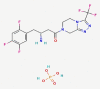 |
407.31 | 268 | 654671-78-0 | 99% (m/m) | Amin Pharmaceutical Company (Iran) (Esfahan, Iran) |
| Carbon dioxide |  |
44.01 | 124-38-9 | 99.99% (GC) | Aboughadare Co. (Shiraz, Iran) | |
| Methanol |  |
32.04 | 67-68-5 | 99% (GC) | MercK Group (Darmstadt, Germany) |
Experimental section
The Fig. 1 shows the apparatususedfor themeasurement of the Sitagliptin solubility in scCO2. More details about this system can be found in our previous studies22–24. This laboratory setup includes a CO2 tank, a cooling unit, a high-pressure pump, an equilibrium cell and a magnetic stirrer, which are clearly marked in the Fig. 1.
Figure 1.

Schematic diagram of solubility device.
In this solubility measurement method, initially, CO2 from the tank at 60 bar, after passing through the molecular sieve filter (1 µm pores) and removing pollution, entered the refrigerator unit forits liquefaction by decreasingtemperature from ambient to about − 20 °C. Then liquid CO2 was pressurized using a high-pressure pump until reached the appropriate pressure. The pressure values were controlled and recorded on both the pressure gauge (WIKA, Germany) and pressure transmitter with an accuracy of u(P) = 0.1 MPa. After adjusting the pressure, the liquefied CO2 entered to the equilibrium cell whose volume was 70 mL. In the cell, liquefied CO2 was contacted with the drug (Sitagliptin phosphate) that was already loaded in the cell.
The equilibrium cell was placed in an oven with temperature control with an accuracy of u(T) = ± 1 K. Also, a magnet stirrer was used to achieve a complete saturation of the drug inscCO2. The time required for the process was 120 min. After equilibrium, using the opening a 2-status 3-way port valve and reducing the pressure,saturated scCO2 (600 μL)was delivered into the injection loop. Finally, by opening the micrometer valve, saturated scCO2was collectedinto a vial which was already loaded with 4 mL of methanol. Further, the loopwas washed with 1 mL of methanol through an external line. During the experimentspressurewas controlled with a back pressure valve. Sitagliptin absorbance in methanol was measured with a spectrophotometer- Perkin-Elmer UV–Vis at 268 nm (λmax) with the calibration curve (with a regression coefficient of 0.998). The experimental runs were performed three times to determine averages. The relationships used to calculate the solubility of Sitagliptin in scCO2 at different temperatures and pressures, in terms of mole fraction (y) and equilibrium solubility (S (g L−1)), are reported in our previous work25.
Results and discussion
Experimental solubility
The reliability of the solubility device was tested by determining the solubility of naphthalene at a temperature of 308 K anddifferent pressure values was measured by the used setup used in the work and the obtained data was compared with reported data by Iwai et al.26, Yamini et al.27 and Sodeifian et al.28. These data are listed in Table 2.
Table 2.
Experimental solubility data of naphthalene in sc-CO2 at 308 K and comparison with the literature data.
| Pressure (MPa)a |
Iwai et al.36 (y × 103) |
Yamini et al.37 (y × 103) |
Sodeifian et al.38 (y × 103) |
This work (y × 103)a |
|---|---|---|---|---|
| 10.7 | – | 11.6 | 11.4 | 11.7 ± 0.2 |
| 13.8 | 14.1 | 15.2 | 14.3 | 14.8 ± 0.3 |
| 16.8 | 16.5 | 16.2 | 16.6 | 16.1 ± 0.3 |
| 20.4 | 17.6 | 17.4 | 17.7 | 17.9 ± 0.2 |
| 24.0 | – | – | – | 19.9 ± 0.4 |
aStandard uncertainty u are u(P) = 0.1 MPa and relative uncertainty (ur), u (y) = 0.10.
The solubility data for (R)-4-oxo-4-[3-(trifluoromethyl)-5,6-dihydro [1,2,4] triazolo[4,3-a] pyrazin-7(8H)-yl]-1-(2,4,5-trifluorophenyl) butan-2-amine (also known as sitagliptin phosphate) in scCO2 at different temperature (308, 318, 328 and 338 K) and pressure (12 and 30 MPa) values are shown in Table 3. Crossover points in Fig. 2 are observed for different isotherms between 15 and 16.5 MPa. Below the crossover point’s solubility increase is influenced due to increase in the density of scCO2, on the other hand above the crossover points the increase in solubility influenced by increase in sublimation pressure of the solute.
Table 3.
The experimental data of sitagliptin phosphate solubility in SC-CO2 based on distinct conditions (temperatures (T) and pressures (P) for binary system).
| Temperaturea (K) | Pressurea (MPa) | Densityb (kg m−3) | y × 104 (mole fraction) | Standard deviation × (105) | Expanded uncertainty of mole fraction (104 U) | S (Solubility (g l−1)) |
|---|---|---|---|---|---|---|
| 308 | 12 | 768.42 | 0.302 | 0.040 | 0.101 | 0.267 |
| 15 | 816.06 | 0.337 | 0.056 | 0.131 | 0.316 | |
| 18 | 848.87 | 0.359 | 0.072 | 0.162 | 0.350 | |
| 21 | 874.4 | 0.387 | 0.090 | 0.197 | 0.389 | |
| 24 | 895.54 | 0.441 | 0.118 | 0.253 | 0.454 | |
| 27 | 913.69 | 0.477 | 0.154 | 0.323 | 0.500 | |
| 30 | 929.68 | 0.517 | 0.172 | 0.360 | 0.552 | |
| 318 | 12 | 659.73 | 0.271 | 0.036 | 0.091 | 0.206 |
| 15 | 743.17 | 0.352 | 0.059 | 0.138 | 0.301 | |
| 18 | 790.18 | 0.395 | 0.079 | 0.177 | 0.358 | |
| 21 | 823.7 | 0.449 | 0.145 | 0.304 | 0.424 | |
| 24 | 850.1 | 0.506 | 0.067 | 0.169 | 0.494 | |
| 27 | 872.04 | 0.530 | 0.100 | 0.227 | 0.531 | |
| 30 | 890.92 | 0.583 | 0.117 | 0.263 | 0.596 | |
| 328 | 12 | 506.85 | 0.239 | 0.056 | 0.122 | 0.139 |
| 15 | 654.94 | 0.333 | 0.070 | 0.156 | 0.250 | |
| 18 | 724.13 | 0.426 | 0.085 | 0.191 | 0.355 | |
| 21 | 768.74 | 0.494 | 0.137 | 0.292 | 0.436 | |
| 24 | 801.92 | 0.551 | 0.147 | 0.315 | 0.507 | |
| 27 | 828.51 | 0.586 | 0.176 | 0.372 | 0.557 | |
| 30 | 850.83 | 0.651 | 0.217 | 0.454 | 0.636 | |
| 338 | 12 | 384.17 | 0.207 | 0.028 | 0.070 | 0.092 |
| 15 | 555.23 | 0.303 | 0.051 | 0.119 | 0.193 | |
| 18 | 651.18 | 0.456 | 0.091 | 0.205 | 0.341 | |
| 21 | 709.69 | 0.553 | 0.074 | 0.186 | 0.451 | |
| 24 | 751.17 | 0.609 | 0.102 | 0.239 | 0.525 | |
| 27 | 783.29 | 0.635 | 0.127 | 0.285 | 0.571 | |
| 30 | 809.58 | 0.698 | 0.163 | 0.356 | 0.649 |
aStandard uncertainty u are u(T) = ± 0.1 K; u(p) = ± 1 bar. Also, relative standard uncertainties are obtained below 5% for mole fractions and solubilities. The value of the coverage factor k = 2 was chosen on the basis of the level of confidence of approximately 95 percent.
bData from the Span–Wagner equation of state62.
Figure 2.
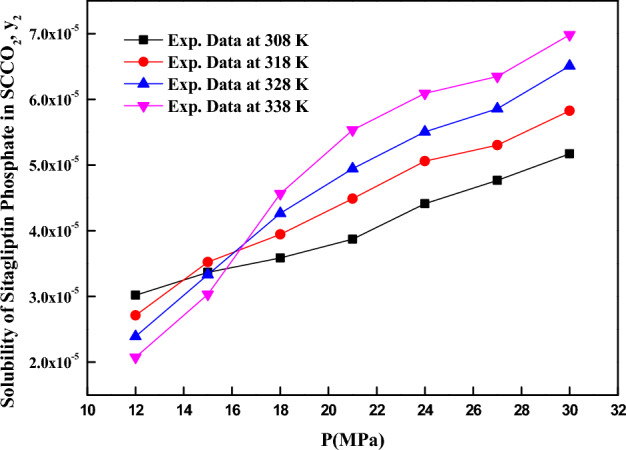
Sitagliptin phosphate solubility vs. pressure.
From Fig. 2, for an isotherm higher solubility is observed at higher pressures and it is due to enhancement of scCO2 density at higher pressures. The effect of temperature on solubility is typical in nature and crossover points are observed. Below the crossover point’s density of scCO2 influence the solubility, when density of scCO2 is higher correspondingly solubility is high even though temperature is lower. On the other hand above the crossover point’s solubility increases with temperature and it is due to increase in sublimation pressure of the solute. Thus, temperature has duel effect on solubility via solvent density and solute sublimation pressure.
Modeling
Solubility of drugs in supercritical fluids was modeled using different approaches that can beclassified indensity, equations of state, solid–liquid equilibrium andintelligence-based models. However, each approach has its own advantages and drawbacks. The density-based models are simple and easy to apply for data correlation due to doesn’t require solute information such as critical properties, acentric factor and sublimation pressure. Sitagliptin phosphate is a typical compound, and its acentric factor, critical properties (Tc and Pc) molar volumes and sublimation pressures can’t be predicted using regular group contribution methods29–32, due to the presence of phosphate in its chemical structure. Therefore, equation of sate (EOS) and solid–liquid equilibrium methods cannot be applied to correlate the solubility data of sitagliptin phosphate. Thus, only semi-empirical models (i.e., density-based model) are useful in data correlation. In this work for data correlation Josef Chrastil model33, Reformulated Chrastil model34,Méndez-Santiago and Teja (MST) model35, Bartle et al. model36 and Kumar and Johnston (KJ) model37 were used. For a better data correlation, a new association model requiring only density, pressure, and temperature of scCO2 was proposed. Following subsections discuss about the models considered in detail.
Josef Chrastil model
According to this model, the solubility of solutes in SCF is expressed with the following relation:
| 1 |
where , and are model constants.
Equation (1) can be rearranged to mole fraction as follows38
| 2 |
| 3 |
Mole fraction () and mole ratio are related as follows
| 4 |
| 5 |
| 6 |
In Eq. (6), the model constants are treated as independent of temperature and their values are obtained by regression with experimental data38. The obtained values are reported in Table 4. It is quite evident that a linear plot is observed when the data is depicted as vs. (Fig. 3a) and as vs. (Fig. 3b), this confirms the applicability of the Chrastil model to the solubility data39. From the constant , total heat of reaction is calculated (i.e., ), the obtained values are reported in Table 5
Table 4.
The correlation results of the sitagliptin phosphate–CO2 system provided by semi-empirical models and new association model.
| Sl. no | Name of the model & Equation number |
Model parameters | R2 | R2adj | AARD% |
|---|---|---|---|---|---|
| 1 |
Chrastil Model & Eq. (6) |
3.2364; − 14.548; − 2624.0 |
0.92249 | 0.91951 | 4.97 |
| 2 |
Reformulated Chrastil Model & Eq. (7) |
3.2439; − 17.896; − 1910.2 |
0.96697 | 0.96570 | 4.95 |
| 3 |
MT Model & Eq. (8) |
− 6486.6; 2.193; 10.103 |
0.91635 | 0.9059 | 8.721 |
| 4 |
Bartle et. al. Model & Eq. (9) |
9.8241; − 4861,2 0.0065735 |
0.89618 | 0.89219 | 9.06 |
| 5 |
KJ Model & Eq. (10) |
− 4.197 0.0031559 − 2671.2 |
0.98536 | 0.98480 | 3.16 |
| 6 |
New Association Model & Eq. (30) |
1.1945; − 1519.5; 2.1846; 0.0024843; − 20.894 |
0.98817 | 0.98772 | 2.53 |
Figure 3.

(a) Experimental data of supercritical solubility of sitagliptin phosphate (points) compared to data calculated with the Chrastil model (line). (b) Results of self-consistency analysis for the Chrastil model.
Table 5.
Calculated enthalpies of sitagliptin phosphate–CO2 system provided by semi-empirical models.
| Model | Property | ||
|---|---|---|---|
| Total enthalpy in kJ mol−1 | Sublimation enthalpy, kJ mol−1 | Solvation enthalpy, kJ mol−1 | |
| Chrastil Modela | 21.815a | *− 18.601b | |
|
Reformulated Chrastil Modelc |
15.881c | **− 24.535d | |
| Bartle et al. Modele | 40.416e | ||
*Solvation enthalpyb = Total Enthalpy obtained from Chrastil Modela-Sublimation Enthalpy obtained from Bartle et al. Modele; **Solvation enthalpyd = Total Enthalpy obtained from reformulated Chrastil Modelc-Sublimation Enthalpy obtained from Bartle et al. Modele; A negative sign is attributed solvation enthalpy.
Reformulated Chrastil model
According to this model, solubility is a function of (association number), (solvent density (scCO2)) and T (temperature). In Eq. (7), it is important to note that depending on the reference fugacity units, R units are selected.
| 7 |
where R denotes universal gas constant (0.082057 atm m3 kgmole−1 K−1), is molecular weight of solvent (For CO2 44.01 kg kgmol−1), is reference fugacity (1 atm) and and are the reformulated model constants.
In Eq. (7), the model constants were treated as independent of temperature and their values were obtained by regression with experimental data. The obtained values are reported in Table 4 It is quite evident that a linear plot is observed when the data are depicted as vs. (Fig. 4a) and as vs. (Fig. 4b), this confirms the applicability of the reformulated Chrastil model to the solubility data. From the constant , total heat of reaction is calculated (i.e.,), the obtained values are reported in Table 5.
Figure 4.

(a) Experimental data of supercritical solubility of sitagliptin phosphate (points) compared to data calculated with the Reformulated Chrastil Model (line). (b) Results of self-consistency analysis for the Reformulated Chrastil Model.
Méndez-Santiago and Teja (MT) model
Internal consistency of the measured solubility data was checked with this model. It is stated as Eq. (8) and when vs. is established, all data points fall around a single straight line.
| 8 |
where A3 to C3 are the model constants.
In Eq. (8), the model constants were treated as independent of temperature and their values were obtained by regression with experimental data. The obtained values were reported in Table 4. The experimental data obtained in this work is checked for consistency with the help of Mendez-Santiago and Teja model (MT model). According to the MT model, the solubility data at different temperatures collapsed into a single line. It is quite evident that linear plots are observed when the data are depicted as vs. (Fig. 5a) and as vs. (Fig. 5b), this confirms the applicability of the MT model to the solubility data.
Figure 5.

(a) Experimental data of supercritical solubility of sitagliptin phosphate (points) compared to data calculated with the MT Model (line). (b) Results of self-consistency analysis for the MT Model.
Bartle et al., model
According to the model the solubility was expressed as Eq. (9)
| 9 |
where reference pressure is 0.1 MPa or 1 bar, reference density is 700 kg m−3 and A4 to C4 are the model constants. From the constant , sublimation enthalpy is calculated (i.e.,).
In Eq. (9), the model constants were treated as independent of temperature and their values were obtained by regression with experimental data. The obtained values were reported in Table 4 it is quite evident that linear plots are observed when the data are depicted as vs. (Fig. 6a) and as vs. (Fig. 6b) this confirms the applicability of the Bartle et al. model to the solubility data.
Figure 6.

(a) Experimental data of supercritical solubility of sitagliptin phosphate (points) compared to data calculated with the Bartle et al. Model (line). (b) Results of self-consistency analysis for the Bartle et al. Model.
Kumar and Johnston (KJ) model
According to the model the solubility was expressed as Eq. (10)
| 10 |
where A5 to C5 are the model constants.
In Eq. (10), the model constants were treated as independent of temperature and their values were obtained by regression with experimental data. The obtained values were reported in Table 3 it is quite evident that a linear plots are observed when the data are depicted as vs.(Fig. 7a) and as vs. (Fig. 7b), this confirms the applicability of the KJ model to the solubility data.
Figure 7.
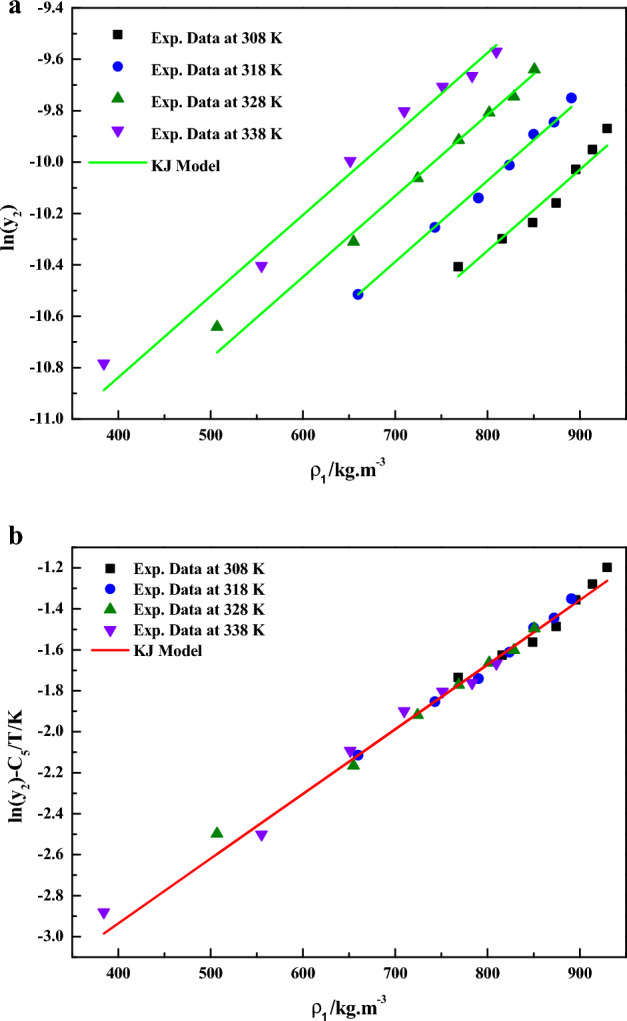
(a) Experimental data of supercritical solubility of sitagliptin phosphate (points) compared to data calculated with the KJ Model (line). (b) Results of self-consistency analysis for the KJ Model.
New association model
If one molecule of a solute (A) associates with molecules of solvent (B) to form one molecule of a solvato complex in equilibrium with the gaseous system33,
| 11 |
Equation (12) represents the equilibrium constant in terms of the individual component’s fugacity
| 12 |
where ScP represents the supercritical phase, S represents the solute phase and is reference fugacity.
The fugacity for each component can be calculated by the following equations40–42.
| 13 |
| 14 |
| 15 |
| 16 |
| 17 |
| 18 |
Here the main assumption is fluid-phase component does not dissolve in the solid. i.e., the solid is pure. Solute A exists in an associated state in ScP
| 19 |
where are mole fraction of solvent and solvato complex respectively.
Since the solute A mainly exists in an associating state, the solubility of solute A in ScP is43–45
| 20 |
when standard state of the solute A is treated as pure solute at system pressure (P) and temperature (T), then
| 21 |
The fugacity of pure solute can be written as
| 22 |
where is the sublimation pressure of the pure solid, and is the molar volume of the pure solid at system temperature(T), and pressure, (P).
Substituting Eqs. (13)–(18) and Eq. (22) in Eq. (12) gives Eq. (23)
| 23 |
| 24 |
The equilibrium constant, may be expressed as .
where , the heat of solvation and qsis a constant and may be expressed as where is the density of the supercritical phase. At the supercritical state, is a function of three variables namely pressure, temperature and composition. Thus, the fugacities in Eq. (24) are a very complex function of pressure, temperature and composition.
Then Eq. (24) may be expressed as
| 25 |
The sublimation pressure of the solid solute may be expressed as
| 26 |
where , and are temperature independent parameters.
When (~ 10–9) term is neglected (since the sublimation pressures (~ 10–4) and molar volume of solid solutes (~ 10–4) are very low) and density of solution is treated as approximately as density of supercritical fluid
| 27 |
where , , and
Equation (27) may be written as Eq. (28)
| 28 |
Because the solubility of drug in scCO2 are very dilute, therefore for a binary system we may assume is unity. Then Eq. (28) reduced to Eq. (29)
| 29 |
Combining Eq. (20) and Eq. (29) gives expression for solubility Eq. (30)
| 30 |
From Eq. (30),it is clear that solubility is a function of density, temperature and association number (i.e.,) and further all equations are dimensionally consistent. Hereafter, this equation may be called as the new association model. In Eq. (30), the model constants were treated as independent of temperature and their values were obtained by regression with experimental data. The obtained values are reported in Table 4 it is quite evident that a better fit is observed when the data is plotted as Sitagliptin Phosphate solubility, vs. (Fig. 8a). It is important to note that Fig. 8a is not linear due to its functionality (i.e., ). However, a linear plot is observed when the data are depicted as vs. (Fig. 8b),which confirms the applicability of the new association model to the solubility data. Solubility of solids substances in scCO2 are best understood in terms of solvato-complex formation, thus the interactions between sitagliptin phosphate (solute) and supercritical carbon dioxide (solvent) is visualized as formation of a solvato-complex. The new association model (solvato-complex model) proposed in this study is able to capture solubility phenomena with least AARD% (i.e., 2.53%). Thus, present study confirms solvato-complex theory holds good for this sitagliptin phosphate–scCO2 system.
Figure 8.
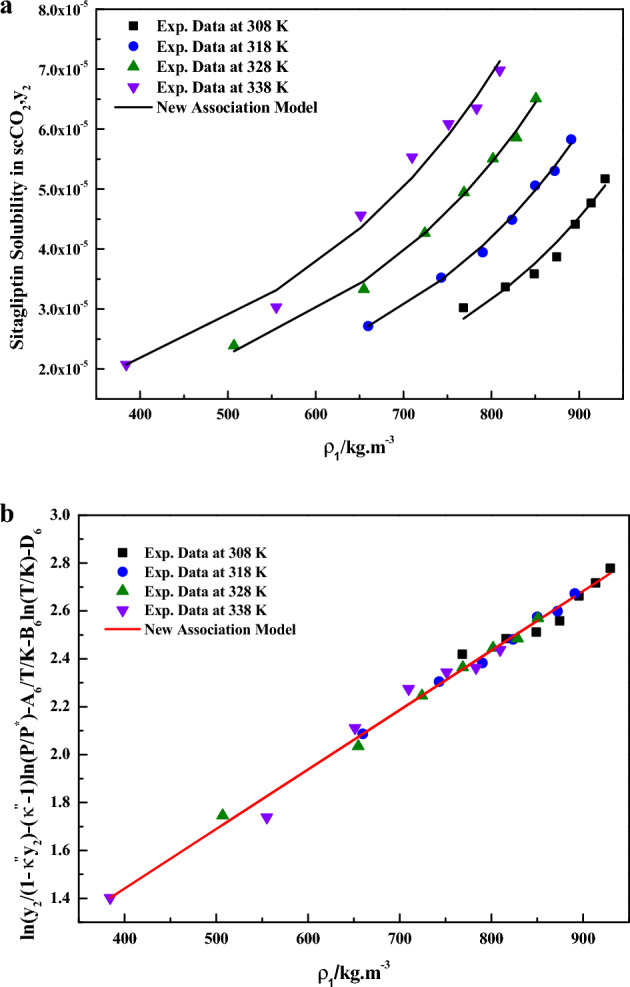
(a) Sitagliptin phosphate solubility, vs. . (b) Results of self-consistency analysis for the New Association Model.
Conclusion
Thesolubility of (R)-4-oxo-4-[3-(trifluoromethyl)-5,6-dihydro [1,2,4] triazolo[4,3-a] pyrazin-7(8H)-yl]-1-(2,4,5-trifluorophenyl) butan-2-amine (i.e., sitagliptin phosphate) was measured by a static method in the pressure range of 12–30 MPa for different temperature values (30, 318, 328 and 338 K). The measured solubilities range from (0.2074 to 0.698) × 10–4 mol fraction of (R)-4-oxo-4-[3-(trifluoromethyl)-5,6-dihydro [1,2,4] triazolo[4,3-a] pyrazin-7(8H)-yl]-1-(2,4,5-trifluorophenyl) butan-2-amine. Further, measured solubilities are reasonably correlated with the Chrastil model, the reformulated Chrastil model,the Méndez-Santiago and Teja (MST) model, the Bartle et al., model, the Kumar and Johnston (KJ) model. The newly proposed association model was able to correlate the solubility data with the lowest absolute relative deviation (2.53%). Calculated sublimation and solvation enthalpies of Sitagliptin phosphate in scCO2 are 40.416 kJ mol−1, − 24.535 kJ mol−1 for Bartle et al., model and Bartle et al., model + Chrastil model combination, respectively.
Acknowledgements
Authors would like to thank the generous support provided by the research laboratory of Dr. Sajadian. Prof. G. C thank Prof. G. Madras for his inspiration and guidance.
List of symbols
- A1,B1
Eq. (6) Constants
- A2, B2
Eq. (7) Constants
- A3, B3, C3
Eq. (8) Constants
- A4, B4, C4
Eq. (9) Constants
- A5, B5, C5
Eq. (10) Constants
- A6, B6, C6,D6,E6,F6
Eq. (30) Constants
- AARD%
Average absolute relative deviation percentage
Fugacity in mixtuer
- Hsol
Solvation enthalpy(kJ/mol)
- Hsub
Sublimation enthalpy(kJ/mol)
- Htotal
Total enthalpy(kJ/mol)
Equilibrium constant
- MCO2
Molar mass of CO2 and drug (g/mol)
Solute Molar mass
- P
System pressure
- P*
Reference pressure
- Ps
Sublimation pressure(Pa)
- R
Universal gas constant, 8.314 J/(molK)
- scCO2
Supercritical carbon dioxide
- T
System temperature (K)
Drug solute solubility in mole fraction
Greek symbols
Fugacity coefficient
Eq. (26) Constants
Solvent density
Association numbers
Author contributions
N.A. ,S.S., N.E. and A.R. are responsible for solubility data generation and compound selection and literature review and G.C. is responsible for modeling software. All authors reviewed the manuscript.
Competing interests
The authors declare no competing interests.
Footnotes
Publisher's note
Springer Nature remains neutral with regard to jurisdictional claims in published maps and institutional affiliations.
Contributor Information
Seyed Ali Sajadian, Email: seyedali.sajadian@gmail.com.
Chandrasekhar Garlapati, Email: chandrasekhar@ptuniv.edu.in.
References
- 1.Sivaprasad S, Gupta B, Crosby-Nwaobi R, Evans J. Prevalence of diabetic retinopathy in various ethnic groups: A worldwide perspective. Surv. Ophthalmol. 2012;57:347–370. doi: 10.1016/j.survophthal.2012.01.004. [DOI] [PubMed] [Google Scholar]
- 2.SreeHarsha N, et al. Mucoadhesive particles: A novel, prolonged-release nanocarrier of sitagliptin for the treatment of diabetics. BioMed Res. Int. 2019;2019:3950942. doi: 10.1155/2019/3950942. [DOI] [PMC free article] [PubMed] [Google Scholar]
- 3.Herman GA, et al. Pharmacokinetics and pharmacodynamic effects of the oral DPP-4 inhibitor sitagliptin in middle-aged obese subjects. J. Clin. Pharmacol. 2006;46:876–886. doi: 10.1177/0091270006289850. [DOI] [PubMed] [Google Scholar]
- 4.Kazi M, et al. Development and optimization of sitagliptin and dapagliflozin loaded oral self-nanoemulsifying formulation against type 2 diabetes mellitus. Drug Deliv. 2021;28:100–114. doi: 10.1080/10717544.2020.1859001. [DOI] [PMC free article] [PubMed] [Google Scholar]
- 5.Haq-Asif A, Harsha S, Hodalur-Puttaswamy N, Al-Dhubiab B. An effective delivery system of sitagliptin using optimized mucoadhesive nanoparticles. Appl. Sci. 2018;8:6. doi: 10.3390/app8060861. [DOI] [Google Scholar]
- 6.Mukherjee B. Nanosize drug delivery system. Curr. Pharmaceut. Biotechnol. 2013;14:1221. doi: 10.2174/138920101415140804121008. [DOI] [PubMed] [Google Scholar]
- 7.Champeau M, Thomassin JM, Tassaing T, Jérôme C. Drug loading of polymer implants by supercritical CO2 assisted impregnation: A review. J. Controll. Release. 2015;209:248–259. doi: 10.1016/j.jconrel.2015.05.002. [DOI] [PubMed] [Google Scholar]
- 8.Prosapio V, De Marco I, Reverchon E. PVP/corticosteroid microspheres produced by supercritical antisolvent coprecipitation. Chem. Eng. J. 2016;292:264–275. doi: 10.1016/j.cej.2016.02.041. [DOI] [Google Scholar]
- 9.Saadati-Ardestani N, Amani M. Supercritical solvent impregnation of sodium valproate nanoparticles on polymers: Characterization and optimization of the operational parameters. J. CO2 Utiliz. 2022;64:102159. doi: 10.1016/j.jcou.2022.102159. [DOI] [Google Scholar]
- 10.Riekes MK, et al. Enhanced hypotensive effect of nimodipine solid dispersions produced by supercritical CO2 drying. Powd. Technol. 2015;278:204–210. doi: 10.1016/j.powtec.2015.03.029. [DOI] [Google Scholar]
- 11.Jesson G, et al. Carbon dioxide-mediated generation of hybrid nanoparticles for improved bioavailability of protein kinase inhibitors. Pharm. Res. 2014;31:694–705. doi: 10.1007/s11095-013-1191-4. [DOI] [PMC free article] [PubMed] [Google Scholar]
- 12.Park JW, et al. A nanosystem for water-insoluble drugs prepared by a new technology, nanoparticulation using a solid lipid and supercritical fluid. Arch. Pharm. Res. 2013;36:1369–1376. doi: 10.1007/s12272-013-0187-2. [DOI] [PubMed] [Google Scholar]
- 13.Obaidat RM, Tashtoush BM, Awad AA, Al-Bustami RT. Using supercritical fluid technology (SFT) in preparation of tacrolimus solid dispersions. AAPS Pharm. Sci. Tech. 2017;18:481–493. doi: 10.1208/s12249-016-0492-4. [DOI] [PubMed] [Google Scholar]
- 14.Wu K, Li J, Wang W, Winstead DA. Formation and characterization of solid dispersions of piroxicam and polyvinylpyrrolidone using spray drying and precipitation with compressed antisolvent. J. Pharm. Sci. 2009;98:2422–2431. doi: 10.1002/jps.21598. [DOI] [PubMed] [Google Scholar]
- 15.Pathak P, Prasad GL, Meziani MJ, Joudeh AA, Sun Y-P. Nanosized paclitaxel particles from supercritical carbon dioxide processing and their biological evaluation. Langmuir. 2007;23:2674–2679. doi: 10.1021/la062739d. [DOI] [PubMed] [Google Scholar]
- 16.Stahl E, Schilz W, Schütz E, Willing E. A quick method for the microanalytical evaluation of the dissolving power of supercritical gases. Angew. Chem. 1978;17:731–738. doi: 10.1002/anie.197807311. [DOI] [Google Scholar]
- 17.Shojaee S, Rajaei H, Hezave A, Lashkarbolooki M, Esmaeilzadeh F. Experimental solubility measurement of cephalexin in supercritical carbon dioxide. Chem. Ind. Chem. Eng. Q. 2014;20:387–395. doi: 10.2298/CICEQ121128021S. [DOI] [Google Scholar]
- 18.Zeinolabedini-Hezave A, Khademi MH, Esmaeilzadeh F. Measurement and modeling of mefenamic acid solubility in supercritical carbon dioxide. Fluid Phase Equilib. 2012;313:140–147. doi: 10.1016/j.fluid.2011.09.031. [DOI] [Google Scholar]
- 19.Shojaee SA, Rajaei H, Hezave AZ, Lashkarbolooki M, Esmaeilzadeh F. Experimental measurement and correlation for solubility of piroxicam (a non-steroidal anti-inflammatory drugs (NSAIDs)) in supercritical carbon dioxide. J. Supercrit. Fluids. 2013;80:38–43. doi: 10.1016/j.supflu.2013.03.015. [DOI] [Google Scholar]
- 20.Wang S-W, Chang S-Y, Hsieh C-M. Measurement and modeling of solubility of gliclazide (hypoglycemic drug) and captopril (antihypertension drug) in supercritical carbon dioxide. J. Supercrit. Fluids. 2021;174:105244. doi: 10.1016/j.supflu.2021.105244. [DOI] [Google Scholar]
- 21.Ardjmand M, Mirzajanzadeh M, Zabihi F. Measurement and correlation of solid drugs solubility in supercritical systems. Chin. J. Chem. Eng. 2014;22:549–558. doi: 10.1016/S1004-9541(14)60073-2. [DOI] [Google Scholar]
- 22.Sajadian SA, Ardestani NS, Jouyban A. Solubility of montelukast (as a potential treatment of COVID-19) in supercritical carbon dioxide: Experimental data and modelling. J. Mol. Liquids. 2022;349:118219. doi: 10.1016/j.molliq.2021.118219. [DOI] [Google Scholar]
- 23.Sajadian SA, Ardestani NS, Esfandiari N, Askarizadeh M, Jouyban A. Solubility of favipiravir (as an anti-COVID-19) in supercritical carbon dioxide: An experimental analysis and thermodynamic modeling. J. Supercrit. Fluids. 2022;183:105539. doi: 10.1016/j.supflu.2022.105539. [DOI] [PMC free article] [PubMed] [Google Scholar]
- 24.Esfandiari N, Sajadian SA. Experimental and modeling investigation of Glibenclamide solubility in supercritical carbon dioxide. Fluid Phase Equilibr. 2022;556:113408. doi: 10.1016/j.fluid.2022.113408. [DOI] [Google Scholar]
- 25.Amani M, Ardestani NS, Jouyban A, Sajadian SA. Solubility measurement of the fludrocortisone acetate in supercritical carbon dioxide: Experimental and modeling assessments. J. Supercrit. Fluids. 2022;190:105752. doi: 10.1016/j.supflu.2022.105752. [DOI] [PMC free article] [PubMed] [Google Scholar]
- 26.Iwai Y, Fukuda T, Koga Y, Arai Y. Solubilities of myristic acid, palmitic acid, and cetyl alcohol in supercritical carbon dioxide at 35 degree C. J. Chem. Eng. Data. 1991;36:430–432. doi: 10.1021/je00004a025. [DOI] [Google Scholar]
- 27.Yamini Y, Fat'hi MR, Alizadeh N, Shamsipur M. Solubility of dihydroxybenzene isomers in supercritical carbon dioxide. Fluid Phase Equilibr. 1998;152:299–305. doi: 10.1016/S0378-3812(98)00385-9. [DOI] [Google Scholar]
- 28.Sodeifian G, Sajadian SA, Ardestani NS. Determination of solubility of Aprepitant (an antiemetic drug for chemotherapy) in supercritical carbon dioxide: Empirical and thermodynamic models. J. Supercrit. Fluids. 2017;128:102–111. doi: 10.1016/j.supflu.2017.05.019. [DOI] [Google Scholar]
- 29.Jain A, Yang G, Yalkowsky SH. Estimation of melting points of organic compounds. Ind. Eng. Chem. Res. 2004;43:7618–7621. doi: 10.1021/ie049378m. [DOI] [Google Scholar]
- 30.Immirzi A, Perini B. Prediction of density in organic crystals. Acta Crystallogr. Sect. A: Cryst. Phys. Diffract. Theor. General Crystallogr. 1977;33:216–218. doi: 10.1107/S0567739477000448. [DOI] [Google Scholar]
- 31.Lyman W, Reehl W, Rosenblatt D. Research and Development of Methods for Estimating Physicochemical Properties of Organic Compounds of Environmental Concern. McGraw Hill Book Co.; 1982. [Google Scholar]
- 32.Reid R, Prausnitz JM, Poling BE. The properties of gases and liquids. Chem. Eng. Ser. 1987;657:89. [Google Scholar]
- 33.Chrastil J. Solubility of solids and liquids in supercritical gases. J. Phys. Chem. 1982;86:3016–3021. doi: 10.1021/j100212a041. [DOI] [Google Scholar]
- 34.Garlapati C, Madras G. Solubilities of palmitic and stearic fatty acids in supercritical carbon dioxide. J. Chem. Thermodyn. 2010;42:193–197. doi: 10.1016/j.jct.2009.08.001. [DOI] [Google Scholar]
- 35.Méndez-Santiago J, Teja AS. The solubility of solids in supercritical fluids. Fluid Phase Equilibr. 1999;158:501–510. doi: 10.1016/S0378-3812(99)00154-5. [DOI] [Google Scholar]
- 36.Bartle K, Clifford A, Jafar S, Shilstone G. Solubilities of solids and liquids of low volatility in supercritical carbon dioxide. J. Phys. Chem. Ref. Data. 1991;20:713–756. doi: 10.1063/1.555893. [DOI] [Google Scholar]
- 37.Kumar SK, Johnston KP. Modelling the solubility of solids in supercritical fluids with density as the independent variable. J. Supercrit. Fluids. 1988;1:15–22. doi: 10.1016/0896-8446(88)90005-8. [DOI] [Google Scholar]
- 38.Mahesh G, Garlapati C. Correlating solubilities of some parabens in supercritical carbon dioxide using Modified Wilson’s model. Austin Chem. Eng. 2023;10(1):1096. [Google Scholar]
- 39.Garlapati C, Madras G. Solubilities of some chlorophenols in supercritical CO2 in the presence and absence of cosolvents. J. Chem. Eng. Data. 2010;55:273–277. doi: 10.1021/je900328c. [DOI] [Google Scholar]
- 40.Sridar R, Bhowal A, Garlapati C. A new model for the solubility of dye compounds in supercritical carbon dioxide. Thermochim. Acta. 2013;561:91–97. doi: 10.1016/j.tca.2013.03.029. [DOI] [Google Scholar]
- 41.Ch R, Madras G. An association model for the solubilities of pharmaceuticals in supercritical carbon dioxide. Thermochim. Acta. 2010;507:99–105. doi: 10.1016/j.tca.2010.05.006. [DOI] [Google Scholar]
- 42.Reddy SN, Madras G. An association and Wilson activity coefficient model for solubilities of aromatic solid pollutants in supercritical carbon dioxide. Thermochim. acta. 2012;541:49–56. doi: 10.1016/j.tca.2012.04.025. [DOI] [Google Scholar]
- 43.Anita N, Garlapati C. A statistical analysis of solubility models employed in supercritical carbon dioxide. AIP Conf. Proc. 2022;2446:180003. doi: 10.1063/5.0108200. [DOI] [Google Scholar]
- 44.Zhong M, Han B, Ke J, Yan H, Peng D-Y. A model for correlating the solubility of solids in supercritical CO2. Fluid Phase Equilibr. 1998;146:93–102. doi: 10.1016/S0378-3812(98)00207-6. [DOI] [Google Scholar]
- 45.Lemert RM, Johnston KP. Chemical complexing agents for enhanced solubilities in supercritical fluid carbon dioxide. Ind. Eng. Chem. Res. 1991;30:1222–1231. doi: 10.1021/ie00054a024. [DOI] [Google Scholar]