



Abstract
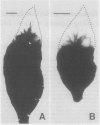
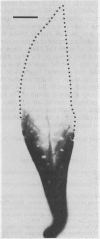
The sink-source conversion in developing leaves of tobacco (Nicotiana tabacum L.) was studied to determine whether import termination is caused by the onset of export or is related to achievement of positive carbon balance. Albino shoots were grown in vitro and grafted to detopped stems of green tobacco plants. Termination of import was studied by providing mature leaves of the stock plant with 14CO2 and detecting the presence of labeled nutrient in developing albino leaves by whole-leaf autoradiography. In albino leaves, import terminated progressively in the basipetal direction at the same stage of development as in leaves of green shoots. Starch was not present in the plastids of mesophyll cells of mature albino leaves but starch was synthesized when discs were cut from these leaves and incubated on 3 millimolar sucrose. Import ceased progressively in developing green leaves even when photosynthesis was prevented by darkening. It was concluded that cessation of import does not require achievement of positive carbon balance and is not the direct result of export initiation.
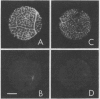
To determine whether vein loading capacity develops in albino leaves, discs were cut from mature leaves and floated on [14C]sucrose solution. Uptake of label into the veins was detected by autoradiography and this uptake was sensitive to the phloem loading inhibitor p-chloromercuribenzenesulfonic acid. However, the amount of label taken up by veins in albino leaves was less than that taken up by veins of mature green leaves.
Full text
PDF


Images in this article
Selected References
These references are in PubMed. This may not be the complete list of references from this article.
- Fellows R. J., Geiger D. R. Structural and Physiological Changes in Sugar Beet Leaves during Sink to Source Conversion. Plant Physiol. 1974 Dec;54(6):877–885. doi: 10.1104/pp.54.6.877. [DOI] [PMC free article] [PubMed] [Google Scholar]
- Fenzl F., Decker M., Haass D., Tanner W. Characterization and partial purification of an inducible protein related to hexose proton cotransport of Chlorella vulgaris. Eur J Biochem. 1977 Feb;72(3):509–514. doi: 10.1111/j.1432-1033.1977.tb11274.x. [DOI] [PubMed] [Google Scholar]
- Giaquinta R. Evidence for Phloem loading from the apoplast: chemical modification of membrane sulfhydryl groups. Plant Physiol. 1976 Jun;57(6):872–875. doi: 10.1104/pp.57.6.872. [DOI] [PMC free article] [PubMed] [Google Scholar]
- Giaquinta R. Source and sink leaf metabolism in relation to Phloem translocation: carbon partitioning and enzymology. Plant Physiol. 1978 Mar;61(3):380–385. doi: 10.1104/pp.61.3.380. [DOI] [PMC free article] [PubMed] [Google Scholar]
- Loescher W. H., Marlow G. C., Kennedy R. A. Sorbitol metabolism and sink-source interconversions in developing apple leaves. Plant Physiol. 1982 Aug;70(2):335–339. doi: 10.1104/pp.70.2.335. [DOI] [PMC free article] [PubMed] [Google Scholar]
- Pate J. S., Atkins C. A. Xylem and Phloem transport and the functional economy of carbon and nitrogen of a legume leaf. Plant Physiol. 1983 Apr;71(4):835–840. doi: 10.1104/pp.71.4.835. [DOI] [PMC free article] [PubMed] [Google Scholar]
- Quinlan J. D., Weaver R. J. Influence of Benzyladenine, Leaf Darkening, and Ringing on Movement of C-labeled Assimilates Into Expanded Leaves of Vitis vinifera L. Plant Physiol. 1969 Sep;44(9):1247–1252. doi: 10.1104/pp.44.9.1247. [DOI] [PMC free article] [PubMed] [Google Scholar]