



Abstract
China prioritizes ecological civilization construction and embraces the concept of “lucid waters and lush mountains are invaluable assets.” Great achievements have been made in ecological protection and restoration through implementing a series of policies and projects. This paper reviews the history of ecological restoration in China and the current development of the “integrated protection and restoration project of mountains, rivers, forests, farmlands, lakes, grasslands, and deserts (IPRP).” Furthermore, the characteristics of IPRP were systematically elaborated from the perspectives of the ecological civilization thought, the policy management, and the key scientific issues. Also, the current achievements were summarized in the fields of national ecological space management, biodiversity conservation, and ecological protection and restoration. Existing challenges in management policy, scientific issues, and engineering practices were highlighted. Future perspectives include ecological space control, nature-based Solutions, biodiversity big data platform, modern techniques, and value realization mechanisms of ecological products.
Keywords: Ecological civilization, Ecological protection and restoration, Life community, Territorial spatial management
Introduction
The natural resources and services provided by ecosystems are fundamental to the development of human society. Ecosystems also have great economic value. For example, the gross value of terrestrial ecosystems in China has been estimated to be equivalent to 1.01 times the GDP (Ma et al. 2017). In recent decades, rapid economic development has caused serious ecological degradation problems in China (Gu and Xie 2013). To offset these problems, China’s government has continuously promoted the ecological protection and restoration strategies, such as top-level policy design, diversified restoration project investment, and regulatory capacity of restoration effectiveness. These actions have ensured a solid foundation of ecological security to guarantee sustainable development in future (Wang et al. 2017).
Since 2012, China promotes ecological civilization by implementing the policy of “respecting nature, adapting to nature, and protecting nature” and adhered to the principles of “prioritizing resource conservation and environmental protection, and letting nature restore itself.” From the overall perspective, the concept of “life community of mountains, rivers, forests, farmlands, lakes, grasslands, and deserts (LC)” was put forward in the construction of ecological civilization in China, which indicated that mountains, rivers, forests, farmlands, lakes, and grasslands are a community of life. For the LC, holistic ecological protection and restoration should be carried out to coordinate the systematic management of mountains, rivers, forests, farmlands, lakes, and grasslands. LC concept emphasized the restoration should be in an all-round way, in whole region and in whole process. Under the guidance of this concept, China has implemented a series of huge investment projects which are named as holistic protection and restoration project for mountains, rivers, forests, farmlands, lakes, and grasslands (IPRP) (Wu et al. 2019). The IPRP is based on the territorial spatial planning system at national scale, with the goals of ensuring the national ecological security. To achieve these goals, the IPRP is used to optimize the spatial layout of land use pattern, adjust the relationship between different land uses, and restore the degraded, damaged, and destroyed ecosystems at landscape scales. The planning and actions will consider all habitats—from mountains to plains, aboveground and underground, land and sea, and upstream and downstream of watersheds (Zou et al. 2018; Luo et al. 2020).
The IPRP promotes ecological protection and restoration from local, single-factor restoration to integrated and comprehensive management of regions. The IPRP is pivotal to the building of "Beautiful China" which is a national branding strategy promoting China's environmental and cultural landscapes, emphasizing sustainability and environmental responsibility, and establishes priority actions to accelerate the ecological civilization construction (Wang et al. 2020). Currently, the IPRP is one of the important basic supporting work for ecological protection and restoration, which provides a solid foundation for regional sustainable development (Wang et al. 2021).
To deepen the understanding of the development history from traditional ecological restoration to IPRP stages in China, this paper focuses on the policy development of ecological protection and restoration in China in the past two decades. To highlight the importance of the IPRP implementation, the connotation characteristics of the IPRP were elaborated in details. Furthermore, the current progress and the effectiveness of the ecological protection and restoration in China were summarized from the aspects of land space regulation, nature reserve construction, and different ecosystems. We also analyzed the problems in the management, practice, and implementation of IPRP and presented the perspectives for the future development of the IPRP.
History and time line of the development of IPRP
Since 1980s, the ecological protection and restoration in China have progressed through multiple stages, beginning with pollution control in 1980s, then biodiversity conservation after 1990s and ecological restoration after 2000s, and finally ecological civilization with IPRP implementation (Wang et al. 2020). The transformation of tasks in the past decades accordingly has fundamentally innovated policies related to ecological protection and restoration, which reflected people's aspiration for a better life (Guan et al. 2022). In general, the status and role of ecological protection and restoration in the national governance system have gradually become more and more important. The strategies for ecological protection and restoration have gradually changed from emphasizing ecological construction to prioritizing protection and natural restoration. The restoration modes have gradually changed from local restoration and environmental pollution end treatment to strict control of ecological space and integrated and holistic protection and restoration (Hou et al. 2021).
In terms of the development of IPRP, the history of ecological protection and restoration projects in China has evolved from ecological construction and restoration in key ecological areas, such as the Loess Plateau, ecological space management, and key ecological function improvement to IPRP (Wang et al. 2021). In the stage of ecological construction and restoration in key ecological areas from 2000 to 2006, China has delineated important ecological function areas, carried out water source protection and ecological restoration based on zoning and classification schemes, and launched and implemented a large number of key regional ecological restoration projects, which effectively curbed the trend of ecological deterioration in some fragile areas. At the stage of ecological space management and key ecological function improvement stage from 2007 to 2011, China has determined different key ecological functions including water conservation, soil erosion control, wind and sand control, biodiversity maintenance, and flood regulation in the important ecological function counties. Also, the ecological protection red lines in ecologically sensitive and fragile areas were delineated, and the idea of controlling important ecological space with ecological red lines has preliminarily formed (Wang et al. 2021). From 2012, China has established the ecological protection and restoration system based on LC concept, in which the strategy has gradually transformed into integrated protection, system restoration and comprehensive management of ecosystems. The ecological protection and restoration system covers the integrated regulation of ecosystem structure, process, pattern, function, and quality," centering on maintaining national ecological security, stabilizing and enhancing ecosystem services, and improving ecosystem quality (MOF et al. 2016).
In 2013, the central government of China brought out that “mountains, rivers, forests, farmlands, and lakes are a life community.” In 2017, "grassland" was included in the life community. In October 2017, the policy of "the system management of mountains, rivers, forests, farmlands, lakes, and grasslands should be coordinated, and the strictest ecological and environmental protection system should be implemented" was further strengthened. In 2021, the ecosystem element “sand” was included in the integrated ecological restoration. These ideas have been reflected in relevant reports and policies (Luo et al. 2019). In addition, the UN Sustainable Development Goals (SDGs) and the UN Decade of Ecological Restoration have positive effects on ecological restoration in China by enhancing international cooperation, promoting sustainable development, improving ecological restoration technology, and strengthening the integration of ecological and socioeconomic development (Zhang 2019).
Based on the database of China Knowledge Network (CNKI), the keywords of “mountains-rivers-forests-farmlands-lakes-grasslands” were searched for literature and a total of 1080 pieces of literature were obtained after eliminating irrelevant literature. The results showed that since 2017, this topic emerged quickly and the relevant literature has been maintained at around 200 every year. From the keyword co-occurrence network of the bibliometric mapping in Fig. 1, it can be seen that the keyword is closely related to ecological restoration, ecological civilization construction, and life community. The relevant studies involve land space control and planning, high-quality development, green development, ecological protection red line, environmental pollution management, and “Beautiful China” construction.
Fig. 1.

The occurrence network map of keywords of ecological restoration
The characteristics of the IPRP
Ecological civilization thought of the IPRP
The ecological civilization line of thought in China describes how "the lifeblood of man lies in the farmlands, that of farmlands lies in the rivers, that of rivers lies in mountains, that of mountains lies in soils, and that of soils lies in forests" demonstrating the LC concept. Many studies have been carried out on the theoretical basis, framework and restoration technology of LC (Wu et al. 2019). The LC reveals that different ecosystems have extremely close symbiotic relationships with humans and form an organic and orderly life community together. This reveals the rational spatial configuration and integrated landscape optimization for the sustainable development of human beings (Ma et al. 2017). The assertion of LC reflects the humans needs and value recognition for ecosystem health and ecosystem services, and the expectation for green products, green space, and livable environment (Lu 2022). The LC is a generalization of the elements of different ecosystems, specifically those of “mountains, rivers, forests, farmlands, and lakes” are not actual meaning of one certain ecosystem. The concept focuses on highlighting the philosophical relationship among different ecosystems in terms of their mutual influence, constraints, and interactions (Zhang et al. 2020). For instances, nature is a mutually interdependent and influential system. The vitality of man depends on farmlands and that of farmlands depends on rivers. Similar relations exist for rivers and mountains, mountains and soils, soils, and forests.
In China, both the government and public are gradually beginning to recognize that ecological restoration must follow natural rules of the LC. The policy-makers realized that those who plant trees only plant trees, those who treat water only treat water, and those who protect farmlands simply protect farmlands. This means that it is easy to attend to one thing and lost sight of another, ultimately causing systemic damage to the ecosystem. Therefore, there are major differences between the IPRP and traditional ecological restoration projects in China. Table 1 summarizes the differences between them (Zhong et al. 2020).
Table 1.
Differences between IPRP and traditional ecological restoration projects in China
| Aspects | IPRP | Traditional ecological restoration projects |
|---|---|---|
| Guiding ideology | Concept of ecological civilization, the way of nature, holistic approach | Guided by traditional ecological theories, without considering the broader landscape context |
| Goal | Multi-objective management, enhancing the quality of land space, biodiversity conservation, ecosystem services provision, sustainable development and human well-being | Habitat quality, species |
| Ecological principles | Nature-based Solution (NbS) concept, rewilding, LC | Population and community dynamics |
| Process | Multiple ecological process | Usually, single ecological process |
| Department involved | Collaboration of multiple departments | Often one department |
| Scale | Whole region, whole watershed | Small or single scale |
| Restoration element | Land space, ecological connectivity, social elements; all kinds of natural resources and non-natural elements, such as abandoned mines, urban landscape, etc. | Usually, single ecosystem or smaller spatial scale |
| Restoration strategy | Multi-scale ecological security pattern | Climax community or ecosystem stability |
| Adaptive management | Flexible and adaptive management approach, allowing for adjustments based on monitoring and feedback | Rigid management plan and may not incorporate feedback |
| Stakeholder involvement | Local communities, government agencies, and NGOs | Limited stakeholder involvement and may not take into account local knowledge and perspectives |
Policy management system of the IPRP
In terms of management policy, implementation of the IPRP is based on the land spatial planning system to carry out a scientific pattern configuration. Based on the five-level (national, provincial, municipal, county, and township) and three-type (master plan, detailed plan, and special plan) plans of the land spatial planning system, three functional spaces including ecological space, agricultural space, and urban space are delineated for the whole region. These three land spaces are determined according to local ecological carrying capacity and should be planned for coordination. Furthermore, according to different aims of protection, restoration, development, and utilization for the land spaces, the activities including nature reserve establishment, ecological corridors and ecological network design, land consolidation, and environmental control will be carried out (Kong and Xiao 2018).
The IPRP continuously promotes the innovation of technical system and system standards, including ecological protection, ecological restoration, ecological reconstruction, and ecosystem service improvement, thus providing technical guidelines for project implementation. In order to improve the overall, systematic, scientific, and operability of the IPRP, the Ministry of Natural Resources has established the “1 + N” technical standard system to guide the implementation of the IPRP in various regions in China. Among them, “1” is the “Guide to the IPRP (trial version)” (Luo et al. 2020), which was released in 2020 with general provisions. For the IPRP, three spatial scales including landscape, ecosystem, and site should be considered and four phases including planning, design, implementation, and management during the project execution period (Fig. 2). “N” is the technical requirements for different aspects of the IPRP, including the guidance of the implementation plan, acceptance protocols, effectiveness assessment specifications, technical guidelines, adaptive management specifications, and so on (Luo et al. 2021).
Fig. 2.

Flow chart of the guide to the IPRP
The fund management of the IPRP guides the participation of social capital. In October 2021, the Ministry of Finance revised and issued the “Measures for the Management of Funds for Key Ecological Protection and Restoration,” specifying that the use and management of funds should follow the principles of adhering to the directions of improving the quality and stability of the ecosystem for the public welfare, reasonable division of governance, coordinated and centralized use, and open and transparent funding arrangements. Since 2016, the central government has invested an average of 10 billion yuan annually to support eligible “IPRP project.” In November 2021, the General Office of the State Council issued the “Opinions on Encouraging and Supporting Social Capital Participation in Ecological Protection and Restoration,” which fully released policy dividends from different aspects including fiscal support, financial support, property right incentives, and resource utilization. For a certain IPRP, it has four dimensions including ecology, society, economy, and human well-being in which ecosystem services link ecology and human acting as the restoration aims of IPRP. Policy-making and management strategy determine the IPRP implementations and cost–benefit of economy drives the effectiveness of the project (Fig. 3).
Fig. 3.
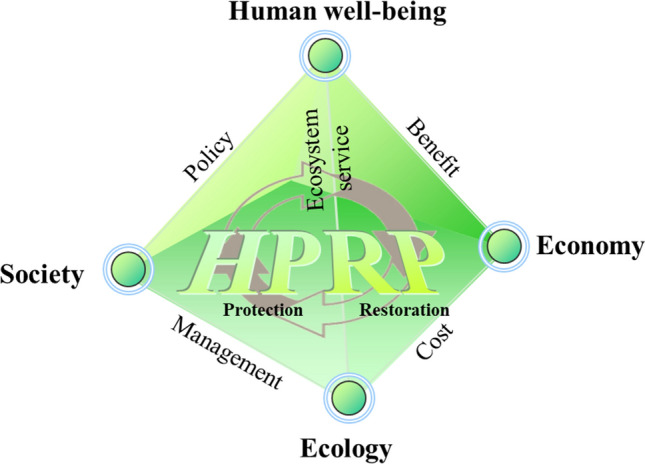
The four aspects and coupling mechanism of the management system of the IPRP
Scientific connotations of the IPRP
Implementation of the IPRP should consider the complexity of ecosystems, the interactions between different ecosystems, the holistic characteristics of LC, and the integrity of natural geographical units at watershed scale. In terms of spatial implication of LC, mountains and water are closely related while forest, farmlands, and grasslands have a close connection. Forests, farmlands, and grasslands do not overlap with each other, but they are all dependent on mountains and water and form a community of life together with human beings. In terms of ecosystem processes, LC reflects the coupling mechanism among different ecosystem elements (Li et al. 2018). In terms of landscape pattern, mountains belong to the geomorphological factors and water is an ecological factor, while forests, farmlands, lakes, and grasslands belong to different ecosystem types and farmlands embody the human utilization and management. Thus, the IPRP project emphasizes the importance of maintaining a healthy ecosystem for sustainable development and reflects the interdependence between humans and nature. From the perspective of space and time, the IPRP project is based on landscape ecology principles, which recognizes that ecological processes and functions operate at multiple scales and are influenced by both natural and human factors. The importance of landscape patterns and their spatial relationships as well as the ecological processes was emphasized. Also, it recognizes the importance of ecosystem services, such as water and air purification, carbon sequestration, and biodiversity conservation, in supporting human well-being (Li et al. 2018). Forest, field, lake, and grassland can provide ecosystem services to human society and mountain and water are the carrier and lifeline of forest, field, lake and grass supporting the ecosystems which can also be defined as landscape units (Fig. 4). The IPRP needs to consider the landscape integrity as the quantity, composition, quality, and spatial configuration of landscape elements directly determine the prosperity, health, and sustainability of the LC (Wu et al. 2018). The IPRP region is a complex blend of a human-oriented socioeconomic system and natural resources, including mountains, rivers, forests, farmlands, lakes, and grasslands (Li et al. 2018). Humans are both have negative effects on nature as the consumers of natural resources and positive effect as the implementer of ecological protection and restoration projects, so the role of humans in the IPRP should be given considerable attention.
Fig. 4.

The interactions between human and different elements of LC
Progresses of ecological restoration projects in China
In the past 20 years, a large number of major projects have implemented for the protection and restoration of important ecosystems in China, such as natural forest resource protection, returning cultivated land to forest and grassland, returning grazing land to grassland, shelterbelt construction, wetland protection and restoration, wind and sand source restoration of Beijing-Tianjin, prevention and control of desertification, soil and water conservation, rock desertification control, and so on (Wang et al. 2020).
Land space management and biodiversity conservation
China has initially established a policy system of land ecological space management and control, focusing on nature reserve establishment and “ecological protection red lines” delineation, supplemented by other key ecological functional regions. The policies are to regulate various resource development and construction activities such as road construction, mining activities, and strictly protect important ecological spaces. The skeleton of the national ecological security pattern has been basically established across China. In 2014, the Ministry of Environmental Protection issued the “National Ecological Protection Red Line—the Technical Guidelines for the Delineation of Ecological Function Baselines (Trial version)” (Huang and Yang 2016). The national land spatial planning has also included the achievements of ecological protection red line delineation, incorporating all extremely important ecological function regions such as nature reserves and ecologically sensitive and fragile areas such as glaciers and alpine grasslands. The territorial area of the ecological protection red line accounts for more than 30% of the land area (Zhang et al. 2017). China continues to promote the nature reserve system construction with national parks as the main body and has carried out 10 new pilot national park construction since 2015. Since 2020, the integration and optimization of current nature reserves and further adjustment of ecological protection red lines have also been implemented. Now, the area of nature reserves has accounted for about 17% of the land area. Overall, 90% of terrestrial ecosystem types, 85% of wildlife populations, and 65% of higher plant species in China are included in the protected areas (Gao et al. 2021).
Effectiveness of ecological protection and restoration and progresses of the IPRP
In the past 10 years, the forest area is about 230, and the forest accumulation volume is 19.493 billion cubic meters in China. The area of plantation forest is 87.6 million hectares, which ranks the first in the world, and the area of grassland is about 265 million hectares, ranking the second. In total, the carbon stock of forest and grass in China is 11.443 billion tons. The afforestation progress has significantly accelerated in the past 10 years, and forest resources have been expanded in area and improved in quality and efficiency with the forest coverage increasing from 21.63 to 24.02%. Restoration projects emphasize on the quantity and quality of afforestation, and 64 million hectares of afforestation and 82.7 million hectares of forest conservation were completed in the past ten years. The achievements of the new round of “returning farmland to forest and grassland” are further consolidated, with a total of 34.7 million hectares of returned farmland, accounting for about 40% of the reforestation area in the same period. The forest coverage in the project area has increased by more than 4 percentage points. Also, the fifth phase of the construction project of the “Three North Protection Forest System” has been fully completed, and more than 5.27 million hectares of forest construction has been completed. In the “Three North” (Northwest, North and Northeast of China) region, more than 45% of the treatable sandy land has been initially restored, more than 61% of the soil erosion area has been effectively controlled, and more than 45% of the agricultural and pastoral area has been protected by artificial protection forest networks (Xinhuanet 2022).
China has implemented grassland ecological restoration projects, such as the return of grazing to grassland, and has completed about 34.3 million hectares of ecological restoration through artificial grassland restoration, degraded grassland improvement and fencing. The overload rate of livestock in key natural grasslands has been significantly reduced by a grassland grazing ban, grass-livestock balance, and compensation policy. Until April in 2021, the grassland vegetation cover nationwide reached 56.1% with total grassland area of about 265 million hectares and designated basic grassland area of about 247 million hectares, increasing by approximately 5% from 2011 (Xinhuanet 2022).
During the “13th Five-Year Plan” period in China, more than 200 thousands hectares of wetlands were added, reaching a total of about 56.7 million hectares in China. The wetland protection and restoration projects have been greatly promoted with more than 3400 projects being implemented in the past ten years. At present, the wetland protection system with national parks, wetland nature reserves, and wetland parks as the main body has been established, and the wetland protection percentage has reached more than 52%. China has designated 64 wetlands of international importance, 29 wetlands of national importance, and 1011 wetlands of provincial importance and established 901 national wetland parks (Gao et al. 2021).
In the past 10 years, great efforts have been made to combat sandy desertification and completed a total area of 18.5 million hectares of prevention and control of desertification projects. The area of sandy land closure and protection reached 1.77 million hectares and achieved the goal of zero growth in land degradation ahead of the schedule of 2030. In total, 41 comprehensive demonstration zones for sand prevention and control and 128 national desert (stone desert) parks have been established, and currently, the control rate of treatable sandy land has reached 53.1% (Wang et al. 2021).
Since 2016, China has gradually implemented three batches of 25 pilot projects in 24 provinces (including autonomous regions and municipalities) (Table 2; Fig. 5) and launched two batches of 19 IPRP in 2021 and 2022. By the end of 2021, the pilot projects have completed a total of ecological protection and restoration area of about 2 million hectares (land integrated consolidation: 180 000 hectares, mine ecological restoration: 50 000 hectares, watershed environmental governance: 110 000 hectares, polluted and degraded land restoration: 290 000 hectares, forest and grassland restoration: 220 000 hectares, biodiversity conservation and restoration: 510 000 hectares, coastline restoration: 1500 km, and coastal wetlands: 30 000 hectares) (Wu et al. 2019).
Table 2.
List of the implemented IPRP in China (Wu et al. 2019)
| Batch | Project location (Province) |
|---|---|
| The first batch | Liaohe River Basin (Liaoning), Wuling Mountains Region (Guizhou), Middle and Upper Han River in Nanling Mountains (Guangdong), Horqin Grassland (Inner Mongolia), Jiulong River Basin (Fujian), Oujiang River Headwaters Region (Zhejiang), Chaohu Lake Basin (Anwei), Yimeng Mountains Region (Shandong), Tarim River Important Headwaters Region (Xinjiang), Upper Yellow River Water Conservation Area in Gannan (Gansu) |
| The second batch | Luo River Basin in the eastern part of the Qinling Mountains (Henan), Erhai Basin (Yunnan), Jing River and Hong Lake of the Yangtze River (Hubei), Li River Basin of Guilin (Guangxi), Ruoerge Grassland Wetland in the upper reaches of the Yellow River (Sichuan), Hinterland of the Three Gorges Reservoir Area (Chongqing), Lake Network Area of the South-North Water Diversion East Line (Jiangsu), Main Body of the Northern Qinling Mountains (Shaanxi), Dongting Lake Region of the Yangtze River Economic Belt Key Ecological Zone (Hunan) |
| Pilot first batch | Loess Plateau (Shaanxi), Ganzhou City (Jiangxi), Beijing-Tianjin-Hebei Water Containment Area (Hebei), Qilian Mountains (Heihe River Basin) (Gansu), Qilian Mountains (Qinghai) |
| The second batch of the pilot | Fuxian Lake Basin (Yunnan), Minjiang River Basin (Fujian), Zuoyou River Basin (Guangxi), Taishan Region (Shandong), Changbai Mountains (Jilin), Huayin Mountain Region in Guang'an (Sichuan) |
| The third batch of the pilot | Wuliangsuhai Basin (Inner Mongolia), Xiong'an New Area (Hebei), Irtysh River Basin (Xinjiang), Middle and Upper Fen River Basin (Shanxi), Xiaoxing’an mountain-Three Rivers Plain (Heilongjiang), Upper Yangtze River Ecological barrier (Chongqing), North Guangdong Nanling Mountains (Guangdong), Three Gorges Region (Hubei), Xiangjiang River Basin and Dongting Lake (Hunan), Qiantang River Headwaters Region (Zhejiang), East side of Helan Mountains (Ningxia), Wumeng Mountains (Guizhou), Lhasa River Basin (Tibet), South Taihang Region (Henan) |
Fig. 5.

Distribution of the implemented IPR in China
Problems of ecological protection and restoration
In recent years, the theoretical and methodological system of ecological protection and restoration of national land space in China have been greatly improved, and a lot of exploration and practices have been implemented from the central governmental level to local governmental level, but some problems still exist as follows:
Management policy problems
Although the division of responsibilities for ecological protection and restoration in China has been rationalized and the policy system has been gradually improved, the integrated ecological protection and restoration mechanism have not yet been fully established. The responsibilities for ecological protection and restoration are still scattered in three or even more departments. Such practice easily leads to such phenomena as fragmented planning, scattered funding, fragmented projects, and fragmented tasks (Hu et al. 2022). In addition, a unified ecological survey, monitoring and evaluation system needs to be established for the ecological restoration projects, as most of the ecological background data for the project areas is still lacking or inconsistent. Therefore, in terms of management system, the IPRP still needs to improve the integrated governance, consistent policy, powerful implementation, and effective feedback (Fu 2021). Also, the overall spatial layout of the IPRP across China has been an issue with regard to ensuring regional balance between different provinces. It is important to further consider the spatial distribution of ecologically degraded areas, the identification of priority areas for ecological restoration, and the effectiveness of project implementation. Although China has made great achievements in marine ecological protection and restoration and has implemented many projects, including coastal wetland restoration, mangrove protection, shoreline rehabilitation, and island protection, these projects have not yet been included in the IPRP system. Thus, more restoration efforts should be made in the land and sea coordination and policy-making.
Scientific problems of implementation
At present, the scientific and technological support for the IPRP still remains mostly at the conceptual level. On the whole, the overall and systematic layout of the project is seriously inadequate, and some projects focus too much on engineering measures, lacking NbS concept. As a result, the rigid management mode of the project is not adapted to the ecological succession law, and the coordination of short-term benefits and long-term sustainability is not adequate. In addition, there is a lack of assessment methods and standard specifications for restoration effectiveness after project implementation, and lack of sufficient technical support for subsequent adaptive management and stability maintenance. For sustainability studies, the cost–benefit analysis should be further improved. The invest ratio of natural restoration to artificial restoration should be taken as an important basis for adaptive management (Hou et al. 2021; Yang et al. 2021).
At different spatial and temporal scales, the relationships that occur among restoration patterns, ecological processes, and ecosystem services are not clear. The structure and function of the LC under different restoration measures needs to be further studied. The restoration priority and sequence of restoration projects need to be further clarified (Wang and Zhong 2019).
In addition, the implemented restoration projects are still disconnected from socioeconomic development goals, lacking the effective strategies to improving ecosystem service. Many restoration projects have a single capital invest, rely excessively on financial inputs, and even have repeated investment. Because of the lack of incentive policies and measures, it is necessary to further use policy and economic levers to attract social capital investment and establish the market mechanism for ecological protection and restoration. The market mechanism is to share the responsibility of ecological management and the results of management and to realize positive mutual feedback between ecological protection and economic development (Fu 2021).
Engineering problems of practices
At present, some implemented restoration projects still neglects natural conditions such as water-carrying capacity, land resource limitation, and the implementation of NbS or rewilding concept is not enough (Yang and Cao2019; Yang et al. 2021). Generally, the restoration approaches are relatively single with “patchwork” projects, for example, some restoration sites are totally spatially irrelevant, some restoration measures are independent with inconsistent restoration goals. In terms of orientation, the evaluation and performance assessment indicators of the IPRP are not comprehensive and focus on budget execution rate and project quantity, which are not systematic and scientific enough (Wang and Yang 2022).
In practice, the main problems of implemented projects include over-restoration, too much emphasis on manual intervention measures, and quantitative indicators of restoration. The ecological restoration often neglects ecological succession stages and regional characteristics. In addition, short-term effects are usually emphasized, while later maintenance is neglected. The self-regulating ability and maintenance mechanism of the ecosystem are not yet established. Some projects adopt fast-growing plants or even exotic species in order to quickly meet the quantitative assessment indicators. Also, the implemented projects lacked a rational multifunctional targets and consideration of time scale, especially for biodiversity and ecosystem integrity (Fu 2019).
Future prospects
In future, the IPRP projects need to establish an integrated management mode to improve the self-restoration capacity and ecological stability, fully implementing the basic concept of " lucid waters and lush mountains are invaluable assets" and adhering to the governance strategy of LC. To increase the overall quality of natural ecosystems and build the ecological foundation of “Beautiful China,” it is necessary to promote related work in terms of institutional mechanisms, basic theories, and technical support (MEE 2018) (Fig. 6).
Fig. 6.

Supporting system for the IPRP projects
First, it is necessary to take important ecological space control as a priority initiative and implement the most stringent environmental assess control system, fully realizing the zoning control scheme and environmental assess permit list system. Also, the transfer payment system for key ecological functional areas should be further improved. For the restoration projects in the national key regions, the supervision of whole project process and comprehensive performance evaluation should be carried out. The government should establish a multi-departmental, multi-level, and cross-regional synergistic promotion mechanism and strengthen the synergy and information sharing between departments and regions to improve the quality and efficiency of the IPRP projects (Liu et al. 2019).
Second, it is necessary to strengthen the NbS policy, solidify the modes of ecological measures, and scientifically configure different project types according to local conditions and ecological carrying capacity. It is better to introduce international concepts, such as “rewilding” and “wilderness protection,” and IUCN guidelines for ecological restoration in China (Luo et al. 2021). For example, rewilding concepts intend to enhance core areas and connectivity of wilderness regions and conserve and reintroduce keystone species (including large carnivores). The success in IPRP project should consider the availability of suitable habitat and the presence of appropriate species to populate the area (Yang and Cao 2019). In addition, it is necessary to further study the theories, methods, techniques, standards, and models of the IPRP projects to solve the contradiction between intensive human activities and nature conservation. The assessment of the IPRP projects should utilize the indicator species, structural and functional indexes, patterns and processes, ecosystem health, ecological risks, ecological vulnerability and stability, and ecosystem service methods at different scales to carry out a comprehensive evaluation (Zhang et al. 2016). According to the regional resource endowment, economic development level, restoration cost, and roadmap of the IPRP can be formulated according to the “one life community, one policy” strategy.
Third, the national big data platform of biodiversity conservation should be established to promote the information sharing and management applications and to improve ecosystem quality and stability, focusing on biodiversity conservation in key regions. Furthermore, biodiversity conservation network covering the national territory needs to be established to gradually restore the integrity and connectivity of important species habitats (Luo et al. 2021). Aiming to enhance the ecosystem services and human well-being, urban and rural ecological corridors should be greatly improved and green ecological space should be expanded to improve the ecological quality of urban and rural settlement (Wang et al. 2018).
Fourth, modern techniques such as remote sensing and big data should be applied to consolidate basic data support, which can provide the basis for IPRP projects. The dynamic and whole cycle-monitoring system is important to carry out “pre-status assessment, process performance evaluation, and post-management assessment” (Wang et al. 2018). It is useful to strengthen the comprehensive effectiveness assessment and evaluation, coordinate the short-term and long-term ecosystem benefits and social benefits, and incorporate them into the evaluation and assessment of local ecological civilization construction goals. The multi-level, long-term, and dynamic real-time ecosystem monitoring and tracking documents of the projects are necessary to accurately evaluate the restoration effect (Zhang et al. 2019a, b).
Fifth, ecological restoration needs to further play more and more important role of the market to solve the contradiction between ecological protection and economic development. On the one hand, it is to solve the problem of capital investment by diversified financing and exploration to guide more participation of social capital (Zhang et al. 2019a, b). In China, the Eco-environment-oriented Development (EOD) policy is becoming a new mode for ecological management, which promotes the profits of local special industry to support the ecological restoration to integrate economic development with environmental protection (Zhao et al. 2022).
On the other hand, it is necessary to further explore the value realization mechanism of ecological products, such as the establishment of a regional ecological economic development mode, a sound and diversified property right system for natural resource assets, a market-oriented horizontal ecological compensation mechanism and a green financial system. The IPRP projects should be guided by the construction of ecological civilization demonstration sites to form a whole chain of special industries from products to industries, thus promoting green and high-quality development and increasing the sustainability of the projects (Wang et al. 2020).
Acknowledgements
This work was written and directed by Shiliang Liu. Other authors also contributed to this work by providing suggestions, participating in discussions, and proofreading the manuscript. Also, we want to thank the anonymous reviewers’ and Associate editor for their constructive criticism. The author(s) disclosed the receipt of the following financial support for the research, authorship, and/or publication of this article: The work was supported by National Key Research and Development Project (No. 2022YFF1303204), National Natural Sciences Fund Project (No. 42271097), and the Second Scientific Expedition to the Qinghai-Tibet Plateau (No. 2019QZKK0405-05).
Biographies
Shiliang Liu
is a professor at the School of Environment of Beijing Normal University. His research interests include landscape ecology, restoration ecology, environmental impact assessment, and planning.
Yuhong Dong
is an associate professor at the Chinese Academy of Forestry. Her research interests include landscape ecology and ecosystem services.
Kim R. McConkey
is a professor at the University of Nottingham, Malaysia. Her research interests include biodiversity conservation, ecology, and evolution and climate change.
Lam-Son Phan Tran
is a professor at the Department of Plant and Soil Science, Texas Tech University. His research interests include regulatory networks and crosstalk among signaling molecules in plant responses to environmental stresses.
Fangfang Wang
is a PhD student in progress at the School of Environment of Beijing Normal University. Her research interests are nitrogen flow and its environmental effects.
Hua Liu
is a PhD student in progress at the School of Environment of Beijing Normal University. Her research interests are landscape ecology and ecosystem services.
Gang Wu
is a professor at the Research Center for Eco-Environmental Sciences, Chinese Academy of Sciences. His research interests include ecology, environmental economics, and environmental management.
Declarations
Conflict of interest
We declare that we have no conflict of interest.
Footnotes
Publisher's Note
Springer Nature remains neutral with regard to jurisdictional claims in published maps and institutional affiliations.
References
- Fu BJ. Land resource system cognition and land ecological security pattern. China Land. 2019;12:9–11. doi: 10.13816/j.cnki.ISSN1002-9729.2019.12.03. [DOI] [Google Scholar]
- Fu BJ. Several key points in territorial ecological restoration. Bulletin of the Chinese Academy of Sciences. 2021;36:64–69. doi: 10.16418/j.issn.1000-3045.20201222001. [DOI] [Google Scholar]
- Gao JX, Liu XM, Wang C, Wang Y, Fu Z, Hou P, Lv N. Evaluating changes in ecological land and effect of protecting important ecological spaces in China. Acta Geographica Sinica. 2021;7:1708–1721. doi: 10.11821/dlxb202107010. [DOI] [Google Scholar]
- Gu SZ, Xie SZ. Innovation on agricultural resources and regional planning based on the perspective of construction of ecological civilization. Chinese Journal of Agricultural Resources and Regional Planning. 2013;1:5–12. doi: 10.7621/cjarrp.1005-9121.20130102. [DOI] [Google Scholar]
- Guan YJ, Liu JG, Cui WH, Jia JL. Progress in bibliometrics of ecological restoration in China. Acta Ecological Sinica. 2022;42:5125–5135. [Google Scholar]
- Hou P, Gao JX, Wan HW. Progress and some scientific issues on effectiveness assessment of terrestrial ecosystem conservation and restoration. Environmental Ecology. 2021;3:1–7. [Google Scholar]
- Hu CM, Wang SF, Zheng JY, You L, Zheng YK. Application of the mountains-revivers-forestes-lakes-grasses in the design of ecological engineering. Sichuan Environment. 2022;41:44–48. doi: 10.14034/j.cnki.schj.2022.03.007. [DOI] [Google Scholar]
- Huang XJ, Yang DY. Orderly ecological system for mountains, rivers, forest, farmland and lakes, and innovation path of purpose regulation of natural resources. Shanghai Land and Resources. 2016;37:1–4. doi: 10.3969/j.issn.2095-1329.2016.03.001. [DOI] [Google Scholar]
- Kong DK, Xiao M. Constructing the endogenous mechanism of ecological protection and restoration of ‘mountains, water, forests, fields, lakes and grass’. Land and Resources Information. 2018;5:22–29. [Google Scholar]
- Li DJ, Zhang SH, Liu B, Zhang HQ, Wang HM, Yan FM, Wang HM. The connotation, problems and innovation of life community of mountains, rivers, forests, farmlands, lakes, grasslands and human. Chinese Journal of Agricultural Resources and Regional Planning. 2018;11:93. doi: 10.7621/cjarrp.1005-9121.20181101. [DOI] [Google Scholar]
- Liu SL, Dong YH, Sun YX, Shi FN. Priority area of mountains-rivers-forests-farmlands based on the improvement of ecosystem services: A case study of Guizhou Province. Acta Ecologica Sinica. 2019;39:8957–8965. doi: 10.5846/stxb201905301140. [DOI] [Google Scholar]
- Lu JX. From “Unity of Nature and Man” to “Clear water and Green Mountains”: The development course of Chinese ecological view. People’s Tribune. 2022;8:120–122. [Google Scholar]
- Luo M, Yu EY, Zhou Y, Ying LX, Wang J, Wu G. Distribution and technical strategies of ecological protection and restoration projects for mountains-rivers-forests-farmlands-lakes-grasslands”. Acta Ecologica Sinica. 2019;23:8692–8701. doi: 10.5846/stxb201905291108. [DOI] [Google Scholar]
- Luo M, Zhang Y, Zhang H. Application of nature-based solutions in project guide for ecological protection and restoration of mountains, forests, fields, lakes and grass. China Land. 2020;10:14–17. doi: 10.13816/j.cnki.ISSN1002-9729.2020.10.05. [DOI] [Google Scholar]
- Luo M, Liu SL, Zhang Y. A preliminary study on priority areas of Nature-based solutions (NbS) China Land. 2021;2:4–11. doi: 10.13816/j.cnki.ISSN1002-9729.2021.02.02. [DOI] [Google Scholar]
- Ma GX, Yu F, Wang JN. Measuring gross ecosystem product (GEP) OF 2015 for terrestrial ecosystems in China. China Environmental Science. 2017;37:1474–1482. [Google Scholar]
- The Ministry of Ecology and Environment (MEE). 2018 Opinions on Further Deepening the Reform of Streamlining Administration, Delegating Power, Strengthening Regulation and Improving Services in the Field of Ecology and Environment, and Promoting High-Quality Economic Development. https://www.mee.gov.cn/gkml/sthjbgw/sthjbwj/201808/t20180831457389.htm (accessed May 23, 2021).
- The Ministry of Finance (MOF), the Ministry of Land and Resources (MLR), and the Ministry of Ecology and Environment (MEE). 2016 Notice on promoting the ecological protection and restoration of mountains, rivers, forests, farmlands and lakes. http://www.gov.cn/xinwen/2016-10/09/content5116335.htm (accessed October 22, 2022).
- Wang J, Yang ZY. Controversy and reflections on natural solutions. China Land. 2022;2:21–23. doi: 10.13816/j.cnki.ISSN1002-9729.2022.02.07. [DOI] [Google Scholar]
- Wang J, Zhong LN. Application of ecosystem service theory for ecological protection and restoration of mountain-river-forest-field-lake-grassland. Acta Ecologica Sinica. 2019;23:8702–8708. doi: 10.5846/stxb201905291110. [DOI] [Google Scholar]
- Wang JN, Su JQ, Wan J. An analysis of the theory of “lucid waters and lush mountains are invaluable assets” and its innovative development mechanism. Environmental Protection. 2017;45:13–17. doi: 10.14026/j.cnki.0253-9705.2017.11.002. [DOI] [Google Scholar]
- Wang XH, He J, Sheng R, Jiang HQ. Design of implementation path of ecological engineering for ecological protection and restoration of multi ecological elements. Environmental Protection. 2018;46:17–20. doi: 10.14026/j.cnki.0253-9705.2018.z1.003. [DOI] [Google Scholar]
- Wang XH, Jun HE, Wang B, Zhang Xiao. Thoughts and practice of ecological protection and restoration of mountains, rivers, forests, farmlands, lakes and grasslands. Journal of Landscape Research. 2020;12:5–8. doi: 10.16785/j.issn1943-989x.2020.3.002. [DOI] [Google Scholar]
- Wang XH, He J, Mou XJ. 20 Years of ecological protection and restoration in China: Review and prospect. Chinese Journal of Environmental Management. 2021;5:85–92. doi: 10.16868/j.cnki.1674-6252.2021.05.085. [DOI] [Google Scholar]
- Wu ND, Wu Q, Liu DX. Systemic governance: Adhering to the concept that mountains, rivers, forests, farmlands, lakes and grasslands are a community of shared life. Water Resources Development Research. 2018;9:25–32. doi: 10.13928/j.cnki.wrdr.2018.09.004. [DOI] [Google Scholar]
- Wu G, Zhao M, Wang CX. Research on the theoretical support system of ecological protection and restoration of full-array ecosystems. Acta Ecologica Sinica. 2019;39:8685–8691. doi: 10.5846/stxb201911212525. [DOI] [Google Scholar]
- Xinhuanet. China in this decade series of themed news release China’s forest and grass construction has delivered excellent ecological results since the 18th CPC National Congress. http://www.xinhuanet.com/2022-09/19/c_1129014148.htm.
- Yang R, Cao Y. Rewilding: New ideas for ecological protection and restoration projects of mountains-rivers-forests-farmlands-lakes-grasslands. Acta Ecologica Sinica. 2019;39:8763–8770. doi: 10.5846/stxb201907301612. [DOI] [Google Scholar]
- Yang CY, Zhou Y, Chen Y, Wang LW. Ecosystem conservation and restoration through Nature-based Solutions. Earth Science Frontiers. 2021;28:25–34. doi: 10.13745/j.esf.sf.2020.10.3. [DOI] [Google Scholar]
- Zhang ZF. Sustainable land use goals, challenges and countermeasures in China for SDGs. China Land Science. 2019;33:48–55. doi: 10.11994/zgtdkx.20191010.140058. [DOI] [Google Scholar]
- Zhang K, Lv YH, Fu BJ. Ecosystem services evolution in ecological restoration: Trend, process, and evaluation. Acta Ecologica Sinica. 2016;36:6337–6344. doi: 10.5846/stxb201504030668. [DOI] [Google Scholar]
- Zhang X, Rao S, He J. Policy framework and suggestions for the management of ecological protection redlines. Environment Protection. 2017;45:43–46. doi: 10.14026/j.cnki.0253-9705.2017.23.010. [DOI] [Google Scholar]
- Zhang HY, Li JH, Gou MM, Hao HG. Expand fund channel and innovate management system-Ganzhou solves the difficult problem of ecological protection and restoration and economic and social development. China Ecological Civilization. 2019;1:76–79. [Google Scholar]
- Zhang HY, Li YY, Feng DY, Hao HG. Clarifying the content standard and strengthening the implementation supervision-exploring the path of ecological protection and restoration of mountains, rives, forests, fields, lakes and grass. China Ecological Civilization. 2019;1:66–69. [Google Scholar]
- Zhang JJ, Guo YQ, Rao YH, Wang YB, Wang K. Philosophical thoughts of territorial ecological restoration. China Land Science. 2020;34:27–32. doi: 10.11994/zgtdkx.20200511.134907. [DOI] [Google Scholar]
- Zhao YH, Xu ZJ, Xin L. Research on the marketization path of ecological product value based on the national EOD model pilot practice. Ecological Economy. 2022;7:160–166. [Google Scholar]
- Zhong YX, Shao HY, Xu CL, Feng XH. The research progress and prospect of life community of mountain, river, forest, farmland, lake and grassland in watershed based on bibliometric analysis. Journal of Jiangxi Normal University (natural Science Edition) 2020;1:95–101. doi: 10.16357/j.cnki.issn1000-5862.2020.01.16. [DOI] [Google Scholar]
- Zou CX, Wang Y, Wang WL, Xu DL, Lin NF, Li WJ. Theory of mountain-river-forest-lake-grass system and ecological protection and restoration research. Journal of Ecology and Rural Environment. 2018;34:961–967. doi: 10.11934/j.issn.1673-4831.2018.11.001. [DOI] [Google Scholar]