



Abstract
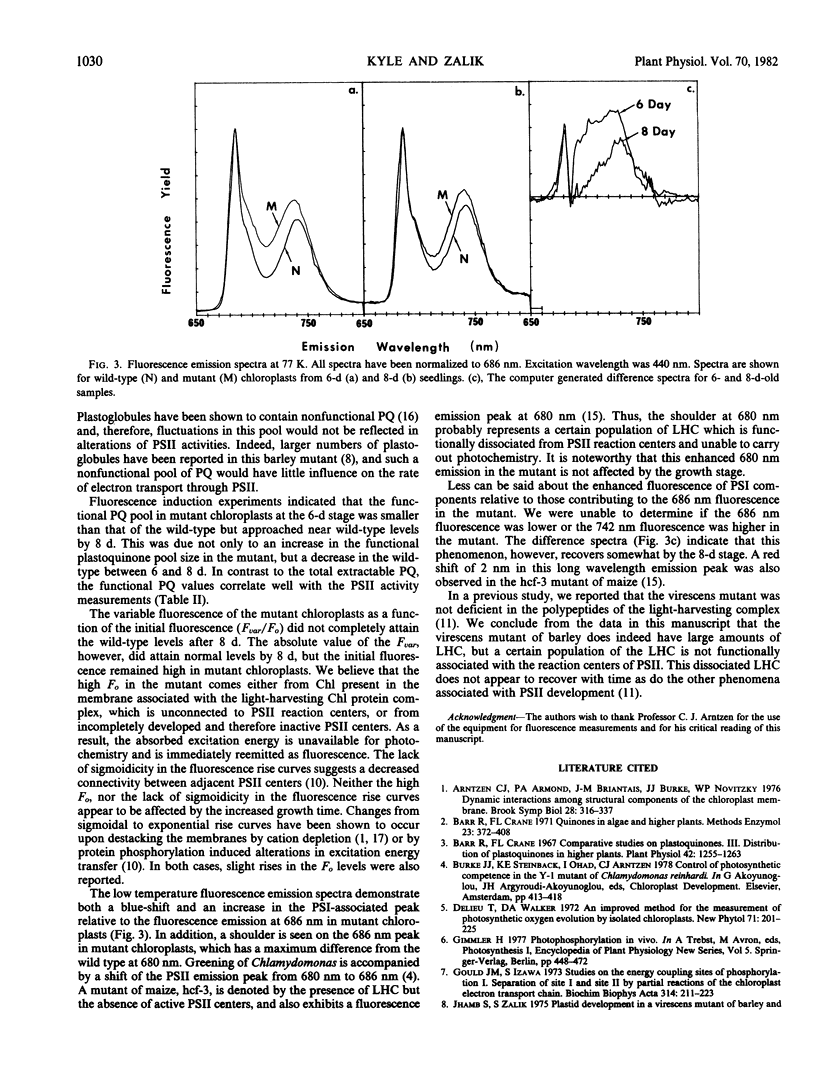
Chloroplasts isolated from seedlings of a virescens mutant of barley (Hordeum vulgare L cv Gateway) grown for 6 days under continuous illumination had lower levels of photosystem II activities on a chlorophyll basis than wild-type seedlings. After 8 days, however, the photosystem II rates of the mutant and wild-type were approximately equal. Lower levels of the photosystem II activities in the mutant were correlated with a smaller functional plastoquinone pool size as determined by room temperature fluorescence induction. Higher levels of extractable plastoquinone A on a chlorophyll basis, however, were obtained from mutant chloroplasts. An increased room temperature fluorescence yield in the mutant was shown to be due to a higher level of initial fluorescence. A decreased sigmoidicity in the room temperature fluorescence induction transient in the presence of diuron and an increased 77 K fluorescence emission at 680 nanometers lead us to believe that a certain population of the light harvesting chlorophyll protein complex in the mutant membranes is unconnected to photo-system II reaction centers. Although photochemical activities of the mutant approach wild-type values as the mutant develops, the population of dissociated light harvesting complexes does not appear to change.
Full text
PDF



Selected References
These references are in PubMed. This may not be the complete list of references from this article.
- Barr R., Crane F. L. Comparative Studies on Plastoquinones. III. Distribution of Plastoquinones in Higher Plants. Plant Physiol. 1967 Sep;42(9):1255–1263. doi: 10.1104/pp.42.9.1255. [DOI] [PMC free article] [PubMed] [Google Scholar]
- Gould J. M., Izawa S. Studies on the energy coupling sites of photophosphorylation. I. Separation of site I and site II by partial reactions of the chloroplast electron transport chain. Biochim Biophys Acta. 1973 Aug 31;314(2):211–223. doi: 10.1016/0005-2728(73)90136-9. [DOI] [PubMed] [Google Scholar]
- Kelley P. M., Izawa S. The role of chloride ion in photosystem II. I. Effects of chloride ion on photosystem II electron transport and on hydroxylamine inhibition. Biochim Biophys Acta. 1978 May 10;502(2):198–210. doi: 10.1016/0005-2728(78)90042-7. [DOI] [PubMed] [Google Scholar]
- Kyle D. J., Zalik S. Development of photochemical activity in relation to pigment and membrane protein accumulation in chloroplasts of barley and its virescens mutant. Plant Physiol. 1982 Jun;69(6):1392–1400. doi: 10.1104/pp.69.6.1392. [DOI] [PMC free article] [PubMed] [Google Scholar]
- Leese B. M., Leech R. M. Sequential changes in the lipids of developing proplastids isolated from green maize leaves. Plant Physiol. 1976 May;57(5):789–794. doi: 10.1104/pp.57.5.789. [DOI] [PMC free article] [PubMed] [Google Scholar]
- Melis A., Homann P. H. A selective effect of Mg2+ on the photochemistry at one type of reaction center in photosystem II of chloroplasts. Arch Biochem Biophys. 1978 Oct;190(2):523–530. doi: 10.1016/0003-9861(78)90306-5. [DOI] [PubMed] [Google Scholar]
- Strasser R. J., Butler W. L. Fluorescence emission spectra of photosystem I, photosystem II and the light-harvesting chlorophyll a/b complex of higher plants. Biochim Biophys Acta. 1977 Nov 17;462(2):307–313. doi: 10.1016/0005-2728(77)90129-3. [DOI] [PubMed] [Google Scholar]
- Sun E., Barr R., Crane F. L. Comparative Studies on Plastoquinones. IV. Plastoquinones in Algae. Plant Physiol. 1968 Dec;43(12):1935–1940. doi: 10.1104/pp.43.12.1935. [DOI] [PMC free article] [PubMed] [Google Scholar]
- Thomson L. W., Zalik S. Acyl lipids, pigments, and gramine in developing leaves of barley and its virescens mutant. Plant Physiol. 1981 Apr;67(4):646–654. doi: 10.1104/pp.67.4.646. [DOI] [PMC free article] [PubMed] [Google Scholar]
- Vernon L. P. Diphenylcarbazone: a reagent for photosystem 1 activity in chloroplast fragments. Plant Physiol. 1972 May;49(5):862–863. doi: 10.1104/pp.49.5.862. [DOI] [PMC free article] [PubMed] [Google Scholar]