



Abstract
Background
A prospective study was extended to the new antiretroviral and monitoring strategies in HIV-infected adults in low-income countries (NAMSAL-ANRS)-12313 trial, a 96-week open-label, multicenter, randomized phase 3 trial comparing dolutegravir (DTG) 50 mg with efavirenz 400 mg (EFV400), both administered with tenofovir disoproxil fumarate and lamivudine (TDF/3TC) as first-line treatment for antiretroviral therapy (ART)–naive people living with human immunodeficiency virus type 1 (HIV). Noninferiority of DTG to EFV400 was demonstrated at 48-week and sustained at 96 weeks. Here, we present results at 192-week.
Methods
Previous trial participants were reconsented and followed up on their initial randomization arm (1:1 DTG/TDF/3TC:EFV400/TDF/3TC). Assessments included changes in viral suppression, biological parameters, and new serious adverse events (SAEs).
Results
Among the participants enrolled in the trial, 81% (499/613) were analyzed at week 192: 84% (261/310) on DTG/TDF/3TC and 78% (238/303) on EFV400/TDF/3TC. HIV RNA suppression was maintained in 69% (214/310) on DTG/TDF/3TC-based and 62% (187/303) on EFV400/TDF/3TC-based regimens (difference, 7.3% [95% confidence interval, −.20 to 14.83]; P = .057). Five (DTG/TDF/3TC = 2; EFV400/TDF/3TC = 3) new viral failures (World Health Organization definition) without related resistance DTG mutations and 24 new SAEs were observed (DTG/TDF/3TC = 13; EFV400/TDF/3TC = 11). Mean weight gain was +9.4 kg on DTG/TDF/3TC and +5.9 kg on EFV400/TDF/3TC. The percentage of participants with obesity increased from 6.9% to 27.7% on DTG/TDF/3TC (P < .0001) and from 8.3% to 16.7% on EFV400/TDF/3TC (P = .0033).
Conclusions
Four-year follow-up of people with HIV on DTG- and EFV400-based regimens showed long-term efficacy and safety of both ARTs, markedly among participants on DTG/TDF/3TC with high baseline viral load. However, unexpected substantial weight gain over time was prominent among participants on DTG/TDF/3TC, which should be closely monitored.
Clinical Trials Registration. NCT02777229.
Keywords: dolutegravir, efficacy-durability, HIV-1, low-dose-efavirenz, weight gain
Initiation of first-line antiretroviral therapy (ART) for people with human immunodeficiency virus type 1 (HIV) has been widely discussed, notably in order to make innovative therapeutic strategies accessible worldwide [1, 2]. The latest international standards [3] recommend dolutegravir (DTG) 50 mg, a robust integrase strand transfer inhibitor with a high barrier to resistance [4], as once-daily, fixed-dose, preconception and pregnancy-safe ART as preferred first-line therapy in ART-naive adults [5, 6]. The World Health Organization (WHO)–recommended alternative is a reduced dose (400 mg) of efavirenz (EFV400) [7, 8], a nonnucleoside reverse transcriptase inhibitor better tolerated at low dose; the 600-mg dose (EFV600) remains largely used in case of tuberculosis coinfection.
The New Antiretroviral and Monitoring Strategies in HIV-infected Adults in Low-income countries (NAMSAL-ANRS)-12313 trial was designed to evaluate the efficacy and safety of DTG in comparison to EFV400, both combined with tenofovir disoproxil fumarate (TDF) and lamivudine (3TC), as first-line ART for adults with HIV in low- and middle-income countries (LMICs). Although both of these therapies have previously shown efficacy and safety over 48 weeks [9, 10] and 96 weeks [11, 12] in real-life conditions in LMICs, some findings were highlighted: (1) Participants with HIV with baseline high viral load (VL) had impaired viral suppression, including people on DTG/TDF/3TC, although the latter had achieved undetectability faster than participants randomized to EFV400/TDF/3TC; (2) the retrospective analysis of drug resistance mutations at baseline showed a low prevalence of primary resistance to nucleoside reverse transcriptase inhibitors; (3) the DTG-based regimen was shown to be cost-effective as compared with the EFV400-based regimen based on the 96-week data further extrapolated to 10 years [13]; and (4) the weight gain among women on DTG/TDF/3TC was greater than weight gain among women on EFV400/TDF/3TC and compared to men on both groups (additionally, it has been increasing across groups over time, emphasizing the need to assess long-term efficacy and safety of these lifelong medications).
This article presents the prospective-cohort profile of the NAMSAL participants in order to provide comparative long-term effect of initial therapy with DTG/TDF/3TC-based and EFV400/TDF/3TC-based regimens, evaluating the virologic evolution, the development of ART resistance, and safety (including weight gain), over 4 years.
METHODS
Study Design
The NAMSAL study was a randomized, open-label, noninferiority phase 3, multicenter trial carried out through 96 weeks among adults with HIV (Supplementary Table 2). The trial was extended to assess the long-term efficacy and safety of DTG/TDF/3TC and EFV400/TDF/3TC in the same groups of participants over 192 weeks. Methods, including ethical compliance information [14], have previously been published [9, 11] and are briefly described below. Eligible participants were aged 18 years or older, ART-naive, with HIV-1 group M infection and a VL ≥1000 copies/mL. Participants were stratified according to HIV RNA at baseline (<100 000 vs ≥100 000 copies/mL) and study site, then randomly assigned in a 1:1 ratio to receive DTG/TDF/3TC or EFV400/TDF/3TC once daily.
The trial primary objective of the trial was to assess the noninferiority of DTG/TDF/3TC versus EFV400/TDF/3TC as first-line treatment among ART-naive adults at week 48. The planned sample size (606 participants, 303 per group) was estimated to ensure a power of 90% in the intention-to-treat (ITT) analysis, assuming a lower response rate of 80% at week 48 and a statistical power >80% in the ITT and per-protocol analyses (1-sided P value of .025 and a 10% noninferiority margin). The study was open to accrual in June 2016 and had enrolled 613 participants by July 2017. The study is registered with ClinicalTrials.gov (NCT02777229).
Study History
The initial approval was obtained in November 2015 and the extension approval was obtained in May 2017 by the Cameroon National Ethics Committee. An independent data and safety monitoring committee performed separate reviews of unblinded efficacy and safety data during the trial. The scientific board followed up the prospective-cohort period. Following the WHO DTG teratogenicity alert issued in May 2018, regulatory authorities and study sponsors prompted a switch from DTG/TDF/3TC to EFV600/TDF/3TC to all women of childbearing age who were not on effective contraception for whichever reason; pregnancy testing was performed at each protocol visit, and pregnant women were switched to EFV600/TDF/3TC and followed up until the end of pregnancy.
Noninferiority of DTG/TDF/3TC over EFV400/TDF/3TC was demonstrated at week 48 [9], then sustained at week 96 [11], before the trial ended. No treatment-emergent resistance mutations were detected among the participants with confirmed virologic failure. Notably, participants’ weights continued to increase with time in both groups, especially among those on DTG/TDF/3TC and among women.
Near the end of the trial, the protocol was revised to amend the study extension in July 2018; participants had the choice to stay on their randomized initial and were offered continued study follow-up every 3 months. Plasma HIV RNA, immunologic, and weight assessments were conducted every 3 months (Supplementary Table 3).
Patient Consent Statement
Participants’ written consent was obtained to enter the study extension. The design of the work has been approved by the national ethics committee of Cameroon (number 2017/05/893/CE/CNERSH/SP).
Statistical Analysis
The trial primary endpoint was the proportion of participants with HIV RNA <50 copies/mL at week 48 using the United States Food and Drug Administration snapshot algorithm, which has been described previously [10, 12, 15]. HIV RNA <50 copies/mL at week 192 was analyzed to compare the difference between proportions. Reasons for switching included both protocol and non-protocol-mandated factors, which has made it more difficult to interpret the outcomes.
To evaluate whether treatment switching of pregnant women was influencing conclusions, we performed sensitivity analyses on a subsample including all participants except women who switched due to fertility desire and actual pregnancy before or after the WHO signal in 2018, using the same statistical tests as for the main analysis. The VL <50 copies/mL at the week 192 endpoint was analyzed by calculating the difference in the proportion of participants reaching the VL cutoff and using the χ2 test at the 2-sided level of .05 [15, 16]. Median change of CD4+ cell count from baseline was analyzed using the Wilcoxon test. Drug resistance was described by proportions of participants with primary or acquired resistance; adverse events (AEs) and serious adverse events (SAEs) were summarized and described by proportions. Weight-related outcomes were described by the evolution over follow-up of weight in kilograms, body mass index (BMI; kg/m2), and the proportion of patients with obesity. We calculated the mean (standard deviation [SD]) or proportion (standard error) of each outcome at each follow-up visit. We used independent group t tests and 2-sample proportion tests to assess between-arm differences in means or proportions, respectively. We also employed the Wilcoxon rank-sum test and the McNemar χ2 test to assess median and proportion changes over time, respectively.
RESULTS
Participants
Between 2016 and 2017, 820 participants were screened, of whom 613 were randomly assigned to either DTG/TDF/3TC (n = 310) or EFV400/TDF/3TC (n = 303). Five hundred seventy-six participants were followed up at the week 48 cutoff (trial main endpoint) and 555 at week 96 (secondary endpoint), and 501 consented to extend follow-up at week 192 (Table 1). Overall, 112 (DTG/TDF/3TC = 80; EFV400/TDF/3TC = 32) participants were excluded from the per-protocol analysis at week 192 for protocol deviations. Permanent discontinuations were observed for adaptation of treatment due to pretreatment drug resistance in 8 (3%) participants on EFV400/TDF/3TC and for treatment switches to EFV600 in 52 (14%) pregnant women on DTG/TDF/3TC, due to the July 2018 WHO signal (vs 1 on EFV400/TDF/3TC). Participants’ disposition through 192 weeks is presented in Figure 1. By week 192, 24 participants had died (DTG/TDF/3TC: 9; EFV400/TDF/3TC: 14), 25 (DTG/TDF/3TC: 9; EFV400/TDF/3TC: 16) had withdrawn, and 61 (DTG/TDF/3TC: 28; EFV400/TDF/3TC: 33) were lost to follow-up (Supplementary Table 4). A total of 499 participants (DTG/TDF/3TC: 261; EFV400/TDF/3TC: 238) were analyzed at week 192. The attrition rate at week 192 was 16% on DTG/TDF/3TC and 21% on EFV400/TDF/3TC. The per-protocol attrition rate was 25% and 11%, respectively, and was not associated with treatment arm.
Table 1.
Baseline Characteristics of the Trial and the Prospective Study Extension
| Characteristic | Trial Baseline | Prospective Study Extension Baseline | ||||||
|---|---|---|---|---|---|---|---|---|
| DTGa (n = 310) |
EFV400a (n = 303) |
Total (n = 613)b |
P Value | DTGa (n = 310) |
EFV400a (n = 303) |
Total (n = 613)d |
P Value | |
| Trial site, No. (%) | .99 | .92 | ||||||
| Central Hospital | 172 (55.5) | 169 (55.8) | 341 (55.6) | 156 (57) | 148 (56) | 304 (57) | ||
| Military Hospital | 67 (21.6) | 64 (21.1) | 131 (21.4) | 56 (20) | 57 (22) | 113 (21) | ||
| Cité Verte Hospital | 71 (22.9) | 70 (23.1) | 141 (23.0) | 63 (23) | 58 (22) | 121 (22) | ||
| Female sex, No. (%) | 197 (63.5) | 207 (68.3) | 404 (65.9) | .21 | 176 (64) | 187 (71) | 363 (67) | .079 |
| Median age, y | 38 (31–46) | 36 (29–43) | 37 (29–44) | .02 | 38 (32–47) | 36 (28–43) | 37 (29–45) | .002 |
| Median weight, kg | 64 (58–73) | 64 (56–71) | 64 (57–72) | .50 | 70 (63–80) | 68 (60–76) | 69 (61–79) | .003 |
| Median BMI, kg/m2 | 23 (21–26) | 23 (21–26) | 23 (21–26) | .33 | 25 (23–30) | 25 (22–28) | 25 (22–29) | .004 |
| WHO stagec, No. (%) | .85 | .52 | ||||||
| 1 | 178 (57.6) | 184 (60.7) | 362 (59.2) | 155 (57) | 165 (63) | 320 (60) | ||
| 2 | 41 (13.3) | 40 (13.2) | 81 (13.2) | 37 (14) | 33 (13) | 70 (13) | ||
| 3 | 85 (27.5) | 75 (24.8) | 160 (26.1) | 77 (28) | 61 (23) | 138 (26) | ||
| 4 | 5 (1.6) | 4 (1.3) | 9 (1.5) | 5 (2) | 4 (2) | 9 (2) | ||
| Positive for hepatitis B virus surface antigen, No. (%) | 25 (8.1) | 34 (11.2) | 59 (9.6) | .19 | 22 (8) | 29 (11) | 51 (9) | .23 |
| HIV-1 viral load | ||||||||
| VL <50 copies/mL, No. (%) | ||||||||
| Median VL, log10 copies/mL | 5.3 (4.8–5.8) | 5.3 (4.7–5.8) | 5.3 (4.8–5.8) | .99 | 1.6 (1.6–1.7) | 1.6 (1.6–1.6) | 1.6 (1.6–1.6) | .88 |
| ≥100 000 copies/mL, No. (%) | 207 (66.8) | 200 (66.0) | 407 (66.4) | .84 | 2 (1) | 2 (1) | 4 (1) | .96 |
| ≥500 000 copies/mL, No. (%) | 93 (30.0) | 95 (31.4) | 188 (30.7) | .72 | 1 (0) | 0 (0) | 1 (0) | .33 |
| Median CD4+ T-cell count/μL | 289 (157–452) | 271 (147–427) | 281 (154–444) | .30 | 517 (385–734) | 488 (341–705) | 509 (356–725) | .24 |
| CD4+ T-cell count/μL, No. (%) | .67 | .31 | ||||||
| <200 | 97 (31.3) | 107 (35.3) | 204 (33.3) | 10 (4) | 13 (5) | 23 (4) | ||
| 200–349 | 89 (28.7) | 88 (29.0) | 177 (28.9) | 45 (17) | 58 (22) | 103 (19) | ||
| 350–499 | 63 (20.3) | 56 (18.5) | 119 (19.4) | 72 (27) | 61 (23) | 133 (25) | ||
| ≥500 | 61 (19.7) | 52 (17.2) | 113 (18.4) | 144 (53) | 129 (49) | 273 (51) | ||
| Hematologic measurements | ||||||||
| Median hemoglobin level, g/dL | 12 (11–13) | 12 (10–13) | 12 (10–13) | .16 | 13 (12–14) | 12 (11–14) | 13 (12–14) | <.001 |
| Median neutrophil count, 109/L | 1.7 (1.3–2.3) | 1.8 (1.4–2.2) | 1.8 (1.3–2.2) | .20 | 2 (1.6–2.5) | 1.9 (1.4–2.6) | 2 (1.5–2.5) | .56 |
| Renal function measurements | ||||||||
| Median creatinine level, mg/L | 8.0 (6.9–9.0) | 7.6 (6.4–9.0) | 7.7 (6.6–9.0) | .30 | 9 (7–10) | 7 (6–9) | 8 (7–9.8) | <.001 |
| Median renal clearance (MDRD equation), mL/min | 122 (105–143) | 123 (105–146) | 122 (105–145) | .53 | 103 (87–125) | 125 (106–150) | 116 (94–141) | <.001 |
| Renal clearance (MDRD equation <70 mL/min) | 8 (2.6) | 7 (2.3) | 15 (2.4) | .83 | 17 (6) | 9 (3) | 26 (5) | .14 |
| Other laboratory measurements | ||||||||
| Median ALT level, IU/L | 28 (19–39) | 28 (21–38) | 28 (20–38) | .55 | 28 (22–38) | 30 (24–41) | 29 (22–40) | .13 |
| Median glucose level, g/L | 0.82 (0.74–0.89) | 0.81 (0.75–0.88) | 0.81 (0.75–0.88) | .55 | 0.82 (0.75–0.89) | 0.81 (0.75–0.89) | 0.82 (0.75–0.89) | .96 |
| Lipid measurements | ||||||||
| Median cholesterol level, g/L | 1.5 (1.3–1.7) | 1.5 (1.3–1.8) | 1.5 (1.3–1.8) | .53 | 1.5 (1.2–1.8) | 1.6 (1.4–1.9) | 1.5 (1.3–1.9) | <.001 |
| Median triglyceride level, g/L | 0.84 (0.61–1.08) | 0.81 (0.61–1.08) | 0.82 (0.61–1.08) | 0.79 | 0.73 (0.5–0.97) | 0.75 (0.57–1) | 0.73 (0.53–0.99) | .17 |
Data are presented as median (interquartile range) unless otherwise indicated.
Abbreviations: ALT, alanine aminotransferase; BMI, body mass index; DTG, dolutegravir; EFV400, efavirenz 400 mg; HIV-1, human immunodeficiency virus type 1; MDRD, Modification of Diet in Renal Disease; VL, viral load; WHO, World Health Organization.
aDTG and EFV400 arms are both combined with tenofovir disoproxil fumarate/lamivudine.
bData available in the DTG arm (n = 264) and the EFV400 arm (n = 243).
c P values were estimated using the χ2 test.
dData available at 96 weeks in the DTG arm (n = 275) and the EFV400 arm (n = 263).
Figure 1.

Participant flowchart. Abbreviations: DTG, dolutegravir; EFV400, efavirenz 400 mg; HIV-1, human immunodeficiency virus type 1; PP, per protocol.
Study Population Characteristics
Population characteristics of the trial was previously described [9, 11]. The extension baseline characteristics of included participants were well balanced between arms (Table 1). In brief, the median age was 37 years (interquartile range [IQR], 29–45 years) and 67.0% were women. The median VL was 1.6 log10 (IQR, 1.6–1.6 log10); 1% of participants had VL ≥100 000 copies/mL; less than 1% of participants had VL ≥500 000 copies/mL. The median CD4+ T-cell count was 509 cells/μL (356–725 cells/μL); 19.0% of participants had a count of <200 cells/μL. The median weight was 69 kg (IQR, 61–79 kg); the median BMI was 25 kg/m2 (IQR, 22–29 kg/m2).
Treatment adherence was also balanced between arms (Supplementary Table 5).
Efficacy on Virologic and Immune Responses
At week 192, 214 (69.0%) participants on DTG/TDF/3TC and 187 (61.7%) of those on EFV400/TDF/3TC had maintained RNA levels <50 copies/mL (Figure 2). The difference between treatment arms, adjusted to the baseline VL, was 7.3 percentage points (95% confidence interval [CI], −.2 to 14.8) (P = .057; Table 2). Efficacy outcomes were similar in the sensitivity analysis on the subsample including all participants except women who switched due to fertility desire and actual pregnancy before or after the 2018 WHO signal. Indeed, in this subsample of 488 participants, there was a significant difference in efficacy between arms (DTG/TDF/3TC = 70.2%; EFV400/TDF/3TC = 58.5%; P = .007). In the per-protocol analysis, 75% (172/230) of participants on DTG/TDF/3TC and 66% (178/271) participants on EFV400/TDF/3TC maintained RNA VL <50 copies/mL (difference, 9.1% [95% CI, 1.13%–17.07%]; P = .022).
Figure 2.

Evolution of the proportion of patients with human immunodeficiency virus type 1 (HIV-1) with a viral load (VL) <50 copies/mL over 192 weeks. A, Evolution of the proportions (with vertical bars for confidence intervals [CI]) of patients with a VL <50 copies/mL over time according to the treatment group (dolutegravir [DTG]/tenofovir disoproxil fumarate [TDF]/lamivudine [3TC] or efavirenz 400 mg [EFV400]/TDF/3TC). B, Evolution of the proportions (with vertical bars for CI) of patients with a VL <50 copies/mL over time according to the treatment group (DTG/TDF/3TC or EFV400/TDF/3TC) and the baseline VL (<100 000 vs ≥100 000 copies/mL).
Table 2.
Viral Suppression Analysis (Viral Load <50 Copies of HIV/mL of Blood)
| Week 192 | Main Analysis—ITT Population | Sensitivity Analysis (Without Switches due to Fertility Desire and Actual Pregnancy Before, During, or After the WHO Signal) | ||||||
|---|---|---|---|---|---|---|---|---|
| DTG (n = 310) |
EFV400 (n = 303) |
Total (n = 613) |
P Value | DTG (n = 235) |
EFV400 (n = 253) |
Total (n = 488) |
P Value | |
| ITT populationa | ||||||||
| VL <50 copies/mL | 214 (69.0) | 187 (61.7) | 401 (65.4) | .057 | 165 (70.2) | 148 (58.5) | 313 (64.1) | .007 |
| VL ≥50 copies/mL | 40 | 41 | 81 | 29 | 34 | 63 | ||
| Including treatment modification | 15 | 35 | 50 | 4 | 32 | 36 | ||
| Discontinuation for AE/death | 9 | 15 | 24 | … | … | … | ||
| Discontinuation for other reasons (loss to follow-up, withdrawal) | 37 | 49 | 86 | … | … | … | ||
| Missing VL in the windowb | 2 | 0 | 2 | … | … | … | ||
| VL day 14 <100 000 | 76/103 (73.8) | 79/103 (76.7) | 155/206 (75.2) | 60/75 (80.0) | 59/82 (72.0) | 119/157 (75.8) | ||
| VL day 14 ≥100 000 | 138/207 (66.7) | 108/200 (54.0) | 246/407 (60.4) | 105/160 (65.6) | 89/171 (52.0) | 194/331 (58.6) | ||
| 100 000–299 999 | 54/75 (72.0) | 36/76 (47.4) | 90/151 (59.6) | 39/56 (69.6) | 26/60 (43.3) | 65/116 (56.0) | ||
| 300 000–499 999 | 27/39 (69.2) | 21/29 (72.4) | 48/68 (70.6) | 21/28 (75.0) | 18/26 (69.2) | 39/54 (72.2) | ||
| ≥500 000 | 57/93 (61.3) | 51/95 (53.7) | 108/188 (57.5) | 45/76 (59.2) | 45/85 (52.9) | 90/161 (55.9) | ||
| PP population | 230 | 271 | 501 | 210 | 227 | 437 | ||
| VL <50 copies/mL | 172 (74.8) | 178 (65.7) | 350 (69.9) | .027 | 156 (74.3) | 142 (62.6) | 298 (68.2) | .009 |
| VL ≥50 copies/mL | 24 | 28 | 52 | 22 | 24 | 46 | ||
| Including treatment modification | 5 | 21 | 26 | 3 | 20 | 23 | ||
| Discontinuation for AE/death | 6 | 12 | 18 | … | … | … | ||
| Discontinuation for other reasons (loss to follow-up, withdrawal) | 20 | 42 | 62 | … | … | … | ||
| Missing VL in the windowb | 1 | 0 | 1 | … | … | … | ||
Definition of viral efficacy or viral suppression means VL <50 copies/mL. P values are estimated from the superiority test (χ² test).
Abbreviations: AE, adverse event; DTG, dolutegravir; EFV400, efavirenz 400 mg; ITT, intention-to-treat; PP, per protocol; VL, viral load; WHO, World Health Organization.
aPatients with at least 1 dose of treatment.
bWindow defined as week 24 ± 3 weeks.
The analysis of the virologic response by baseline HIV RNA showed that in the subgroup of participants with baseline VL ≥100 000 copies/mL, virologic maintenance on DTG/TDF/3TC was statistically superior compared to EFV400/TDF/3TC; 66.7% (138/205) and 54.0% (108/200) maintained HIV RNA <50 copies/mL on DTG/TDF/3TC and EFV400/TDF/3TC, respectively. In that subset, both arms displayed lower virologic maintenance compared to the subset of participants with baseline high VL <100 000 copies/mL (64% vs 87%, respectively). Among participants with the baseline very high VL ≥500 000 copies/mL, the proportion maintaining viral suppression <50 copies/mL was even lower, with 61.3% and 53.7% on DTG/TDF/3TC and on EFV400/TDF/3TC, respectively (Figure 2).
In the subgroup of participants with baseline VL <100 000 copies/mL, the virologic maintenance was 73.8% in DTG versus 76.7 in EFV400. The treatment difference was −2.9 in favor of EFV400/TDF/3TC, which was not statistically significant. These data indicate that the difference in virologic maintenance rates in favor of DTG/TDF/3TC were driven by participants with very high VLs at baseline.
The evolution of CD4 count (cells/μL) per treatment arm at each clinical visit is shown in Supplementary Figure 1. Between baseline and week 192, mean CD4 count increased from 289 cells/μL (IQR, 157–452) to 304 cells/μL (IQR, 188–424) on DTG/TDF/3TC, and from 289 cells/μL (IQR, 157–452) to 306 cells/μL (IQR, 197–440) on EFV400/TDF/3TC; the increase was not significant.
The number of overall protocol-defined virologic failures (ie, confirmed VL >1000 copies/mL after adherence intervention) at week 192 was 11 (4%) and 23 (8%) on DTG/TDF/3TC and EFV400/TDF/3TC, respectively. Compared with outcomes of the 48 and 96 weeks, no new acquired DTG-related or EFV-related mutations were observed at week 192 of follow-up (Supplementary Table 6).
Safety Outcomes
The safety profile of DTG/TDF/3TC at week 192 was similar to that at week 48 and week 96. Fewer drug-related clinical AEs occurred with DTG/TDF/3TC than with EFV400/TDF/3TC recipients (13 [4%] vs 11 [4%]; P = .719; Supplementary Table 7).
Adverse Events
The incidence of new WHO HIV-related stage 3 and 4 events was similar in both groups, 13 (4%) on DTG/TDF/3TC and 11 (4%) on EFV400/TDF/3TC, respectively, as well as the number of SAEs (13 [4%] on DTG/TDF/3TC and 11 [4%] on EFV400/TDF/3TC); the number of new deaths was 4 (1%) on DTG/TDF/3TC and 5 (2%) on EFV400/TDF/3TC, respectively. Deaths were secondary to abdominal pathology, heart disease, bronchopulmonary infection, and cervical cancer on DTG/TDF/3TC and to hemorrhagic stroke, multifocal tuberculosis, hepatic cirrhosis, hepatopathy, and cervical cancer on EFV400/TDF/3TC; 11 new treatment discontinuations were observed and did not significantly differ by regimen (DTG/TDF/3TC = 5; EFV400/TDF/3TC = 6). No new tuberculosis cases were reported. There was no meaningful difference in hematology or chemistry outcomes between arms. Of note, no incident diabetes or myocardial infarction was observed during the study period.
Pregnancy Outcomes
Thirty-nine women conceived on their per randomization treatment (DTG/TDF/3TC = 18; EFV400/TDF/3TC = 21), resulting in 23 (DTG/TDF/3TC = 10; EFV400/TDF/3TC = 13) live births and 4 (DTG/TDF/3TC = 2; EFV400/TDF/3TC = 2) miscarriages or stillbirths over the study extension. Pregnancy outcomes were comparable across arms (Supplementary Table 8).
Weight-Related Outcomes
The evolution of weight, BMI, and the percentage of patients with obesity, respectively, per treatment arm at each clinical visit is shown in Figure 3 and Supplementary Tables 9 and 10, and further detailed by sex in Supplementary Figure 2 and Supplementary Tables 11 and 12. Between baseline and week 192, mean weight significantly increased from 65.5 kg (SD, 11.8) to 74.9 kg (SD, 13.7) on DTG/TDF/3TC (ie, +9.4 kg, P < .0001), and from 64.9 kg (SD, 12.4) to 70.8 kg (SD, 13.9) on EFV400/TDF/3TC (ie, +5.9 kg, P < .0001). Mean weight was significantly higher on DTG/TDF/3TC from week 24 onward. The difference amounted to +2.2 kg at week 24 (P = .0285) and +4.1 kg at week 192 (P = .0019). Mean BMI significantly increased from 23.8 kg/m2 (SD, 3.8) at baseline to 27.1 kg/m2 (SD, 4.5) at week 192 on DTG/TDF/3TC (P < .0001), and from 23.6 kg/m2 (SD, 4.1) to 25.7 kg/m2 (SD, 4.7) on EFV400/TDF/3TC (P < .0001). Mean BMI was significantly higher in the DTG/TDF/3TC from week 24 onward. There was a +0.7 kg/m2 difference in favor of DTG at week 24 (P = .0285), and a +1.4 kg/m2 difference at week 192 (P = .0018). Finally, between baseline and week 192, the percentage of participants with obesity increased from 6.9% to 27.7% on DTG/TDF/3TC (P < .0001) versus from 8.3% to 16.7% on EFV400/TDF/3TC (P = .0033). At week 192, there was a 10.9 percentage point higher incidence of obesity in the DTG/TDF/3TC arm (P = .0056).
Figure 3.
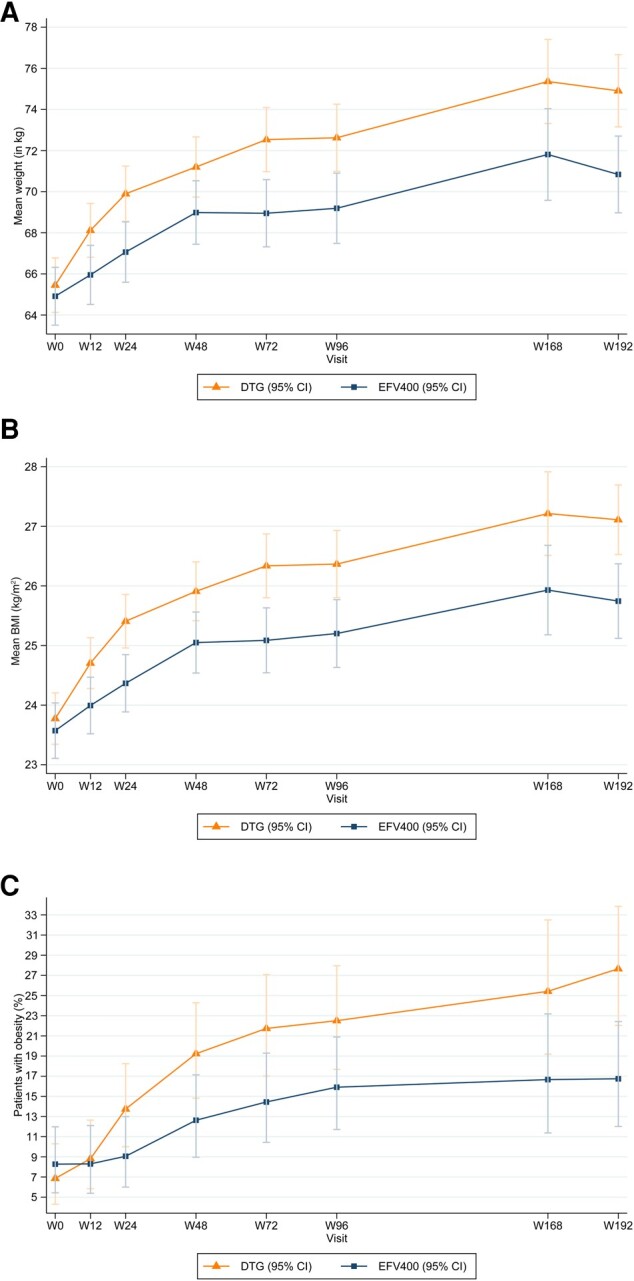
Weight-related outcomes per treatment group over 192 weeks. The figure shows the evolution over follow-up of participants’ mean weight (A), participants’ mean body mass index (B), and the proportion of patients with obesity (C). Abbreviations: BMI, body mass index; CI, confidence interval; DTG, dolutegravir; EFV400, efavirenz 400 mg; W, week.
DISCUSSION
This article describes efficacy and safety profiles of DTG and low-dose efavirenz in ART-naive adults through 192 weeks of follow-up, both combined with TDF/3TC. Our findings reported higher performance of DTG/TDF/3TC over EFV400/TDF/3TC among participants with very high baseline viral loads. Given that high baseline HIV RNA have each been associated with poorer treatment responses, it is reassuring that the performance of DTG/TDF/3TC-based regimen was maintained at week 192 among participants with baseline HIV RNA ≥100 000 copies/mL, including those with VL >500 000 copies/mL, a common occurrence in LMICs.
Efficacy results of this extended study were consistent with the results of analysis from weeks 48 and 96 in that statistical noninferiority of DTG over EFV400 was demonstrated, confirming the sustainability of both DTG and EFV efficacy over 4 years of follow-up [17]. However, the safety profile of DTG through 4 years of follow-up raises the issue of persistent, long-term, and substantial weight gain in a considerable proportion of women, all of which supports the keeping of DTG-based regimens as initial therapy for HIV and EFV-based regimens as an acceptable alternative.
In the ITT analysis, the treatment difference was similar to the results found in the ADVANCE Study of DTG + TAF + FTC vs DTG + TDF + FTC and EFV + TDF+FTC in First-line Antiretroviral Therapy (ADVANCE) at week 192 [18], the only randomized trial found to provide comparable follow-up data. DTG’s lower risk of resistance emergence, especially among ART-naive participants, was abundantly described in the literature. That asset was confirmed in NAMSAL as both regimens were associated with high proportions of participants maintaining virologic success at week 192, low proportions experiencing virologic failure, and higher adherence to treatments.
Globally, tolerability to both regimens was maintained at week 192. The analysis of 1074 pregnant women in 5 randomized trials showed no significant difference in the overall risk of neonatal death, stillbirth, or mother-to-child transmission between DTG/TDF/3TC and EFV400/TDF/3TC [19]; similar findings in NAMSAL show no differences in pregnancies or birth outcomes with the DTG/TDF/3TC-based regimen compared to the EFV400/TDF/3TC-based regimen.
In the NAMSAL study, the magnitude of unexpected weight gain on DTG/TDF/3TC, persistent through 192 weeks—seemingly beyond the “return-to-health” effect—was notable. Weight gain was considerable, ranging from 0 to 13 kg, with a mean of +9.4 kg, associated with high incidence of obesity on DTG/TDF/3TC (P = .0048). In the ADVANCE trial at week 192, the mean weight gain was +4.3 kg and the incidence of obesity on DTG/TDF/3TC was 27%, raising concerns about cardiovascular diseases and potential adherence issues. Compared to other antiretrovirals, DTG is increasingly being reported as a key risk factor for greater weight gain and incidence of obesity in the immediate period following ART initiation [20–24]; such undesirable effects have led to treatment discontinuations [25]. In 1 study [22], the rate of weight gain slowed within a year while in NAMSAL, there was little sign of imminent decline of the weight gained on DTG/TDF/3TC at year 4.
Consistent with what was observed in other studies, female sex and Black race appear to be associated with greater weight gain after ART initiation [22, 26]. The difference in long-term weight outcomes between studies may be related to the difference in participants, who were mostly White, with lower baseline VL, higher CD4 count, and higher male to female ratio, compared to the population recruited in NAMSAL, which comprised mostly females of African descent, one-third of whom were underweight and two-thirds had a VL >100 000 copies/mL.
CONCLUSIONS
The virologic suppression on DTG/TDF/3TC was maintained through 192 weeks, demonstrating sustainable efficacy of DTG/TDF/3TC over EFV400/TDF/3TC; concerning safety signals as adverse pregnancy outcomes were invalidated, and unexpected weight gain and high incidence of obesity persist in a substantial proportion of participants in the long-term. These data further support the durable safety and efficacy of DTG/TDF/3TC as initial therapy for HIV and the keeping of EFV400/TDF/3TC as an alternative. Close metabolic and cardiovascular monitoring is recommended to assess the impact of weight gain.
This trial provides the first comparative, randomized data on long-term (192 weeks) outcomes with DTG/TDF/E3TC-based and EFV400/TDF/3TC-based regimens as first-line ART in LMICs. The trial also confirms that the initial responses of both regimens are durable with longer-term follow-up and displays the importance of trying ART on diverse populations. However, evident safety benefits of DTG/TDF/3TC are associated with considerable and steady weight gain past 3 years of initiation.
Supplementary Material
Contributor Information
Mireille Mpoudi-Etame, Service Spécialisé d'Epidemiologie et Maladies Infectieuses, Hopital Militaire de Région No.1 Yaoundé, Yaoundé, Cameroon; Site Agence Nationale de Recherche sur le Sida et Maladies Infectieuses Emergentes du Cameroun, Yaoundé Central Hospital, Cameroon.
Tamara Tovar Sanchez, TransVIHMI, Université de Montpellier, Institute de Recherche pour le Développement, Inserm, Montpellier, France.
Marwân-al-Qays Bousmah, Aix Marseille Univ, Inserm, Institut de Recherche pour le Développement, Sciences Economiques et Sociales de la Santé et Traitement de l'Information Médicale, Institut Science de la Santé Publique d'Aix-Marseille, Marseille, France; Université Paris Cité, Institute de Recherche pour le Développement, Inserm, Ceped, F-75006 Paris, France.
Pierrette Omgba Bassega, Unité de prise en charge du VIH, Hôpital de District de la Cité Verte, Yaoundé, Cameroon.
Justin Olinga, Site Agence Nationale de Recherche sur le Sida et Maladies Infectieuses Emergentes du Cameroun, Yaoundé Central Hospital, Cameroon.
Eric Mimbe, Site Agence Nationale de Recherche sur le Sida et Maladies Infectieuses Emergentes du Cameroun, Yaoundé Central Hospital, Cameroon.
Michel Foalem, Site Agence Nationale de Recherche sur le Sida et Maladies Infectieuses Emergentes du Cameroun, Yaoundé Central Hospital, Cameroon; Faculty of Medicine and Pharmaceutical Sciences, University of Dschang, Cameroon.
Camille Chiep, Site Agence Nationale de Recherche sur le Sida et Maladies Infectieuses Emergentes du Cameroun, Yaoundé Central Hospital, Cameroon.
Serge Edimo, Site Agence Nationale de Recherche sur le Sida et Maladies Infectieuses Emergentes du Cameroun, Yaoundé Central Hospital, Cameroon.
Marie Varloteaux, Site Agence Nationale de Recherche sur le Sida et Maladies Infectieuses Emergentes du Cameroun, Yaoundé Central Hospital, Cameroon.
Raphaël Pelloquin, TransVIHMI, Université de Montpellier, Institute de Recherche pour le Développement, Inserm, Montpellier, France.
Nadine Lamare, Centre de Recherches sur les Maladies Emergentes et Ré-émergentes, Yaoundé, Cameroon.
Sylvie Boyer, Aix Marseille Univ, Inserm, Institut de Recherche pour le Développement, Sciences Economiques et Sociales de la Santé et Traitement de l'Information Médicale, Institut Science de la Santé Publique d'Aix-Marseille, Marseille, France; Université Paris Cité, Institute de Recherche pour le Développement, Inserm, Ceped, F-75006 Paris, France.
Martine Peeters, TransVIHMI, Université de Montpellier, Institute de Recherche pour le Développement, Inserm, Montpellier, France.
Jacques Reynes, TransVIHMI, Université de Montpellier, Institute de Recherche pour le Développement, Inserm, Montpellier, France; Service de Maladies Infectieuses, Centre Hospitalier Universitaire de Montpellier, Montpellier, France.
Alexandra Calmy, Service des maladies infectieuses, Hôpital Universitaire de Genève, Geneva, Switzerland.
Andrew Hill, Department of Pharmacology and Therapeutics, University of Liverpool, Liverpool, United Kingdom.
Eric Delaporte, TransVIHMI, Université de Montpellier, Institute de Recherche pour le Développement, Inserm, Montpellier, France; Service de Maladies Infectieuses, Centre Hospitalier Universitaire de Montpellier, Montpellier, France.
Charles Kouanfack, Unité de prise en charge du VIH, Hôpital de District de la Cité Verte, Yaoundé, Cameroon; Faculty of Medicine and Pharmaceutical Sciences, University of Dschang, Cameroon; Hôpital du Jour, Hôpital Central de Yaoundé, Cameroon.
New Antiretroviral and Monitoring Strategies in HIV-infected Adults in Low-income countries (NAMSAL-ANRS-12313) study group:
E Delaporte, A Ayouba, A Agholeng, C Butel, B Granouillac, A Lacroix, S Leroy, M Peeters, R Pelloquin, L Serrano, J Reynes, T Tovar-Sanchez, N Vidal, C Kounfack, M Foalem, P J Fouda, R Mougnoutou, J Olinga, V Omgba, S C Tchokonte Ngandé, B Ymele, M Mpoudi-Etamé, L Donfack, A Kambi, C D Epoupa Mpacko, M Fotso, R Moukoko, T Nké, P Omgba Bassega, A Akamba, S Lekelem, S Ngono, S B Tongo Fotack, M Tanga, M Tsafack, A Bissek, L Ciaffi, S Lem, E D Mimbé, M Niba, N Camille, J Olinga, M Varloteaux, E Mpoudi-Ngolé, E Ebong, N Lamare, G Edoul Mbesse, M Tongo, S Boyer, M Bousmah, P Huynh, G Maradan, M L Nishimwe, B Spire, G Peytavin, M P Lê, Y Yazdanpanah, A Diallo, I Fournier, A Montoyo, N Mercier, V Petrov-Sanchez, J Jean-Rassat, C Rekacewicz, and C Perez Casas
Supplementary Data
Supplementary materials are available at Open Forum Infectious Diseases online. Consisting of data provided by the authors to benefit the reader, the posted materials are not copyedited and are the sole responsibility of the authors, so questions or comments should be addressed to the corresponding author.
Notes
Acknowledgments. We thank all of the participants and staff from all the centers who participated in this trial.
Author contributions. M. M-E.: principal investigator, first draft of the manuscript, and data analysis. T. T. S.: head of the project, data analysis, and first draft of the manuscript. M.-Q. B.: socioeconomic and weight statistical analysis. P. O. B.: principal investigator, obtained data in Cameroon. J. O.: trial follow-up. E. M.: data management. M. F.: clinical follow-up. C. C.: trial follow-up assistance. S. E.: pharmacist. M. V.: general management and supervision in Cameroon. R. P.: statistical analysis. N. L.: virologic testing and analysis. S. B.: supervision of the socioeconomic analysis. M. P.: supervision of virologic testing and analysis. J. R.: member of the steering committee and clinical supervision. A. C.: head of the scientific advisory board. A. H.: scientific advisory board member. E. D.: coordinating principal investigator, supervision, and interpretation of all study results. C. K.: co-coordinating principal investigator, supervision, and interpretation of all study results.
Data availability. The individual patient data that underlie the results reported in this article, after de-identification, will be shared. Individual patient data will be available beginning 3 months and ending 1 year after publication. Supporting clinical documents including the study protocol, statistical analysis plan, and the informed consent form will be available immediately following publication for at least 1 year. Researchers who provide a scientifically sound proposal will be allowed access to the individual patient data. Proposals should be directed to Professor Eric Delaporte. These proposals will be reviewed and approved by the sponsor, investigator, and collaborators on the basis of scientific merit. To gain access, data requesters will need to sign a data access agreement.
Financial support. The NAMSAL-ANRS 12313 study is funded by the French National Agency for AIDS and Emerging Infectious Diseases Research (ANRS-MIE; protocol number ANRS-12313) and by Unitaid (grant number 2016-03-IBB).
References
- 1. Gupta A, Juneja S, Vitoria M, et al. Projected uptake of new antiretroviral (ARV) medicines in adults in low- and middle-income countries: a forecast analysis 2015–2025. PLoS One 2016; 11:e0164619. [DOI] [PMC free article] [PubMed] [Google Scholar]
- 2. World Health Organization (WHO) . Antiretroviral medicines in low- and middle-income countries: forecasts of global and regional demand for 2021–2025. 2022. Available at: https://apps.who.int/iris/handle/10665/352000. Accessed 30 May 2022.
- 3. World Health Organization (WHO) Regional Office for Europe . Pocket book of primary health care for children and adolescents: guidelines for health promotion, disease prevention and management from the newborn period to adolescence. 2022. Available at: https://apps.who.int/iris/handle/10665/352485. Accessed 30 May 2022.
- 4. Walmsley SL, Antela A, Clumeck N, et al. Dolutegravir plus abacavir–lamivudine for the treatment of HIV-1 infection. N Engl J Med 2013; 369:1807–18. [DOI] [PubMed] [Google Scholar]
- 5. Chen J, Chen R, Shen Y, et al. Efficacy and safety of lower dose tenofovir disoproxil fumarate and efavirenz versus standard dose in HIV-infected, antiretroviral-naive adults: a multicentre, randomized, noninferiority trial. Emerg Microbes Infect 2020; 9:843–50. [DOI] [PMC free article] [PubMed] [Google Scholar]
- 6. Kintu K, Malaba TR, Nakibuka J, et al. Dolutegravir versus efavirenz in women starting HIV therapy in late pregnancy (DolPHIN-2): an open-label, randomised controlled trial. Lancet HIV 2020; 7:e332–9. [DOI] [PMC free article] [PubMed] [Google Scholar]
- 7. ENCORE1 Study Group . Efficacy of 400 mg efavirenz versus standard 600 mg dose in HIV-infected, antiretroviral-naive adults (ENCORE1): a randomised, double-blind, placebo-controlled, non-inferiority trial. Lancet 2014; 383:1474–82. [DOI] [PubMed] [Google Scholar]
- 8. ENCORE1 Study Group; Carey D, Puls R, Amin J, et al. Efficacy and safety of efavirenz 400 mg daily versus 600 mg daily: 96-week data from the randomised, double-blind, placebo-controlled, non-inferiority ENCORE1 study. Lancet Infect Dis 2015; 15:793–802. [DOI] [PubMed] [Google Scholar]
- 9. The NAMSAL ANRS 12313 Study Group . Dolutegravir-based or low-dose efavirenz–based regimen for the treatment of HIV-1. N Engl J Med 2019; 381:816–26. [DOI] [PubMed] [Google Scholar]
- 10. Venter WDF, Moorhouse M, Sokhela S, et al. Dolutegravir plus two different prodrugs of tenofovir to treat HIV. N Engl J Med 2019; 381:803–15. [DOI] [PubMed] [Google Scholar]
- 11. Calmy A, Tovar Sanchez T, Kouanfack C, et al. Dolutegravir-based and low-dose efavirenz-based regimen for the initial treatment of HIV-1 infection (NAMSAL): week 96 results from a two-group, multicentre, randomised, open label, phase 3 non-inferiority trial in Cameroon. Lancet HIV 2020; 7:e677–87. [DOI] [PubMed] [Google Scholar]
- 12. Venter WDF, Sokhela S, Simmons B, et al. Dolutegravir with emtricitabine and tenofovir alafenamide or tenofovir disoproxil fumarate versus efavirenz, emtricitabine, and tenofovir disoproxil fumarate for initial treatment of HIV-1 infection (ADVANCE): week 96 results from a randomised, phase 3, non-inferiority trial. Lancet HIV 2020; 7:e666–76. [DOI] [PubMed] [Google Scholar]
- 13. Bousmah MA, Nishimwe ML, Tovar-Sanchez T, et al. Cost-utility analysis of a dolutegravir-based versus low-dose efavirenz-based regimen for the initial treatment of HIV-infected patients in Cameroon (NAMSAL ANRS 12313 trial). Pharmacoeconomics 2021; 39:331–43. [DOI] [PMC free article] [PubMed] [Google Scholar]
- 14. World Medical Association Declaration of Helsinki . Ethical principles for medical research involving human subjects. JAMA 2013; 310:2191. [DOI] [PubMed] [Google Scholar]
- 15. World Health Organization (WHO) . WHO case definitions of HIV for surveillance and revised clinical staging and immunological classification of HIV-related disease in adults and children. Geneva, Switzerland: WHO; 2007. [Google Scholar]
- 16. Smith F, Hammerstrom T, Soon G, et al. A meta-analysis to assess the FDA DAVP's TLOVR algorithm in HIV submissions. Drug Inf J 2011; 45:291–300. [Google Scholar]
- 17. Bousmah MA, Protopopescu C, Mpoudi-Etame M, et al. Improvements in patient-reported outcomes following initiation of dolutegravir- or low-dose efavirenz-based first-line antiretroviral therapy: a four-year longitudinal analysis in Cameroon (NAMSAL ANRS 12313 trial). J Acquir Immune Defic Syndr 2023; 94:262–72. [DOI] [PubMed] [Google Scholar]
- 18. Venter WF, Bosch B, Sokhela S, et al. Final week 192 results from the ADVANCE trial: first-line TAF/FTC/DTG, TDF/FTC/DTG vs TDF/FTC/EFV. 24th International AIDS Conference, Montreal, abstract PELBB01. 2022.
- 19. Venter WF, Moorhouse M, Sokhela S, et al. Risks of hypertension with first-line dolutegravir (DTG) and tenofovir alafenamide (TAF) in the NAMSAL and ADVANCE trials. 12th International AIDS Society Conference on HIV Science (IAS 2023), Brisbane, Australia, abstract OALBB0504, 2023.
- 20. Sax PE, Erlandson KM, Lake JE, et al. Weight-gain following initiation of antiretroviral therapy: risk factors in randomized comparative clinical trials. Clin Infect Dis 2019; 68:535–44. [DOI] [PMC free article] [PubMed] [Google Scholar]
- 21. Bailin SS, Gabriel CL, Wanjalla CN, Koethe JR. Obesity and weight-gain in persons with HIV. Curr HIV/AIDS Rep 2020; 17:138–50. [DOI] [PMC free article] [PubMed] [Google Scholar]
- 22. Bakal DR, Coelho LE, Luz PM, et al. Obesity following ART initiation is common and influenced by both traditional and HIV-/ART-specific risk factors. J Antimicrob Chemother 2018; 73:2177–85. [DOI] [PMC free article] [PubMed] [Google Scholar]
- 23. Ruderman SA, Crane HM, Nance RM, et al. Brief report: weight-gain following ART initiation in ART-naive people living with HIV in the current treatment era. J Acquir Immune Defic Syndr 2021; 86:339–43. [DOI] [PMC free article] [PubMed] [Google Scholar]
- 24. Bourgi K, Rebeiro PF, Turner M, et al. Greater weight-gain in treatment-naive persons starting dolutegravir-based antiretroviral therapy. Clin Infect Dis 2020; 70:1267–74. [DOI] [PMC free article] [PubMed] [Google Scholar]
- 25. Menard A, Meddeb L, Tissot-Dupont H, et al. Dolutegravir and weight-gain: an unexpected bothering side effect? AIDS 2017; 31:1499–500. [DOI] [PubMed] [Google Scholar]
- 26. Bedimo R, Adams-Huet B, Xilong L, et al. Integrase inhibitors-based HAART is associated with greater BMI gains in Blacks and Hispanics [abstract 538]. In: IDWeek, San Francisco, CA, 2018.
Associated Data
This section collects any data citations, data availability statements, or supplementary materials included in this article.