



Abstract
Objectives
We examined literacy related to healthy gestational weight gain (GWG) in immigrant and native Japanese mothers and determined whether it is associated with children’s birth weight.
Design
Longitudinal cohort study.
Setting
As the baseline survey in the Japan Environment and Children’s Study (JECS), mothers completed self-administered questionnaires distributed by hand during pregnancy. The self-administered questionnaires used in this study were distributed by mail 6 months after delivery. Children’s birth weight, actual GWG and any complications during delivery were recorded by obstetricians collaborating with JECS.
Participants
Of 97 452 mothers who consented to participate in the JECS during pregnancy between January 2011 and March 2014, 67 953 were included in this study after exclusions for multiple births, multiple instances of consent by the same pregnant woman, miscarriages/stillbirths or withdrawal from the study within 3 years after participating. In total, 324 immigrant mothers and 963 native Japanese mothers were selected by propensity score matching for analysis.
Primary and secondary outcome measures
Data were collected on maternal literacy related to healthy GWG at the baseline survey, and data on actual GWG and children’s birth weight were collected by obstetricians. The associations of knowledge about healthy GWG and mothers’ actual GWG with maternal nativity status were examined using a χ2 or Student’s t-test.
Results
More native Japanese mothers than immigrant mothers knew the appropriate GWG and reason the for needing to know this. Actual GWG was significantly higher among the immigrant mothers, but was within the recommended range. The low birthweight (LBW) incidence was significantly higher among the native mothers.
Conclusions
Immigrant mothers to Japan had less knowledge about appropriate GWG, but their actual GWG was appropriate and they delivered fewer LBW infants than native Japanese mothers. These findings may indicate the presence of other protective factors for pregnancy or delivery among immigrant mothers.
Keywords: Paediatric gastroenterology, Health Education, EPIDEMIOLOGIC STUDIES
STRENGTHS AND LIMITATIONS OF THIS STUDY.
The Japan Environment and Children’s Study (JECS) is a large nationwide longitudinal birth cohort study that includes 103 060 mothers with confirmed obstetric outcomes recruited between 2011 and 2014.
JECS covered 45% of live births that occurred within the study areas in 2013.
The data on the characteristics of the mothers and children who participated in JECS show similarities with the data from Japan’s 2013 Vital Statistics Survey.
The model accounted for nine matching variables, including maternal factors and environmental factors.
The two main limitations are the lack of data related to origin of the parents of the target children and the potential selection bias among non-Japanese mother associated with Japanese language literacy.
Introduction
Health and nutrition disturbances typically influence children’s growth, and growth assessment, which compares anthropometric measurements to a set of reference values at given ages, is widely used to detect abnormal growth patterns.1 Several studies have identified that differences in the growth curves of children can be related to the nativity status of their mothers.2–5 In an American study, Lawrence et al compared body mass index (BMI) between the children of non-Hispanic white mothers and those of Mexican-heritage mothers and found that the children of mothers with Mexican heritage had on average higher BMI and greater rates of obesity, particularly preschool-age boys.6 Some studies suggested that such differences are related to the mothers’ beliefs, knowledge and attitudes about prenatal care, as well as their employment status and language barrier issues.7–11 Chen et al examined whether the body composition of preschool children was associated with the mothers’ prepregnancy weight and found that the children of mothers who had excessive gestational weight gain (GWG) were more likely to have a higher fat mass index status than the children of mothers with appropriate GWG.12 It is clear then that women should know about the appropriate GWG and the reason why this is important.
During pregnancy, expectant mothers in Japan receive the Maternal and Child Health Handbook13 and are offered health and medical services such as medical check-ups and nutritional counselling. The handbook includes reference growth charts for Japanese children aged 0–6 years that are based on growth measurements obtained from the National Growth Survey on Preschool Children14 and are referred to during growth assessments as the children develop. Since 2011, when around 2.0% of children in Japan were born to immigrant parents and half of them had a non-Japanese mother,15 more children are being born to immigrant mothers. In our previous study examining the height, weight and BMI trajectories of Japanese children between the ages of 0 and 3 years according to maternal nativity status, we found that the children of immigrant mothers were significantly heavier at birth than those of native Japanese mothers (currently in submission). We hypothesised that this might be related to maternal weight before pregnancy or to GWG. In the present study, we examined whether this difference in the children’s weight at birth could be linked to an association between maternal health literacy about GWG and nativity status.
Methods
Study design
The Japan Environment and Children’s Study (JECS) is a nationwide birth cohort study. The study recruited approximately 100 000 pregnant women between January 2011 and March 2014 in order to collect biosamples, environmental samples and questionnaire information from the participants and their children from pregnancy until the children reached 13 years of age.16 The present study analysed the jecs-qa-20210401 (jecs-ta-20190930) dataset released to stakeholders in April 2021 and completed in February 2022. (The dataset supporting the conclusions of this article will become available after the JECS Steering Committee permits access.) The dataset includes 103 057 pregnancies of 97 452 pregnant women who consented to participate in the JECS. After excluding women who had a multiple birth, multiple instances of consent by the same pregnant woman, cases of miscarriages or stillbirths and women who withdrew from the study within the first 3 years, data on 67 953 mothers were selected as the frame population. Maternal nativity status was determined from the response to a question about nationality in the JECS self-administered questionnaire that was distributed 6 months after delivery and collected by mail. In total, 324 immigrant mothers were among the respondents.
In the JECS, the initial baseline survey, which was conducted twice during pregnancy, involved the distribution and collection by hand of a self-administered questionnaire to mothers. The data collected were the socioeconomic status, medical history, health status and health-related behaviours or literacy of the mothers. Using the data collected from the baseline survey, we calculated propensity scores for immigrant mothers by logistic regression. The variables included in the model were maternal factors (age, BMI before pregnancy, highest education level, occupation during pregnancy and experience of delivery) and environmental factors (family income, nativity status of partner, living with their mother and living with their partner’s mother). The immigrant mothers were matched 1:3 to native mothers using the greedy matching method,17 with 963 Japanese mothers selected for analysis. In total, data on 1287 mothers were selected and used for this study (figure 1).
Figure 1.
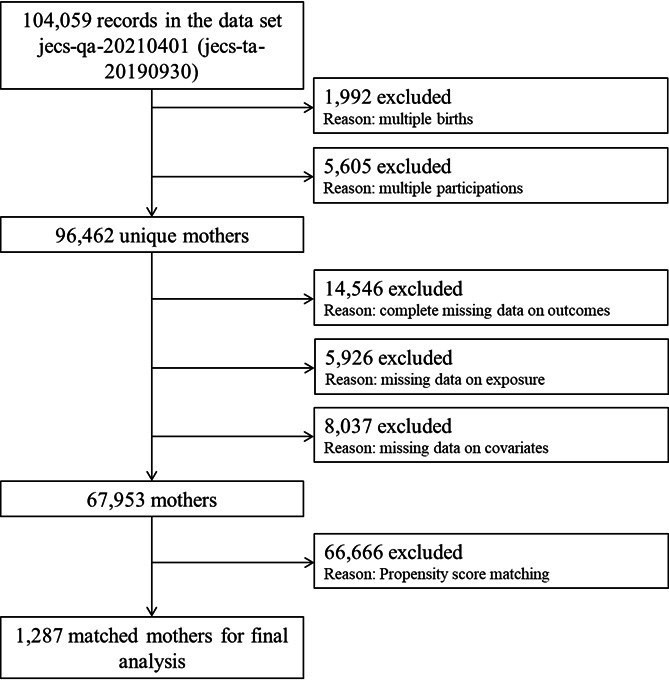
Participant flow diagram.
Also, from the JECS baseline survey, we collected data on the mother’s knowledge about the appropriate GWG and the reason they gave for why GWG should not be exceeded. The actual GWG was calculated using maternal weight recorded before pregnancy and at the time of delivery. The baby’s birth weight was collected and low birth weight (LBW) was defined as smaller than 2500 g. Any problems during delivery (threatened abortion, gestational diabetes, gestational hypertension, etc) recorded by obstetricians collaborating with JECS were defined as obstetric complications.
Patient and public involvement
There was no patient or public involvement in this study.
Statistical analysis
Differences in knowledge of appropriate GWG and the reason, actual GWG and prevalence of LBW according to maternal nativity status were examined using the χ2 or Student’s t-test. A significance level of 0.05 (two tailed) was considered significant. SAS V.9.4 was used for all statistical analyses.
Results
The baseline characteristics of the participants are shown in table 1. There were no significant differences between the native and immigrant mothers in the variables used to calculate the propensity score.
Table 1.
Baseline characteristics of mothers according to nativity status
| Immigrant mothers n=324 |
Japanese mothers n=963 |
|
| Mother’s age at delivery, years | ||
| <25 | 23 (7.1) | 87 (9.0) |
| 25 to <30 | 79 (24.4) | 219 (22.7) |
| 30 to <35 | 129 (39.8) | 344 (35.7) |
| 35 to <40 | 73 (22.5) | 245 (25.4) |
| ≥40 | 20 (6.2) | 68 (7.1) |
| Parity | ||
| Primiparous | 152 (46.9) | 446 (46.3) |
| Multiparous | 172 (53.1) | 517 (53.7) |
| Highest education level, years | ||
| <13 | 109 (33.6) | 348 (36.1) |
| 13 to <16 | 78 (24.1) | 243 (25.2) |
| ≥16 | 137 (42.3) | 372 (38.6) |
| Employed during early pregnancy | ||
| No | 175 (54.0) | 539 (56.0) |
| Yes | 149 (46.0) | 424 (44.0) |
| Prepregnancy body mass index, kg/m2 | ||
| <18.5 | 47 (14.5) | 155 (16.1) |
| 18.5 to <25.0 | 242 (74.7) | 701 (72.8) |
| ≥25.0 | 35 (10.8) | 107 (11.1) |
| Partner’s nationality | ||
| Japanese | 219 (67.6) | 657 (68.2) |
| Non-Japanese | 105 (32.4) | 306 (31.8) |
| Living with her mother | 14 (4.3) | 52 (5.4) |
| Living with partner’s mother | 34 (10.5) | 112 (11.6) |
| Annual household income, million JPY | ||
| <4 | 128 (39.5) | 383 (39.8) |
| 4 to <6 | 108 (33.3) | 335 (34.8) |
| ≥6 | 88 (27.2) | 245 (25.4) |
JPY, Japanese Yen.
In relation to knowledge of the appropriate GWG and the reason for its importance as an indicator of health literacy related to delivery, a significantly larger proportion of native mothers answered that they knew the appropriate GWG compared with immigrant mothers (χ2 9.98, p=0.0016; table 2). Regarding the importance of not exceeding the appropriate GWG, significantly more native mothers answered that they knew this than immigrant mothers (χ2 15.38, p<0.001). Native mothers chose a significantly lower appropriate GWG value than immigrant mothers. For the question about why appropriate GWG is important, the most common answer among native mothers was ‘to make childbirth easier’, followed by ‘to deliver a healthy child’ and then ‘to return to original shape soon after giving birth’. Significantly more native mothers than immigrant mothers answered ‘to make childbirth easier’. The most common answer among immigrant mothers was ‘to deliver a healthy baby’. In relation to knowing the appropriate GWG, immigrant mothers reported a significantly higher GWG (range, 12.7–16.5 kg, maximum 18.1 kg) than native mothers (range, 8.6–12.6 kg, maximum 13.6 kg).
Table 2.
Mother’s knowledge about appropriate gestational weight gain (GWG) according to nativity status
| Immigrant mothers | Japanese mothers | P value | |
| Knows about amount of appropriate GWG | 236 (72.8) | 781 (81.1) | 0.0016 |
| Knows about importance of not exceeding appropriate GWG | 292 (90.1) | 926 (96.2) | <0.001 |
| Reason why appropriate GWG is important to know | |||
| To deliver a healthy baby | 222 (68.5) | 655 (68.0) | 0.866 |
| To make childbirth easier | 208 (64.2) | 735 (76.3) | <0.001 |
| To return to original shape soon after giving birth | 154 (47.5) | 453 (47.0) | 0.787 |
| To prevent non-communicable diseases after childbirth | 98 (30.2) | 269 (27.9) | 0.426 |
| To not leave stretch marks | 63 (19.4) | 158 (16.4) | 0.214 |
| Because doctors or nurses suggest it | 101 (31.2) | 302 (31.4) | 0.949 |
| Because a family member or friend suggests it | 23 (7.1) | 94 (9.8) | 0.139 |
| Knowledge about amount of appropriate GWG | |||
| From (kg) (n=205; 669) | 12.7±15.7 | 8.6±8.7 | <0.001 |
| To (kg) (n=208; 670) | 16.5±16.4 | 12.6±9.5 | 0.0013 |
| Or until (kg) (n=117; 455) | 18.1±17.7 | 13.6±11.9 | 0.0096 |
The results for delivery are shown in table 3. The proportion of mothers who had nutritional consultation did not differ significantly between the immigrant mothers and native mothers, but actual GWG was significantly higher among the immigrant mothers, at 11.8 kg (1 SD, 3.9 kg), than among the native mothers (mean, 10.4 kg; SD, 4.0 kg; p<0.001). The LBW incidence was higher in native mothers than in immigrant mothers (p=0.028). The incidence of complications during pregnancy and delivery was not statistically different between the two groups.
Table 3.
Mother’s actual gestational weight gain (GWG) and baby’s birth weight according to nativity status
| Immigrant mothers | Japanese mothers | P value | |
| Actual GWG (kg) | 11.8±3.9 | 10.4±4.0 | <0.001 |
| Baby’s birth weight | 0.029 | ||
| >2500 g | 11 (3.4) | 66 (6.8) | |
| 2500–4000 g | 304 (93.8) | 881 (91.5) | |
| ≥4000 g | 9 (2.8) | 16 (1.7) | |
| Having nutritional consultation | 287 (89.1) | 853 (89.0) | 0.964 |
| Having obstetric complications | 170 (52.5) | 517 (54.0) | 0.640 |
Discussion
Studies have shown that childhood obesity is a factor in subsequent non-communicable diseases,18 and several epidemiological studies have suggested that this theory can also be applied to Japanese children.19–22 However, it has been reported that the growth status of children born to immigrant mothers differs from that of the children born to native mothers, making it a health challenge in the destination country. Messiah et al showed that children of foreign-born parents were 2.5 times more obese than children of US-born parents in a baseline assessment of randomised controlled obesity prevention interventions for preschoolers.7 On the other hand, a systematic review by Almeida et al suggests there is a higher health risk profile in immigrant pregnant women in association with reduced access to health facilities, poor communication between the immigrant women and other caregivers, and a lower rate of obstetrical interventions.23
In this study, a propensity score was developed using maternal age, parity, socioeconomic status, highest education level and being employed, which have all been found to be related with children’s growth status in immigration studies. Igarashi et al examined non-Japanese mothers’ ratings of care from pregnancy to the postpartum period in Japan and found that immigrant women who strongly felt lonely reported lower satisfaction with prenatal care.24 In the present study, we also hypothesised that the native status of the partner or family member living with the mother would be associated with their role as informants for the mother. We used the information about the person living with the mother for the propensity score analysis. The information was also used to take into account the presence of informants on childbirth for the mother in Japan. We have no information on the language literacy of the immigrant mothers who participated in this study, although we consider that they had a certain level of Japanese language literacy because the JECS allowed non-Japanese mothers to participate only if they were able to understand and answer the questionnaires in Japanese.
In studies where control subjects are more readily obtained than cases, Breslow and Day suggested selecting two, three or even more controls matched to each case,25 and Taylor suggested more than three controls per case.26 In this study, we therefore selected three Japanese mothers for one non-Japanese mother as a control.
Although more native mothers than immigrant mothers answered that they knew the appropriate GWG, more immigrant mothers answered the appropriate GWG correctly and immigrant mothers reported a significantly higher, appropriate GWG range than native mothers. One of the reasons for this could be due to native mothers not knowing that the Japanese GWG guidelines have been amended several times since 1997, with the appropriate GWG range being increased over time. In March 2021, the Japanese Society of Obstetrics and Gynecology revised its 2006 GWG guidelines and the revised version was adopted by the Japanese Ministry of Health, Labour and Welfare. These new guidelines advise on GWG by 40 weeks as follows: underweight women should gain 12–15 kg (vs 9–12 kg previously), normal weight women should gain 10–13 kg (vs 7–12 kg), overweight women should gain 7–10 kg (vs no official recommendation) and obese women should gain ≤5 kg (vs no official recommendation). Our results about the appropriate GWG indicate that the immigrant mothers know about the minimum GWG stated in the guidelines, while the Japanese mothers know about the maximum GWG stated. The actual GWG of immigrant mothers was significantly heavier than that of Japanese mothers, but still fell within the guidelines.
Japan has a system that allows pregnant women to receive free medical check-ups and consultation from dietitians at the obstetric clinic during their pregnancy. Participants in this study were recruited at maternity hospitals (cooperating healthcare providers) and underwent ongoing medical checks there according to the JECS Conceptual Plan. Pregnant women were briefed by obstetricians, nurses or dietitians on the appropriate GWG and also had their GWG assessed throughout pregnancy. The proportion having nutritional consultation did not differ significantly among the two groups. This also supports our suggestion that native mothers’ knowledge may be based on earlier versions of the GWG guidelines and that they obtained such information from sources other than medical professionals. Nowadays, the full version of the Maternal and Child Health Handbook is provided by the government in both Japanese and English forms, but short versions of the handbook in other languages have been developed and are provided by a non-governmental organisation. This may have resulted in the difference in knowledge between the two groups.
The actual GWG was lower than the known appropriate GWG in both maternal nativity groups and may have been influenced by the instruction provided at the maternity hospitals (cooperating healthcare providers). Suzuki et al found that pregnant women with knowledge of the recommended GWG had lower energy intake and a higher percentage of nutrient intake below the required amount than pregnant women without such knowledge, suggesting that pregnant women with correct knowledge may have excessive awareness of energy intake, which may lead to inappropriate nutritional intake status.27 In the present study, there was no statistical difference in the rate at which obstetric and delivery complications occurred in the two groups with different knowledge, but significantly more native mothers than immigrant mothers delivered LBW infants. Nutritional management of pregnant women in Japan has been designed to treat or prevent gestational hypertension,28 but this management may affect neonatal birth weight. Mendoza reviewed a finding termed the ‘immigrant paradox’29 and this paradox may be related to our finding.
There are two main limitations of this study. First, the JECS dataset we used did not provide detailed information on the origin of the parents of the target children. We considered only whether they were Japanese citizens or not, and as we did not know their place of birth, in this study we assumed that their Japanese nationality followed that of their parents. According to data from the Ministry of Internal Affairs and Communications, the nationalities of mothers of children born in Japan to foreign mothers in 2011–2014, when JECS recruited, were predominantly Chinese, Filipino and Korean (Republic of Korea, North Korea and former Korean nationality), and the mothers of the JECS target children in this study are considered to be similar in composition.30 Second, only data from mothers participating and cooperating in the JECS were used. According to data from the Ministry of Internal Affairs and Communications, the proportion of children born to non-Japanese mothers was 1% of all children born in Japan, while in the JECS dataset, the proportion of non-Japanese mothers was 0.4% of JECS participants. As mentioned earlier, the questionnaire used in the JECS was designed in Japanese only, and non-Japanese mothers were required to be able to answer it. This may represent a selection bias among non-Japanese mothers. This bias is associated with higher maternal language literacy and may underestimate the impact of language proficiency among immigrant mothers in the destination nation, as reported previously. However, such bias could explain why more immigrant mothers than native mothers knew the appropriate GWG and delivered fewer LBW infants.
Conclusions
Immigrant mothers to Japan had less knowledge about appropriate GWG, but their actual GWG was appropriate and they delivered fewer LBW infants than native Japanese mothers. These findings may indicate the presence of other protective factors for pregnancy or delivery among immigrant mothers. In Japan, information is provided through the Maternal and Child Health Handbook, but the provision of additional translations and additional methods and materials for consultation and support for immigrant mothers should be explored.
Supplementary Material
Acknowledgments
We thank the children and their families who participated in and cooperated with this study. We also thank all members of the JECS Group as of 2023. We thank ThinkSCIENCE for English language editing of this manuscript.
Footnotes
Collaborators: The Japan Environment and Children’s Study (JECS) Group as of 2023: Michihiro Kamijima (principal investigator, Nagoya City University, Nagoya, Japan), Shin Yamazaki (National Institute for Environmental Studies, Tsukuba, Japan), Yukihiro Ohya (National Center for Child Health and Development, Tokyo, Japan), Reiko Kishi (Hokkaido University, Sapporo, Japan), Nobuo Yaegashi (Tohoku University, Sendai, Japan), Koichi Hashimoto (Fukushima Medical University, Fukushima, Japan), Chisato Mori (Chiba University, Chiba, Japan), Shuichi Ito (Yokohama City University, Yokohama, Japan), Zentaro Yamagata (University of Yamanashi, Chuo, Japan), Takeo Nakayama (Kyoto University, Kyoto, Japan), Tomotaka Sobue (Osaka University, Suita, Japan), Masayuki Shima (Hyogo Medical University, Nishinomiya, Japan), Seiji Kageyama (Tottori University, Yonago, Japan), Narufumi Suganuma (Kochi University, Nankoku, Japan), Shoichi Ohga (Kyushu University, Fukuoka, Japan) and Takahiko Katoh (Kumamoto University, Kumamoto, Japan).
Contributors: MK designed and carried out this study, performed the statistical analysis and wrote the manuscript. AT and KM carried out data collection, assisted with statistical analysis and helped in drafting the manuscript. MI and TT carried out data collection and helped in critically revising the manuscript. KH and HI participated in the design of the study and helped in critically revising the manuscript. YA helped in critically revising the manuscript. The JECS Group assisted in data collection. All authors have read and approved the final manuscript.
Funding: The Japan Environment and Children’s Study was funded by the Ministry of the Environment, Japan (NA).
Competing interests: None declared.
Patient and public involvement: Patients and/or the public were not involved in the design, or conduct, or reporting, or dissemination plans of this research.
Provenance and peer review: Not commissioned; externally peer reviewed.
Contributor Information
Collaborators: The Japan Environment and Children’s Study (JECS) Group, Michihiro Kamijima, Shin Yamazaki, Yukihiro Ohya, Reiko Kishi, Nobuo Yaegashi, Koichi Hashimoto, Chisato Mori, Shuichi Ito, Zentaro Yamagata, Takeo Nakayama, Tomotaka Sobue, Masayuki Shima, Seiji Kageyama, Narufumi Suganuma, Shoichi Ohga, and Takahiko Katoh
Data availability statement
Data are available upon reasonable request. Data are unsuitable for public deposition due to ethical restrictions and legal framework of Japan. It is prohibited by the Act on the Protection of Personal Information (Act No. 57 of 30 May 2003, amendment on 9 September 2015) to publicly deposit the data containing personal information. Ethical Guidelines for Medical and Health Research Involving Human Subjects enforced by the Japan Ministry of Education, Culture, Sports, Science and Technology and the Ministry of Health, Labour and Welfare also restricts the open sharing of the epidemiologic data. All inquiries about access to data should be sent to: jecs-en@nies.go.jp. The person responsible for handling enquiries sent to this e-mail address is Dr Shoji F. Nakayama, JECS Programme Office, National Institute for Environmental Studies.
Ethics statements
Patient consent for publication
Not applicable.
Ethics approval
This study involves human participants. The Japan Environment and Children’s Study (JECS) protocol was reviewed and approved by the Japanese Ministry of the Environment’s Institutional Review Board on Epidemiological Studies (#100910001) and the ethics committees of all participating institutions. The protocol of the present study was reviewed and approved by the University of Toyama Ethics Committee (R2019170). Participants gave informed consent to participate in the study before taking part.
References
- 1.de Onis M, Garza C, Victora CG, et al. The WHO multicentre growth reference study: planning, study design, and methodology. Food Nutr Bull 2004;25:S15–26. 10.1177/15648265040251S103 [DOI] [PubMed] [Google Scholar]
- 2.Martinson ML, McLanahan S, Brooks-Gunn J. Variation in child body mass index patterns by race/ethnicity and maternal nativity status in the United States and England. Matern Child Health J 2015;19:373–80. 10.1007/s10995-014-1519-7 [DOI] [PubMed] [Google Scholar]
- 3.Hof MHP, van Dijk AE, van Eijsden M, et al. Comparison of growth between native and immigrant infants between 0-3 years from the dutch ABCD cohort. Ann Hum Biol 2011;38:544–55. 10.3109/03014460.2011.576701 [DOI] [PubMed] [Google Scholar]
- 4.Besharat Pour M, Bergström A, Bottai M, et al. Body mass index development from birth to early adolescence; effect of perinatal characteristics and maternal migration background in a Swedish cohort. PLoS ONE 2014;9:e109519. 10.1371/journal.pone.0109519 [DOI] [PMC free article] [PubMed] [Google Scholar]
- 5.Fredriks AM, van Buuren S, Jeurissen SER, et al. Height, weight, body mass index and pubertal development references for children of moroccan origin in the Netherlands. Acta Paediatr 2004;93:817–24. 10.1111/j.1651-2227.2004.tb03024.x [DOI] [PubMed] [Google Scholar]
- 6.Lawrence E, Mollborn S, Riosmena F. Early childhood disadvantage for sons of Mexican immigrants: body mass index across ages 2–5. Am J Health Promot 2016;30:545–53. 10.4278/ajhp.140725-QUAN-366 [DOI] [PMC free article] [PubMed] [Google Scholar]
- 7.Messiah SE, Asfour L, Arheart KL, et al. Relationship between parent demographic characteristics, perinatal and early childhood behaviors, and body mass index among preschool-age children. J Immigr Minor Health 2015;17:414–21. 10.1007/s10903-014-0079-7 [DOI] [PubMed] [Google Scholar]
- 8.Cheah CSL, Van Hook J. Chinese and Korean immigrants' early life deprivation: an important factor for child feeding practices and children’s body weight in the United States. Soc Sci Med 2012;74:744–52. 10.1016/j.socscimed.2011.10.040 [DOI] [PMC free article] [PubMed] [Google Scholar]
- 9.Gualdi-Russo E, Manzon VS, Masotti S, et al. Weight status and perception of body image in children: the effect of maternal immigrant status. Nutr J 2012;11:85. 10.1186/1475-2891-11-85 [DOI] [PMC free article] [PubMed] [Google Scholar]
- 10.Baker E, Balistreri KS, Van Hook J. Maternal employment and overweight among hispanic children of immigrants and children of natives. J Immigr Minor Health 2009;11:158–67. 10.1007/s10903-007-9096-0 [DOI] [PMC free article] [PubMed] [Google Scholar]
- 11.Khanolkar AR, Sovio U, Bartlett JW, et al. Socioeconomic and early-life factors and risk of being overweight or obese in children of Swedish- and foreign-born parents. Pediatr Res 2013;74:356–63. 10.1038/pr.2013.108 [DOI] [PubMed] [Google Scholar]
- 12.Chen F, Wang J, Liao Z, et al. Body composition in preschool children and the association with prepregnancy weight and gestational weight gain: an ambispective cohort study. Front Nutr 2022;9:881452. 10.3389/fnut.2022.881452 [DOI] [PMC free article] [PubMed] [Google Scholar]
- 13.Ministry of Health, Labour and welfare . Maternal and child health handbook English version. 2017. Available: https://sukoyaka21.cfa.go.jp/useful-tools/thema3/ [Accessed 13 Jun 2023].
- 14.Ministry of Health, Labour and Welfare . Report of national growth survey on preschool children [in Japanese]. 2010. Available: https://www.mhlw.go.jp/toukei/list/dl/73-22-01.pdf [Accessed 21 Dec 2022].
- 15.Ministry of Health, Labour and Welfare . Annual changes in the number of births by nationality of parents [in Japanese]. 2019. Available: https://www.mhlw.go.jp/toukei/saikin/hw/jinkou/suii09/brth8.html [Accessed 13 Jun 2023].
- 16.Kawamoto T, Nitta H, Murata K, et al. Rationale and study design of the Japan environment and children’s study (JECS). BMC Public Health 2014;14:25. 10.1186/1471-2458-14-25 [DOI] [PMC free article] [PubMed] [Google Scholar]
- 17.Thomas L, Li F, Pencina M. Using propensity score methods to create target populations in observational clinical research. JAMA 2020;323:466–7. 10.1001/jama.2019.21558 [DOI] [PubMed] [Google Scholar]
- 18.Gluckman PD, Hanson MA. Living with the past: evolution, development, and patterns of disease. Science 2004;305:1733–6. 10.1126/science.1095292 [DOI] [PubMed] [Google Scholar]
- 19.Kikuchi T, Uchiyama M. Epidemiological studies of the developmental origins of adult health and disease in Japan: a pediatric perspective in present day Japan. Clin Pediatr Endocrinol 2010;19:83–90. 10.1297/cpe.19.83 [DOI] [PMC free article] [PubMed] [Google Scholar]
- 20.Manabe M. Relationship between birth weight and family history for lifestyle related disease in childhood screening [in Japanese]. The Journal of the Japan Pediatric Association 2022;64:44–5. [Google Scholar]
- 21.Hatta Y, Hirata M, Urashima M, et al. Influence of differences in birth weight on the muscle function of adult males; considaration from a physical function examination in adulthood [in Japanese]. Japanese Jounal of Health Promotion and Physical Therapy 2022;12:13–8. 10.9759/hppt.12.13 [DOI] [Google Scholar]
- 22.Kubo T, Furujo M, Nakamura M, et al. Research on verification of dohad among Japanese women [in Japanese]. Annual Research Reports of the Foundation for Growth Science 2011;34:137–48. [Google Scholar]
- 23.Almeida LM, Caldas J, Ayres-de-Campos D, et al. Maternal healthcare in migrants: a systematic review. Matern Child Health J 2013;17:1346–54. 10.1007/s10995-012-1149-x [DOI] [PubMed] [Google Scholar]
- 24.Igarashi Y, Horiuchi S, Porter SE. Immigrants' experiences of maternity care in Japan. J Community Health 2013;38:781–90. 10.1007/s10900-013-9679-8 [DOI] [PMC free article] [PubMed] [Google Scholar]
- 25.Breslow NE, Day NE. 1:M matching: dichotomous exposures. In: Statistical methods in cancer research. 1980. [Google Scholar]
- 26.Taylor JMG. Choosing the number of controls in a matched case-control study, some sample size, power and efficiency considerations. Stat Med 1986;5:29–36. 10.1002/sim.4780050106 [DOI] [PubMed] [Google Scholar]
- 27.Suzuki M, Suzuki K, Yoshida K. Association of total energy intake, nutrient and supplement use with knowledge of recommended weight gain in early pregnancy [in Japanese]. Tokai J Public Health 2019;7:151–7. [Google Scholar]
- 28.Itoh H. Pregnancy-induced hypertension (PIH) and nutritional care in Japan. Eiyogaku Zasshi 2011;69:3–9. 10.5264/eiyogakuzashi.69.3 [DOI] [Google Scholar]
- 29.Mendoza FS. Health disparities and children in immigrant families: a research agenda. Pediatrics 2009;124 Suppl 3:S187–95. 10.1542/peds.2009-1100F [DOI] [PubMed] [Google Scholar]
- 30.Immigration Services Agency of Japan . Statistics on foreign residents in Japan (formerly, registered alien Statistics) [in Japenese]. 2011. Available: https://www.moj.go.jp/isa/policies/statistics/toukei_ichiran_touroku.html?hl=en [Accessed 13 Jun 2023].
Associated Data
This section collects any data citations, data availability statements, or supplementary materials included in this article.
Supplementary Materials
Data Availability Statement
Data are available upon reasonable request. Data are unsuitable for public deposition due to ethical restrictions and legal framework of Japan. It is prohibited by the Act on the Protection of Personal Information (Act No. 57 of 30 May 2003, amendment on 9 September 2015) to publicly deposit the data containing personal information. Ethical Guidelines for Medical and Health Research Involving Human Subjects enforced by the Japan Ministry of Education, Culture, Sports, Science and Technology and the Ministry of Health, Labour and Welfare also restricts the open sharing of the epidemiologic data. All inquiries about access to data should be sent to: jecs-en@nies.go.jp. The person responsible for handling enquiries sent to this e-mail address is Dr Shoji F. Nakayama, JECS Programme Office, National Institute for Environmental Studies.