



Abstract
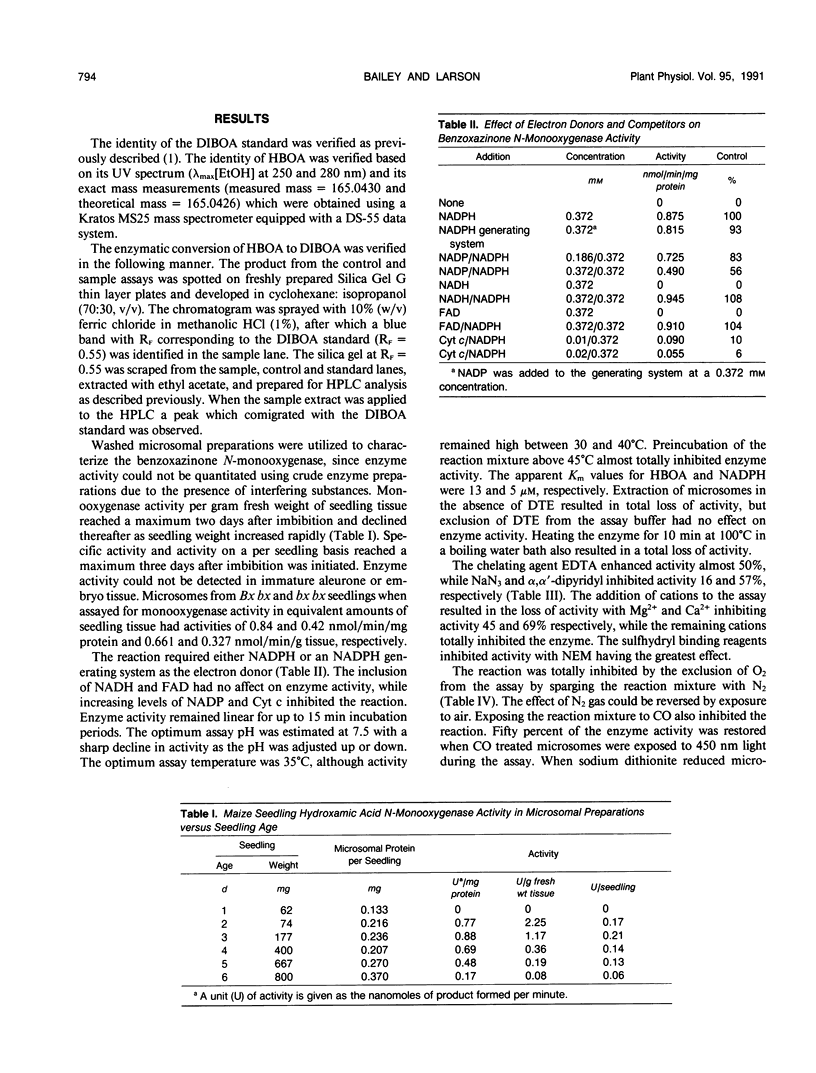
The benzoxazinones occur in hydroxamic acid and lactam forms in maize (Zea mays L.) tissue. The hydroxamic acid forms which possess a N-hydroxyl group are found in the highest concentration while the lactam members which lack the N-hydroxyl group occur in lower concentrations. The hydroxamic acid 2,4-dihydroxy-1,4-benzoxazin-3-one (DIBOA) has as its lactam counterpart 2-hydroxy-1,4-benzoxazin-3-one (HBOA). An enzyme has been identified in maize microsomal preparations which catalyzes the N-hydroxylation of HBOA to form DIBOA. The enzyme is initially observed in seedlings 2 days after imbibition which coincides with the onset of hydroxamic acid accumulation. The enzyme requires NADPH and is inhibited by sulfhydryl reagents, NADP, cytochrome c, cations, carbon monoxide, and nitrogen gas. The effect of nitrogen can be reversed by exposing the enzyme to air, while the effect of carbon monoxide can be reversed by exposing the enzyme to 450 nanometer light during the incubation period. The apparent Km values for HBOA and NADPH are 13 and 5 micromolar, respectively. The pH optimum is 7.5 and the temperature optimum for the enzyme is 35°C. A 450 nanometer absorbance peak is observed when reduced microsomal preparations are exposed to carbon monoxide which in combination with other data presented supports the hypothesis that the enzyme is a cytochrome P-450 dependent N-monooxygenase.
Full text
PDF



Selected References
These references are in PubMed. This may not be the complete list of references from this article.
- Bailey B. A., Larson R. L. Hydroxamic Acid glucosyltransferases from maize seedlings. Plant Physiol. 1989 Jul;90(3):1071–1076. doi: 10.1104/pp.90.3.1071. [DOI] [PMC free article] [PubMed] [Google Scholar]
- Bradford M. M. A rapid and sensitive method for the quantitation of microgram quantities of protein utilizing the principle of protein-dye binding. Anal Biochem. 1976 May 7;72:248–254. doi: 10.1016/0003-2697(76)90527-3. [DOI] [PubMed] [Google Scholar]
- Emery T. Hydroxamic acids of natural origin. Adv Enzymol Relat Areas Mol Biol. 1971;35:135–185. doi: 10.1002/9780470122808.ch4. [DOI] [PubMed] [Google Scholar]
- Larson R. L., Bussard J. B. Microsomal flavonoid 3'-monooxygenase from maize seedlings. Plant Physiol. 1986 Feb;80(2):483–486. doi: 10.1104/pp.80.2.483. [DOI] [PMC free article] [PubMed] [Google Scholar]
- Lu A. Y., Levin W. The resolution and reconstitution of the liver microsomal hydroxylation system. Biochim Biophys Acta. 1974 Sep 16;344(2):205–240. doi: 10.1016/0304-4157(74)90004-5. [DOI] [PubMed] [Google Scholar]
- Madyastha K. M., Coscia C. J. Detergent-solubilized NADPH-cytochrome c(P-450) reductase from the higher plant, Catharanthus roseus. Purification and characterization. J Biol Chem. 1979 Apr 10;254(7):2419–2427. [PubMed] [Google Scholar]
- Møller B. L., Conn E. E. The biosynthesis of cyanogenic glucosides in higher plants. Channeling of intermediates in dhurrin biosynthesis by a microsomal system from Sorghum bicolor (linn) Moench. J Biol Chem. 1980 Apr 10;255(7):3049–3056. [PubMed] [Google Scholar]
- OMURA T., SATO R. THE CARBON MONOXIDE-BINDING PIGMENT OF LIVER MICROSOMES. I. EVIDENCE FOR ITS HEMOPROTEIN NATURE. J Biol Chem. 1964 Jul;239:2370–2378. [PubMed] [Google Scholar]
- Parli C. J., Wang N., McMahon R. E. The enzymatic N-hydroxylation of an imine. A new cytochrome P-450-dependent reaction catalyzed by hepatic microsomal monooxygenases. J Biol Chem. 1971 Nov 25;246(22):6953–6955. [PubMed] [Google Scholar]
- Tipton C. L., Klun J. A., Husted R. R., Pierson M. D. Cyclic hydroxamic acids and related compounds from maize. Isolation and characterization. Biochemistry. 1967 Sep;6(9):2866–2870. doi: 10.1021/bi00861a030. [DOI] [PubMed] [Google Scholar]
- Yu C., Gunsalus I. C., Katagiri M., Suhara K., Takemori S. Cytochrome P-450cam. I. Crystallization and properties. J Biol Chem. 1974 Jan 10;249(1):94–101. [PubMed] [Google Scholar]