



Abstract
Scars are fibrous tissues that replace normal tissue during the wound healing process. Scarring can lead to low self‐esteem, social impairment, depression, anxiety, and other psychiatric and psychological distress, necessitating a comprehensive understanding of the latest perspectives, topical research, and directions in scarring‐mental health. This is a biblioshiny and VOSviewer based bibliometric analysis study. All data were obtained from the Web of Science, and a total of 664 articles from 2003 to 2022 met the criteria. The last 7 years have been a period of rapid growth in the field, with 2022 having the highest number of articles. The United States is the core country with the highest production and citation rate. The most cited literature was written in 2003 by Van Loey NE et al. Van Loey NE is the most prolific and influential author in this field. The top five popular keywords include “quality of life”, “depression”, “management”, “anxiety”, and “prevalence”. The paper concludes that the current focus of scholars in the field is on the treatment of scars and that multidisciplinary treatment of such patients is worth exploring. These findings provide relevant researchers with the current state of research and possible future directions in this field.
Keywords: bibliometric analysis, Biblioshiny, psychological impact, scar, VOSviewer
1. INTRODUCTION
Scars are fibrous tissues that replace normal skin during the healing process of a wound. As a result of wound healing, scars ensure the integrity of human skin and contribute to the basic function of the skin. 1 However, scars are not only a product of the body's self‐protection, but they can also have certain negative effects on people. In addition, keloid and hypertrophic scars arise as a result of rational healing of skin diseases when injuries including trauma, insect bites, burns, congenital injuries, and infectious skin diseases involve the dermis. 2 , 3 This is more damaging to the skin. It has been reported that at least 48.5% of participants in 11 000 people worldwide reported at least one scar, with the face and abdomen being the most frequently reported sites. 4 The adverse effects of skin scars include not only physical symptoms, such as dryness, burning sensation, and itching, but also mental and psychological problems. 4 , 5 Patients with facial atrophic acne scars can have a significant impact on their quality of life, even if this scarring is mild, and that this impact rises with the severity of the scarring. 6 The most common emotional variables were self‐awareness (68.0%) and fear that the scars would not go away (74.8%). 6
Scarred patients' self‐esteem and self‐satisfaction are often affected. Self‐esteem is defined as an evaluative aspect of self‐perception that involves how much people like themselves, while self‐satisfaction refers to the congruence between the real and ideal self, and they are associated with a reduced risk of depression and improved mental health. 7 , 8 Perfect appearance can lead to pleasant feelings, which may be related to the activation of reward structures that act as stress buffers. 9 People who are sensitive to their appearance will adopt methods to maintain their appearance to increase their self‐satisfaction. 10 Defects in appearance often lead to self‐satisfaction or low self‐esteem. In this regard, low self‐esteem or self‐satisfaction has been reported in cicatricial patients, but self‐esteem does not appear to be negatively correlated with the severity of facial scars. 11 , 12 , 13 Burn characteristics, social stigma, social support, depression, and physical self‐esteem were measured in burn survivors, and physical self‐esteem and social stigma were significantly correlated with scarring, although this correlation was low. 14 In addition, psychiatric and psychological disorders are common in patients with scars, and treating scars may be effective in reducing depression. 15 , 16 Scars can cause many psychological problems and even psychosomatic disorders in patients. Importantly, the pathways by which scars affect patients' psychosocial well‐being appear to be diverse and their mechanisms remain unclear. Moreover, the diversity of approaches is a characteristic of scar treatment. Therefore, there is a need to summarize and explore this area to better contribute to the resolution of this challenge.
Bibliometric analysis is the application of statistical methods to the analysis of literature to reveal the historical development of the subject area as well as authorship, publication, and usage patterns. 17 Because bibliometric analysis has not been conducted on the literature related to scarring and mental health, this article will use bibliometric methods to explore current research hotspots and directions in the field to inform subsequent research.
2. METHODS
2.1. Data source and search strategy
We searched the MeSH database for medical subject headings related to scars and mental health. Web of Science (WoS) Core Collection, including versions of SCI‐EXPANDED (2003–2022), SSCI (2003–2022), A&HCI (2003–2022), ESCI (2015–2022), CCR‐EXPANDED (1985–2022), and IC (1993–2022), was our database for searching all documents. We searched the following: #1, Scar (Topic) or Cicatrix (Topic) or Cicatrization (Topic) or Scarring (Topic); #2, “Psychological Distress” (Topic) or “Emotional Distress” (Topic) or “Psychological Trauma” (Topic) or “Mental health” (Topic) or “Psychological health” (Topic) or Depression (Topic) or Anxiety (Topic) or PTSD (Topic) or PTSS (Topic) or “Post‐traumatic stress disorder” (Topic) or “Post‐traumatic stress symptoms” (Topic); #3, #1 and #2. The study was conducted on January 16, 2023, and generated a record of 1131 documents. Then we restricted the language to English, selected the document type as article and review, limited the publication years until 2022, and obtained a result of 1065 publications. We further screened the data because of the presence of visceral scars, psychological scars, and animal studies. The definitive analysis consisted of 664 records which were downloaded from the WoS as plain text files with the record content of the full record and cited references.
2.2. Data analysis
The “citation report” in the Web of Science played a based function in acquiring information on the total documents, the sum of times cited and all citing articles, and average citations per term.
Biblioshiny website and VOSviewer software as the major tools were utilized to analyse the data we obtained from the WoS.
As a frequently used tool in bibliometrics, biblioshiny, a package of R‐studio (version 4.2.1), was applied to analyse and visualize the data. 18 We channelled the data collected from WOS into the biblioshiny website. From the website, the information on these publications was acquired, including the overview of data, sources analysis, authors analysis, documents analysis, countries analysis, affiliations analysis, clustering analysis by coupling and a three‐field plot summarized the relationships among the top authors, organizations, and the most productive countries.
With the minimum number of articles as the screening condition, VOSviewer (version 1.6.18.0) was applied to analyse the co‐authorship of countries and the bibliographic coupling of organizations to identify the countries and institutions active in cooperation in this area. In the same way, this software was also used to analyse the co‐citation of authors and the co‐occurrence of all keywords to explore the collaboration of authors and hotspots in this field. The acquisition of the total link strength which digitizes the strength of the connection is also one of the functions of VOSviewer. 19 Microsoft Excel (2016) was applied to display the map of publications over time and citations over time.
3. RESULTS
3.1. Trends in Global Publications
As of 2022, we collected a total of 664 articles from the WoS in the field of scar psychology. The change in literature publication showed a fluctuating growth trend, from 11 articles in 2003 to 94 articles in 2022, as shown in Figure 1A. The earliest publication was in 2003, while 2022 had the highest number of published manuscripts in the literature (n = 94, 14.16%). The period from 2017 to 2022 experienced burgeoning publication in the cicatrix and mental health field (n = 396, 59.64% of all articles).
FIGURE 1.
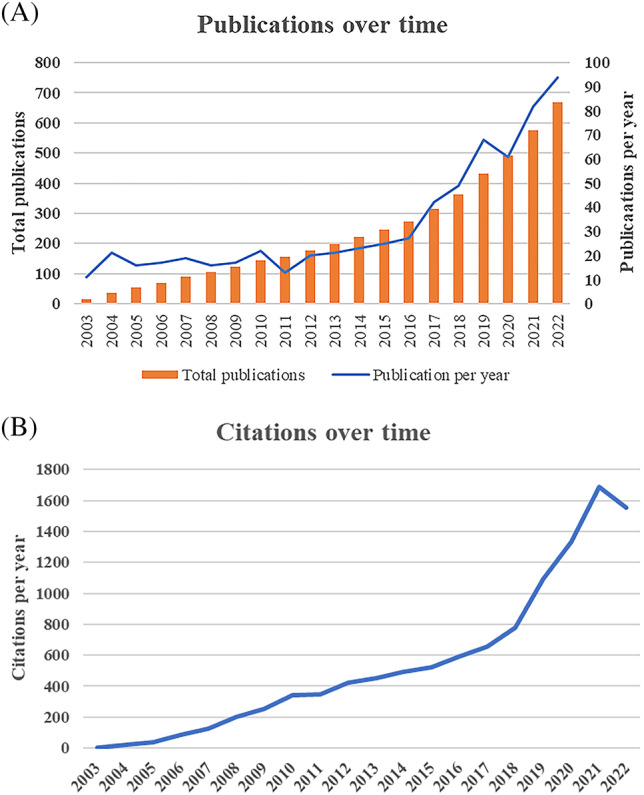
The overview information in the scar and psychological health field. (A) Annual scientific production and total publications in this research area from 2003 to 2022. (B) The number of article citations per year in this research area from 2003 to 2022.
A total of 9698 references were cited in the 664 publications, of which 9502 were not self‐cited (97.98%) and 196 were self‐cited (2.02%). In terms of times cited, these publications were cited 11 018 times, including 345 self‐citations (3.13%) and 10 673 non‐self‐citations (96.87%), with each paper cited 16.59 times. To grasp the tendency of citation in this field, times cited over time graph was generated. As shown in Figure 1B, during the period from 2003 to 2022, the number of references cited each year presented a gradually increasing trend. The most cited was in 2021, with 1685 citations (accounting for 15.29% of all times cited). This trend increased sharply between 2018 and 2021, with growth from 777 to 1685.
3.2. Citation analyses
Table S1 lists the 10 most cited papers in the field of scarring and mental health. The publication years of these highly cited references ranged from 2003 to 2020, among which the most cited reference was an article published by Van Loey NE et al in 2003, with a total of 339 citations (3.08% of times cited). 20 After that, “The hidden cost of skin scars: quality of life after skin scarring” published by Brown BC in 2008 received 295 citations. 5 In third place was “Psychological reactions, quality of life, and body image after bilateral prophylactic mastectomy in women at high risk for breast cancer: a prospective 1‐year follow‐up study” written by Brandberg (2008), which received 168 citations. 21 Articles written by Onderdijk (2013) and Andrews (2016) were close behind, with 163 and 158 citations, respectively. 22 , 23 Van Loey et al. suggested that a minor role appears to play in the scars of burn survivors in psychopathology and psychological problems. 20 The article by Brown et al, which reported for most participants, the appearance of scars was unacceptable, further contributing to life, work, and social dysfunction, had the most citations in the last 5 years (n = 165, 55.93% of all its cited times). 5 In the last 5 years, it was followed by Andrews (2016) which was cited 140 times (88.61% of all its cited times), and Sabat R (2020) (n = 137, 100% of its cited times). 23 , 24 The total citations of these top 10 articles were 1795 times (accounting for 16.29% of all citations). This indicated that these most cited articles are still active in this field and have important reference value. There were 15 works (2.26% of all publications) cited more than 100 times, with 2364 citations (21.46% of all times cited).
3.3. Analysis of authors
We used the biblioshiny website to get 2963 authors from 664 articles, including 2924 multi‐authored documents authors and 39 authors of single‐authored publications. Co‐authors per document was 4.85 and international co‐authorships was 13.1 percent. As shown in Table 1, Van Loey NE was a producer of the most articles, with 10, followed by Burke TA (n = 6) and Alloy LB (n = 5). Dreno B and Chen W came in at No.4 and No.5 with 5 and 4 articles, respectively.
TABLE 1.
Top 10 contributing authors in this field.
| Authors | Articles | Articles fractionalized | h‐index | g‐index | m‐index | TC |
|---|---|---|---|---|---|---|
| Van Loey NE | 10 | 2.58 | 8 | 10 | 0.381 | 727 |
| Burke TA | 6 | 1.29 | 6 | 6 | 0.75 | 80 |
| Alloy LB | 5 | 1.09 | 5 | 5 | 0.625 | 72 |
| Dreno B | 5 | 0.76 | 3 | 5 | 0.5 | 61 |
| Chen W | 4 | 0.53 | 3 | 4 | 0.5 | 123 |
| Kimble R | 4 | 0.67 | 3 | 4 | 0.188 | 36 |
| Li J | 4 | 1.04 | 2 | 4 | 0.182 | 48 |
| Ammerman BA | 3 | 0.59 | 3 | 3 | 0.429 | 39 |
| Bagatin E | 3 | 0.82 | 3 | 3 | 0.5 | 63 |
| Bakker A | 3 | 0.64 | 3 | 3 | 0.214 | 162 |
Figure S1 shows the authors' production over time. The first article published by Van Loey NE was in 2003 and his last was in 2021. During this period, the publications of Van Loey NE maintained a relatively stable increase. The year 2014 was the one with the largest number of publications published by Van Loey NE, with both publishing 3 articles, and the annual total citation was the highest in 2003 (n = 16.14). Burke TA, Alloy LB, Dreno B, and Chen W were the emerging authors in this field in the past 7 years. Their annual publications were maintained at a relatively stable level, suggesting that they had a keen interest in this field.
To reflect the impact of the author distinctly, Table 1 was produced with several different indexes. As an indicator to measure the quality and sustainability of scientific output, the h‐index is used to describe the impact of scientists. 25 Van Loey NE occupied the top 1 with an h‐index of 8. Burke TA (h‐index = 6), Alloy LB (h‐index = 5), Dreno B (h‐index = 3), and Chen W (h‐index = 3) followed. However, the h‐index does not accurately describe the influence of authors, as the different seniority of scientists is not considered. As a remedial measure, the m‐index corrects for the time and helps identify truly successful scientists. 25 Burke TA has the highest m‐index of 0.75 among all authors, which suggests that Burke TA features a high‐level writer in this field but is not yet a successful scientist. 26 Van Loey NE possesses an m‐index of 0.381 but the highest g‐index of 10, which indicates he possesses highly cited articles in this field. The g‐index is a modification of the h‐index, solving the problem that the h‐index is insensitive to the most cited papers. 27
We employed VOSviewer software to perform an analysis of author co‐citations. The minimum number of citations of an author was set as 20 to contain a sufficient number of authors. Out of 16 777 authors, 33 authors met the threshold and were selected for analysis. Points of different colours indicate that the authors are classified into various aggregations. The larger the point size, the more times the author is co‐cited. Two authors cited in the same reference are linked by a line. The tightness of the connection is indicated by the length of the line; the shorter the line, the tighter the connection. 28 Figure 2A contains 5 clusters. Cluster 1 is the largest, and the research content is related to “burn scar”. Cluster 2 involves “treatment”, Cluster 3 includes “influence of scar”, 4 is related to “hidradenitis suppurativa”, and “Psychiatry and psychology” is the research content of Cluster 5. Researchers can cooperate with people in similar research fields, or with people in other different research fields to enrich their views. The density visualization displays the frequency of occurrence of the same co‐cited authors (Figure 2B). The redder the circle, the higher the citation frequency of the author, which indicates the better the performance of the researcher in this field. The best performance in Cluster 1 was Lawrence JW. Alster TS was in Cluster 2, Layton AM was in Cluster 3, Zouboulis CC was in Cluster 4, and Beck AT was in Cluster 5.
FIGURE 2.
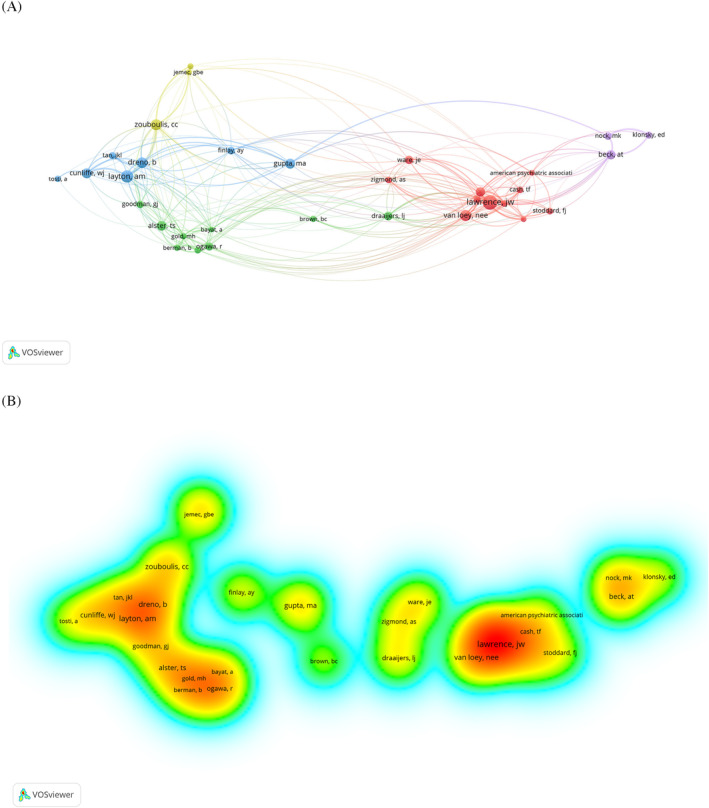
Co‐citation analysis of authors in the field. (A)Visualization of co‐cited networks of authors with over 20 citations per author. (B) Visualization of the co‐citation density of authors cited over 20 times.
3.4. Analysis of countries and institutions
There are 51 countries or regions, out of 664 articles. As shown in Figure 3A, the United States was the world's largest producer, contributing 156 articles (23.49% of all). It included 143 single‐country articles (91.67%) and 13 multi‐country articles (8.33%). China ranked second, with 88 articles (13.25% of the total) and 81 single‐country articles (92.05%). The United Kingdom was third (n = 48, 7.23% of the total), followed by Korea with 38 and Italy with 32.
FIGURE 3.
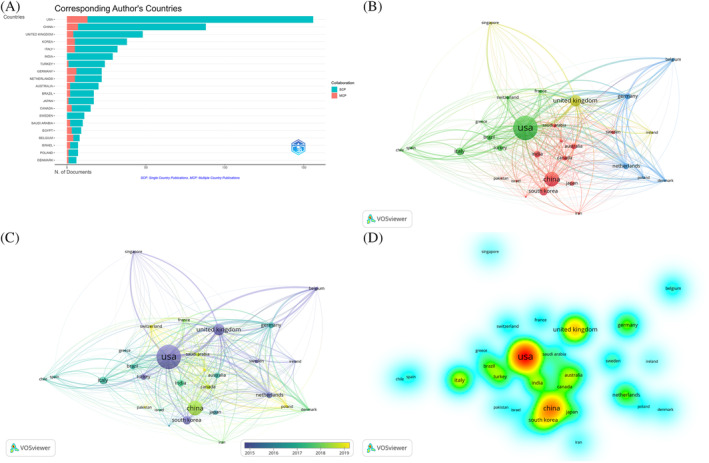
The map of the countries of the corresponding authors and analysis of the country collaborations in the field. (A) The map of total contributions for each country. MCP means multi‐collaboration publications, and SCP represents single‐collaboration publications. (B) The map of bibliographic coupling networks among countries having at least 5 articles published. (C) Bibliographic coupling overlay map among countries having at least 5 documents. Blue for earlier years; yellow for more current years. (D) Map of country bibliographic coupling density.
These countries or regions involved in this area were analysed for showing the bibliographic coupling with a minimum number of five documents of a country. Figure 3B shows the network visualization that performs the identified countries' clusters. The overlay visualization presents the same connected countries mapped by the average publication year (Figure 3C). Figure 3D is a density visualization reflecting the frequency of appearance. Developed countries occupied a leading position in this field. The United States seemed to be the central country for publications in this field, as it had the densest connections with other countries or regions. European countries, such as the United Kingdom, Germany, and the Netherlands, also accounted for a lot of articles and had close ties with other countries. It should be noted that Asian countries, such as China, were emerging drivers of research in this field.
Table S2 shows the countries with the most quotations. The United States ranked first with 3340 citations (30.31%), while the United Kingdom ranked second with 1574 (14.29%). It was followed by the Netherlands (n = 903, 8.20%), Germany (n = 718, 6.52%), and China (n = 552, 5.01%). The other five countries in the top 10 were Sweden (n = 497, 4.51%), Korea (n = 413, 3.75%), Italy (n = 323, 2.93%), Turkey (n = 303, 2.75%), and India (n = 227, 2.06%). Of the top 10 most‐cited countries, Sweden ranked first with an average of 45.18 citations. At the same time, the average number of citations was 41.05 in the Netherlands, 32.79 in the United Kingdom, 32.64 in Germany, and 21.41 in the United States. Conspicuously, the average number of article citations in China only was 6.27. The publications from Sweden were of high quality, but it was the opposite in China.
There were 1044 organizations involved in the field. Pennsylvania University ranked first for the highest number of publications (n = 13, 1.96%). The remaining top five were Utrecht University (n = 12, 1.81%), Miami University (n = 12, 1.81%), Queensland University (n = 12, 1.81%), and Northwestern University (n = 11, 1.66%). Organizations with the same volume of publications were ranked by when the first article was published. The chart shows the change in publication volume of the top five most relevant organizations (Figure S2).
The first publication on Pennsylvania University was published in 2007 and an obvious publication increase appeared from 2013 to 2022. Utrecht University and Miami University had shown strong interest in this field in the past 10 years, with an explosive increase in publication volume. Compared with other institutions, Miami University, Queensland University, and Northwestern University have grown markedly over the past 5 years in the field of scars and mental health. Research at the University of Pennsylvania was about psychological distress and quality of life. Utrecht University was concerned about the psychological distress of burn survivors. Queensland University researched the psychological distress of burn survivors and the treatment of burn scars. Northwestern University's main research interests were the assessment of the quality of life and psychology in patients with scars. Miami University had a broader focus.
Then through VOSviewer, we analysed the bibliographic coupling of institutions that had contributed over five papers and got the results for 26 organizations. There are 5 clusters with seven colours in Figure 4. Pennsylvania University owned the highest level of collaboration with a total link strength of 641. Utrecht University ranked second based on total link strength of 627. Northwestern University followed with a total link strength of 441. The total association strength was the same at Harvard Medical School (n = 427) and the University of Copenhagen (n = 427). Scholars or institutions interested in collaboration can try to contact institutions with corresponding research directions according to their research directions.
FIGURE 4.
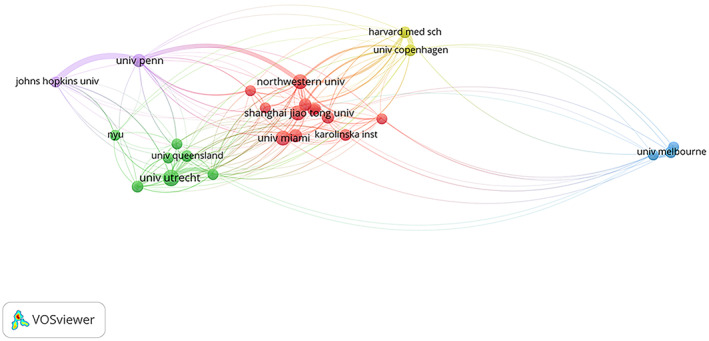
Bibliographic coupling of organizations with the threshold of 5 documents.
The three‐field plot (Figure S3) presents the association of top authors (left), institutions (center), and the most productive countries (right). The nodes' height and the boldness of the lines denote the contribution and connection figures of a country, author, and institution respectively. One of the countries with the highest level of association was the United States, which was associated with 12 institutions. The Netherlands (n = 5) and Germany (n = 5) followed. The Charity University of Berlin Medicine was the organization with the most national connections. The authors who were most active in collaboration between different institutions were Van Loey NE, Bakker A, Geenen R, and Jemec GBE.
3.5. Analysis of journals
Figure 5A illustrates the 10 sources publishing the largest quantity of papers in the field among 363 journals. In terms of journals, “Burns” was the journal responsible for the highest publication output in the scar‐psychological field, with a total of 25 academic papers published. “Aesthetic Plastic Surgery” ranked second with 24 articles. The other top five sources with the most published papers included “Plastic and Reconstructive Surgery” (n = 22), the “Journal of Craniofacial Surgery” (n = 19), and the “Journal of Cosmetic Dermatology” (n = 15). Figure 5B shows the top five most published source dynamics. Since 2015, there has been a rapid increase in the number of “Burns” papers published, with the most marked increase among the top 5 sources. “Aesthetic Plastic Surgery”, “Journal of craniofacial surgery”, and “Journal of Cosmetic Dermatology” also maintained the momentum of rapid growth in the past 5 years. In Table 2, “Burns” obtained the most source local impact with the maximum h‐index and m‐index, and “Plastic and Reconstructive Surgery” also had the same h‐index and m‐index. “Dermatologic Surgery”, “Aesthetic Plastic Surgery” and “American Journal of Clinical Dermatology” followed.
FIGURE 5.
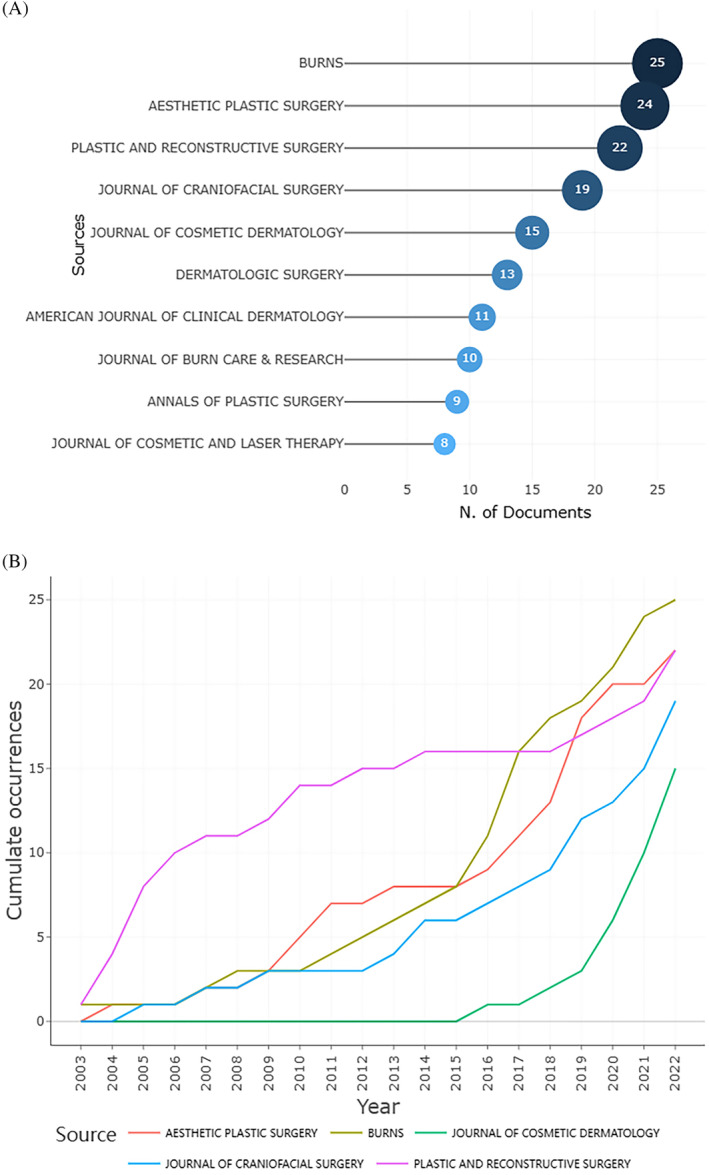
The top 10 sources in the field with the highest number of documents (A) and the tendency of the top 5 sources over time (B).
TABLE 2.
The top 5 most influential journals.
| Journals | h‐index | g‐index | m‐index |
|---|---|---|---|
| Burns | 13 | 18 | 0.619 |
| Plastic and Reconstructive Surgery | 13 | 22 | 0.619 |
| Dermatologic Surgery | 11 | 13 | 0.55 |
| Aesthetic Plastic Surgery | 10 | 13 | 0.5 |
| American Journal of Clinical Dermatology | 9 | 11 | 0.429 |
3.6. Keyword co‐occurrence analysis
The total number of keywords in the scar and psychological field was 3225, analysed by VOSviewer, of which 78 meet the threshold with 10 occurrences of a keyword. Figure 6A displays the network of selected keywords roughly divided into 4 clusters. It is not hard to see that “quality‐of‐life” occupied the most important position which occurs 112 times. “depression” was the second, with 92 times. It was followed by “management” (n = 61), “anxiety” (n = 59), and “prevalence” (n = 55). The average time these keywords appeared in their articles is indicated by the colour of the overlay visualization (Figure 6B). Compared with the hot words in the past: “quality‐of‐life”, “depression”, “anxiety”, and “prevalence”, the words (“management”, “surgery”, “impact”, and “efficacy”) were the latest hotspots. This suggested that the focus of interest in the past was psychological and physical problems caused by scars, but in recent years, more attention has been paid to scar treatment and curative effects.
FIGURE 6.
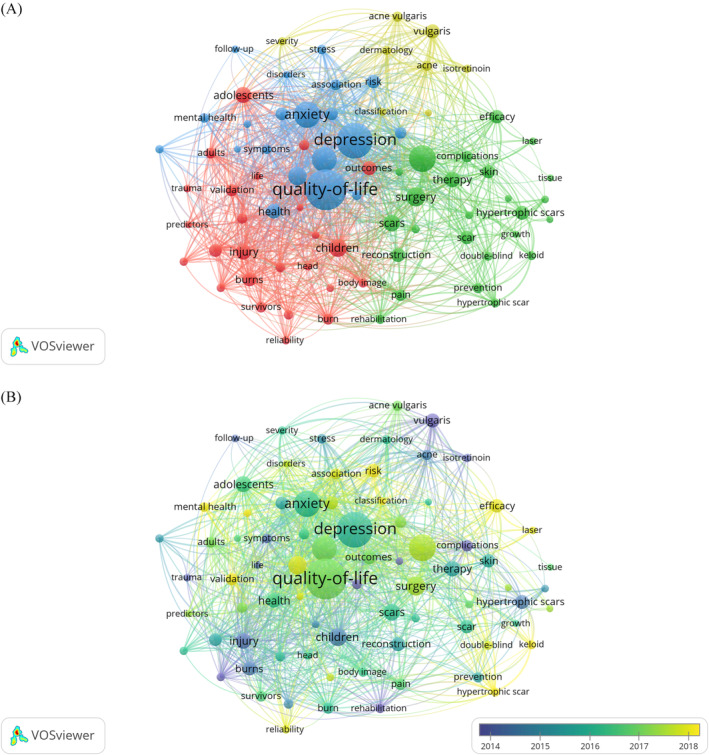
Co‐occurrence analysis of keywords. (A) Related research keyword network mapping (4 clusters). (B) Overlay of keywords according to the year of publication on average.
Keywords plus graphs were analysed through the biblioshiny website to find out which words or phrases appeared frequently in the headings of the referenced articles quoted in the searched publications. 29 Figure S4 presents the “Keywords Plus” thematic map, in which the Y‐axis signifies density which is a measure of a topic's development, and the X‐axis signifies centrality (the importance of a topic). 30 The four quadrants in Figure S4 represent different senses: Quadrant 1 (upper right quadrant): the words with high centrality and impact have developed well and are important in this field. Quadrant 2 (upper left quadrant) is concerned with the highly developed and isolated themes, which implies that they are well‐established but are of less significance because of their weak links to other themes. 31 Quadrant 3 (lower left quadrant) is the decline or emergence theme. Quadrant 4 (lower right quadrant) refers to the underlying themes that are considered to be the fundamental concepts and knowledge of the field of study. It is easy to see the green keywords plus (“depression”, “vulgaris”, “quality‐of‐life”) was in Quadrant 1, indicating these keywords were characterized by adequate development and high concentration. The blue Cluster (“quality‐of‐life”, “injury”, “prevalence”) and orange Cluster (“hospital anxiety”, “depression scale”, “impact”) were in Quadrant 2, suggesting that they had well‐developed but their importance in this field was limited. Although both the green Cluster and blue Cluster contained “quality of life”, their research directions were different: the green Cluster was related to “vulgaris acne”, while the blue Cluster was related to “injury”. The purple keywords plus (“management”, “efficacy”, and “safety”) in Quadrant 3 had moderate development and correlation, suggesting that these keywords appeared to rise rather than disappear according to Figure 6B. The pink Cluster in Quadrant 4, including “hypertrophic scars”, “prevention”, and “imiquimod 5‐percent cream”, had s favourable connection but the development was limited.
4. DISCUSSION
4.1. Analysis of the current situation
Biblioshiny and VOSviewer were combined to characterize the current situation of scar and mental health, to analyse the author, national, institutional, and journal contributions to this burgeoning field, and to predict popular trends that are set to continue to generate research interest. Annual publication output in the field has grown steadily since its emergence in 2003 and has grown particularly rapidly in the last 7 years, accounting for 59.64% of 664 articles. This shows that there is a lot of scope for development in this area and is receiving increasing attention from researchers. Among the major contributors, Van Loey NE and Bakker A are concerned with the psychiatric mental health of patients with burn scars; Burke TA and Alloy LB are interested in the psychological problems of patients with non‐suicidal self‐injury scars; the impact of acne on patients' lives is the focus of Dreno B and Bagatin E; and Chen W, Kimble R, and Li J are interested in the treatment of scars.
We described the contributions of a total of 51 countries to this area of research. What is clear was that developed countries dominate this field. The United States was the leading country with the most publications, citations, and contacts with other countries. Three of the five most productive institutions in the region were based in the USA. There is no doubt that the United States had the greatest contribution and cooperation with other countries and organizations. Second, European countries also made a significant contribution, with three countries in the top five for citations. In addition, European countries also contributed to the volume of publications, taking four of the top 10 most‐published countries. It is worth noting that Sweden, with a small number of papers, ranked 6th in the citations and had the highest average citations, which shows that Sweden plays a significant role in this field. 32 China had the second‐largest number of published articles. However, the number of citations of Chinese articles was significantly lower than that of other countries, suggesting that the level of Chinese articles needs to be improved. 20 This could be for several reasons. China is a country with a large population base and a corresponding number of researchers. It is not difficult to understand that China publishes a lot of articles. On the other sides, the research in this field in China is new and not in‐depth, and there is a lack of deep research and clinical longitudinal research on the mechanism of scar‐causing depression. In this regard, when conducting research in this area, more attention could be paid to the literature published in the more active and higher‐quality countries, such as the United States, the United Kingdom, the Netherlands, Germany, and Switzerland.
Of the 363 journals involved, the most productive journals were classified seven as “cosmetic dermatology”, two as “burn”, and one as “dermatology”. Cosmetic skin research has been the main direction in this field. This indicates that “cosmetic dermatology” journals are the focus of scholars in this field. Similarly, research on the direction of burn is also one of the key areas in this field. Moreover, in the last 10 years, the field of burns has gained attention and achieved rapid development, which may be because of the high morbidity, mortality, and psychological disorders caused by burns. 20 Depression and post‐traumatic stress disorder are prevalent in 13%–23% and 13%–45% of burn scar patients, respectively. 20 , 33 This suggests that scholars interested in the field can focus on these sources. From the perspective of the research content of the main journals, cosmetic disfigurement plays an important role in the development of psycho‐psychological disorders in scarred patients and may even be the cornerstone of the occurrence of this phenomenon. In this regard, patients' subjective perceptions of disfigurement may be more influential than objective disfigurement characteristics. In the facial disfigurement population, female patients have a higher incidence of depression compared to male patients. 34 , 35
4.2. Hotspots analysis
From the keyword analysis, compared with posttraumatic stress disorder and other mental diseases, depression, and anxiety were the most concerning mental illnesses in this field. Interestingly, why are depression and anxiety more concerned and common than other mental diseases in this field? This may be because the negative factors caused by scars tend to give rise to depression or anxiety. We can see that the research focus in this field has shifted from the psychological and physical problems caused by scars (“quality‐of‐life”, “depression”, “anxiety”, and “prevalence”) to the scar treatment (“management”, “surgery”, “impact”, and “efficacy”).
Different types of therapies are employed to address scars, ranging from invasive treatment, like intra‐lesion corticosteroid injections, radiotherapy, cryotherapy, and surgery, to noninvasive ones like silicone gel sheets, physiotherapy, and compression therapy. 36 Chemotherapy, immunotherapy, and anti‐inflammatory therapy are newly emerging treatments. 37 The use of silicone materials has been put forward as the “gold standard” treatment for keloids, with improvements of up to 90% in keloids. 38 , 39 Surprisingly, although many studies have found that the use of silicone gel sheets reduced the incidence, thickness, and size of hyperplastic scars, occlusive silicone gel sheets did not show a significant benefit for scar treatment. 40 , 41 , 42 , 43 , 44 , 45 This may be related to the quality of the study. In response to this debate, scholars may need to conduct more high‐quality clinical studies to better validate the effectiveness of silicone materials as the gold standard treatment. Scholars interested in this area may also explore the mechanisms by which silicone materials affect scars. For now, the mechanism of action of silicone therapy is unclear, but the process may involve occlusion and hydration of the stratum corneum. 46 Intralesional corticosteroid injections are also considered to be a front‐line treatment for keloid scars. 47 It may improve scars by inhibiting fibroblast proliferation, collagen synthesis, and inflammation. 48 , 49 For burn scars, compression therapy is the standard first‐line treatment option but has the disadvantage of being costly and poorly adhered to by patients. 37 Although surgical excision is often chosen, it has a high recurrence rate and can lead to larger lesions, so this treatment needs to be approached with caution or as an adjunct to postoperative treatment. 50 Among these treatments, corticosteroids, radiation therapy, cryotherapy, 5‐fluorouracil (5‐FU) therapy, compression therapy, and stabilization therapy all inhibit the aggressive growth of keloids and hyperplastic scars by reducing inflammation. 2 This also hints at the promising vision of anti‐inflammatory therapy, as an emerging therapy, for future applications.
Scar management interventions can provide an improved life quality for burn patients, especially where scars are visible. 51 Importantly, the management of scars is long‐term and needs to be evaluated. In the evaluation, patients' attention to scars is evaluated after receiving treatment, while there are few reports on the psychological evaluation of patients. 36 , 52 In this regard, the scale Mekeres, GM et al. reported to assess the psychological condition of burn scar patients could be used for reference. 53 Although improvement in scars is associated with improvement in depression, the extent to which scar therapy improves depression has not been reported. Therefore, in addition to the treatment of scars, whether other treatments are needed to improve patients' psycho‐psychological disorders is worth discussing.
4.3. Analysis of pathogenesis and treatment
The development of psychological disorders in scarring patients may be mediated by certain variables. There is growing evidence that scarring is associated with the development of psychiatric disorders such as depression and anxiety. Scar formation can lead to certain negative effects. A variety of conditions exist in acne scar patients, such as low self‐esteem, embarrassment, feelings of worthlessness and less attractiveness, social distress in patients with acne scars, social avoidance, and the severity correlate with the severity of acne. 54 , 55 The changes produced are multifaceted, such as psychosocial dimensions, cognitive dimensions, personality dimensions, and stressful life events. 56 Patients' ratings of these variables may be more meaningful because the severity and visibility of scars evaluated by patients are related to psychosocial distress, rather than objective evaluation. 57
These influences play a role in the development of psychological distress in people with scarring. Body imagery dissatisfaction mediates in the development of psychological distress in adult survivors of childhood cancer with treatment‐related scarring/disfigurement. 58 Similarly, Orth U et al. validated that low self‐esteem can lead to the onset of depression. 59 Moreover, depression can in turn promote negative variables such as social impairment, pessimistic cognitions, and neuroticism, which in turn increase the likelihood of recurrence of depression. 56 The relationship between scars, negative variables, and mental illness may form a vicious cycle, and ending this cycle may have a positive effect on treatment.
This raises an interesting question. Are there significant treatment outcomes of multidisciplinary treatment compared with scar treatment outcomes alone for this group of patients? Peng, Y et al. reported that cognitive behavioural‐oriented psychological interventions played a positive role in the psychological state and mental health of some patients with depressed facial acne scarring treated with photothermal therapy. 60 This suggests that multidisciplinary treatment can be meaningful. However, reports of multidisciplinary treatment are rare, so this area is worth exploring.
5. LIMITATIONS
Although we followed the steps of a scientometric study, there were some shortcomings in our research. First, WOS as the only database for our included articles, even though it is one of the largest databases in the world, resulted in our study not being able to fully cover the entire literature on all scars and psychosomatic disorders. Secondly, there are limitations to the analysis tools we used. For example, when performing a co‐citation analysis of authors through VOSviewer, only the first author of the document is analysed. Despite these shortcomings, we believe that our findings are useful for research in this direction and may guide the direction of research in the field.
6. CONCLUSION
This bibliometric study analyzes the value of information on the psychological impact of scarring on people from 2003 to 2022, reveals the contributions of national collaborative networks, institutions, journals, and authors, and provides research findings from landmark articles, as well as research hotspots and directions. The field of scar‐mediated depression research is new in the last 20 years and has grown rapidly in the last 7 years.
We found that the United States is the major contributor in this field, Van Loey NE is the most prolific author, and “Cosmetic Dermatology” and “Burns” sources are mainstream journals. Currently, scholars are more concerned with the treatment and management of scars. In addition, we have discussed the mechanisms by which scars lead to psychological disorders. In this article, we present research hotspots, potential mechanisms, and development opportunities in this field to contribute to research in this area.
FUNDING INFORMATION
This work was supported by the Special Fund Project of Guangdong Science and Technology (210728156901524), Shantou Medical Science and Technology Planning Project (grant number 200622115260639, 2021‐68‐44, 2022‐88‐27), and Administration of Traditional Chinese Medicine of Guangdong Province project (202205092315428030).
CONFLICT OF INTEREST STATEMENT
The authors declare that the research was conducted in the absence of any commercial or financial relationships that could be construed as a potential conflict of interest.
Supporting information
Table S1. The top 10 most‐cited papers in the scar and mental health research.
Table S2. The top 10 countries cited most in the scar‐psychological area.
Figure S1. The top 10 authors' production in this field over time. The red line represents the periods from the author's earliest article to the latest document. The depth of colour is proportionate to the annual total citations and the size of the blue circle is dependent on the volume of articles.
Figure S2. The top 5 affiliations' production over time in this field.
Figure S3. Three‐field plot among top authors(left), the institutions(middle), and the most productive countries(right).
Figure S4. Thematic map of keywords plus.
ACKNOWLEDGMENTS
The authors thank Shantou University, supervisors, and colleagues for giving the opportunity and guidance.
Wu J, Zou J, Yang Q, et al. The effects of scar in psychological disorder: A bibliometric analysis from 2003 to 2022. Int Wound J. 2024;21(1):e14373. doi: 10.1111/iwj.14373
Contributor Information
Zhiyang Li, Email: s_zyli4@stu.edu.cn.
Yanna Xie, Email: 17f1ynxie1@stu.edu.cn.
DATA AVAILABILITY STATEMENT
The data that support the findings of this study are available from the corresponding author upon reasonable request.
REFERENCES
- 1. Bryant RA, Rolstad BS. Examining threats to skin integrity. Ostomy Wound Manage. 2001;47(6):18‐27. [PubMed] [Google Scholar]
- 2. Ogawa R. Keloid and hypertrophic scars are the result of chronic inflammation in the reticular dermis. Int J Mol sci. 2017;18(3):606. doi: 10.3390/ijms18030606 [DOI] [PMC free article] [PubMed] [Google Scholar]
- 3. Wang ZC, Zhao WY, Cao Y, et al. The roles of inflammation in keloid and hypertrophic scars. Front Immunol. 2020;11:603187. doi: 10.3389/fimmu.2020.603187 [DOI] [PMC free article] [PubMed] [Google Scholar]
- 4. Amici JM, Taïeb C, LeFloc'h C, Demessant‐Flavigny AL, Seité S, Cogrel O. Prevalence of scars: an international epidemiological survey in adults. J Eur Acad Dermatol Venereol. 2022;36(10):e799‐e800. doi: 10.1111/jdv.18277 [DOI] [PMC free article] [PubMed] [Google Scholar]
- 5. Brown BC, McKenna SP, Siddhi K, McGrouther DA, Bayat A. The hidden cost of skin scars: quality of life after skin scarring. J Plast Reconstr Aesthet Surg. 2008;61(9):1049‐1058. doi: 10.1016/j.bjps.2008.03.020 [DOI] [PubMed] [Google Scholar]
- 6. Tan J, Beissert S, Cook‐Bolden F, et al. Impact of facial atrophic acne scars on quality of life: a multi‐country population‐based survey. Am J Clin Dermatol. 2022;23(1):115‐123. doi: 10.1007/s40257-021-00628-1 [DOI] [PMC free article] [PubMed] [Google Scholar]
- 7. Pavlickova H, Turnbull OH, Bentall RP. Discrepancies between explicit and implicit self‐esteem and their relationship to symptoms of depression and mania. Psychol Psychother‐Theory Res Pract. 2014;87(3):311‐323. doi: 10.1111/papt.12015 [DOI] [PubMed] [Google Scholar]
- 8. Gallo LMH, Giampietro V, Zunszain PA, Tan KS. Covid‐19 and mental health: could visual art exposure help? Front Psychol. 2021;12:650314. doi: 10.3389/fpsyg.2021.650314 [DOI] [PMC free article] [PubMed] [Google Scholar]
- 9. Mithunasri LV, Jadhav A. Influence of self‐perception and importance of body image on the methods implemented to enhance the physical appearance. Chang Soc Pers. 2021;5(1):126‐142. doi: 10.15826/csp.2021.5.1.125 [DOI] [Google Scholar]
- 10. Hoogewerf CJ, van Baar ME, Middelkoop E, van Loey NE. Impact of facial burns: relationship between depressive symptoms, self‐esteem and scar severity. Gen Hosp Psych. 2014;36(3):271‐276. doi: 10.1016/j.genhosppsych.2013.12.001 [DOI] [PubMed] [Google Scholar]
- 11. Hoogewerf CJ, van Baar ME, Middelkoop E, van Loey NE. Patient reported facial scar assessment: directions for the professional. Burns. 2014;40(2):347‐353. doi: 10.1016/j.burns.2013.07.015 [DOI] [PubMed] [Google Scholar]
- 12. Millar K, Bell A, Bowman A, et al. Psychological status as a function of residual scarring and facial asymmetry after surgical repair of cleft lip and palate. Cleft Palate‐Craniofac J. 2013;50(2):150‐157. doi: 10.1597/10-222 [DOI] [PubMed] [Google Scholar]
- 13. Lawrence JW, Fauerbach JA, Heinberg L, Doctor M. The 2003 clinical research award ‐ visible vs hidden scars and their relation to body esteem. J Burn Care Rehabil. 2004;25(1):25‐32. doi: 10.1097/01.Bcr.0000105090.99736.48 [DOI] [PubMed] [Google Scholar]
- 14. Ault P, Plaza A, Paratz J. Scar massage for hypertrophic burns scarring‐a systematic review. Burns. 2018;44(1):24‐38. doi: 10.1016/j.burns.2017.05.006 [DOI] [PubMed] [Google Scholar]
- 15. Roh YS, Cho H, Oh JO, Yoon CJ. Effects of skin rehabilitation massage therapy on pruritus, skin status, and depression in burn survivors. J Korean Acad Nurs. 2007;37(2):221‐226. [DOI] [PubMed] [Google Scholar]
- 16. Moral‐Munoz JA, Herrera‐Viedma E, Santisteban‐Espejo A, Cobo MJ. Software tools for conducting bibliometric analysis in science: an up‐to‐date review. Prof Inferm. 2020;29(1):20. doi: 10.3145/epi.2020.ene.03 [DOI] [Google Scholar]
- 17. Aria M, Cuccurullo C. Bibliometrix: an R‐tool for comprehensive science mapping analysis. J Informet. 2017;11(4):959‐975. doi: 10.1016/j.joi.2017.08.007 [DOI] [Google Scholar]
- 18. van Eck NJ, Waltman L. Software survey: VOSviewer, a computer program for bibliometric mapping. Scientometrics. 2010;84(2):523‐538. doi: 10.1007/s11192-009-0146-3 [DOI] [PMC free article] [PubMed] [Google Scholar]
- 19. Wang J, Dong P, Zheng S, et al. Advances in gut microbiome in metabonomics perspective: based on bibliometrics methods and visualization analysis. Front Cell Infect Microbiol. 2023;13:1196967. doi: 10.3389/fcimb.2023.1196967 [DOI] [PMC free article] [PubMed] [Google Scholar]
- 20. Van Loey NEE, Van Song MJM. Psychopathology and psychological problems in patients with burn scars—epidemiology and management. Am J Clin Dermatol. 2003;4(4):245‐272. doi: 10.2165/00128071-200304040-00004 [DOI] [PubMed] [Google Scholar]
- 21. Brandberg Y, Sandelin K, Erikson S, et al. Psychological reactions, quality of life, and body image after bilateral prophylactic mastectomy in women at high risk for breast cancer: a prospective 1‐year follow‐up study. J Clin Oncol. 2008;26(24):3943‐3949. doi: 10.1200/jco.2007.13.9568 [DOI] [PubMed] [Google Scholar]
- 22. Onderdijk AJ, van der Zee HH, Esmann S, et al. Depression in patients with hidradenitis suppurativa. J Eur Acad Dermatol Venereol. 2013;27(4):473‐478. doi: 10.1111/j.1468-3083.2012.04468.x [DOI] [PubMed] [Google Scholar]
- 23. Andrews JP, Marttala J, Macarak E, Rosenbloom J, Uitto J. Keloids: the paradigm of skin fibrosis ‐ Pathomechanisms and treatment. Matrix Biol. 2016;51:37‐46. doi: 10.1016/j.matbio.2016.01.013 [DOI] [PMC free article] [PubMed] [Google Scholar]
- 24. Sabat R, Jemec GBE, Matusiak Ł, Kimball AB, Prens E, Wolk K. Hidradenitis suppurativa. Nat Rev Dis Primers. 2020;6(1):18. doi: 10.1038/s41572-020-0149-1 [DOI] [PubMed] [Google Scholar]
- 25. von Bohlen Und Halbach O. How to judge a book by its cover? How useful are bibliometric indices for the evaluation of “scientific quality” or “scientific productivity”? Ann Anat. 2011;193(3):191‐196. doi: 10.1016/j.aanat.2011.03.011 [DOI] [PubMed] [Google Scholar]
- 26. Hirsch JE. An index to quantify an individual's scientific research output. Proc Natl Acad Sci USA. 2005;102(46):16569‐16572. doi: 10.1073/pnas.0507655102 [DOI] [PMC free article] [PubMed] [Google Scholar]
- 27. Garg K, Ranjan M, Krishna V, Singh M, Rezai A. A scientometric analysis of the 100 most cited articles on magnetic resonance guided focused ultrasound. Front Hum Neurosci. 2022;16:981571. doi: 10.3389/fnhum.2022.981571 [DOI] [PMC free article] [PubMed] [Google Scholar]
- 28. Huang T, Zhong W, Lu C, et al. Visualized analysis of global studies on cervical spondylosis surgery: a bibliometric study based on web of science database and VOSviewer. Indian J Orthop. 2022;56(6):996‐1010. doi: 10.1007/s43465-021-00581-5 [DOI] [PMC free article] [PubMed] [Google Scholar]
- 29. Zhu X, Hu J, Deng S, et al. Comprehensive bibliometric analysis of the kynurenine pathway in mood disorders: focus on gut microbiota research. Front Pharmacol. 2021;12:687757. doi: 10.3389/fphar.2021.687757 [DOI] [PMC free article] [PubMed] [Google Scholar]
- 30. Aria M, Alterisio A, Scandurra A, Pinelli C, D'Aniello B. The scholar's best friend: research trends in dog cognitive and behavioral studies. Anim Cogn. 2021;24(3):541‐553. doi: 10.1007/s10071-020-01448-2 [DOI] [PMC free article] [PubMed] [Google Scholar]
- 31. Chen L, Liu Y, Cai J, et al. Global trends in research of androgen receptor associated with breast cancer from 2011 to 2020: a Scientometric analysis. Front Endocrinol (Lausanne). 2022;13:887612. doi: 10.3389/fendo.2022.887612 [DOI] [PMC free article] [PubMed] [Google Scholar]
- 32. Xie H, Zhang Y, Wu Z, Lv T. A bibliometric analysis on land degradation: current status, development, and future directions. Landarzt. 2020;9(1):28. doi: 10.3390/land9010028 [DOI] [Google Scholar]
- 33. Roh YS, Chung HS, Kwon B, Kim G. Association between depression, patient scar assessment and burn‐specific health in hospitalized burn patients. Burns. 2012;38(4):506‐512. doi: 10.1016/j.burns.2011.12.027 [DOI] [PubMed] [Google Scholar]
- 34. Fukunishi I. Relationship of cosmetic disfigurement to the severity of posttraumatic stress disorder in burn injury or digital amputation. Psychother Psychosom. 1999;68(2):82‐86. doi: 10.1159/000012317 [DOI] [PubMed] [Google Scholar]
- 35. Wiechman SA, Ptacek JT, Patterson DR, Gibran NS, Engrav LE, Heimbach DM. Rates, trends, and severity of depression after burn injuries. J Burn Care Rehabil. 2001;22(6):417‐424. doi: 10.1097/00004630-200111000-00012 [DOI] [PubMed] [Google Scholar]
- 36. Meaume S, Le Pillouer‐Prost A, Richert B, Roseeuw D, Vadoud J. Management of scars: updated practical guidelines and use of silicones. Eur J Dermatol. 2014;24(4):435‐443. doi: 10.1684/ejd.2014.2356 [DOI] [PubMed] [Google Scholar]
- 37. Kim SW. Management of keloid scars: noninvasive and invasive treatments. Arch Plast Surg. 2021;48(2):149‐157. doi: 10.5999/aps.2020.01914 [DOI] [PMC free article] [PubMed] [Google Scholar]
- 38. Mustoe TA, Cooter RD, Gold MH, et al. International clinical recommendations on scar management. Plast Reconstr Surg. 2002;110(2):560‐571. doi: 10.1097/00006534-200208000-00031 [DOI] [PubMed] [Google Scholar]
- 39. Monstrey S, Middelkoop E, Vranckx JJ, et al. Updated scar management practical guidelines: non‐invasive and invasive measures. J Plast Reconstr Aesthet Surg. 2014;67(8):1017‐1025. doi: 10.1016/j.bjps.2014.04.011 [DOI] [PubMed] [Google Scholar]
- 40. Tan E, Chua S, Lim J. Topical silicone gel sheet versus intralesional injections of triamcinolone acetonide in the treatment of keloids—a patient‐controlled comparative clinical trial. J Dermatol Treat. 1999;10(4):251‐254. [Google Scholar]
- 41. Niessen FB, Spauwen PH, Robinson PH, Fidler V, Kon M. The use of silicone occlusive sheeting (Sil‐K) and silicone occlusive gel (Epiderm) in the prevention of hypertrophic scar formation. Plast Reconstr Surg. 1998;102(6):1962‐1972. doi: 10.1097/00006534-199811000-00023 [DOI] [PubMed] [Google Scholar]
- 42. Li‐Tsang CW, Zheng YP, Lau JC. A randomized clinical trial to study the effect of silicone gel dressing and pressure therapy on posttraumatic hypertrophic scars. J Burn Care Res. 2010;31(3):448‐457. doi: 10.1097/BCR.0b013e3181db52a7 [DOI] [PubMed] [Google Scholar]
- 43. Li‐Tsang CW, Lau JC, Choi J, Chan CC, Jianan L. A prospective randomized clinical trial to investigate the effect of silicone gel sheeting (Cica‐care) on post‐traumatic hypertrophic scar among the Chinese population. Burns. 2006;32(6):678‐683. doi: 10.1016/j.burns.2006.01.016 [DOI] [PubMed] [Google Scholar]
- 44. Gold MH, Foster TD, Adair MA, Burlison K, Lewis T. Prevention of hypertrophic scars and keloids by the prophylactic use of topical silicone gel sheets following a surgical procedure in an office setting. Dermatol Surg. 2001;27(7):641‐644. doi: 10.1046/j.1524-4725.2001.00356.x [DOI] [PubMed] [Google Scholar]
- 45. Cruz‐Korchin NI. Effectiveness of silicone sheets in the prevention of hypertrophic breast scars. Ann Plast Surg. 1996;37(4):345‐348. doi: 10.1097/00000637-199610000-00001 [DOI] [PubMed] [Google Scholar]
- 46. Mustoe TA. Evolution of silicone therapy and mechanism of action in scar management. Aesthetic Plast Surg. 2008;32(1):82‐92. doi: 10.1007/s00266-007-9030-9 [DOI] [PubMed] [Google Scholar]
- 47. Gold MH, Berman B, Clementoni MT, Gauglitz GG, Nahai F, Murcia C. Updated international clinical recommendations on scar management: part 1–evaluating the evidence. Dermatol Surg. 2014;40(8):817‐824. doi: 10.1111/dsu.0000000000000049 [DOI] [PubMed] [Google Scholar]
- 48. Wolfram D, Tzankov A, Pülzl P, Piza‐Katzer H. Hypertrophic scars and keloids–a review of their pathophysiology, risk factors, and therapeutic management. Dermatol Surg. 2009;35(2):171‐181. doi: 10.1111/j.1524-4725.2008.34406.x [DOI] [PubMed] [Google Scholar]
- 49. Berman B, Maderal A, Raphael B. Keloids and hypertrophic scars: pathophysiology, classification, and treatment. Dermatol Surg. 2017;43(Suppl 1):S3‐s18. doi: 10.1097/dss.0000000000000819 [DOI] [PubMed] [Google Scholar]
- 50. Berman B, Flores F. Recurrence rates of excised keloids treated with postoperative triamcinolone acetonide injections or interferon alfa‐2b injections. J Am Acad Dermatol. 1997;37(5 Pt 1):755‐757. doi: 10.1016/s0190-9622(97)70113-0 [DOI] [PubMed] [Google Scholar]
- 51. Oh H, Boo S. Assessment of burn‐specific health‐related quality of life and patient scar status following burn. Burns. 2017;43(7):1479‐1485. doi: 10.1016/j.burns.2017.03.023 [DOI] [PubMed] [Google Scholar]
- 52. Nicholas RS, Falvey H, Lemonas P, et al. Patient‐related keloid scar assessment and outcome measures. Plast Reconstr Surg. 2012;129(3):648‐656. doi: 10.1097/PRS.0b013e3182402c51 [DOI] [PubMed] [Google Scholar]
- 53. Mekeres GM, Buhas CL, Bulzan M, Marian P, Hozan CT. Objective criteria IN evaluating the consequences of the posttraumatic scars. Pharmacophore. 2022;13(1):56‐61. doi: 10.51847/nSmkjXUdzR [DOI] [Google Scholar]
- 54. Tasoula E, Gregoriou S, Chalikias J, et al. The impact of acne vulgaris on quality of life and psychic health in young adolescents in Greece. Results of a population survey. An Bras Dermatol. 2012;87(6):862‐869. doi: 10.1590/s0365-05962012000600007 [DOI] [PMC free article] [PubMed] [Google Scholar]
- 55. Tan J, Beissert S, Cook‐Bolden F, et al. Evaluation of psychological well‐being and social impact of atrophic acne scarring: a multinational, mixed‐methods study. JAAD Int. 2022;6:43‐50. doi: 10.1016/j.jdin.2021.11.006 [DOI] [PMC free article] [PubMed] [Google Scholar]
- 56. Burcusa SL, Iacono WG. Risk for recurrence in depression. Clin Psychol Rev. 2007;27(8):959‐985. doi: 10.1016/j.cpr.2007.02.005 [DOI] [PMC free article] [PubMed] [Google Scholar]
- 57. Brown BC, Moss TP, McGrouther DA, Bayat A. Skin scar preconceptions must be challenged: importance of self‐perception in skin scarring. J Plast Reconstr Aesthet Surg. 2010;63(6):1022‐1029. doi: 10.1016/j.bjps.2009.03.019 [DOI] [PubMed] [Google Scholar]
- 58. Vuotto SC, Ojha RP, Li CH, et al. The role of body image dissatisfaction in the association between treatment‐related scarring or disfigurement and psychological distress in adult survivors of childhood cancer. Psycho‐Oncol. 2018;27(1):216‐222. doi: 10.1002/pon.4439 [DOI] [PMC free article] [PubMed] [Google Scholar]
- 59. Orth U, Robins RW. Understanding the link between low self‐esteem and depression. Curr Dir Psychol. 2013;22(6):455‐460. doi: 10.1177/0963721413492763 [DOI] [Google Scholar]
- 60. Peng Y, Bai ZAL, Guo Y, et al. Effect of cognitive behavior oriented psychological intervention on the psychological status of depressed facial acne scar patients undergoing fractional Photothermolysis. J Craniofac Surg. 2022;33(5):1493‐1496. doi: 10.1097/scs.0000000000008448 [DOI] [PubMed] [Google Scholar]
Associated Data
This section collects any data citations, data availability statements, or supplementary materials included in this article.
Supplementary Materials
Table S1. The top 10 most‐cited papers in the scar and mental health research.
Table S2. The top 10 countries cited most in the scar‐psychological area.
Figure S1. The top 10 authors' production in this field over time. The red line represents the periods from the author's earliest article to the latest document. The depth of colour is proportionate to the annual total citations and the size of the blue circle is dependent on the volume of articles.
Figure S2. The top 5 affiliations' production over time in this field.
Figure S3. Three‐field plot among top authors(left), the institutions(middle), and the most productive countries(right).
Figure S4. Thematic map of keywords plus.
Data Availability Statement
The data that support the findings of this study are available from the corresponding author upon reasonable request.