



Introduction
The Scheduled Tribes (ST) are recognized under Article 342 of the Constitution of India.1 But despite specific policy provisions, health and socioeconomic underdevelopment has been a long-standing policy concern with the ST population,2 who account for 8.6% of India’s population.3 The commitment of India to the 2030 Sustainable Development Goals (SDGs) provides a new catalyst to promote the welfare of STs, especially as India still has some distance to cover with regard to its progress on SDGs.4
Various policies and programmes of the Ministry for Tribal Affairs, the National Commission for Scheduled Tribe (NCST), and the Scheduled Tribe Component (STC or previously known as Tribal Sub-Plan) focus on the development of the ST population.4,5 These initiatives have twin objectives: (a) faster progress among the ST population on health and welfare priorities and (b) reducing disparities between ST and Non-ST populations. Realizing these goals necessitates robust tracking of the performance and progress of the ST population. The Census of India 2011 enumerates ST population of more than 104 million, affiliated across 705 notified ethnic groups. Recognizing this, the Report of the Expert Committee on Tribal Health calls for segregated analysis and dissemination of available data.3,6
The India ST Factsheet presents an analysis of key population and health indicators to reflect the status and progress of the tribal community (Table 1). The Factsheet uses data from the fourth (2015–2016, hereafter 2016) and fifth (2019–2021, hereafter 2021) waves of the National Family Health Survey (NFHS) and provides performance measures of STs, Non-STs and total population for 129 indicators following the commonly used NFHS factsheet.7 The change in performance for ST population between 2021 and 2016 is also shown to highlight indicators that are improving or worsening.
Table 1.
Policy indicators related to population, health, and nutrition for Scheduled Tribes (ST) and Non-Scheduled Tribes (Non-ST) for India, 2016 and 2021.
 |
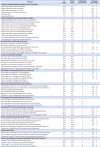 |
Note: ST (2021) indicates values for the Scheduled Tribes (ST) population from the NFHS-5 (2019–2021) microdata.
Non-ST (2021) indicates values for Non-Scheduled Tribes (Non-ST) population from the NFHS-5 (2019–2021) microdata.
ST Better than Non-ST (2021) indicates when the values for Scheduled Tribes (ST) is better than Non Scheduled Tribes (Non-ST) in NFHS-5 (2019–2021).
[• Denotes ST have better indicators; • Denotes Non-ST have better indicators]
ST Change (2021–2016): indicates percentage point difference between NFHS-5 (2019–2021) and NFHS-4 (2015–2016) for Scheduled Tribes (ST).
[• Denotes Performance of ST has improved; • Denotes performance of ST has worsened].
Data Rounding: values are rounded to one decimal place when applicable.
Blank: indicates not applicable because the comparable indicator was not measured in NFHS-4 (2015–2016).
Progress among STs between 2016 and 2021
Between 2016 and 2021, the ST population registered improvements in 83 of the selected indicators in the domains of population, health, and nutrition (Table 1). During these years, Scheduled Tribes experienced major improvements in access to improved sanitation facilities (an increase of 30.4 percentage points between 2015–2016 and 2019–2021). Similarly, more births are now being attended by skilled health personnel (an increase of 13 percentage points) and full vaccination coverage among children aged 12–23 months (an increase of 18.6 percentage points). The civil registration of births among the ST population also increased from 76% in 2016 to 88% in 2021.
Status of STs and Non-STs in 2021
In 2021, for most of the indicators (81 out of 129), the Non-ST population were better off than the STs (Table 1), who remained disadvantaged regarding the status of women, as well as prominent public health concerns such as child undernutrition, anemia, incomplete basic vaccination coverage, and fertility and mortality differentials. Nevertheless, the ST population outperformed the Non-STs in 48 of the 129 indicators, including overall sex ratio, sex ratio at birth, utilization of family planning services, better treatment adherence during pregnancy, and proper breastfeeding practices. The ST population also had a lower prevalence of diabetes and hypertension.
We categorized the 129 indicators into 10 thematic domains of health and well-being to assess the relative performance of STs and Non-STs in 2021 (Supplementary Fig. S1). The scatterplot compares the count of indicators within each domain for which the ST population outperforms the Non-STs and vice versa.
Except for indicators related to Non-Communicable Diseases (NCDs) among adults, all domains reveal a disadvantaged position for the Scheduled Tribes. Domains where they are more vulnerable deserve concerted policy engagement. The under-five mortality rate among STs continues to be high at 50 per 1000 live births. Child undernutrition is also a major concern, as over 40 percent of ST children below five years are stunted, and a similar percentage are underweight. Additionally, there are new emerging challenges for the ST population. Between 2016 and 2021, the prevalence of elevated blood pressure among ST men and women (15–49 years) has increased by 7.5 and 8.9 percentage points, respectively.
Way forward
Improvements in the information landscape for India’s Scheduled Tribes is a significant step towards the development of an efficient knowledge management repository to promote the well-being of all marginalized sections in India. With India completing more than 75 years of independence, now is an opportune moment to expand the data landscape assessing the health status of ST population vis-à-vis the Non-ST population, as well as the progress that Scheduled Tribes are making as a group. Engagement with sub-national data for monitoring tribal health can support policymaking and program implementation. Data analysis of the progress of these tribal populations also has vital implications for equitably aligning resources with community needs. Nevertheless, it is worth noting that these comparisons, while informative, do not necessarily capture the differentials between ST communities across geographies. Heterogeneity7 within tribal communities is a prominent concern and merits a disaggregated view at subnational level.8 For instance, the ST population in the northeastern states of India perform better in maternal and child nutrition but lag behind STs from other states in utilization of basic health care services such as immunization and delivery care.
Even though measurable progress in population health and welfare indicators is occurring among India’s Scheduled Tribe populations, the continued need to close the gap with Non-ST populations requires immediate and sustained policy attention. These efforts will be consistent with the SDGs Agenda of the United Nations that mandates tracking of indigenous communities on ratified developmental goals.9 Indeed, India’s performance on several policy indicators related to population, health, and nutrition will be tied to how well India’s marginalized communities, of which Scheduled Tribes are a prominent group, are equally able to achieve these targets to further the well-being of their people.
Contributors
Conceptualization and Design: SVS; Data Acquisition and Analysis: WJ; Data Interpretation: SVS, WJ; Writing of the Manuscript: WJ, SVS; Critical Revisions: SVS, WJ; Overall Supervision: SVS.
Data sharing statement
The study is based on publicly available data and can be accessed from https://dhsprogram.com/data/available-datasets.cfm.
Declaration of interests
None.
Acknowledgement
The authors would like to thank the Demographic and Health Surveys program for making the National Family Health Survey data freely accessible. We would also like to acknowledge research assistance provided by Debayanti Bhowmick, Prateek Singh, Akhil Kumar, Mohit Chaurasiya and Rockli Kim.
Funding: This study was supported by a grant from the Bill & Melinda Gates Foundation INV-002992. The funders had no role in study design, data collection and analysis, decision to publish or preparation of the manuscript. All authors had access to the data.
Footnotes
Supplementary data related to this article can be found at https://doi.org/10.1016/j.lansea.2023.100266.
Contributor Information
S.V. Subramanian, Email: svsubram@hsph.harvard.edu.
William Joe, Email: william@iegindia.org.
Appendix A. Supplementary data
References
- 1.GOI . Government of India; 1949. The constitution of India. [Google Scholar]
- 2.Subramanian S.V., Smith G.D., Subramanyam M. Indigenous health and socioeconomic status in India. PLoS Med. 2006;3(10):e421. doi: 10.1371/journal.pmed.0030421. [DOI] [PMC free article] [PubMed] [Google Scholar]
- 3.Census . 2011. Scheduled Tribes in India as revealed in census 2011 census of India. [Google Scholar]
- 4.Subramanian S., Ambade M., Kumar A., et al. Progress on sustainable development goal indicators in 707 districts of India: a quantitative mid-line assessment using the national family health Surveys, 2016 and 2021. Lancet Reg Health Southeast Asia. 2023;13 doi: 10.1016/j.lansea.2023.100155. [DOI] [PMC free article] [PubMed] [Google Scholar]
- 5.GOI . Government of India; 2016. Ministry of tribal Affairs; F. No. 11015/06/2016-SG-II. [Google Scholar]
- 6.MoHFW . Ministry of health and family welfare and Ministry of Tribal Affairs; 2018. Tribal Health in India: Bridging the gap and a roadmap for the future. [Google Scholar]
- 7.IIPS . IIPS: International Institute for Population Sciences, Mumbai; Mumbai: 2021. National Family Health Survey (NFHS-5), 2019-21: India. [Google Scholar]
- 8.Neff D., Haasnoot C.W., Renner S., Sen K. Routledge; 2019. Routledge handbook of indigenous wellbeing. [Google Scholar]
- 9.Indigenous peoples and the 2030 Agenda - United Nations. Backgrounder SDG. United Nations: the United Nations permanent forum on indigenous issues; 2016.
Associated Data
This section collects any data citations, data availability statements, or supplementary materials included in this article.