Revista de Neurología logoLink to Revista de Neurología
. 2023 Dec 16;77(12):285–291. [Article in Spanish] doi: 10.33588/rn.7712.2023249
View full-text in English

Neurofobia entre médicos residentes en los servicios de urgencias

Ignacio Saldaña-Inda 1,2,4, Ana I Cisneros-Gimeno 1,3, Álvaro Lambea-Gil 1,2,5,
PMCID: PMC10831740  PMID: 38095052

Abstract

Introducción.

La neurofobia se define como el miedo hacia la neurología que surge de la incapacidad para aplicar los conocimientos teóricos a situaciones clínicas prácticas. Este fenómeno parece no limitarse únicamente a estudiantes de medicina, pero no se dispone de estudios previos en el ámbito de urgencias. Este trabajo valora la percepción de conocimientos en las distintas patologías neurológicas urgentes por parte de médicos en formación y posibles motivos de neurofobia.

Material y métodos.

Se trata de un estudio transversal multicéntrico mediante encuestas autoadministradas a médicos en formación de todo el Servicio Aragonés de Salud. Se interrogó sobre su miedo a la neurología y otras especialidades médicas, posibles causas y percepción de conocimientos en patologías neurológicas en el servicio de urgencias.

Resultados.

Se obtuvieron 134 respuestas. El 27,6% (37) sufría neurofobia. La neurología fue la tercera disciplina que mayor interés despertó, pero se considera la de mayor dificultad. Las áreas en las que mayor seguridad mostraron fueron las cefaleas y la patología vascular. Donde mayor inseguridad existía fue en la neuromuscular, la neurooftalmología y la lesión medular aguda. En ninguna de las áreas hubo un porcentaje mayor del 50% que se sintiera seguro o muy seguro.

Conclusiones.

La neurofobia está presente entre los médicos en formación que desempeñan su labor en los servicios de urgencias. Su distribución depende del grado de exposición a los pacientes. Los neurólogos debemos desempeñar un papel activo en la formación de nuevos especialistas y promover la colaboración con los servicios de urgencias.

Palabras clave: Educación, Enseñanza, Neurofobia, Neurología, Residencia, Urgencias

Introducción

Hace casi tres décadas que el profesor Ralph F. Jozefowicz acuñó el término ‘neurofobia’ para referirse al miedo o rechazo que presentaban sus estudiantes de medicina hacia la neurología clínica, fundamentalmente asociado a la falta de capacidad de los alumnos para aplicar sus conocimientos teóricos en neurociencias [1]. Desde entonces, este concepto, no descrito en otras áreas de la medicina, ha sido corroborado por diversos autores, la mayoría en países de tradición anglosajona [2-6].

Algunos trabajos han observado que esta aversión hacia la neurología parece mantenerse entre médicos jóvenes, pero con algunas diferencias con respecto a la etapa del pregrado, y es un aspecto muy poco estudiado [2,3,7]. Si uno de los principales argumentos de este fenómeno es la incapacidad para aplicar los conocimientos teóricos en situaciones de práctica clínica diaria, las urgencias hospitalarias serían un entorno clave para estudiar la existencia de neurofobia en nuestro medio.

El objetivo principal de este trabajo es conocer si existe neurofobia entre los médicos en formación que realizan guardias de urgencias hospitalarias y describir sus causas. Además, analizamos la percepción que tienen los médicos internos residentes (MIR) de su actuación sobre los principales motivos de consultas neurológicas que se pueden encontrar en urgencias.

Materiales y métodos

Es un estudio transversal mediante encuestas autoadministradas entre octubre y diciembre de 2022 a MIR que estaban desarrollando su formación sanitaria especializada en el Servicio Aragonés de Salud. Para su inclusión, los MIR debían pertenecer a especialidades que realizasen en algún año de su formación guardias médicas en los servicios de urgencias hospitalarias.

Las encuestas se diseñaron mediante la plataforma Google Forms, basándonos en estudios previos adaptados a nuestro medio. El cuestionario consta de 22 preguntas. Las respuestas de formato Likert de 1 a 5 se dicotomizaron para su análisis en 1-2 o 4-5, según la pregunta. Definimos neurofobia como un nivel alto o muy alto de miedo o rechazo hacia la neurología y áreas afines (respuestas 4-5 en la escala Likert). Los formularios se remitieron por correo electrónico a las comisiones de docencia de cada uno de los ocho centros formadores del Servicio Aragonés de Salud. En Aragón, para el año 2022-2023 comenzaron su formación sanitaria especializada 251 MIR, teniendo una duración total la etapa formativa de cuatro o cinco años, según la especialidad. De acuerdo con el modelo formativo, distribuimos las especialidades en no hospitalarias –medicina de familia y comunitaria (MdF)– y hospitalarias (todas las demás).

Tabla.

Características de la muestra y distribución por años.

Total (n = 134)
Edad, M (RIC) 28 (26-29)

Contacto con enfermedades neurológicas, n (%) 70 (52,2)

Prácticas en neurología durante la etapa universitaria, n (%) 74 (55,2)

Rotación en neurología durante la residencia, n (%) 58 (43,3)

Miedo o rechazo a la neurología, n (%) 37 (27,6)

Año de especialidad, n (%)

 Primer año 29 (21,6)

 Segundo año 47 (35,1)

 Tercer año 28 (20,9)

 Cuarto año 26 (19,4)

 Quinto año 4 (3)

Alma mater, n (%)

 Universidad de Zaragoza 71 (53)

 Otra universidad española 55 (41)

 Universidad extranjera 8 (6)

M: media; RIC: rango intercuartílico.

Para el análisis descriptivo, las variables cualitativas se presentan mediante la distribución de frecuencias. En el caso de las variables cuantitativas se usaron indicadores de tendencia central (media o mediana) y de dispersión (desviación estándar o rango intercuartílico). Para el análisis inferencial se estableció como significancia estadística valores de p < 0,05 y se usaron las siguientes pruebas de contraste de hipótesis: χ2 o prueba exacta de Fisher para comparar proporciones cuando ambas variables fueran cualitativas; y, en el caso de que una de ellas fuera cuantitativa, t de Student o ANOVA en distribuciones normales, y U de Mann-Whitney o Kruskal-Wallis si seguían una distribución no normal.

Para el análisis estadístico se empleó R-Studio (versión R: 4.1.2) [8] con el paquete de R ‘tableone’. Las gráficas y tablas se realizaron mediante Microsoft Excel 365 (Microsoft) y con los paquetes de R ‘ggplot2’, ‘ggpubr’ y ‘likert’.

El estudio fue aprobado por el Comité de Ética de la Investigación de la Comunidad Autónoma de Aragón.

Resultados

Se recibió respuesta de 134 MIR distribuidos entre los ocho hospitales formadores de Aragón. Las especialidades de las que se obtuvieron mayor número de respuestas fueron MdF (63; 47%) y medicina interna (10; 7,5%). Los dos principales centros en responder fueron el Hospital Universitario Miguel Servet (58; 43,3%) y el Hospital Clínico Universitario Lozano Blesa (37; 27,6%), únicos centros terciarios de la región. En la tabla se detallan las principales variables analizadas y la distribución por años.

La edad media de los encuestados fue de 28 años (rango intercuartílico: 26-29). Setenta residentes (52.2%) notificaron haber tenido un contacto estrecho con enfermedades neurológicas, bien en primera persona, bien a través del apoyo o cuidado de familiares o amigos cercanos. En cuanto a la formación en neurología, 74 (55,2%) respondieron haber realizado prácticas hospitalarias durante su etapa universitaria, mientras que 58 (43,3%) habían realizado un rotatorio específico en un servicio de neurología durante la residencia.

Treinta y siete encuestados (27,6%) sintieron un nivel alto o muy alto de miedo o rechazo hacia la neurología (neurofobia). No se encontraron diferencias estadísticamente significativas entre la existencia de neurofobia y el centro donde se estudió la carrera de Medicina, la especialidad en la que se están formando o si los MIR trabajaban en un centro con guardia específica de neurología de 24 horas. Entre los que habían realizado una rotación específica en un servicio de neurología hubo menor proporción de neurofobia (el 22,4% frente al 34,5%), si bien esta diferencia no fue estadísticamente significativa (p = 0,174).

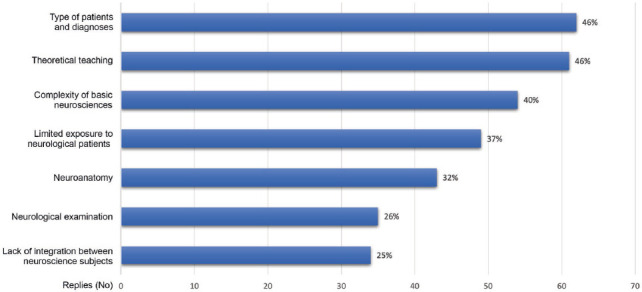
Entre los principales motivos identificados por los residentes como causantes de sus miedos y dificultades hacia la neurología encontramos el tipo de paciente y diagnósticos (62; 46%), y una enseñanza eminentemente teórica durante la etapa universitaria (61; 46%). El conjunto de motivos y su peso se muestran en la figura 1. Al realizar un subanálisis comparativo entre los residentes de MdF y el resto, encontramos diferencias significativas en los que identificaban la escasa exposición a pacientes como motivo para su neurofobia (el 20,6% de MdF frente al 50,7% de especialidades hospitalarias; p < 0,01).

Figura 1.
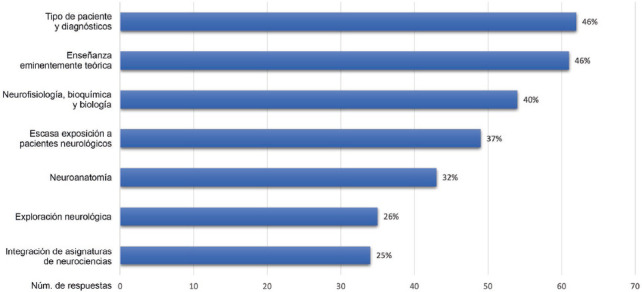
Figura 1

Motivos que identifican los médicos internos residentes (MIR) como la causa de sus dificultades, miedo o rechazo hacia la neurología. Diagrama de barras con respuesta de selección múltiple y opción abierta. Por ‘Integración de la enseñanza’ nos referimos a la fragmentación de las asignaturas de neurociencias durante los años universitarios y su impartición sin coordinación entre sí.

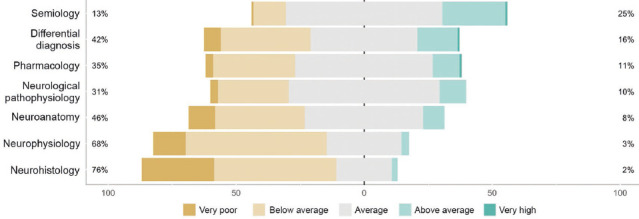
Al preguntar sobre neurología y áreas básicas de conocimiento en neurociencias (neuroanatomía, histología, fisiología, farmacología y patología médica), 121 encuestados (90,3%) consideraron tener conocimientos escasos o muy escasos al menos en una de ellas. En la figura 2 se visualiza la percepción de todas las subáreas y sus frecuencias relativas.

Figura 2.
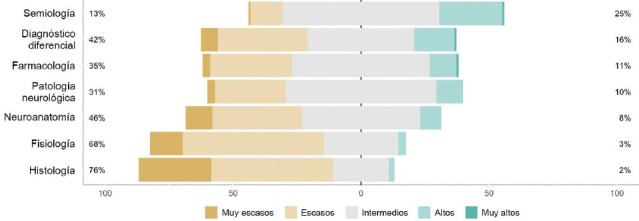
Figura 2

Autopercepción de conocimientos en distintas disciplinas de neurociencias. Diagrama de frecuencia de distribución de respuestas en escala Likert (1-5); en los extremos, porcentaje agregado de respuestas extremas: ‘muy escasos-escasos’ (1-2) y ‘altos-muy altos’ (4-5).

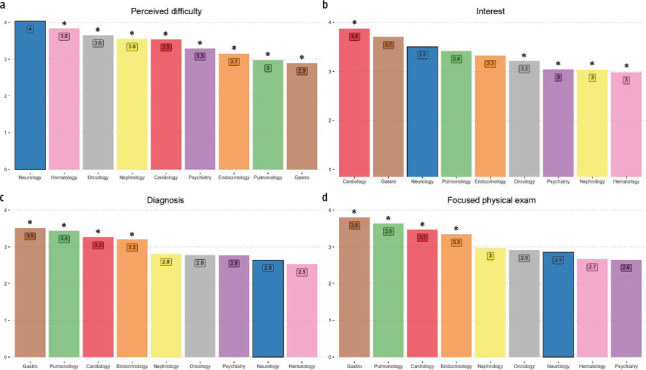
A continuación, se interrogó sobre el interés, la dificultad percibida, la seguridad al emitir un diagnóstico diferencial y la comodidad al realizar una exploración dirigida en las siguientes especialidades: cardiología, gastroenterología, neurología, neumología, endocrinología, oncología, psiquiatría, nefrología y hematología (Fig. 3). La neurología fue la tercera disciplina que mayor interés despertó, por detrás de la cardiología y la gastroenterología. Al mismo tiempo, la neurología se consideró la de mayor dificultad (p < 0,05 respecto al resto).

Figura 3.
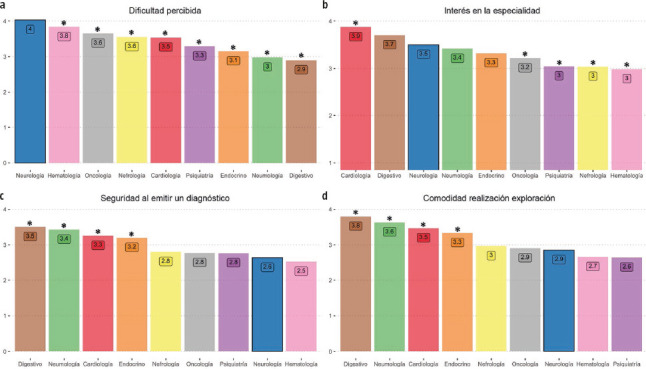
Figura 3

Diagrama de barras de la percepción residentes de Aragón acerca de las diferentes especialidades médicas en cuanto a dificultad percibida (a), interés en la materia (b), seguridad al emitir un diagnóstico diferencial (c) y comodidad al realizar una exploración dirigida (d). Puntuación media de respuestas en escala Likert de 1 a 5. Se ofrece una comparativa de la neurología frente a cardiología, endocrinología, gastroenterología, hematología, nefrología, neumología, neurología, psiquiatría y oncología; identificando con * cuando el valor de p es < 0,05 frente a neurología.

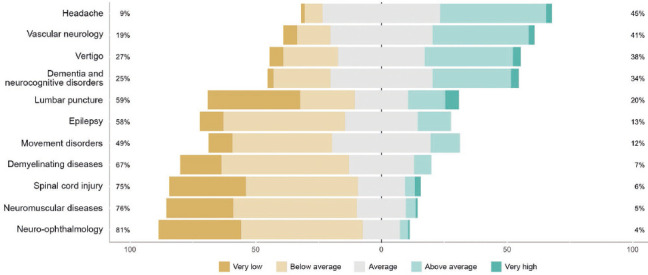
Por último, se preguntó a los residentes sobre su seguridad al abordar pacientes en urgencias con distintas patologías neurológicas (Fig. 4). Las áreas donde menor seguridad mostraron (Likert 1-2: ‘inseguro-muy inseguro’) fueron la neurooftalmología (108; 81%), seguida de la patología neuromuscular (100; 76%) y la lesión medular aguda (99; 75%). Por contrapartida, donde mayor seguridad notificaron (Likert 4-5 ‘seguro-muy seguro’) fue en cefaleas (59; 45%) y patología vascular (54; 41%). Al realizar un subanálisis comparativo entre los residentes de MdF y los de especialidades hospitalarias, encontramos diferencias significativas en la inseguridad al valorar a pacientes con demencia y trastornos cognitivos (el 16% de MdF frente al 33% de especialidades hospitalarias; p = 0,03), y la seguridad al valorar a pacientes con síndrome vertiginoso agudo (el 52% de MdF frente al 26% de especialidades hospitalarias; p < 0,01).

Figura 4.
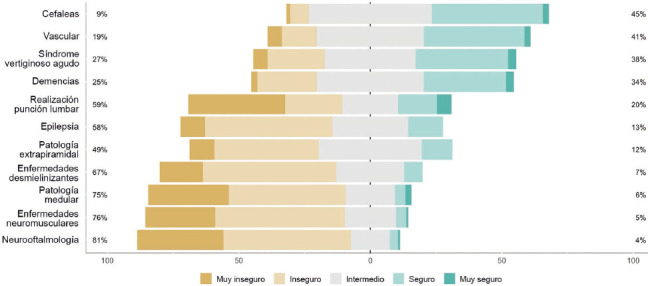
Figura 4

Seguridad al abordar a un paciente en urgencias en distintas subespecialidades neurológicas. Diagrama de frecuencia de distribución de respuestas en escala Likert (1-5); en los extremos, porcentaje agregado de respuestas extremas: ‘muy escasos-escasos’ (1-2) y ‘altos-muy altos’ (4-5).

Discusión

Existen escasos trabajos que estudien la neurofobia específicamente en médicos durante la etapa de formación reglada, y ninguno hasta la fecha concretamente en los servicios de urgencias. Hemos constatado que la neurofobia no es sólo un problema endémico entre los estudiantes de medicina, sino que se mantiene entre los médicos residentes, variando las causas.

A lo largo de la carrera profesional como médicos, el contacto con la patología neurológica es inevitable, independientemente de la especialidad. A nivel global, las enfermedades neurológicas son la primera causa de años de vida perdidos ajustados por discapacidad y la segunda causa de mortalidad [9]. Además, suponen uno de los principales motivos de consulta urgente [10,11]. En el clima actual de sobrecarga de la atención primaria se ha incrementado más aún la demanda sobre los servicios de urgencias, convertidos en la puerta de entrada al sistema para muchos pacientes [12]. Es ahí donde el primer contacto con el paciente lo realizan a menudo médicos en formación de diversas especialidades, con sus miedos e inseguridades a pesar de la supervisión existente. La neurofobia entre los MIR puede conducir a una mala interpretación de los síntomas y signos neurológicos, acarreando diagnósticos incorrectos o demorados. A su vez, los médicos con neurofobia pueden sentirse incómodos al manejar enfermedades neurológicas, lo que puede dar lugar a derivaciones innecesarias y a una atención fragmentada para los pacientes [1,6]. Esto puede generar una mayor carga en el sistema y aumentar los costos asociados con la atención de salud [13].

En nuestro trabajo, el 27,6% de los MIR ‘sufriría’ neurofobia. No existe una definición formal de este fenómeno, por lo que la capacidad de comparación entre distintos trabajos es limitada. Sin embargo, nuestras cifras se asemejan a las descritas en otros trabajos realizados en estudiantes [14-16] y médicos jóvenes [7]. Un trabajo previo de nuestro grupo encontró una tasa de neurofobia del 34,1% entre los alumnos de medicina del mismo territorio [17]. Los escasos trabajos que han comparado de forma indirecta la neurofobia entre estudiantes y médicos en formación han encontrado una ligera menor prevalencia entre estos últimos [3,4,7], como también se observa en los trabajos de nuestro grupo. Esto evidencia que se trata de una percepción dinámica y, por tanto, modificable.

Podríamos pensar que estos miedos son también extensibles a otras patologías encontradas en las urgencias. Sin embargo, cuando comparamos la neurología con otras especialidades, vemos que ésta no deja indiferente. Se percibe como la disciplina de mayor dificultad e inseguridad al emitir un diagnóstico o realizar una exploración dirigida, pero, a la vez, se encuentra entre las especialidades que mayor interés suscitan. ¿Cuál es entonces la causa de estos miedos y dificultades? Como ya adelantaba Jozefowicz [1], la génesis de la neurofobia se encuentra en la ‘incapacidad de aplicar los conocimientos de neurociencias básicas a situaciones clínicas concretas’, es decir, en la dificultad de trasladar sus conocimientos teóricos a la realidad asistencial del paciente; pero parecen existir diferencias entre las etapas del pregrado y posgrado.

En nuestra serie, las principales razones para dichos miedos fueron el tipo del paciente y sus diagnósticos (46%), y la enseñanza eminentemente teórica (46%), por delante de los conocimientos de neurociencias básicas (40%) y la escasa exposición a pacientes neurológicos (37%), factores que se repiten en los distintos estudios publicados [2,13, 18,19]. Merece atención especial la situación de la neuroanatomía. Por una parte, casi la mitad de los residentes (46%) consideraban sus conocimientos en dicha área escasos o muy escasos, pero apenas un tercio (32%) lo identificaba como un factor para su miedo a la neurología. Este porcentaje contrasta con los resultados obtenidos en estudios realizados con estudiantes, donde la neuroanatomía tenía un peso mucho mayor (el 47,8% en nuestro trabajo previo [17]). No obstante, esta tendencia ya se intuía al acotar a estudiantes universitarios de último año y se reproduce en otros trabajos [3]. Podemos decir que, conforme nos enfrentamos a situaciones clínicas reales, no damos tanto peso a nuestros conocimientos en ciencias básicas en sí, sino a su utilidad y cómo los aplicamos en cuestiones de práctica diaria.

No encontramos diferencias en la tasa de neurofobia entre los residentes de MdF y los de especialidades hospitalarias ni entre los que realizaban una rotación específica de neurología y los que no. Esto nos reafirma en la opinión de que el mejor momento para abordar el miedo o rechazo a la neurología sería desde el inicio de la formación universitaria y no tanto en momentos formativos más avanzados. Además, no existieron diferencias en cuanto a la presencia de neurofobia entre MIR que realizan su actividad de urgencias en centros con guardia de neurología 24 horas y los que no, por lo que un mayor acceso al neurólogo no parece mitigar ni favorecer este rechazo. Finalmente, tampoco encontramos diferencias en la presencia de neurofobia entre los que estudiaron la carrera en nuestra región, en otras universidades españolas o en el extranjero (Hispanoamérica), lo que nuevamente reafirma que la neurofobia se trata de un fenómeno global [3,7,14,20,21].

De especial interés nos parecen las percepciones en cuanto al abordaje de los diferentes motivos de consulta neurológica que pueden presentarse en urgencias. Las áreas donde mayor seguridad mostraban los residentes fueron las cefaleas y la patología neurovascular. Por el contrario, donde mayor inseguridad existía fue en la patología neuromuscular y la neurooftalmología seguidas de la lesión medular aguda. No resulta sorprendente comprobar que las patologías donde más cómodos se encuentran se solapan con las patologías neurológicas más prevalentes, y viceversa [22]. Es decir, se muestran más seguros en las que son más frecuentes y, en definitiva, tienen mayor exposición en las urgencias. En este sentido, encontramos muy ilustrativo cómo comparando MIR de MdF con los de hospitalaria, los primeros se mostraban significativamente menos inseguros al valorar a pacientes con trastornos cognitivos y con mareo/vértigo, ambos motivos de consulta frecuentes en el ambulatorio. Asimismo, era significativamente menor la proporción de residentes de MdF que aducían la escasa exposición a pacientes como causa de su neurofobia, dado su continuo contacto con un variado tipo de pacientes. Sí que resulta llamativo cómo la realización de punción lumbar, pese a ser una técnica rutinaria y fundamental en los servicios de urgencias, resultó el área de mayor inseguridad a nivel individual, sin llegar a encontrar diferencias significativas entre MdF y especializada. Todo ello no hace sino reforzar lo expuesto en párrafos anteriores, de cómo el quid de la neurofobia yace en la docencia y la falta de exposición para aplicar sus conocimientos teóricos. Pese a todo, en ninguna de las áreas de la neurología subsidiarias de presentarse en urgencias había un porcentaje mayor del 50% de MIR que se sintieran seguros o muy seguros, por lo que todavía hay mucho por hacer en la etapa de formación sanitaria especializada.

Por último, debemos destacar que la mayoría de los trabajos que abordan la neurofobia entre profesionales se ha centrado en el entorno hospitalario. Nuevos estudios que analicen otras realidades, como la atención primaria, serían de gran ayuda para estudiar y entender este fenómeno.

Limitaciones

Las principales limitaciones del estudio son las propias del uso de encuestas autoadministradas. Las encuestas se remitieron a través de las unidades docentes de cada centro, pero no es posible asegurar con certeza absoluta quién las contestó ni el grado de información o compromiso. Esta debilidad es compartida por trabajos con similar metodología. Por su parte, la tasa de respuesta por parte de los MIR, aunque reducida, ha permitido disponer de grupos de tamaño similar entre médicos en formación de atención primaria y hospitalaria. Casi la mitad de nuestra muestra corresponde a médicos residentes de la especialidad de medicina familiar y comunitaria. Este sesgo de selección se debe al entorno al que se encuentra dirigido, aunque, al mismo tiempo, la hace más representativa de la realidad de los equipos de residentes en los servicios de urgencias.

Conclusión

La neurofobia no es un fenómeno exclusivo de estudiantes universitarios, sino que también está muy presente entre los residentes en formación que de­sempeñan su labor en los servicios de urgencias. La demanda de atención urgente está en ascenso y la atención a las urgencias de neurología ha experimentado un importante cambio en los últimos años. La neurofobia podría repercutir, por consiguiente, en la asistencia y el manejo de estos pacientes. Su distribución entre los motivos de consulta parece depender del grado de exposición a pacientes. Como escribió el filósofo estadounidense Will Durant: ‘Somos lo que hacemos repetidamente. La excelencia no es un acto, es un hábito’. El tratamiento de la neurofobia ha de centrarse, por tanto, en la docencia y aplicabilidad práctica de los conocimientos adquiridos. Los neurólogos debemos desempeñar un papel activo en la formación de nuevos especialistas y colaborar activamente con los servicios de urgencias.
Rev Neurol. 2023 Dec 16;77(12):285–291. [Article in English]

Neurophobia among resident physicians in the emergency service

Ignacio Saldaña-Inda 1,2,4, Ana I Cisneros-Gimeno 1,3, Álvaro Lambea-Gil 1,2,5,

Abstract

Introduction.

Neurophobia is defined as the fear towards clinical neurology caused by the inability to apply theoretical knowledge to practical clinical situations. This phenomenon is not restricted to medical students and has never been studied before in the Emergency Department. We aimed to study how resident doctors perceive their knowledge in neurology and urgent neurological conditions as well as possible causes for said fears.

Materials and methods.

Cross-sectional multicentric study using self-administered surveys sent to medical residents within the Aragon Health Service. They were questioned about their fear of neurology and other medical specialties, possible causes, and perception of knowledge in neurological pathologies and subareas in the emergency service.

Results.

We obtained 134 responses. 27.6% (37) suffered from neurophobia. Despite neurology being considered the most difficult discipline, it did also arouse the third most interest among the students. The areas where they showed the most confidence were headaches and vascular pathology. The areas where they felt the most insecure were neuromuscular diseases, neuro-ophthalmology, and spinal cord injury. In none of the areas surveyed, the percentage of respondents who felt secure exceeded 50%.

Conclusions.

Neurophobia is prevalent among trainee doctors working in the emergency department. Their confidence correlates with the degree of exposure to patients. Neurologist must play an active role in the education of new specialist and promote the collaboration with emergency departments.

Key words: Education, Emergency, Neurology, Neurophobia, Residency, Teaching

Introduction

Three decades ago, Professor Ralph F. Jozefowicz coined the term ‘neurophobia’ to refer to the fear or rejection towards clinical neurology shown by medical students. He argued it stems from the students’ inability to apply their knowledge of basic sciences to clinical situations [1]. This phenomenon, not found in other areas of medicine, has been corroborated by several authors mostly in the anglosphere [2–6].

Said fear and rejection persists among junior doctors, albeit exhibiting certain distinct characteristics compared to the undergraduate stage [2,3,7]. This phenomenon has thus far received limited attention. A&E provide a privileged environment to study this phenomenon. Emergency medicine requires swift decision-making across various pathologies and tests doctors’ ability to translate theoretical into their day-to-day practice. Neurological pathology is a frequent reason for consultation in emergency services [8,9]. It is essential to distinguish between potentially grave and time-dependent pathologies, where the application of theoretical knowledge for diagnostic and therapeutic decision-making must be swift, as is the case with stroke, status epilepticus, or infectious diseases of the central nervous system, among others.

The aim of our study was to ascertain the presence of neurophobia among medical residents who perform shifts in the emergency department. Additionally, we conducted a secondary analysis to explore whether their respective specialties (hospital specialties versus general medicine), training background (presence or absence of rotations in neurology), and type of hospital (hospitals with a physical presence of on-call neurologist versus those without) could play a role. Furthermore, we will delve into the concept of neurophobia and will evaluate the perception held by resident physicians of their performance across the various subspecialties within the field of neurology.

Materials and methods

We conducted a cross-sectional study. Between October and December 2022 self-administered surveys were sent to trainee medical residents undergoing specialized healthcare training within the Aragon Health Service (SALUD). We selected doctors whose specialty involved mandatory shifts in hospital emergency departments during their training period.

Table.

Characteristics of our sample and its distribution per years.

Total (n = 134)
Age, M (IQR) 28 (26-29)

Exposure to neurological diseases, n (%) 70 (52.2)

Neurology rota during university years, n (%) 74 (55.2)

Neurology rota during residency, n (%) 58 (43.3)

Fear or rejection to neurology, n (%) 37 (27.6)

Year of training, n (%)

 First year 29 (21.6)

 Second year 47 (35.1)

 Third year 28 (20.9)

 Fourth year 26 (19.4)

 Fifth year 4 (3)

Alma mater, n (%)

 Universidad de Zaragoza 71 (53)

 Other Spanish universities 55 (41)

 Non-Spanish universities 8 (6)

M: mean; IQR: interquartile range.

The questionnaire was designed using Google Forms, we employed a modified and adapted version of that used by previous studies. It included demographic data, their perception of knowledge, interest, fear, or rejection towards neurology and other medical specialties, as well as their self-perceived knowledge in different neurological pathologies. The questionnaire, available in the Supplementary Material consisted of 22 questions. Likert scale responses from 1 to 5 were later dichotomized for analysis into 1-2 or 4-5, depending on the question. We defined ‘neurophobia’ as a high or very high level of fear or rejection towards neurology and related areas (responses 4-5 on the Likert scale). The forms were sent via email to the Teaching Committees of each of the eight training centres within Health’s Aragon Service. In our region, 251 residents began their specialized healthcare training for the year 2022-2023, with a total duration of four or five years, depending on the specialty. According to their chosen specialty, they were divided between non-hospital-based (Family and Community Medicine; MdF) and hospital-based (all others).

For the descriptive analysis, the qualitative variables were presented by frequencies and their percentages for each category. In the case of quantitative variables, indicators of central tendency (mean or median) and dispersion (standard deviation or interquartile range) were used depending on whether they followed a normal distribution or not, which was determined by the Saphiro-Wilk test. For the inferential analysis, statistical significance was established as p < 0,05 and the following contrast tests were used: χ2 or Fisher’s exact test to compare proportions when both variables were qualitative; and in the case that one of them was quantitative, Student’s t test or ANOVA for normal distributions, and Mann-Whitney U or Kruskal-Wallis for those that followed a non-normal distribution.

For statistical analysis, R-Studio (version R: 4.1.2.) [8] with the R package ‘tableone’ was used. Graphs and tables were created using Microsoft Excel 365 (Microsoft) and the R packages ‘ggplot2,’ ‘ggpubr,’ and ‘likert.’

The study was approved by the Research Ethics Committee of our region.

Results

We received responses from 134 Medical Interns distributed among the eight training hospitals in Aragon. The specialties with the highest number of responses were MdF (63; 47%) and internal medicine (10; 7.5%). The complete distribution by specialties can be found in the Supplementary material. The two main responding centres were the Miguel Servet University Hospital (58; 43.3%) and the Lozano Blesa University Clinical Hospital (37; 27.6%), which are the only tertiary centers in the region. The table provides details of the main variables analyzed and their distribution per years.

The mean age of the respondents was 28 years (IQR 26-29). Seventy residents (52.2%) reported close contact with neurological diseases, either first-hand or through supporting or caring for close family members or friends. Regarding neurology training, 74 (55.2%) had completed hospital rotations during their university years, while 58 (43.3%) had undertaken a specific rotation in a neurology department during their residency.

Thirty-seven respondents (27.6%) experienced a high or very high level of fear or rejection towards neurology (neurophobia). No statistically significant differences were found between the presence of neurophobia and the medical school they attended, the specialty in which they were training, nor whether a 24-hour specific neurology shift existed at their centre. Those who had completed a rotation at a neurology service showed less neurophobia (22,4% vs. 34,5%). However, this difference was not statistically significant (p = 0,174).

The main reasons identified as causes for their fears and difficulties towards neurology were the type of patients and diagnoses (62; 46%), predominantly theoretical teaching during their university years (61; 46%), followed by the complexity of basic neurosciences (physiology, biology, and biochemistry) (54; 40%), and the limited exposure to neurological patients (49; 37%). These results are further elaborated on figure 1. We performed a sub-analysis comparing MdF residents with the hospital-based residents. Significant differences were found in those identifying limited patient exposure as a reason for their neurophobia (20.6% in MdF vs. 50.7% for hospital-based specialties; p < 0,01).

Figure 1.

Figure 1

Causes for neurophobia identified by medical residents as the cause of their difficulties, fear or rejection of neurology. Bar chart with multiple choice and open-ended answers. By ‘Integration of teaching’ we mean the fragmentation of neuroscience subjects during university years and their uncoordinated delivery.

When asked about neurology and basic areas of neuroscience knowledge (neuroanatomy, histology, physiology, pharmacology, and medical pathology), 121 respondents (90.3%) considered their knowledge to be low or very low in at least one of these areas. Figure 2 visualizes the perception of all sub-areas and their relative frequencies. We found significant difference when comparing MdF with other specialties regarding their knowledge of neuropharmacology (low or very low) (25% MdF vs. 44% hospital-based specialties; p = 0,042).

Figure 2.

Figure 2

Self-perception of knowledge in neurosciences. Likert scale chart (1 to 5). Extreme values are represented on the edges (‘very poor-below average’ [1-2] and ‘above average-very high’ [4-5]).

Next, they were questioned about their interest, perceived difficulty, confidence in making a differential diagnosis, and comfort in conducting a targeted examination in the following specialties: cardiology, gastroenterology, neurology, respiratory medicine, endocrinology, oncology, psychiatry, nephrology, and hematology (Fig. 3). Neurology ranked third in terms of interest, behind cardiology and gastroenterology. Simultaneously, it was considered the most difficult (p < 0,05 compared to the rest). Both in terms of making a differential diagnosis and conducting a targeted examination, neurology was among those with the least confidence, with these differences being statistically significant compared to cardiology, gastroenterology, respiratory medicine, and endocrinology (p < 0,05).

Figure 3.

Figure 3

Bar chart of the perception medical interns regarding each medical specialty in terms of interest in the subject (a), perceived difficulty (b), confidence in making a diagnosis (c) and comfort in performing a focused physical exam (d). Mean score of responses on a Likert scale from 1 to 5. A comparison of neurology versus cardiology, endocrinology, gastroenterology (gastro), hematology, nephrology, pulmonology, neurology and psychiatry is provided; identifying with (*) when the p value is <0,05 versus neurology. The p value was calculated using the Mann-Whitney test between each pair of groups with significance correction.

Finally, residents were asked about their confidence in managing patients in emergencies with different neurological pathologies (Fig. 4). The areas where they showed the least confidence (Likert 1-2: ‘insecure-very insecure’) were neuro-ophthalmology (108; 81%), followed by neuromuscular pathology (100; 76%) and acute spinal cord injury (99; 75%). Conversely, they reported the highest confidence (Likert 4-5: ‘confident-very confident’) in headaches (59; 45%) and vascular pathology (54; 41%). When performing a sub-analysis comparing MdF residents with hospital-based specialties, significant differences were found in the insecurity when assessing patients with dementia and cognitive disorders (16% MdF vs. 33% hospital-based specialties; p = 0,03) and the confidence when evaluating patients with acute vertigo syndrome (52% MdF vs. 26% hospital-based specialties; p < 0,01).

Figure 4.

Figure 4

Confidence in managing neurological pathologies. Likert scale chart of each Neurology subarea (1 to 5). Extreme values are represented on the edges: ‘very poor-below average’ [1-2] and ‘above average-very high’ [4-5].

Discussion

Studies centered on neurophobia and resident physicians are few, and so far, none has been conducted specifically in residents working in the emergency department. We have observed how neurophobia is prevalent not only among medical students but among junior doctors too. Interestingly, the underlying causes for neurophobia exhibit a degree of variability. Of particular interest to us is their perception of the different neurological pathologies that they could potentially encounter in urgent care.

Over the course of our medical career, exposure to neurological pathology is unavoidable, regardless of one’s specialty. Globally, neurological diseases are the leading cause of years of life lost due to disability and the second leading cause of mortality [9]. Additionally, they represent one of the main reasons for urgent medical consultations [10,11]. Within the current landscape marked by Primary Care overload, the pressure on the emergency department has further increased, thereby becoming the gateway to the healthcare system for many patients [12]. It is at this point that the first contact with the patient is made by resident doctors from various specialties, with their fears and insecurities. Neurophobia among these junior doctors can lead to misinterpretation of neurological symptoms and signs, resulting in incorrect and delayed diagnoses. Moreover, doctors grappling with neurophobia may feel uncomfortable managing neurological diseases, leading to unnecessary referrals and fragmented care for patients [1,6]. This places additional burden the healthcare system and increase the economic costs [13].

In our study, 27.6% of resident doctors reported suffering ‘neurophobia.’ No formal definition of neurophobia exits, so we are unable to directly compare with previous works. However, our findings are similar to those reported in other studies conducted among both students [14-16] and medical residentes [7]. A previous study conducted by our team found a neurophobia rate of 34.1% among medical students of the same region [17]. The few studies that tangentially compared neurophobia between students and resident doctors indicated a slightly lower prevalence among the latter, which is consistent with our findings [3,4,7]. This underscores how perception of neurophobia is in fact dynamic and can, therefore, be modified.

One might think that these fears might similarly extend to other pathologies encountered in emergency settings. However, upon comparing neurology with the other specialties, it became evident that neurology stands out significantly. It is perceived as the most challenging discipline and it is among the specialties where they felt the most uncertain when making a diagnosis or conducting a physical examination. Amusingly, it was also among the specialties that garner the highest interest from the residents. What is it then the cause for these fears and difficulties? As Jozefowicz pointed out, the genesis of neurophobia lies in the ‘inability to apply basic neuroscience knowledge to specific clinical situations,’ meaning the difficulty in translating theoretical knowledge into patient care [1]. However, there seem to be differences between undergraduate and postgraduate stages.

Main reasons identified in our survey for said fears were the type of patient and their diagnoses (46%) and predominantly theoretical teaching (46%), followed by the complexity of basic neuroscience (40%) and limited exposure to neurological patients (37%). These factors have been identified in other published studies as well [2,13,18,19]. Of particular significance is the role of neuroanatomy. Almost half of the residents (46%) regarded their knowledge in this are as scarce or very scarce, yet only a third (32%) acknowledged it as a contributing factor to their fear of neurology. This contrasts with the results observed in studies conducted exclusively on students, where neuroanatomy played a much more significant role (47,8% in our previous research [17]). This trend could be sensed in works that targeting last-year medical students and has been replicated in other studies [3]. As we face real clinical situations, we seem to give less weight to our basic science knowledge and place greater emphasis on its usefulness and application in daily practice.

We did not find differences in the rate of neurophobia between residents across different specialties or between those who completed a specific neurology rotation and those who did not. This reinforces our belief that the best time to address neurophobia lies at the beginning of medical education rather than in later training stages. Moreover, we observed no differences in the prevalence of neurophobia between residents who worked in emergency centers with 24-hour neurology coverage and those who did not. Hence, greater access to neurologists does not seem to mitigate nor favor neurophobia. Lastly, we did not find differences in the presence of neurophobia between those who studied medicine within our region, at other Spanish universities, or abroad (Spanish America). This further attest to the global dimension of neurophobia [3,7,14,20,21].

Of special interest is the perception of their knowledge in different neurological pathologies within the emergency room. Notably, the areas where residents showed the highest level of confidence encompassed headaches and neurovascular pathology, followed by dementia and vertigo/dizziness. Conversely, they felt the most insecure in relation to neuromuscular pathology and neuro-ophthalmology, followed by acute spinal cord injury. It is not surprising how they their comfort levels correlates with the prevalence of pathologies [22]. Upon comparing residents from different specialties, those in Family Medicine showed significantly less insecurity when evaluating patients with cognitive disorders and dizziness/vertigo, both of which are frequent reasons for ambulatory consultations. Likewise, fewer residents in Family Medicine attributed their neurophobia to limited exposure to patients or insufficient knowledge of neuropharmacology, which once again correlates to their continuous contact with a varied patient population. It is noteworthy that despite lumbar puncture being a routine and indispensable technique in emergency medicine, was the area of greatest individual insecurity, with no significant differences between specialties. This further reinforces the notion that the core of neurophobia lies in teaching and the lack of exposure to apply theoretical knowledge in clinical practice. Lastly, it is concerning that in none of the pathologies surveyed, the percentage of respondents who felt secure exceeded 50%. This illustrates how there is still much to do during postgraduate training.

Lastly, it should be pointed how most studies dealing with neurophobia among medical doctors have so far focused on the hospital level. New studies oriented at primary care practices would be of great significant to help us understand this phenomenon.

Limitations

The main limitations of the study are those inherent to the use of self-administered surveys. The surveys were distributed through the teaching comitee of each center, but it is not possible to ascertain with absolute certainty who responded to them, nor the level of information or commitment at the time of completion. This weakness is shared by studies with similar data collection methodologies. Moreover, the response rate from participants, although limited, has allowed for the availability of groups of similar size between primary care and hospital-based residents. Almost half our sample corresponded to primary care medical residents. This constitutes a selection bias; however, it is not unexpected and resembles the composition of emergency services.

Conclusion

Neurophobia is not exclusive to university students, and it is prevalent among residents working within the emergency departments. The demand for urgent care is ever rising, and the management of neurological emergencies has undergone significant changes in recent years. Neurophobia has an impact on the care and handling of these patients. Its prevalence seems to depend on the level of patient exposure. In words of the American philosopher Will Durant, ‘We are what we repeatedly do. Excellence, then, is not an act but a habit.’ Therefore, potential solutions for neurophobia should focus on teaching and the practical application of acquired theoretical knowledge. Neurologists must play an active role in the training of new specialists and collaborate actively with emergency services.

Bibliografía/References

  • 1.Jozefowicz RF. Neurophobia:the fear of neurology among medical students. Arch Neurol. 1994;51:328–9. doi: 10.1001/archneur.1994.00540160018003. [DOI] [PubMed] [Google Scholar]
  • 2.Flanagan E, Walsh C, Tubridy N. «Neurophobia»- attitudes of medical students and doctors in Ireland to neurological teaching. Eur J Neurol. 2007;14:1109–12. doi: 10.1111/j.1468-1331.2007.01911.x. [DOI] [PubMed] [Google Scholar]
  • 3.Zinchuk AV, Flanagan EP, Tubridy NJ, Miller WA, McCullough LD. Attitudes of US medical trainees towards neurology education:«Neurophobia»- a global issue. BMC Med Educ. 2010;10:49. doi: 10.1186/1472-6920-10-49. [DOI] [PMC free article] [PubMed] [Google Scholar]
  • 4.McCarron MO, Stevenson M, Loftus AM, McKeown P. Neurophobia among general practice trainees:the evidence, perceived causes and solutions. Clin Neurol Neurosurg. 2014;122:124–8. doi: 10.1016/j.clineuro.2014.03.021. [DOI] [PubMed] [Google Scholar]
  • 5.Pakpoor J, Handel AE, Disanto G, Davenport RJ, Giovannoni G, Ramagopalan SV. National survey of UK medical students on the perception of neurology. BMC Med Educ. 2014;14:225. doi: 10.1186/1472-6920-14-225. [DOI] [PMC free article] [PubMed] [Google Scholar]
  • 6.Ridsdale L, Massey R, Clark L. Preventing neurophobia in medical students, and so future doctors. Pract Neurol. 2007;7:116. [PubMed] [Google Scholar]
  • 7.Kam K, Tan GSE, Tan K, Lim ECH, Koh NY, Tan NCK. Neurophobia in medical students and junior doctors–blame the GIK. Ann Acad Med Singap. 2013;42:559–66. [PubMed] [Google Scholar]
  • 8.R Core Team. R:a language and environment for statistical computing. Vienna, Austria: R Foundation for Statistical Computing; 2021. [Google Scholar]
  • 9.Feigin VL, Nichols E, Alam T, Bannick MS, Beghi E, Blake N, et al. Global, regional, and national burden of neurological disorders, 1990-2016:a systematic analysis for the Global Burden of Disease Study 2016. Lancet Neurol. 2019;18:459–80. doi: 10.1016/S1474-4422(18)30499-X. [DOI] [PMC free article] [PubMed] [Google Scholar]
  • 10.Casado V. Neurological patient care in emergency departments. A review of the current situation in Spain. Neurologia (Engl Ed) 2011;26:233–8. doi: 10.1016/j.nrl.2010.07.033. [DOI] [PubMed] [Google Scholar]
  • 11.Ramírez-Moreno JM, Ollero-Ortiz A, Gómez-Baquero MJ, Roa-Montero A, Constantino-Silva AB, Hernández Ramos FJ. Acerca de las interconsultas a los neurólogos formuladas desde urgencias. Respuesta del autor. Neurologia. 2015;30:320–2. doi: 10.1016/j.nrl.2013.06.020. [DOI] [PubMed] [Google Scholar]
  • 12.Presión en las urgencias españolas - SEMES. [Fecha última consulta:06.06.2023]. URL: https://www.semes.org/los-urgenciologos-alertan-los-servicios-de-urgencias-de-todo-el-pais-estan-saturados-con-un-incremento-de-la-carga-asistencial-que-llega-al-40-en-algunas-comunidades/#:~:text=De%20manera%20global%2C%20hablamos%20de,datos%20mensuales%20de%20enero%202022 .
  • 13.Hernando-Requejo V. Neurophobia:why, how much, consequences and solutions. Med Ed Publish. 2020;9:3. doi: 10.15694/mep.2020.000003.1. [DOI] [PMC free article] [PubMed] [Google Scholar]
  • 14.Youssef FF. Neurophobia and its implications:evidence from a Caribbean medical school. BMC Med Educ. 2009;9:39. doi: 10.1186/1472-6920-9-39. [DOI] [PMC free article] [PubMed] [Google Scholar]
  • 15.McGovern E, Louapre C, Cassereau J, Flamand-Roze C, Corsetti E, Jegatheesan P, et al. NeuroQ:a neurophobia screening tool assesses how roleplay challenges neurophobia. J Neurol Sci. 2021;421:117320. doi: 10.1016/j.jns.2021.117320. [DOI] [PubMed] [Google Scholar]
  • 16.Fantaneanu TA, Moreau K, Eady K, Clarkin C, De Meulemeester C, Maclean H, et al. Neurophobia inception:a study of trainees'perceptions of neurology education. Can J Neurol Sci. 2014;41:421–9. doi: 10.1017/s0317167100018436. [DOI] [PubMed] [Google Scholar]
  • 17.Lambea-Gil Á, Saldaña-Inda I, Lamíquiz-Moneo I, Cisneros-Gimeno AI. Neurofobia entre los estudiantes de medicina de una universidad española:experiencias más alláde la anglosfera. Rev Neurol. 2023;76:351. doi: 10.33588/rn.7611.2023102. [DOI] [PMC free article] [PubMed] [Google Scholar]
  • 18.Moreno-Zambrano D, Sandrone S, Meza-Venegas J, Jimenez J, Freire-Bonifacini A, Santibanez-Vasquez R, et al. Exploring the key factors behind neurophobia:a systematic review of the English, Spanish and Portuguese literature. Brain Disord. 2021;2:100011. [Google Scholar]
  • 19.Shelley BP, Chacko TV, Nair BR. Preventing «neurophobia»:remodeling neurology education for 21(st)-century medical students through effective pedagogical strategies for «neurophilia». Ann Indian Acad Neurol. 2018;21:9–18. doi: 10.4103/aian.AIAN_371_17. [DOI] [PMC free article] [PubMed] [Google Scholar]
  • 20.Matthias AT, Nagasingha P, Ranasinghe P, Gunatilake SB. Neurophobia among medical students and non-specialist doctors in Sri Lanka. BMC Med Educ. 2013;13:164. doi: 10.1186/1472-6920-13-164. [DOI] [PMC free article] [PubMed] [Google Scholar]
  • 21.Gupta N, Khadilkar S, Bangar S, Patil T, Chaudhari C. Neurology as career option among postgraduate medical students. Ann Indian Acad Neurol. 2013;16:478. doi: 10.4103/0972-2327.120427. [DOI] [PMC free article] [PubMed] [Google Scholar]
  • 22.Feigin VL, Stark BA, Johnson CO, Roth GA, Bisignano C, Abady GG, et al. Global, regional, and national burden of stroke and its risk factors, 1990-2019:a systematic analysis for the Global Burden of Disease Study 2019. Lancet Neurol. 2021;20:795–820. doi: 10.1016/S1474-4422(21)00252-0. [DOI] [PMC free article] [PubMed] [Google Scholar]

Articles from Revista de Neurología are provided here courtesy of IMR Press

RESOURCES