



Abstract
Clinical data mining of predictive models offers significant advantages for re-evaluating and leveraging large amounts of complex clinical real-world data and experimental comparison data for tasks such as risk stratification, diagnosis, classification, and survival prediction. However, its translational application is still limited. One challenge is that the proposed clinical requirements and data mining are not synchronized. Additionally, the exotic predictions of data mining are difficult to apply directly in local medical institutions. Hence, it is necessary to incisively review the translational application of clinical data mining, providing an analytical workflow for developing and validating prediction models to ensure the scientific validity of analytic workflows in response to clinical questions. This review systematically revisits the purpose, process, and principles of clinical data mining and discusses the key causes contributing to the detachment from practice and the misuse of model verification in developing predictive models for research. Based on this, we propose a niche-targeting framework of four principles: Clinical Contextual, Subgroup-Oriented, Confounder- and False Positive-Controlled (CSCF), to provide guidance for clinical data mining prior to the model's development in clinical settings. Eventually, it is hoped that this review can help guide future research and develop personalized predictive models to achieve the goal of discovering subgroups with varied remedial benefits or risks and ensuring that precision medicine can deliver its full potential.
Keywords: Clinical data mining, Transformative application, Heterogeneity, Analytic workflow, Predictive model
Background
Big Data is currently reinventing medicine. Clinical management has undergone a digital transformation, leading to a vast array of data known as real-world data, ranging from electronic health records (EHR) of disease phenotypes [1, 2] to the molecular atlas of patient-generated information [3], despite the acknowledged restrictions in comparison with randomized controlled trials (RCTs). Surveillance, Epidemiology, and End Results [4] is the most noteworthy example of the EHR data, while The Cancer Genome Atlas [5] represents the latter. Even the data obtained from comparative studies in which randomization is used also becomes an increasingly important source of clinical data mining [6]. With deeper involvement of machine learning, the availability of these data has led to the rapid adoption of data mining in medicine, demonstrating the prospects of developing predictive models [7–9], assessing patient risks [10–12], and facilitating physicians’ clinical decisions [13, 14]. For example, it has become possible to predict the cytotoxicity of silver nanoparticles, which are biosynthesized with anti-cancer and antibacterial activity [15–17]. Through a systematic review and statistical integration of silver nanoparticle cytotoxicity data, machine learning model training and development on these aggregated data pools can enhance the precision of risk prediction and avoid over- or underestimation of the actual risk of human exposure to nanotoxicity [18]. Although there is potential to guide precision therapies, improve efficiency, and achieve better outcomes, limited progress has been made to deal with decision-making in the clinical context.
In clinical data mining research, two perennial concerns of clinicians experienced in clinical practice have not been addressed thoroughly. The first is that data mining takes place only when the data is available rather than when the clinical needs arise, due to absence of the clinician’s active cooperation [19, 20]. Still, the invigorating works of data mining with active involvement of the experienced physician have been accepted by clinical guidelines [21, 22], suggesting that data mining is merging with medical practice in a fascinating way of multidisciplinary integration and raising situations in which clinical actual needs may not yet be the leading strength but increasingly become an important part of clinical data mining. The second concern is that the exotic predictive model of data mining, which has been internally or externally validated by the research conductor, does not work for current patients in the local hospital [23–26].
Recently, well-established standards for clinical data mining such as STROBE [27], TRIPOD [28] and regulatory requirements for prediction model approval from the Food and Drug Administration [29] have been available to rely on. Yet, with the dispute over "the rigor of regulations such as ENCePP [30], scholars have also questioned their feasibility [31]. As a result, it is easy to form the perception that external validation with favorable performance for prediction models does not prove universal applicability, considering the heterogeneity in spatial, temporal, and healthcare contexts.
Given these concerns and the purpose of our review, we conducted a systematic literature search on PubMed for articles published from 1997 to 2023, using the Medical Subject Headings (MeSH) terms "Data mining" or "Prediction model". After reviewing, we propose a frame of four principles: Clinical Contextual, Subgroup-Oriented, Confounder- and False Positive-Controlled (CSCF), to provide guidance for clinical data mining prior to the model's implementation in clinical settings. The CSCF principles are as understandable as possible by individuals engaged in data mining and are held to traditional clinical research standards. Our aim is not to substitute these established authoritative regulations with another batch of such guidelines. Rather, the target is to recognize the leading principles of clinical data mining and propose conceptual innovations that robust analytic workflows fixing a clinical problem should be serviceable and transplantable more than developed models that can be used by clinicians. Although not exhaustive, the CSCF principles can not only maximize the authenticity of developing model workflows and their products in clinical data mining, but also endow them with improved clinical outcomes when implemented in practice.
Represent accurately and integrate into clinical practice seamlessly
There is no exception in clinical medicine where a large volume of data is generated from Hospital Information Systems, including but not limited to the Electronic Health Records (EHRs), Laboratory Information Systems, and Picture Archiving & Communication Systems. With such a large volume of data mining, many clinical questions could be addressed by developing predictive models. The use of predictive models in clinical settings includes, but is not limited to, curable factors [32], diagnosis [33], predictive and prognostic stratification [34], phenotypic occurrence [35], and the effectiveness of professional interventions [36–39]. In other words, analytical workflows of data mining encompass the whole process of the disease course, from prevention, diagnosis, treatment, and finally to prognosis. Various types of clinical questions are resolvable through clinical data mining, but the most common are summarized in Table 1.
Table 1.
Various clinical problems based on data mining
| Type | Clinical data mining questions | Case | PMID |
|---|---|---|---|
| Disease prevention | What are the risk factors associated with the development of the disease? | Heart disease risk factors detection from electronic health records using advanced NLP and deep learning techniques | 37138014 |
| Are there high-risk individuals who may benefit from preventive interventions or early screening? | A Cardiac Deep Learning Model (CDLM) to Predict and Identify the Risk Factor of Congenital Heart Disease | 37443589 | |
| How do lifestyle and environmental factors influence the likelihood of developing the disease? | The Contribution of Genetic Risk and Lifestyle Factors in the Development of Adult-Onset Inflammatory Bowel Disease: A Prospective Cohort Study | 36695739 | |
| Disease diagnosis | What are the diagnostic markers or features that are most relevant for accurate disease identification? | Neutrophil-, Monocyte- and Platelet-to-Lymphocyte Ratios, and Absolute Lymphocyte Count for Diagnosis of Malignant Soft-tissue Tumors | 37351995 |
| How can data-driven approaches be utilized to improve the accuracy of diagnostic tests or imaging techniques? | A semi-supervised multi-task learning framework for cancer classification with weak annotation in whole-slide images | 36327654 | |
| Does data mining have the ability to differentiate between different subtypes or stages of the disease? | Machine learning models based on immunological genes to predict the response to neoadjuvant therapy in breast cancer patients | 35935976 | |
| Disease treatment | Which treatments or therapies are most effective for specific patient subgroups or disease stages? | Darolutamide Plus Androgen-deprivation Therapy and Docetaxel in Metastatic Hormone-Sensitive Prostate Cancer by Disease Volume and Risk Subgroups in the Phase III ARASENS Trial | 36795843 |
| Can data mining be used to optimize treatment plans and personalize medicine based on individual patient characteristics? | Clinical Outcomes With and Without Plasma Exchange in the Treatment of Rapidly Progressive Interstitial Lung Disease Associated With Idiopathic Inflammatory Myopathy | 36729874 | |
| How do we predict treatment response and potential adverse reactions to specific medications? | Prognostic and predictive biomarkers for immunotherapy in advanced renal cell carcinoma | 36414800 | |
| Disease prognosis | What are the key prognostic factors influencing disease outcomes and patient survival rates? | Construction and Validation of a UPR-Associated Gene Prognostic Model for Head and Neck Squamous Cell Carcinoma | 35707371 |
| Can data mining assist in predicting disease progression and potential complications? | An inflammatory-related genes signature based model for prognosis prediction in breast cancer | 37304237 | |
| How can predictive analytics help to identify patients who are more likely to experience a recurrence or relapse of their disease? | Prognostic risk factor of major salivary gland carcinomas and survival prediction model based on random survival forests | 36934429 | |
| Population health | How does data mining contribute to public health initiatives and disease surveillance efforts? | Perceived Impact of Digital Health Maturity on Patient Experience, Population Health, Health Care Costs, and Provider Experience: Mixed Methods Case Study | 37463008 |
| What patterns and trends emerge when looking at the occurrence and spread of disease across different populations or geographic regions? | Analytical exploratory tool for healthcare professionals to monitor cancer patients' progress | 36698423 |
Raising and defining the clinical question
The clinical problem arising from clinical practice is the starting point and destination of clinical data mining. It is a common myth that the clinical problem for data mining is not natural, but rather artificial, due to a poor understanding of the clinical settings of the problem [23]. The deep reasons causing this problem lies in the fact that the complex processes of clinical decision-making are absent in the dataset for data mining [19]. By having access to shared clinical data, thousands of researchers can gain insight into a patient's treatment plan prescribed by the physician, yet without being privy to the rationale behind the physician's decisions and the factors they took into consideration. Consequently, it is essential to prioritize communication and collaboration with physicians on the clinical issue at the start of the research.
A true picture of the clinical problem directly determines the fate of clinical data mining results, whether the report is shelved after publication or takes root in clinical practice. And, the Cross-industry Standard Process for Data Mining, which is widely accepted, emphasizes understanding and grasping application scenarios above all else [40]. Thus, what kind of clinical problems can be solved and to what extent fundamentally determines the clinical significance of findings in clinical data mining. Therefore, only by effectively transforming clinical problems into data mining needs can we veraciously design data extraction of clinical characteristic variables, transparently establish a flowchart of statistical analysis, rationally select predictor parameters and significantly optimization target metrics, and iteratively implement predictive models, which requires that clinical thinking run through the entire data mining process.
Raising and defining the clinical question is the core process of clinical data mining research [41, 42]. Reference to RCT design principles [43–45], a clinical question has three components: participants, interventions (absent in the diagnostic problem), and outcomes, plus one tenet of comparison, denoted by PIOC (Fig. 1). The size of the patients, the cost of the interventions, and the health damage of the disease all bind together to determine the potential of conducting the clinical problem. Special emphasis is placed on the fact that there are more than two standpoints to define the participants in a clinical problem, which a novice would not have the experience to differentiate. The reason behind this is that a diagnosis of a disease phenotype is made by a team of multiple clinical subspecialists, who are bound by certain disciplinary contexts consisting of inspection tools and angles, and by the applied pursuits of professionalism.
Fig. 1.
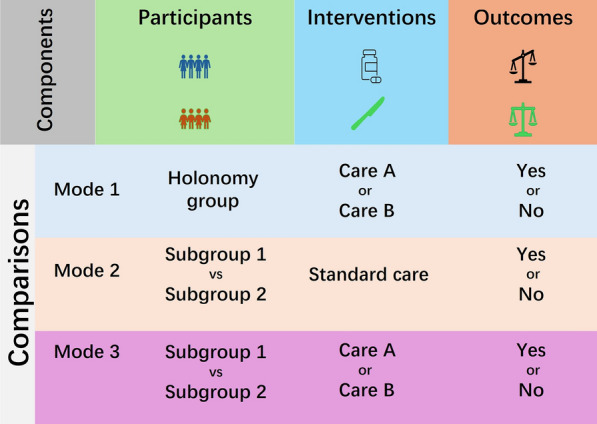
A schematic diagram for raising a clinical question based on PIOC. The clinical problem components include patients (P), interventions (I), outcomes (O) and comparisons (C). The comparative fundamental tenet shows the possibility of two or more interventions and outcomes
The outcome is defined by a set of measures using various subjective and objective tools and includes three subtypes: a measure of treatment effectiveness (rehabilitation or survival at three years), a measure of side effects (quantitative or qualitative), and a measure of patient trajectory by use of the professional scale following clinical guidelines. Beyond that together determining the optimal metric for prediction model training [46, 47], each subtype of outcome has its own clinical value; we urge investigators to first understand each one and then begin with the clinical practice need for data mining, even though this results in pooling data across institutions being challenging.
Above all else, the fundamental tenet of comparison is that both the intervention and the outcome variables have more than two possible values; that is, two or more treatments can be chosen for a patient, and then the outcomes of those patients could be either positive or negative. It is not appropriate to raise a research question involving participants who have only one available treatment or one treatment outcome. A schematic diagram for raising a clinical question is shown in Fig. 1.
The multidimensional heterogeneity of treatment effectiveness
The most undeniable problem that we face in defining the clinical problem is having a thorough grasp of a high degree of dimensional heterogeneity in clinical practice reality. The heterogeneity facing data mining comes from two sources: the existing variation of patients in risk factor, genotype [48] and phenotype [49, 50], and the artificial variation of data capture by a measurement system [51–54] including devices, algorithms and definitions. Controlling the latter at a reasonable level is the precondition for identifying the former [55, 56] and is the surmountable challenge unsurprisingly hindering most model validations of data mining.
Then, closer than that, recognizing the former should be based on three dimensions: the temporal clinical practice following a continually updated clinical guideline [57], the spatial variation of the patient demographics [58–60], and the infinitely varied efficiencies of hospital operational systems [61, 62]. The first raises a requirement on the prospective validation of prediction models and endows the prediction model with a remarkable valid period [57, 63]. The second requires an off-site validation when the predictive model is going to be used outside of the original development place [64–67].
But the use of drugs or medical devices off-site is largely due to high costs, high risks, and long cycles for their development, and it does not seem to be necessary for the predictive model in a new era of big data. Consequently, in a certain sense, there was hardly a need to introduce a non-indigenous prediction model due to a very low overhead for developing the native one. Furthermore, the heterogeneity of hospital operational systems in terms of efficiency means that the same utilization of technological and material resources can lead to a variety of outputs, which determines the service quality of a hospital that can be expected to improve through prediction models.
These things above tremendously aggravate the problem of heterogeneity in treatment effectiveness, fostering great uncertainty for externally validating predictive models in clinical data mining. Table 2 summarizes the main heterogeneities in clinical practice for data mining in terms of participants, interventions, outcomes, and comparisons.
Table 2.
The main heterogeneities in clinical practice for data mining
| Source of heterogeneity | Attributes | ||
|---|---|---|---|
| Participants | Demographic characteristics | Spatial heterogeneity; Time heterogeneity; Space–time heterogeneity | |
| Phenotype | |||
| Genotype | |||
| Behavioral characteristics and social factors | |||
| Interventions | Proficiency in professional skills | Diversity of therapeutic regimen (monotonically improvement); Diversity of clinical practice guidelines | |
| Nursing quality | |||
| Medical quality | |||
| Accessibility of medical devices | |||
| Outcomes | Type of the outcome: primary and secondary outcomes, side effects, disease progression | Subjectivity: doctor subjective report and patient self-report | |
| Definition of the outcome: including binary and continue with cut-off | Objectivity: diagnostic report (imaging, pathology, laboratory tests) | ||
| Observation duration | Time effect: timeliness or lateness of outcome occurrence time | ||
| Comparisons | Case–control | PS Matching | Post-hot randomization |
| PS Weighting (IPTW, SMRW) | Non-randomization | ||
| Cohort studies | Instrumental variable | Randomization-like | |
| Randomization | Randomized controlled trial | ||
IPTW inverse probability of treatment weighting, SMRW standardized morbidity ratio weighting
The most efficient model in clinical practice
To manage heterogeneity effectively during model development, we suggest transforming a local clinical dataset into a prediction model that can be used by local doctors to manage their patients; namely the best models are those that are seamlessly deployed, markedly assisting with clinical decision-making, and improving the clinical paths in current practice. And one goal is to persuade you that internal validation is essential for confirming the predictive repeatability of analytic workflow using clinical data that originate from the same people as the training data. External validity, on the other hand, may not seem to be problematic, for being overly stringent and timid in clinical practice.
The assessment of verifying a predictive model in clinical data mining is a newer challenge. So far, there has been no scientific consensus about what constitutes the rule of externally verifying predictive model performance in clinical data mining, and about whether we need a unique set of standards for external validity. In our opinion, the precision of the prediction model based on data mining is more sensitive to the artificial variation of clinical data than the biomarker when conducting an external validity, while its cost is lower than that of the biomarker when conducting development. This review is not a discussion of these standards, nor does it end the discussion about them, but rather helps these standards evolve in a direction that is more adaptable to translation.
The optimal transplantable workflow developing indigenized models
Clinical prediction models are typically the products of developing analytic workflows processing massive amounts of clinical data of various types based on computing power [13]. Internal and external validation do not necessarily guarantee the elimination of impacts from both natural and artificial variations, which inevitably impede the accuracy of clinical prediction models [24, 68]. In general, the external validation accuracy of clinical predictive models tends to decrease, as evidenced by the data in Table 3. But for now, we have identified that the internal validation of outstanding performance endorses the overall development process of a clinical predictive model [59, 69]. And the analytic workflows of developing predictive models, namely the process flow or workflow, are robust to these variations of clinical data.
Table 3.
Accuracy summary of external validation for prediction model in clinical application scenario
| Clinical scenarios | Model developer | Model feature | Training set | External verification set | PMID | ||
|---|---|---|---|---|---|---|---|
| Optimal model accuracy (%) | Optimal model AUC | Optimal model accuracy (%) | Optimal model AUC | ||||
| Predicting pathological complete response after neoadjuvant chemoradiotherapy in LARC | Wei et al | Clinical-Imaging | 99.8 | 1.0 | 86.3 | 0.872 | 36355199 |
| Defeudis et al | Imaging | 83 | 0.90 | 68 | 0.61 | 35501512 | |
| Bordron et al | Imaging | 90 | 0.95 | 85.5 | 0.81 | 35205826 | |
| Huang et al | Clinical | 87 | 0.79 | 86 | 0.81 | 32724164 | |
| Guo et al | Gene pairs | 92.86 | 0.95 | 90.91 | 0.91 | 29402470 | |
LARC locally advanced rectal cancer
Hence, we suggest that the current focus on transporting new models should shift to a focus on a transparently analytic workflow consisting of widely spread, feasibly conducted, and realistically assumed algorithms. In our view, some clinical problems might permit the development of general models, and some might merely allow general development workflows. There is no doubt that what allows a general model also allows a general workflow, but not vice versa.
This may be argued that their predictive model has already incorporated the knowledge and experience of professional doctors, as evidenced by the training clinical dataset. In response, we believe that by consulting these experts and revising our clinical practices, the quality of our clinical data will be significantly improved before training the predictive model.
Aiming to identify clinically significant subgroups
Identifying clinically significant subgroups is a cornerstone of personalized medicine, enabling the tailoring of treatments to patient characteristics that influence therapeutic outcomes. In clinical practice, a subset of patients are more likely to gain benefit from the current treatment, outweighing the harm [70], whereas some are at a greater probability of the opposing situation [71]. Identifying a subgroup of patients with a unique eigenvalue or effect emerges continuously across a broad range of medical fields [72], often with the goal of delineating patient risk stratification and facilitating optimal decision-making for varied patients. In addition, the data of RCT studies failing to meet the primary endpoint can be reused to explore possible benefits in specific subgroups of participants [73]. And the subgroup poorly represented in RCTs, such as minorities of younger patients with comorbidities, is also found in adequate numbers to permit subgroup analyses in clinical data mining. Ultimately, identification of a clinically meaningful subgroup may lead to positive change in clinical practice [74], which is a sign of the success of the data mining.
Discover or construct variables that define subgroups
There is no doubt that sharing clinical data offers a variety of opportunities to detect or discover a subgroup. By performing unplanned subgroup analyses, it is possible to uncover new hypotheses from clinical data mining. More critically, it will unmask that patients with severe comorbidities or vulnerabilities who have been excluded from RCTs have received different therapeutic benefits post-launch [75].
Leveraging a new variable to define clinical subgroups of patients is the core of developing a prediction model in clinical data mining. There are two ways in which one can use a variable to define a subgroup. The first is to directly use key baseline characteristics, including demographic variables such as age [76] and gender [77, 78], as well as important clinical phenotypes [79], such as disease severity [71] and comorbidities [80], to define the subgroups in a separate or combined manner. By conducting subgroup analyses based on natural features, it is possible to uncover the heterogeneity of the intervention effects among target patients, thus enabling the selection of those who would most likely benefit from the intervention. As an alternative, one can use a aposteriori variable to divide into subgroups, to identify subgroups with beneficial characteristics [81], such as improved therapeutic responses [34] or fewer treatment-related complications [82]. Researchers are increasingly reporting these created variables, such as polygenic scores [83, 84], on a continuous scale, enabling them to investigate how the effectiveness of treatment changes as the value of the novel variable increases [85–87]. Despite the potential of multivariable continuous models to reveal complex interactions, investigators should ultimately rely on binary subgroups that require a reasonable cut-off for a simpler explanation.
Cut-offs of variables define subgroups
Keeping the same definition of patient subgroups allows for comparison of results between analogous subgroups in different research reports of clinical data mining. Utilizing continuous variables to define subgroups is a common practice, and it is recommended to use pre-existing or published cut-offs, as in reference [88]. As one embarks on the exploration, often there are no predetermined cutoffs for use in clinical data mining, as in reference [89].
The most classic example is that a new continuous predictive score of a clinical multivariable prediction model will be used to categorize patients into low and high risk of a benefited or adverse outcome [90–93]. Thus, the optimal cutoff point should be selected to maximize the disparity in outcomes or intervention benefits between the two subgroups. There are a couple of ways to specify the cutoff, and the most common, albeit inadvisable, one is that cutoff points are often identified groundlessly by simple percentiles, such as dichotomization using the median [94, 95]. By contrast, the better solution is to use the Subpopulation Treatment Effect Pattern Plot (STEPP) to identify the cut-off [96]. STEPP graphically explores the linear or nonlinear patterns of intervention effect across overlapping intervals of the definition variable of subgroups [96], in which the cutoff distinguishing the subgroups with different benefit patterns was determined.
Exploratory and confirmatory subgroups
Clinical data mining enables two types of subgroup analyses: a confirmatory analysis that relies on a hypothesis (hypothesis-driven), and an exploratory analysis to build a hypothesis (data-driven). In confirmatory cases, the subgroups must be clearly predetermined on the solid evidence of hypotheses, and the endpoints must be established regarding the subgroup-specific treatment effects [97–100]. Moreover, a strategy limiting the type I error rate and ensuring adequate power for testing the subgroup treatment effects must be established before the research [99].
Exploratory subgroup analyses are conducted either post hoc [101] or prespecified at the design stage [102], although the latter usually lacks the strength to formally assess intervention effects [103]. When planning for prespecified exploratory subgroups analyses, one should consider the definition of the subgroup, the endpoints, and the method carrying out the subgroup analyses. The difference between confirmatory and exploratory subgroup analyses has been summarized in reference [104]. Recognizing the difference between them, we caution that both are equally important and work together [105] to form a complete entity.
Matters needing attention in subgroup analyses
Subgroup analysis, however, increases the possibility of introducing bias and making interpretation more difficult on the variables that define subgroups. Consequently, it is vital to distinguish between the inexplicable subgroup analyses and those that are conducted appropriately. Certainly, it is improbable that a subgroup analysis will satisfy all or none of the current regulations for RCTs [106–108].
There is not yet a consensus on the value and significance given to each of these regulations in observational studies. Despite this, there is a high rate of methodological inadequacies in subgroup analyses [109, 110], especially in the illogical absence of statistical interaction tests [99] and arbitrary cut points for dividing subgroups [111]. In terms of testing the interaction, the multiplicative and additive interactions could have completely different impacts and clinical interpretations [112] so it is essential to understand how to properly conduct and interpret them.
We caution, however, that the statistical methods applied in current studies have not been adhered to as recommended. Firstly, when conducting subgroup analysis, the sample size should be adequate to robustly demonstrate the hypothesized subgroup effects. Additionally, a data-driven subgroup analysis should be accompanied by a hypothesis-driven subgroup analysis. Furthermore, the definition of subgroups should be based on the pathophysiology of the disease, its mechanisms, and high-quality internal and external data. Finally, and most importantly, caution should be taken when interpreting the findings of a subgroup analysis. Please refer to the literatures [72, 113–117] for more detailed methodological points.
Evaluating the consequences of controlling confounders on the potential for bias in research findings
Clinical data mining complements RCTs by leveraging historical data to identify patient groups that may respond differently to existing treatments, thus enriching the evidence base for personalized care. Data mining of EHRs has been demonstrated to be able to replicate the findings of clinical trials [118–120], and to be more realistically assessed than in RCTs given their size and multifariousness of patients. However, it is unlikely to substitute but rather to be complementary to RCTs [121], for the justification that data mining is not as good at controlling imbalance confounders of unmeasured or crudely measured variables as RCTs.
Swollen risk of confounding factors in clinical data mining
For clinical data mining studies, two analytical frameworks are available: a historical cohort study and a case–control study, both of which are observational in nature. Historical cohort studies require that the patient’s data be organized and presented over time, often referred to as an ad hoc database and a result of clinical data governance dealing with fragmented data storage [121, 122]. In contrast, case–control studies do not necessarily require any systematic data governance and are thus far more commonly used than historical cohort studies in clinical data mining.
Regardless of the analysis frameworks used in clinical data mining, researchers cannot randomize patients to receive treatment [123, 124]; rather, the patients have tendentiously received the treatments in past clinical practice [125]. Unfortunately, in most cases, this specific information on treatment selection is also missed or unrecorded in EHRs for clinical data mining. For instance, patients with a severe phenotype usually receive intensive treatment, yet this often leads to unfavorable results in practice, creating a misconception that intensive treatment yields poorer outcomes. This has led to the most common bias problem, namely, the treatment uptake mechanism introducing indication bias, which is a form of selection bias and occurs when selecting participants based on the presence of certain factors.
Moreover, compared to RCTs, data quality control is particularly intricate, and its impact is difficult to assess, inevitably resulting in the generation of bias, particularly in gathering non-structured clinical data from EHRs [119, 126]. Consequently, it is almost impossible to prevent confounding, or a threat to internal validity, without taking deliberate steps, including data collection and processing.
Commonly used methods of propensity score
Comparison is essential in clinical research [127, 128], and the fundamental feature of various research designs is to identify the most comparable control group to the observed group [120, 129]. It is well known that confounders, which cause selection bias, are associated with both the intervention variable and the clinical outcome. Naturally, there are two approaches to reducing the effects of confounders: the Propensity Score (PS) and Mendelian Randomization (MR).
The PS seeks to create screening conditions [130], namely PS, for the observed and control groups that allow for secondary selection and make the two groups similar in terms of known confounding variables. A patient’s PS is a continuously distributed probability value, ranging from 0 to 1, of receiving the experimental treatment given the pretreatment confounding variables [131]. Hence, it is necessary to have knowledge and measurement of confounders, in addition to participants having a chance of being assigned either the observed or the control intervention [132].
To attain unbiased treatment effects in clinical data mining, PSs can be used in four ways: PS matching, PS hierarchy, PS correction, and PS weighting [133]. Their distinguishing features are outlined in the Table 4. Therein, two special reminders are needed: (1) In subgroup analyses, one must use the PS within each prespecified subgroup for matching or weighting; (2) The PS approaches are incapable when a confounder or intervention is time-varying, as is often the case for chronic diseases.
Table 4.
Overview of four different PS-based approaches
| Aspect | PS matching | PS hierarchy | PS correction | PS weighting |
|---|---|---|---|---|
| Principle | Matching one or more control cases with a propensity score almost equal to the PS for each treatment case | Stratifying the sample based on rank-ordered PSs and performing comparisons between groups within each stratum | Incorporating PS values as a covariate in regression analysis models | Utilizing the PS to develop weights and applying all outcomes of interest |
| Ability to control confounding bias | Superior to the PS hierarchy and PS correction | Weaker than other methods in particular to survival analysis | Weaker than PS matching and PS weight | Superior to PS hierarchy and PS correction |
| Data utilization | Removing data that does not match the study objectives | Retaining data from all study objectives | Retaining data from all study objectives | Retaining data from all study objectives |
| Causal effect estimation | Matching can estimate only the ATT | Hierarchy can estimate only marginal effect but neither the ATT nor the ATE | Correction can estimate only marginal effect but neither the ATT nor the ATE | Weighting can estimate either effect (ATT or ATE) according to the way weights are defined |
| Advantages | Addressing the confounding from multiple variables to guarantee equalization between individuals; The strength of the argument is strong and mirrors a closer randomized experiment | Achieving equilibrium of intergroup covariates within each stratum | Model-based analysis with a straightforward application | The strength of the argument is strong and mirrors a closer randomized experiment |
| Disadvantages | As only areas of the domain that are mutually supported by PS values can be matched, the sample size is reduced | Inadequate covariate equalization, particularly for the uppermost and lowest tiers | A model-dependent approach that can sometimes be challenging to meet the assumptions of the model | The sample in the study is only theoretical; Excessive weight will have an impact on the effect estimates |
PS propensity scores, ATT average effect of the treatment on the treated, ATE average treatment effect
The PS method does not address the confounders directly; yet it is able to produce a randomization-like effect by re-recruiting participants to even out the two groups, thus diminishing or balancing the effect of the confounders on the results. Hence, it is also referred to as post-hoc randomization [134].
Promising Mendelian randomization
Despite their efforts, PS methods are unable to address unmeasured confounders in clinical data mining. In clinical practice setting, if two patients with the same measured features receive different treatments, there may be valid but undocumented contributors [135]. Such items as extramural labs, clinical features, lifestyles, and cognitive and physical functioning that are obtained outside the hospital and affect both treatment decisions and outcomes are often not documented in HER. This presents a great opportunity to apply MR to clinical data mining.
MR is a poster-child example of the Instrumental Variable (IV) method [136], which can be used to determine the causal-effect estimates, even when unmeasured confounding is present [137]. The basic idea of MR is to find an instrumental variable that acts as a natural randomizer to mimic the obligation of randomizing the allocation of interventions [138]. For IVs to be valid, they must be able to affect treatment assignment, be independent of any measured or unmeasured confounders, and not have a direct effect on the interested outcomes [139], referred to as relevance, restriction, and independence.
In the opinion of experts, inherited genetic variants from parents can certainly be used as an excellent IV in research, as they are allocated randomly, remain unmodified, and are not influenced, perfectly suited to the rigors of these laws at conception [140]. MR can pinpoint the variant sites from thousands of options that fulfill the three criteria, thus making them a flawless IV. Moreover, utilizing multiple IVs which all point to the same conclusion would strengthen the persuasiveness of the evidence.
MR analysis consists of two steps: examining the three core assumptions and evaluating the causal effect between variables and outcomes, as in conferences [141, 142]. This process, where the two steps are carried out in the same sample, is known as one-sample MR [143], and when done in two distinct samples from the same population, it is referred to as two-sample MR [144]. MR is becoming increasingly popular among clinical data miners due to its time- and cost-effectiveness, largely attributed to the availability of chances to screen an abundance of published genetic associations [145]. Thus, genic IVs can be identified by searching through databases or reports that assess the relationship between genetic factors and the observed variable in question. Previous genome-wide association studies (GWASs) are especially useful in this regard [146, 147], as they are hypothesis-free scans that depict the correlation between millions of SNPs and the observed variables and clinical outcomes.
Yet, Mendelian randomization studies can be distorted by sample selection and misclassification if the observed variables are not universally measured with the same definition in all participants [148, 149]. Moreover, when utilizing MR, two aspects should be mulled over: (1) Population stratification, which involves the presence of subpopulations that are more likely to possess the genetic variant; (2) and the potential of the genetic variant used as an IV and its genetically linked genes to initially affect the outcome through a route other than the variable being observed [150–153]. Even so, it is important to bear in mind that the restricted access to dependable IVs and the minimal sample size may cause substantial finite sample bias and standard errors.
What is indispensable may not have desired consequences
Clinical data mining studies are advantageous in terms of efficient design schemes, yet they can be biased if the control group fails to reflect the distribution of contributors in the population from which the participants were taken. Locating this population is usually difficult, and controls can be selected to a certain extent for convenience. We must be cognizant that no single control strategy is optimal for all clinical questions, and all of them have certain drawbacks.
In comparison to PS strategies, IV tactics may be more intricate and less explicable, yet can be more dependable in scenarios of unmeasured confounders. Meanwhile, unless there is evidence that the controlling confounders approach will be significantly impacted by unobserved confounding, PS approaches should be preferred in clinical data mining. More importantly, in this paper, we seek to raise awareness that both approaches are equally necessary for obtaining precise intervention effects that vary across subgroups, as observational data is being increasingly used. Researchers must understand the basic suppositions of these approaches and the situations in which these approaches are most suitable, as unavoidable examples leading to distorted estimates in the literature still exist [154–156].
Vigilance and mitigation of increased false positives due to multiple hypothesis
The concept of false positive findings has a long history in statistics, and especially in data mining, is far from trivial [157, 158]; indeed, they can cause unsafe prediction failures. Until now, this essential issue, which greatly determines the success of clinical data mining, has not been given sufficient attention. Clinical data mining studies strongly involve numerous analytic steps (Fig. 2), and at each step, hypotheses must be thoroughly evaluated, thereby leading to a heightened risk of false positives due to multiple hypothesis tests [159, 160].
Fig. 2.

Clinical data mining studies analyze workflows. The analytic workflows for developing a model consist of eight steps, including phase 1: problem definition (show in purple); phase 2: data collection (show in orange); phase 3: data processing (show in light green); phase 4: feature analysis (show in blue); phase 5: model developing (show in light yellow); phase 6: model validation and visualization (show in dark yellow); phase 7:model evaluation (show in dark green); phase 8: model application and upgrades (show in pink)
Intentional or unintentional multi-testing
From a data scientist's point of view, the near exhaustiveness of data analyses is advantageous; however, it also means that coincidental random fluctuations can be misinterpreted as significant changes in the clinical practice context, resulting in erroneous positive results and potentially deceptive conclusions. In clinical data mining research, concerns about excessively bloated rates of false-positive findings have led to a serious lack of confidence in prospectively validating results, incurring costs in money and time; this is the main reason why translational application is few and far between. In the following, we enumerate the more prevalent types.
Clinical data mining involves multiple comparisons of clinical outcomes [161], such as assessing if a selected clinical outcome differs between more than two intervention groups [162], or which of these outcomes vary between two intervention groups [163], especially in data from basket and umbrella trials [164]. Simultaneously, clinical data mining screens frequently clinically relevant variables or IVs, with multiple judgments being made to determine whether thousands of characteristics, such as genomic nucleotide site polymorphisms [165], transcriptomes [166], proteomes [167], metabolomes [168], and microbiomes [169], are linked to a certain observed variable or endpoint [170]. As the definitions of subgroups and endpoints become more intricate in clinical data mining, this issue is becoming more complex as well.
Extremely inflated false positives in data mining
A false-positive result is a risk with any statistical test, as it is caused by chance rather than any difference between the comparison groups [171]. This means that if the original hypothesis is rejected, a Type I error has been made. Unexpectedly, as the number of tests increases, the likelihood of a false-positive result also rises surprisingly [172]. To ensure that the total number of Type I errors remains below a predetermined level, appropriate methods must be employed.
Benjamini and Hochberg were the first to introduce the concept of False Discovery Rate (FDR) [173], which is the proportion of false positive test results [174]. They also proposed a corresponding control method, known as the BH method. Compared to Type I error correction, FDR can be adjusted according to the needs of data mining and used as a criterion for variable selection or feature extraction.
We strongly recommend taking note that FDR is calculated based on the P-value under certain conditions that the assumptions are independent of each other [171]. The extensive existence of correlations between variables or outcomes is always inconsistent with the assumptions mentioned above, thus FDR does not guarantee a finding in fact, but rather provides a conservative approach in statistics. Before coming to any sweeping conclusions, it is imperative to understand the statistical caveats and limitations of the approaches [175, 176].
Focuses and outlooks
Over the past decade, technological advances in data have greatly enhanced our ability to stockpile and revisit complex processes of clinical diagnosis and treatment on a large scale and to be in ascendance. The sheer volume of clinical data has necessitated the utilization of data mining methods that are being specifically upgraded in tandem. Clinical data mining is largely aimed at clinical scenarios of actual practice, in which unrestricted patients range from whole genotypes to whole phenotypes and are tendentiously given various treatments in a non-randomized manner. And with data collection in the glare of scientific organization, RCT presents a new source of clinical data that is measured on-demand. Tying the two together, data mining has the potential to produce an enhanced version of the findings and is therefore expected to yield valid evidence for medical decision-making.
The limited translational application prevents any improvements from being seen in clinical practice. Various standards and guidelines have been suggested by academics, yet their impact has not been perceptible. The standards, to some degree, are too rigorous to be met, and there is no agreement among them as to whether the same standards of pharmaceuticals or medical devices should be applied. Perhaps it may take some time to observe the positive impacts of the existing regulations. But we all know deep down that the omnipresent heterogeneity of curative effects and prognoses is not a temporary bet, but a major impediment to their use in long-span populations, making it difficult for many predictive models of clinical data mining to match our field observations.
The time is right for a new doctrine. More concretely, to satisfy the needs of translational applications, we propose that adjustments must be made to the principles of clinical data mining. Most importantly, the present conception, namely PIOCs, maximizes the significance of clinical issues that are defined in clinical data mining. Subsequently, systematic analysis of the effect of heterogeneity on each of the PIOCs interprets as much as possible the failures of the translational application of predictive models in clinical data mining. Recognizing these, this review has devised a strategy for contributing to the speed-increasing gearbox of translational applications by prioritizing the execution of development analytic workflows from clinical data mining in the future. In other words, clinical data mining research should focus on recognizing and assessing data inconsistencies and confirming the analytic procedure and its executable files employed to develop the predictive model, instead of simply popularizing the developed model. Rather than simply providing predictive models, the sharing of analytic processes for creating them should be more widespread in the same medical field among hospitals. In short, by utilizing external but credible analytical workflows, clinical data mining employs local data to train an indigenized model to play an auxiliary role in a clinical specialty during a period in local hospitals, upgrading the predictive model when clinical practices isomerize significantly.
Of these, identifying the subgroup of patients with markedly different intervention results or risk of side effects can be achieved by using the natural variables or constructing novel variables to leverage subgroup analysis. In this process, one must address these creeping cracks of potential bias due to the non-randomization of the intervention and patient characteristics, and we propose a set of heuristics to help select the most suitable method that compromises those assumptions to the least extent. And if there is a pitfall to address, it would be the false positives, reducing which demand us gathering information on the background of the FDR and its resolution in clinical data mining.
It is the responsibility of clinical decision makers to develop personalized prediction models that are transparent, clinically effective, and beneficial for the patients they are caring for. Most importantly, an analytic workflow developing a tailored model for the data-mined evidence is practicable for decision makers now. Automatically, the data-mined evidence will be employed by clinicians to make distinct prescribing decisions without any doubt. As the translation of single-hospital discovery to single-hospital application is being increased, an increase in the accessibility of clinical data and analytical codes [157, 177] combined with a mitigation of conceptual and metric shifts for PIOCs [178, 179], guarantees that precision medicine will reach its full potential. Moreover, precise models hold significant potential in the current biomedical field. In contrast to the majority of application universality models, our CSCF framework emphasizes diversity and personalization of models. We believe that personalization and accuracy of the model should not be compromised for the sake of generalization. The CSCF framework ensures that the model is truly customized to the specific needs of patient populations or geographic regions by considering factors such as the clinical context, subgroups, confounders, and false positives, leading to a deeper understanding of disease mechanisms. This targeted approach not only improves the predictive accuracy of the models, but also ensures their usefulness and operability in clinical settings. By promoting diversity and personalization of models, we can avoid the trap of overgeneralization, thereby preventing a loss of correlation between model accuracy and specific patient populations. We are certain that clinical professionals will be able to increase the curative quality they offer due to the implementation of clinical data mining, and this will remain true in the days to come. Clinical data mining will not substitute for clinical professionals, but rather will facilitate them to carry out their duties more effectively and give them more time to collaborate with data scientists, exchange ideas with their peers, and engage with patients.
Acknowledgements
The authors want to thank all the participants in the review.
Author contributions
YG: Conceptualization, funding acquisition, project administration, and amendment. HQ: Writing, editing, and tabulation. YC: Illustration. CQ: Tabulation.
Funding
This study was supported by the National Natural Science Foundation of China (NSFC, 82060618), the Key Research and Development Program of Jiangxi Province (20203BBGL73184), and Doctoral Fund of First Affiliated Hospital of Gannan Medical University.
Data availability
This article does not involve any research data or code.
Declarations
Ethical approval and consent to participate
Not applicable.
Consent for publication
Not applicable.
Competing interests
The authors declare that the research was conducted in the absence of any commercial or financial relationships that could be construed as a potential competing interests.
Footnotes
Publisher's Note
Springer Nature remains neutral with regard to jurisdictional claims in published maps and institutional affiliations.
References
- 1.Juhn Y, Liu H. Artificial intelligence approaches using natural language processing to advance EHR-based clinical research. J Allergy Clin Immunol. 2020;145(2):463–469. doi: 10.1016/j.jaci.2019.12.897. [DOI] [PMC free article] [PubMed] [Google Scholar]
- 2.Rodemund N, Wernly B, Jung C, Cozowicz C, Koköfer A. The Salzburg intensive care database (SICdb): an openly available critical care dataset. Intensive Care Med. 2023;49(6):700–702. doi: 10.1007/s00134-023-07046-3. [DOI] [PMC free article] [PubMed] [Google Scholar]
- 3.Correction to Lancet Oncol. 2019;20(5):e262–e273.
- 4.Doll KM, Rademaker A, Sosa JA. Practical guide to surgical data sets: surveillance, epidemiology, and end results (SEER) database. JAMA Surg. 2018;153(6):588–589. doi: 10.1001/jamasurg.2018.0501. [DOI] [PubMed] [Google Scholar]
- 5.Cancer Genome Atlas Research, Weinstein, JN, Collisson EA, Mills GB, Shaw KR, Ozenberger BA, et al. The cancer genome atlas pan-cancer analysis project. Nat Genet. 2013;45(10):1113–20. [DOI] [PMC free article] [PubMed]
- 6.Saesen R, Van Hemelrijck MJ, Bogaerts CM, Booth CM, Cornelissen JJ, Dekker A, et al. Defining the role of real-world data in cancer clinical research: the position of the European Organisation for Research and Treatment of Cancer. Eur J Cancer. 2023;186:52–61. [DOI] [PubMed]
- 7.Banoei MM, Lee CH, Hutchison J, Panenka W, Wellington C, Wishart DS, et al. Using metabolomics to predict severe traumatic brain injury outcome (GOSE) at 3 and 12 months. Crit Care. 2023;27(1):295. doi: 10.1186/s13054-023-04573-9. [DOI] [PMC free article] [PubMed] [Google Scholar]
- 8.Guman NAM, Mulder FI, Ferwerda B, Zwinderman AH, Kamphuisen PW, Büller HR, et al. Polygenic risk scores for prediction of cancer-associated venous thromboembolism in the UK Biobank cohort study. J Thromb Haemost. 2023;S1538–7836:00571–578. doi: 10.1016/j.jtha.2023.07.009. [DOI] [PubMed] [Google Scholar]
- 9.Yang X, Kar S, Antoniou AC, Pharoah PDP. Polygenic scores in cancer. Nat Rev Cancer. 2023;23(9):619–630. doi: 10.1038/s41568-023-00599-x. [DOI] [PubMed] [Google Scholar]
- 10.Sarkar R, Martin C, Mattie H, Gichoya JW, Stone DJ, Celi LA. Performance of intensive care unit severity scoring systems across different ethnicities in the USA: a retrospective observational study. Lancet Digit Health. 2021;3(4):e241–e249. doi: 10.1016/S2589-7500(21)00022-4. [DOI] [PMC free article] [PubMed] [Google Scholar]
- 11.Miller WD, Han X, Peek ME, Charan Ashana D, Parker WF. Accuracy of the sequential organ failure assessment score for in-hospital mortality by race and relevance to crisis standards of care. JAMA Netw Open. 2021;4(6):e2113891. doi: 10.1001/jamanetworkopen.2021.13891. [DOI] [PMC free article] [PubMed] [Google Scholar]
- 12.Tanguay-Sabourin C, Fillingim M, Guglietti GV, Zare A, Parisien M, Norman J, et al. A prognostic risk score for development and spread of chronic pain. Nat Med. 2023;29(7):1821–1831. doi: 10.1038/s41591-023-02430-4. [DOI] [PMC free article] [PubMed] [Google Scholar]
- 13.Swanson K, Wu E, Zhang A, Alizadeh AA, Zou J. From patterns to patients: advances in clinical machine learning for cancer diagnosis, prognosis, and treatment. Cell. 2023;186(8):1772–1791. doi: 10.1016/j.cell.2023.01.035. [DOI] [PubMed] [Google Scholar]
- 14.Sinka L, Abraira L, Imbach LL, Zieglgänsberger D, Santamarina E, Álvarez-Sabín J, et al. Association of mortality and risk of epilepsy with type of acute symptomatic seizure after ischemic stroke and an updated prognostic model. JAMA Neurol. 2023;80(6):605–613. doi: 10.1001/jamaneurol.2023.0611. [DOI] [PMC free article] [PubMed] [Google Scholar]
- 15.Baran A, Keskin C, Baran MF, Huseynova I, Khalilov R, Eftekhari A, et al. Ecofriendly synthesis of silver nanoparticles using Ananas comosus fruit peels: anticancer and antimicrobial activities. Bioinorg Chem Appl. 2021;2021:2058149. doi: 10.1155/2021/2058149. [DOI] [PMC free article] [PubMed] [Google Scholar]
- 16.Gunashova GY. Synthesis of silver nanoparticles using a thermophilic bacterium strain isolated from the spring Yukhari istisu of the Kalbajar region (Azerbaijan) Adv Biol Earth Sci. 2022;7(3):198–204. [Google Scholar]
- 17.Baran A, Fırat Baran M, Keskin C, Hatipoğlu A, Yavuz Ö, İrtegün Kandemir S, et al. Investigation of antimicrobial and cytotoxic properties and specification of silver nanoparticles (AgNPs) derived from Cicer arietinum L. Green leaf extract. Front Bioeng Biotechnol. 2022;10:855136. doi: 10.3389/fbioe.2022.855136. [DOI] [PMC free article] [PubMed] [Google Scholar]
- 18.Bilgi E, Karakus CO. Machine learning-assisted prediction of the toxicity of silver nanoparticles: a meta-analysis. J Nanopart Res. 2023;23:157. doi: 10.1007/s11051-023-05806-2. [DOI] [Google Scholar]
- 19.Kelly CJ, Karthikesalingam A, Suleyman M, Corrado G, King D. Key challenges for delivering clinical impact with artificial intelligence. BMC Med. 2019;17(1):195. doi: 10.1186/s12916-019-1426-2. [DOI] [PMC free article] [PubMed] [Google Scholar]
- 20.Gill SK, Karwath A, Uh HW, Cardoso VR, Gu Z, Barsky A, et al. Artificial intelligence to enhance clinical value across the spectrum of cardiovascular healthcare. Eur Heart J. 2023;44(9):713–725. doi: 10.1093/eurheartj/ehac758. [DOI] [PMC free article] [PubMed] [Google Scholar]
- 21.Raith EP, Udy AA, Bailey M, McGloughlin S, MacIsaac C, Bellomo R, et al. Prognostic accuracy of the SOFA score, SIRS criteria, and qSOFA score for in-hospital mortality among adults with suspected infection admitted to the intensive care unit. JAMA. 2017;317(3):290–300. doi: 10.1001/jama.2016.20328. [DOI] [PubMed] [Google Scholar]
- 22.Xu H, Feng G, Han Y, La Marca A, Li R, Qiao J. POvaStim: an online tool for directing individualized FSH doses in ovarian stimulation. Innovation (Camb) 2023;4(2):100401. doi: 10.1016/j.xinn.2023.100401. [DOI] [PMC free article] [PubMed] [Google Scholar]
- 23.Liu Y, Chen PC, Krause J, Peng L. How to read articles that use machine learning: users' guides to the medical literature. JAMA. 2019;322(18):1806–1816. doi: 10.1001/jama.2019.16489. [DOI] [PubMed] [Google Scholar]
- 24.Panch T, Pollard TJ, Mattie H, Lindemer E, Keane PA, Celi LA. "Yes, but will it work for my patients?" Driving clinically relevant research with benchmark datasets. NPJ Digit Med. 2020;3:87. doi: 10.1038/s41746-020-0295-6. [DOI] [PMC free article] [PubMed] [Google Scholar]
- 25.Cohen JP, Cao T, Viviano JD, Huang CW, Fralick M, Ghassemi M, et al. Problems in the deployment of machine-learned models in health care. CMAJ. 2021;193(35):E1391–E1394. doi: 10.1503/cmaj.202066. [DOI] [PMC free article] [PubMed] [Google Scholar]
- 26.Van Calster B, Steyerberg EW, Wynants L, van Smeden M. There is no such thing as a validated prediction model. BMC Med. 2023;21(1):70. doi: 10.1186/s12916-023-02779-w. [DOI] [PMC free article] [PubMed] [Google Scholar]
- 27.von Elm E, Altman DG, Egger M, Pocock SJ, Gøtzsche PC, Vandenbroucke JP, et al. The Strengthening the Reporting of Observational Studies in Epidemiology (STROBE) statement: guidelines for reporting observational studies. Ann Intern Med. 2007;147(8):573–577. doi: 10.7326/0003-4819-147-8-200710160-00010. [DOI] [PubMed] [Google Scholar]
- 28.Collins GS, Moons KGM. Reporting of artificial intelligence prediction models. Lancet. 2019;393(10181):1577–1579. doi: 10.1016/S0140-6736(19)30037-6. [DOI] [PubMed] [Google Scholar]
- 29.FDA. Proposed regulatory framework for modifications to artificial intelligence/machine learning-based software as a medical device; 2019.
- 30.ENCePP. Guide on methodological standards in pharmacoepidemiology rev8; 2022.
- 31.Parikh RB, Obermeyer Z, Navathe AS. Regulation of predictive analytics in medicine. Science. 2019;363(6429):810–812. doi: 10.1126/science.aaw0029. [DOI] [PMC free article] [PubMed] [Google Scholar]
- 32.Cao X, You X, Wang D, Qiu W, Guo Y, Zhou M, et al. Short-term effects of ambient ozone exposure on daily hospitalizations for circulatory diseases in Ganzhou, China: a time-series study. Chemosphere. 2023;327:138513. doi: 10.1016/j.chemosphere.2023.138513. [DOI] [PubMed] [Google Scholar]
- 33.Ao L, Zhang Z, Guan Q, Guo Y, Guo Y, Zhang J, et al. A qualitative signature for early diagnosis of hepatocellular carcinoma based on relative expression orderings. Liver Int. 2018;38(10):1812–1819. doi: 10.1111/liv.13864. [DOI] [PMC free article] [PubMed] [Google Scholar]
- 34.Xue Z, Yang S, Luo Y, He M, Qiao H, Peng W, et al. An immuno-score signature of tumor immune microenvironment predicts clinical outcomes in locally advanced rectal cancer. Front Oncol. 2022;12:993726. doi: 10.3389/fonc.2022.993726. [DOI] [PMC free article] [PubMed] [Google Scholar]
- 35.Chen R, He J, Wang Y, Guo Y, Zhang J, Peng L, et al. Qualitative transcriptional signatures for evaluating the maturity degree of pluripotent stem cell-derived cardiomyocytes. Stem Cell Res Ther. 2019;10(1):113. doi: 10.1186/s13287-019-1205-1. [DOI] [PMC free article] [PubMed] [Google Scholar]
- 36.Weintraub WS, Fahed AC, Rumsfeld JS. Translational medicine in the era of big data and machine learning. Circ Res. 2018;123(11):1202–1204. doi: 10.1161/CIRCRESAHA.118.313944. [DOI] [PubMed] [Google Scholar]
- 37.Seyed Tabib NS, Madgwick M, Sudhakar P, Verstockt B, Korcsmaros T, Vermeire S. Big data in IBD: big progress for clinical practice. Gut. 2020;69(8):1520–1532. doi: 10.1136/gutjnl-2019-320065. [DOI] [PMC free article] [PubMed] [Google Scholar]
- 38.Corti C, Cobanaj M, Dee EC, Criscitiello C, Tolaney SM, Celi LA, et al. Artificial intelligence in cancer research and precision medicine: applications, limitations and priorities to drive transformation in the delivery of equitable and unbiased care. Cancer Treat Rev. 2023;112:102498. doi: 10.1016/j.ctrv.2022.102498. [DOI] [PubMed] [Google Scholar]
- 39.Jia P, Xue H, Liu S, Wang H, Yang L, Hesketh T, et al. Opportunities and challenges of using big data for global health. Sci Bull (Beijing) 2019;64(22):1652–1654. doi: 10.1016/j.scib.2019.09.011. [DOI] [PubMed] [Google Scholar]
- 40.Rivo E, de la Fuente J, Rivo Á, García-Fontán E, Cañizares MÁ, Gil P. Cross-industry standard process for data mining is applicable to the lung cancer surgery domain, improving decision making as well as knowledge and quality management. Clin Transl Oncol. 2012;14(1):73–79. doi: 10.1007/s12094-012-0764-8. [DOI] [PubMed] [Google Scholar]
- 41.Chen LH, Leder K, Wilson ME. Closing the gap in travel medicine: reframing research questions for a new era. J Travel Med. 2017;24(4):1. [DOI] [PubMed]
- 42.Calow P. Co-producers help frame research questions, not answers. Nature. 2018;562(7728):494. doi: 10.1038/d41586-018-07155-w. [DOI] [PubMed] [Google Scholar]
- 43.Lauer MS, Gordon D, Wei G, Pearson G. Efficient design of clinical trials and epidemiological research: is it possible? Nat Rev Cardiol. 2017;14(8):493–501. doi: 10.1038/nrcardio.2017.60. [DOI] [PubMed] [Google Scholar]
- 44.Hemming K, Eldridge S, Forbes G, Weijer C, Taljaard M. How to design efficient cluster randomised trials. BMJ. 2017;358:j3064. doi: 10.1136/bmj.j3064. [DOI] [PMC free article] [PubMed] [Google Scholar]
- 45.Verweij J, Hendriks HR, Zwierzina H. Cancer drug development forum. innovation in oncology clinical trial design. Cancer Treat Rev. 2019;74:15–20. [DOI] [PubMed]
- 46.Reyna MA, Nsoesie EO, Clifford GD. Rethinking algorithm performance metrics for artificial intelligence in diagnostic medicine. JAMA. 2022;328(4):329–330. doi: 10.1001/jama.2022.10561. [DOI] [PMC free article] [PubMed] [Google Scholar]
- 47.Korn EL, Allegra CJ, Freidlin B. Clinical benefit scales and trial design: some statistical issues. J Natl Cancer Inst. 2022;114(9):1222–1227. doi: 10.1093/jnci/djac099. [DOI] [PMC free article] [PubMed] [Google Scholar]
- 48.Wang Y, Wang D, Zhang L, Sun W, Zhang Z, Chen W, et al. Intra-host variation and evolutionary dynamics of SARS-CoV-2 populations in COVID-19 patients. Genome Med. 2021;13(1):30. doi: 10.1186/s13073-021-00847-5. [DOI] [PMC free article] [PubMed] [Google Scholar]
- 49.Thompson MJ, Capilla-Lasheras P, Dominoni DM, Réale D, Charmantier A. Phenotypic variation in urban environments: mechanisms and implications. Trends Ecol Evol. 2022;37(2):171–182. doi: 10.1016/j.tree.2021.09.009. [DOI] [PubMed] [Google Scholar]
- 50.Kong C, Liang L, Liu G, Du L, Yang Y, Liu J, et al. Integrated metagenomic and metabolomic analysis reveals distinct gut-microbiome-derived phenotypes in early-onset colorectal cancer. Gut. 2023;72(6):1129–1142. doi: 10.1136/gutjnl-2022-327156. [DOI] [PubMed] [Google Scholar]
- 51.Poldrack RA. The costs of reproducibility. Neuron. 2019;101(1):11–14. doi: 10.1016/j.neuron.2018.11.030. [DOI] [PubMed] [Google Scholar]
- 52.Taylor SC, Nadeau K, Abbasi M, Lachance C, Nguyen M, Fenrich J. The ultimate qPCR experiment: producing publication quality, reproducible data the first time. Trends Biotechnol. 2019;37(7):761–774. doi: 10.1016/j.tibtech.2018.12.002. [DOI] [PubMed] [Google Scholar]
- 53.Kaminski MF, Robertson DJ, Senore C, Rex DK. Optimizing the quality of colorectal cancer screening worldwide. Gastroenterology. 2020;158(2):404–417. doi: 10.1053/j.gastro.2019.11.026. [DOI] [PubMed] [Google Scholar]
- 54.McDermott MBA, Wang S, Marinsek N, Ranganath R, Foschini L, Ghassemi M. Reproducibility in machine learning for health research: Still a ways to go. Sci Transl Med. 2021;13(586):1655. [DOI] [PubMed]
- 55.Xu C, Doi SAR, Zhou X, Lin L, Furuya-Kanamori L, Tao F. Data reproducibility issues and their potential impact on conclusions from evidence syntheses of randomized controlled trials in sleep medicine. Sleep Med Rev. 2022;66:101708. doi: 10.1016/j.smrv.2022.101708. [DOI] [PubMed] [Google Scholar]
- 56.Dirnagl U, Duda GN, Grainger DW, Reinke P, Roubenoff R. Reproducibility, relevance and reliability as barriers to efficient and credible biomedical technology translation. Adv Drug Deliv Rev. 2022;182:114118. doi: 10.1016/j.addr.2022.114118. [DOI] [PubMed] [Google Scholar]
- 57.Jaiyesimi IA, Owen DH, Ismaila N, Blanchard E, Celano P, Florez N, et al. Therapy for stage IV non-small-cell lung cancer without driver alterations: ASCO living guideline, Version 2022.3. J Clin Oncol. 2023;41(11):e21–e30. [DOI] [PubMed]
- 58.Van Calster B, McLernon DJ, van Smeden M, Wynants L, Steyerberg EW, Topic Group ‘Evaluating diagnostic tests and prediction models’ of the STRATOS initiative. Calibration: the Achilles heel of predictive analytics. BMC Med. 2019;17(1):230. [DOI] [PMC free article] [PubMed]
- 59.Ramspek CL, Jager KJ, Dekker FW, Zoccali C, van Diepen M. External validation of prognostic models: what, why, how, when and where? Clin Kidney J. 2020;14(1):49–58. doi: 10.1093/ckj/sfaa188. [DOI] [PMC free article] [PubMed] [Google Scholar]
- 60.de Hond AAH, Shah VB, Kant IMJ, Van Calster B, Steyerberg EW, Hernandez-Boussard T. Perspectives on validation of clinical predictive algorithms. NPJ Digit Med. 2023;6(1):86. doi: 10.1038/s41746-023-00832-9. [DOI] [PMC free article] [PubMed] [Google Scholar]
- 61.Wray CM, Carmody JB. Equal and no longer separate: examining quality of care provided by osteopathic and allopathic physicians. Ann Intern Med. 2023;176(6):868–869. doi: 10.7326/M23-1165. [DOI] [PubMed] [Google Scholar]
- 62.Gilmore B, Dsane-Aidoo PH, Rosato M, Yaqub NO, Jr, Doe R, Baral S. Institutionalising community engagement for quality of care: moving beyond the rhetoric. BMJ. 2023;381:e072638. doi: 10.1136/bmj-2022-072638. [DOI] [PMC free article] [PubMed] [Google Scholar]
- 63.Lee CS, Lee AY. Clinical applications of continual learning machine learning. Lancet Digit Health. 2020;2(6):e279–e281. doi: 10.1016/S2589-7500(20)30102-3. [DOI] [PMC free article] [PubMed] [Google Scholar]
- 64.Barbour SJ, Coppo R, Zhang H, Liu ZH, Suzuki Y, Matsuzaki K, et al. International Ig, evaluating a new international risk-prediction tool in IgA nephropathy. JAMA Intern Med. 2019;179(7):942–952. doi: 10.1001/jamainternmed.2019.0600. [DOI] [PMC free article] [PubMed] [Google Scholar]
- 65.Baldwin DR, Gustafson J, Pickup L, Arteta C, Novotny P, Declerck J, et al. External validation of a convolutional neural network artificial intelligence tool to predict malignancy in pulmonary nodules. Thorax. 2020;75(4):306–312. doi: 10.1136/thoraxjnl-2019-214104. [DOI] [PMC free article] [PubMed] [Google Scholar]
- 66.Slieker RC, van der Heijden AAWA, Siddiqui MK, Langendoen-Gort M, Nijpels G, Herings R, et al. Performance of prediction models for nephropathy in people with type 2 diabetes: systematic review and external validation study. BMJ. 2021;374:n2134. doi: 10.1136/bmj.n2134. [DOI] [PMC free article] [PubMed] [Google Scholar]
- 67.Dvijotham KD, Winkens J, Barsbey M, Ghaisas S, Stanforth R, Pawlowski N, et al. Enhancing the reliability and accuracy of AI-enabled diagnosis via complementarity-driven deferral to clinicians. Nat Med. 2023;29(7):1814–1820. doi: 10.1038/s41591-023-02437-x. [DOI] [PubMed] [Google Scholar]
- 68.Antoniou T, Mamdani M. Evaluation of machine learning solutions in medicine. CMAJ. 2021;193(36):E1425–E1429. doi: 10.1503/cmaj.210036. [DOI] [PMC free article] [PubMed] [Google Scholar]
- 69.Poldrack RA, Huckins G, Varoquaux G. Establishment of best practices for evidence for prediction: a review. JAMA Psychiat. 2020;77(5):534–540. doi: 10.1001/jamapsychiatry.2019.3671. [DOI] [PMC free article] [PubMed] [Google Scholar]
- 70.Shaikh N, Hoberman A, Shope TR, Jeong JH, Kurs-Lasky M, Martin JM, et al. Identifying children likely to benefit from antibiotics for acute sinusitis: a randomized clinical trial. JAMA. 2023;330(4):349–358. doi: 10.1001/jama.2023.10854. [DOI] [PMC free article] [PubMed] [Google Scholar]
- 71.Khoa Ta HD, Nguyen NN, Ho DKN, Nguyen HD, Ni YC, Yee KX, et al. Association of diabetes mellitus with early-onset colorectal cancer: a systematic review and meta-analysis of 19 studies including 10 million individuals and 30,000 events. Diabetes Metab Syndr. 2023;17(8):102828. doi: 10.1016/j.dsx.2023.102828. [DOI] [PubMed] [Google Scholar]
- 72.Wang H, Wang B, Tu XM, Feng C. Inconsistency between overall and subgroup analyses. Gen Psychiatr. 2022;35(3):e100732. doi: 10.1136/gpsych-2021-100732. [DOI] [PMC free article] [PubMed] [Google Scholar]
- 73.Held G, Thurner L, Poeschel V, Ott G, Schmidt C, Christofyllakis K, et al. Radiation and dose-densification of R-CHOP in Primary mediastinal B-cell lymphoma: subgroup analysis of the UNFOLDER trial. Hemasphere. 2023;7(7):e917. doi: 10.1097/HS9.0000000000000917. [DOI] [PMC free article] [PubMed] [Google Scholar]
- 74.Blay JY, Chevret S, Le Cesne A, Brahmi M, Penel N, Cousin S, et al. Pembrolizumab in patients with rare and ultra-rare sarcomas (AcSe Pembrolizumab): analysis of a subgroup from a non-randomised, open-label, phase 2, basket trial. Lancet Oncol. 2023;24(8):892–902. doi: 10.1016/S1470-2045(23)00282-6. [DOI] [PubMed] [Google Scholar]
- 75.Tan YY, Papez V, Chang WH, Mueller SH, Denaxas S, Lai AG. Comparing clinical trial population representativeness to real-world populations: an external validity analysis encompassing 43,895 trials and 5,685,738 individuals across 989 unique drugs and 286 conditions in England. Lancet Healthy Longev. 2022;3(10):e674–e689. doi: 10.1016/S2666-7568(22)00186-6. [DOI] [PubMed] [Google Scholar]
- 76.Siembida EJ, Fladeboe KM, Ip E, Zebrack B, Snyder MA, Salsman JM. A developmental science approach to informing age subgroups in adolescent and young adult cancer research. J Adolesc Health. 2023;73(3):543–552. doi: 10.1016/j.jadohealth.2023.04.014. [DOI] [PMC free article] [PubMed] [Google Scholar]
- 77.Hilberink JR, van Zeventer IA, Chitu DA, Pabst T, Klein SK, Stussi G, et al. Age and sex associate with outcome in older AML and high risk MDS patients treated with 10-day decitabine. Blood Cancer J. 2023;13(1):93. doi: 10.1038/s41408-023-00850-6. [DOI] [PMC free article] [PubMed] [Google Scholar]
- 78.Nyirjesy P, Sobel JD, Fung A, Mayer C, Capuano G, Ways K, et al. Genital mycotic infections with canagliflozin, a sodium glucose co-transporter 2 inhibitor, in patients with type 2 diabetes mellitus: a pooled analysis of clinical studies. Curr Med Res Opin. 2014;30(6):1109–1119. doi: 10.1185/03007995.2014.890925. [DOI] [PubMed] [Google Scholar]
- 79.Bergamaschi L, Foà A, Paolisso P, Renzulli M, Angeli F, Fabrizio M, et al. Prognostic Role of Early Cardiac Magnetic Resonance in Myocardial Infarction With Nonobstructive Coronary Arteries. JACC Cardiovasc Imaging. 2023: S1936–878X(23)00242-5. [DOI] [PubMed]
- 80.Hanlon P, Butterly EW, Shah AS, Hannigan LJ, Lewsey J, Mair FS, et al. Treatment effect modification due to comorbidity: individual participant data meta-analyses of 120 randomised controlled trials. PLoS Med. 2023;20(6):e1004176. doi: 10.1371/journal.pmed.1004176. [DOI] [PMC free article] [PubMed] [Google Scholar]
- 81.Guo Y, Jiang W, Ao L, Song K, Chen H, Guan Q, et al. A qualitative signature for predicting pathological response to neoadjuvant chemoradiation in locally advanced rectal cancers. Radiother Oncol. 2018;129(1):149–153. doi: 10.1016/j.radonc.2018.01.010. [DOI] [PubMed] [Google Scholar]
- 82.Otero Sanchez L, Zhan CY, Gomes da Silveira Cauduro C, Cauduro C, Crenier L, Njimi H, et al. A machine learning-based classification of adult-onset diabetes identifies patients at risk of liver-related complications. JHEP Rep. 2023;5(8):100791. [DOI] [PMC free article] [PubMed]
- 83.Wand H, Lambert SA, Tamburro C, Iacocca MA, O'Sullivan JW, Sillari C, et al. Improving reporting standards for polygenic scores in risk prediction studies. Nature. 2021;591(7849):211–219. doi: 10.1038/s41586-021-03243-6. [DOI] [PMC free article] [PubMed] [Google Scholar]
- 84.Patel AP, Wang M, Ruan Y, Koyama S, Clarke SL, Yang X, et al. A multi-ancestry polygenic risk score improves risk prediction for coronary artery disease. Nat Med. 2023;29(7):1793–1803. doi: 10.1038/s41591-023-02429-x. [DOI] [PMC free article] [PubMed] [Google Scholar]
- 85.Johansson Å, Andreassen OA, Brunak S, Franks PW, Hedman H, Loos RJF, et al. Precision medicine in complex diseases-Molecular subgrouping for improved prediction and treatment stratification. J Intern Med. 2023;294(4):378–396. doi: 10.1111/joim.13640. [DOI] [PMC free article] [PubMed] [Google Scholar]
- 86.Stefan N, Schulze MB. Metabolic health and cardiometabolic risk clusters: implications for prediction, prevention, and treatment. Lancet Diabetes Endocrinol. 2023;11(6):426–440. doi: 10.1016/S2213-8587(23)00086-4. [DOI] [PubMed] [Google Scholar]
- 87.Guntupalli SR, Spinosa D, Wethington S, Eskander R, Khorana AA. Prevention of venous thromboembolism in patients with cancer. BMJ. 2023;381:e072715. doi: 10.1136/bmj-2022-072715. [DOI] [PubMed] [Google Scholar]
- 88.Kim Y, Chang Y, Cho Y, Chang J, Kim K, Park DI, et al. Serum 25-hydroxyvitamin D levels and risk of colorectal cancer: an age-stratified analysis. Gastroenterology. 2023;165(4):920–931. doi: 10.1053/j.gastro.2023.06.029. [DOI] [PubMed] [Google Scholar]
- 89.Hall WA, Li J, You YN, Gollub MJ, Grajo JR, Rosen M, et al. Prospective correlation of magnetic resonance tumor regression grade with pathologic outcomes in total neoadjuvant therapy for rectal adenocarcinoma. J Clin Oncol. 2023;41(29):4643–4651. doi: 10.1200/JCO.22.02525. [DOI] [PMC free article] [PubMed] [Google Scholar]
- 90.Cheong JH, Yang HK, Kim H, Kim WH, Kim YW, Kook MC, et al. Predictive test for chemotherapy response in resectable gastric cancer: a multi-cohort, retrospective analysis. Lancet Oncol. 2018;19(5):629–638. doi: 10.1016/S1470-2045(18)30108-6. [DOI] [PubMed] [Google Scholar]
- 91.Luo XJ, Zhao Q, Liu J, Zheng JB, Qiu MZ, Ju HQ, et al. Novel genetic and epigenetic biomarkers of prognostic and predictive significance in stage II/III colorectal cancer. Mol Ther. 2021;29(2):587–596. doi: 10.1016/j.ymthe.2020.12.017. [DOI] [PMC free article] [PubMed] [Google Scholar]
- 92.Huntley C, Torr B, Sud A, Rowlands CF, Way R, Snape K, et al. Utility of polygenic risk scores in UK cancer screening: a modelling analysis. Lancet Oncol. 2023;24(6):658–668. doi: 10.1016/S1470-2045(23)00156-0. [DOI] [PubMed] [Google Scholar]
- 93.Segan L, Canovas R, Nanayakkara S, Chieng D, Prabhu S, Voskoboinik A, et al. New-onset atrial fibrillation prediction: the HARMS2-AF risk score. Eur Heart J. 2023;44(36):3443–3452. doi: 10.1093/eurheartj/ehad375. [DOI] [PubMed] [Google Scholar]
- 94.Li C, Wirth U, Schardey J, Ehrlich-Treuenstätt VV, Bazhin AV, Werner J, et al. An immune-related gene prognostic index for predicting prognosis in patients with colorectal cancer. Front Immunol. 2023;14:1156488. doi: 10.3389/fimmu.2023.1156488. [DOI] [PMC free article] [PubMed] [Google Scholar]
- 95.Yang D, Zhao F, Su Y, Zhou Y, Shen J, Zhao K, et al. Analysis of M2 macrophage-associated risk score signature in pancreatic cancer TME landscape and immunotherapy. Front Mol Biosci. 2023;10:1184708. doi: 10.3389/fmolb.2023.1184708. [DOI] [PMC free article] [PubMed] [Google Scholar]
- 96.Yip WK, Bonetti M, Cole BF, Barcella W, Wang XV, Lazar A, et al. Subpopulation treatment effect pattern plot (STEPP) analysis for continuous, binary, and count outcomes. Clin Trials. 2016;13(4):382–390. doi: 10.1177/1740774516643297. [DOI] [PMC free article] [PubMed] [Google Scholar]
- 97.Dehbi HM, Hackshaw A. Investigating subgroup effects in randomized clinical trials. J Clin Oncol. 2017;35(2):253–254. doi: 10.1200/JCO.2016.70.2217. [DOI] [PubMed] [Google Scholar]
- 98.Wallach JD, Sullivan PG, Trepanowski JF, Sainani KL, Steyerberg EW, Ioannidis JP. Evaluation of evidence of statistical support and corroboration of subgroup claims in randomized clinical trials. JAMA Intern Med. 2017;177(4):554–560. doi: 10.1001/jamainternmed.2016.9125. [DOI] [PMC free article] [PubMed] [Google Scholar]
- 99.Taji Heravi A, Gryaznov D, Schandelmaier S, Kasenda B, Briel M, Adherence to SPIRIT Recommendations (ASPIRE) Study Group. Evaluation of Planned Subgroup Analysis in Protocols of Randomized Clinical Trials. JAMA Netw Open. 2021;4(10):e2131503. [DOI] [PMC free article] [PubMed]
- 100.Fan J, Song F, Bachmann MO. Justification and reporting of subgroup analyses were lacking or inadequate in randomized controlled trials. J Clin Epidemiol. 2019;108:17–25. doi: 10.1016/j.jclinepi.2018.12.009. [DOI] [PubMed] [Google Scholar]
- 101.Arora S, Balasubramaniam S, Zhang H, Berman T, Narayan P, Suzman D, et al. FDA approval summary: olaparib monotherapy or in combination with bevacizumab for the maintenance treatment of patients with advanced ovarian cancer. Oncologist. 2021;26(1):e164–e172. doi: 10.1002/onco.13551. [DOI] [PMC free article] [PubMed] [Google Scholar]
- 102.Osgood CL, Chuk MK, Theoret MR, Huang L, He K, Her L, et al. FDA approval summary: eribulin for patients with unresectable or metastatic liposarcoma who have received a prior anthracycline-containing regimen. Clin Cancer Res. 2017;23(21):6384–6389. doi: 10.1158/1078-0432.CCR-16-2422. [DOI] [PMC free article] [PubMed] [Google Scholar]
- 103.Dmitrienko A, Muysers C, Fritsch A, Lipkovich I. General guidance on exploratory and confirmatory subgroup analysis in late-stage clinical trials. J Biopharm Stat. 2016;26(1):71–98. doi: 10.1080/10543406.2015.1092033. [DOI] [PubMed] [Google Scholar]
- 104.Wang X, Piantadosi S, Le-Rademacher J, Mandrekar SJ. Statistical considerations for subgroup analyses. J Thorac Oncol. 2021;16(3):375–380. doi: 10.1016/j.jtho.2020.12.008. [DOI] [PMC free article] [PubMed] [Google Scholar]
- 105.Kristensen LE, Danese S, Yndestad A, Wang C, Nagy E, Modesto I, et al. Identification of two tofacitinib subpopulations with different relative risk versus TNF inhibitors: an analysis of the open label, randomised controlled study ORAL Surveillance. Ann Rheum Dis. 2023;82(7):901–910. doi: 10.1136/ard-2022-223715. [DOI] [PMC free article] [PubMed] [Google Scholar]
- 106.Sun X, Briel M, Walter SD, Guyatt GH. Is a subgroup effect believable? Updating criteria to evaluate the credibility of subgroup analyses. BMJ. 2010;340:c117. doi: 10.1136/bmj.c117. [DOI] [PubMed] [Google Scholar]
- 107.Kent DM, Paulus JK, van Klaveren D, D'Agostino R, Goodman S, Hayward R, et al. The predictive approaches to treatment effect heterogeneity (PATH) statement. Ann Intern Med. 2020;172(1):35–45. doi: 10.7326/M18-3667. [DOI] [PMC free article] [PubMed] [Google Scholar]
- 108.Schandelmaier S, Briel M, Varadhan R, Schmid CH, Devasenapathy N, Hayward RA, et al. Development of the instrument to assess the credibility of effect modification analyses (ICEMAN) in randomized controlled trials and meta-analyses. CMAJ. 2020;192(32):E901–E906. doi: 10.1503/cmaj.200077. [DOI] [PMC free article] [PubMed] [Google Scholar]
- 109.Paratore C, Zichi C, Audisio M, Bungaro M, Caglio A, Di Liello R, et al. Subgroup analyses in randomized phase III trials of systemic treatments in patients with advanced solid tumours: a systematic review of trials published between 2017 and 2020. ESMO Open. 2022;7(6):100593. doi: 10.1016/j.esmoop.2022.100593. [DOI] [PMC free article] [PubMed] [Google Scholar]
- 110.Brand KJ, Hapfelmeier A, Haller B. A systematic review of subgroup analyses in randomised clinical trials in cardiovascular disease. Clin Trials. 2021;18(3):351–360. doi: 10.1177/1740774520984866. [DOI] [PMC free article] [PubMed] [Google Scholar]
- 111.Mannion E, Ritz C, Ferrario PG. Post hoc subgroup analysis and identification-learning more from existing data. Eur J Clin Nutr. 2023;77(8):843–844. doi: 10.1038/s41430-023-01297-5. [DOI] [PubMed] [Google Scholar]
- 112.Lesko CR, Henderson NC, Varadhan R. Considerations when assessing heterogeneity of treatment effect in patient-centered outcomes research. J Clin Epidemiol. 2018;100:22–31. doi: 10.1016/j.jclinepi.2018.04.005. [DOI] [PMC free article] [PubMed] [Google Scholar]
- 113.Wang R, Lagakos SW, Ware JH, Hunter DJ, Drazen JM. Statistics in medicine—reporting of subgroup analyses in clinical trials. N Engl J Med. 2007;357(21):2189–2194. doi: 10.1056/NEJMsr077003. [DOI] [PubMed] [Google Scholar]
- 114.Burke JF, Sussman JB, Kent DM, Hayward RA. Three simple rules to ensure reasonably credible subgroup analyses. BMJ. 2015;351:h5651. doi: 10.1136/bmj.h5651. [DOI] [PMC free article] [PubMed] [Google Scholar]
- 115.Lipkovich I, Dmitrienko A, B R D'Agostino Sr. Tutorial in biostatistics: data-driven subgroup identification and analysis in clinical trials. Stat Med. 2017;36(1):136–196. [DOI] [PubMed]
- 116.Alosh M, Huque MF, Bretz F, D'Agostino RB., Sr Tutorial on statistical considerations on subgroup analysis in confirmatory clinical trials. Stat Med. 2017;36(8):1334–1360. doi: 10.1002/sim.7167. [DOI] [PubMed] [Google Scholar]
- 117.Graf AC, Magirr D, Dmitrienko A, Posch M. Optimized multiple testing procedures for nested sub-populations based on a continuous biomarker. Stat Methods Med Res. 2020;29(10):2945–2957. doi: 10.1177/0962280220913071. [DOI] [PubMed] [Google Scholar]
- 118.Dahabreh IJ, Sheldrick RC, Paulus JK, Chung M, Varvarigou V, Jafri H, et al. Do observational studies using propensity score methods agree with randomized trials? A systematic comparison of studies on acute coronary syndromes. Eur Heart J. 2012;33(15):1893–1901. doi: 10.1093/eurheartj/ehs114. [DOI] [PMC free article] [PubMed] [Google Scholar]
- 119.Bartlett VL, Dhruva SS, Shah ND, Ryan P, Ross JS. Feasibility of Using Real-World Data to Replicate Clinical Trial Evidence. JAMA Netw Open. 2019;2(10):e1912869. doi: 10.1001/jamanetworkopen.2019.12869. [DOI] [PMC free article] [PubMed] [Google Scholar]
- 120.Wang SV, Schneeweiss S, Initiative R-D, Franklin JM, Desai RJ, Feldman W, et al. Emulation of randomized clinical trials with nonrandomized database analyses: results of 32 clinical trials. JAMA. 2023;329(16):1376–1385. doi: 10.1001/jama.2023.4221. [DOI] [PMC free article] [PubMed] [Google Scholar]
- 121.Wallach JD, Zhang AD, Skydel JJ, Bartlett VL, Dhruva SS, Shah ND, et al. Feasibility of using real-world data to emulate postapproval confirmatory clinical trials of therapeutic agents granted US food and drug administration accelerated approval. JAMA Netw Open. 2021;4(11):e2133667. doi: 10.1001/jamanetworkopen.2021.33667. [DOI] [PMC free article] [PubMed] [Google Scholar]
- 122.Luo Y, Thompson WK, Herr TM, Zeng Z, Berendsen MA, Jonnalagadda SR, et al. Natural language processing for EHR-based pharmacovigilance: a structured review. Drug Saf. 2017;40(11):1075–1089. doi: 10.1007/s40264-017-0558-6. [DOI] [PubMed] [Google Scholar]
- 123.Cheng Y, He N, Yan Y. How do we credit the evidence generated from subgroup analyses in randomized clinical trials? JAMA Cardiol. 2023;8(6):623. doi: 10.1001/jamacardio.2023.0668. [DOI] [PubMed] [Google Scholar]
- 124.Hlatky MA, Stone NJ, Manson JE. How do we credit the evidence generated from subgroup analyses in randomized clinical trials? Reply. JAMA Cardiol. 2023;8(6):623. doi: 10.1001/jamacardio.2023.0671. [DOI] [PubMed] [Google Scholar]
- 125.Segal JB, Varadhan R, Groenwold RHH, Li X, Nomura K, Kaplan S, et al. Assessing heterogeneity of treatment effect in real-world data. Ann Intern Med. 2023;176(4):536–544. doi: 10.7326/M22-1510. [DOI] [PMC free article] [PubMed] [Google Scholar]
- 126.Liu F, Panagiotakos D. Real-world data: a brief review of the methods, applications, challenges and opportunities. BMC Med Res Methodol. 2022;22(1):287. doi: 10.1186/s12874-022-01768-6. [DOI] [PMC free article] [PubMed] [Google Scholar]
- 127.Armstrong K. Methods in comparative effectiveness research. J Clin Oncol. 2012;30(34):4208–4214. doi: 10.1200/JCO.2012.42.2659. [DOI] [PMC free article] [PubMed] [Google Scholar]
- 128.Franklin JM, Patorno E, Desai RJ, Glynn RJ, Martin D, Quinto K, et al. Emulating randomized clinical trials with nonrandomized real-world evidence studies: first results from the RCT DUPLICATE initiative. Circulation. 2021;143(10):1002–1013. doi: 10.1161/CIRCULATIONAHA.120.051718. [DOI] [PMC free article] [PubMed] [Google Scholar]
- 129.Eichler HG, Pignatti F, Schwarzer-Daum B, Hidalgo-Simon A, Eichler I, Arlett P, et al. Randomized controlled trials versus real world evidence: neither magic nor myth. Clin Pharmacol Ther. 2021;109(5):1212–1218. doi: 10.1002/cpt.2083. [DOI] [PMC free article] [PubMed] [Google Scholar]
- 130.Heinze G, Jüni P. An overview of the objectives of and the approaches to propensity score analyses. Eur Heart J. 2011;32(14):1704–1708. doi: 10.1093/eurheartj/ehr031. [DOI] [PubMed] [Google Scholar]
- 131.Rubin DB. Estimating causal effects from large data sets using propensity scores. Ann Intern Med. 1997;127(8 Pt 2):757–763. doi: 10.7326/0003-4819-127-8_Part_2-199710151-00064. [DOI] [PubMed] [Google Scholar]
- 132.Brookhart MA, Schneeweiss S, Rothman KJ, Glynn RJ, Avorn J, Stürmer T. Variable selection for propensity score models. Am J Epidemiol. 2006;163(12):1149–1156. doi: 10.1093/aje/kwj149. [DOI] [PMC free article] [PubMed] [Google Scholar]
- 133.Benedetto U, Head SJ, Angelini GD, Blackstone EH. Statistical primer: propensity score matching and its alternatives. Eur J Cardiothorac Surg. 2018;53(6):1112–1117. doi: 10.1093/ejcts/ezy167. [DOI] [PubMed] [Google Scholar]
- 134.Williamson EJ, Forbes A. Introduction to propensity scores. Respirology. 2014;19(5):625–635. doi: 10.1111/resp.12312. [DOI] [PubMed] [Google Scholar]
- 135.Jemielita T, Widman L, Fox C, Salomonsson S, Liaw KL, Pettersson A. Replication of oncology randomized trial results using swedish registry real world-data: a feasibility study. Clin Pharmacol Ther. 2021;110(6):1613–1621. doi: 10.1002/cpt.2424. [DOI] [PubMed] [Google Scholar]
- 136.Didelez V, Sheehan N. Mendelian randomization as an instrumental variable approach to causal inference. Stat Methods Med Res. 2007;16(4):309–330. doi: 10.1177/0962280206077743. [DOI] [PubMed] [Google Scholar]
- 137.Zawadzki RS, Grill JD, Gillen DL, Alzheimer’s Disease Neuroimaging Initiative. Frameworks for estimating causal effects in observational settings: comparing confounder adjustment and instrumental variables. BMC Med Res Methodol. 2023;23(1):122. [DOI] [PMC free article] [PubMed]
- 138.Baiocchi M, Cheng J, Small DS. Instrumental variable methods for causal inference. Stat Med. 2014;33(13):2297–2340. doi: 10.1002/sim.6128. [DOI] [PMC free article] [PubMed] [Google Scholar]
- 139.Jackson JW, Swanson SA. Toward a clearer portrayal of confounding bias in instrumental variable applications. Epidemiology. 2015;26(4):498–504. doi: 10.1097/EDE.0000000000000287. [DOI] [PMC free article] [PubMed] [Google Scholar]
- 140.Guo K, Diemer EW, Labrecque JA, Swanson SA. Falsification of the instrumental variable conditions in Mendelian randomization studies in the UK Biobank. Eur J Epidemiol. 2023;38(9):921–927. doi: 10.1007/s10654-023-01003-6. [DOI] [PMC free article] [PubMed] [Google Scholar]
- 141.Kharazmi E, Scherer D, Boekstegers F, Liang Q, Sundquist K, Sundquist J, et al. Gallstones, cholecystectomy, and kidney cancer: observational and mendelian randomization results based on large cohorts. Gastroenterology. 2023;165(1):218–227.e8. doi: 10.1053/j.gastro.2023.03.227. [DOI] [PubMed] [Google Scholar]
- 142.Aung N, Wang Q, van Duijvenboden S, Burns R, Stoma S, Raisi-Estabragh Z, et al. Association of longer leukocyte telomere length with cardiac size, function, and heart failure. JAMA Cardiol. 2023;8(9):808–815. doi: 10.1001/jamacardio.2023.2167. [DOI] [PMC free article] [PubMed] [Google Scholar]
- 143.Litkowski EM, Logue MW, Zhang R, Charest BR, Lange EM, Hokanson JE, et al. Mendelian randomization study of diabetes and dementia in the Million Veteran Program. Alzheimers Dement. 2023;19(10):4367–4376. doi: 10.1002/alz.13373. [DOI] [PMC free article] [PubMed] [Google Scholar]
- 144.Patchen BK, Balte P, Bartz TM, Barr RG, Fornage M, Graff M, et al. Investigating associations of omega-3 fatty acids, lung function decline, and airway obstruction. Am J Respir Crit Care Med. 2023;208(8):846–857. doi: 10.1164/rccm.202301-0074OC. [DOI] [PMC free article] [PubMed] [Google Scholar]
- 145.Wang X, Glubb DM, O'Mara TA. 10 years of GWAS discovery in endometrial cancer: aetiology, function and translation. EBioMedicine. 2022;77:103895. doi: 10.1016/j.ebiom.2022.103895. [DOI] [PMC free article] [PubMed] [Google Scholar]
- 146.Sood T, Perrot N, Chong M, Mohammadi-Shemirani P, Mushtaha M, Leong D, et al. Biomarkers associated with severe COVID-19 among populations with high cardiometabolic risk: a 2-sample mendelian randomization study. JAMA Netw Open. 2023;6(7):e2325914. doi: 10.1001/jamanetworkopen.2023.25914. [DOI] [PMC free article] [PubMed] [Google Scholar]
- 147.Maina JG, Balkhiyarova Z, Nouwen A, Pupko I, Ulrich A, Boissel M, et al. Bidirectional mendelian randomization and multiphenotype GWAS show causality and shared pathophysiology between depression and type 2 diabetes. Diabetes Care. 2023;46(9):1707–1714. doi: 10.2337/dc22-2373. [DOI] [PMC free article] [PubMed] [Google Scholar]
- 148.Mitchell RE, Hartley AE, Walker VM, Gkatzionis A, Yarmolinsky J, Bell JA, et al. Strategies to investigate and mitigate collider bias in genetic and Mendelian randomisation studies of disease progression. PLoS Genet. 2023;19(2):e1010596. doi: 10.1371/journal.pgen.1010596. [DOI] [PMC free article] [PubMed] [Google Scholar]
- 149.Bouillon R, Manousaki D, Rosen C, Trajanoska K, Rivadeneira F, Richards JB. The health effects of vitamin D supplementation: evidence from human studies. Nat Rev Endocrinol. 2022;18(2):96–110. doi: 10.1038/s41574-021-00593-z. [DOI] [PMC free article] [PubMed] [Google Scholar]
- 150.Gentiluomo M, Canzian F, Nicolini A, Gemignani F, Landi S, Campa D. Germline genetic variability in pancreatic cancer risk and prognosis. Semin Cancer Biol. 2022;79:105–131. doi: 10.1016/j.semcancer.2020.08.003. [DOI] [PubMed] [Google Scholar]
- 151.Skrivankova VW, Richmond RC, Woolf BAR, Yarmolinsky J, Davies NM, Swanson SA, et al. Strengthening the reporting of observational studies in epidemiology using mendelian randomization: The STROBE-MR statement. JAMA. 2021;326(16):1614–1621. doi: 10.1001/jama.2021.18236. [DOI] [PubMed] [Google Scholar]
- 152.Wu Y, Wang L, Zhang CY, Li M, Li Y. Genetic similarities and differences among distinct definitions of depression. Psychiatry Res. 2022;317:114843. doi: 10.1016/j.psychres.2022.114843. [DOI] [PubMed] [Google Scholar]
- 153.Wu Y, Li Y, Zhu J, Long J. Shared genetics and causality underlying epilepsy and attention-deficit hyperactivity disorder. Psychiatry Res. 2022;316:114794. doi: 10.1016/j.psychres.2022.114794. [DOI] [PubMed] [Google Scholar]
- 154.Booth CM, Karim S, Peng Y, Siemens DR, Brennan K, Mackillop WJ. Radical treatment of the primary tumor in metastatic bladder cancer: potentially dangerous findings from observational data. J Clin Oncol. 2018;36(6):533–535. doi: 10.1200/JCO.2017.76.1759. [DOI] [PubMed] [Google Scholar]
- 155.Bozkurt Duman B, Çil T. Do the survival data of primary tumor resection provide sufficient data without considering the tumor sidedness, predictive biomarkers, and biologic agents? J Clin Oncol. 2021;39(26):2970. doi: 10.1200/JCO.21.00560. [DOI] [PubMed] [Google Scholar]
- 156.Liu R, Wei L, Zhang P. A deep learning framework for drug repurposing via emulating clinical trials on real-world patient data. Nat Mach Intell. 2021;3(1):68–75. doi: 10.1038/s42256-020-00276-w. [DOI] [PMC free article] [PubMed] [Google Scholar]
- 157.He J, Baxter SL, Xu J, Xu J, Zhou X, Zhang K. The practical implementation of artificial intelligence technologies in medicine. Nat Med. 2019;25(1):30–36. doi: 10.1038/s41591-018-0307-0. [DOI] [PMC free article] [PubMed] [Google Scholar]
- 158.Semenkovich NP, Szymanski JJ, Earland N, Chauhan PS, Pellini B, Chaudhuri AA. Earland NGenomic approaches to cancer and minimal residual disease detection using circulating tumor DNA. J Immunother Cancer. 2023;11(6):e006284. doi: 10.1136/jitc-2022-006284. [DOI] [PMC free article] [PubMed] [Google Scholar]
- 159.Armstrong RA. When to use the Bonferroni correction. Ophthalmic Physiol Opt. 2014;34(5):502–508. doi: 10.1111/opo.12131. [DOI] [PubMed] [Google Scholar]
- 160.Francis G, Thunell E. Reversing bonferroni. Psychon Bull Rev. 2021;28(3):788–794. doi: 10.3758/s13423-020-01855-z. [DOI] [PubMed] [Google Scholar]
- 161.Pocock SJ, Rossello X, Owen R, Collier TJ, Stone GW, Rockhold FW. Primary and secondary outcome reporting in randomized trials: JACC state-of-the-art review. J Am Coll Cardiol. 2021;78(8):827–839. doi: 10.1016/j.jacc.2021.06.024. [DOI] [PubMed] [Google Scholar]
- 162.Liu SM, Yan HH, Wei XW, Lu C, Dong XR, Du Y, et al. Biomarker-driven studies with multi-targets and multi-drugs by next-generation sequencing for patients with non-small-cell lung cancer: an open-label, multi-center, phase II adaptive umbrella trial and a real-world observational study (CTONG1702&CTONG1705) Clin Lung Cancer. 2022;23(7):e395–e399. doi: 10.1016/j.cllc.2022.05.009. [DOI] [PubMed] [Google Scholar]
- 163.Jeger RV, Farah A, Ohlow MA, Mangner N, Möbius-Winkler S, Leibundgut G, et al. Drug-coated balloons for small coronary artery disease (BASKET-SMALL 2): an open-label randomised non-inferiority trial. Lancet. 2018;392(10150):849–856. doi: 10.1016/S0140-6736(18)31719-7. [DOI] [PubMed] [Google Scholar]
- 164.Park JJH, Hsu G, Siden EG, Thorlund K, Mills EJ. An overview of precision oncology basket and umbrella trials for clinicians. CA Cancer J Clin. 2020;70(2):125–137. doi: 10.3322/caac.21600. [DOI] [PMC free article] [PubMed] [Google Scholar]
- 165.Samani NJ, Erdmann J, Hall AS, Hengstenberg C, Mangino M, Mayer B, et al. Genomewide association analysis of coronary artery disease. N Engl J Med. 2007;357(5):443–453. doi: 10.1056/NEJMoa072366. [DOI] [PMC free article] [PubMed] [Google Scholar]
- 166.Wang R, Singaraju A, Marks KE, Shakib L, Dunlap G, Adejoorin I, et al. Clonally expanded CD38(hi) cytotoxic CD8 T cells define the T cell infiltrate in checkpoint inhibitor-associated arthritis. Sci Immunol. 2023;8(85):eadd1591. [DOI] [PMC free article] [PubMed]
- 167.Yang KL, Yu F, Teo GC, Li K, Demichev V, Ralser M, et al. MSBooster: improving peptide identification rates using deep learning-based features. Nat Commun. 2023;14(1):4539. doi: 10.1038/s41467-023-40129-9. [DOI] [PMC free article] [PubMed] [Google Scholar]
- 168.He Y, Ling Y, Zhang Z, Mertens RT, Cao Q, Xu X, et al. Butyrate reverses ferroptosis resistance in colorectal cancer by inducing c-Fos-dependent xCT suppression. Redox Biol. 2023;65:102822. doi: 10.1016/j.redox.2023.102822. [DOI] [PMC free article] [PubMed] [Google Scholar]
- 169.Zhang H, Zhu Y, Liu Z, Peng Y, Peng W, Tong L, et al. A volatile from the skin microbiota of flavivirus-infected hosts promotes mosquito attractiveness. Cell. 2022;S0092–8674(22):00641–649. doi: 10.1016/j.cell.2022.05.016. [DOI] [PubMed] [Google Scholar]
- 170.Hasin Y, Seldin M, Lusis A. Multi-omics approaches to disease. Genome Biol. 2017;18(1):83. doi: 10.1186/s13059-017-1215-1. [DOI] [PMC free article] [PubMed] [Google Scholar]
- 171.Glickman ME, Rao SR, Schultz MR. False discovery rate control is a recommended alternative to Bonferroni-type adjustments in health studies. J Clin Epidemiol. 2014;67(8):850–857. doi: 10.1016/j.jclinepi.2014.03.012. [DOI] [PubMed] [Google Scholar]
- 172.Goodman SN. Multiple comparisons, explained. Am J Epidemiol. 1998;147(9):807–12; discussion 815. [DOI] [PubMed]
- 173.Benjamini Y, Hochberg H. Controlling the false discovery rate: a practical and powerful approach to multiple testing. J R Stat SocSer B. 1995;57(1):289–300. [Google Scholar]
- 174.Jones HE, Ohlssen DI, Spiegelhalter DJ. Use of the false discovery rate when comparing multiple health care providers. J Clin Epidemiol. 2008;61(3):232–240. doi: 10.1016/j.jclinepi.2007.04.017. [DOI] [PubMed] [Google Scholar]
- 175.Noble WS. How does multiple testing correction work? Nat Biotechnol. 2009;27(12):1135–1137. doi: 10.1038/nbt1209-1135. [DOI] [PMC free article] [PubMed] [Google Scholar]
- 176.Sjölander A, Vansteelandt S. Frequentist versus Bayesian approaches to multiple testing. Eur J Epidemiol. 2019;34(9):809–821. doi: 10.1007/s10654-019-00517-2. [DOI] [PMC free article] [PubMed] [Google Scholar]
- 177.Kazijevs M, Samad MD. Deep imputation of missing values in time series health data: a review with benchmarking. J Biomed Inform. 2023;144:104440. doi: 10.1016/j.jbi.2023.104440. [DOI] [PMC free article] [PubMed] [Google Scholar]
- 178.Choudhury A, Asan O. Role of artificial intelligence in patient safety outcomes: systematic literature review. JMIR Med Inform. 2020;8(7):e18599. doi: 10.2196/18599. [DOI] [PMC free article] [PubMed] [Google Scholar]
- 179.Yin J, Ngiam KY, Teo HH. Role of artificial intelligence applications in real-life clinical practice: systematic review. J Med Internet Res. 2021;23(4):e25759. doi: 10.2196/25759. [DOI] [PMC free article] [PubMed] [Google Scholar]
Associated Data
This section collects any data citations, data availability statements, or supplementary materials included in this article.
Data Availability Statement
This article does not involve any research data or code.