



Abstract
Background
EM Talk is a communication skills training program designed to improve emergency providers’ serious illness conversational skills. Using the Reach, Effectiveness, Adoption, Implementation, and Maintenance (RE-AIM) framework, this study aims to assess the reach of EM Talk and its effectiveness.
Methods
EM Talk consisted of one 4-h training session during which professional actors used role-plays and active learning to train providers to deliver serious/bad news, express empathy, explore patients’ goals, and formulate care plans. After the training, emergency providers filled out an optional post-intervention survey, which included course reflections. Using a multi-method analytical approach, we analyzed the reach of the intervention quantitatively and the effectiveness of the intervention qualitatively using conceptual content analysis of open-ended responses.
Results
A total of 879 out of 1,029 (85%) EM providers across 33 emergency departments completed the EM Talk training, with the training rate ranging from 63 to 100%. From the 326 reflections, we identified meaning units across the thematic domains of improved knowledge, attitude, and practice. The main subthemes across the three domains were the acquisition of Serious Illness (SI) communication skills, improved attitude toward engaging qualifying patients in SI conversations, and commitment to using these learned skills in clinical practice.
Conclusion
Our study showed the extensive reach and the effectiveness of the EM Talk training in improving SI conversation. EM Talk, therefore, can potentially improve emergency providers’ knowledge, attitude, and practice of SI communication skills.
Trial registration
Clinicaltrials.gov: NCT03424109; Registered on January 30, 2018.
Supplementary Information
The online version contains supplementary material available at 10.1186/s12904-024-01349-y.
Keywords: Palliative care, Emergency medicine, Serious illness conversation, VitalTalk, Education and training
Introduction
More than half of seriously ill older adults visit the Emergency Department (ED) in the last six months of life [1, 2]. It is estimated that between 50 and 60 percent of seriously ill older adults do not have advanced directives [3, 4] and are at risk of receiving care inconsistent with their wishes [5]. The ED presents an opportunity to engage these patients in discussions focused on goals of care, advanced directives, and willingness to obtain hospice and palliative care. Initiating serious illness (SI) conversations are never easy for providers, irrespective of specialty [6–8]. Emergency Medicine (EM) providers tend to avoid such conversations as they are more likely to assume that they are better suited to provide life-prolonging interventions and providers of other specialties are better equipped to handle such conversations [9].
Unlike medical specialties with a controlled patient-provider environment like primary care and oncology, navigating SI conversations in the ED environment requires additional skills in engaging patients and caregivers in a fast-paced environment while maintaining patient privacy. EM Talk, adapted from VitalTalk, [10, 11] is the only known SI communication skill training model available for EM providers. It is unknown how effective the educational intervention is in improving the knowledge, attitude, and practice of EM providers. However, other specialty-focused adaptations of VitalTalk such as OncoTalk (for oncology providers) [12, 13] had been associated with a substantial increased skill acquisition in delivering bad news and transitioning qualifying patients to palliative care [14, 15]. Also, Geritalk for geriatric providers [16, 17] , has been associated with substantial improvement in self-reported preparedness and practice of engaging in SI conversations [18, 19]. Integral to the VitalTalk training framework are evidence-based pedagogical techniques such as the use of simulated patients and caregivers, role-playing, and small group learning [15, 17, 20]. It is, therefore, plausible that EM Talk may exhibit similar effectiveness as Geritalk and OncoTalk.
Understanding the reach and effectiveness of EM Talk is important as it may provide the necessary Accreditation Council of Graduate Medical Education competency in engaging in SI conversations [21]. Hence, to evaluate the reach and effectiveness of the EM Talk, we adopted the Reach, Effectiveness, Adoption, Implementation, and Maintenance (RE-AIM) framework [22–24]. The two-decade-old RE-AIM framework is a planning and evaluation tool commonly used to assess project implementation across clinical, public health, and health behavior-focused research [22]. For this study, we focused on assessing the intervention’s reach – defined as the absolute number of persons who participated in the intervention, and the intervention’s effectiveness – defined as the impact of the intervention on individual outcome measures [22]. Therefore, the aim of this study, is to assess the reach of EM Talk and its effectiveness in improving knowledge, attitude, and practice among EM providers.
Methods
Study design
We employed a multi-method approach to assess the reach and effectiveness of the EM Talk intervention in providing SI communication skills for full-time EM physicians and advanced practice providers (hereafter referred to as EM providers). The advanced practice providers involved in SI communication skills training were those involved in the care of high-acuity patients. Consistent with this multi-method research design, [25] the reach of the intervention was assessed quantitatively using a cross-sectional study design while the effectiveness was assessed qualitatively using a conceptual content analytical design [22]. We defined the reach of the EM Talk intervention as the absolute number and proportion of representative EM providers across each participating ED that obtained the SI communication skill training. Also, we estimated the number of seriously ill patients encountered by the trained EM providers and the estimated yearly number of patients each trained provider will reach across each ED, assuming a 100 percent practice rate. We defined the effectiveness of the EM Talk intervention as the self-reported thematic domains of improved knowledge, attitude, and practice of SI communication skills. The unit of analysis of the quantitative study was at the institutional level while the unit of analysis of the qualitative study was phrases and sentences. This study followed the consolidated criteria for reporting qualitative research (COREQ) guideline [26].
Study population
The study population was a census of full-time EM providers across 33 EDs enrolled in the Primary Palliative Care for Emergency Medicine (PRIM-ER) study. The PRIM-ER study is a cluster-randomized pragmatic trial that assesses the impact of EM provider interventions on healthcare utilization and outcomes among seriously ill older adults that visit the ED [27]. The PRIM-ER intervention consists of (1) education in palliative and end-of-life care for EM providers and emergency nurses, (2) communication skills training and simulation workshops for EM providers (using EM Talk training) and emergency nurses (using the End-of-Life Nursing Education Consortium (ELNEC) training), and (3) the integration of a clinical decision support tool to identify and engage seriously ill older adults in SI conversations. The PRIM-ER study is still ongoing and this index study explores the implementation of the intervention by reporting the reach and effectiveness of the intervention. This study does not provide reports across the study arms or an assessment of the primary outcomes of the PRIM-ER study. We had reported the reach of the ELNEC intervention and emergency nurses' perceived barriers and solutions to conducting SI conversations in the ED [28]. The current study focuses on the reach and effectiveness of EM Talk across the cross-section of providers who underwent the training.
EM Talk intervention
EM Talk is a one-day 4-h SI communication skills training session, delivered both in-person and virtually. Consistent with our cluster-randomized stepped wedge design, [27] the EM Talk training occurred sequentially across 33 EDs for three years (2019 to 2021). Before each training session, an EM Champion – an influential EM provider, was selected to encourage and mobilize EM providers for the training and organize the training logistics in their ED. The first half of the session comprised large group lectures and the second half of the session focused on small group practice for delivering bad news, discussing goals of care, and for reflective exercises. Each session was facilitated by two VitalTalk-trained personnel. Details of the EM Talk course description have been published earlier [20]. Within one week after the SI communication skill training, EM providers completed a self-administered post-training survey and received a five-unit continuing medical education (CME) credit and a $67 gift card for their time.
Quantitative data analysis
We obtained administrative data from each ED of the PRIM-ER study and the Centers for Medicare & Medicaid Services (CMS). Using the administrative data, we computed the counts of the EM providers that completed the EM Talk training and generated the sum of EM providers in each participating ED. Using the CMS data, we generated the yearly number of seriously ill patients that visit the ED by computing the mean of the number of qualifying seriously ill patients that visited the participating sites between 2018 and 2020. A qualifying seriously ill patient is a patient, 66 years or older, that visited the ED within the study period with a life-limiting illness identified using a GAGNE index (a measure of one-year mortality) greater than 6 [27, 29]. We defined the proportion of EM providers trained as the number of EM providers trained divided by the total number of EM providers in the participating EDs (Table 1). We defined the estimated number of seriously ill patients as the yearly average number of qualifying seriously ill patients in each ED multiplied by the proportion of EM Talk-trained providers in the ED. We defined the yearly seriously ill patient and EM provider ratio as the average yearly average of the seriously ill patients reached divided by the number of EM providers trained.
Table 1.
Statistical definitions of the reach of the primary palliative care for emergency medicine (PRIM-ER) Study
| Term | Statistical Definitions |
|---|---|
| Seriously ill (SI) patient |
Meets the following criteria: a. 66 years and older b. Visited one of the 33 EDs at least once c. Has a GAGNE > 6 |
| Proportion of EM providers trained | |
| Yearly average of SI patient visits | |
| Estimated number of SI patients reached | |
| SI patient: EM provider ratio |
Qualitative data analysis
Consistent with a conceptual content analytical approach, we identified codes that fell into three a priori-defined thematic domains of improved knowledge, attitude, and practice. The knowledge, attitude, and practice (KAP) theory [30], a commonly used theoretical model to assess behavior change, divides the steps in behavioral change into knowledge acquisition, belief and attitude generation, and practice creation. We selected the KAP theory as the conceptual model to assess the effectiveness of the EM Talk intervention since the intent of the intervention was to equip EM providers with communication skills (knowledge acquisition), create a simulated practice experience (attitude generation) so that they can effectively engage seriously ill patients on discussions around goals of care (practice creation).
Data for the qualitative analysis was from one of the open-ended questions in the EM Talk post-training survey – designed consistent with the requirement of continuing medical education assessment (Appendix 1) [31]. The specific question selected for this qualitative study was: In the space below, please reflect on your personal experience with this educational intervention. Responses that were collected before, during, and after the peak period of the COVID-19 pandemic were prefixed as “A”, “B”, and “C”.
Using each respondent's sentences as the unit of analysis, the coding team, made up of three coders (two males (OA, AG), one female (RK), all MDs), inductively and deductively identified codes and meaning units after an initial textual immersion [32]. A codebook was generated after analyzing the responses to the first 50 open-ended questions and the codebook was iteratively modified as the coding process continued (Table 2) [33]. Each coder coded the qualitative data pool independently and final codes were agreed upon through voice voting during coding and debriefing meetings. After an initial round of coding (open coding), the coding team performed focused coding, during which the initial codes were merged and re-categorized. Meaning units (exemplary sentence or phrasal codes) were generated from the sentences through the use of in-vivo, structural, and process coding techniques, and their counts were reported in tables [34]. Subthemes were identified by pooling codes with similar meaning units [32].
Table 2.
Codebook
| Theme | Description | Inclusion | Exclusion |
|---|---|---|---|
| Improved Knowledge | Improved or augmented comprehension, understanding, or command of serious illness conversations | Include any item that refers, explicitly or implicitly, to an individual’s improved knowledge in hospice and palliative care practice, with or without specific details |
Exclude if the statement refers to the course and does not reflect on individual or group improved knowledge For implicit meaning: Exclude “close code but not exact” and “no, code is different” after applying the synonym rule |
| Improved Attitude | A positive feeling or disposition towards engaging in serious illness conversations | Include any item that refers, explicitly or implicitly, to an individual’s improved attitude in engaging in hospice and palliative care, with or without specifics | Exclude if the statement refers to the course and does not reflect on individual or group improved attitude. For implicit coding: Exclude “close code but not exact” and “no, code is different” after applying the synonym rule |
| Improved Practice | Improved day-to-day activities and expertise in engaging in serious illness conversations | Include any item that refers, explicitly or implicitly, to an individual’s improved practice or acquisition of skills in hospice and palliative care, with or without specific details | Exclude if the statement refers to the course and does not reflect on individual or group improved clinical practice or skill acquisition. For implicit coding: Exclude “close code but not exact” and “no, code is different” after applying the synonym rule |
Synonym rule: For items that have implicit meanings, a synonym of the anchor word or phrase is applied and the sentence is re-assessed and categorized as either “yes, code is exact”, “no, code is different”, or “close code but not exact”
We employed several methods to ensure methodological and interpretive rigor. To ensure credibility, the coding team reported the final codebook created after a series of debriefing and coding meetings [35]. The open-ended questions that informed the responses provide information on the dependability of the study and the details of the study participants and the source of data provide information on the transferability of our findings [36]. By reporting the counts of the meaning units of each theme and using quotes from the participants to explain the thematic domain, we ensured the confirmability of the study [37].
Human subject concern
Ethical approval was obtained from the New York University Grossman School of Medicine Institutional Review Board (ID: i18-00607) and the PRIM-ER study protocol is reported on ClinicalTrials.gov (NCT03424109) [38].
Results
Quantitative results: reach of intervention
There were a total of 1,029 EM providers eligible for the EM Talk training. These providers were predominantly aged 30—39 years (44%), male (51%), non-Hispanic White (77%), physicians (74%), with two to 10 years of practice (45%) (Table 3). A total of 879 out of 1,029 EM providers (85%) completed the EM Talk training (Table 4). The proportion of EM providers that had the training across the 33 EDs ranged from 63 to 100%. Between 2018 and 2020, a total of 2,698,198 unique patients, 66 years and older, visited the 33 EDs at least once. Of this population, the number (and proportion) of unique seriously ill patients (GAGNE score > 6) was 57,136 (2.1%). The yearly average of seriously ill patients across the 33 EDs was 19,045. We estimated that the trained EM providers would have encountered 16,389 seriously ill patients across all 33 EDs. Assuming a 100% practice rate among the trained EM providers, one trained EM provider will reach an average of 19 qualifying seriously ill patients and the number will vary from 4 to 115 across the 33 EDs.
Table 3.
Demographic Characteristics of the Eligible EM Providers That Underwent the EM-Talk Training (N = 1,029)
| Variables | Frequency (N = 1,029) |
|---|---|
| Age Categories | |
| Less than 30 years | 77 (7.5) |
| 30 – 39 years | 455 (44.2) |
| 40 – 49 years | 294 (28.6) |
| 50 – 59 years | 144 (14.0) |
| 60 years and older | 59 (5.7) |
| Sex | |
| Male | 528 (51.3) |
| Female | 501 (48.7) |
| Race/Ethnicity | |
| Non-Hispanic White | 792 (77.0) |
| Non-Hispanic Black | 57 (5.5) |
| Hispanic | 118 (11.5) |
| Other Races | 62 (6.0) |
| Provider Type | |
| Physicians | 762 (74.1) |
| Advanced Practice Provider | 267 (25.9) |
| Years of Practice | |
| Less than 2 years | 136 (13.2) |
| 2 – 10 years | 462 (44.9) |
| More than 10 years | 431 (41.9) |
Table 4.
Reach of the EM Talk Training Across the Participating Emergency Departments
| Hospital Name | Number of Full-Time EM Providers Trained | Total Number of Full-Time EM Providers | Percent Trained (%) | Average Annual Index Visits of Qualifying SI Patients | Number of SI Patients Encountered /Year | Yearly SI Patient: EM Provider ratio |
|---|---|---|---|---|---|---|
| Allegheny General Hospital | 16 | 16 | 100.0 | 330 | 330 | 20.6 |
| Baystate | 33 | 35 | 94.3 | 915 | 863 | 26.2 |
| Baystate Franklin | 9 | 9 | 100.0 | 182 | 182 | 20.2 |
| Beaumont Royal Oak | 10 | 11 | 90.9 | 1265 | 1150 | 115.0 |
| Beaumont Troy | 15 | 18 | 83.3 | 1091 | 909 | 60.6 |
| Bellevue Hospital Center | 15 | 18 | 83.3 | 97 | 81 | 5.4 |
| Brigham and Women's Hospital | 19 | 21 | 90.5 | 1054 | 954 | 50.2 |
| Brigham and Women's Faulkner | 71 | 78 | 91.0 | 309 | 281 | 4.0 |
| Christiana Hospital | 33 | 44 | 75.0 | 892 | 669 | 20.3 |
| Henry Ford Hospital | 45 | 50 | 90.0 | 321 | 289 | 6.4 |
| Henry Ford West Bloomfield | 22 | 22 | 100.0 | 457 | 457 | 20.8 |
| Henry Ford Fairlane | 29 | 32 | 90.6 | 144 | 130 | 4.5 |
| Hospital of the Univ of Penn | 33 | 36 | 91.7 | 683 | 626 | 19.0 |
| Mayo Austin Albert Lea | 12 | 16 | 75.0 | 262 | 197 | 16.4 |
| Mayo Mankato | 17 | 22 | 77.3 | 367 | 284 | 16.7 |
| Mayo St Mary | 51 | 53 | 96.2 | 1162 | 1118 | 21.9 |
| MD Anderson | 21 | 26 | 80.8 | 1521 | 1229 | 58.5 |
| Mount Sinai Beth Israel | 16 | 19 | 84.2 | 281 | 237 | 14.8 |
| Mount Sinai Hospital | 47 | 48 | 97.9 | 722 | 707 | 15.0 |
| Mount Sinai West | 36 | 37 | 97.3 | 467 | 454 | 12.6 |
| NYU Brooklyn | 25 | 31 | 80.6 | 715 | 576 | 23.0 |
| NYU Long Island | 40 | 45 | 88.9 | 1100 | 978 | 24.5 |
| Ochsner Medical Center | 30 | 34 | 88.2 | 468 | 413 | 13.8 |
| OSU Wexner Medical Center | 49 | 78 | 62.8 | 800 | 502 | 10.2 |
| Penn Presbyterian | 15 | 20 | 75.0 | 305 | 229 | 15.3 |
| Pennsylvania Hospital | 10 | 13 | 76.9 | 280 | 215 | 21.5 |
| UCSF Medical Center | 15 | 18 | 83.3 | 623 | 519 | 34.6 |
| UF Health Shands Hospital | 23 | 31 | 74.2 | 215 | 160 | 7.0 |
| UF Kanapaha | 9 | 10 | 90.0 | 49 | 44 | 4.9 |
| UF Springhill | 11 | 13 | 84.6 | 141 | 119 | 10.8 |
| University of Utah Hospital | 35 | 39 | 89.7 | 490 | 440 | 12.6 |
| Yale New Haven Hospital | 33 | 42 | 78.6 | 1073 | 843 | 25.5 |
| Zuckerberg SF General | 34 | 44 | 77.3 | 264 | 204 | 6.0 |
| Total | 879 | 1029 | 85.4 | 19,045 | 16,389 | 18.6 |
Average SI Patients Qualifying Index Visits: Number of patients 66 years and older with an index ED visits who had a GAGNE index of six or higher. The average is calculated by dividing the 2018, 2019, and 2020 counts by 3. Estimated SI Patients Reached/Year = Percent Trained * SI Patients Qualifying Index Visits; Yearly SI Patient: EM Provider ratio Estimated SI Patients Reached/Number of EM Providers Trained, OSU Ohio State University, UF University of Florida, UCSF University of San Francisco, NYU New York University, Univ of Penn University of Pennsylvania
Qualitative results: effectiveness of intervention
Of the 879 EM providers who completed the EM Talk training, 326 completed the survey (37.1%) (Fig. 1). A total of 302 comments emerged from the open-ended question. After excluding 185 comments that were not related to either knowledge, attitude, or practice of SI conversations, we coded 117 open-ended responses (i.e. 38.7% of 302 comments). Sentences from 60 respondents were coded under the improved knowledge domain while sentences from 45 and 25 respondents were coded under the improved attitude and improved practice domains, respectively. With some sentences producing multiple codes across the thematic domains, the code counts exceeded 117 (Table 5).
Fig. 1.
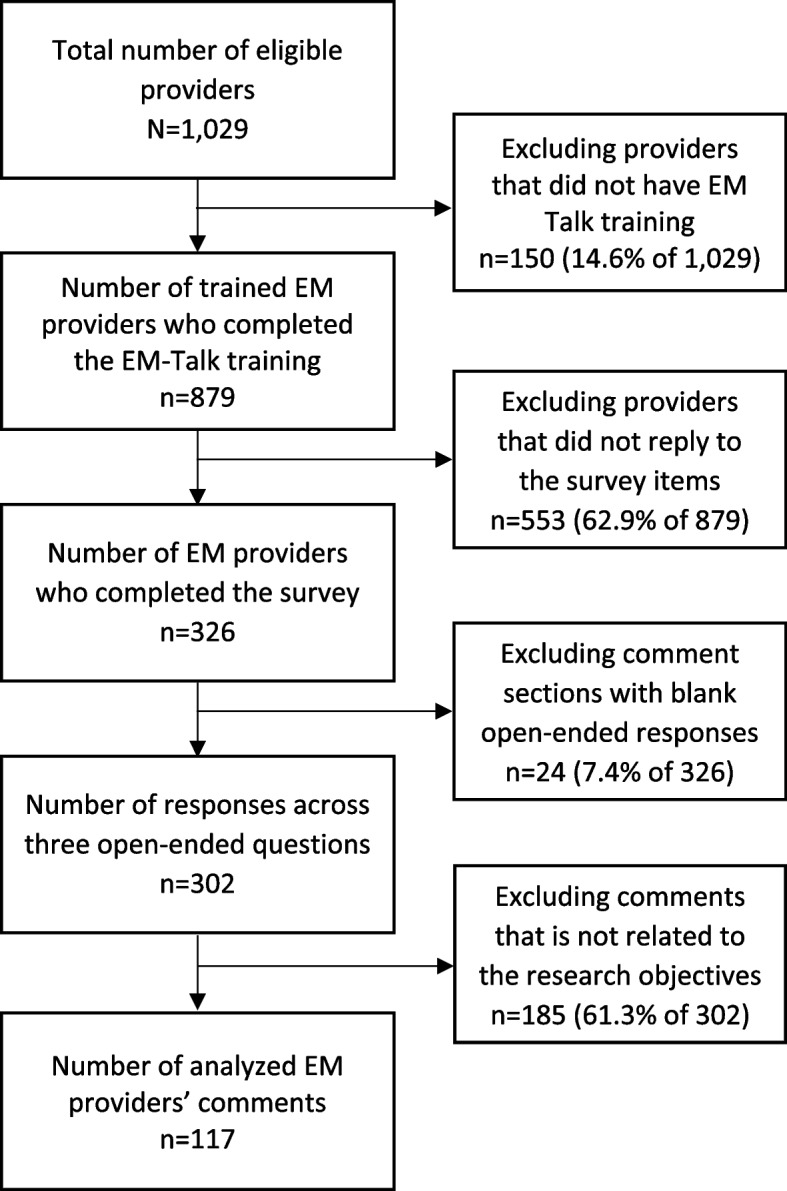
Data selection steps
Table 5.
Content Coding
| Theme and Subthemesa | Code Counts |
|---|---|
| Improved Knowledge (N = 60)b | |
| Acquired SI communication skills | 47 |
| Acquired general useful knowledge | 14 |
| Improved Attitude (N = 45) | |
| Attitudes toward engaging in SI conversations | 30 |
| Attitudes toward improving patient care | 10 |
| Attitudes toward receiving future training in SI conversations | 5 |
| Improved Practice (N = 25) | |
| Commitment to using acquired skills in clinical practice | 20 |
| Already utilizing taught skills in clinical practice | 5 |
aThemes in bold; bMultiple coding categories across subthemes account for the sum exceeding the total
Improved knowledge
The theme of improved knowledge was referenced by 60 respondents. The most common subthemes that emerged from these responses were the acquisition of SI communication skills (n = 47) and acquired general useful knowledge (n = 14) (Table 6).
Table 6.
Apriori themes, emerged subthemes, and the associated meaning units
| Theme | Subtheme | Code label | Meaning Units |
|---|---|---|---|
| Improved Knowledge | Acquired SI communication skills | Acquired talking techniques in framing discussions | “Learned some techniques to talk to the family of palliative patients” |
| Acquired useful general knowledge | Good learning experience | “This was a pretty good learning experience for me” | |
| Acquired empathy skills | Acquired empathetic skills | “…Learned a lot about empathetic skills that I can use in daily practice” | |
| Improved Attitude | Attitude towards engaging in SI conversations | Comfortable and at ease | “…helped me become more comfortable and at ease with end-of-life conversations” |
| Attitude towards improving patient care | I see the value | “I see the value it brings to patients and their families” | |
| Attitude towards receiving future training in SI conversations | Extremely applicable | “…it is extremely applicable to our practice. I would recommend all EM doctors undergo training such as this” | |
| Improved Practice | Commitment to using acquired skills in clinical practice | I will incorporate skills into practice | “I look forward to incorporating this style of talking about goals of care with my patients and families” |
| Already utilizing taught skills in clinical practice | I already used learned skill | “The very next day I had a patient/family interaction that I was able to identify and navigate because of the training…” |
Acquired SI communication skills
A majority of respondents acknowledged that they “learned some really valuable tools” (A254) and that “the tips and tricks provided were concise and therefore relatively easy to remember with regular practice/use” (A256). One provider recounted:
“I did learn some helpful skills that I will try to bring into my practice.” (B64)
Some of the respondents were more specific on the tips and tricks they acquired which included using the “NURSE” statement (Naming, Understanding, Respecting, Supporting, and Exploring) for articulating empathy and the “REMAP” model (Reframe why the status quo is not working, Expect emotion and empathize, Map the future, Align with the patient’s values, and Plan medical treatment that match patient values) for addressing goals of care.
“I will utilize NURSE and REMAP to help conversations.” (B47)
“I will practice more NURSE phrases and yet work to be much more direct.” (B48)
“I will utilize the REMAP structure.” (B75)
To these trained EM providers, the SI communication skills taught in the course were viewed as “techniques to talk to the family of palliative patients” (B35). One provider highlighted the importance of this skill based on the frequency of contact with SI patients and their caregivers in the EDs:
“This was a useful educational intervention to ED providers who often have to have end-of-life discussions with patients and families in an emergent setting.” (B34)
Acquired general useful knowledge
In contrast to EM providers that specified specific skills EM Talk provided, some providers reported a general improvement in their knowledge of palliative care. For some, the training was “a pretty good learning experience for me” (C314) while another provider felt the training “really helped me grow as a provider” (A194). A provider shared:
“I learned more than I thought I would, made me think about these issues more than I had before.” (B49)
A few EM providers reported that the while the training “did not introduce new concepts, it did help (me) put these concepts into an easier to deliver package”(B12).
“The experience was similar to what we did during residency but still allowed me to assess myself in a judgement free zone and identify areas where I still struggle. I came out with a couple of tips/tricks that I know I will incorporate into my practice moving forward.”(A179)
Improved attitude
The theme of improved attitude was present in 46 responses. The most common subtheme that was identified was improved attitudes toward engaging in hospice and palliative care discussions (n = 30). Less frequently identified subthemes included attitude towards improving patient care (n = 10) and attitude towards receiving future training on SI conversations (n = 5) (Table 6).
Improved attitude toward engaging in SI conversations
The improved attitude towards engaging in SI conversations referred to being “more comfortable and at ease with end-of-life conversations” (A190). For some EM providers, the training helped them “realize the importance of having discussions with family early/often regarding goals of care for their loved ones” (A188).
Some EM providers, however, discussed the deliberate attempt of the EM provider “to slow down and listen to your patients and family members” (A166). The importance of being intentional about listening was stated by one of the EM providers:
“Patients end up being more satisfied when you listen and they feel as if their needs and concerns are being addressed” (C311)
A few EM providers stated that the training helped increase the motivation to engage in SI conversations. For example, one provider wrote about negative past experiences and how the course made them feel more confident with such conversations:
“…due to time constraints and some negative patient interactions regarding the goal of care discussions, I was initially resistant but now motivated and optimistic in my ability to navigate these talks” (B63).
Improved attitude toward patient care
Improved attitude towards patient care referred to the EM providers “see(ing) the value [the training] brings to patients and their families” (A208). The training provided an opportunity for self-reflection and assessment with one provider stating that “I identified various areas in which I can improve not only my communication in end-of-life discussions but also with all my patients” (A258). The awareness of how the training may improve patient care served as a motivation for some EM providers to practice SI conversations.
“[The course] pushed my comfort level with these discussions and has motivated me to practice and improve (B27).”
Improved attitude towards future training on SI conversations
A few EM providers reflected on the EM Talk training and stated that “[the training] is extremely applicable to our practice. I would recommend all EM doctors undergo training such as this” (A152). Other EM providers referred to the effectiveness of the small group discussion format and the ability to download the VitalTalk app for future reference.
“I had a great time in the small groups practicing difficult conversations. I also was happy to get the app downloaded to keep some very useful tools on hand” (B84).
Improved practice
The theme of improved practice was referenced by 25 respondents. The majority of these reflected the subtheme of commitment to using acquired skills in clinical practice (n = 20) while a minority of respondents (n = 5) stated that were already utilizing taught skills in clinical practice (Table 6).
Commitment to using acquired skills in clinical practice
The commitment to using acquired skills in clinical practice was indicated by providers who shared a plan to “incorporating this style of talking about goals of care with my patients and families” (B63). A provider acknowledged the ease of acquiring SI conversation skills and that it might take some time for the skill to become second nature.
“It [the training] was interesting and the tool is easy to follow so it should be easy to incorporate into practice. I suspect it will be more comfortable with time and eventually become second nature” (A82).
Already utilizing taught skills in clinical practice
A few EM providers expressed that, between the training completion and survey completion, they had been in clinical scenarios where they had to use some of the SI conversational skills taught. One provider stated that “I feel better about approaching end-of-life discussions and have had some success in my recent practice” (B69). Also, another provider attributed the success in navigating SI conversations he recently experienced to the training he received.
“The very next day I had a patient/family interaction that I was able to identify and navigate because of the training” (C104)
Discussion
We report that across the 33 EDs enrolled in the PRIM-ER study, over 85 percent of the EM providers completed the EM Talk training and we estimate that these trained providers will reach approximately 16,389 seriously ill older adult patients that visit the ED. Also, across the thematic domains of improved knowledge, attitudes, and practice, the EM providers reported that the training improved their SI communication skills, improved their attitude towards engaging qualifying patients in SI conversations, and encouraged their commitment to using these learned skills in clinical practice.
The extensive reach of the EM Talk training is noteworthy. We trained a total of 879 EM providers, representing 85 percent of EM providers across the 33 EDs. The OncoTalk training by Back et al. [12], in comparison, reached 115 medical oncology fellows across 62 institutions, representing 42 percent of fellows across the selected institution. The GeriTalk intervention by Frydman et al. [18] reached 20 Geriatric and Palliative fellows across three institutions representing 100 percent of the fellows in the institutions. The extensive reach of the EM Talk training reflects the commitment of the departmental leadership of each site and their willingness to integrate the training into the educational curriculum in their departments. Also, compressing the training modules of the VitalTalk into a four-hour session made it logistically feasible to organize. In contrast, the OncoTalk [12] and GeriTalk training sessions [18] occurred over four days. In addition, our flexibility in converting the in-person training to a fully virtual training during the COVID-19 pandemic might have helped in logistically scheduling the sessions. Furthermore, we selected EM physician champions that were tasked with disseminating the information about the EM Talk training and facilitating attendance. The selection of appropriate and influential clinical champions is pivotal to the successful engagement and training of providers. Earlier studies have reported that clinical champions are instrumental in the quicker initiation of interventions, assist in overcoming institutional barriers, and can motivate and involve staff in clinical trials [39, 40].
We report that, assuming a 100 percent practice rate, a trained EM provider will reach between four and 115 seriously ill older adult patients every year depending on the ED volume, patient mix, geographic setting, and the type of acute and chronic diseases predominant among the population the ED serves, among other factors. This wide range of encounter highlights the diversity in the patient population that visit the ED, and the need for each ED to conduct a needs assessment, create ED-specific standard operating procedures in engaging qualifying patients in SI conversations, and provide a conducive environment for SI conversations in their respective EDs [41–44]. Engaging in SI conversations is never an easy task, and creating an enabling environment within the ED for EM providers to engage in such conversations may lighten the burden of delivering bad news and engaging patients in end-of-life goal discussions. Earlier studies have reported that some of the barriers EM providers and emergency nurses face in engaging qualifying patients in SI conversations include lack of privacy, limited patient engagement time, and the fast-paced ED work culture [9, 28, 45, 46].
EM Talk was designed to provide SI communication skills training to EM providers. Consistent with the goal of the intervention, the EM providers reported that they acquired SI communication skills, are willing to engage qualifying patients in SI conversations, and have the intent to incorporate these learned skills in clinical practice. The observed harmony between the expected goal and self-reported outcome may be explained by the evidenced-based pedagogical technique employed in delivering the EM Talk training. VitalTalk – the parent program from which EM Talk emerged has consistently prioritized role play and small group learning sessions as a bedrock of successful training sessions [10, 11]. Similarly, other authors that taught GeriTalk – another derivative of the VitalTalk, reported that Geriatric and Palliative Medicine fellows had high levels of satisfaction after they underwent the training [17, 18]. Similarly, Berg et al. [47] reported that Oncology fellows self-reported significant improvement in SI communication skills after undergoing OncoTalk training.
This study has its limitations. Although a large proportion of full-time EM providers completed the training, it is unlikely that all EM providers will embrace and utilize the SI communication skill in their practice. The estimated average of seriously ill patients that would be reached yearly, therefore, represents the best-case scenario. On the other hand, EM providers may learn from one another and the training and knowledge may even spread to those who are not formally trained– i.e., adoption of behavior due to peer influence. There is a possibility that attitude and practice towards engaging qualifying patients in SI conversations will differ by age, race/ethnicity, religious affiliation, and years of practice. Third, differences in the pedagogical styles of the different facilitators may positively or negatively influence the knowledge, attitude, and practice of EM providers toward engaging qualifying patients in SI conversations. Despite training 879 EM providers, about a third completed the open-ended question. The possibility exists that more meaning units might have emerged if everyone completed the survey. However, within the ambits of the responses obtained, the meaning units defined the bounded concepts of improved knowledge, attitude, and practice, and saturation was deemed achieved when no new information emerged from the codes. Also, the EM Talk course started as an in-person training program but was transitioned into an online training session due to the COVID-19 pandemic. We conducted a total of 106 EM Talk trainings. Before the start of the COVID-19 pandemic (May 2019-March 2020), we conducted 49 in-person trainings (46% of all trainings). At the start of the pandemic, we paused the intervention for six months (between March 2020 and September 2020). Following best-practice guidelines [48] and conversations with the leadership of each participating institution, we restarted the intervention in September 2020. Between September 2020 and December 2021, the remaining 57 sessions (54%) were virtual. It is unknown to what extent this change in pedagogy affects the reach and effectiveness of the intervention. Despite these limitations, this study is one of the few that assessed the effectiveness of EM Talk training across the domains of knowledge, attitude, and practice. Also, this is one of the few studies that used the RE-AIM framework to assess the reach and effectiveness of a provider-focused intervention. Furthermore, this study is strengthened by its spread across over 30 EDs and its large sample size.
Conclusion
The EM Talk training reached a substantial proportion of EM providers working in the 33 EDs enrolled in the PRIM-ER study. The effectiveness of the EM Talk training was reflected across the thematic domains of improved knowledge, attitude, and practice evidenced by EM providers' self-reported acquisition of SI communication skills, willingness to engage qualifying patients in SI conversations, and intent to incorporate the learned skills into clinical practice. Future studies may assess to what extent learned communication skills translate into the proportion of qualifying seriously ill older adults with documented end-of-life goals and the proportion successfully transitioned to comfort care.
Supplementary Information
Additional file 1: Appendix 1. Open-ended questions in the EM Talk post-training survey.
Acknowledgements
Not applicable.
Nominated PRIM-ER Consortia Representative
Lauren T. Southerland, MD
614–293-8305
Lauren.Southerland@osumc.edu
The PRIM-ER Investigators Consortium
| 13 | Lauren T. Southerland | The Ohio State University- Wexner Medical Center | US |
| 13 | Peg Gulker | The Ohio State University- Wexner Medical Center | US |
| 14 | Andrew Johnston | Allegheny Health Network | US |
| 14 | Arvind Venkat | Allegheny Health Network | US |
| 14 | David Chuirazzi | Allegheny Health Network | US |
| 14 | John O'Neill | Allegheny Health Network | US |
| 14 | Kelly Szabo | Allegheny Health Network | US |
| 14 | Rachel Urosek | Allegheny Health Network | US |
| 15 | Ashley Deutsch | Baystate Medical Center | US |
| 15 | Elizabeth Schoenfeld | Baystate Medical Center | US |
| 15 | Melissa Shaw | Baystate Medical Center | US |
| 15 | Tricia Guerino | Baystate Medical Center | US |
| 16 | Alayna Perko | Beaumont Health | US |
| 16 | Lauren Cameron- Comasco | Beaumont Health | US |
| 16 | Michael Banish | Beaumont Health | US |
| 16 | Pamela Sloan | Beaumont Health | US |
| 16 | Robert Swor | Beaumont Health | US |
| 16 | Ronny Otero | Beaumont Health | US |
| 17 | Aaron Elliot | Bellevue Hospital | US |
| 17 | Kim Reiner | Bellevue Hospital | US |
| 17 | Nicole Hurd | Bellevue Hospital | US |
| 18 | Brittany Ballaron | Brigham and Women's Hospital | US |
| 18 | Kei Ouchi | Brigham and Women's Hospital | US |
| 18 | Natasha Egorova | Brigham and Women's Hospital | US |
| 18 | Andrew Dundin | Brigham and Women's Hospital | US |
| 18 | Niza Troncoso | Brigham and Women's Hospital | US |
| 18 | Robin Powell | Brigham and Women's Hospital | US |
| 19 | Barbara J Debbage | ChristianaCare | US |
| 19 | Deborah Johnson | ChristianaCare | US |
| 19 | John Powell | ChristianaCare | US |
| 19 | Julie Cooper | ChristianaCare | US |
| 20 | Doretha Graham-Brekke | Henry Ford Health System | US |
| 20 | Erin Zimny | Henry Ford Health System | US |
| 20 | Glenn Tokarski | Henry Ford Health System | US |
| 20 | Joseph Miller | Henry Ford Health System | US |
| 20 | Olive Sadia | Henry Ford Health System | US |
| 21 | Christopher Richardson | Icahn School of Medicine at Mount Sinai | US |
| 21 | Jennifer Kroll | Icahn School of Medicine at Mount Sinai | US |
| 21 | Jennifer Siller | Icahn School of Medicine at Mount Sinai | US |
| 21 | Jessica Fleischer-Black | Icahn School of Medicine at Mount Sinai | US |
| 21 | Karen Evelyn | Icahn School of Medicine at Mount Sinai | US |
| 21 | Laura Stark | Icahn School of Medicine at Mount Sinai | US |
| 21 | Lauren Gordon | Icahn School of Medicine at Mount Sinai | US |
| 21 | Lynne Richardson | Icahn School of Medicine at Mount Sinai | US |
| 21 | Michelle Lin | Icahn School of Medicine at Mount Sinai | US |
| 22 | Audrey Tan | Landmark Health | US |
| 23 | Alicia Sommer | Mayo Clinic Health System | US |
| 23 | Caitlin Loprinzi-Brauer | Mayo Clinic Health System | US |
| 23 | Heather Heaton | Mayo Clinic Health System | US |
| 23 | Laura Walker | Mayo Clinic Health System | US |
| 23 | M Fernanda Bellolio | Mayo Clinic Health System | US |
| 23 | Molly Christenson | Mayo Clinic Health System | US |
| 24 | Donna Shelley | New York University School of Global Public Health | US |
| 25 | Audie Liametz | NYU Langone Health | US |
| 25 | Barry Rosenthal | NYU Langone Health | US |
| 25 | Ian Wittman | NYU Langone Health | US |
| 25 | Kathy Peterson | NYU Langone Health | US |
| 25 | Lila Hageman-Sheehan | NYU Langone Health | US |
| 25 | Rajneesh Gulati | NYU Langone Health | US |
| 25 | Robert Smeltz | NYU Langone Health | US |
| 25 | Staci Mandola | NYU Langone Health | US |
| 25 | Stephen Stark | NYU Langone Health | US |
| 25 | Suchismita Datta | NYU Langone Health | US |
| 25 | Susan Cohen | NYU Langone Health | US |
| 25 | Tisha Thompson | NYU Langone Health | US |
| 25 | Joshua Chodosh | NYU Langone Health | US |
| 25 | Katharine Lawrence | NYU Langone Health | US |
| 25 | Abraham Brody | NYU Langone Health | US |
| 25 | Leora Horwitz | NYU Langone Health | US |
| 25 | Nicholas Genes | NYU Langone Health | US |
| 26 | Ashley Shreves | Ochsner Health | US |
| 26 | Deidre Bolden | Ochsner Health | US |
| 26 | Kelly Hutchinson | Ochsner Health | US |
| 27 | Maureen Gang | Rutgers University | US |
| 27 | Rebecca Goett | Rutgers University | US |
| 27 | Sangeeta Lamba | Rutgers University | US |
| 28 | Eric Isaacs | University of California San Francisco Medical Center | US |
| 28 | Jennifer Harris | University of California San Francisco Medical Center | US |
| 28 | Karen Martinez | University of California San Francisco Medical Center | US |
| 29 | Matthew Shaw | University of Florida Health | US |
| 29 | Rebecca Murray | University of Florida Health | US |
| 29 | Rosemarie Fernandez | University of Florida Health | US |
| 29 | Shannon Bledsoe | University of Florida Health | US |
| 29 | Travis Wood | University of Florida Health | US |
| 29 | Matthew Ryan | University of Florida Health | US |
| 30 | Benjamin S. Abella | University of Pennsylvania School of Medicine | US |
| 30 | Elizabeth Long | University of Pennsylvania School of Medicine | US |
| 30 | Gabriela De Hoyos | University of Pennsylvania School of Medicine | US |
| 30 | Julie Uspal | University of Pennsylvania School of Medicine | US |
| 30 | M. Bradley Falk | University of Pennsylvania School of Medicine | US |
| 30 | Phillip Landis | University of Pennsylvania School of Medicine | US |
| 31 | Ahmed Elsayem | University of Texas MD Anderson | US |
| 31 | Cecilia Yniguez | University of Texas MD Anderson | US |
| 31 | Danielle Milling | University of Texas MD Anderson | US |
| 31 | Denise Langabeer | University of Texas MD Anderson | US |
| 31 | Sorayah Bourenane | University of Texas MD Anderson | US |
| 32 | Terri Cridge | University of Utah Hospital | US |
| 32 | Troy Madsen | University of Utah Hospital | US |
| 33 | Emilia Boutsioulis | Yale New Haven Health System | US |
| 33 | Hannah Nofsinger | Yale New Haven Health System | US |
| 33 | Karen Jubanyik | Yale New Haven Health System | US |
| 33 | Theresa Cohen | Yale New Haven Health System | US |
| 34 | Marie-Carmelle Elie | The University of Alabama at Birmingham | US |
Abbreviations
- RE-AIM
Reach, Effectiveness, Adoption, Implementation, and Maintenance
- EM
Emergency Medicine
- SI
Serious Illness
- ED
Emergency Department
- COREQ
Consolidated criteria for reporting qualitative research
- PRIM-ER
Primary Palliative Care for Emergency Medicine
- ELNEC
End-of-Life Nursing Education Consortium
- CME
Continuing Medical Education
- CMS
Centers for Medicare & Medicaid Services
- KAP
Knowledge, Attitude, and Practice
- MDs
Medical Doctor
Authors’ contributions
OA: Conceptualization, Methodology, Formal analysis, Investigation, Data curation, Writing- Original draft; ADG: Formal analysis, Investigation, Writing- Review and; Editing; RK: Formal analysis, Investigation, Writing- Review and; Editing; AC: Writing-Review and; Editing, Supervision, Project administration; NZ: Writing- Review and; Editing; NS: Formal analysis, Writing- Review and; Editing; KG: Writing- Review and; Editing; LLE: Writing- Review and; Editing; CD: Writing- Review and; Editing; RY: Writing- Review and; Editing; JBBM: Writing- Review and; Editing; JC: Writing- Review and; Editing; CRG: Conceptualization, Investigation, Writing- Review and; Editing, Funding acquisition; The PRIM-ER Investigators: Implementation of intervention; Review and; Editing.
Funding
This work is supported within the National Institutes of Health (NIH) Health Care Systems Research Collaboratory by cooperative agreement (UG3/ UH3 AT009844) from the National Institute on Aging. This work also received logistical and technical support from the NIH Collaboratory Coordinating Center through cooperative agreement U24AT009676. Support was also provided by the NIH National Center for Complementary and Integrative Health Administrative Supplement for Complementary Health Practitioner Research Experience through cooperative agreement (UH3 AT009844) and by the National Center for Complementary and Integrative Health of the National Institutes of Health under award number (UH3AT009844). The content is solely the responsibility of the authors and does not necessarily represent the ofcial views of the National Institutes of Health.
Availability of data and materials
The datasets used and/or analysed during the current study are available from the corresponding author on reasonable request.
Declarations
Ethics approval and consent to participate
This study was approved by New York University Grossman School of Medicine Institutional Review Board (ID: i18-00607). For this study, a waiver of authorization of Informed Consent was obtained from NYU Langone Medical Center, New York University Grossman School of Medicine. A waiver of authorization of informed consent was waived by New York University Grossman School of Medicine’s Institutional Review Board as this research presents no more than minimal risk as no protected health information was stored or collected and it did not adversely affect the rights and welfare of participants. The design, methods and implementation was guided by the ethical guidelines stated in the Declaration of Helsinki and overseen in accordance to regional and institutional ethical recommendations.
Consent for publication
Not applicable.
Competing interests
The authors declare no competing interests.
Footnotes
Publisher’s Note
Springer Nature remains neutral with regard to jurisdictional claims in published maps and institutional affiliations.
Contributor Information
Allison M. Cuthel, Email: Allison.Cuthel@nyulangone.org
The PRIM-E. R. Investigators:
Lauren T. Southerland, Peg Gulker, Andrew Johnston, Arvind Venkat, David Chuirazzi, John O’Neill, Kelly Szabo, Rachel Urosek, Ashley Deutsch, Elizabeth Schoenfeld, Melissa Shaw, Tricia Guerino, Alayna Perko, Lauren Cameron- Comasco, Michael Banish, Pamela Sloan, Robert Swor, Ronny Otero, Aaron Elliot, Kim Reiner, Nicole Hurd, Brittany Ballaron, Kei Ouchi, Natasha Egorova, Andrew Dundin, Niza Troncoso, Robin Powell, Barbara J. Debbage, Deborah Johnson, John Powell, Julie Cooper, Doretha Graham-Brekke, Erin Zimny, Glenn Tokarski, Joseph Miller, Olive Sadia, Christopher Richardson, Jennifer Kroll, Jennifer Siller, Jessica Fleischer-Black, Karen Evelyn, Laura Stark, Lauren Gordon, Lynne Richardson, Michelle Lin, Audrey Tan, Alicia Sommer, Caitlin Loprinzi-Brauer, Heather Heaton, Laura Walker, MFernanda Bellolio, Molly Christenson, Donna Shelley, Audie Liametz, Barry Rosenthal, Ian Wittman, Kathy Peterson, Lila Hageman-Sheehan, Rajneesh Gulati, Robert Smeltz, Staci Mandola, Stephen Stark, Suchismita Datta, Susan Cohen, Tisha Thompson, Katharine Lawrence, Abraham A. Brody, Leora Horwitz, Nicholas Genes, Ashley Shreves, Deidre Bolden, Kelly Hutchinson, Maureen Gang, Rebecca Goett, Sangeeta Lamba, Eric Isaacs, Jennifer Harris, Karen Martinez, Matthew Shaw, Rebecca Murray, Rosemarie Fernandez, Shannon Bledsoe, Travis Wood, Matthew Ryan, Benjamin S. Abella, Elizabeth Long, Gabriela De Hoyos, Julie Uspal, M. Bradley Falk, Phillip Landis, Ahmed Elsayem, Cecilia Yniguez, Danielle Milling, Denise Langabeer, Sorayah Bourenane, Terri Cridge, Troy Madsen, Emilia Boutsioulis, Hannah Nofsinger, Karen Jubanyik, Theresa Cohen, and Marie-Carmelle Elie
References
- 1.Ouchi K, Strout T, Haydar S, et al. Association of emergency clinicians' assessment of mortality risk with actual 1-month mortality among older adults admitted to the hospital. JAMA Netw Open. 2019;2(9):e1911139. doi: 10.1001/jamanetworkopen.2019.11139. [DOI] [PMC free article] [PubMed] [Google Scholar]
- 2.Smith AK, McCarthy E, Weber E, et al. Half of older Americans seen in emergency department in last month of life; most admitted to hospital, and many die there. Health Aff (Millwood) 2012;31(6):1277–1285. doi: 10.1377/hlthaff.2011.0922. [DOI] [PMC free article] [PubMed] [Google Scholar]
- 3.Yadav KN, Gabler NB, Cooney E, et al. Approximately one in three US adults completes any type of advance directive for end-of-life care. Health Aff. 2017;36(7):1244–1251. doi: 10.1377/hlthaff.2017.0175. [DOI] [PubMed] [Google Scholar]
- 4.Kass-Bartelmes BL, Hughes R. Advance care planning: preferences for care at the end of life. J Pain Palliat Care Pharmacother. 2004;18(1):87–109. [PubMed] [Google Scholar]
- 5.Benson WF, Adldrich N. Advance care planning: ensuring your wishes are known and honored if you are unable to speak for yourself. Critical Issue Brief. Centers for Disease Control and Prevention; 2012. Accessed 02 Nov 2022. https://www.cdc.gov/aging/pdf/advanced-care-planning-critical-issue-brief.pdf.
- 6.Hafid A, Howard M, Guenter D, et al. Advance care planning conversations in primary care: a quality improvement project using the serious illness care program. BMC Palliat Care. 2021;20(1):122. doi: 10.1186/s12904-021-00817-z. [DOI] [PMC free article] [PubMed] [Google Scholar]
- 7.Chary AN, Naik AD, Ouchi K. It takes courage to pause: rapid goals-of-care conversations in the emergency department. J Geriatr Emerg Med. 2021;2(12):4. doi: 10.17294/2694-4715.1020. [DOI] [PMC free article] [PubMed] [Google Scholar]
- 8.Karim S, Levine O, Simon J. The serious illness care program in oncology: evidence, real-world implementation and ongoing barriers. Curr Oncol. 2022;29(3):1527–1536. doi: 10.3390/curroncol29030128. [DOI] [PMC free article] [PubMed] [Google Scholar]
- 9.Grudzen CR, Richardson LD, Hopper SS, Ortiz JM, Whang C, Morrison RS. Does palliative care have a future in the emergency department? discussions with attending emergency physicians. J Pain Symptom Manage. 2012;43(1):1–9. doi: 10.1016/j.jpainsymman.2011.03.022. [DOI] [PMC free article] [PubMed] [Google Scholar]
- 10.Arnold RM, Back A, Tulsky J. VitalTalk: intensive small group training—Addressing goals of care (P02) J Pain Symptom Manage. 2016;51(2):307. doi: 10.1016/j.jpainsymman.2015.12.106. [DOI] [Google Scholar]
- 11.Claxton R, Fettig L, Back AL, Arnold R, Tulsky JA. VitalTalk: intensive small group training—addressing goals of care (P01) J Pain Symptom Manage. 2019;57(2):354. doi: 10.1016/j.jpainsymman.2018.12.009. [DOI] [Google Scholar]
- 12.Back AL, Arnold RM, Baile WF, et al. Efficacy of communication skills training for giving bad news and discussing transitions to palliative care. Arch Intern Med. 2007;167(5):453–460. doi: 10.1001/archinte.167.5.453. [DOI] [PubMed] [Google Scholar]
- 13.Epner DE, Baile WF. Difficult conversations: teaching medical oncology trainees communication skills one hour at a time. Acad Med. 2014;89(4):578–584. doi: 10.1097/acm.0000000000000177. [DOI] [PMC free article] [PubMed] [Google Scholar]
- 14.Back A, Arnold RM, Baile W, Fryer-Edwards K, Tulsky JA. A framework for enhanced doctor–patient communication: Oncotalk learning modules. 2002. http://depts.washington.edu/oncotalk/learn/modules.html. Accessed 4 Feb 2014.
- 15.Pham AK, Bauer MT, Balan S. Closing the patient-oncologist communication gap: a review of historic and current efforts. J Cancer Educ. 2014;29(1):106–113. doi: 10.1007/s13187-013-0555-0. [DOI] [PubMed] [Google Scholar]
- 16.Frydman JL, Dow L, Smith C, Kelley A, Lindenberger E, P Gelfman L. Virtual Geritalk: does intensive virtual communication skills training improve use of serious illness communication skills? Am J Hosp Palliat Care. 2023;40(6):620–3. 10.1177/10499091221116078. [DOI] [PMC free article] [PubMed]
- 17.Kelley AS, Back AL, Arnold RM, et al. Geritalk: communication skills training for geriatric and palliative medicine fellows. J Am Geriatr Soc. 2012;60(2):332–337. doi: 10.1111/j.1532-5415.2011.03787.x. [DOI] [PMC free article] [PubMed] [Google Scholar]
- 18.Frydman JL, Gelfman LP, Lindenberger EC, Smith CB, Berns S, Kelley AS, et al. Virtual Geritalk: improving serious illness communication of clinicians who care for older adults. J Pain Symptom Manage. 2021;62(3):e206–12. 10.1016/j.jpainsymman.2021.02.024. [DOI] [PMC free article] [PubMed]
- 19.Gelfman LP, Lindenberger E, Fernandez H, et al. The effectiveness of the Geritalk communication skills course: a real-time assessment of skill acquisition and deliberate practice. J Pain Symptom Manage. 2014;48(4):738–44. doi: 10.1016/j.jpainsymman.2013.12.231. [DOI] [PMC free article] [PubMed] [Google Scholar]
- 20.Grudzen CR, Emlet LL, Kuntz J, et al. EM talk: communication skills training for emergency medicine patients with serious illness. BMJ Support Palliat Care. 2016;6(2):219–224. doi: 10.1136/bmjspcare-2015-000993. [DOI] [PubMed] [Google Scholar]
- 21.Accreditation Council for Graduate Medical Education. ACGME Program Requirements for Graduate Medical Education in Emergency Medical Services. 2022. Accessed 11 Nov 2022. https://www.acgme.org/globalassets/pfassets/programrequirements/112_emergencymedicalservices_2022.pdf.
- 22.Glasgow RE, Harden SM, Gaglio B, et al. RE-AIM planning and evaluation framework: adapting to new science and practice with a 20-year review. Front Public Health. 2019;7:64–64. doi: 10.3389/fpubh.2019.00064. [DOI] [PMC free article] [PubMed] [Google Scholar]
- 23.Harden SM, Smith ML, Ory MG, Smith-Ray RL, Estabrooks PA, Glasgow RE. RE-AIM in clinical, community, and corporate settings: perspectives, strategies, and recommendations to enhance public health impact. Front Public Health. 2018;6:71–71. doi: 10.3389/fpubh.2018.00071. [DOI] [PMC free article] [PubMed] [Google Scholar]
- 24.Kwan BM, McGinnes HL, Ory MG, Estabrooks PA, Waxmonsky JA, Glasgow RE. RE-AIM in the real world: use of the RE-AIM framework for program planning and evaluation in clinical and community settings. Front Public Health. 2019;7:345–345. doi: 10.3389/fpubh.2019.00345. [DOI] [PMC free article] [PubMed] [Google Scholar]
- 25.Martha D, Sousa VD, Mendes IAC. An overview of research designs relevant to nursing: Part 3: mixed and multiple methods. Rev Lat Am Enfermagem. 2007;15:1046–1049. doi: 10.1590/S0104-11692007000500025. [DOI] [PubMed] [Google Scholar]
- 26.Tong A, Sainsbury P, Craig J. Consolidated criteria for reporting qualitative research (COREQ): a 32-item checklist for interviews and focus groups. Int J Qual Health Care. 2007;19(6):349–357. doi: 10.1093/intqhc/mzm042. [DOI] [PubMed] [Google Scholar]
- 27.Grudzen CR, Brody AA, Chung FR, et al. Primary palliative Care for Emergency Medicine (PRIM-ER): protocol for a pragmatic, cluster-randomised, stepped wedge design to test the effectiveness of primary palliative care education, training and technical support for emergency medicine. BMJ Open. 2019;9(7):e030099. doi: 10.1136/bmjopen-2019-030099. [DOI] [PMC free article] [PubMed] [Google Scholar]
- 28.Adeyemi O, Walker L, Bermudez ES, Cuthel AM, Zhao N, Siman N, et al. Emergency nurses' perceived barriers and solutions to engaging patients with life-limiting illnesses in serious illness conversations: a United States multicenter mixed-method analysis. J Emerg Nurs. 2023:S0099-1767(23)00249-0. 10.1016/j.jen.2023.09.010. Epub ahead of print. [DOI] [PMC free article] [PubMed]
- 29.Gagne JJ, Glynn RJ, Avorn J, Levin R, Schneeweiss S. A combined comorbidity score predicted mortality in elderly patients better than existing scores. J Clin Epidemiol. 2011;64(7):749–759. doi: 10.1016/j.jclinepi.2010.10.004. [DOI] [PMC free article] [PubMed] [Google Scholar]
- 30.Gumicio S, Merica M, Luhman N, Fauvel G, Zompi S, Ronsse A. The KAP survey model (Knowledge, Attitudes & Practices). Medicíns du Monde. https://issuu.com/medecinsdumonde/docs/47-the-kap-survey-model-knowledge-a
- 31.American Medical Association. Guidance on new procedure for CME. Accessed 12/05/2022, https://www.ama-assn.org/education/ama-pra-credit-system/guidance-new-procedure-cme
- 32.Erlingsson C, Brysiewicz P. A hands-on guide to doing content analysis. Afr J Emerg Med. 2017;7(3):93–99. doi: 10.1016/j.afjem.2017.08.001. [DOI] [PMC free article] [PubMed] [Google Scholar]
- 33.Strauss A, Corbin J. Basics of qualitative research. Sage publications; 1990.
- 34.Saldaña J. The coding manual for qualitative researchers. 3rd Edition ed. Sage; 2015. Accessed 15 Dec 2022. https://study.sagepub.com/saldanacoding3e
- 35.Janesick VJ. The Blackwell Encyclopedia of Sociology. 2015. https://doi.org/10.1002/9781405165518.wbeosp014.pub2 Accessed 15 Dec 2022.
- 36.Graneheim UH, Lundman B. Qualitative content analysis in nursing research: concepts, procedures and measures to achieve trustworthiness. Nurse Educ Today. 2004;24(2):105–112. doi: 10.1016/j.nedt.2003.10.001. [DOI] [PubMed] [Google Scholar]
- 37.Elo S, Kääriäinen M, Kanste O, Pölkki T, Utriainen K, Kyngäs H. Qualitative content analysis: a focus on trustworthiness. SAGE Open. 2014;4(1):2158244014522633. doi: 10.1177/2158244014522633. [DOI] [Google Scholar]
- 38.ClinicalTrials.Gov. Primary Palliative Care for Emergency Medicine (PRIM-ER). U.S. National Library of Medicine. Accessed 3 Dec 2021, https://clinicaltrials.gov/ct2/show/NCT03424109
- 39.Morena AL, Gaias LM, Larkin C. Understanding the role of clinical champions and their impact on clinician behavior change: the need for causal pathway mechanisms. Hypothesis and theory. Front Health Serv. 2022;210.3389/frhs.2022.896885. [DOI] [PMC free article] [PubMed]
- 40.Wood K, Giannopoulos V, Louie E, et al. The role of clinical champions in facilitating the use of evidence-based practice in drug and alcohol and mental health settings: a systematic review. Implement Res Pract. 2020;1:2633489520959072. doi: 10.1177/2633489520959072. [DOI] [PMC free article] [PubMed] [Google Scholar]
- 41.Lamba S, DeSandre PL, Todd KH, Bryant EN, Chan GK, Grudzen CR, et al. Integration of palliative care into emergency medicine: the Improving Palliative Care in Emergency Medicine (IPAL-EM) collaboration. J Emerg Med. 2014;46(2):264–70. doi: 10.1016/j.jemermed.2013.08.087. [DOI] [PubMed] [Google Scholar]
- 42.Aaronson EL, Daubman BR, Petrillo L, et al. Emerging palliative care innovations in the ED: a qualitative analysis of programmatic elements during the COVID-19 pandemic. J Pain Symptom Manage. 2021;62(1):117–124. doi: 10.1016/j.jpainsymman.2020.10.035. [DOI] [PMC free article] [PubMed] [Google Scholar]
- 43.Grudzen C, Richardson LD, Baumlin KM, et al. Redesigned geriatric emergency care may have helped reduce admissions of older adults to intensive care units. Health Aff (Millwood) 2015;34(5):788–795. doi: 10.1377/hlthaff.2014.0790. [DOI] [PubMed] [Google Scholar]
- 44.Wright RJ, Lowton K, Robert G, Grudzen CR, Grocott P. Emergency department staff priorities for improving palliative care provision for older people: a qualitative study. Palliat Med. 2018;32(2):417–425. doi: 10.1177/0269216317705789. [DOI] [PubMed] [Google Scholar]
- 45.Brickey J, Flannery M, Cuthel A, Cho J, Grudzen CR. Barriers to recruitment into emergency department-initiated palliative care: a sub-study of a multi-site, randomized controlled trial. BMC Palliative Care. 2022;21(1):22. doi: 10.1186/s12904-021-00899-9. [DOI] [PMC free article] [PubMed] [Google Scholar]
- 46.Grudzen CR, Stone SC, Morrison RS. The palliative care model for emergency department patients with advanced illness. J Palliat Med. 2011;14(8):945–950. doi: 10.1089/jpm.2011.0011. [DOI] [PMC free article] [PubMed] [Google Scholar]
- 47.Berg MN, Ngune I, Schofield P, et al. Effectiveness of online communication skills training for cancer and palliative care health professionals: a systematic review. Psychooncology. 2021;30(9):1405–1419. doi: 10.1002/pon.5702. [DOI] [PubMed] [Google Scholar]
- 48.Shiely F, Foley J, Stone A, et al. Managing clinical trials during COVID-19: experience from a clinical research facility. Trials. 2021;22(1):62. doi: 10.1186/s13063-020-05004-8. [DOI] [PMC free article] [PubMed] [Google Scholar]
Associated Data
This section collects any data citations, data availability statements, or supplementary materials included in this article.
Supplementary Materials
Additional file 1: Appendix 1. Open-ended questions in the EM Talk post-training survey.
Data Availability Statement
The datasets used and/or analysed during the current study are available from the corresponding author on reasonable request.