



Abstract
Adolescence is a key developmental period for socio-emotional skills, and companion animal relationships may be one potential source of emotional support and resilience during this time. This study used longitudinal data from 940 pet-owning adolescents, collected over four time points, from youth in the Northeastern United States. We assessed whether pet relationship quality (indexed by relationship satisfaction, companionship, and emotional disclosure) predicted trajectories of loneliness, social anxiety, and depression. Results indicated that high satisfaction with a pet relationship was associated with more favorable trajectories, but companionship (i.e., regarding frequency of interacting with the pet) was not related significantly to socio-emotional functioning. High levels of disclosure to a pet were linked with less favorable trajectories for loneliness and depression, but not related to social anxiety. These results suggest that a pet relationship can, in some cases, be associated positively with socio-emotional development, but that there is significant complexity in these associations. Families, educators, and practitioners should take a nuanced approach to understanding individual adolescent-pet relationships as a contextual asset for specific youth.
During adolescence, the importance of developing autonomy, independence, and managing peer relationships increases compared to childhood (Allen & Loeb, 2015; Laursen & Hartl, 2013). These developmental tasks in early adolescence involve managing complex and changing social relationships among family members and peers, and the use of social skills to cope with social stress and interpersonal conflict (Allen & Loeb, 2015). However, these socio-emotional developmental tasks also can be associated with vulnerability, and there is a marked increase in mental health diagnoses during adolescence (Kessler et al., 2005; Merikangas et al., 2009). Pets are highly prevalent in the family setting (over two thirds of households in the United States have at least one pet; APPA, 2022) and can provide a source of social support (Cassels et al., 2017) that may support resilience and reduce risk for challenges with socio-emotional functioning during early adolescence. However, the role of companion animal relationship quality in this specific developmental context has been underexplored, hindering practical applications regarding how pet relationships can be leveraged effectively to support adolescent well-being. Therefore, the purpose of this study was to examine whether pet relationship quality (i.e., satisfaction with the relationship, companionship, emotional disclosure) was associated with trajectories of socio-emotional functioning (for this study, operationalized by loneliness, social anxiety, and depressive symptoms) during early adolescence, controlling for racial/ethnic identity, maternal education, and species of pet. Through the consideration of the quality of pet relationships, the present investigation aimed to inform intervention efforts aimed at promoting resilience through strengthening social relationships during early adolescence.
Social Development and Risk for Loneliness, Social Anxiety, and Depressive Symptoms
Socio-emotional functioning is a broad term that encompasses many aspects of youth social relationships, social skills, emotional states, and regulation. In this study, we focus on three key aspects of socio-emotional functioning that are particularly important during the adolescent period: loneliness, social anxiety, and depressive symptoms. Early adolescence is characterized by a shift in autonomy and independence that is marked by increased distance from family/parent relationships (Laursen & Hartl, 2013), and is consequently an important developmental period for understanding socio-emotional functioning. As part of this development of autonomy, the composition of youth social relationships changes, with adolescents spending more time with peers, and less time with family (Larson & Richards, 1991), as well as more time with romantic partners (Collins et al., 2009). Physical and psychological distance from family, although important for the development of autonomy, can culminate in social isolation and loneliness if social needs are not fulfilled through other relationships (Laursen & Hartl, 2013). As peer relationships become increasingly salient for youth as they move from childhood to adolescence, high social acceptance and friendship are protective against loneliness, whereas low acceptance and weak friendships are associated with higher risk for loneliness (Vanhalst et al., 2014; Woodhouse et al., 2012).
Loneliness is important in understanding adolescent mental health more broadly, as loneliness has been linked closely to both anxiety disorders and depression in adolescence (Heinrich & Gullone, 2006). Social anxiety is particularly common among adolescents (Burstein et al., 2011), with average onset occurring during early to mid-adolescence (Rapee & Spence, 2004; Schneier et al., 1992). Many of the same factors that contribute to risk for loneliness are also relevant for social anxiety, and there is a strong reciprocal positive association between social anxiety and loneliness (Maes et al., 2019). Similarly, loneliness has been linked consistently to depressive symptoms in adolescence (Ladd & Ettekal, 2013; Lasgaard et al., 2011; Schinka et al., 2013).
Given the prevalence of loneliness, social anxiety, and depression in adolescence as key indicators of socio-emotional functioning, the specific patterns and predictors of developmental trajectories of these outcomes have been studied extensively. For all three of these indices of socio-emotional functioning, the majority of the literature suggests multiple classes of trajectories (typically three to four classes for social anxiety and depression; two to five for loneliness), almost always characterized by the presence of a large percentage of youth who show low and stable patterns (e.g., Fernandez Castelao & Kröner-Herwig, 2013; Hutten et al., 2021; Miers et al., 2013; Musliner et al., 2016; Poole et al., 2022; van Dulmen & Goossens, 2013; Yaroslavsky et al., 2013). Additional trajectories often include a high stable pattern, and various combinations of low, moderate, and high increasing and decreasing patterns, with some variation by specific sample characteristics and contexts. Non-linear or U-shaped patterns are not reported commonly (Musliner et al., 2016). Therefore, this study aimed to explore the structure of these trajectories in the context of pet relationships, to assess whether different dimensions of pet relationship quality (i.e., relational satisfaction, companionship, and emotional disclosure) predicted these trajectories.
Dimensions of Social Support from Companion Animals: Relational Satisfaction, Companionship, and Emotional Disclosure
Although the development of autonomy and shifts in relative importance of parent and peer relationships are part of typical developmental trajectories for youth, there is a need to identify contextual assets that can lower the risks associated with these changes and support positive youth development. Having a household pet is increasingly common (APPA, 2022), and therefore, pets are an often readily available social resource embedded within a youth’s developmental context. Relationships with companion animals have the opportunity to buffer some of the specific social challenges associated with this developmental period (Purewal et al., 2017). For example, pets can provide an emotionally supportive relationship (e.g., relational satisfaction), and companionship (Cassels et al., 2017) while maintaining adolescents’ autonomy. As non-judgmental confidants, pets may also be an outlet for safe emotional disclosure, as children often report turning to their pets to share feelings and secrets (Melson & Schwarz, 1994). As discussed below, these three features of pet relationships (satisfaction, companionship, and emotional disclosure) may be supportive of resilience during the developmental tasks of early adolescence.
Strong social relationships outside of the school setting can provide a buffer for some of the social effects of transitory periods such as entering middle school (Benner et al., 2017), and positive human social relationships are protective against loneliness (Woodhouse et al., 2012). Relationships with companion animals may be a unique bridge for social support during a time where adolescents are distancing from family relationships but are still in the process of developing strong and stable peer relationships that will carry them into young adulthood. Companion animals are a link to the family system, but are functionally different from parental relationships, lacking elements of supervision and control. Therefore, youth may feel that relational satisfaction derived from a pet is a way of maintaining a socially supportive relationship without compromising independence or autonomy. Strong relationships with a pet also may provide an avenue for adaptive coping with stress through relational support, as has been demonstrated with close peer and family relationships (Hazel et al., 2014; Shulman, 1993). A positive relationship with a companion animal may provide the emotional support that a youth needs to cope with stressors without increasing anxiety. In fact, pet relationship quality has been associated with the use of adaptive social coping skills during periods of stress (Mueller & Callina, 2014).
Children and young adolescents also frequently report turning to their pets for emotional support through companionship (Melson & Schwarz, 1994), suggesting that this companionship provides psychological comfort, and that youth view their pets as trusted confidants. This relationship may be conceptually similar to the strong peer relationships that are protective against loneliness (Woodhouse et al., 2012). A relationship with a pet can become part of an adolescent’s representation of social resources, which may reduce the perception of social risk, lower the expectation of stress, and lead to decreased anxiety (Kertes et al., 2017). Especially in the context of less time spent with parents as youth move through adolescence, companionship with a pet may be a particularly important social relationship that can maintain a link with family social support, while still allowing youth independence.
Adolescents who are experiencing socially-oriented anxiety are often unlikely to self-disclose feelings of social discomfort to others, including family members (Colognori et al., 2012), so finding sources of social support that adolescents view as safe is essential. A close and supportive relationship with a pet can provide a way for youth to process their emotions during times of stress as a safe outlet for emotional disclosure (Cassels et al., 2017). Furthermore, emotional disclosure to a pet typically does not involve risk of co-rumination, which can occur with peer relationships and is associated with maladaptive outcomes (Felton et al., 2019; Huang et al., 2022). Particularly in the context of adversity and stress, pets often are perceived as being non-judgmental and are therefore able to provide a source of safe social support (Applebaum et al., 2021). Social support and social anxiety, in particular, have a reciprocal relationship (Barnett et al., 2021; Calsyn et al., 2005), and therefore social support from pets in the form of both emotional disclosure and companionship may serve as a protective factor for adolescents who may be navigating social stressors.
Pet Relationship Quality Predicting Socio-Emotional Outcomes for Youth
There is an increasingly substantial body of research assessing the role of companion animal relationships in supporting socio-emotional well-being, but this research has produced notably mixed and inconclusive results. There is some initial evidence that adolescents who own pets are less lonely than non-pet owners, and that connection to animals may be related to a more robust social support network (Black, 2012). Several studies have found dog relationships, in particular, to be associated with positive outcomes such as teenagers feeling less socially isolated (Charmaraman, Mueller et al., 2020) and children reporting higher levels of social skills (Dueñas et al., 2021). However, other research has also found mixed or null relations between pet ownership and adolescent social relationships and/or direct mental health outcomes (Mathers et al., 2010; Mueller, Richer et al., 2021), and a recent systematic review found that the existing research on the relation between companion animals and anxiety and depression was inconclusive (Purewal et al., 2017). Research on adult populations similarly has been mixed with regard to anxiety and depression (Bradley & Bennett, 2015; Parslow et al., 2005; Sharpley et al., 2020).
Relationship quality is an important factor that may influence some of the existing mixed findings regarding companion animals and socio-emotional well-being. In general, pet ownership status (i.e., is there a pet in the home or not) has not been a particularly reliable predictor of developmental outcomes. Pet status does not account for variability in relationship quality, emotional support, or frequency of interaction, and these features of relationship quality may impact significantly any potential outcomes associated with companion animals (Jacobson & Chang, 2018; Zilcha-Mano et al., 2011). It is becoming increasingly apparent that relationship quality (e.g., satisfaction with the relationship, companionship, and emotional disclosure) and the types of support that adolescents seek from their pets may be crucial in understanding how pets can foster socio-emotional well-being. In fact, many of the studies that have found positive social developmental outcomes associated with pets have assessed relationship quality (Hall et al., 2016; Marsa-Sambola et al., 2017; Muldoon, Williams, Lawrence, et al., 2019). Higher strength of bond with a pet has been associated with increased caring and emotional disclosure behaviors in youth (Hawkins & Williams, 2017) that are associated with social support.
Strength of relationship with a pet also appears to vary based on species of pet, with some research indicating that youth have higher levels of bonding to dogs compared to other pets (Cassels et al., 2017; Hawkins & Williams, 2017; Mueller, Richer, et al., 2021). Therefore, relationship quality may be driving some of the existing findings showing more positive socio-emotional outcomes associated with dogs compared to other types of pets (e.g., Bao & Schreer, 2016; Gadomski et al., 2017). These findings underscore the need for disentangling the role of relationship quality in contributing to any associations between pet ownership (including species of pet) and socio-emotional outcomes.
Furthermore, there are relatively few studies that assess the association between pet relationship quality and developmental outcomes longitudinally; (McCune et al., 2014; Rodriguez et al., 2021). In order to understand the potential contribution of pets to social resilience in adolescence through relationship quality, a longitudinal approach to understanding these developmental phenomena is necessary.
The Present Study
The specific challenges associated with the development of autonomy, independence, and peer relationships during early adolescence align with the type of social and emotional support that can be associated with a positive relationship with a pet. Furthermore, the COVID-19 pandemic has created an increased sense of urgency in understanding how to support socio-emotional well-being in adolescents. The initial periods of lockdowns and school closures created conditions of increased risk of loneliness, stress, depression, and other mental health challenges for youth (Espinoza & Hernandez, 2022; Fegert et al., 2020; Rothe et al., 2021).
However, in order to make evidence-based recommendations regarding how to optimize pet relationships for youth, there is a need for developmentally focused research on the relationship quality between adolescents and their companion animals. Therefore, the purpose of this study was to explore the protective role of pet relationships during early adolescence by examining whether youth-pet relationship quality predicted trajectories of socio-emotional functioning. We analyzed longitudinal data from pet-owning adolescents to assess whether relationship quality (operationalized with three indices of pet relationship quality; relational satisfaction, companionship, and emotional disclosure) predicted trajectories of loneliness, social anxiety, and depressive symptoms. Based on prior literature, we hypothesized: 1) that there would be three to four trajectories of loneliness, social anxiety, and depression characterized by stable or linear patterns of change, and 2) that higher levels of relationship quality with a pet would predict membership in positive trajectories of the three outcomes (e.g., trajectories characterized by lower levels of loneliness, social anxiety, and depressive symptoms, and with stable or decreasing patterns over time).
Method
Participants
We used data collected at four time points as part of a larger longitudinal study (N = 1,597), referred to as Waves 1 through 4. This study focused on the role of pet relationship quality in predicting developmental trajectories, and therefore we used a subsample of 940 youth who had at least one pet. Within this subsample, 58% (n = 548) identified as White, 15% (n = 138) as Hispanic, 5% (n = 50) as Black, 21% (n = 199) as Other, and 1% (n = 5) did not include racial/ethnic information. Fifty-two percent (n = 491) of pet owners identified as Female, 46% (n = 436) as Male, and 1% (n = 13) as Other. Student average age at Wave 1 was 11.72 years (SD = 1.47), at Wave 2 was 12.37 years (SD = 1.46), at Wave 3 was 12.98 years (SD = 1.42), and at Wave 4 was 13.51 years (SD = 1.49). For maternal education, 22 (2%) reported not completing high school, 92 (10%) completed high school, 93 (10%) some college, 344 (37%) completed college, and 293 (31%) completed graduate or professional school.
Procedure
Participants were recruited as part of a larger ongoing longitudinal study of early adolescent social technology use and wellbeing (Charmaraman, Moreno et al., 2020; Charmaraman et al., 2021, 2022). Data were collected at four time points approximately 6–8 months apart, February-June 2019 (Wave 1), October-December 2019 (Wave 2), June-July 2020 (Wave 3), and November-December 2020 (Wave 4). Three middle schools in the Northeastern United States were recruited in 2019 based on varying school enrollment size, internet accessibility, and diverse racial/ethnic composition (e.g., a minimum of 30% of students identifying as a racial/ethnic minority). Upon obtaining Institutional Review Board approval from Brandeis University (on behalf of Wellesley College) and school district-level permissions, we worked with school and afterschool liaisons to distribute informed consent/opt-out forms (in English, Spanish, and Portuguese) to parents through parent email listservs, school e-newsletters, and direct emails. For spring and fall 2019 data collection (referred to as Wave 1 and Wave 2), members of the research team proctored the online Qualtrics survey in person during a pre-scheduled advisory period lasting up to 60 minutes. Students primarily used school or afterschool program-provided Chromebooks, and the survey took about 25–40 minutes to complete. Because survey links were emailed to students through their Google Classroom, those who were absent during the survey administration were still able to participate from home.
During the initial months of the COVID-19 pandemic, we collected data from the same cohort in late spring of 2020 (referred to as Wave 3). Due to schools conducting remote learning at the time, we relied on different strategies to retain our sample. These included sending out the parent informed consent/opt out forms through email and parent listservs via principals and afterschool program directors, using contact information provided by the earlier cohort (when available) to re-engage participants in completing the Wave 3 survey, and offering raffle prize gift cards to increase engagement. In two out of the three sites, students had access to school-provided Chromebooks to complete their surveys from home. Once school districts returned to in person learning in the fall of 2020, we conducted an additional fourth wave of data collection. Our research team was able to proctor the survey remotely during a pre-scheduled advisory period or wellness class while students attended school in person and also via email. For all four data collection periods, we gave schools an honorarium for participation, as well as gift card incentives to teachers and program coordinators to help with survey recruitment. We gave students who participated in the survey an embossed pen from our institution, snacks (only during in-person afterschool programming), and entry into a raffle prize for a chance to win a $25 gift card.
Participation rates (calculated as a percentage of the number of participants compared to the number of students possible at each site) for Wave 1 in February-June 2019 ranged from 41.6% in the afterschool programs to 90.4% in the whole school data collection, which includes 9.8% parent or student opt-out or absence during the designated data collection period. Participation rates for Wave 2 in October-December 2019 ranged from 40% in the afterschool programs to 93% in the whole school data collection, which includes 5.2% parent or student opt-out or absence on the day the survey was administered. Participation rates for Wave 3 in June-July 2020 ranged from 15% in the afterschool programs to 47% in the whole school data collection, which includes 16.3% parent or student opt-out. Due to the remote learning period caused by the COVID-19 pandemic, it was difficult to capture an accurate rate of students absent during the survey data collection period as students were working asynchronously from home. Participation rates for Wave 4 in November-December 2020 ranged from 68% to 94% across the whole school sites, which includes 8.8% parent or student opt-out or absence.
Measures
Demographic Covariates
Gender was measured using the students’ self-reported response of either male, female or other. Students self-reported their race/ethnicity, selecting all that apply from the following: White, Black, Asian, Native American, Middle Eastern, Latin American, Hispanic or Other. Students selecting more than one option, except for Hispanic, were coded as “Biracial.” Due to small sample sizes in some of the racial/ethnic categories, for the purpose of using racial/ethnic identity as covariates, these groups were collapsed into four categories: White, Black, Hispanic, and Other. Both gender and race/ethnicity used the student’s most recent wave of data as the value for the covariate as these characteristics did not typically change over time. Mother’s education was measured by taking the highest level of mother’s education reported by the student across the four waves of data. Mother’s education was measured on a five-point scale ranging from 1 (less than high school) to 5 (graduate or professional level).
Household Pets
Household pet status was measured at all four time points (Waves 1 to 4) using a single dichotomous item asking youth whether they had a pet in their home. For youth with a pet, they were asked about the species of pet(s) living in their home. Across time points, 581 (62%) participants reported having a dog, 245 (26%) had a cat, 96 (10%) had a fish/reptile, 104 (11%) had another type of pet (horse, bird, chicken, hamster, ferret, rabbit, other), and five participants (0.5%) were missing pet species information at all waves. Dog ownership was used as a covariate, and included any reports of having a dog across the four waves of data.
Pet Relationship Quality
Pet relationship quality was measured at three time points (Waves 2 to 4) using nine items from the Network of Relationships Inventory-Pet (NRI-Pet), which is validated for use with adolescents (Cassels et al., 2017). Items from the satisfaction, companionship, and disclosure domains were used (three items per subscale). Satisfaction items measured how happy youth were with their pet relationship (e.g., “How satisfied are you with your relationship with your pet?”), companionship items measured how often they spent time with their pet and play with the pet (e.g., “How much free time do you spend with your pet?”), and disclosure items measured whether youth confided to their pet about secrets and feelings (e.g., “How much do you share your secrets and private feelings with your pet?”). Items were rated on a six-point scale ranging from 0 (Little to none) to 5 (The most). If youth had multiple pets in the home, they reported on their relationship with their favorite pet.
Based on our theoretical conceptualization of pet relationship quality as a stable construct, pet relationship quality (measured by the three subscales) was treated as a time-invariant construct. Repeated measures ANOVAs conducted on each of the relationship quality subscales suggested that mean scores on satisfaction, companionship, and disclosure did not differ across time points, but rather the scores remained stable across the three time points (see Supplementary Materials). Therefore, composite global relationship quality scores for each subscale were created by averaging the items for each subscale across the three waves. Reliability was calculated similarly (for items across waves) and was acceptable for all subscales (satisfaction α = .74; companionship α = .77; disclosure α = .94). The distributions of the satisfaction and disclosure scales were skewed, a common challenge with pet relationship scales. Therefore, prior to use in analysis, we transformed satisfaction into a dichotomous variable where scores of 5 (the highest possible response to all three items) were categorized as 1 (highly satisfied) and scores of 0 to 4 were categorized as 0 (not highly satisfied). Similarly, disclosure was dichotomized into 1 (discloses to a pet) and 0 (never discloses to a pet). The companionship subscale had a normal distribution and was used as a continuous predictor.
Loneliness
Loneliness was measured at three time points (Waves 2 to 4) using a three-item scale asking students how often they feel left out, lack companionship, or isolated from others (e.g., “How often do you feel that you lack companionship?”; Hughes et al., 2004). Items were measured on a three-point scale ranging from 1 (Hardly ever) to 3 (Often) and demonstrated good reliability (Wave 2 α = .80, Wave 3 α = .82, Wave 4 α = .79).
Social Anxiety
Social anxiety was measured at all four time points (Waves 1 to 4) using three items that assessed adolescents’ comfort meeting new people, asking others for help, and doing new things in front of people (e.g., “I get nervous when I meet new people”). These items were derived from the Social Avoidance and Distress Scale, which is a subscale of the Social Anxiety Scales for Adolescents (SAS-A; Nelemans et al., 2019). Items were measured on a four-point scale ranging from 1 (Mostly Disagree) to 4 (Mostly Agree) and had good reliability across time (Wave 1 α = .83, Wave 2 α = .76, Wave 3 α = .83, Wave 4 α = .82).
Depressive Symptoms
Depressive symptoms were measured at all four time points (Waves 1 to 4) using a sum of responses to the 10-item Center for Epidemiologic Studies Depression Scale Revised (CESDR-10), which has been validated in diverse adolescent samples (Haroz et al., 2014). Participants reported the number of days in the past week they felt the presence of 10 depressive symptoms, such as “I was bothered by things that usually don’t bother me” and “I had trouble keeping my mind on what I was doing.” Response choices included 0 (Not at all or less than 1 day), 1 (1–2 days), 2 (3–4 days), or 3 (5–7 days). The CESDR-10 had good reliability at each wave (Wave 1 α =.84, Wave 2 α =.80, 3 α =.85, Wave 4 α =.87).
Data Analysis
Prior to proceeding with our analyses with the pet-owning subsample, we conducted supplementary analyses to establish whether there were differences between youth with pets youth without pets. Consistent with prior research with adolescent pet relationships (e.g., Mueller, King et al., 2021), we found some differences in demographic composition between pet owners and non-pet owners (see Supplementary Materials, Table S1). However, when we compared pet owners to non-pet owners on all outcome variables at all waves, there were no significant differences between the groups on any of the outcomes (see Supplementary Materials, Table S2). Given that there were no differences across outcomes between pet owners and non-pet owners, we proceeded with our analyses on the pet owning subsample with the inclusion of demographic covariates in our trajectory analyses.
Table 1 reports descriptive statistics for all time-invariant covariates and longitudinal predictors, and Table 2 includes correlations among all variables. To address the question of whether quality of pet relationships was associated with trajectories of adolescents’ wellbeing, the data analysis proceeded in three steps (van de Schoot et al., 2017), and all analyses were conducted using RStudio Version 1.3.1056. First, to test our hypothesis that participants in the sample would cluster into different developmental trajectories of loneliness, social anxiety, and depression, we conducted a separate Latent Class Growth Analysis (LCGA) on each outcome using the lcmm package in R (v1.9.2; Proust-Lima et al., 2017). LCGA identifies latent subgroups based on common longitudinal patterns; intercept and slope parameters are estimated to describe trajectories. For loneliness, trajectories were based on the three available time points (Waves 2 to 4); for social anxiety and depression, trajectories were based on the four available time points (Waves 1 to 4).
Table 1.
Descriptive Statistics (valid responses, mean and standard deviation or percent, and range) for Pet Relationship Quality Subscales, Covariates, and Longitudinal Outcomes
| Valid Responses (n) | M (SD) or % | Range | |
|---|---|---|---|
| Pet Satisfaction | 827 | 49% | 0–1 |
| Pet Companionship | 816 | 3.09 (1.16) | 1–5 |
| Pet Disclosure | 717 | 55% | 0–1 |
| Girl | 927 | 53% | 0–1 |
| White | 935 | 58% | 0–1 |
| Hispanic | 935 | 15% | 0–1 |
| Black | 935 | 5% | 0–1 |
| Other Race | 935 | 21% | 0–1 |
| Maternal education | 844 | 3.94 (1.06) | 1–5 |
| Dog Ownership | 935 | 62% | 0–1 |
| Wave 1 Social Anxiety | 400 | 2.22 (0.86) | 1–4 |
| Wave 1 Depression | 413 | 0.54 (0.57) | 0–3 |
| Wave 2 Loneliness | 576 | 1.44 (0.53) | 1–3 |
| Wave 2 Social Anxiety | 567 | 2.36 (0.80) | 1–4 |
| Wave 2 Depression | 586 | 0.62 (0.56) | 0–3 |
| Wave 3 Loneliness | 199 | 1.61 (0.60) | 1–3 |
| Wave 3 Social Anxiety | 200 | 2.37 (0.95) | 1–4 |
| Wave 3 Depression | 200 | 0.84 (0.65) | 0–3 |
| Wave 4 Loneliness | 540 | 1.59 (0.59) | 1–3 |
| Wave 4 Social Anxiety | 540 | 2.57 (0.91) | 1–4 |
| Wave 4 Depression | 546 | 0.85 (0.72) | 0–3 |
Table 2.
Correlations for Pet Relationship Quality Subscales, Covariates, and Longitudinal Outcomes
| Correlations | |||||||||||||||||||
|---|---|---|---|---|---|---|---|---|---|---|---|---|---|---|---|---|---|---|---|
| 1 | 2 | 3 | 4 | 5 | 6 | 7 | 8 | 9 | 10 | 11 | 12 | 13 | 14 | 15 | 16 | 17 | 18 | 19 | |
| 1. Pet Companionship | -- | ||||||||||||||||||
| 2. Pet Satisfaction | .44** | -- | |||||||||||||||||
| 3. Pet Disclosure | .23** | .12 | -- | ||||||||||||||||
| 4. Girl | .06 | −.02 | .16** | -- | |||||||||||||||
| 5. Hispanic | .06 | .03 | .06 | .08* | -- | ||||||||||||||
| 6. Black | .02 | .01 | −.03 | −.01 | .17** | -- | |||||||||||||
| 7. Other Race | .06 | .04 | .07 | .07* | .26** | .03 | -- | ||||||||||||
| 8. Maternal education | .02 | −.07 | −.06 | −.02 | −.29** | −.13** | −.09** | -- | |||||||||||
| 9. Dog Ownership | .33** | .09* | .004 | −.03 | −.04 | −.11** | .03 | .07 | -- | ||||||||||
| 10. Wave 1 Social Anxiety | −.12* | −.15** | −.04 | .26** | .03 | −.02 | .04 | .08 | −.02 | -- | |||||||||
| 11. Wave 1 Depression | .09 | −.07 | .15** | .27** | .15** | .14** | .17** | −.07 | −.05 | .39** | -- | ||||||||
| 12. Wave 2 Loneliness | −.05 | −.17** | .23** | .23** | .06 | .09* | .03 | −.10* | −.13** | .34** | .40** | -- | |||||||
| 13. Wave 2 Social Anxiety | −.09* | −.16** | .07 | .23** | .03 | .07 | −.06 | −.02 | −.12** | .54** | .23** | .38** | -- | ||||||
| 14. Wave 2 Depression | .01 | −.11* | .21** | .21** | .07 | .07 | .06 | −.10* | −.05 | .32** | .56** | .60** | .34** | -- | |||||
| 15. Wave 3 Loneliness | −.08 | −.25** | .11 | .13 | −.10 | .16* | −.15* | −.19** | −.07 | .28** | .38** | .56** | .28** | .38** | -- | ||||
| 16. Wave 3 Social Anxiety | −.22** | −.31** | .07 | .20** | −.03 | .10 | −.07 | −.14 | −.09 | .55** | .30** | .47** | .63** | .38** | .52** | -- | |||
| 17. Wave 3 Depression | −.04 | −.21** | .23** | .30** | −.04 | .12 | −.01 | −.26** | −.05 | .28** | .50** | .45** | .27** | .51** | .59** | .48** | -- | ||
| 18. Wave 4 Loneliness | −.05 | −.21** | .23** | .19** | .12** | .07 | −.004 | −.14** | −.05 | .24** | .42** | .50** | .30** | .37** | .62** | .46** | .48** | -- | |
| 19. Wave 4 Social Anxiety | −.01 | −.07 | .12* | .23** | .03 | .02 | −.02 | −.07 | −.06 | .49** | .33** | .33** | .47** | .23** | .42** | .67** | .39** | .46** | -- |
| 20. Wave 4 Depression | −.002 | −.15** | .26** | .22** | .04 | .11** | .01 | −.10* | −.04 | .18** | .54** | .48** | .27** | .53** | .47** | .46** | .64** | .65** | .39** |
Note.
p < .05;
p < .01
The procedure for LCGA involves testing models with varying numbers of trajectory classes and comparing fit indices, as well as theoretical interpretability, to decide on the most appropriate number of trajectory groups. LCGA models were tested using 100 starts. Within-wave missingness on the variables of interest ranged from 38–79%. Nevertheless, the parameter estimates are likely to be unbiased under the conditions that a) LCGA is estimated using maximum likelihood (Proust-Lima et al., 2017) and b) the data are missing at random (MAR; Herle et al., 2020). A total of 100 students (11%) had data at all four waves. Students with four waves of outcome data were more likely to have a mother with a higher level of education, were less likely to report being “highly satisfied” with their pet, and were more likely to be female compared to students with three or fewer waves of data. Students in both groups were equally likely to disclose to their pets, identify as Hispanic, Black, or Other Race and own a dog. We followed guidelines from Baraldi and Enders (2010) on missing data to evaluate the missingness mechanism and are confident in applying the MAR assumption given that missingness patterns are conditional on observed variables and therefore we can assume that these patterns are associated randomly with individual COVID school absences, school closures, lack of access to internet-enabled devices, or school non-participation. Accordingly, we used Full Information Maximum Likelihood (FIML) to estimate the LCGA.
Relative model fit statistics (AIC, BIC), entropy, and model interpretability were used to select the best fitting model (see Table 3; Collins & Lanza 2009; Nagin 2005). We considered model fit improved when adding classes led to a lower BIC and AIC. Entropy is an index of the accuracy with which individuals were placed into trajectory classes based on the posterior probabilities of class membership and range from 0 to 1, with values near 1 indicating completely discrete trajectory groups (van de Schoot et al., 2017).
Table 3.
Relative Fit Statistics, Entropy, and Percent Sample in Each Class for Loneliness, Social Anxiety, and Depressive Symptoms Latent Class Growth Analyses
| Class %s | |||||||||
|---|---|---|---|---|---|---|---|---|---|
| # Classes | Log Likelihood | AIC | BIC | Entropy | Class 1 | Class 2 | Class 3 | Class 4 | Class 5 |
| Loneliness | |||||||||
| 2 | −959.22 | 1930.44 | 1958.60 | 0.75 | 77.20 | 22.80 | |||
| 3 | −924.08 | 1866.16 | 1908.40 | 0.69 | 27.39 | 10.16 | 62.45 | ||
| 4 | −924.08 | 1872.16 | 1928.48 | 0.45 | 28.38 | 61.46 | 0.00 | 10.16 | |
| 5 | −924.08 | 1878.16 | 1948.56 | 0.37 | 33.21 | 10.16 | 56.63 | 0.00 | 0.00 |
| Social Anxiety | |||||||||
| 2 | −2016.73 | 4045.46 | 4074.00 | 0.60 | 50.06 | 49.94 | |||
| 3 | −1983.64 | 3985.27 | 4028.08 | 0.56 | 33.88 | 19.44 | 46.68 | ||
| 4 | −1976.85 | 3977.70 | 4034.76 | 0.52 | 4.66 | 21.77 | 36.32 | 37.25 | |
| 5 | −1966.69 | 3963.40 | 4034.73 | 0.48 | 31.89 | 9.43 | 30.85 | 13.15 | 14.67 |
| Depressive Symptoms | |||||||||
| 2 | −1420.03 | 2852.07 | 2880.72 | 0.80 | 80.82 | 19.18 | |||
| 3 | −1355.74 | 2729.48 | 2772.45 | 0.76 | 7.08 | 73.86 | 19.06 | ||
| 4 | −1327.74 | 2679.48 | 2736.78 | 0.74 | 6.16 | 10.84 | 11.87 | 71.12 | |
| 5 | −1302.28 | 2634.56 | 2706.19 | 0.74 | 9.70 | 6.51 | 2.97 | 70.21 | 10.62 |
Note. Bold indicates selected class solution
Second, following the selection of a model, class membership was determined using maximum probability assignment, generating posterior probabilities that estimate an individual’s probability of membership in each class. The procedure we describe here has been criticized for ignoring classification errors in class assignment, resulting in potential attenuation of the relationship between class membership and covariates. However, reasonable class separation (i.e., entropy) indicates less bias in the prediction of class membership (van de Schoot et al., 2017). With entropy values in the present study ranging from .60 to .76, we acknowledge the risk of underestimating the class membership and felt comfortable moving forward with the three-step procedure for predicting class membership in the subsequent multinomial logistic regression models.
Finally, to examine our second hypothesis regarding the relations between pet relationship quality and trajectory membership, we conducted three separate multinomial logistic regression models. Class membership in the loneliness, social anxiety, and depression trajectories were treated as the categorical outcome variable in each model (see Tables 4 to 6). Demographic characteristics were included in the multinomial logistic regression models to account for variation in predicted class membership due to student race (with “White” serving as the referent category), gender (“male” referent category), and mother’s education (as a proxy for socioeconomic status). Global composites of the subscales of pet relationship quality (i.e., satisfaction, companionship, disclosure) were included as predictors. In addition, dog ownership (vs. non-dog pet ownership) was included in each model to parse the unique contribution of pet species.
Table 4.
Multinomial Logistic Regression Predicting Loneliness Trajectory Class Membership
| Increasing vs. Low | High vs. Low | |||||||
|---|---|---|---|---|---|---|---|---|
| Estimate | Std. Error | Odds Ratio | p-value | Estimate | Std. Error | Odds Ratio | p-value | |
| (Intercept) | −0.81 | 0.52 | .12 | −1.04 | 0.76 | .17 | ||
| Pet Satisfaction | −0.76 | 0.22 | 0.47 | <.001 | −1.22 | 0.36 | 0.30 | <.001 |
| Pet Companionship | −0.12 | 0.10 | 0.89 | .26 | −0.06 | 0.16 | 0.94 | .69 |
| Pet Disclosure | 0.65 | 0.23 | 1.91 | <.001 | 1.24 | 0.42 | 3.44 | <.001 |
| Female+ | 0.60 | 0.20 | 1.82 | <.001 | 1.31 | 0.34 | 3.69 | <.001 |
| Hispanic^ | −0.07 | 0.31 | 0.93 | .82 | −0.30 | 0.46 | 0.74 | .51 |
| Black^ | 0.48 | 0.52 | 1.62 | .35 | 0.90 | 0.62 | 2.46 | .15 |
| Other Race^ | 0.04 | 0.25 | 1.04 | .86 | −0.03 | 0.37 | 0.97 | .94 |
| Maternal education | −0.06 | 0.10 | 0.94 | .57 | −0.40 | 0.14 | 0.67 | <.001 |
| Dog ownership++ | 0.19 | 0.22 | 1.21 | .38 | −0.55 | 0.31 | 0.58 | .08 |
Note. The referent groups for categorical variables in the multinomial logistic regression models are +Male; Ŵhite; ++Non-dog pet owners. Nagelkerke’s R2 = .17.
Table 6.
Multinomial Logistic Regression Predicting Depression Trajectory Class Membership
| Increasing vs. Low | High vs. Low | |||||||
|---|---|---|---|---|---|---|---|---|
| Estimate | Std. Error | Odds Ratio | p-value | Estimate | Std. Error | Odds Ratio | p-value | |
| (Intercept) | −1.26 | 0.56 | .02 | −4.14 | 1.00 | <.001 | ||
| Pet Satisfaction | −0.70 | 0.24 | 0.50 | <.001 | −0.79 | 0.40 | 0.45 | .05 |
| Pet Companionship | −0.20 | 0.12 | 0.82 | .08 | 0.07 | 0.19 | 1.08 | .70 |
| Pet Disclosure | 1.26 | 0.29 | 3.53 | <.001 | 0.56 | 0.43 | 1.75 | .20 |
| Female+ | 0.81 | 0.22 | 2.25 | <.001 | 1.98 | 0.49 | 7.25 | <.001 |
| Hispanic^ | −0.16 | 0.34 | 0.85 | .63 | 0.86 | 0.47 | 2.35 | .07 |
| Black^ | 0.20 | 0.58 | 1.22 | .73 | 1.93 | 0.60 | 6.90 | <.001 |
| Other Race^ | 0.12 | 0.26 | 1.13 | .65 | 0.73 | 0.43 | 2.07 | .09 |
| Maternal education | −0.18 | 0.10 | 0.84 | .09 | −0.11 | 0.16 | 0.90 | .50 |
| Dog ownership++ | 0.33 | 0.24 | 1.39 | .17 | 0.11 | 0.37 | 1.12 | .76 |
Note. The referent groups for categorical variables in the multinomial logistic regression models are +Male; Ŵhite; ++Non-dog pet owners. Nagelkerke’s R2 = .20
Results
Trajectories of Loneliness, Social Anxiety, and Depression
To establish the trajectories of socio-emotional functioning that may be related to companion animal relationships, we explored two, three, four, and five class solutions for loneliness, social anxiety, and depression. We capped the number of estimated class solutions at five because we had a priori concerns about interpretability of more than five trajectory classes, and because we noted that in some instances, class sizes for four and five classes were extremely small. Table 3 describes the relative fit statistics, entropy, and class sizes for linear growth models for each outcome. For the loneliness and social anxiety trajectories, we chose a three-class solution based on the lowest BIC, reasonable entropy, class sizes, and interpretability of the solution. For the depression model, the BIC continued to decrease with each additional class; however, the three-class solution was favorable in terms of entropy, class sizes, and interpretability of the solution. Figures 1 to 3 show the class-specific mean predicted trajectories of loneliness, social anxiety, and depression, respectively. Each of the three-class solutions were characterized by the following trajectory groups: low intercepts with zero slopes (i.e., consistently low, flat problem levels); moderate intercepts with positive (slightly increasing) slopes; and high intercepts with zero slopes (i.e., consistently high, stable problem levels). The latent groups for the loneliness, social anxiety, and depression models are therefore labeled “low”, “increasing”, and “high”.
Figure 1.
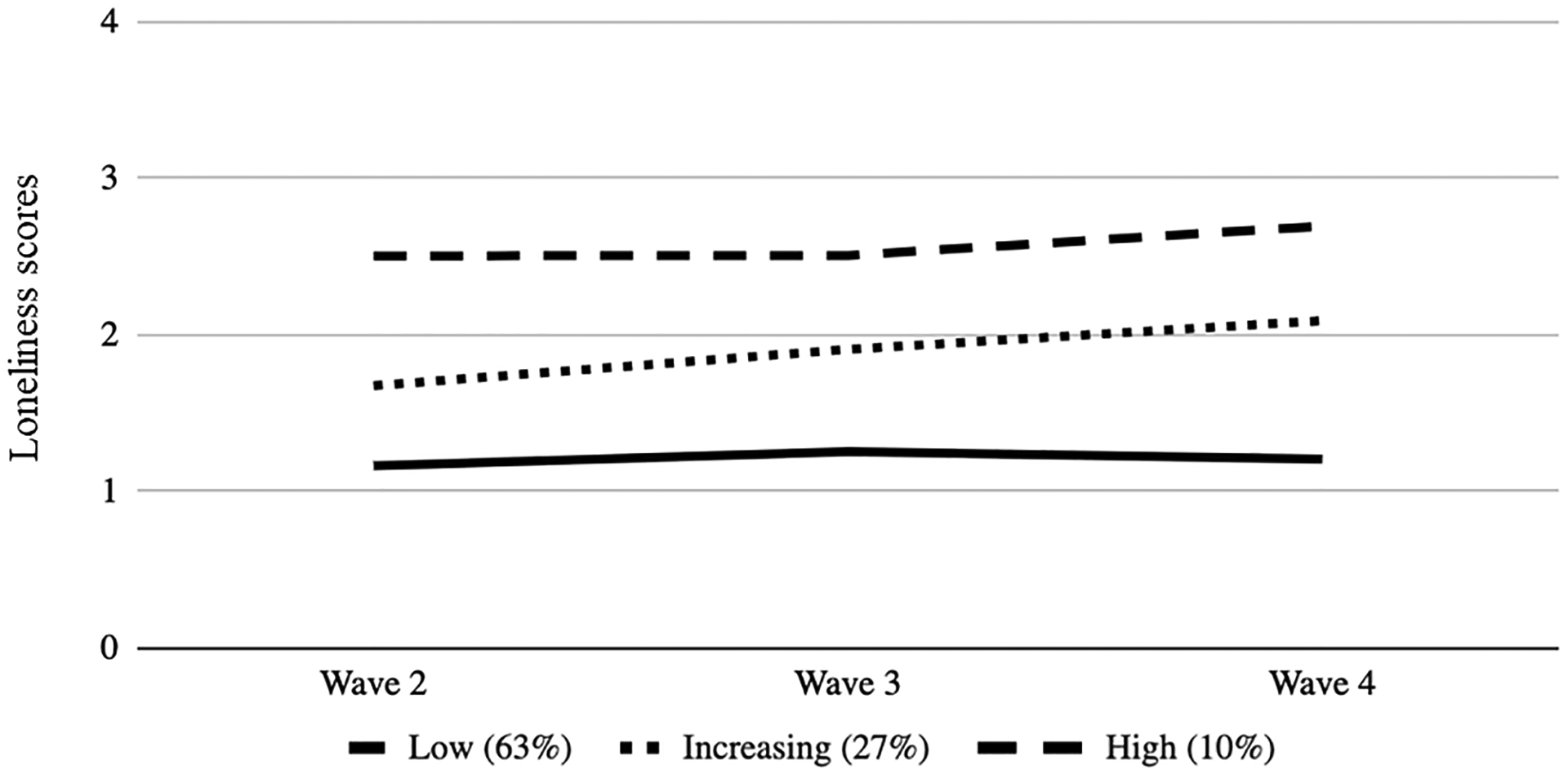
Class-specific mean predicted trajectories of loneliness
Figure 3.
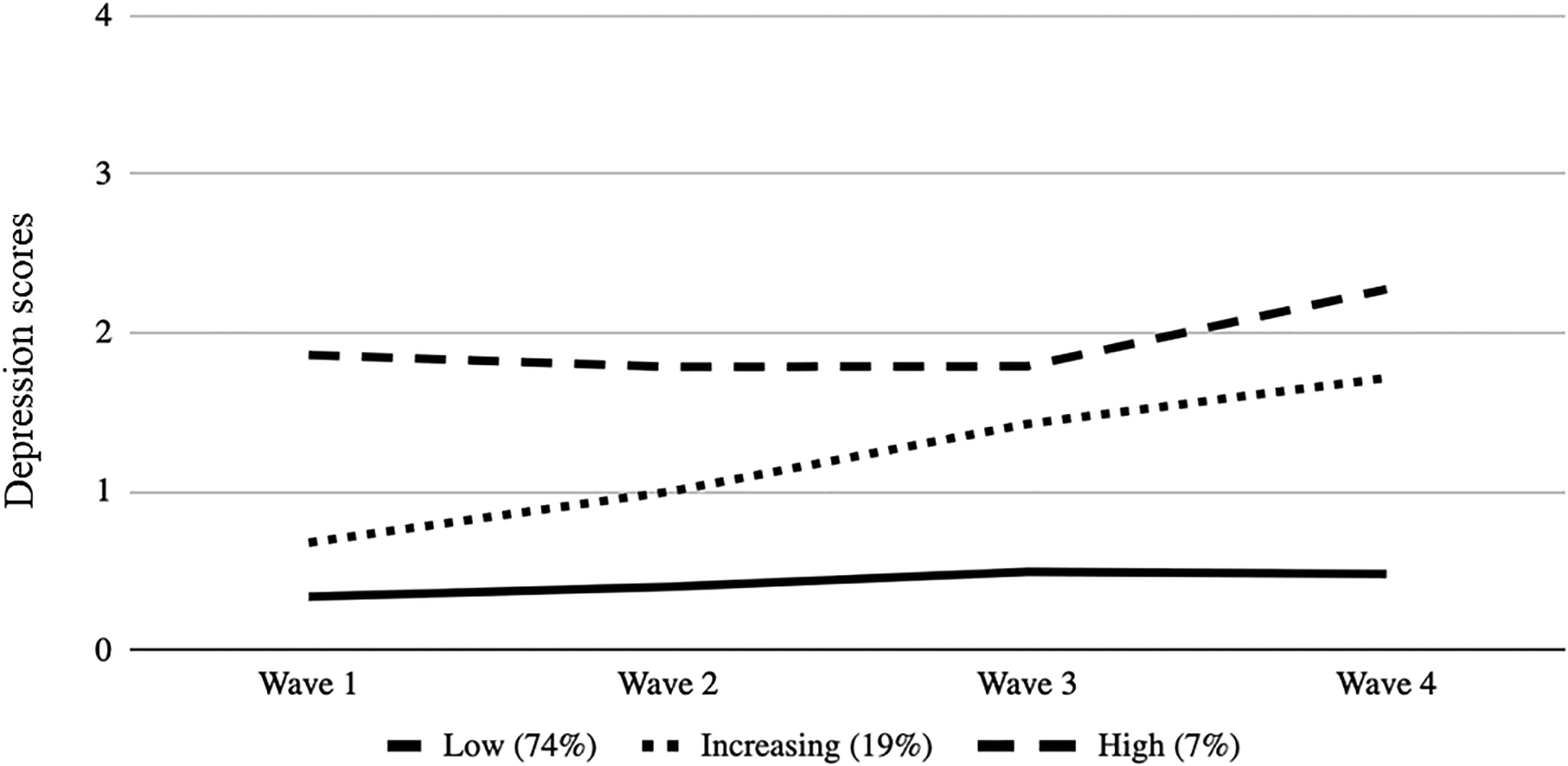
Class-specific mean predicted trajectories of depression
Pet Relationships and Trajectories of Socio-emotional Well-Being
Table 4 shows the estimates and odds ratios (ORs) for the multinomial logistic regression model assessing whether pet relationship quality was predictive of membership in the increasing (vs. low) loneliness trajectory and the high (vs. low) loneliness trajectory. The Nagelkerke pseudo R2 indicated that the model accounted for 17% of the total variance, and model classification accuracy was 62%, suggesting adequate model fit. High satisfaction with one’s pet was associated with more favorable trajectories of loneliness: youth who were satisfied with their pet were less likely than those who were unsatisfied to be in the increasing or high loneliness trajectories (vs. low). There was no association with pet companionship scores and loneliness trajectories. Pet disclosure was associated with loneliness trajectories in the opposite direction, such that youth who disclosed to their pets were more likely to be in the increasing and high loneliness trajectories (vs. low). Dog ownership was not associated with loneliness trajectory membership. Demographic characteristics largely were not predictive of loneliness trajectories, with the notable exception that girls were more likely than boys to be in the increasing and high loneliness trajectories (vs. low).
Table 5 shows the estimates and ORs for the models assessing pet ownership predicting membership in the increasing (vs. low) social anxiety trajectory and the high (vs. low) social anxiety trajectory. The Nagelkerke pseudo R2 indicated that the model accounted for 13% of the total variance, and model classification accuracy was 52%, suggesting adequate model fit. Youth who were satisfied with their pet were about half as likely as those who were unsatisfied to be in the increasing or high social anxiety trajectories (vs. low). Companionship and disclosure were not related to social anxiety trajectory membership. Dog ownership, race, and mother’s education also were not predictive of social anxiety trajectories. Girls were more likely than boys to be in the increasing and high social anxiety trajectories (vs. low).
Table 5.
Multinomial Logistic Regression Predicting Social Anxiety Trajectory Class Membership
| Increasing vs. Low | High vs. Low | |||||||
|---|---|---|---|---|---|---|---|---|
| Estimate | Std. Error | Odds Ratio | p-value | Estimate | Std. Error | Odds Ratio | p-value | |
| (Intercept) | 1.32 | 0.52 | .01 | −0.01 | 0.66 | .99 | ||
| Pet Satisfaction | −0.52 | 0.21 | 0.59 | .01 | −0.62 | 0.28 | 0.54 | .02 |
| Pet Companionship | −0.15 | 0.10 | 0.86 | .16 | −0.25 | 0.13 | 0.78 | .05 |
| Pet Disclosure | 0.26 | 0.21 | 1.30 | .22 | 0.20 | 0.28 | 1.23 | .47 |
| Female+ | 0.63 | 0.19 | 1.87 | <.001 | 1.37 | 0.26 | 3.94 | <.001 |
| Hispanic^ | 0.13 | 0.31 | 1.13 | .68 | 0.24 | 0.40 | 1.27 | .55 |
| Black^ | −0.11 | 0.54 | 0.90 | .84 | 0.25 | 0.62 | 1.29 | .68 |
| Other Race^ | −0.21 | 0.25 | 0.81 | .39 | 0.35 | 0.30 | 1.43 | .24 |
| Maternal education | −0.16 | 0.10 | 0.85 | .10 | −0.06 | 0.13 | 0.94 | .62 |
| Dog ownership++ | −0.08 | 0.22 | 0.92 | .70 | −0.43 | 0.27 | 0.65 | .11 |
Note. The referent groups for categorical variables in the multinomial logistic regression models are +Male; Ŵhite; ++Non-dog pet owners. Nagelkerke’s R2 = .13
Finally, Table 6 shows the estimates and ORs for the models with pet relationship quality predicting membership in the increasing (vs. low) depression trajectory and the high (vs. low) depression trajectory. The Nagelkerke pseudo R2 indicated that the model accounted for 20% of the total variance, and model classification accuracy was 72%, suggesting adequate model fit. Youth who were satisfied with their pet were about half as likely to be in the increasing or high depression trajectories (vs. low). Pet companionship was not associated with differences in depression trajectory. Youth who disclosed to their pets were more likely than those who did not to be in the increasing depression trajectory (vs. low) but disclosure was not associated with differences in high vs. low trajectory membership. Dog ownership was not associated with depression trajectory membership. Girls were more likely than boys to be in the increasing and high depression trajectories (vs. low). Youth identifying as Black were more likely than White students to be in the high depression trajectory (vs. low).
Discussion
The goal of this study was to examine whether there was an association between youth-pet relationship quality and socio-emotional well-being during a critical developmental period of adolescence. Although pets potentially represent a positive resource within the family context for resilience in adolescence, existing evidence points to complexity and variability in how companion animals are linked to positive socio-emotional outcomes. Understanding how relationship quality may relate to any associations between pets and youth well-being is crucial in informing how to maximize any benefits from these relationships. For all three outcomes (loneliness, social anxiety, and depression), results indicated three trajectories reflective of low, stable, increasing, and high stable patterns of adjustment. These findings are generally consistent with prior research with regard to the pattern and shape of the trajectories (e.g., Fernandez Castelao & Kröner-Herwig, 2013; Hutten et al., 2021; Miers et al., 2013; Musliner et al., 2016; Poole et al., 2022; van Dulmen & Goossens, 2013; Yaroslavsky et al., 2013). We found that high satisfaction with a pet was associated with higher likelihood of being in the more favorable trajectories (low stable patterns of loneliness, depression, and social anxiety) compared to the increasing or high trajectories. However, pet companionship was not associated with trajectory membership. Further, emotional disclosure to a pet was associated with higher likelihood of being in the less favorable trajectories of loneliness and depression (increasing and high trajectories), compared to the low, stable patterns of these outcomes. Emotional disclosure was not, however, associated with trajectory membership for social anxiety.
The Role of Pet Relationship Quality in Trajectories of Socio-Emotional Well-Being
Consistent with prior studies with human relational companions in adolescence (e.g., Hazel et al., 2014; Woodhouse et al., 2012), the findings suggest that pet relationships can be associated with positive patterns of socio-emotional adjustment, but that there is variability regarding the discrete links between specific relational and adjustment outcomes. Satisfaction with a pet relationship was associated consistently with more favorable trajectories of loneliness, social anxiety, and depression. Specifically, youth who had high satisfaction with their pets were less likely to be in the increasing or high trajectories of these outcomes. However, the companionship subscale was not related significantly to trajectories of socio-emotional functioning. The satisfaction subscale items were related to overall happiness and strength of the relationship with a pet as a global concept (e.g., “how good is your relationship with your pet?”), whereas the companionship subscale items were associated with time spent with the pet as a companion (e.g., “how much free time do you spend with your pet?”). The differential findings between satisfaction compared to companionship point to the importance of the perceived strength of the relationship compared to actual time spent with the pet as a close companion. The importance of satisfaction as an element of positive youth-pet relationships suggests that emotional and social support may be a key underlying factor associated with socio-emotional well-being. The measures of pet relationships in this study do not capture responsibility for the care of a pet, which has been demonstrated in prior research to impact relationship quality (Hartwig & Signal, 2020). Teasing out the relative impacts of time spent interacting/playing with a pet and engaging in responsibility for care is a fruitful direction for future research.
Interestingly, high levels of emotional disclosure to the pet were associated with less favorable trajectories for both loneliness and depression. High disclosure to a pet was related to a higher likelihood of being in the increasing or high trajectories of loneliness and increasing trajectories of depression. There were no significant associations between disclosure and social anxiety trajectories. The disclosure items relate to sharing feelings with pets (e.g., “how much do you share your secrets and private feelings with your pets?”; “how much do you talk to your pet about things you don’t want others to know?”). Future work should attempt to disentangle emotional disclosure to pets with other types of emotional disclosure and peer interactions an adolescent is experiencing, and to explore the potential bidirectional and interactional nature of these relationships. One potential explanation for these findings is that high emotional disclosure may be indicative of extremely high levels of emotional connection to a pet. Although pet relationship quality generally is predictive of positive outcomes, the relationship may not be entirely linear; extreme levels of bonding with a pet have been shown to be detrimental in other age groups (Chur-Hansen et al., 2009; Hartwig & Signal, 2020) and indicative of an over-reliance on the pet and/or excessive caregiving. Although this phenomenon has not been explored in adolescence and the causal direction of this relationship has not been well elucidated, it is possible that this extreme emotional connection to a pet is indicative of social isolation and would be useful as an indicator for intervention.
It is also possible that there are age-related differences in how much youth disclose to a pet, and these developmental changes should be assessed in longer-term longitudinal studies that span a wider age range. For example, prior work has shown that connectedness to a pet can decrease with age, as youth consolidate and strengthen their peer relationships (Muldoon, Williams, & Currie, 2019). If pets are able to create an emotional bridge as youth shift from relying on family relationships to relying on peer relationships, once peer relationships are established it may be that pets move into a companionship role that is less related to emotional disclosure. These developmental differences should be explored in future, longer-term longitudinal research.
Despite prior research demonstrating that dog relationships often are associated the most strongly with youth outcomes (Marsa-Sambola et al., 2017), having a dog was not a significant predictor of trajectories of loneliness, social anxiety, or depression, when controlling for pet relationship quality and demographics. This finding suggests that pet relationship quality could be one of the explanatory factors driving the association between having a dog and positive outcomes, as prior work demonstrates youth with dogs often show higher levels of connection (Cassels et al., 2017; Muldoon, Williams, & Currie, 2019; Muldoon, Williams, Lawrence, et al., 2019). Future research should explore the nuances of species differences in more detail to ascertain the relative role that different types of pets can play for different youth in the context of social and emotional support. Furthermore, it may be that existing pet relationship quality measures capture the types of relational behaviors that are more common when interacting with dogs, and that different measurement approaches are needed to capture relationship quality in other species with different types of interactions (e.g., fish, reptiles, birds).
Consistent with the literature, girls were more likely to be in the increasing and high trajectories of loneliness, social anxiety, and depression, and youth identifying as Black were more likely than youth identifying as White to be in the high depression trajectory. Thus, for these groups of youth, connection with a pet could be particularly important. Prior work on pet relationship quality also has found that girls often have higher levels of pet bonding (Muldoon, Williams, & Currie, 2019), but no gender differences were found in this study. Further exploration of the nuances of individual trajectories of pet relationship quality and socio-emotional well-being would be useful in clarifying the nuances of these relationships. These types of person-centered analyses would allow for a more precise understanding of which youth, under what circumstances, having a pet can be beneficial, which, in turn, would allow for the development of appropriate recommendations and interventions for families and practitioners.
Implications and Future Research Directions
Although this study found evidence for a positive association between pet satisfaction and trajectories of socio-emotional functioning, there are still lingering questions about the potential reciprocal relationship between socio-emotional functioning and pet relationships. It may be that having a strong relationship with a pet is protective during this developmental period, but it also is possible that youth who are better able to have strong satisfaction with their pet relationships also are able to have better social relationships with parents and/or peers that contribute to decreased risk for loneliness, social anxiety, and depression. Furthermore, it would be worthwhile in future research to explore how specific individual or pet-level variables such as gender identity or pet type might moderate relationship quality in ways that would impact trajectories of socio-emotional outcomes. The nature and patterns of relationship quality also should be explored in detail to assess how profiles of certain clusters of behaviors might predict outcomes differentially. Overall, the findings underscore the need to consider assessing pet relationships as a part of the developmental context, as well as highlighting how these relationships should be treated methodologically with the same type of nuance that is used to approach other social relationships (e.g., peers, family).
Limitations and Future Directions for Research
Although this study represents a significant advancement in our understanding of adolescent-pet relationships, there were several notable limitations. The design of this study did not allow us to assess when and how youth acquired a pet. An important component of pet relationship quality may be length of the relationship (Bagley & Gonsman, 2005), as well as the circumstances around acquisition (Holland, 2019). Duration of relationship potentially could mediate any associations between pet relationships and developmental outcomes over time. Additionally, combining data on peer relationships with pet relationship quality to assess whether there are interactive elements of peer and companion animal influence would provide important information about how pet relationships fit into the broader system of social development (Christian et al., 2020). For example, pet relationships may have relatively higher or lower importance based on the strength of peer relationships. A limitation of this study was that we were not able to assess whether pet relationships could compensate specifically for weak peer or parental relationships, which would be an area of future research with high practical value.
Although this study was relatively diverse, it was geographically limited to one area of the United States. Pet experiences can vary significantly based on geographic location, housing type and location, cultural and community backgrounds, and other sociodemographic factors (Liu et al., 2019; Mueller, King, et al., 2021; Stanley et al., 2014). Understanding systematic differences in the ability or desire for families to have pets may help elucidate why and how pets can constitute a social resource for youth and also help remove barriers to pet ownership for those who wish to have a companion animal in their home. Pet relationships may be a significant contextual factor within the family system for some youth, and therefore measures of human-animal interaction should be included in large, population-representative studies.
Although this study was not designed specifically to assess COVID-related changes in socio-emotional outcomes, the timing of data collection (in particular, Waves 3 and 4) took place during the pandemic. As previously noted, the pandemic has had a significant negative impact on youth loneliness, depression, and mental health through social isolation, decreased contact with friends, and school closures (Espinoza & Hernandez, 2022). It is plausible that some of the increasing patterns of loneliness, social anxiety, and depressive symptoms seen in this study could be attributed to the negative effects of the pandemic. For example, our team’s prior research found that dog owners reported lower levels of loneliness prior to the pandemic compared to non-dog owners, but this association did not hold up during COVID in the context of increased loneliness across all participants (Mueller, Richer et al., 2021).
This study also did not explore in depth individual animal-level characteristics that could contribute to the quality of the youth-pet relationship (Elvers & Lawriw, 2019). There is significant variation across species, breeds, and individual animals with regard to the types of behaviors and interactions that might be characteristic of the adolescent-pet relationship (Canejo-Teixeira et al., 2020). For example, a dog who exhibits highly friendly/affiliative behaviors and spends a lot of time in proximity to a teenager might elicit a stronger bond compared to a dog with significant anxiety or aggressive behaviors. However, these specific features have not been studied in detail in the prior developmental literature.
Finally, this study was limited by the self-report nature of both the pet relationship quality variables and the socio-emotional outcomes (Crockett et al., 1987). Although subjective assessment of relationship satisfaction and socio-emotional functioning provides important information, it may be prone to capturing momentary or daily fluctuations in mood or reflect recency bias (Solhan et al., 2009). Future work should expand measurement approaches to combine self-report with additional data sources such as parent, teacher, or practitioner reported functioning, psychophysiological measures, and ecological momentary assessment involving intensive repeated measures.
Conclusions
It is clear from the results of this study that different types of interactions with pets can be associated with both positive and negative trajectories of well-being. Future research should continue to explore the conditions under which relationship quality with pets can be a contextual asset within the family, employing nuanced measurement approaches that inform how to best support adaptive human-animal interaction during an important developmental period. Despite the noted limitations, this study provides important information about the relationship between pet relationship quality and trajectories of adolescent loneliness, social anxiety, and depression, linking with prior literature underscoring the importance of peer relationships in fostering adjustment (e.g., Hazel et al., 2014). As satisfaction with a pet relationship is associated with more favorable trajectories of these outcomes, it may be useful for families to consider how to maximize the positive aspects of companion animal relationships in the home, or for practitioners to develop interventions to help families support positive pet relationships. Identifying ways to support youth having the opportunity for quality interactions with their pets could maximize the benefits of these relationships, and this type of support could be provided directly to families, or through structured interventions in the context of youth-serving programs. Furthermore, determining barriers to satisfaction with companion animal relationships (e.g., animal behavior challenges, lack of green space for interacting with pets outdoors) may be of high impact for maximizing translational application. For mental health clinicians, understanding how pet relationships fit into the family system, and constitute a source of contextual support may be crucial in informing how to best leverage existing resources. Although the present study was not suited for considering clinical levels of depression, the present findings indicate that youth with high levels of emotional disclosure to pets are at elevated risk for loneliness and depression. Therefore, if youth report that their pet is their only source of emotional support, this could be an indication to family members, teachers, and clinicians that further assessment or intervention is needed.
Supplementary Material
Figure 2.
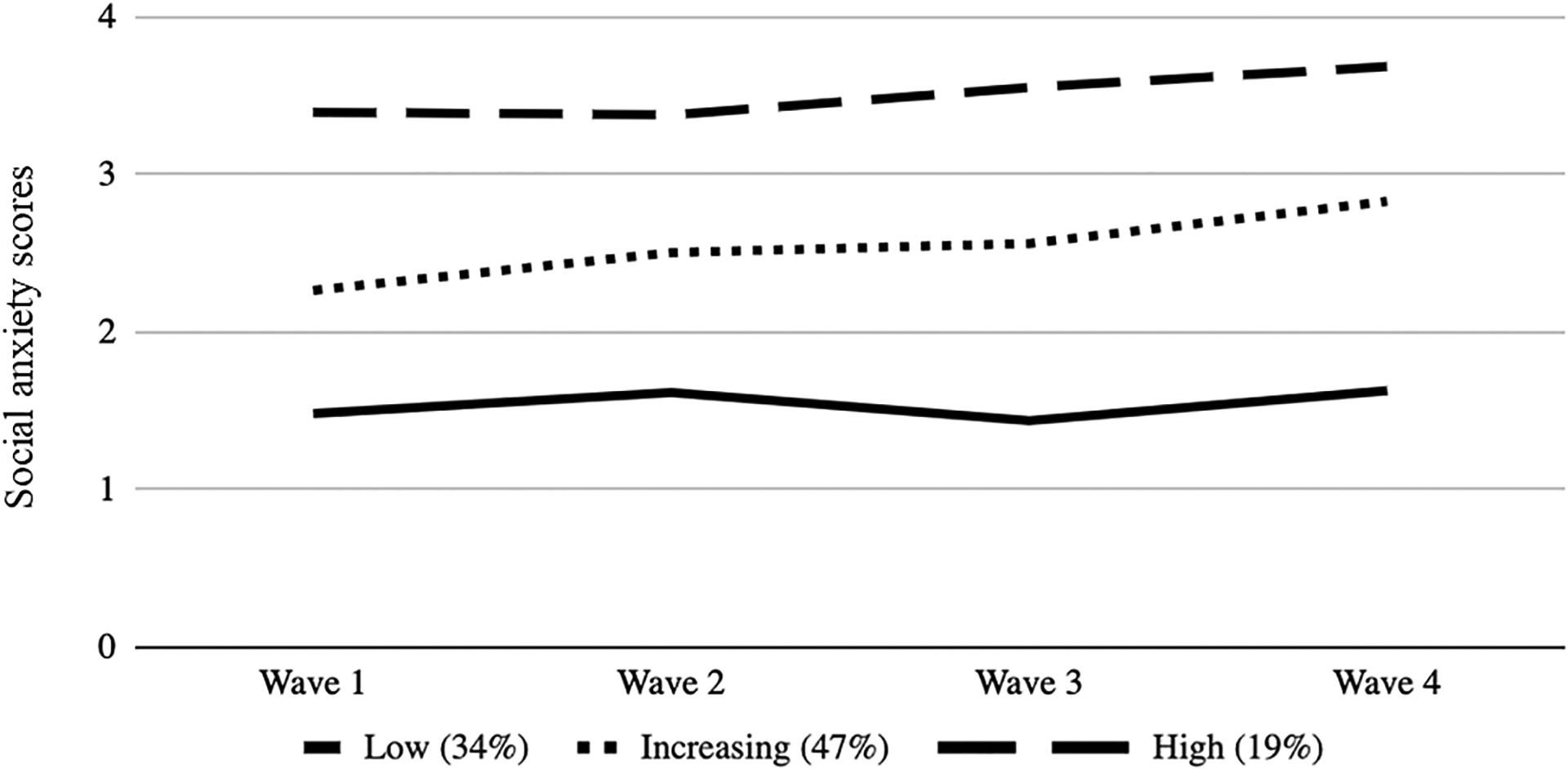
Class-specific mean predicted trajectories of social anxiety
Acknowledgements:
Research reported in this study was supported by the Eunice Kennedy Shriver National Institute for Child Health and Human Development under award numbers R03HD101060 and R15HD094281. The content is solely the responsibility of the authors and does not necessarily represent the official views of the National Institutes of Health.
Footnotes
Conflicts of Interest: The authors have no conflicts of interest to disclose.
References
- Allen JP, & Loeb EL (2015). The autonomy-connection challenge in adolescent–peer relationships. Child Development Perspectives, 9(2), 101–105. 10.1111/cdep.12111 [DOI] [PMC free article] [PubMed] [Google Scholar]
- American Pet Products Manufacturers Association (APPA). (2022). 2021–2022 APPA National Pet Owners Survey. Retrieved June 2, 2022, from http://www.americanpetproducts.org/press_industrytrends.asp.
- Applebaum JW, Ellison C, Struckmeyer L, Zsembik BA, & McDonald SE (2021). The impact of pets on everyday life for older adults during the COVID-19 pandemic. Frontiers in Public Health, 9, 652610. 10.3389/fpubh.2021.652610 [DOI] [PMC free article] [PubMed] [Google Scholar]
- Bagley DK, & Gonsman VL (2005). Pet attachment and personality type. Anthrozoös, 18(1), 28–42. 10.2752/089279305785594333 [DOI] [Google Scholar]
- Bao KJ, & Schreer G (2016). Pets and happiness: Examining the association between pet ownership and wellbeing. Anthrozoös, 29(2), 283–296. 10.1080/08927936.2016.1152721 [DOI] [Google Scholar]
- Baraldi AN, & Enders CK (2010). An introduction to modern missing data analyses. Journal of School Psychology, 48(1), 5–37. [DOI] [PubMed] [Google Scholar]
- Barnett MD, Maciel IV, Johnson DM, & Ciepluch I (2021). Social anxiety and perceived social support: Gender differences and the mediating role of communication styles. Psychological Reports, 124(1), 70–87. 10.1177/0033294119900975 [DOI] [PubMed] [Google Scholar]
- Benner AD, Boyle AE, & Bakhtiari F (2017). Understanding students’ transition to high school: Demographic variation and the role of supportive relationships. Journal of Youth and Adolescence, 46(10), 2129–2142. 10.1007/s10964-017-0716-2 [DOI] [PMC free article] [PubMed] [Google Scholar]
- Black K (2012). The relationship between companion animals and loneliness among rural adolescents. Journal of Pediatric Nursing, 27(2), 103–112. 10.1016/j.pedn.2010.11.009 [DOI] [PubMed] [Google Scholar]
- Bradley L, & Bennett PC (2015). Companion-animals’ effectiveness in managing chronic pain in adult community members. Anthrozoös, 28(4), 635–647. 10.1080/08927936. [DOI] [Google Scholar]
- Burstein M, He JP, Kattan G, Albano AM, Avenevoli S, & Merikangas KR (2011). Social phobia and subtypes in the National Comorbidity Survey-Adolescent Supplement: Prevalence, correlates, and comorbidity. Journal of the American Academy of Child & Adolescent Psychiatry, 50(9), 870–880. 10.1016/j.jaac.2011.06.005 [DOI] [PMC free article] [PubMed] [Google Scholar]
- Calsyn RJ, Winter JP, & Burger GK (2005). The relationship between social anxiety and social support in adolescents: A test of competing causal models. Adolescence, 40, 103–113. [PubMed] [Google Scholar]
- Canejo-Teixeira R, Almiro PA, Baptista LV, & Niza MMGRE (2020). Predicting dysfunctional human–dog dyads. Anthrozoös, 33(6), 743–758. 10.1080/08927936.2020.1824655 [DOI] [Google Scholar]
- Cassels MT, White N, Gee N, & Hughes C (2017). One of the family? Measuring early adolescents’ relationships with pets and siblings. Journal of Applied Developmental Psychology, 49, 12–20. 10.1016/j.appdev.2017.01.003 [DOI] [Google Scholar]
- Charmaraman L, Lynch AD, Richer A, & Grossman JM (2022). Associations of early social media initiation on digital behaviors and the moderating role of limiting use. Computers in Human Behavior, 127. 10.1016/j.chb.2021.107053 [DOI] [PMC free article] [PubMed] [Google Scholar]
- Charmaraman L, Moreno M, & Richer AM (2020). Social and behavioral health factors associated with violent and mature gaming in early adolescence. International Journal of Environmental Research and Public Health, 17(14), 4996. 10.3390/ijerph17144996 [DOI] [PMC free article] [PubMed] [Google Scholar]
- Charmaraman L, Mueller MK, & Richer A (2020) The role of pet companionship in online and offline social interactions in adolescence. Child and Adolescent Social Work Journal, 37, 589–599. 10.1007/s10560-020-00707-y [DOI] [Google Scholar]
- Charmaraman L, Richer AM, Ben-Joseph EP, & Klerman E (2021). Quantity, content, and context matter: Associations among social technology use and sleep habits in early adolescents. Journal of Adolescent Health, 69(1), 162–165. 10.1016/j.jadohealth.2020.09.035 [DOI] [PMC free article] [PubMed] [Google Scholar]
- Christian H, Mitrou F, Cunneen R, & Zubrick SR (2020). Pets are associated with fewer peer problems and emotional symptoms, and better prosocial behavior: Findings from the Longitudinal Study of Australian Children. The Journal of Pediatrics, 220, 200–206.e202. 10.1016/j.jpeds.2020.01.012 [DOI] [PubMed] [Google Scholar]
- Chur-Hansen A, Winefield HR, & Beckwith M (2009). Companion animals for elderly women: The importance of attachment. Qualitative Research in Psychology, 6(4), 281–293. 10.1080/14780880802314288 [DOI] [Google Scholar]
- Collins LM & Lanza ST (2009). Latent class and latent transition analysis: With applications in the social, behavioral and health sciences. John Wiley & Sons, Inc. 10.1002/9780470567333 [DOI] [Google Scholar]
- Collins WA, Welsh DP, & Furman W (2009). Adolescent romantic relationships. Annual Review of Psychology, 60, 631–652. 10.1146/annurev.psych.60.110707.163459 [DOI] [PubMed] [Google Scholar]
- Colognori D, Esseling P, Stewart C, Reiss P, Lu F, Case B, & Warner CM (2012). Self-disclosure and mental health service use in socially anxious adolescents. School Mental Health, 4(4), 219–230. 10.1007/s12310-012-9082-0 [DOI] [PMC free article] [PubMed] [Google Scholar]
- Crockett LJ, Schulenberg JE, & Petersen AC (1987). Congruence between objective and self-report data in a sample of young adolescents. Journal of Adolescent Research, 2(4), 383–392. 10.1177/074355488724006 [DOI] [Google Scholar]
- Dueñas J-M, Gonzàlez L, Forcada R, Duran-Bonavila S, & Ferre-Rey G (2021). The relationship between living with dogs and social and emotional development in childhood. Anthrozoös, 34(1), 33–46. 10.1080/08927936.2021.1878680 [DOI] [Google Scholar]
- Elvers GC, & Lawriw AN (2019). The behavioral style of the cat predicts owner satisfaction. Anthrozoös, 32(6), 757–768. ttps://doi.org/ 10.1080/08927936.2019.1673038 [DOI] [Google Scholar]
- Espinoza G, & Hernandez HL (2022). Adolescent loneliness, stress and depressive symptoms during the COVID-19 pandemic: The protective role of friends. Infant and Child Development, e2305. 10.1002/icd.2305 [DOI] [PMC free article] [PubMed] [Google Scholar]
- Fegert JM, Vitiello B, Plener PL, & Clemens V (2020). Challenges and burden of the Coronavirus 2019 (COVID-19) pandemic for child and adolescent mental health: A narrative review to highlight clinical and research needs in the acute phase and the long return to normality. Child and Adolescent Psychiatry and Mental Health, 14(1), 20. 10.1186/s13034-020-00329-3 [DOI] [PMC free article] [PubMed] [Google Scholar]
- Felton JW, Cole DA, Havewala M, Kurdziel G, & Brown V (2019). Talking together, thinking alone: Relations among co-rumination, peer relationships, and rumination. Journal of Youth and Adolescence, 48(4), 731–743. 10.1007/s10964-018-0937-z [DOI] [PMC free article] [PubMed] [Google Scholar]
- Fernandez Castelao C, & Kröner-Herwig B (2013). Different trajectories of depressive symptoms in children and adolescents: Predictors and differences in girls and boys. Journal of Youth and Adolescence, 42(8), 1169–1182. 10.1007/s10964-012-9858-4 [DOI] [PMC free article] [PubMed] [Google Scholar]
- Gadomski AM, Scribani MB, Krupa N, & Jenkins P (2017). Pet dogs and child physical activity: The role of child–dog attachment. Pediatric Obesity, 12(5), e37–e40. 10.1111/ijpo.12156 [DOI] [PMC free article] [PubMed] [Google Scholar]
- Hall NJ, Liu J, Kertes D, & Wynne CD (2016). Behavioral and self-report measures influencing children’s reported attachment to their dog. Anthrozoös, 29(1), 137–150. 10.1080/08927936.2015.1088683 [DOI] [PMC free article] [PubMed] [Google Scholar]
- Haroz EE, Ybarra ML, & Eaton WW (2014). Psychometric evaluation of a self-report scale to measure adolescent depression: The CESDR-10 in two national adolescent samples in the United States. Journal of Affective Disorders, 158, 154–160. 10.1016/j.jad.2014.02.009 [DOI] [PMC free article] [PubMed] [Google Scholar]
- Hartwig E, & Signal T (2020). Attachment to companion animals and loneliness in Australian adolescents. Australian Journal of Psychology, 72(4), 337–346. 10.1111/ajpy.12293 [DOI] [Google Scholar]
- Hawkins RD, & Williams JM (2017). Childhood attachment to pets: Associations between pet attachment, attitudes to animals, compassion, and humane behaviour. International Journal of Environmental Research and Public Health, 14(5), 490. 10.3390/ijerph14050490 [DOI] [PMC free article] [PubMed] [Google Scholar]
- Hazel NA, Oppenheimer CW, Technow JR, Young JF, & Hankin BL (2014). Parent relationship quality buffers against the effect of peer stressors on depressive symptoms from middle childhood to adolescence. Developmental Psychology, 50(8), 2115–2123. 10.1037/a0037192 [DOI] [PMC free article] [PubMed] [Google Scholar]
- Heinrich LA, & Gullone E (2006). The clinical significance of loneliness: A literature review. Clinical Psychology Review, 26, 695–718. 10.1016/j.cpr.2006.04.002 [DOI] [PubMed] [Google Scholar]
- Herle M, Micali N, Abdulkadir M, Loos R, Bryant-Waugh R, et al. (2020). Identifying typical trajectories in longitudinal data: modelling strategies and interpretations. European Journal of Epidemiology, 35, 205–222. 10.1007/s10654-020-00615-6 [DOI] [PMC free article] [PubMed] [Google Scholar]
- Holland KE (2019). Acquiring a pet dog: A review of factors affecting the decision-making of prospective dog owners. Animals, 9(4), 124. 10.3390/ani9040124 [DOI] [PMC free article] [PubMed] [Google Scholar]
- Huang Y, Bullock A, Liu J, Wang Z, Xu G, & Sang B (2022). Co-rumination with friends exacerbates association between peer victimization and adjustment in adolescence. Journal of Applied Developmental Psychology, 80, 101410. 10.1016/j.appdev.2022.101410 [DOI] [Google Scholar]
- Hughes ME, Waite LJ, Hawkley LC, & Cacioppo JT (2004). A short scale for measuring loneliness in large surveys: Results from two population-based studies. Research on Aging, 26(6), 655–672. 10.1177/0164027504268574 [DOI] [PMC free article] [PubMed] [Google Scholar]
- Hutten E, Jongen EMM, Verboon P, Bos AER, Smeekens S, & Cillessen AHN (2021). Trajectories of loneliness and psychosocial functioning. Frontiers in Psychology, 12. 10.3389/fpsyg.2021.689913 [DOI] [PMC free article] [PubMed] [Google Scholar]
- Jacobson KC, & Chang L (2018). Associations between pet ownership and attitudes toward pets with youth socioemotional outcomes. Frontiers in Psychology, 9, 2304. 10.3389/fpsyg.2018.02304 [DOI] [PMC free article] [PubMed] [Google Scholar]
- Kertes DA, Liu J, Hall NJ, Hadad NA, Wynne CDL, & Bhatt SS (2017). Effect of pet dogs on children’s perceived stress and cortisol stress response. Social Development, 26(2), 382–401. 10.1111/sode.12203 [DOI] [PMC free article] [PubMed] [Google Scholar]
- Kessler RC, Berglund P, Demler O, Jin R, Merikangas KR, & Walters EE (2005). Lifetime prevalence and age-of-onset distributions of DSM-IV disorders in the national comorbidity survey replication. Archives of General Psychiatry, 62(6), 593–602. 10.1001/archpsyc.62.6.593 [DOI] [PubMed] [Google Scholar]
- Ladd GW, & Ettekal I (2013). Peer-related loneliness across early to late adolescence: Normative trends, intra-individual trajectories, and links with depressive symptoms. Journal of Adolescence, 36(6), 1269–1282. 10.1016/j.adolescence.2013.05.004 [DOI] [PubMed] [Google Scholar]
- Larson R, & Richards MH (1991). Daily companionship in late childhood and early adolescence: Changing developmental contexts. Child Development, 62(2), 284–300. 10.1111/j.1467-8624.1991.tb01531.x [DOI] [PubMed] [Google Scholar]
- Lasgaard M, Goossens L, & Elklit A (2011). Loneliness, depressive symptomatology, and suicide ideation in adolescence: Cross-sectional and longitudinal analyses. Journal of Abnormal Child Psychology, 39(1), 137–150. 10.1007/s10802-010-9442-x [DOI] [PubMed] [Google Scholar]
- Laursen B, & Hartl AC (2013). Understanding loneliness during adolescence: Developmental changes that increase the risk of perceived social isolation. Journal of Adolescence, 36(6), 1261–1268. 10.1016/j.adolescence.2013.06.003 [DOI] [PubMed] [Google Scholar]
- Liu S, Powell L, Chia D, Russ TC, McGreevy PD, Bauman AE, Edwards KM, & Stamatakis E (2019). Is dog ownership associated with mental health? A population study of 68,362 adults living in England. Anthrozoös, 32(6), 729–739. 10.1080/08927936.2019.1673033 [DOI] [Google Scholar]
- Maes M, Nelemans SA, Danneel S, Fernández-Castilla B, Van den Noortgate W, Goossens L, & Vanhalst J (2019). Loneliness and social anxiety across childhood and adolescence: Multilevel meta-analyses of cross-sectional and longitudinal associations. Developmental Psychology, 55(7), 1548. 10.1037/dev0000719 [DOI] [PubMed] [Google Scholar]
- Marsa-Sambola F, Williams J, Muldoon J, Lawrence A, Connor M, & Currie C (2017). Quality of life and adolescents’ communication with their significant others (mother, father, and best friend): the mediating effect of attachment to pets. Attachment & Human Development, 19(3), 278–297. 10.1080/14616734.2017.1293702 [DOI] [PubMed] [Google Scholar]
- Mathers M, Canterford L, Olds T, Waters E, & Wake M (2010). Pet ownership and adolescent health: Cross-sectional population study. Journal of Paediatrics and Child Health, 46(12), 729–735. 10.1111/j.1440-1754.2010.01830.x [DOI] [PubMed] [Google Scholar]
- McCune S, Kruger KA, Griffin JA, Esposito L, Freund LS, Hurley KJ, & Bures R (2014). Evolution of research into the mutual benefits of human–animal interaction. Animal Frontiers, 4(3), 49–58. 10.2527/af.2014-0022 [DOI] [Google Scholar]
- Melson GF, & Schwarz R (1994). Pets as social supports for families of young children. Paper presented at the annual meeting of the Delta Society, New York [Google Scholar]
- Merikangas KR, Nakamura EF, & Kessler RC (2009). Epidemiology of mental disorders in children and adolescents. Dialogues in Clinical Neuroscience, 11(1), 7. 10.31887/DCNS.2009.11.1/krmerikangas [DOI] [PMC free article] [PubMed] [Google Scholar]
- Miers AC, Blöte AW, de Rooij M, Bokhorst CL, & Westenberg PM (2013). Trajectories of social anxiety during adolescence and relations with cognition, social competence, and temperament. Journal of Abnormal Child Psychology, 41(1), 97–110. 10.1007/s10802-012-9651-6 [DOI] [PMC free article] [PubMed] [Google Scholar]
- Mueller MK, & Callina KS (2014). Human–animal interaction as a context for thriving and coping in military-connected youth: The role of pets during deployment. Applied Developmental Science, 18(4), 214–223. 10.1080/10888691.2014.955612 [DOI] [Google Scholar]
- Mueller MK, King EK, Callina K, Dowling-Guyer S, & McCobb E (2021). Demographic and contextual factors as moderators of the relationship between pet ownership and health. Health Psychology & Behavioral Medicine, 9(1), 701–723. 10.1080/21642850.2021.1963254 [DOI] [PMC free article] [PubMed] [Google Scholar]
- Mueller MK, Richer AM, Callina KS, & Charmaraman L (2021). Companion animal relationships and adolescent loneliness during COVID-19. Animals, 11(3), 885. https://www.mdpi.com/2076-2615/11/3/885 [DOI] [PMC free article] [PubMed] [Google Scholar]
- Muldoon JC, Williams JM, & Currie C (2019). Differences in boys’ and girls’ attachment to pets in early-mid adolescence. Journal of Applied Developmental Psychology, 62, 50–58. 10.1016/j.appdev.2018.12.002 [DOI] [Google Scholar]
- Muldoon JC, Williams JM, Lawrence A, & Currie C (2019). The nature and psychological impact of child/adolescent attachment to dogs compared with other companion animals. Society & Animals, 27(1), 55–74. 10.1163/15685306-12341579 [DOI] [Google Scholar]
- Musliner KL, Munk-Olsen T, Eaton WW, & Zandi PP (2016). Heterogeneity in long-term trajectories of depressive symptoms: Patterns, predictors and outcomes. Journal of Affective Disorders, 192, 199–211. 10.1016/j.jad.2015.12.030 [DOI] [PMC free article] [PubMed] [Google Scholar]
- Nagin DS (2005). Group-based modelling of development. Cambridge, MA: Harvard University Press. [Google Scholar]
- Nelemans SA, Meeus WH, Branje SJ, Van Leeuwen K, Colpin H, Verschueren K, & Goossens L (2019). Social Anxiety Scale for Adolescents (SAS-A) Short Form: Longitudinal measurement invariance in two community samples of youth. Assessment, 26(2), 235–248. 10.1177/1073191116685808 [DOI] [PubMed] [Google Scholar]
- Parslow RA, Jorm AF, Christensen H, Rodgers B, & Jacomb P (2005). Pet ownership and health in older adults: Findings from a survey of 2,551 community-based Australians aged 60–64. Gerontology, 51(1), 40–47. 10.1159/000081433 [DOI] [PubMed] [Google Scholar]
- Poole KL, Degnan KA, Harrewijn A, Almas A, Fox NA, & Henderson HA (2022). Trajectories of socially anxious behavior from age 5 to 13: Temperamental and sociocognitive pathways. Child Development, 93(5), 1334–1346. 10.1111/cdev.13767 [DOI] [PMC free article] [PubMed] [Google Scholar]
- Proust-Lima C, Philipps V, & Liquet B (2017). Estimation of extended mixed models using latent classes and latent processes: The R package lcmm. Journal of Statistical Software, 78(2). 10.18637/jss.v078.i0 [DOI] [Google Scholar]
- Purewal R, Christley R, Kordas K, Joinson C, Meints K, Gee N, & Westgarth C (2017). Companion animals and child/adolescent development: A systematic review of the evidence. International Journal of Environmental Research and Public Health, 14(3). 10.3390/ijerph14030234 [DOI] [PMC free article] [PubMed] [Google Scholar]
- Rapee RM, & Spence SH (2004). The etiology of social phobia: empirical evidence and an initial model. Clinical Psychology Review, 24(7), 737–767. 10.1016/j.cpr.2004.06.004 [DOI] [PubMed] [Google Scholar]
- Rodriguez KE, Herzog H, & Gee NR (2021). Variability in human-animal interaction research. Frontiers in Veterinary Science, 7, 619600. 10.3389/fvets.2020.619600 [DOI] [PMC free article] [PubMed] [Google Scholar]
- Rothe J, Buse J, Uhlmann A, Bluschke A, & Roessner V (2021). Changes in emotions and worries during the Covid-19 pandemic: An online-survey with children and adults with and without mental health conditions. Child and Adolescent Psychiatry and Mental Health, 15, 11. 10.1186/s13034-021-00363-9 [DOI] [PMC free article] [PubMed] [Google Scholar]
- Schinka KC, van Dulmen MH, Mata AD, Bossarte R, & Swahn M (2013). Psychosocial predictors and outcomes of loneliness trajectories from childhood to early adolescence. Journal of Adolescence, 36(6), 1251–1260. 10.1016/j.adolescence.2013.08.002 [DOI] [PubMed] [Google Scholar]
- Schneier FR, Johnson J, Hornig CD, Liebowitz MR, & Weissman MM (1992). Social phobia: Comorbidity and morbidity in an epidemiologic sample. Archives of General Psychiatry, 49(4), 282–288. 10.1001/archpsyc.1992.01820040034004 [DOI] [PubMed] [Google Scholar]
- Sharpley C, Veronese N, Smith L, Lopez-Sanchez GF, Bitsika V, Demurtas J, Celotto S, Noventa V, Soysal P, Isik AT, Grabovac I, & Jackson SE (2020). Pet ownership and symptoms of depression: A prospective study of older adults. Journal of Affective Disorders, 264, 35–39. 10.1016/j.jad.2019.11.134 [DOI] [PubMed] [Google Scholar]
- Shulman S (1993). Close relationships and coping behavior in adolescence. Journal of Adolescence, 16(3), 267–283. 10.1006/jado.1993.1025 [DOI] [PubMed] [Google Scholar]
- Solhan MB, Trull TJ, Jahng S, & Wood PK (2009). Clinical assessment of affective instability: comparing EMA indices, questionnaire reports, and retrospective recall. Psychological Assessment, 21(3), 425. 10.1037/a0016869 [DOI] [PMC free article] [PubMed] [Google Scholar]
- Stanley IH, Conwell Y, Bowen C, & Van Orden KA (2014). Pet ownership may attenuate loneliness among older adult primary care patients who live alone. Aging & Mental Health, 18(3), 394–399. 10.1080/13607863.2013.837147 [DOI] [PMC free article] [PubMed] [Google Scholar]
- van de Schoot R, Sijbrandij M, Winter SD, Depaoli S, & Vermunt JK (2017). The GRoLTS-Checklist: Guidelines for reporting on latent trajectory studies. Structural Equation Modeling: A Multidisciplinary Journal, 24(3), 451–467. 10.1080/10705511.2016.1247646 [DOI] [Google Scholar]
- van Dulmen MHM, & Goossens L (2013). Loneliness trajectories. Journal of Adolescence, 36(6), 1247–1249. 10.1016/j.adolescence.2013.08.001 [DOI] [PubMed] [Google Scholar]
- Vanhalst J, Luyckx K, & Goossens L (2014). Experiencing loneliness in adolescence: A matter of individual characteristics, negative peer experiences, or both? Social Development, 23(1), 100–118. 10.1111/sode.12019 [DOI] [Google Scholar]
- Woodhouse SS, Dykas MJ, & Cassidy J (2012). Loneliness and peer relations in adolescence. Social Development, 21(2), 273–293. 10.1111/j.1467-9507.2011.00611.x [DOI] [Google Scholar]
- Yaroslavsky I, Pettit JW, Lewinsohn PM, Seeley JR, & Roberts RE (2013). Heterogeneous trajectories of depressive symptoms: Adolescent predictors and adult outcomes. Journal of Affective Disorders, 148(2), 391–399. 10.1016/j.jad.2012.06.028 [DOI] [PMC free article] [PubMed] [Google Scholar]
- Zilcha-Mano S, Mikulincer M, & Shaver PR (2011). An attachment perspective on human–pet relationships: Conceptualization and assessment of pet attachment orientations. Journal of Research in Personality, 45(4), 345–357. 10.1016/j.jrp.2011.04.001 [DOI] [Google Scholar]
Associated Data
This section collects any data citations, data availability statements, or supplementary materials included in this article.