



Summary
Despite high expectations from the government and researchers regarding data utilization, comprehensive analysis of long-term care (LTC)-related data use has been limited. This study reviewed the use of LTC-related data, including Kaigo-DB, in Japan after 2020. There was an increase in studies using LTC-related data in Japan between 2020 and 2021, followed by a stabilization period. The national government provided 13.5% of this data (6.5% from Kaigo-DB), while prefectures and municipalities contributed 85.2%, and facilities provided 1.3%. The linked data used in 90.4% of the studies primarily consisted of original questionnaire or interview surveys (34.6%) and medical claims (34.0%). None of the studies based on Kaigo-DB utilized linked data. In terms of study design, cohort studies were the most common (84.6%), followed by descriptive (5.1%), cross-sectional (3.2%), and case-control studies (1.3%). Among the 138 individual-based analytical descriptive studies, the most frequently used LTC-related data as an exposure was LTC services (26.8%), and the most common data used as an outcome was LTC certification or care need level (43.5%), followed by the independence degree of daily living for the older adults with dementia (18.1%). To enhance the use of LTC-related data, especially the valuable national Kaigo-DB, insights can be gleaned from how researchers effectively utilize municipal and prefectural data. Streamlining access to Kaigo-DB and enabling its linkage with other datasets are promising for future research in this field.
Keywords: long-term care claims, certification information, LIFE data
Introduction
Japan introduced its Long-Term Care (LTC) insurance system in 2000, providing universal coverage to ensure all citizens can access it when needed (1). Older adults requiring these services usually approach their local municipalities, which act as insurers. Subsequently, they undergo a care-needs assessment and are then certified for needed LTC. A qualified care manager then develops a personalized care plan, including home visits, day services, short-term stays, and residential or in-facility care. Service providers submit LTC claims to the National Health Insurance Organizations for processing and reimbursement, with municipalities bearing most of the costs.
In administering the Japan's LTC system, a nationwide standardized data on LTC certification and claims are generated. This data is initially held by the municipalities and aggregated at the national level for policymaking. The comprehensive LTC insurance database, Kaigo-DB, established in 2013 by the Ministry of Health, Labor and Welfare, compiles LTC-related data anonymously (2). It consists of three main data categories: anonymous LTC certification information from municipalities, anonymous LTC receipt data from service providers, and anonymous Long-term care Information system For Evidence (LIFE) data from service providers detailing user conditions and care. LIFE data includes a wide array of information, such as demographics, daily living activities, oral health, nutrition, dementia, functional training and rehabilitation plans, and more. Although these data categories are anonymous, they share the same individual IDs, enabling interconnected analysis.
The LTC certification information and claims held by local governments and the Kaigo-DB are rich data sources in Japan, encompassing regional and national data. These datasets are invaluable for research purposes, not just for administrative use. Despite high expectations from both the government and researchers regarding the utilization of data for research, comprehensive analysis of LTC-related data use has remained limited. Apart from Jin and Tamiya's review in 2021 (3), there has been minimal in-depth exploration into the volume and trends of research papers employing this data or the themes and content of such papers. Furthermore, despite the government's efforts to promote the use of Kaigo-DB, a valuable resource at the national level, no study has focused on its utilization. To address this gap, our study undertakes an extensive literature review post-2020, the period after Jin's coverage, examining the use of LTC-related data, including Kaigo-DB. We aim to provide an updated overview of the research landscape, highlighting the current state of this field and proposing directions for enhancing future research.
Comprehensive search of studies using LTC-related data
Search strategy and selection criteria
To conduct this review, we performed a literature search using the PubMed database in accordance with the PRISMA (Preferred Reporting Items for Systematic Reviews and Meta-Analyses) guidelines (4). Our search included titles, keywords, and abstracts from January 1, 2020, to November 15, 2023.
We used specific search terms to narrow the results: ("long-term care" OR "long-term care insurance") AND ("data" OR "database" OR "databases" OR "claims" OR "billing" OR "certification" OR "research" OR "administrative data") AND ("Japanese" OR "Japan"). The search was limited to studies published in English or Japanese.
This review focused on studies that used LTC certification information, receipt data, and LIFE data within the Japanese LTC system. Studies based on independently obtained information about LTC certification status or the use of its services and those utilizing LTC-related data from outside Japan were excluded. Additionally, non-original articles, such as letters, were not included.
We also conducted manual searches of electronic databases, including PubMed and the Japanese Medical Abstracts Society's Ichushi Web, to supplement our primary search.
Data classification and analysis
We systematically screened studies adhering to the predetermined inclusion and exclusion criteria. The final selection of studies and the determination of their characteristics was achieved through consensus among the authors. Each study was methodically categorized based on its year, language, and publication journal. Additionally, studies were classified according to their source of data, any linked data, design, and unit of study. Furthermore, outcomes and exposures were detailly analyzed for observational studies focusing on individuals.
Description of identified studies using LTC-related data in Japan
Study selection process
Figure 1 illustrates the study selection process. The initial search yielded 466 studies. Upon assessing eligibility, 142 studies were deemed suitable for inclusion in this review. Additionally, 14 studies emerged from manual searches, culminating in 156 studies being identified for the final review.
Figure 1.
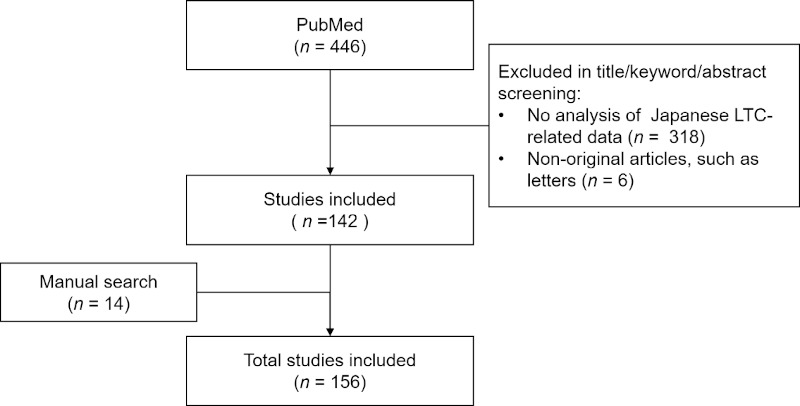
Study selection process.
Publication characteristics
Studies using LTC-related data in Japan rose from 2020 to 2021, then stabilized, as depicted in Figure 2. Most publications (84.6%) are in English. "Geriatrics & Gerontology International" is the most common journal, comprising 7.1% of these studies, followed by "BMC Geriatrics" and "Japanese Journal of Public Health (Nihon Koshu Eisei Zasshi)", each accounting for 6.4% of the total publications (Table 1).
Figure 2.

Frequency of publications using studies using LTC-related data in Japan.
Table 1. Characteristics of publications utilizing LTCrelated data (n = 156).
| Characteristics | n | % |
|---|---|---|
| Language | ||
| English | 132 | 84.6% |
| Japanese | 24 | 15.4% |
| Journals | ||
| Geriatr Gerontol Int | 11 | 7.1% |
| BMC Geriatr | 10 | 6.4% |
| Nihon Koshu Eisei Zasshi | 10 | 6.4% |
| J Am Med Dir Assoc | 9 | 5.8% |
| J Epidemiol | 7 | 4.5% |
| Others | 109 | 69.9% |
Data Characteristics
Table 2 outlines the LTC-related data sources and linked data used in the analyzed studies. The national government provided 13.5% of the data, with prefectures and municipalities contributing 85.2% and facilities 1.3%. Government-held data included 6.5% from the Kaigo-DB and 7.1% from the Statistics of Long-term Care Benefit Expenditures containing national-level LTC receipts available to researchers before the Kaigo- DB. Data from prefectures and municipalities were split, with 16.8% from one prefecture, 25.2% from multiple municipalities, and 43.2% from a single municipality.
Table 2. Characteristics of LTC-related data and linked data utilized in studies (n = 156).
| Characteristics | n | % |
|---|---|---|
| Data source | ||
| Kaigo-DB | 10 | 6.5% |
| Statistics of Long-term Care Benefit Expenditures | 11 | 7.1% |
| One prefectur | 26 | 16.8% |
| Multiple municipalities | 39 | 25.2% |
| One municiparity | 67 | 43.2% |
| Multiple facilities | 2 | 1.3% |
| Linked data* | ||
| Questionnaire survey / Interview | 54 | 34.6% |
| Medical claim | 53 | 34.0% |
| Health check-up data | 10 | 6.4% |
| Measurement data without health check-up | 10 | 6.4% |
| Kihon checklist | 7 | 4.5% |
| Vital statistics | 7 | 4.5% |
| Others data only | 4 | 14.1% |
| No data Linked | 29 | 9.6% |
*Multiple choices possible.
Linked data, used in 90.4% of studies, mainly comprised original questionnaire or interview surveys (34.6%) and medical claims (34.0%). Health check-up data and other measurement data each contributed 6.4%. Many studies used pre-created datasets such as The Japan Gerontological Evaluation Study (JAGES) survey (n = 19), Ohsaki Cohort (n = 8), National Center for Geriatric and Gerontology-Study of Geriatric Syndromes (NCGG-SGS) (n = 5), and the Longevity Improvement & Fair Evidence Study (LIFE Study) (n = 4). However, it was often unclear whether studies utilized mortality information or basic resident register data such as addresses from local governments, making it difficult to analyze these data. None of the studies employing Kaigo-DB used linked data.
Study characteristics
Table 3 provides an overview of study designs and participants. Cohort studies were the most prevalent (84.6%), followed by descriptive (5.1%), cross-sectional (3.2%), and case-control studies (1.3%). Others were two ecological studies, two difference-in-differences approaches, one regression discontinuity design, three methodological and one validity studies. The study participants varied, with 42.9% focusing on healthy older adults, 24.4% on patients with specific conditions or treatments, and 22.4% on older adults needing care. Other studies targeted older adults, LTC facilities and users, municipalities, and secondary medical areas.
Table 3. Characteristics of studies utilizing LTC-related data (n = 156).
| Characteristics | n | % |
|---|---|---|
| Study design | ||
| Descriptive study | 8 | 5.1% |
| Cross-sectional study | 5 | 3.2% |
| Case-control study | 2 | 1.3% |
| Cohort study | 132 | 84.6% |
| Ecological study | 2 | 1.3% |
| Difference-in-differences approach | 2 | 1.3% |
| Regression discontinuity design | 1 | 0.6% |
| Methodological study | 3 | 1.9% |
| Validity study | 1 | 0.6% |
| Study subject | ||
| Healthy older adults | 67 | 42.9% |
| Patients with specific conditions or treatments | 38 | 24.4% |
| Older adults needing care | 35 | 22.4% |
| All older people | 8 | 5.1% |
| LTC facility users | 4 | 2.6% |
| LTC facilities | 1 | 0.6% |
| Municipalities | 1 | 0.6% |
| Secondary medical areas | 2 | 2.6% |
Table 4 reviews 138 individual-based analytical descriptive studies, including cross-sectional, case-control, and cohort studies. Of these, 36 (26.8%) utilized LTC-related data as exposure, 17 (12.3%) examined the use of LTC services, and 12 (8.7%) focused on LTC certification or care need level. One study utilized LIFE data, that began collection in 2021. There were 113 studies (81.9%) that employed LTC-related data as an outcome, of which 60 (43.5%) analyzed LTC certification or care needs level, and 25 (18.1%) concentrated on independence degree of daily living for older adults with dementia.
Table 4. Characteristics of individual-based analytical descriptive studies utilizing LTC-related data (n = 138).
| Characteristics | n | % |
|---|---|---|
| Exposure* | ||
| LTC certification or care needs level | 12 | 8.7% |
| Use of LTC Services | 17 | 12.3% |
| Independence degree of daily living for the disabled elderly | 4 | 2.9% |
| Independence degree of daily living for older adults with dementia | 4 | 2.9% |
| LTC certification information | 3 | 2.2% |
| LIFE data | 1 | 0.7% |
| Other than LTC-related data | 101 | 73.2% |
| Outcome* | ||
| LTC certification or care needs level | 60 | 43.5% |
| Use of LTC Services | 13 | 9.4% |
| Independence degree of daily living for older adults with dementia | 25 | 18.1% |
| LTC cost | 18 | 13.0% |
| Other than LTC-related data | 25 | 18.1% |
*Multiple choices possible.
Discussion of current status and perspectives of studies using LTC-related data
This review has demonstrated increased research involving LTC-related data in Japan from 2020 to 2021, consistent with Jin's findings of a similar rise from 2016 to 2020 (3). However, recently, this growth has slowed down. Most of these studies, published in English and focused on gerontology and public health, align with Jin's findings (3).
The national government provided 13.5% of the LTC-related data, with 6.5% coming from Kaigo-DB (5-14). However, prefectures and municipalities contributed the majority (85.2%). Despite governmental support for Kaigo-DB, there has been a noticeable preference among researchers for local LTC-related data. This could be attributed to the challenges associated with Kaigo- DB, such as its limited allowance for linkage (restricted to NDB and DPC-DB) and the complexities involved in accessing it (15,16). Linked data, utilized in 90.4% of the studies, mainly consisted of original questionnaire or interview surveys (34.6%) and medical claims (34.0%). Notably, none of the studies using Kaigo-DB incorporated linked data. Datasets like the JAGES survey (n = 19), Ohsaki Cohort (n = 8), NCGG-SGS (n = 5), and the LIFE Study (n = 4), which integrated local LTC-related data with unique surveys and/or medical claims, were frequently employed. The widespread use of pre-created, user-friendly linked data may offer valuable insights for enhancing the utilization of Kaigo-DB.
In terms of study design, cohort studies were predominant, accounting for 84.6% of the research, followed by descriptive (5.1%), cross-sectional (3.2%), and case-control (1.3%) studies. Within the individual-based analytical descriptive studies, including cross-sectional, case-control, and cohort studies, the most commonly used LTC-related data as exposure was the use of LTC services (26.8%). The most frequent outcome data involved LTC certification or care needs level (43.5%), followed by the independence degree of daily living for older adults with dementia (18.1%). The typical study was a cohort of healthy older adults, with information from unique questionnaires, interviews, health check-up data, other measurement data measurements and medical claims as the exposure and LTC certification or care needs level data as the outcome (17-42). Additionally, several similar studies with the independent degree of daily living for older adults with dementia as an outcome were conducted (43-59). Easily applicable research like this is expected to continue to be widely conducted. Only one study has utilized LIFE data, collected by the Ministry of Health, Labor and Welfare since 2021, and this study used data from facilities (60). Although currently underutilized, this rich dataset holds potential for broader application in future research, thereby enhancing studies related to LTC (61).
To optimize the utilization of LTC-related data, especially national Kaigo-DB, we can learn from the successful use of municipal and prefectural data by researchers. Furthermore, drawing insights from implementing datasets like the JAGES study is crucial. An important consideration is reducing the time and effort required to access Kaigo-DB and enabling its integration with other datasets while maintaining personal data protection. The government's initiatives aimed at simplifying access to the Kaigo-DB and enhancing its integration with other databases are promising for future research in this field (15,16).
This study is not without limitations. Given the variations in how LTC-related data is expressed in English, we followed Jin's methodology and limited our searches to some common keywords, such as "long-term care" and "databases" (3). Despite conducting an extensive search, it's possible that we might have overlooked some relevant publications.
Conclusion
This review highlights an increase in the utilization of LTC-related data between 2020 and 2021, followed by a stabilization period. The national government's contribution to the data source was modest, including data from Kaigo-DB, while most data was sourced from prefectures and municipalities. Notably, most studies utilized linked data. This study underscores the importance of concerted efforts to streamline access to Kaigo-DB and promote its integration with diverse data sources. Implementing these measures is essential for enhancing research involving LTC-related data in Japan.
Funding
This study was supported by a grant-in-aid from the Ministry of Health, Labor and Welfare; Health, Labor and Welfare Sciences Research Grant, and Research on Region Medical (21IA1010).
Conflict of Interest
The authors have no conflicts of interest to disclose.
References
- 1. Ministry of Health, Labor and Welfare. Long-term care insurance system of Japan. https://www.mhlw.go.jp/english/policy/care-welfare/care-welfare-elderly/dl/ltcisj_e.pdf (accessd December 15, 2023) .
- 2. Ministry of Health, Labor and Welfare. Considerations in the provision of anonymized long-term care data. https://www.mhlw.go.jp/content/12301000/000922065.pdf (accessd December 15, 2023) .
- 3. Jin X, Tamiya N. The use of Japanese long-term care insurance claims in health services research: current status and perspectives. Global Health & Medicine. 2021; 3:142-148. [DOI] [PMC free article] [PubMed] [Google Scholar]
- 4. Moher D, Liberati A, Tetzlaff J, Altman DG; PRISMA Group. Preferred reporting items for systematic reviews and meta-analyses: The PRISMA statement. PLoS Med. 2009; 6:e1000097. [DOI] [PMC free article] [PubMed] [Google Scholar]
- 5. Hasegawa K, Tsukahara T, Nomiyama T. Associations between long-term care-service use and service- or care-need level progression: A nationwide cohort study using the Japanese Long-Term Care Insurance Claims database. BMC Health Serv Res. 2023; 23:577. [DOI] [PMC free article] [PubMed] [Google Scholar]
- 6. Yoshikawa M, Goto E, Shin JH, Imanaka Y. Regional disparities in Dementia-free Life Expectancy in Japan: An ecological study, using the Japanese long-term care insurance claims database. PLoS One. 2023; 18:e0280299. [DOI] [PMC free article] [PubMed] [Google Scholar]
- 7. Ikeda K, Yoshida S, Okazaki Y, Miyamori D, Kashima S, Ishii S, Koike S, Kanno K, Ito M, Matsumoto M. Increased care-need in older long-term care insurance users after the 2018 Japan Floods: A retrospective cohort study based on the Japanese long-term care insurance claims. Environ Health Prev Med. 2023; 28:31. [DOI] [PMC free article] [PubMed] [Google Scholar]
- 8. Jin X, Uda K, Ishimaru M, Kihara T, Sugiyama T, Yamagishi K, Iso H, Tamiya N. The effect of business operating systems on nursing home termination. Int J Public Health. 2023; 68:1605439. [DOI] [PMC free article] [PubMed] [Google Scholar]
- 9. Ishii S, Tanabe K, Ishimaru B, Kitahara K. Impact of COVID-19 on long-term care service utilization of older home-dwelling adults in Japan. J Am Med Dir Assoc. 2023; 24:156-163. e123 [DOI] [PMC free article] [PubMed] [Google Scholar]
- 10. Miyamori D, Yoshida S, Kashima S, Koike S, Ishii S, Okazaki Y, Ikeda K, Matsumoto M. How the 2018 Japan Floods impacted nursing home admissions for older persons: A longitudinal study using the long-term care insurance comprehensive database. J Am Med Dir Assoc. 2023; 24:368-375. e1 [DOI] [PubMed] [Google Scholar]
- 11. Miyamori D, Yoshida S, Kashima S, Koike S, Ishii S, Matsumoto M. Discontinuation of long-term care among persons affected by the 2018 Japan Floods: A longitudinal study using the Long-term Care Insurance Comprehensive Database. BMC Geriatr. 2022; 22:168. [DOI] [PMC free article] [PubMed] [Google Scholar]
- 12. Yoshida S, Kashima S, Ishii S, Koike S, Matsumoto M. Effects of the 2018 Japan Floods on long-term care insurance costs in Japan: Retrospective cohort study. BMC Public Health. 2022; 22:341. [DOI] [PMC free article] [PubMed] [Google Scholar]
- 13. Yoshida S, Kashima S, Matsumoto M. The effect of the 2018 Japan Floods on cognitive decline among long-term care insurance users in Japan: a retrospective cohort study. Environ Health Prev Med. 2021; 26:113. [DOI] [PMC free article] [PubMed] [Google Scholar]
- 14. Goto E, Shin S, Nakabu T, Imanaka Y. Estimation of healthy life expectancy for elderly people with dementia based on their degree of independence in daily activities at the national secondary medical care zone level. Journal of Health and Welfare Statistics. 2023; 70:1-8. (in Japanese) [Google Scholar]
- 15. Ministry of Health, Labor and Welfare. Future integration of LTC databases with other databases. https://www.mhlw.go.jp/content/12301000/000995137.pdf (accessd December 15, 2023) (in Japanese) .
- 16. Ministry of Health, Labor and Welfare. Challenges and responses i n providing anonymous LTC data to third parties. https://www.mhlw.go.jp/content/12301000/000992203.pdf (accessd December 15, 2023) (in Japanese) .
- 17. Tanaka T, Yoshizawa Y, Sugaya K, Yoshida M, Bokyung S, Lyu W, Tsushita K, Iijima K. Predictive validity of the Questionnaire for Medical Checkup of Old-Old for functional disability: Using the National Health Insurance Database System. Geriatr Gerontol Int. 2023; 23:124-130. [DOI] [PubMed] [Google Scholar]
- 18. Ito K, Tomata Y, Obuchi S, Kawai H, Zhang S, Sone T, Sugawara Y, Tsuji I. Time spent walking and disability-free survival in older Japanese: The Ohsaki Cohort 2006 Study. Scand J Med Sci Sports. 2022; 32:1153-1160. [DOI] [PubMed] [Google Scholar]
- 19. Lu Y, Matsuyama S, Sugawara Y, Sone T, Tsuji I. Dairy intake and incident functional disability among older Japanese adults: The Ohsaki Cohort 2006 Study. Eur J Nutr. 2022; 61:2627-2637. [DOI] [PubMed] [Google Scholar]
- 20. Taniguchi Y, Seino S, Headey B, Hata T, Ikeuchi T, Abe T, Shinkai S, Kitamura A. Evidence that dog ownership protects against the onset of disability in an older community-dwelling Japanese population. PLoS One. 2022; 17:e0263791. [DOI] [PMC free article] [PubMed] [Google Scholar]
- 21. Seino S, Nofuji Y, Yokoyama Y, Abe T, Nishi M, Yamashita M, Narita M, Hata T, Shinkai S, Kitamura A, Fujiwara Y. Combined impacts of physical activity, dietary variety, and social interaction on incident functional disability in older Japanese adults. J Epidemiol. 2023; 33:350-359. [DOI] [PMC free article] [PubMed] [Google Scholar]
- 22. Tajika A, Ide K, Iizuka G, Tsuji T, Yokoyama M, Ojima T, Kondo K. Does participation in community gatherings suppress aggravation of functional decline risk among older people? A study based on 2013-2016 data from the Japan Gerontological Evaluation Study Nihon Koshu Eisei Zasshi. 2022; 69:136-145. (in Japanese) [DOI] [PubMed] [Google Scholar]
- 23. Saito M, Tsuji T, Fujita K, Kondo N, Aida J, Ojima T, Kondo K. Accumulated long-term care benefits by risk assessment scales for incident functional disability: A six-year follow-up study of long-term care receipt data. Nihon Koshu Eisei Zasshi. 2021; 68:743-752. [DOI] [PubMed] [Google Scholar]
- 24. Matsumoto D, Takatori K. Regional differences in disability incidence among Japanese adults aged 75 years and older: A 4-year prospective cohort study. Int J Environ Res Public Health. 2021; 18:6791. [DOI] [PMC free article] [PubMed] [Google Scholar]
- 25. Nagai Y, Kojima S, Kowa H, Yamamoto Y, Kajita H, Osaki T, Kakei Y, Kothari KU, Kayano R. Kobe project for the exploration of newer strategies to reduce the social burden of dementia: A study protocol of cohort and intervention studies. BMJ Open. 2021; 11:e050948. [DOI] [PMC free article] [PubMed] [Google Scholar]
- 26. Makizako H, Shimada H, Tsutsumimoto K, Makino K, Nakakubo S, Ishii H, Suzuki T, Doi T. Physical frailty and future costs of long-term care in older adults: Results from the NCGG-SGS. Gerontology. 2021; 67:695-704. [DOI] [PubMed] [Google Scholar]
- 27. Ukawa S, Tamakoshi A, Okada Y, Ito YM, Taniguchi R, Tani Y, Sasaki Y, Saito J, Haseda M, Kondo N, Kondo K. Social participation patterns and the incidence of functional disability: The Japan Gerontological Evaluation Study. Geriatr Gerontol Int. 2020; 20:765-772. [DOI] [PubMed] [Google Scholar]
- 28. Fujii Y, Fujii K, Jindo T, Kitano N, Seol J, Tsunoda K, Okura T. Effect of exercising with others on incident functional disability and all-cause mortality in community-dwelling older adults: A five-year follow-up survey. Int J Environ Res Public Health. 2020; 17:4329. [DOI] [PMC free article] [PubMed] [Google Scholar]
- 29. Tamada Y, Takeuchi K, Yamaguchi C, Saito M, Ohira T, Shirai K, Kondo K. Does laughter predict onset of functional disability and mortality among older Japanese adults? The JAGES Prospective Cohort Study. J Epidemiol. 2021; 31:301-307 [DOI] [PMC free article] [PubMed] [Google Scholar]
- 30. Shimada H, Tsutsumimoto K, Doi T, Lee S, Bae S, Nakakubo S, Makino K, Arai H. Effect of sarcopenia status on disability incidence among Japanese older adults. J Am Med Dir Assoc. 2021; 22:846-852. [DOI] [PubMed] [Google Scholar]
- 31. Tsutsumimoto K, Doi T, Nakakubo S, Kim M, Kurita S, Ishii H, Shimada H. Cognitive frailty as a risk factor for incident disability during late life: A 24-month follow-up longitudinal study. J Nutr Health Aging. 2020; 24:494-499. [DOI] [PubMed] [Google Scholar]
- 32. Kurita S, Doi T, Tsutsumimoto K, Nakakubo S, Kim M, Ishii H, Shimada H. Association of physical activity and cognitive activity with disability: A 2-year prospective cohort study. Phys Ther. 2020; 100:1289-1295. [DOI] [PMC free article] [PubMed] [Google Scholar]
- 33. Chen T, Honda T, Chen S, Narazaki K, Kumagai S. Dose-response association between accelerometer-assessed physical activity and incidence of functional disability in older Japanese adults: A 6-year prospective study. J Gerontol A Biol Sci Med Sci. 2020; 75:1763-1770. [DOI] [PMC free article] [PubMed] [Google Scholar]
- 34. Okura M, Ogita M, Arai H. Are self-reported masticatory ability and regular dental care related to mortality? J Nutr Health Aging. 2020; 24:262-268. [DOI] [PubMed] [Google Scholar]
- 35. Fujihara K, Matsubayashi Y, Harada Yamada M, Kitazawa M, Yamamoto M, Kaneko M, Kodama S, Yahiro T, Tsutsui A, Kato K, Sone H. Combination of diabetes mellitus and lack of habitual physical activity is a risk factor for functional disability in Japanese. BMJ Open Diabetes Res Care. 2020; 8:e000901. [DOI] [PMC free article] [PubMed] [Google Scholar]
- 36. Tomioka K, Kurumatani N, Saeki K. Regular dental visits may prevent severe functional disability: A community-based prospective study. Arch Gerontol Geriatr. 2020; 88:104019. [DOI] [PubMed] [Google Scholar]
- 37. Doi T, Nakakubo S, Tsutsumimoto K, Kim MJ, Kurita S, Ishii H, Shimada H. Spatio-temporal gait variables predicted incident disability. J Neuroeng Rehabil. 2020; 17:11. [DOI] [PMC free article] [PubMed] [Google Scholar]
- 38. Otsuka H, Kobayashi H, Suzuki K, Hayashi Y, Ikeda J, Kushimoto M, Omoto W, Hara M, Abe M, Kato K, Soma M. Mobility performance among healthy older adults eligible for long-term care in Japan: A prospective observational study. Aging Clin Exp Res. 2020; 32:1931-1937. [DOI] [PubMed] [Google Scholar]
- 39. Matsuyama S, Zhang S, Tomata Y, Abe S, Tanji F, Sugawara Y, Tsuji I. Association between improved adherence to the Japanese diet and incident functional disability in older people: The Ohsaki Cohort 2006 Study. Clin Nutr. 2020; 39:2238-2245. [DOI] [PubMed] [Google Scholar]
- 40. Chen T, Honda T, Chen S, Kishimoto H, Kumagai S, Narazaki K. Potential utility of physical function measures to improve the risk prediction of functional disability in community-dwelling older Japanese adults: A prospective study. BMC Geriatr. 2021; 21:476. [DOI] [PMC free article] [PubMed] [Google Scholar]
- 41. Kurita A, Nakamura Y. Health check-up results, death, and occurrence of the need for nursing care among Japanese older adults: Analysis using the Kokuho Database system. Nihon Koshu Eisei Zasshi. 2023; 70:16-26. (in Japanese) [DOI] [PubMed] [Google Scholar]
- 42. Kitamura A, Seino S, Taniguchi Y, Yokoyama Y, Amano H, Nishi M, Nofuji Y, Narita M, Ikeuchi T, Abe T, Fujiwara Y, Shinkai S. Impact of lifestyle-related diseases and frailty on the incidence of loss of independence in Japanese community-dwelling older adults: A Longitudinal Study on Aging and Health in Kusatsu. Nihon Koshu Eisei Zasshi. 2020; 67:134-145. [DOI] [PubMed] [Google Scholar]
- 43. Lu Y, Sugawara Y, Inomata S, Tsuji I. Psychological distress in later life and incident dementia: The Ohsaki Cohort 2006 Study. Arch Gerontol Geriatr. 2023; 113:105053. [DOI] [PubMed] [Google Scholar]
- 44. Kobayashi H, Tominaga R, Otani K, Sekiguchi M, Nikaido T, Watanabe K, Kato K, Yabuki S, Konno SI. Lumbar spinal stenosis is a risk factor for the development of dementia: Locomotive syndrome and health outcomes in the Aizu cohort study. Eur Spine J. 2023; 32:488-494. [DOI] [PubMed] [Google Scholar]
- 45. Matsumura T, Muraki I, Ikeda A, Yamagishi K, Shirai K, Yasuda N, Sawada N, Inoue M, Iso H, Brunner EJ, Tsugane S. Hobby engagement and risk of disabling dementia. J Epidemiol. 2023; 33:456-463. [DOI] [PMC free article] [PubMed] [Google Scholar]
- 46. Nemoto Y, Sato S, Kitabatake Y, Takeda N, Maruo K, Arao T. Do the impacts of mentally active and passive sedentary behavior on dementia incidence differ by physical activity level? A 5-year longitudinal study. J Epidemiol. 2023; 33:410-418 [DOI] [PMC free article] [PubMed] [Google Scholar]
- 47. Ihira H, Sawada N, Inoue M, Yasuda N, Yamagishi K, Charvat H, Iwasaki M, Tsugane S. Association between physical activity and risk of disabling dementia in Japan. JAMA Netw Open. 2022; 5:e224590. [DOI] [PMC free article] [PubMed] [Google Scholar]
- 48. Wang Y, Shirai K, Ohira T, Hirosaki M, Kondo N, Takeuchi K, Yamaguchi C, Tamada Y, Kondo K, Cadar D, Iso H. Occasions for laughter and dementia risk: Findings from a six-year cohort study. Geriatr Gerontol Int. 2022; 22:392-398. [DOI] [PubMed] [Google Scholar]
- 49. Kitamura K, Watanabe Y, Kabasawa K, Takahashi A, Saito T, Kobayashi R, Takachi R, Oshiki R, Tsugane S, Iki M, Sasaki A, Yamazaki O, Watanabe K, Nakamura K. Leisure-time and non-leisure-time physical activities are dose-dependently associated with a reduced risk of dementia in community-dwelling people aged 40-74 years: The Murakami Cohort Study. J Am Med Dir Assoc. 2022; 23:1197-1204. e4 [DOI] [PubMed] [Google Scholar]
- 50. Nakagomi A, Shiba K, Ueno T, Kondo K, Kawachi I. General health checks and incident dementia: A six-year follow-up study of community-dwelling older adults in Japan. Prev Med. 2021; 153:106757. [DOI] [PubMed] [Google Scholar]
- 51. Miyaguni Y, Tabuchi T, Aida J, Saito M, Tsuji T, Sasaki Y, Kondo K. Community social support and onset of dementia in older Japanese individuals: a multilevel analysis using the JAGES cohort data. BMJ Open. 2021; 11:e044631. [DOI] [PMC free article] [PubMed] [Google Scholar]
- 52. Tani Y, Fujiwara T, Kondo K. Adverse childhood experiences and dementia: Interactions with social capital in the Japan Gerontological Evaluation Study Cohort. Am J Prev Med. 2021; 61:225-234. [DOI] [PubMed] [Google Scholar]
- 53. Arafa A, Eshak ES, Shirai K, Iso H, Kondo K. Engaging in musical activities and the risk of dementia in older adults: A longitudinal study from the Japan gerontological evaluation study. Geriatr Gerontol Int. 2021; 21:451-457. [DOI] [PubMed] [Google Scholar]
- 54. Lu Y, Sugawara Y, Matsuyama S, Tsuji I. Association between long-term weight change since midlife and risk of incident disabling dementia among elderly Japanese: The Ohsaki Cohort 2006 Study. J Epidemiol. 2022; 32:237-243. [DOI] [PMC free article] [PubMed] [Google Scholar]
- 55. Lu Y, Matsuyama S, Sugawara Y, Sone T, Tsuji I. Changes in a specific dietary pattern and incident dementia: A prospective cohort study. Clin Nutr. 2021; 40:3495-3502. [DOI] [PubMed] [Google Scholar]
- 56. Lu Y, Sugawara Y, Zhang S, Tomata Y, Tsuji I. Smoking cessation and incident dementia in elderly Japanese: The Ohsaki Cohort 2006 Study. Eur J Epidemiol. 2020; 35:851-860. [DOI] [PMC free article] [PubMed] [Google Scholar]
- 57. Tani Y, Fujiwara T, Kondo K. Association between adverse childhood experiences and dementia in older Japanese adults. JAMA Netw Open. 2020; 3:e1920740. [DOI] [PubMed] [Google Scholar]
- 58. Liu Y, Zhang S, Tomata Y, Otsuka T, Nurrika D, Sugawara Y, Tsuji I. Emotional support (giving or receiving) and risk of incident dementia: The Ohsaki Cohort 2006 Study. Arch Gerontol Geriatr. 2020; 86:103964. [DOI] [PubMed] [Google Scholar]
- 59. Yokomichi H, Kondo K, Nagamine Y, Yamagata Z, Kondo N. Dementia risk by combinations of metabolic diseases and body mass index: Japan Gerontological Evaluation Study Cohort Study. J Diabetes Investig. 2020; 11:206-215. [DOI] [PMC free article] [PubMed] [Google Scholar]
- 60. Aishima M, Ishikawa T, Ikuta K, Noguchi-Watanabe M, Nonaka S, Takahashi K, Anzai T, Fukui S. Unplanned hospital visits and poor oral health with undernutrition in nursing home residents. J Am Med Dir Assoc. 2023; 24:1855-1860. e1 [DOI] [PubMed] [Google Scholar]
- 61. Shimada H, Nitta J, Sasaki H, Watanabe T, Sakamoto T, Komoto S, Arai H. Japan's long-term care issues: Construction and adoption of the LIFE database for establishing evidence-based care practice. J Am Med Dir Assoc. 2022; 23:1433-1434. [DOI] [PubMed] [Google Scholar]