



Abstract
Although the last decade has welcomed evidence that individuals with Rett syndrome (RTT) can communicate using alternative and augmentative communication (AAC), less is known about effective procedures for teaching various component skills required for expressive communication of individuals with complex communication needs. The purpose of the current study was to evaluate the effects of systematic individualized instruction procedures on the page-linking skills of individuals with RTT. A nonconcurrent multiple baseline design across participants was used to evaluate independent and accurate responding utilizing both a high-tech and low-tech AAC device for three participants. All sessions were conducted in the participants’ homes by their parents with remote coaching from a researcher via telehealth. Results indicated that for all three participants, individualized procedures that included behavior chaining, differential reinforcement, and delayed prompting were effective for teaching page-linking in both a high-tech and a low-tech AAC device. Directions for future research and practice are discussed.
Keywords: Alternative and augmentative communication, Complex communication needs, Page-linking, Rett syndrome, Telehealth
Rett syndrome (RTT) is a neurodevelopmental disorder linked to the X chromosome and occurs in approximately 1 in 10,000–15,000 girls (Ellaway & Christodoulou, 2001; NINDS, 2021). The developmental arrest and deterioration observed in early childhood of individuals with RTT are often evidenced by regression of communication skills, difficulty acquiring new communication skills, and deterioration in cognitive and motor skills (Hagberg & Witt-Engerstrom, 1986; NINDS, 2021). The symptoms of RTT are pervasive and life-long (Hagberg & Zoghbi, 2002). Communication skill deficits can impair an individual’s ability to indicate immediate needs, request preferred items or activities, initiate social interaction, or gain attention from others (Urbanowicz et al., 2016), let alone severely limit social relationships and of life. Individuals with RTT require a communication system or modality that supports the individual in meeting, at the very least, their basic needs. The effects of RTT are heterogeneous across individuals (Ellaway & Christodoulou, 2001), necessitating individualization of treatments and communication modalities.
Individuals with RTT use a variety of communication modalities (Byiers et al., 2014; Koppenhaver et al., 2001; Simacek et al., 2016), primarily informal and idiosyncratic. In a survey conducted by (Bartolotta et al., 2011), parents of individuals with RTT reported that their children used an average of three different idiosyncratic communication modalities, including gestures, laughing, crying, vocalizations, and both high- and low-tech augmentative and alternative communication (AAC) devices.
Examples of AAC modalities range from low-tech symbols or picture cards to high-tech eye-gaze devices. Regardless of AAC modality, individualized and evidence-based skill instruction is necessary to teach an individual with complex communication to utilize the device accurately and competently for communication (Reichle et al., 2019), particularly for the acquisition of complex multi-step communicative behavior through AAC. Procedures to teach complex multi-step communicative behaviors include prompting, prompt fading, differential reinforcement, and behavior chaining (Alzrayer et al., 2017; Simacek et al., 2016).
Individuals with complex communication needs are described by (Reichle et al., 2019) as individuals who cannot use speech as their primary mode of communication and demonstrate significant impairments in communication production and comprehension. Furthermore, individuals with complex communication needs have diverse challenges that may interfere with their ability to access AAC devices for communication, including physical limitations and the need for interdisciplinary collaboration to implement evidence-based procedures to teach AAC use (Reichle et al., 2019). Previous research (Byiers et al., 2014; Koppenhaver et al., 2001) supports the use of evidence-based interventions not only to teach AAC, but to teach it in an effective and socially significant way (Murphy et al., 2018). More specifically, procedures for teaching AAC skills to individuals with complex communication needs must be individualized to their current skill set and applicable to and within their environment (Sigafoos & Iacono, 1993).
Page-linking is a component skill of complex communicative behavior that is necessary when using AAC. As described by (Reichle et al., 2019) page-linking involves the ability to select or navigate through one or more symbols, folders, or pages to find the desired symbol. Functionally, page-linking on an AAC device is a behavior chain, defined by (Cooper et al., 2020) as a sequence of responses that are linked and occur in the same order each time and in close temporal sequence. Together, these responses lead to a terminal outcome that reinforces the behavior chain (Cooper et al., 2020). To illustrate, if a child points to a symbol on a touch screen device that says I WANT and then subsequently points to a symbol displaying a picture of candy, the communication partner receiving the message reinforces the sequence of responses with giving the child candy. Page-linking with AAC devices to make requests requires that steps are performed in a specific order to access the target item, as errors in the chain lead to an incorrect response or no response at all from the communication partner.
The development of page-linking skills enables the communicator to improve their communication repertoire beyond a single word request to emit multiword messages and increase conversational exchange length. Given the reinforcing nature of page-linking to request a preferred item, behavior chaining can effectively teach these skills (Albert et al., 2012; Brady et al., 1995). The Picture Exchange Communication System (PECS) provides an exact protocol and procedure for teaching page-linking using a low-tech modality (Frost & Bondy, 2002); however, there is limited research on individuals with neurodevelopmental disorders and motor limitations acquiring requests with page-linking using high-tech AAC modalities. A study by (Achmadi et al., 2012) focused on teaching adolescents with an autism spectrum disorder to navigate between two screen pages to complete a multi-step response sequence to request preferred stimuli using response prompting, prompt fading, and differential reinforcement. The results of (Achmadi et al., 2012) are promising for teaching page-linking skills. However, the authors did not target symbol discrimination, and there is still a need for further research on teaching procedures for individuals with RTT to page-link on their AAC devices.
In addition to mastering a behavior chain to page-link, an individual may also need to learn symbol discriminations if their AAC device contains more than one symbol per page, as most do. A method to teach symbol discrimination in the lowtech AAC modality of PECS is documented in PECS Phase III (Frost & Bondy, 2002). In the context of teaching three preschool-aged children initial requesting skills, (Boesch et al., 2013) compared the frequency of responding and symbol discrimination across high-tech and low-tech AAC modalities. Participants learned symbol discrimination on both modalities, suggesting that they are equally appropriate for developing initial requesting skills. This sets a foundation for more advanced AAC skills, such as page-linking.
Page-linking requires the learner to not only identify what they would like to request, but to remember that item while navigating through their device to access the target symbol, a process called delayed matching (Reichle et al., 2019). While the task of delayed matching for page-linking with categorical representation (Reichle et al., 2019) is a skill that some individuals may acquire without explicit teaching, others may require highly systematic teaching strategies with repeated trials to learn. In other words, it is essential to consider each individual’s unique learning needs when teaching page-linking skills that require discrimination of symbols.
Selecting an individualized AAC modality requires consideration of the individual’s gross and fine motor skills, preferences, and visual-perceptual skills (Reichle et al., 2019); Sigafoos & Iacono, 1993). After an appropriate AAC modality has been chosen, the individual must learn how to use the device to make requests (Simacek et al., 2016). More research is needed that examines evidence-based methods for teaching communication skills beyond single-word requests. The current study was designed to examine the effects of an intervention package to increase AAC page-linking skills. The following research question guided the study: What are the effects of systematic, individualized instruction procedures on page-linking of individuals with RTT?
Method
This paper is a companion paper with (Unholz-Bowden et al., 2023). Although the studies aim to investigate different aspects of each participant’s acquisition of AAC, the same individuals participated in both studies. The studies in both papers were conducted in the same time frame and by the same researchers.
Compliance with Ethical Standards
The authors of this study declare that they have no conflict of interest. This study was approved by the University of Minnesota’s Institutional Review Board. All ethics procedures and codes based on the Declaration of Helsinki, the Institutional Review Board, and the Behavior Analyst Certification Board Professional and Ethical Compliance Code for Behavior Analysts were followed during the study. Written informed consent was obtained from a parent/legal guardian of each child participant.
Participants
Three females with RTT, ranging in age from 3 to 19 years, participated in this study with their parents, who were the interventionists. Child participant demographic information is displayed in Table 1, and parent participant demographic information is displayed in Table 2. Participant information was gathered through parent interviews. Individuals were accepted into this study if they met the following criteria (a) had a clinical diagnosis of RTT, (b) did not use vocal communication as their primary communication modality, and (c) did not independently use page-linking skills with high- nor low-tech AAC devices (i.e., demonstrated less than 50% correct, independent responses during baseline assessment or demonstrated variable responding during baseline).
Table 1.
Demographic Information for Child Participants
| Child participant | Rett mutation | Age (years) | Race | Ambulatory/use of hands |
|---|---|---|---|---|
| Alice | 925C > T | 3 | white | Y/Y |
| Courtney | P152r | 5 | white | N/Y* |
| Nina | T158M | 19 | Asian | Y/Y* |
denotes ambulatory with assistance
Table 2.
Demographic Information for Parent Participants
| Parent | Parent age (years) | Parent race | Parent education | Parent marital Status |
|---|---|---|---|---|
| Alice’s mother | 44 | white | Master’s degree | married |
| Courtney’s mother | 34 | white | Associate degree | married |
| Nina’s father | 47 | Asian | Master’s degree | married |
Due to the study being conducted via telehealth, it was required that the participants’ parents (a) understood English and (b) had high-speed internet access in their homes. Written informed consent to participate was obtained from the parents prior to the start of the study. All participants provided assent through engagement with the procedures; however, no participants were able to provide written assent.
Alice
Alice was 3 years old and had a clinical diagnosis of atypical RTT. Prior to the start of the study, Alice used four vocal approximations (bottle, bye, more, and an approximation for the name of the family pet), three spoken words (all, book, and no), and approximated the sign MORE. Alice also reliably pointed to request items and could shake her head “no” and “yes.” She had the use of both of her hands and all her fingers, was able to grasp items, use an isolated point, and could self-feed. Alice walked independently and was able to climb onto furniture.
During the study, Alice used a Wego with TouchChat or Proloquo2Go software for her high-tech modality and laminated symbols in a 3-ring binder for her low-tech modality. She activated the Wego using her hands and picked up the laminated picture cards to exchange. Prior to this investigation, Alice learned to request items in an array of nine symbols when presented with the laminated picture cards on the front of the 3-ring binder. Using the Wego, Alice learned to discriminate symbols on the screen in a field size of nine. She was not able to page-link to request items. Alice’s mother was a 44-year-old married woman with a master’s degree in education.
Courtney
Courtney was a 5-year-old girl with RTT. Before the start of the study, Courtney used one vocal approximation (mama). Courtney could reliably reach for preferred items and walk independently. Her mother also reported that she could communicate “yes” and “no” when asked and make a choice by touching one of her mother’s palms as she held them up in front of Courtney. She could grasp some items but needed assistance when eating, drinking, and operating toys. During the study, Courtney used an eye gaze to activate a Tobii i13 device with Snap Core First by Tobii6 software (high-tech modality) and used an eye point to request items and actions using a flipbook with laminated symbols (low-tech modality). Prior to investigation, Courtney learned to request items in an array of five symbols on the same screen of the Tobii i13. Before the start of the study, she was not able to use the Tobii i13 to navigate across multiple pages to request items. Courtney’s mother was the interventionist during the study. She was a married, 34-year-old woman with an associate’s degree.
Nina
Nina, a 19-year-old woman, had a clinical diagnosis of RTT. Before the start of the study, Nina used idiosyncratic vocalizations to gain attention and protest and could lead others to items or activities in her environment to request access to them. She had the use of both of her hands and all her fingers, was able to grasp items, use an isolated point, and could self-feed by using her fingers. Nina walked independently, although she sometimes displayed an unsteady gait, and Nina required assistance to complete self-care tasks.
Prior to this investigation, Nina learned to request items in an array of four symbols using.an iPad with Proloquo2Go software, which was her high-tech AAC modality. Nina’s low-tech AAC modality was laminated symbols in a 3-ring binder with three laminated pages. She had learned to activate the Proloquo2Go software using her pointer finger and used her hands to pick up the laminated symbols to exchange. She could discriminate among five symbols to request TV shows. Prior to the start of the study, she was not able to page-link to request items with either high-or low-tech AAC modalities. Nina’s father was a 47-year-old married man with a master’s degree in business administration.
Researchers
The research team included three doctoral research assistants, a research staff member, and a faculty member in the educational psychology department of a mid-western university. All members of the research team were board certified behavior analysts except for one who was in training for certification. All research assistants had master’s degrees and were pursuing doctoral degrees in special education.
Materials
Communication Materials
The target communicative response(s) varied across participants (see Table 3) and AAC, in the form of laminated symbols (similar to those used in PECS) and vocal output devices that included multi-message software programs (e.g., Proloquo2Go and WeGo) on touch-screen tablets, and eye gaze-activated multi-message software programs (e.g., Snap Core First by Tobii Dynavox) on dedicated tablets (e.g., Tobii I Series) were used. Courtney used the same symbols on both her high-tech and lowtech devices. Nina and Alice’s low-tech and high-tech symbols varied slightly; both Nina and Alice’s high-tech symbols were produced by their individual high-tech software, and their low-tech symbols were from the Boardmaker software. Additionally, the research team created and mailed laminated symbols and books to all participants.
Table 3.
Procedures for Child Participants
| Participant | Behavior chaining | Prompt delay | Contingent reinforcement |
|---|---|---|---|
| Alice | Backward | Yes | Yes |
| Courtney | Forward | Yes | Yes |
| Nina | Forward, Total Task | NO | Yes |
Videoconferencing Equipment
Researchers communicated with participants’ families via internet-based live video-conferencing conducted over a high-speed internet connection using the Google Meet platform or Zoom. Participants were provided with a dedicated email address to use to connect to Google Meet or Zoom. Researchers used a dedicated computer (Dell OptiPlex 3010 Desktop) with a Dell 24″ monitor, a Logitech HD Pro Webcam14 C920 on a Polaroid 8″ Heavy Duty Mini Tripod to capture their image for the participant and their parent to see the researcher, and a Logitech ClearChat Comfort/USB Headset H390 to capture sound (i.e., researcher talking) and for the researcher to hear the participant and their parent. Researchers recorded all sessions using Debut Video Capture software or the video capture options on Zoom and Google Meet. All data, including videos, were stored on the university’s secure encrypted server. All families had pre-existing high-speed internet service to their homes. Two of three participants used the video camera, speaker, and microphone on their personal laptop computer, electronic tablet, or telephone to communicate with researchers. For one participant, researchers mailed loaner equipment to the family for use during the study (i.e., 11.6-inch Samsung Chromebook 318 with built-in microphone and camera).
Research Design
The University’s institutional review board (IRB) approved this study prior to its inception. Participants were referred to this study via an RTT parent group, and consent was obtained for both the participants and their caregivers using an IRB-approved process.
Dependent Variable
For all three participants, the dependent variable was independent and accurate page-linking responses. Page-linking responses include (1) independently selecting a preferred/target category, (2) independently selecting a preferred/target item within that category, and (3) engaging in or consuming the target item. See below for details on the response chain for each participant.
Experimental Design and Data Analysis
A nonconcurrent multiple baseline across participants design was used for both high-tech and low-tech modalities. For the high-tech modality, Courtney was taught to request food and drinks, Alice was taught to request play, and Nina was taught to request tv shows. For the low-tech modality, Courtney was taught to request help, Alice was taught to request videos, and Nina was taught to request tv shows. Nina also worked on requesting food and drink across both modalities; only the results for tv shows are reported here. Additional results for Nina’s other targets are reported in (Unholz-Bowden et al., 2023). For all three participants, the mastery criterion was set at 80% or higher for independent, accurate page-linking responses for three consecutive sessions. Visual analysis was used to examine participant data and determine mastery and subsequent phase introduction.
Procedures
Data Collection and Analysis
Page-linking responses were scored as independent if the participant either selected the target/preferred category then item by activating a symbol with their finger or by using eye gaze (high-tech modalities) or opened the communication book to the target/preferred category page, then picked up and exchanged the symbol or used eye pointing without prompting from their parent. Eve pointing is the process of selecting a symbol using a fixed-eye gaze for at least two consecutive seconds (low-tech modalities). Independent responses resulted in the delivery of the requested item. Responses were scored as prompted if the parent used vocal, physical, or gesture prompts to assist the participant in emitting the correct response. Responses were scored as incorrect or an error if the participant selected a non-targeted item. Trial-by-trial data were collected, and the percentage of trials was calculated by dividing the number of trials with independent responses by the total number of trials and multiplying by 100 for each session.
Procedural Fidelity
Procedural fidelity measures were recorded for at least 33% of baseline and intervention sessions for each participant. Researchers observed video recordings of the sessions to score parent fidelity of procedure implementation. The steps of procedural fidelity during intervention included: (a) access to the target item or activity, (b) providing the appropriate prompt, (c) waiting the target amount of time before providing a prompt, and (d) providing reinforcement following a communicative response. Across all sessions, procedural fidelity accuracy percentage averaged 96%, r = 80% to 100% for Courtney’s mother, 96%, r = 66% to 100% for Nina’s father, and 99%, r = 95% to 100% for Alice’s mother.
Interobserver Agreement
Inter-observer agreement (IOA) was measured for at least 33% of all sessions for each participant using percentage agreement: number of trials in which both observers agreed the response occurred divided by the total number of trials or opportunities and multiplied by 100 (Gast & Ledford, 2018). For baseline sessions, the percentage of occurrence IOA was 100% for Alice, 96.4% for Courtney, r = 75–100%, and 100% for Nina. Across intervention sessions, the percentage of occurrence IOA was 94%, r = 80–100% for Alice; 90%, r = 75–100% for Courtney; and 92% for Nina, r = 60–100%. For Courtney’s maintenance sessions, the average percentage of occurrence IOA was 91.7%, r = of 80–100%. For Courtney’s two-step probe sessions on the Tobii, the average percentage of occurrence IOA was 92.4%, r = 80–100%.
Pre-intervention Assessment
The research team members first collected information from the parent in the form of an interview. Researchers administered the Inventory of Potential Communicative Acts (IPCA; Sigafoos et al., 2000) to each participant’s parent to identify existing communication repertoires, identify categories and preferred items (e.g., tv shows, foods, drinks), potential communication responses, and modalities to teach during the intervention phase of the study. A structured descriptive assessment (SDA; (Anderson & Long, 2002); Freeman et al., 2000) was also conducted to identify idiosyncratic responses, and pre-intervention use of device(s) to communicate.
Preference Assessment
Parents were coached to conduct a preference assessment with each participant before intervention to identify targets for teaching the participants to request highly preferred items. Alice and Courtney’s parents used a paired-stimulus preference assessment (Fisher et al., 1992) and Nina’s dad used a multiple stimulus with replacement assessment procedure (Broadhead et al., 2016). Alice’s highest preferred items were Play-Doh and watching YouTube videos. Courtney’s highest preferred foods were Cheerios and blueberries, and her highest preferred items were a baby doll and a magic wand. Nina’s highest preferred TV shows were Teen Beach Movie and The Wiggles.
Baseline
The research assistant instructed the participant’s parents to place the participant’s target communication device in front of them and open on either the home page or a specific category page. The parents then presented, either by holding up or presenting on the table immediately in front of the participant, a preferred item and waited for 10 s. Independent page-linking responses were followed by delivery of the item; contingent reinforcement was used during baseline for all participants. Contingent reinforcement was utilized to maintain communication attempts and to avoid the extinction of requests. No consequence was delivered following an incorrect response. For all participants, each trial lasted 10 s, and five trials were conducted for each session, with some sessions occasionally involving six trials. For Alice and Nina, three baseline sessions were conducted for each participant. For Courtney, the number of baseline sessions varied across communication modalities.
Page-Linking Procedures
The following components were used to teach page-linking: discrimination training within and between categories, contingent reinforcement, prompt delay, and behavior chaining. The specific components used varied across participants, based on their individual needs.
Discrimination Training
Alice could discriminate within and between categories in the baseline assessment, so discrimination training was not implemented with her. Discrimination was taught within and between categories for Nina and Courtney, as they did not demonstrate the ability to discriminate between symbols during the baseline assessment. Field size (i.e., the number of symbols that appeared together) was systematically increased from one symbol to an ultimate field size for each category. For example, if a participant had a repertoire of four preferred drinks, then the ultimate field size for drinks was four.
The parent then taught the participant to select the corresponding category. For high-tech devices, the home screen had the corresponding category in a field size of 1. After participants mastered opening a folder on the screen and requesting a symbol with the category symbol in a field size of 1, categories were introduced in a field size of 2. After participants mastered opening a folder and requesting a symbol with the category symbol in a field size of 2, categories were introduced in a field size of 3. This process was continued until the ultimate field size was reached for each category. An example of discrimination training using a low-tech AAC system is represented in Fig. 1. For low-tech devices, the communication book contained only the corresponding page inside of the book. Each category page was labeled with the category name, and each category page was a different color. After participants mastered opening the communication book and requesting a symbol with the category symbol in a field size of 1, categories were introduced in a field size of 2 (i.e., two category pages were available in the communication book). After participants mastered opening the communication book to the corresponding category page and requesting a symbol with the category symbol in a field size of 2, categories were introduced in a field size of 3. This process was continued until the ultimate field size was reached for each category. An example of discrimination training using a low-tech AAC system is represented in Fig. 1.
Fig. 1.
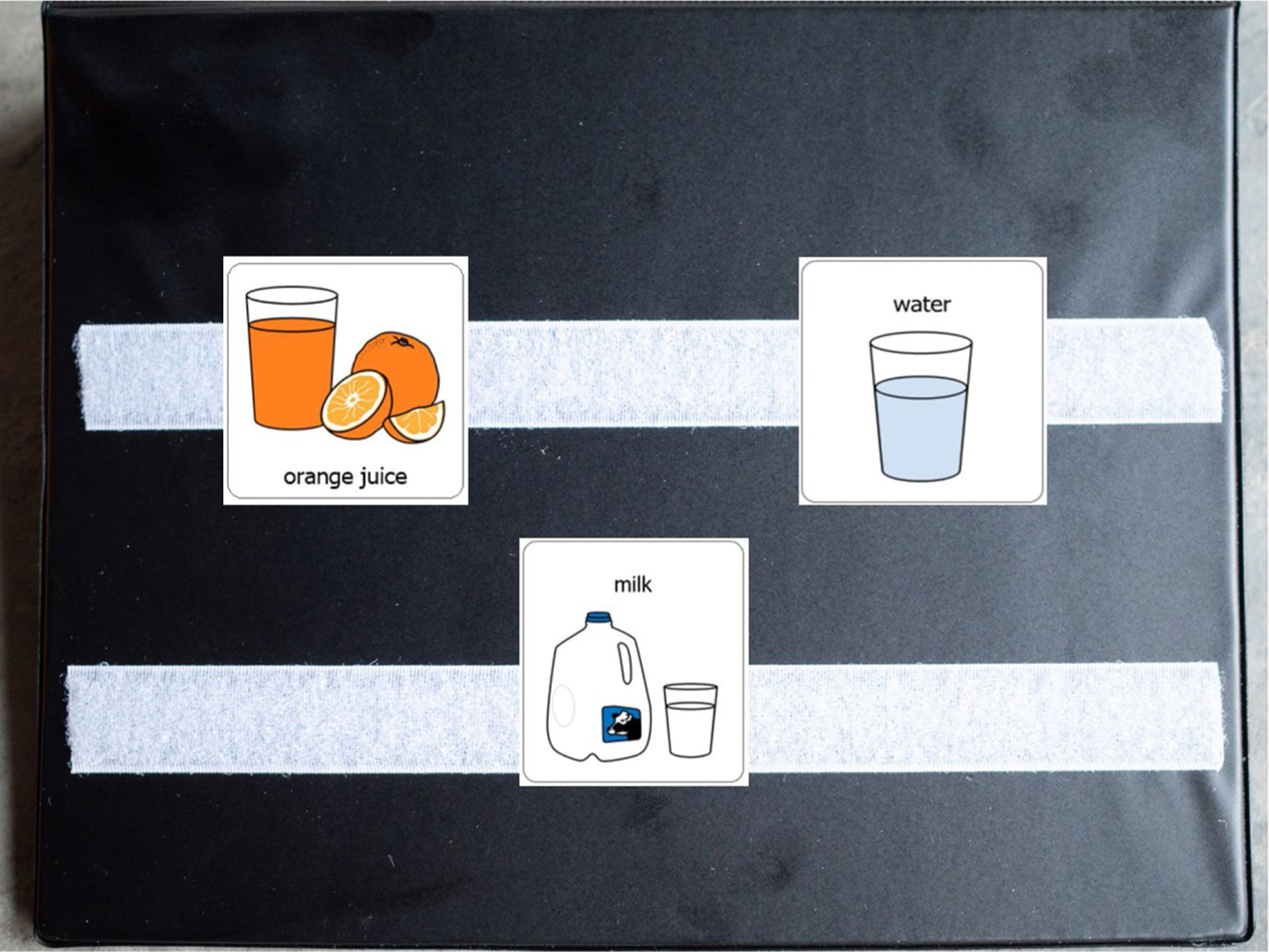
Example of Low-Tech Discrimination Phase. Note. Picture represents the discrimination phase in which the symbols are all on the front of the book in a field size of 2 or more symbols, and page-linking does not yet occur. Symbols were made using Boardmaker software, and the participant’s parents selected the images
When symbols were introduced in a field size of 2 or larger, researchers coached parents to conduct correspondence checks to determine the accuracy of the request. When the participant selected a symbol in a field size of 2 or larger, the parent held out the corresponding items in the field to the participant and said, take it. If the participant chose the item corresponding to the selected symbol, the item was delivered. If the participant chose an item other than the selected symbol, the item was withheld, and the parent pointed to the item that corresponded with the selected symbol and labeled the item (e.g., you asked for videos).
Prompt Delay
Prompt delay procedures were used for Alice and Courtney. For both Courtney and Alice, prompt delays were used to allow them to independently page-link to make a request and to fade out the level of prompts needed to make a request accurately. Nina did not demonstrate prompt dependency, and systematic prompt delay procedures were not required or used during intervention for Nina. Following the presentation of an item or activity to request, the parent waited for the predetermined prompt delay duration for the participant to select the appropriate symbol. If the participant did not begin the target response within the prompt delay duration, the parent provided either a vocal or a gesture prompt to complete the target response. A 10 s prompt delay was used to teach low-tech page-linking to Alice. Courtney’s mother used an increasing (either a 0 s, 4 s, or 7 s) prompt delay across all intervention sessions for both high-tech and low-tech interventions.
Differential Reinforcer Magnitude
Differential reinforcer magnitude procedures were used for Alice to reinforce all communication attempts while increasing her independence. Differential reinforcement was provided by allowing 15 s of access to the target item when Alice required a prompt to complete the target response and 30 s of access to the item when Alice completed the target response independently.
Contingent Reinforcement
For all participants, reinforcement was provided in the form of 20–30 s access to the requested activity item (e.g., tv show), one bite of a food item, or one sip of a drink following a request for the item. The same amount of contingent reinforcement was provided following independent and prompted responses during intervention and maintenance for all participants.
Behavior Chaining
Behavior chaining was used with all participants, using either forward chaining (Courtney, both high and low-tech; Nina, low-tech only), backward chaining (Alice, high-tech only), or total task chaining (Nina, high-tech only). During the behavior chaining procedure, to advance to instruction on a new step, participants were required to complete the targeted steps with at least 80% independence and accuracy for three consecutive sessions.
High-tech page linking to teach an autoclitic mand was taught using a backward chain for Alice. Autoclitic mands are phrases produced by the speaker that requires the listener to respond in a specific way (Cooper et al., 2020). For example, requesting I want followed by an item, results in the listener providing the requested item. The phrase I want cannot stand alone and when combined with an action and noun (e.g., “to watch TV) the entire phrase of I want to watch TV creates an autoclitic mand. Due to the delivery of the requested item following the exchange or selection of a symbol, backward chaining procedures were used for Alice. The last step, Step 3 (selecting a symbol of the preferred item), was taught first. Step 2, selecting an activity category, was taught second, followed by the first step, selecting the I WANT symbol.
At the start of the study, researchers coached Courtney’s mother to teach Courtney to complete three steps to request preferred food and drinks on the Tobii. The three steps of the behavior chain involved using eye-gaze to navigate through three different pages in the Tobii. The first page contained a navigation bar with tabs displaying a general symbol representing the target reinforcer (i.e., food/drinks). The second page contained larger symbols indicating the type of reinforcer (i.e., food or drink). Finally, the third page contained smaller symbols displaying specific items, activities, or actions, depending on the target reinforcer (i.e., water, goldfish).
When Courtney’s low-tech modality was introduced, researchers coached parents to implement procedures to teach two-step page linking using forward chaining. The two steps were: (a) eye-pointing for at least 2 consecutive seconds to a general symbol representing the target reinforcer (i.e., help) displayed on the cover page, and (b) eye-pointing for at least 2 consecutive seconds to symbols representing specific items, activities, or actions, depending on the target reinforcer (i.e., help open container) displayed on individual category pages. With Courtney’s high-tech device, forward chaining procedures began by providing the target reinforcer for completing the first step of the behavior chain. Then, when Courtney met mastery criterion for the first step, she was provided the target reinforcer for completing both the first and second step of the behavior chain. This process continued until Courtney met mastery for all required steps of the behavior chain.
Forward chaining procedures were used to teach low-tech page-linking to Nina. Procedures consisted of the following steps: (a) open cover of the communication book, and (b) select symbol for TV shows. The target page consisting of TV show symbols was then moved to a new place in the book requiring Nina to: (a) open the book, (b) flip through pages until she reached the target page, and (c) select a preferred symbol. Discrimination training was used in Step 2 as additional category pages were added, requiring discrimination between the category pages.
Total-task chaining was used to teach an autoclitic mand of “I want (item)” on Nina’s high-tech device using three steps (a) selecting the I want button (which opened the categories page), (b) selecting a category button (which opened that specific category folder), and (c) selecting a symbol that corresponds to a preferred item Figs. 2 and 3.
Fig. 2.
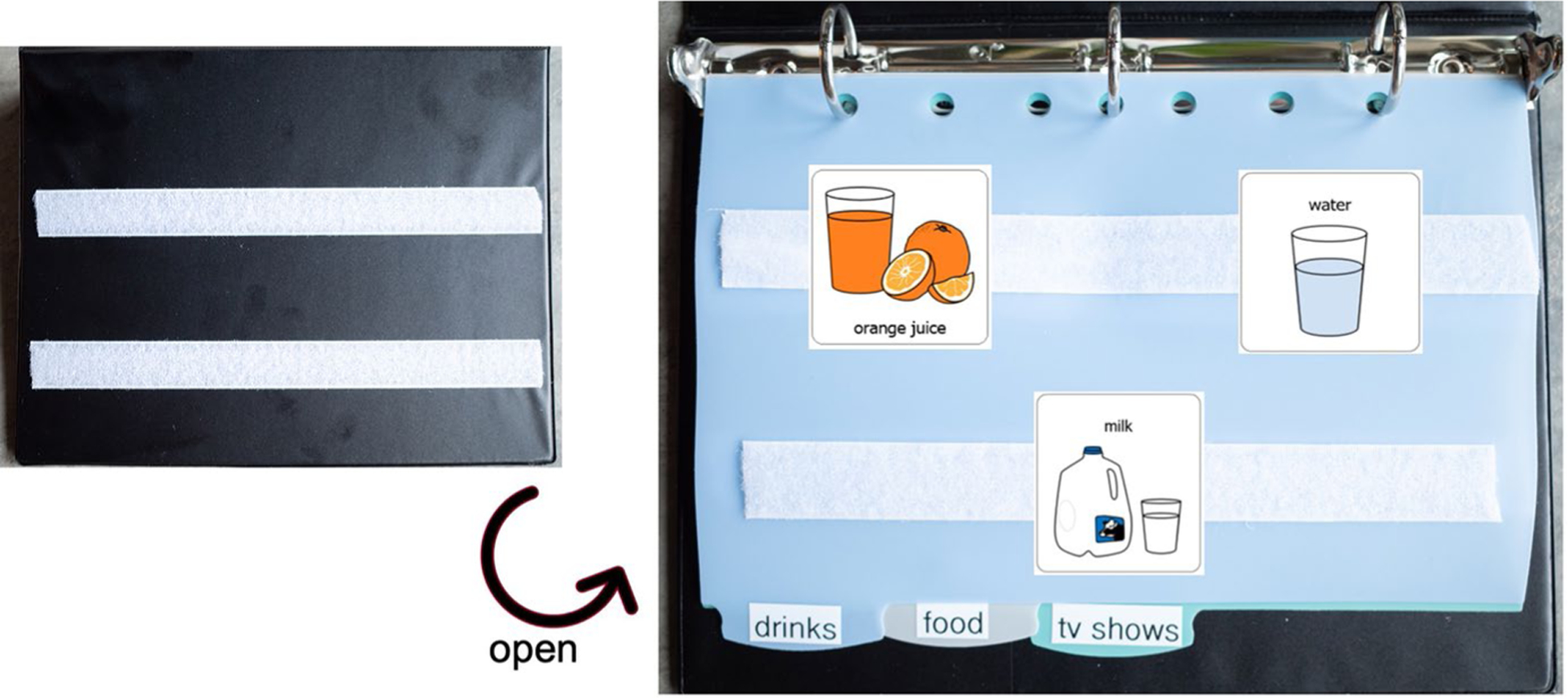
Example of Low-Tech Page-Linking. Note. Picture represents the behavior chain for low-tech page-linking, in which the symbols are inside the book, organized by one category per page. Symbols were made using Boardmaker software, and the participant’s parents selected the images
Fig. 3.
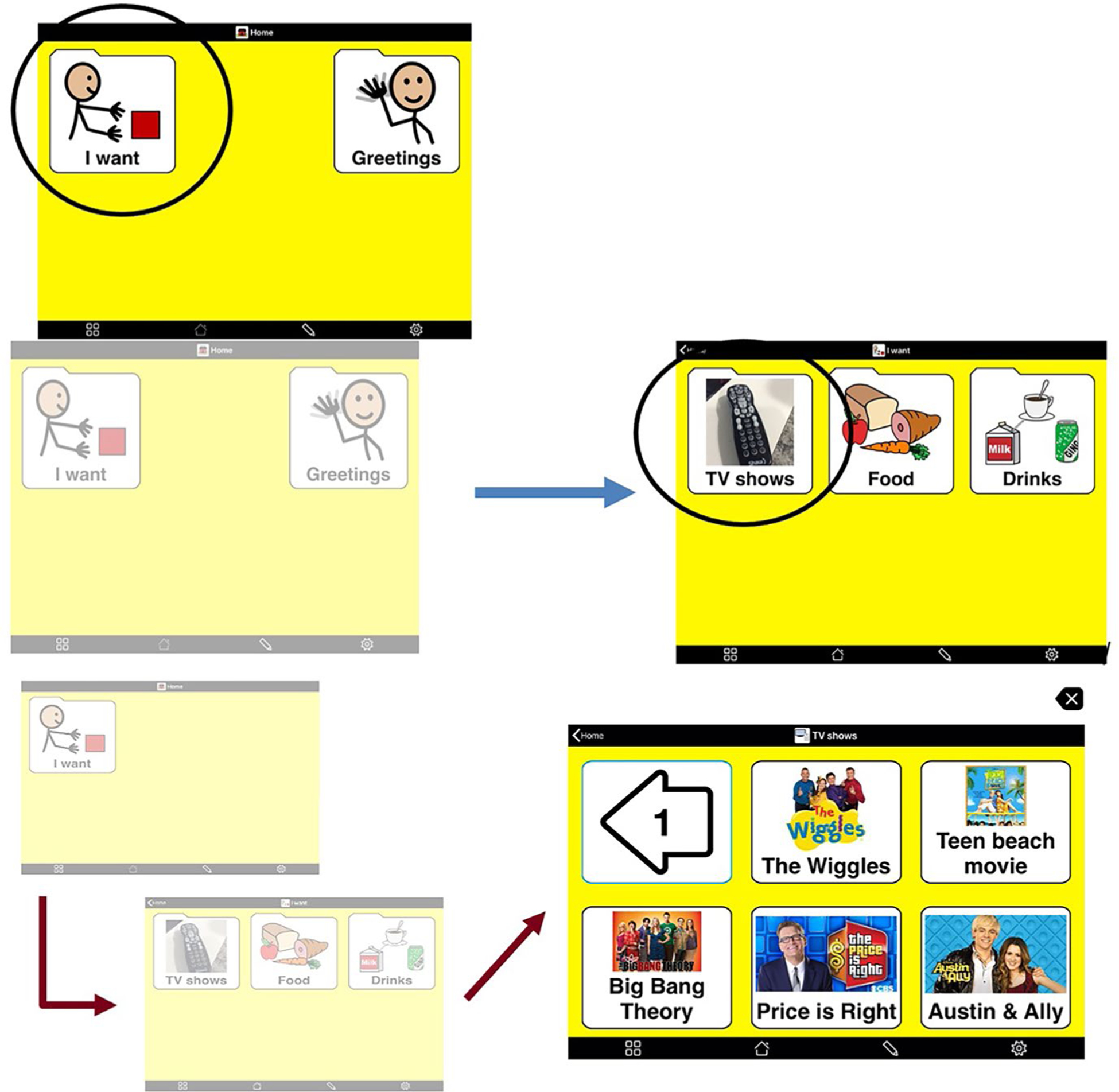
Example of High-Tech Page-Linking. Note. This sequence represents the behavior chain for high-tech page-linking. The black circle represents the symbol selected. These screenshots were taken from a participant’s Prolquo2Go application for iOS19. The participant’s previous therapist previously selected the yellow background screen
Results
Page-linking data for all participants are shown in Fig. 4 with high-tech page-linking on the left and low-tech page-linking results on the right. Courtney’s data appear in the top panel of Fig. 4. During baseline on the Tobii (high-tech; left side of Fig. 4), Courtney’s average page-linking independence was 0% for food/drink. Step 1 was introduced with a 0 s delay. Following six sessions without an increase in trend, a 4 s delay was introduced for Step 2 and mastery criteria was reached after seven sessions. Step 2 was introduced with a 0 s delay and after 3 sessions of intervention, step 1 was added at a 7 s delay; mastery criterion was reached after 10 sessions. Lastly, Steps 2 and 3 were introduced with a 4 s delay and Step 1 with a 7 s delay; mastery criteria were reached following 3 sessions. Average responding over 13 maintenance sessions was 89.6%. Average responding during baseline for Courtney using a low-tech device (low-tech; right side of figure) was 53.3% to request help. Step 1 was introduced at a 7 s delay and Step 2 with a 0 s delay and met mastery criterion following nine sessions. A 7 s delay was then introduced for both steps, meeting mastery criterion following 16 sessions. Courtney completed high-tech page-linking baseline and intervention in 44 weeks and low-tech page-linking baseline and intervention in 9 weeks.
Fig. 4. Page-Linking Results. Note.
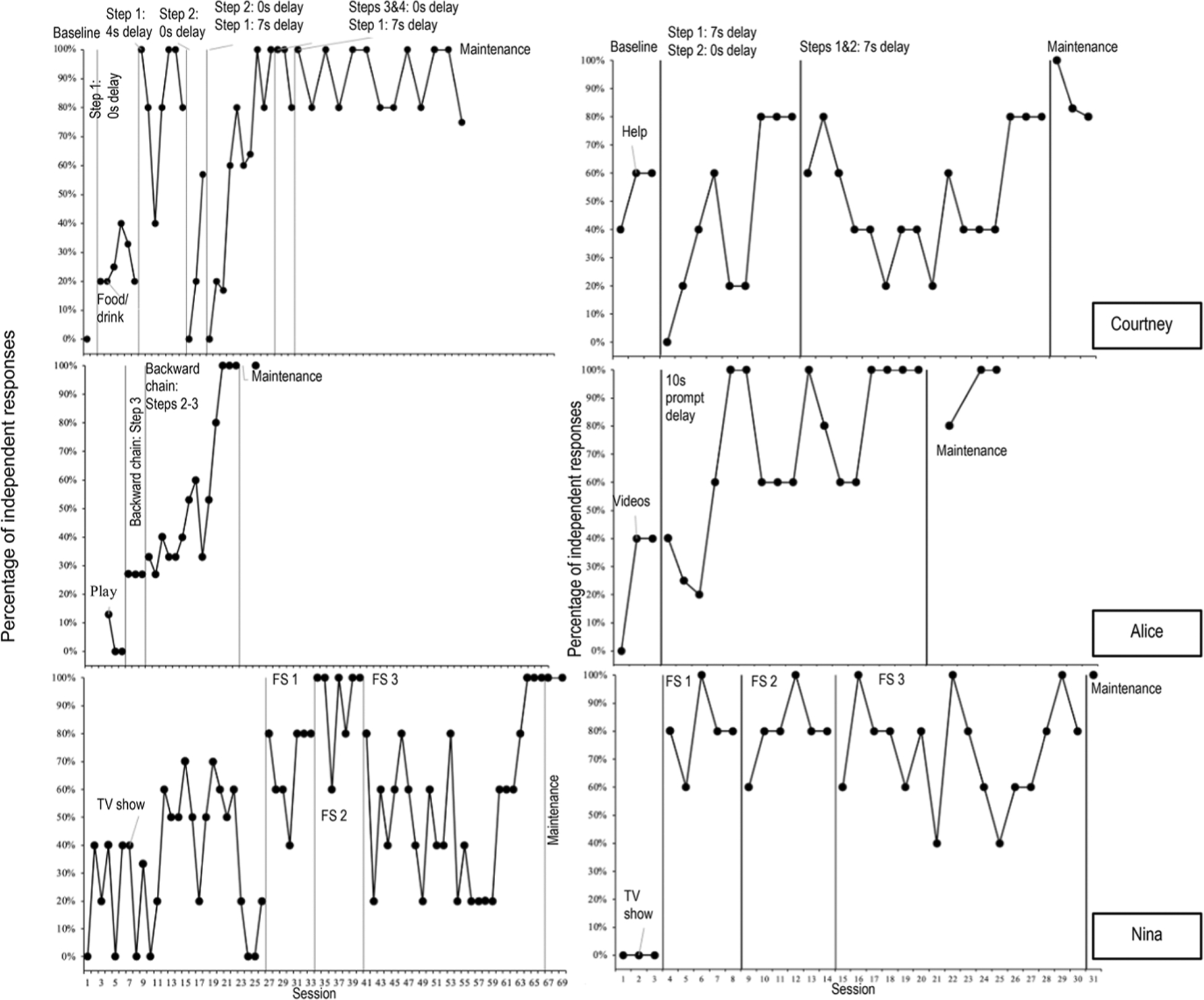
Percentage of independent and accurate responses (per 5-trial session) across all three participants for high-tech (left) and low-tech (right) AAC devices
Alice’s data appear in the middle panel of Fig. 4. During baseline for Alice using a high-tech (WeGo; left side of Fig. 4) AAC modality, average independence in page-linking to request play was 4% for all three steps. Alice mastered high-tech Phase 1, in which Steps 1 and 2 were prompted, in three sessions. Alice mastered high-tech Phase 2, in which only Step 1 was prompted, following 14 sessions, and she mastered Step 1 without explicit teaching. For low-tech (right side of figure), Alice’s average baseline responding across three sessions to request help was 26.7%. A 10 s prompt delay was introduced, and she met mastery criterion following 17 sessions. Alice completed high-tech page-linking baseline and intervention in 12 weeks and low-tech page-linking baseline and intervention in 6 weeks.
Nina’s data appear in the bottom panel of Fig. 4. For high-tech AAC (left side of Fig. 4), during baseline testing in a field size of 3 categories, Nina averaged 33% independence in requesting TV shows. Following a systematic increase in field size in categories, starting at 1 and ending at 3, Nina mastered requesting TV shows in a field size of 3 categories. For low-tech AAC (right side of figure), during baseline in a field size of 3 categories, Nina averaged 0% independence to request TV shows. Following a systematic increase in field size in categories, starting at 1 and ending at 3, Nina mastered requesting TV shows in a field size of 3 categories. Nina completed high-tech page-linking baseline and intervention in 45 weeks and low-tech page-linking baseline and intervention in 15 weeks.
The percentage of non-overlapping data (PND; (Scruggs & Mastropieri, 2001) was calculated by dividing the total number of data points during the intervention phase by the number of data points above the highest baseline data point and multiplying the quotient by 100. PND for high-tech AAC was calculated at 93.1% (127/29 × 100) for Courtney, 100% (17/17 × 100) for Alice, and 28.8% (19/66 × 100) for Nina. PND for low-tech AAC was calculated at 28% (7/25 × 100) for Courtney, 82.4% (14/17 × 100) for Alice, and 100% (27/27 × 100) for Nina.
Discussion
The current study examined the use of individualized and systematic instruction to increase page-linking skills with both high- and low-tech AAC devices for three females with RTT. This study expands on previous research using behavior chaining, discrimination training, and prompt delays to teach a complex behavior by demonstrating the use of individualized interventions applied in a systematic way to increase communication requests. Further, it contributes to the application of these instructional procedures for increasing complexity of requesting, specifically page-linking, of individuals with RTT.
Implications
Forward chaining was an effective intervention to teach Courtney to page-linking to request food using her high-tech modality and to request help using her low-tech modality. Backward chaining was an effective instructional procedure for Alice. During baseline testing with her high-tech device, Alice was not able to perform any of the three steps independently. She acquired step three by session six (three sessions of intervention targeting step three only) and step two by session 20 (14 sessions of intervention targeting Steps 2 and 3 only). Alice also acquired step one by Session 20, even though it was not specifically targeted during the intervention. Given the natural consequence of the reinforcer provided upon completion of the behavior chain, backward chaining was an effective intervention for teaching page-linking with a high-tech device for Alice. Alice acquired page-linking after 16 intervention sessions for her low-tech device, suggesting that differential reinforcement magnitude paired with a prompt delay was an effective procedure. Nina could not page-link during baseline sessions to request TV shows, yet she quickly acquired the behavior chain with her low-tech AAC modality (laminated symbols). For high-tech AAC page-linking with Proloquo2Go, Nina learned to request TV shows in a field size of three.
Overall, this study presents several important implications for teaching individuals with RTT to page-link with their AAC devices. First, this study was not intended to teach language to the participants; this study and its procedures intended to support the participants to establish a single communicative function (i.e., manding/requesting) and to expand communication access. Additional teaching is needed to teach an individual with Rett syndrome a complete and functional language system. Next, the need for individualization is evident in the different intervention procedures used to teach each participant in this study. Each participant required an intervention that supported their use of the device and allowed them to access it independently.
Along with targeting a specific modality during intervention, other communication functions were also honored. For example, if a participant requested a break or engaged in a different activity, their requests were immediately honored. Third, successful interventions varied across modalities for participants. For example, chaining procedures alone effectively taught Alice to page-link in her high-tech modality, yet prompt delays were necessary with her low-tech modality. This discrepancy in required intervention components clearly illustrates that there is no “one size fits all” intervention for everyone or all types of AAC devices. Lastly, response-guided intervention is critical to ensure meaningful skill acquisition.
The use of PND to calculate effect size should be discussed. PND results were considered either effective (PND between 70–90%) or very effective (PND above 90%; (Scruggs & Mastropieri, 2001) for high-tech interventions for two participants (Courtney and Alice) and low-tech interventions for two participants (Alice and Nina). However, for the high-tech intervention for Nina and the low-tech intervention for Courtney, PND was below 50% and therefore considered ineffective if following the PND effect sizes originally outlined in Scruggs et al. (1987). PND effectively quantifies effect sizes for interventions with AAC devices (Chen et al., 2016). However, there are better effect size measures (Tarlow & Penland, 2016). The measure of PND does not consider the intervention and its impact on the individual. For example, PND for Nina’s high-tech intervention across conditions with increasing field size was calculated at 28.8%. Through visual inspection, the data trend continues to increase across both phases of Courtney’s low-tech intervention and is maintained post-intervention without the prompt delay used in the intervention. In the high-tech intervention for Nina, the level of data paths in each phase is higher than the previous adjacent phase, except for the initial introduction of a field size of 3. Following a downward trend in the initial field size of 3 phase, a gesture prompt resulted in mastery. Response-guided intervention, which requires reassessing progress and revising an intervention when necessary, allowed for socially significant and effective interventions, as our original aim was not a clear demonstration of experimental control but rather utilizing interventions that allowed the participants to acquire practical and meaningful communication skills.
Limitations and Future Directions
The current study results should be interpreted in the context of a few limitations. First, the generalization of page-linking skills across environments still needs to be tested. It would be beneficial to program for maintenance and generalization of these skills as they are critical for successfully using the device across environments and time. The exact number of baseline data points was collected for all three low-tech participants. This violates the standard convention of staggering baselines in a concurrent multiple-baseline design. Baselines are typically staggered to demonstrate that changes in the independent variable (manipulated by the researchers) produced the change in response and not something else in the environment that could impact all tiers of the design (in this case, participants). Although more baseline data points may have strengthened the design, when a multiple baseline is run non-concurrently, this logic is less relevant as no environmental factors are occurring that impact all participants simultaneously. Non-concurrent multiple-baseline designs are essentially a series of AB designs (Carr, 2005; Harvey et al., 2004). Although not the strongest single-case design, with multiple replications, produce an acceptable demonstration of experimental control (Cooper et al., 2020; Watson & Workman, 1981). Notably, the non-concurrent multiple baseline design offers a viable experimental design when behavior cannot be reversed (e.g., a teaching procedure). In situations where multiple participants may not be available simultaneously, delaying intervention is unethical. Further, the PND results indicate that the instruction was effective for two out of three participants. Finally, clinically, all participants met mastery criteria during instruction. Thus, we interpret those findings as indicative of the effectiveness of instruction. Each participant had different motor abilities (i.e., the ability to walk and use of hands). The communication modalities selected for each participant were appropriate for their motor movements during the study. Given the potential deterioration in motor skills and/or cognitive skills with RTT (Hagberg & Witt-Engerstrom, 1986; NINDS, 2021), it is possible that communication needs and systems may change for an individual over their lifetime and can vary across individuals. Individualization of communication systems and teaching procedures are vital to teach complex communication skills such as page-linking skills to individuals with RTT. Additional considerations and practice implications for teaching AAC strategies and procedures to individuals with RTT are discussed in (Unholz-Bowden et al., 2023).
Additional research in the area of RTT and communication is necessary to increase our understanding of effective procedures to expand AAC, including moving from pictorial representation to words to spelling and whether visual screen displays are more effective than black line drawings for some individuals. Along with identifying preferences for items and activities to request, interventions to teach other functions, such as commenting, asking questions, and expressing feelings, are needed. Systematic and experimental methods are necessary to identify the interventions that work best for each individual. Additionally, future research could focus on expanding the mean length of utterance or phrase length using AAC devices. The importance of a reliable communication system cannot be understated, and the use of experimental methods to determine the most effective interventions for each individual with RTT is paramount.
Finally, this investigation was limited to targeting a single communicative function: requesting. In addition to research needed on teaching other expressive, communicative functions such as commenting, asking questions, and expressing feelings, the influence of systematic modeling of receptive language on language acquisition seems relevant. Similarly, understanding the appropriate blend of instruction that includes both explicit instructions during which there are accurate and inaccurate responses and open communication during which the individual is encouraged to select any messages, regardless of whether they are “accurate” or contextually relevant, is crucial for promoting a robust communication repertoire that permits an individual with severe motor and communication impairments to communicate their needs and feelings accurately.
Conclusion
The symptoms of RTT are pervasive and life-long (Hagberg & Zoghbi, 2002). Individuals affected with RTT typically have complex communication needs and require individualized instruction. This study demonstrates the need for individualization, as every participant required a unique response guided intervention to acquire page-linking skills. Along with individualized systems of reinforcement that consider the individual’s choice and preference, individualized interventions are necessary to ensure socially significant and meaningful skill acquisition. Finally, this investigation is a preliminary demonstration of how to expand communication skills in terms of additional symbols, discrimination among symbols, and page-linking for navigation within the device. Future investigations are needed to examine how to further expand language skills and communication functions of individuals with RTT to promote independent AAC.
Funding
This study was funded by grant #1R21DC015021.
Footnotes
Conflicts of Interest/Competing interests The authors declare that they have no conflict of interest.
Ethics Approval This study was approved by the University of Minnesota’s Institutional Review Board. All ethics procedures and codes based on the Declaration of Helsinki, the Institutional Review Board, and the Behavior Analyst Certification Board Professional and Ethical Compliance Code for Behavior Analysts were followed during the study.
Informed Consent Written informed consent was obtained from a parent/legal guardian of each child participant.
Data Availability
Data are available upon request from the first author.
References
- Achmadi D, Kagohara D, Van Der Meer L, O’Reilly M, Lancioni G, Sutherland D, Lang R, Marshik PB, Green VA, & Sigafoos J (2012). Teaching advanced operation of an iPod-based speech-generating device to two students with autism spectrum disorders. Research in Autism Spectrum Disorders, 6(4), 1258–1264. 10.1016/j.rasd.2012.05.005 [DOI] [Google Scholar]
- Albert KM, Carbone VJ, Murray DD, Hagerty M, & Sweeney-Kerwin EJ (2012). Increasing the mand repertoire of children with autism through the use of an interrupted chain procedure. Behavior Analysis in Practice, 5(2), 65–76. 10.1007/BF03391825 [DOI] [PMC free article] [PubMed] [Google Scholar]
- Alzrayer NM, Banda DR, & Koul R (2017). Teaching children with autism spectrum disorder and other developmental disabilities to perform multistep requesting using an iPad. Augmentative and Alternative Communication, 33(2), 65–76. 10.1080/07434618.2017.1306881 [DOI] [PubMed] [Google Scholar]
- Anderson CM, & Long ES (2002). Use of a structured descriptive assessment methodology to identify variables affecting problem behavior. Journal of Applied Behavior Analysis, 35(2), 137–154. 10.1901/jaba.2002.35-137 [DOI] [PMC free article] [PubMed] [Google Scholar]
- Bartolotta TE, Zipp GP, Simpkins SD, & Glazewski B (2011). Communication skills in girls with Rett syndrome. Focus on Autism and Other Developmental Disabilities, 26(1), 15–24. 10.1177/1088357610380042 [DOI] [Google Scholar]
- Boesch M, Wendt O, Subramanian A, & Hsu N (2013). Comparative efficacy of the Picture Exchange Communication System (PECS) versus a speech-generating device: Effects on requesting skills. Research in Autism Spectrum Disorders, 7(3), 480–493. 10.1016/j.rasd.2012.12.002 [DOI] [PubMed] [Google Scholar]
- Brady NC, Saunders KJ, & Spradlin JE (1995). A conceptual analysis of request teaching procedures for individuals with severely limited verbal repertoires. The Analysis of Verbal Behavior, 12, 43–52. 10.1007/bf03392896 [DOI] [PMC free article] [PubMed] [Google Scholar]
- Brodhead MT, Al-Dubayan MN, Mates M, Abel EA, & Brouwers L (2016). An evaluation of a brief video-based multiple-stimulus without replacement preference assessment. Behavior Analysis in Practice, 9(2), 160–164. 10.1007/s40617-015-0081-0 [DOI] [PMC free article] [PubMed] [Google Scholar]
- Byiers BJ, Dimian A, & Symons FJ (2014). Functional communication training in Rett syndrome: A preliminary study. American Journal on Intellectual and Developmental Disabilities, 119(4), 340. 10.1352/1944-7558-119.4.340 [DOI] [PubMed] [Google Scholar]
- Carr J (2005). Recommendations for reporting multiple-baseline designs across participants. Behavioral Interventions, 20(3), 219–224. 10.1002/bin.191 [DOI] [Google Scholar]
- Chen M, Hyppa-Martin JK, Reichle JE, & Symons FJ (2016). Comparing single case design overlap-based effect size metrics from studies examining speech generating device interventions. American Journal on Intellectual and Developmental Disabilities, 121(3), 169–193. [DOI] [PMC free article] [PubMed] [Google Scholar]
- Cooper JO, Heron TE, & Heward WL (2020). Applied behavior analysis (3rd ed.). Pearson. [DOI] [PMC free article] [PubMed] [Google Scholar]
- Ellaway J, & Christodoulou C (2001). Rett syndrome: Clinical characteristics and recent genetic advances. Disability and Rehabilitation, 23(3–4), 98–106. 10.1080/09638280150504171 [DOI] [PubMed] [Google Scholar]
- Freeman KA, Anderson CM, & Scotti JR (2000). A structured descriptive methodology: Increasing agreement between descriptive and experimental analyses. Education and Training in Mental Retardation and Developmental Disabilities, 35(1), 55–66. http://www.jstor.org/stable/23879707 [Google Scholar]
- Fisher W, Piazza CC, Bowman LG, Hagopian LP, Owens JC, & Slevin I (1992). A comparison of two approaches for identifying reinforcers for persons with severe and profound disabilities. Journal of Applied Behavior Analysis, 25, 491–498. 10.1901/jaba.1992.25-491 [DOI] [PMC free article] [PubMed] [Google Scholar]
- Frost LA, & Bondy A (2002). The Picture Exchange Communication System training manual. Pyramid Educational Consultants. [Google Scholar]
- Gast DL, & Ledford JR (Eds.). (2018). Single Case Research Methodology: Applications in Special Education and Behavioral Sciences (3rd ed.). Routledge. 10.4324/9781315150666 [DOI] [Google Scholar]
- Hagberg B, & Witt-Engerstrom I (1986). Rett syndrome: A suggested staging system for describing impairment profile with increasing age towards adolescence. American Journal of Medical Genetics, 24(1), 47–59. 10.1002/ajmg.1320250506 [DOI] [PubMed] [Google Scholar]
- Hagberg B, & Zoghbi HY (2002). Clinical manifestations and stages of Rett syndrome. Mental Retardation and Developmental Disabilities Research Reviews, 8(2), 61–65m. 10.1002/mrdd.10020 [DOI] [PubMed] [Google Scholar]
- Harvey M, May T, & Kennedy M (2004). Nonconcurrent multiple baseline designs and the evaluation of educational systems. Journal of Behavioral Education, 13(4), 267–276. 10.1023/B:JOBE.0000044735.51022.5d [DOI] [Google Scholar]
- Koppenhaver DA, Erickson KA, Harris B, McLellan J, Skotko BG, & Newton RA (2001). Storybook-based communication intervention for girls with Rett syndrome and their mothers. Disability and Rehabilitation, 23(3–4), 149–159. 10.1080/09638280150504225 [DOI] [PubMed] [Google Scholar]
- Murphy D, Lyons R, Carroll C, Caulfield M, & de Paor G (2018). Communication as a human right: Citizenship, politics and the role of the speech-language pathologist. International Journal of Speech-Language Pathology, 20(1), 16–20. 10.1080/17549507.2018.1404129 [DOI] [PubMed] [Google Scholar]
- National Institute of Neurological Disorders and Stroke (NINDS). (2021). Rett Syndrome FactSheet. https://www.ninds.nih.gov/Disorders/Patient-Caregiver-Education/FactSheets/Rett-Syndrome-Fact-Sheet
- Scruggs T, Mastropieri M, & Casto G (1987). The quantitative synthesis of single-subject research. Remedial and Special Education, 8(2), 24–33. https://doi.org.ezp1.lib.umn.edu/10.1177/074193258700800206 [Google Scholar]
- Reichle J, Simacek J, Wattanawongwan S, & Ganz J (2019). Implementing aided augmentative communication systems with persons having complex communicative needs. Behavior Modification, 43(6), 841–878. 10.1177/0145445519858272 [DOI] [PubMed] [Google Scholar]
- Sigafoos J, & Iacono T (1993). Selecting augmentative communication devices for persons with severe disabilities: Some factors for educational teams to consider. Australia and New Zealand Journal of Developmental Disabilities, 18(3), 133–146. https://doi.org.ezp2.lib.umn.edu/10.1080/07263869300034901 [Google Scholar]
- Sigafoos J, Woodyatt G, Keen D, Tait K, Tucker M, Roberts-Pennell D, & Pittendreigh N (2000). Identifying potential communicative acts in children with developmental and physical disabilities. Communication Disorders Quarterly, 21(2), 77–86. 10.1177/152574010002100202 [DOI] [Google Scholar]
- Scruggs TE, & Mastropieri MA (2001). How to summarize single-participant research: Ideas and applications. Exceptionality, 9(4), 227–244. 10.1207/S15327035EX0904_5 [DOI] [Google Scholar]
- Simacek J, Reichle J, & McComas J (2016). Communication intervention to teach requesting through aided AAC for two learners with Rett syndrome. Journal of Developmental and Physical Disabilities, 28(1), 59–81. 10.1007/s10882-015-9423-7 [DOI] [PMC free article] [PubMed] [Google Scholar]
- Tarlow KR, & Penland A (2016). Outcome assessment and inference with the Percentage of Nonoverlapping Data (PND) single-case statistic. Practice Innovations, 1(4), 221–233. 10.1037/pri0000029 [DOI] [Google Scholar]
- Unholz-Bowden E, Girtler S, Shipchandler A, Kolb R, & McComas J (2023). Use of augmentative and alternative communication by individuals with Rett syndrome part 2: High-tech and low-tech devices. Journal of Developmental and Physical Disabilities. 10.1007/s10882-023-09902-y [DOI] [PMC free article] [PubMed] [Google Scholar]
- Urbanowicz A, Leonard H, Girdler S, Ciccone N, & Downs J (2016). Parental perspectives on the communication abilities of their daughters with Rett syndrome. Developmental Neurorehabilitation, 19(1), 17–25. 10.3109/17518423.2013.879940 [DOI] [PubMed] [Google Scholar]
- Watson PJ, & Workman FA (1981). The nonconcurrent multiple baseline across individuals design: An extension of the traditional multiple baseline design. Journal of Behavior Therapy and Experimental Psychology, 12, 257–259. 10.1016/0005-7916(81)90055-0 [DOI] [PubMed] [Google Scholar]
Associated Data
This section collects any data citations, data availability statements, or supplementary materials included in this article.
Data Availability Statement
Data are available upon request from the first author.