



Key Clinical Message
Cerebral Venous Sinus Thrombosis (CVST) is a subtype of venous thromboembolism, which occurs in the dural venous sinuses. Blockage of the venous drainage of the brain leads to the development of hemorrhages. Strokes can hence develop in any individual, irrespective of age or sex. CVST is a very serious condition requiring immediate thrombolysis to prevent residual neurological deficits. We report the case of a lady aged 25 years, who presented to the emergency department with a severe diffuse headache for 4 days, associated with vomiting. This was followed by multiple episodes of seizures and altered sensorium the previous day. She had been taking desogestrel for the past 2 months. On examination, the patient was unconscious and febrile (102.8 F). On admission, Glasgow Coma Scale score of E2V2M3 and bilateral extensor plantar response were noted. Signs of meningeal irritation were absent. Her pupils were mid‐dilated, sluggishly reactive to light, and papilledema was present bilaterally. Based on imaging studies, she was diagnosed with a case of CVST. Her homocysteine levels were elevated. She recovered on appropriate treatment and was discharged on Ryle's feeding tube after 26 days of hospital stay with a Glasgow Coma Scale score of E4V5M6 and a flexor plantar response. The case emphasizes the need to rule out CVST in young adult females on oral contraceptive pills (OCP) presenting with severe neurological dysfunction. Vigilant screening, clinical suspicion and timely management can help cut down the associated mortality and morbidity in such cases.
Keywords: cerebral venous sinus thrombosis, Desogestrel, hyper‐homocysteinemia, Oral contraceptive pills, progesterone only pills
MRI showing Superior Sagittal Sinus Thrombosis as evidenced by the hyperintensity shown by the yellow arrow.

1. INTRODUCTION
Cerebral venous sinus thrombosis (CVST) is a rare entity. In 80% patients, it is associated with a prothrombotic state. 1 However, the remaining cases are idiopathic. The various prothrombotic etiologies associated with CVST can be classified into three causes (Virchow's Triad): Hypercoagulable States (Factor V Leiden Mutation, etc), Circulatory Stasis (Arteriovenous Anomalies, etc), and Vascular Injury (Cranial Surgery, etc). 2 The Dutch Venous Sinus Thrombosis Group found an association between CVST and oral contraceptive pill (OCP) use in 80% of women, compared to 45% in the control. 1 Factor V Leiden mutation is the most common pro‐thrombotic risk factor for women with CVST (19%). 1 The association between combined OCP use and CVST is strong (Odds Ratio of 30), 3 but the association between Progestin‐only pills (POP) use and CVST is still not well represented in the medical literature. This is the case of a young woman who developed CVST with no apparent risk factors for the same; and she was later found to have been taking desogestrel prescribed 2 months back for abnormal uterine bleeding (AUB). Her serum homocysteine levels were also found to be elevated.
2. CASE PRESENTATION
A 25‐year‐old woman presented in the emergency ward unconscious with a history of severe diffuse headache for 4 days associated with vomiting. This was followed by multiple episodes of seizures 1 day back and altered sensorium. Her only medication was desogestrel (150 μg/day) for AUB started 2 months back. Patient history was negative for fever, rash, arthralgias, head trauma, or smoking. Family history or personal history for venous thromboembolism (VTE), Diabetes Mellitus or stroke was insignificant. On examination, the patient was febrile (102.8°F), with a pulse rate of 108 beats per minute, blood pressure of 136/94 mmHg, respiratory rate of 26/min and oxygen saturation of 94% on room air. General examination revealed no cyanosis, icterus, clubbing or lymphadenopathy. She had a Glasgow Coma Scale (GCS) score of E2V2M3 and bilateral extensor plantar response. Signs of meningeal irritation were absent. Her pupils were mid‐dilated, sluggishly reactive to light, and bilateral papilledema was present.
Initially, a working diagnosis of encephalitis was made, and the patient was investigated accordingly. Liver and renal function tests, Electrocardiogram (ECG), serum electrolytes, and chest X‐Ray revealed no abnormalities. Laboratory investigations have been summarized in Table 1. Hematological profile suggested anemia (Hemoglobin was 8 mg/dL). Cerebrospinal fluid examination revealed albumino‐cytological dissociation (Total Leucocyte Count was <5/mm3; protein levels were 361 mg%). Tests for viral encephalitis turned out to be negative. Magnetic resonance imaging (MRI) and Computed Tomography (CT) of the head were performed. The Non‐Contrast Enhanced CT scan demonstrated the dense delta sign (Figure 1). MRI suggested thrombosis in the superior sagittal sinus (Figure 2), and multiple foci of hemorrhagic transformation were also visualized (Figure 2 and Figure 3). The Imagings were suggestive of CVST, as opposed to the initial working diagnosis of encephalitis. Given the new developments, screening tests for thrombophilia (Activated Protein C resistance, Factor V Leiden, Prothrombin G20210A, antithrombin activity, free Protein C activity, Protein S activity, Anticardiolipin Antibody, Anti beta‐2 glycoprotein 1 antibody, lupus anticoagulant, homocysteine levels, factor VIII, IX, and X levels, von Willebrand Factor levels, and fibrinogen levels) were done and Enoxaparin (60 mg subcutaneously, twice a day) was initiated. The patient was hyperventilating and was intubated in the intensive care unit on day three of admission. Levetiracetam and mannitol were used for recurrent seizures and as anti‐edema measures, respectively. The screening investigations (as mentioned above) for inherited causes of thrombophilia were negative. Serum Homocysteine levels were elevated to 69.8 mcmol/L (reference range 2.2–13.2 mcmol/L) and Vitamin B12 levels were less than 83 pg/mL (reference range 187–883 pg/mL). The patient was started on Vitamin B12 (Mecobalamin 1000 μg per day); and folic acid (5 mg per day). After day five of treatment, when she could start taking drugs orally, warfarin sodium (2 mg twice daily) was started to cause an overlap between Enoxaparin and warfarin therapies. Two days later Enoxaparin was discontinued. Warfarin was continued with a target international normalized ratio (INR) of 2.0–3.0. She was extubated on day 20 and discharged on Ryle's Tube feed after 26 days of hospital stay with a GCS score of E4V5M6 and a flexor plantar response. On follow‐up after 30 days, the patient showed no signs of residual neurologic dysfunction, and normal laboratory workup (Table 1).
TABLE 1.
Laboratory findings on initial workup and 30‐day follow‐up.
| Investigation | Initial work‐up | 30‐day follow‐up | Reference value | |
|---|---|---|---|---|
| Complete blood count | Hemoglobin | 8 gm/dL | 13 gm/dL | 12–15gm/dL |
| Total leukocyte count | 13,200 cells/mm3 | 10,500 cells/mm3 | 4000–11,000 cells/mm3 | |
| Neutrophils | 89% | 76% | 40%–80% | |
| Lymphocytes | 8% | 16% | 20%–40% | |
| Cerebrospinal fluid | Cells | <5/mm3 | Not done | <5/mm3 |
| Protein | 361 mg% | 15–45 mg% | ||
| Glucose |
74 mg% (RBS‐98.7 mg%) |
70% of blood sugar. | ||
| Serum homocysteine | 69.8 umol/L | 32.8 umol/L | 2.2–13.2umol/L | |
| Serum Vitamin B12 | <83 pg/mL | 190 pg/mL | 187–883 pg/mL | |
| Serum folic acid | 5.2 nmol/L | 8 nmol/L | 7.0–46 nmol/L | |
Abbreviation: RBS, random blood sugar.
FIGURE 1.

Dense delta sign visualized in non‐contrast enhanced CT of the patient; signifying sagittal sinus thrombosis.
FIGURE 2.
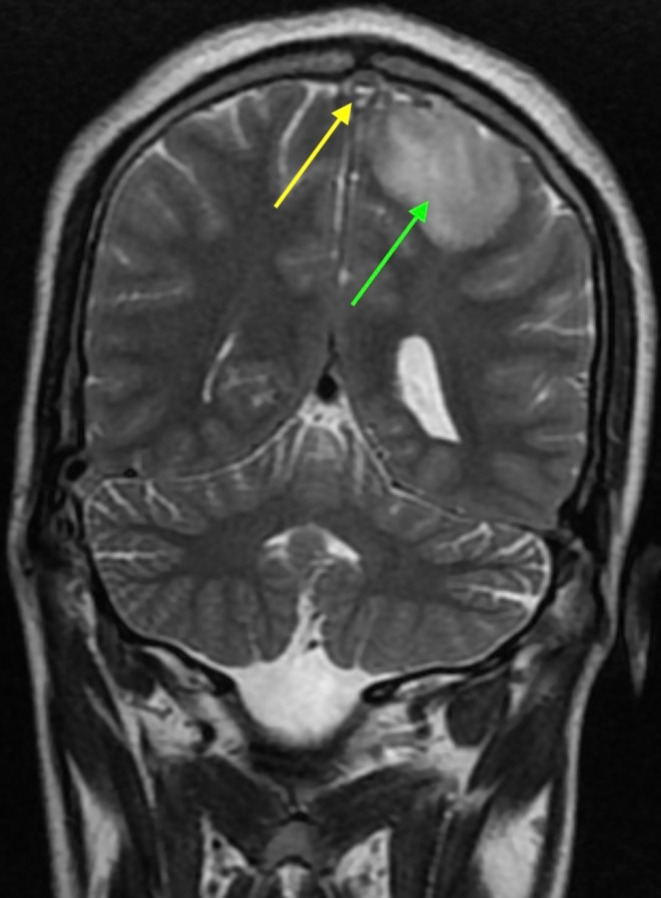
MRI showing superior sagittal sinus thrombosis as evidenced by the hyperintensity shown by the yellow arrow; hemorrhagic transformation (shown by the green arrow).
FIGURE 3.

MRI showing the hemorrhagic transformations (shown by the green arrows).
3. DISCUSSION
CVST is a rare disorder. The estimated annual incidence is three to four cases per one million adults (75% affected are females); and seven cases per million children. 1 , 3 Severe headaches (90%), seizures (47%), hemiparesis (43%), papilledema (41%), impaired consciousness at presentation (39%), and coma (15%) account for the most common signs and symptoms of CVST. 3 20% of cases present with isolated intracranial hypertension‐like features. 3 Our patient presented with a severe diffuse headache followed by seizures and altered sensorium. She had started taking desogestrel recently for AUB. 4 OCPs have been shown to increase the incidence of CVST in women. 5 , 6 Increased risk of VTE has been associated with the ingestion of POPs in medical literature. 5 , 7 , 8 A 2023 case report by Aldraihem et al. showed extensive cerebral venous thrombosis in the right internal jugular vein, sigmoid, transverse, and straight cerebral venous and the application of crushed OCPs mixed with water topically on the scalp was found to be the most important predisposing factor. 9 In a meta‐analysis by Amoozegar et al., it was found that women taking OCPs had 7.59 times higher risk of developing CVST as compared to those not. 10 Smokers and women with body mass index ≥25 kg/m2 are associated with a much higher risk for the same. 8 Progestin‐only preparations had no effect when used as contraceptives, but in the setting of primary menstrual disorders, they increased the risk for VTE. 8 There are evidence that suggest that the probability of VTE is increased in the first months after the start of a new OCP, as seen in a study by Martinelli et al., where it was found that the odds for developing VTE was 9.0 in short (<=1 year), 6.5 in long (>1 and < =5 years) and 5.9 in very long (>5 years) users. 11 In our case the patient had a 2 months history of Desogestrel intake, which was in line with the findings of the above study. Users of third‐generation oral contraceptives, incorporating new progestins like desogestrel, gestodene, and norgestimate, face a 2–3 times higher risk of VTE compared to those using second‐generation counterparts. Additionally, the risk of developing deep vein thrombosis is 2–5 times greater with a low‐estrogen, desogestrel‐containing oral contraceptive than with second‐generation monophasic and triphasic preparations. Researchers suggest that acquired resistance to the anticoagulation effects of activated protein C, a common cause of hereditary thrombophilia, could be a potential mechanism. 12 The American College of Obstetrics and Gynecology's Committee on Gynecologic Practice acknowledges the increased risk associated with third‐generation progestins but leaves the decision to use a desogestrel‐containing formulation to the discretion of individual clinicians and patients, recognizing potential benefits for some individuals. 13 A meta‐analysis by Kemmeren et al. suggests that 3rd generation OCPs pose a greater risk (OR = 1.7) for VTE as compared to 2nd generation OCPs. 14 Laboratory investigations of our patient had revealed anemia with low Vitamin B12 and Folic Acid levels in serum. Since Vitamin B12 and Folic Acid are involved in the homocysteine metabolism, their deficiency causes buildup. An inverse relationship exists between serum Vitamin B12 and folic acid levels, and serum homocysteine levels. Hyper‐homocysteinemia is a well‐known cause of pro‐thrombotic tendency. 15 Cantu, et al. described the direct association between hyper‐homocysteinemia and CVST. 16 The patient's acquired hyper‐homocysteinemia and the concurrent usage of POPs most likely resulted in the development of CVST. The initiation of low molecular weight heparin (LMWH) as an anticoagulant is the treatment of choice for CVST, the use of unfractionated heparin also yields similar results. 17 Osmotic diuretics like mannitol may be used for reducing cerebral oedema in critical conditions, hyperventilation is also a possible treatment modality for the same. 16 Treatment by these guidelines lead to a favorable clinical outcome in our patient. This case signifies the importance of considering the possibility of CVST in young women recently started on OCPs who may present with severe neurological dysfunction. Vigilant screening, clinical suspicion and timely management can help cut down the associated mortality and morbidity in such cases. 80% of the cases have been shown to have a favorable clinical outcome if diagnosed and managed timely. 17 , 18
4. CONCLUSION
Our case stresses on the importance of ruling out CVST in young adult females, who are on or have a history of intake of oral contraceptive pills (OCPs), presenting with severe neurological dysfunction. Vigilant and timely screening, possessing a strong clinical suspicion and an appropriate and timely management can help bring down the associated mortality and morbidity in such cases.
AUTHOR CONTRIBUTIONS
Deepak Sharma: Data curation; formal analysis; funding acquisition; project administration; resources; visualization; writing – original draft; writing – review and editing. Jay Tewari: Formal analysis; funding acquisition; writing – original draft. Shubhajeet Roy: Investigation; methodology; resources; software; supervision; validation; writing – original draft. Paras Sisodia: Investigation; validation; visualization. Anadika Rana: Resources. Virendra Atam: Conceptualization; data curation; formal analysis; investigation; methodology; project administration; resources; software; supervision; validation; visualization; writing – review and editing. Md. Al Hasibuzzaman: Conceptualization; project administration; supervision.
FUNDING INFORMATION
None.
CONFLICT OF INTEREST STATEMENT
None.
ETHICS STATEMENT
Ethics Approval not required.
CONSENT
Written informed consent was obtained from the patient to publish this report in accordance with the journal's patient consent policy.
ACKNOWLEDGMENTS
None.
Sharma D, Tewari J, Roy S, et al. Cerebral venous sinus thrombosis due to desogestrel intake in a young lady: A case report. Clin Case Rep. 2024;12:e8594. doi: 10.1002/ccr3.8594
DATA AVAILABILITY STATEMENT
Not applicable.
REFERENCES
- 1. De Bruijn S, Stam J, Koopman M, et al. Case‐control study of risk of cerebral sinus thrombosis in oral contraceptive users and in carriers of hereditary prothrombotic conditions. The cerebral venous sinus thrombosis study group. BMJ. 1998;316:589‐592. doi: 10.1136/bmj.316.7131.589 [DOI] [PMC free article] [PubMed] [Google Scholar]
- 2. Li AY, Tong E, Yedavalli VS. A case‐based review of cerebral venous infarcts with perfusion imaging and comparison to arterial ischemic stroke. Front Radiol. 2001;1:687045. doi: 10.3389/fradi.2021.687045 [DOI] [PMC free article] [PubMed] [Google Scholar]
- 3. De Bruijn S, de Haan R, Stam J. Clinical features and prognostic factors of cerebral venous sinus thrombosis in a prospective series of 59 patients. J Neurol Neurosurg Psychiatry. 2001;70:105‐108. doi: 10.1136/jnnp.70.1.105 [DOI] [PMC free article] [PubMed] [Google Scholar]
- 4. Ida M, Serena MP, Paolo B. Chapter 71 ‐ Thrombophilic states. In: Biller J, Ferro JM, eds. Handbook of Clinical Neurology. Vol 120. Elsevier; 2014:1061‐1071. doi: 10.1016/B978-0-7020-4087-0.00071-1 [DOI] [PubMed] [Google Scholar]
- 5. Saadatnia M, Tajmirriahi M. Hormonal contraceptives as a risk factor for cerebral venous and sinus thrombosis. Acta Neurol Scand. 2007;115:295‐300. doi: 10.1111/j.1600-0404.2007.00824.x [DOI] [PubMed] [Google Scholar]
- 6. Poulter NR, Chang CL, Farley TMM, Meirik O. Risk of cardiovascular diseases associated with oral progestagen preparations with therapeutic indications. The Lancet. 1999;354:1610. doi: 10.1016/S0140-6736(99)03132-3 [DOI] [PubMed] [Google Scholar]
- 7. Poulter NR, Chang CL, Farley TMM, et al. World Health Organization collaborative study of cardiovascular disease and steroid hormone contraception. A multinational study of cardiovascular disease and steroid hormone contraceptives: description and validation of methods. J Clin Epidemiol. 1995;48:1513‐1547. doi: 10.1016/0895-4356(95)00516-1 [DOI] [PubMed] [Google Scholar]
- 8. Vasilakis C, Jick H, Mar del MMM. Risk of idiopathic venous thromboembolism in users of progestagens alone. The Lancet. 1999;354:1610‐1611. doi: 10.1016/S0140-6736(99)04394-9 [DOI] [PubMed] [Google Scholar]
- 9. Aldraihem MO, Al‐Senani F, Bashir S. Cerebral venous thrombosis with topical estrogen‐progesterone use in a young heterosexual male: a case report. Neurologist. 2023;28(3):184‐186. doi: 10.1097/NRL.0000000000000455 [DOI] [PubMed] [Google Scholar]
- 10. Amoozegar F, Ronksley PE, Sauve R, Menon BK. Hormonal contraceptives and cerebral venous thrombosis risk: a systematic review and meta‐analysis. Front Neurol. 2015;2(6):7. doi: 10.3389/fneur.2015.00007 [DOI] [PMC free article] [PubMed] [Google Scholar]
- 11. Martinelli I, Maino A, Abbattista M, et al. Duration of oral contraceptive use and the risk of venous thromboembolism. A Case‐Control Study Thromb Res. 2016;141:153‐157. doi: 10.1016/j.thromres.2016.03.025 [DOI] [PubMed] [Google Scholar]
- 12. Weiss G. Risk of venous thromboembolism with third‐generation oral contraceptives: a review. Am J Obstet Gynecol. 1999;180(2 Pt 2):295‐301. doi: 10.1016/s0002-9378(99)70721-0 [DOI] [PubMed] [Google Scholar]
- 13. ACOG Practice Bulletin No . 206: use of hormonal contraception in women with coexisting medical conditions. Obstet. Gynecol. 2019;133(2):e128‐e150. doi: 10.1097/AOG.0000000000003072 [DOI] [PubMed] [Google Scholar]
- 14. Kemmeren JM, Algra A, Grobbee DE. Third generation oral contraceptives and risk of venous thrombosis: meta‐analysis. BMJ. 2001;323(7305):131‐134. doi: 10.1136/bmj.323.7305.131 [DOI] [PMC free article] [PubMed] [Google Scholar]
- 15. Durand P, Prost M, Loreau N, Lussier‐Cacan S, Blache D. Impaired homocysteine metabolism and atherothrombotic disease. Lab. Invest. 2001;81:645‐672. [DOI] [PubMed] [Google Scholar]
- 16. Cantu C, Alonso E, Jara A, et al. Hyperhomocysteinemia, low folate and vitamin B12 concentrations, and methylene tetrahydrofolate reductase mutation in cerebral venous thrombosis. Stroke. 2004;35:1790‐1794. doi: 10.1161/01.STR.0000132570.24618.78 [DOI] [PubMed] [Google Scholar]
- 17. Einhäupl K, Stam J, Bousser MG, et al. EFNS guideline on the treatment of cerebral venous and sinus thrombosis in adult patients. Eur. J. Neurol. 2010;17:1229‐1235. doi: 10.1111/j.1468-1331.2010.03011.x [DOI] [PubMed] [Google Scholar]
- 18. Canhão P, Falcao F, Ferro JM. Thrombolytics for cerebral sinus thrombosis: a systematic review. Cerebrovasc. Dis. 2003;15:159‐166. doi: 10.1159/000068833 [DOI] [PubMed] [Google Scholar]
Associated Data
This section collects any data citations, data availability statements, or supplementary materials included in this article.
Data Availability Statement
Not applicable.