



Abstract
Objective:
Open-source data systems, largely drawn from media sources, are commonly used by scholars due to the lack of a comprehensive national data system. It is unclear if these data provide an accurate and complete representation of firearm injuries and their context. The study objectives were to compare firearm injuries in official police records with media reports to better identify the characteristics associated with media reporting.
Methods:
Firearm injuries were identified in open-source media reports and compared to nonfatal firearm injury (n=1,642) data from official police records between January 1, 2021 to December 31, 2022 in Indianapolis, Indiana. Events were matched on date, location, and event circumstances. Four multivariate, multi-level mixed effects logistic regression models were conducted to assess which survivor, event, and community characteristics were associated with media reporting. Data were analyzed 2023 – January 2024.
Results:
Media reported 41% of nonfatal shootings in 2021 and 45% in 2022(p < 0.05), which is approximately two out of every five shootings. Shootings involving multiple survivors, children, and self-defense were more likely to be reported, whereas unintentional shootings and shootings that occurred in structurally disadvantaged communities were less likely to be reported.
Conclusions:
Findings suggest that relying on media reports of firearm injuries alone may misrepresent the numbers and contexts of shootings. Public health interventions that educate journalists about these important issues may be an impactful firearm violence prevention strategy. Also, it is critical to link data systems at the local level to ensure interventions are designed and evaluated using accurate data.
Keywords: firearm injuries, media, communities, structural disadvantage, data linkage
Background
Firearm violence remains a persistent public health crisis in the United States. An estimated 85,000 nonfatal firearm injuries occur annually in the US (E. Kaufman et al., 2020); however, the true prevalence is unknown due to the lack of a comprehensive national data system. In the absence of a national data system, scholars, policymakers, and the public have relied on open-source data reporting systems, largely compiled from local media reports, to examine firearm injuries (Baćak et al., 2021; Gobaud et al., 2023; E. J. Kaufman et al., 2020; Martin et al., 2022; Ssentongo et al., 2021; Ssentongo et al., 2023). The Gun Violence Archive (GVA) currently serves as one de facto national dataset for nonfatal firearm injuries. GVA collects openly sourced data daily from over 7,500 police, media, data aggregates, and other sources to report fatal and nonfatal firearm injuries across the U.S. Scholars have used the GVA to examine racial disparities (Martin et al., 2022), homicides (Gobaud et al., 2023; James et al., 2021; E. J. Kaufman et al., 2020), firearm injuries (Ssentongo et al., 2021; Ssentongo et al., 2023), officer-involved shootings (Crifasi et al., 2023; Ward, 2023), defensive gun use (Hemenway et al., 2022), and mass shootings (Booty et al., 2019). Questions; however, remain among scholars concerning the collection methods and validity of the GVA data.
For instance, when comparing publicly available police firearm injuries with media reports, Kaufman and colleagues found that between 46% and 65% of shootings were reported by the media, with smaller cities reporting more shootings. Fatal shootings, shootings with multiple victims, and shootings with female victims were more likely to make the news compared to single, male victim shootings (E. J. Kaufman et al., 2020). A study that focused on shootings in four U.S. cities using publicly available police data found that GVA was missing 62.6% of nonfatal firearm injuries between 2015 and 2020. Across the three large cities (New York, Philadelphia, and Chicago) the sensitivity of the GVA increased overtime. Within the midsized city of Cincinnati; however, sensitivity remained poor for the entire time period (Gobaud et al., 2023), highlighting the need for further assessment of media reporting on nonfatal firearm injuries in other cities. Additionally, these studies were limited to cities with publicly available police data and overlooked survivor race and ethnicity and whether important community characteristics (e.g., structural disadvantage) were associated with media reported shootings.
Firearm violence is spatially concentrated within micro geographic spaces that have higher incidences of structural disadvantage and racial disparities (Braga et al., 2010; Magee, 2020). Black children are at a substantially higher risk of firearm injury and exposure to firearm violence compared to White children, largely within low socioeconomic communities (Jay et al., 2023; Magee, 2020; Martin et al., 2022; Pino et al., 2023). Despite the well-established existence of this disparity, there is limited research focusing on the community-level characteristics associated with media reporting of firearm violence. Selective reporting can further harm disadvantaged communities by creating false perceptions about crime and violence. Within Black communities, media reports focus more heavily on crime stories that lead people to believe crime is more common than it actually is and can normalize firearm violence (Callanan, 2012; Dixon & Williams, 2015; Parham-Payne, 2014). Selective or misleading coverage can precipitate racial disparities and fear, and leave the public unaware of the critical facets underpinning more common occurrences of firearm injuries (Fox et al., 2021; McGinty et al., 2014).
Therefore, it is vital to further examine media reports as a source of nonfatal firearm injuries to better understand how journalist practices may impact disparities in firearm injuries, thereby limiting our ability to improve public health interventions. The current study extends prior research on media reporting of nonfatal firearm injuries (referred to as “shootings” from here on) beyond the GVA to a locally collected open-source dataset compiled by the Indianapolis Gun Violence Project (IGVP). We compared the IGVP data to shooting data from the Indianapolis Metropolitan Police Department (IMPD). Indianapolis, Indiana is a city of approximately 881,000 residents with a nonfatal firearm injury rate of 74.8 per 100,000 population in 2020 (Magee et al., 2022). We aimed to compare prevalence rates of media reported shootings in IGVP data to official police department records and to examine the community characteristics associated with media reported shootings. Indiana University Institutional Review Board deemed this research exempt.
Methods
Data Sources
We compared media reports on shootings to official police records of shootings in Indianapolis, Indiana between January 1, 2021, and December 31, 2022. Data on media reports were obtained from the IGVP and official records were obtained from the IMPD. Police records are a reliable source of comprehensive shootings compared to clinical records and trauma registries (E. J. Kaufman et al., 2020; Magee et al., 2021). Due to mandatory reporting laws (Gupta, 2007), police investigate all incidences of firearm injury to determine injury intent (i.e., assault, unintentional, self-defense). Injury intent is determined by the detective during the investigation by examining evidence (e.g., bullet trajectory, video surveillance), and victim and witness statements. All firearm injuries are investigated just as homicides are to determine an offender and criminal intent, which then determines the course of the investigation (Phillips et al., 2022). Police records included information on the survivor’s, age, race, ethnicity, and sex; event location, event date, and event motive if known for all firearm injuries.
In 2020, the IGVP started to collect timely, accurate, and detailed information on shootings reported by local media. The IGVP team developed a policy and procedures manual and a protocol to guide the systematic collection of local media reports of shootings. The protocol included predetermined assignment of team members to observation and recording days. These assignments were supplemented with a slate of Google alert key words (see appendix A) to notify team members of shooting reports. Three team members collected information on each shooting incident and the survivor on their assigned days of the week. We conducted monthly audits of IGVP records by comparing records to the GVA. During the study period, our records captured and included 58 media reported shootings that were missing from GVA. IGVP records include information on the date of the shooting, time of the shooting, and survivor name, sex, age, and race and ethnicity if reported. Additional information included location, shooting details (e.g., motive, location type, hospital transport) if provided in the news report.
Matching Procedures
Both data sources were matched at the survivor (i.e., victim) level. We compared shootings in the IGVP to official police records on date, location, survivor demographics, and event details. Two research team members manually matched shooting survivors between IGVP and official records. The matching criteria included 1) date and location within a 100 digit of a block listing, 2) date and event details matched, if a location was unknown or the survivor walked into the hospital or another location seeking care (i.e., male walked into a fire station with gunshot wound), or 3) an exact location match and date was within 24 hours to account for delayed reporting. Among matched records, over 97% of survivors matched on date and location. There were 123 shootings in the IGVP data that did not match to IMPD data.
Measures
The outcome measure was a binary variable to indicate whether the shooting was present in media reports, as defined during the match comparison of IGVP and police records. We defined all other individual and event measures from the police records. Individual level measures were race and ethnicity (Black, White, Hispanic, unknown), sex (male, female, unknown) (Heidari et al., 2016), and age (children <11 years, adolescent 11– 17 years, adult >17 years) (E. J. Kaufman et al., 2020) of survivors. Event level measures were injury intent (assault, self-defense, unintentional), multiple survivors (>1 person shot per event) as a binary measure, and event motive. Event motive helped to provide context into the shooting and was classified as illegal activity (e.g., drugs, robbery), interpersonal dispute (e.g., fight, argument), bystander (e.g., unintended target, drive-by), domestic violence, money/other, and unknown (Magee et al., 2022). We also created a binary variable for year to control for potential temporal trends.
Community level characteristics were defined based on event location per police records using U.S. census data. We created a measure of structural disadvantage using factor analysis and percent of residents living in poverty, percent single female headed households, and median household income. All measures loaded with factor scores greater than 0.80 (Magee et al., 2022; Sampson et al., 1997). We also included measures of percent of Black residents, the GINI index, percent of residents with a high school diploma, percent of residents unemployed, and percent of disability per census tract based on prior studies (Magee et al., 2022; Semenza & Stansfield, 2021). The number of abandoned homes were obtained from the Indianapolis open data portal (data.indy.gov). We divided the number of abandoned homes into quartiles by census tract and included the top quartile versus all other census tracts as a binary measure (Magee et al., 2020; Magee et al., 2022).
Geocoding
We geocoded all addresses of shootings from police records to the street location using ArcGIS v10.8 and Marion County (Indianapolis) base maps. Of the 1,716 shooting events, 96% (n=1,642) were successfully geocoded and geotagged to their associated census tract. Events (n=74) that did not geocode were missing address information or contained unknown incident locations and were excluded from these analyses. Of the 74 shootings excluded, 28 (38%) were reported by media.
Spatial Weights and Analysis
Our final sample included the 1,642 successfully geocoded shooting events. We first compared reported (i.e., matched) and not reported (i.e., unmatched) shootings using chi-square tests across years and injury intent. Next, we calculated weekly counts of reported and not reported shootings to examine shooting trends. Given the spatial nature of these data, a spatial lag variable was created for each shooting location. Spatial lags were based on the count of the number of neighboring shooting locations and were calculated used a queen’s contiguity to the third order spatial weights matrix (Magee, 2020; Wheeler, 2018). We then performed three multivariate, multi-level mixed-effects logistic regression models to assess how survivor characteristics, event characteristics, and community characteristics influence the likelihood of media reporting the shooting. Next, we ran a fourth model to examine if community characteristics, absent survivor, and event characteristics, influence the likelihood of media reporting the shooting. To accommodate potential correlations among shootings within the same census tract we included a census tract specific random intercept in the models. Residual spatial autocorrelation was assessed using Moran’s I.
Results
There was a total of 1,642 shooting survivors, 846 in 2021 and 796 in 2022. Of these shootings, 42.2% were reported by media, 40.0% in 2021 and 45.0% in 2022 (p<0.05;Table 2). In 2022, media reported 323 of 640 (50.5%) of assault related shootings, 16 of 32 (51.5%) self-defense shootings, and 19 of 124 (16.0%) unintentional shootings (p < 0.001). An average of 16.2 shootings occurred weekly, and 6.84 were found in media reports (Figure 1). Shootings spatially clustered within communities with the highest rates of structural disadvantage (Figure 2).
Table 2.
Nonfatal firearm injury survivor and event characteristics by media reported status, Indianapolis, Indiana, 2021 – 2022.
| All firearm Injuries, 2021–2022 | Media Reports | |||
|---|---|---|---|---|
| Total | Not Reported | Reported | p value | |
| n | n(%) | n(%) | ||
| Race Ethnicity | 0.624 | |||
| Black | 1,221 | 700 (57.3) | 521 (42.7) | |
| White | 333 | 199 (59.8) | 134 (40.2) | |
| Hispanic | 84 | 46 (54.8) | 38 (45.2) | |
| Unknown | 4 | 2 (50.0) | 2 (50.0) | |
| Sex | < 0.001 | |||
| Male | 1,342 | 802 (59.7) | 540 (40.2) | |
| Female | 300 | 145 (48.3) | 155 (51.6) | |
| Year | < 0.05 | |||
| 2021 | 846 | 509 (60.0) | 337 (40.0) | |
| 2022 | 796 | 438 (55.0) | 358 (45.0) | |
| Age | 0.051 | |||
| Child <11 years | 38 | 15 (39.5) | 23 (60.5) | |
| Adolescent, 11 – 17 years | 162 | 89 (54.9) | 73 (45.0) | |
| Adult, >18 years | 1,442 | 843 (58.5) | 599 (41.5) | |
| Motive/Circumstance | < 0.001 | |||
| Bystander | 340 | 238 (70.0) | 102 (30.0) | |
| Domestic violence | 43 | 21 (48.8) | 22 (51.2) | |
| Illegal activity | 127 | 79 (62.2) | 48 (37.8) | |
| Interpersonal dispute | 357 | 184 (51.5) | 173 (48.5) | |
| Money/other | 87 | 46 (53.0) | 41 (47.0) | |
| Unknown | 688 | 379 (55.1) | 309 (44.9) | |
| Multiple Survivors | 139 | 35 (25.2) | 104 (74.8) | < 0.001 |
Fig. 1.
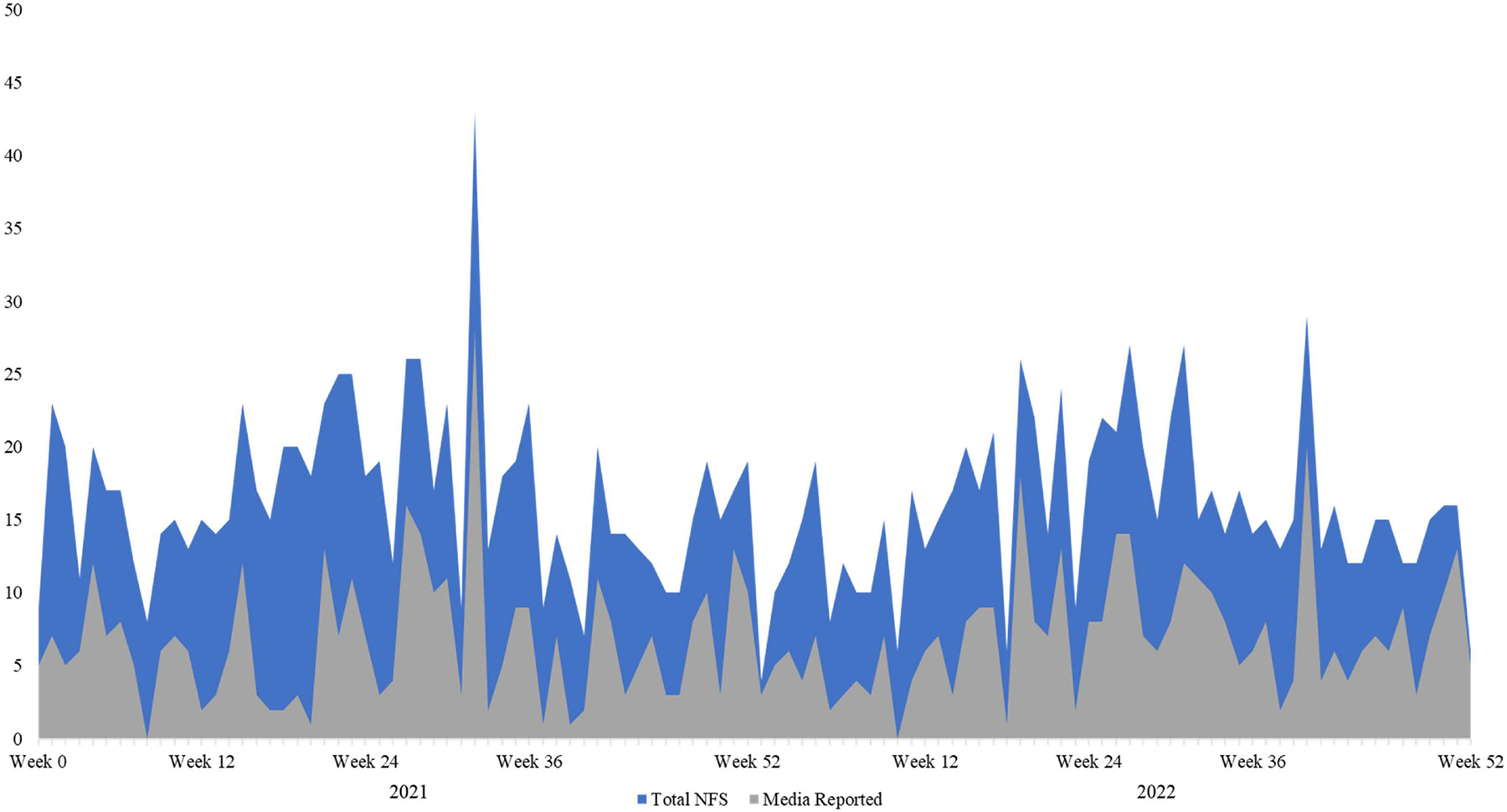
Weekly nonfatal firearm injuries reported in official records versus media reports, Indianapolis, IN, 2021–2022.
Fig. 2.
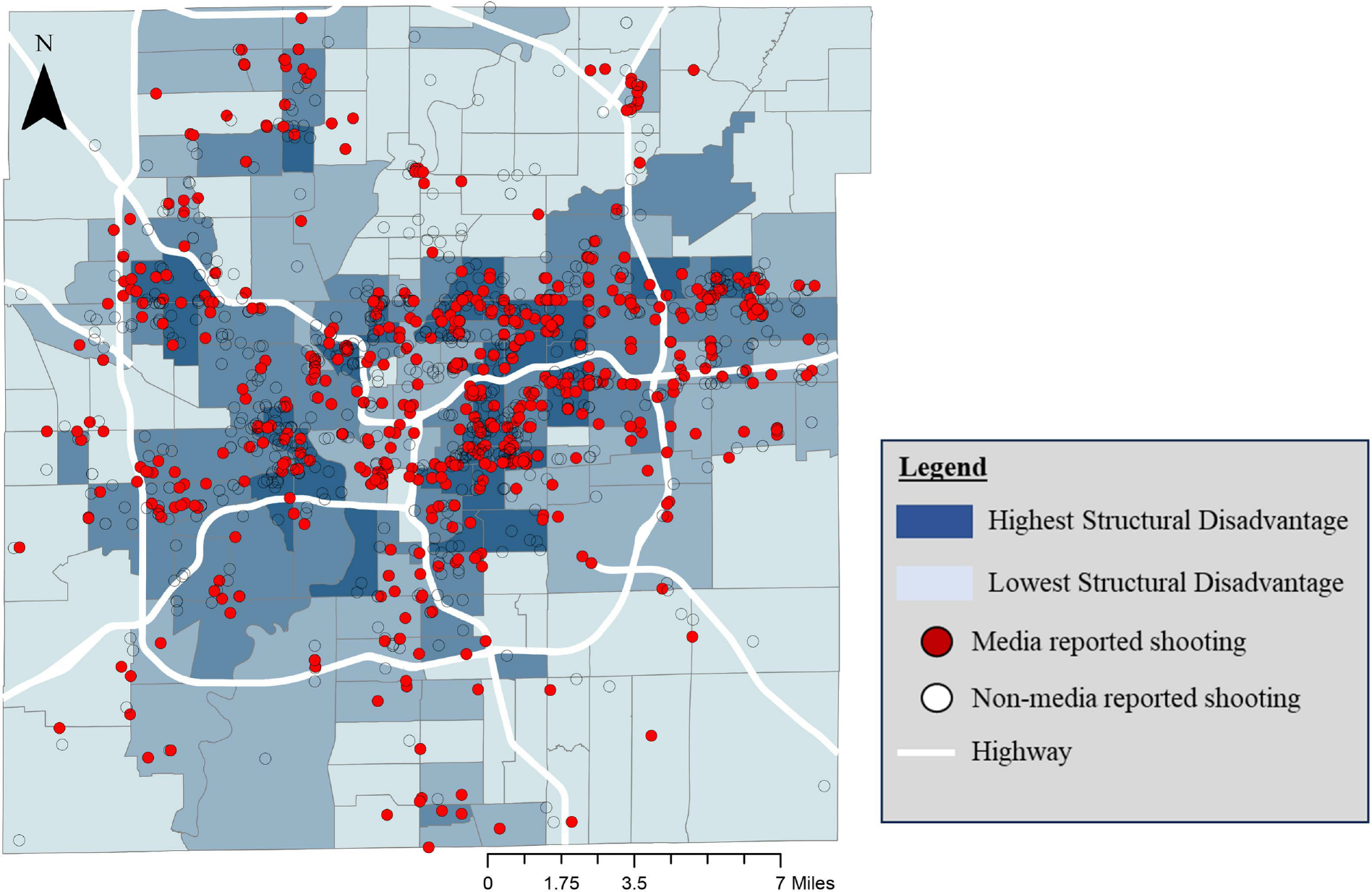
Nonfatal firearm injuries report and unreported by the media, structural disadvantage, Indianapolis, IN, 2021–2022.
Across all shooting events, the majority of shooting survivors were Black (74.3%), despite only 29.0% of the Indianapolis population identifying as Black (Bureau, 2022). Differences in reporting by survivor race and ethnicity were not statistically significant; media reported 42.6% of Black survivor shootings, 40.2% of white survivor shootings, and 45.2% of Hispanic survivor shootings. Female shooting survivors (51.6%) and child shooting survivors (60.5%) were more likely to be reported by media compared to male adolescent and adult shooting survivors (p < 0.001) (Table 2). Of shooting events with multiple survivors (n=139), 112 had two survivors (80.5%), and these were reported 82 times (73.0%). Each of the four shootings that involved four or more survivors were present in media reports (100.0%).
We conducted multivariate models to examine how survivor, event, and community characteristics influenced the odds of a shooting being present in media reports (Table 3). When accounting for community characteristics in Model 3, shootings with multiple survivors had higher odds (OR: 3.05; 95% CI 2.42, 3.85; p < 0.05) of being reported compared to single survivor events. Shootings with adolescents (OR: 0.26; 95% CI 0.10, 0.71; p < 0.05) and adult survivors (OR: 0.21; 95% CI 0.09, 0.55; p < 0.05) had lower odds of being reported, compared to child involved shootings. Shootings that occurred in 2022 had higher odds of being reported (OR: 1.25; 95% CI 1.01, 1.56; p < 0.05), compared to shootings that occurred in 2021. Survivor race and ethnicity, sex, event motive, and community characteristics were not statistically significant. When examining community characteristics without survivor and event characteristics (Model 4; Table 3), shootings located in communities with higher levels of structural disadvantage had lower odds of being reported by media (OR: 0.82; 95% CI 0.67, 0.99; p < 0.05).
Table 3:
Survivor, Event, and Community-level characteristics and media reported status, Indianapolis, IN, 2021 – 2022
| Model 1 – Survivor Only | Model 2 – Survivor + Event | Model 3 – Survivor + Event + Community | Model 4 – Community Only | |
|---|---|---|---|---|
| OR (95% CI) | OR (95% CI) | OR (95% CI) | OR (95% CI) | |
| n = 1,638 | n = 1,638 | n = 1,638 | n=1,642 | |
| Survivor Characteristics | ||||
| Race Ethnicity | ||||
| Black | 0.94 (0.59, 1.52) | 0.79 (0.48, 1.29) | 0.78 (0.47, 1.28) | -- |
| White | 0.83 (0.49, 1.37) | 0.90 (0.53, 1.53) | 0.26 (0.51, 1.49) | -- |
| Hispanic | reference | reference | reference | -- |
| Sex | ||||
| Male | 0.65 (0.50, 0.85) | 0.79 (0.59, 1.05) | 0.79 (0.60, 1.05) | -- |
| Age Group | ||||
| Child, < 11 years | reference | reference | reference | -- |
| Adolescent, 11 – 17 years | 0.46 (0.19, 1.12) | 0.27 (0.10, 0.72) | 0.26 (0.10, 0.71) | -- |
| Adult, >18 years | 0.39 (0.17, 0.91) | 0.22 (0.09, 0.56) | 0.21 (0.09, 0.55) | -- |
| Event Characteristics | ||||
| Year | ||||
| 2022 | 1.24 (1.01, 1.52) | 1.26 (1.01, 1.57) | 1.25 (1.01, 1.56) | 1.24 (1.01, 1.52) |
| Injury Type | ||||
| Self-defense | -- | reference | reference | -- |
| Assault | -- | 1.10 (0.63, 1.91) | 1.10 (0.63, 1.92) | -- |
| Unintentional | -- | 0.22 (0.11, 0.47) | 0.22 (0.10, 0.46) | -- |
| Multiple Survivors | -- | 3.12 (2.47, 3.93) | 3.05 (2.42, 3.85) | -- |
| Motive/Circumstance | ||||
| Bystander | -- | 1.17 (0.79, 1.72) | 1.17 (0.79, 1.71) | -- |
| Domestic violence | -- | 1.42 (0.72, 2.79) | 1.41 (0.71, 2.78) | -- |
| Illegal activity | -- | 0.85 (0.56, 1.30) | 0.85 (0.56, 1.29) | -- |
| Interpersonal dispute | -- | 1.19 (0.90, 1.57) | 1.17 (0.89, 1.55) | -- |
| Money/other | -- | 0.99 (0.58, 1.69) | 1.00 (0.59, 1.70) | -- |
| Unknown | -- | reference | reference | -- |
| Community Characteristics | ||||
| Structural Disadvantage | -- | -- | 0.88 (0.73, 1.07) | 0.82 (0.67, 0.99) |
| Gini Index | -- | -- | 0.95 (0.13, 7.15) | 1.69 (0.22, 12.8) |
| % Black | 1.00 (0.99, 1.01) | 1.00 (0.99, 1.01) | ||
| % High school diploma | -- | -- | 0.99 (0.98, 1.01) | 0.99 (0.98, 1.01) |
| % Disability | -- | -- | 0.99 (0.98, 1.02) | 0.99 (0.98, 1.02) |
| % Unemployed | 1.00 (0.97, 1.03) | 1.01 (0.98, 1.03) | ||
| Abandoned homes | -- | -- | 0.90 (0.65, 1.24) | 0.95 (0.68, 1.32) |
| Moran’s I | 0.02 | −0.001 | 0.01 | 0.14 |
| constant | 1.83 (0.67, 4.99) | 0.77 (0.21, 2.77) | 0.87 (0.18, 4.35) | 0.35 (0.12, 1.02) |
Bold values statistically significant at p <0.05. | OR – odds ratio | CI – confidence interval | Average marginal effects reported in Appendix B
Discussion
This study compared official police records to locally collected media reports on shootings in Indianapolis and examined the characteristics associated with media reported shootings. Our study found that overall, approximately 40% of shootings were present in media reports compared to police records and highlighted that media reports were not stable over time. For instance, 43% of assault shootings were reported by media outlets in 2021 and 50% were reported in 2022. This seven-percentage point difference in media reporting rate could lead to inaccurate conclusions of year-over-year increases in shooting events. Our findings also indicate that shootings that involved children less than 11 years old and shootings with multiple survivors – particularly mass shootings, defined as four or more firearm injuries, were more likely to be reported, whereas unintentional shootings were less likely to be reported, adding to the growing research in this area (Gobaud et al., 2023; E. J. Kaufman et al., 2020).
Our study found that community characteristics were not associated with media reporting a shooting when survivor and event characteristics, such as survivor age and multiple survivors were reported. Our study, however, does highlight shootings that occur within structurally disadvantaged communities were less likely to be present in media reports, but this association is conditional: it exists when survivor and/or event characteristics are omitted from the analysis. This finding suggests that everyday community gun violence may not be sufficiently covered in media reports, further contributing to misrepresentation in media reporting, as previous research demonstrates that most shootings occur in structurally disadvantaged communities (Magee, 2020; Martin et al., 2022; Pino et al., 2023).
Our study also provides a first glimpse into the use of local media data collections, such as the IGVP, to serve as another resource to use with or in replacement of GVA. The findings reported here suggest the GVA missed a small (n=58), but not trivial, number of shooting events reported by Indianapolis media outlets. The reasons for these GVA omissions are not entirely clear, but their presence extends recommendations to complete local GVA validity checks using local media report collections with or without local police records. Additionally, consistent with research exploring the validity of GVA (Gobaud et al., 2023), our findings suggest that local media reports do follow similar longitudinal patterns to local official records. Given the timeliness of open-source data, data like the IGVP could be used as a resource for community groups and the public to understand the direction of current trends (including proportional increases or decreases to pre-determined date anchors) and assist in evaluating community-based interventions, although with needed caution.
Regarding the broader implications of publicly available firearm injury data collected through the media reports, caution needs to be used, particularly when assessing national trends and designing legislative and policy interventions. In particular, findings of prior studies based solely on media data may be biased, especially with respect to unintentional shootings and single shootings of adult men. A better solution, as the current study indicates and others have amply demonstrated, is the critical need for a comprehensive national database on nonfatal firearm injuries (Barber et al., 2022; Magee et al., 2021; Wardell, 2020). This could be accomplished by improving current national level hospital data systems (i.e., National Syndromic Surveillance Program, National Electronic Injury Surveillance System’s Nonfatal Firearm Injury Surveillance System) and police data systems (i.e., National Incident Based Reporting System), which both currently have major limitations (Barber et al., 2022). Until a comprehensive national database exists, more localized efforts to link clinical systems and police data are needed to build the data infrastructure to comprehensively assess community firearm violence, study trends over time, and evaluate interventions to reduce firearm injury (Magee et al., 2021; Mueller et al., 2021) in addition to open-source collections of media reports.
As demonstrated in this study and others using media outlet data (Gobaud et al., 2023; E. J. Kaufman et al., 2020), focusing on a subset of shooting survivors incorrectly frames the scope of the problem of firearm violence to the American public. This is particularly concerning due to the known influence of media reports on public opinion (Huang et al., 2021). Misleading and incomplete coverage primes the public to direct their attention toward a small subset of violent shootings, such as mass shootings and shootings involving women and children. While child survivors and mass shootings are of extreme importance and help start the conversation about legislative and policy reform, they only comprise a small percentage of shooting events in the United States annually (E. Kaufman et al., 2020). Dissemination of accurate information that reflects the violence experienced in the community can provide residents with knowledge needed to engage in local violence prevention efforts. In fact, lack of awareness and misinformation are often obstacles to community engagement, which has many potential benefits for residents (Phalen et al., 2020). In order to implement an effective public health approach to gun violence prevention it is critical to engage media outlets, policy makers, scholars, health care workers, community organizations, and concerned residents in community violence prevention efforts (Hemenway, 2001; Meddings et al., 2021; Wen & Sadeghi, 2020).
Lastly, it is imperative that scholars, practitioners, policy makers, and journalists acknowledge that media coverage of firearm injuries can further compound the trauma and disparities among survivors in disadvantaged communities by excluding the voices of survivors themselves (Beard et al., 2023). Until a national dataset is implemented, media reports may be the necessary avenue to assess nonfatal firearm injuries; however, to improve upon the fatalistic view of firearm violence, survivors have recommended that local media amplify positive stories within the community (Beard et al., 2023). Examples include highlighting community violence prevention organizations, depicting the voices of survivors and concerned residents, and success stories of local youth. It is important to include and amplify the voices of the affected community to design effective evidence-based interventions, in addition to using media reports as a data source.
Strengths and Limitations
This study had several limitations. Its data are limited to one Midwest city in the United States which may limit generalizability of the findings. We successfully matched 97% of shootings but may have underrepresented matches due to differences in location. We were unable to match 123 shootings in IGVP, which likely occurred outside IMPD’s jurisdiction. Although police records are a reliable source of firearm injuries (Magee et al., 2021), injury intent may be misclassified or specific intents undercounted due to lack of survivor cooperativeness with police (Hipple et al., 2019), this is a clear direction for future research. Our study could not comment on the reasons driving media coverage of certain shootings and the omission of other shootings found in official records, so it is plausible journalists chose not to cover a particular shooting for unknown reasons. Future research will need to focus on organizational, historical, and temporal factors to dissect relationships between local news organizations and local law enforcement agencies and how they impact the co-production of firearm injury and firearm violence data. Despite these limitations, this study adds high-quality data to the literature to evaluate the discrepancy between police-reported shootings and what is publicized through media reports.
Conclusions
In Indianapolis, media were more likely to report shootings involving children and those considered mass shootings, while neglecting unintentional shootings or shootings that took place in structurally disadvantaged communities. Our findings highlighted the instability in news reporting overtime and approximately two out of every five shootings were reported by media across a two-year period. While it may not be feasible to place the responsibility on local media to report all shootings, an unbiased reporting across community factors, event factors, and individual factors would more accurately reflect the reality of firearm violence in the community. Public health interventions that seek to educate journalists about these important issues may be an impactful gun violence prevention strategy. Policymakers, scholars, and community organizations can collaborate with media outlets to utilize its power of influence for violence prevention initiatives. Lastly, it is critical to further link data at the local level until a comprehensive national data system is established to have more accurate picture of gun violence in a community and to ensure interventions are designed and evaluated using accurate data.
Table 1.
IGVP vs. IMPD Nonfatal Shooting Events report by the media, by injury intent, Indianapolis, Indiana, 2021 – 2022
| Media Reports | ||||
|---|---|---|---|---|
| Total | Not Reported | Reported | p value | |
| n | n(%) | n(%) | ||
| 2021 | < 0.001 | |||
| Assault | 720 | 410 (57.0) | 310 (43.1) | |
| Self-Defense | 32 | 19 (59.4) | 13 (40.6) | |
| Unintentional | 94 | 80 (85.1) | 14 (14.9) | |
| Total | 846 | 509 (60.2) | 337 (39.8) | |
| 2022 | < 0.001 | |||
| Assault | 640 | 317 (49.5) | 323 (50.5) | |
| Self-Defense | 32 | 16 (48.5) | 16 (51.5) | |
| Unintentional | 124 | 105 (84.0) | 19 (16.0) | |
| Total | 796 | 438 (55.0) | 358 (45.0) | |
| Total | 1,642 | 947 (57.6) | 695 (42.4) | |
Highlights.
Media reports only identified two out of every five shootings compared to police records.
Shootings with multiple survivors and children were more likely to be reported in media outlets.
Shootings in structurally disadvantaged communities were less likely to appear in media reports.
Local level data collection provides more accurate data on nonfatal shootings.
DISCLOSURE OF FUNDING
Dr. Magee’s time was partially supported by KL2 funding support from grant numbers KL2TR002530 (Robb, PI) and UL1TR002529 (S. Moe and S. Wiehe, co-PIs), from the National Institutes of Health, Natioal Center for Advancing Translational Sciences, Clinical and Translational Sciences Award. Internal funding from the Indiana University Purdue University Indianapolis Office of the Vice Chancellor of Research awarded to Dr. Magee and Dr. Grommon partially supported data collection efforts for the Indianapolis Gun Violence Project.
Appendix A: Indianapolis Gun Violence Project Google Alert Key words
IMPD shooting
Indianapolis gun violence
Indianapolis shooting victim
Indianapolis shooting
Indy gun violence
Indy shooting victim
Indy shooting
Marion County gun violence
Marion County shooting
Indianapolis firearm
Indianapolis firearms
Indianapolis gun
Indianapolis shooting
Indy shooting
Central Indiana shooting
Appendix B: Average Marginal Effects for models in Table 3
| Model 1 – Survivor Only | Model 2 – Survivor + Event | Model 3 – Survivor + Event + Community | Model 4 – Community Only | |
|---|---|---|---|---|
| ME (95% CI) | ME (95% CI) | ME (95% CI) | ME (95% CI) | |
| n = 1,638 | n = 1,638 | n = 1,638 | n=1,642 | |
| Survivor Characteristics | ||||
| Race Ethnicity | ||||
| Black | −0.05 (−0.52, 0.42) | −0.23 (−0.73, 0.26) | −0.25 (−0.74, 0.25) | -- |
| White | −0.19 (−0.70, 0.32) | −0.11 (−0.64, 0.42) | −0.13 (−0.67, 0.40) | -- |
| Hispanic | reference | reference | reference | -- |
| Sex | ||||
| Male | −0.43 (−0.69, −0.16) | −0.24 (−0.52, 0.05) | −0.24 (−0.5, 0.05) | -- |
| Age Group | ||||
| Child, < 11 years | reference | reference | reference | -- |
| Adolescent, 11 – 17 years | −0.78 (−1.68, 0.11) | −1.31 (−2.29, −0.33) | −1.16 (−2.35, −0.37) | -- |
| Adult, >18 years | −0.93 (−1.77, −0.09) | −1.51 (−2.43, −0.58) | −1.54 (−2.48, −0.61) | -- |
| Event Characteristics | ||||
| Year | ||||
| 2022 | 0.21 (0.00, 0.42) | 0.23 (0.01, 0.45) | 0.23 (0.01, 0.45) | 0.22 (0.01, 0.42) |
| Injury Type | ||||
| Self-defense | -- | reference | reference | -- |
| Assault | -- | 0.09 (−0.46, 0.64) | 0.09 (−0.46, 0.65) | -- |
| Unintentional | -- | −1.50 (−2.25, −0.75) | −1.52 (−2.27, −0.77) | -- |
| Multiple Survivors | -- | 1.13 (0.91, 1.37) | 1.16 (0.88, 1.35) | -- |
| Motive/Circumstance | ||||
| Bystander | -- | 0.16 (−0.23, 0.54) | 0.15 (−0.23, 0.54) | -- |
| Domestic violence | -- | 0.35 (−0.33, 1.03) | 0.34 (−0.34, 1.02) | -- |
| Illegal activity | -- | −0.15 (−0.57, 0.27) | −0.16 (−0.58, 0.26) | -- |
| Interpersonal dispute | -- | 0.17 (−0.10, 0.45) | 0.16 (−0.12, 0.44) | -- |
| Money/other | -- | −0.00 (−0.54, 0.53) | −0.00 (−0.53, 0.53) | -- |
| Unknown | -- | reference | reference | -- |
| Community Characteristics | ||||
| Structural Disadvantage | -- | -- | −0.13 (−0.32, 0.07) | −0.20 (−0.39, −0.01) |
| Gini Index | -- | -- | −0.05 (−2.06, 1.97) | 0.53 (−1.49, 2.55) |
| % Black | -- | -- | 0.001 (−0.01, 0.01) | 0.003 (−0.00, 0.01) |
| % High school diploma | -- | -- | −0.004 (−0.02, 0.01) | −0.005 (−0.02, 0.01) |
| % Disability | -- | -- | −0.004 (−0.02, 0.01) | −0.002 (−0.02, 0.03) |
| % Unemployed | -- | -- | 0.000 (−0.03, 0.03) | 0.001 (0.02, 0.03) |
| Abandoned homes | -- | -- | −0.11 (−.43, 0.22) | −0.05 (−0.39, 0.28) |
ME= marginal effect | CI = confidence interval
Footnotes
CONFLICTS OF INTEREST
The authors have no conflicts of interest to disclose.
Declaration of interests
The authors declare that they have no known competing financial interests or personal relationships that could have appeared to influence the work reported in this paper.
Publisher's Disclaimer: This is a PDF file of an unedited manuscript that has been accepted for publication. As a service to our customers we are providing this early version of the manuscript. The manuscript will undergo copyediting, typesetting, and review of the resulting proof before it is published in its final form. Please note that during the production process errors may be discovered which could affect the content, and all legal disclaimers that apply to the journal pertain.
References
- Baćak V, Mausolf JG, & Schwarz C (2021). How comprehensive are media-based data on police officer–involved shootings? Journal of interpersonal violence, 36(17–18), NP10055–NP10065. [DOI] [PubMed] [Google Scholar]
- Barber C, Cook PJ, & Parker ST (2022). The emerging infrastructure of US firearms injury data. Preventive Medicine, 165, 107129. [DOI] [PubMed] [Google Scholar]
- Beard JH, Midberry J, Afif IN, Dauer E, MacMillan J, & Jacoby SF (2023). “Like I’m a nobody:” firearm-injured peoples’ perspectives on news media reporting about firearm violence. SSM-Qualitative Research in Health, 3, 100212. [Google Scholar]
- Booty M, O’Dwyer J, Webster D, McCourt A, & Crifasi C (2019). Describing a “mass shooting”: the role of databases in understanding burden. Injury epidemiology, 6(1), 1–8. [DOI] [PMC free article] [PubMed] [Google Scholar]
- Braga AA, Papachristos AV, & Hureau DM (2010). The concentration and stability of gun violence at micro places in Boston, 1980–2008. Journal of Quantitative Criminology, 26(1), 33–53. [Google Scholar]
- Bureau USC (2022). QuickFacts Indiana: Indianapolis, Indiana. [Google Scholar]
- Callanan VJ (2012). Media consumption, perceptions of crime risk and fear of crime: Examining race/ethnic differences. Sociological Perspectives, 55(1), 93–115. [Google Scholar]
- Crifasi CK, Ward J, McCourt AD, Webster D, & Doucette ML (2023). The association between permit-to-purchase laws and shootings by police. Injury epidemiology, 10(1), 28. [DOI] [PMC free article] [PubMed] [Google Scholar]
- Dixon TL, & Williams CL (2015). The changing misrepresentation of race and crime on network and cable news. Journal of Communication, 65(1), 24–39. [Google Scholar]
- Fox JA, Gerdes M, Duwe G, & Rocque M (2021). The newsworthiness of mass public shootings: What factors impact the extent of coverage? Homicide studies, 25(3), 239–255. [Google Scholar]
- Gobaud AN, Mehranbod CA, Kaufman E, Jay J, Beard JH, Jacoby SF, . . . Morrison CN (2023). Assessing the gun violence archive as an epidemiologic data source for community firearm violence in 4 US cities. JAMA network open, 6(6), e2316545–e2316545. [DOI] [PMC free article] [PubMed] [Google Scholar]
- Gupta M (2007). Mandatory reporting laws and the emergency physician. Annals of Emergency Medicine, 49(3), 369–376. [DOI] [PubMed] [Google Scholar]
- Heidari S, Babor TF, De Castro P, Tort S, & Curno M (2016). Sex and gender equity in research: rationale for the SAGER guidelines and recommended use. Research integrity and peer review, 1(1), 1–9. [DOI] [PMC free article] [PubMed] [Google Scholar]
- Hemenway D (2001). The public health approach to motor vehicles, tobacco, and alcohol, with applications to firearms policy. Journal of Public Health Policy, 22, 381–402. [PubMed] [Google Scholar]
- Hemenway D, Shawah C, & Lites E (2022). Defensive gun use: What can we learn from news reports? Injury epidemiology, 9(1), 1–10. [DOI] [PMC free article] [PubMed] [Google Scholar]
- Hipple NK, Garrity KT, Huebner BM, & Magee L (2019). Understanding Victim Cooperation in Cases of Nonfatal Gun Assaults. Criminal Justice and Behavior, 46(12), 1793–1811. doi: 10.1177/0093854819848806 [DOI] [Google Scholar]
- Huang J, Cook GG, & Xie Y (2021). Large-scale quantitative evidence of media impact on public opinion toward China. Humanities and Social Sciences Communications, 8(1), 1–8. [Google Scholar]
- James S, Gold S, Rouhani S, McLanahan S, & Brooks-Gunn J (2021). Adolescent Exposure To Deadly Gun Violence Within 500 Meters Of Home Or School: Ethnoracial And Income Disparities: Study examines adolescent exposure to deadly gun violence near home or school. Health Affairs, 40(6), 961–969. [DOI] [PMC free article] [PubMed] [Google Scholar]
- Jay J, Martin R, Patel M, Xie K, Shareef F, & Simes JT (2023). Analyzing Child Firearm Assault Injuries by Race and Ethnicity During the COVID-19 Pandemic in 4 Major US Cities. JAMA Network Open, 6(3), e233125–e233125. doi: 10.1001/jamanetworkopen.2023.3125 [DOI] [PMC free article] [PubMed] [Google Scholar]
- Kaufman E, Wiebe DJ, Xiong R, Morrison CA, Seamon M, & Delgado M (2020). Epidemiologic trends in fatal and nonfatal firearm injuries in the US, 2009–2017. JAMA internal medicine. [DOI] [PMC free article] [PubMed] [Google Scholar]
- Kaufman EJ, Passman JE, Jacoby SF, Holena DN, Seamon MJ, MacMillan J, & Beard JH (2020). Making the news: Victim characteristics associated with media reporting on firearm injury. Preventive Medicine, 141, 106275. [DOI] [PMC free article] [PubMed] [Google Scholar]
- Magee L (2020). Community-Level Social Processes and Firearm Shooting Events: A Multilevel Analysis. Journal of Urban Health, 97(2), 296–305. doi: 10.1007/s11524-020-00424-y [DOI] [PMC free article] [PubMed] [Google Scholar]
- Magee L, Fortenberry JD, Tu W, & Wiehe SE (2020). Neighborhood variation in unsolved homicides: a retrospective cohort study in Indianapolis, Indiana, 2007–2017. Injury epidemiology, 7(1), 1–10. [DOI] [PMC free article] [PubMed] [Google Scholar]
- Magee LA, Lucas B, & Fortenberry JD (2022). Changing epidemiology of firearm injury: a cohort study of non-fatal firearm victimisation before and during the COVID-19 pandemic, Indianapolis, Indiana. BMJ open, 12(3), e059315. [DOI] [PMC free article] [PubMed] [Google Scholar]
- Magee LA, Ranney ML, Fortenberry JD, Rosenman M, Gharbi S, & Wiehe SE (2021). Identifying nonfatal firearm assault incidents through linking police data and clinical records: Cohort study in Indianapolis, Indiana, 2007–2016. Preventive Medicine, 149, 106605. [DOI] [PMC free article] [PubMed] [Google Scholar]
- Martin R, Rajan S, Shareef F, Xie KC, Allen KA, Zimmerman M, & Jay J (2022). Racial disparities in child exposure to firearm violence before and during COVID-19. American Journal of Preventive Medicine, 63(2), 204–212. [DOI] [PMC free article] [PubMed] [Google Scholar]
- McGinty EE, Webster DW, Jarlenski M, & Barry CL (2014). News media framing of serious mental illness and gun violence in the United States, 1997–2012. American Journal of Public Health, 104(3), 406–413. [DOI] [PMC free article] [PubMed] [Google Scholar]
- Meddings DR, Scarr J-P, Larson K, Vaughan J, & Krug EG (2021). Drowning prevention: turning the tide on a leading killer. The Lancet Public Health, 6(9), e692–e695. [DOI] [PMC free article] [PubMed] [Google Scholar]
- Mueller KL, Trolard A, Moran V, Landman JM, & Foraker R (2021). Positioning public health surveillance for observational studies and clinical trials: The St. Louis region-wide hospital-based violence intervention program data repository. Contemporary clinical trials communications, 21, 100683. [DOI] [PMC free article] [PubMed] [Google Scholar]
- Parham-Payne W (2014). The role of the media in the disparate response to gun violence in America. Journal of Black Studies, 45(8), 752–768. [Google Scholar]
- Phalen P, Bridgeford E, Gant L, Kivisto A, Ray B, & Fitzgerald S (2020). Baltimore Ceasefire 365: estimated impact of a recurring community-led ceasefire on gun violence. American Journal of Public Health, 110(4), 554–559. [DOI] [PMC free article] [PubMed] [Google Scholar]
- Phillips SW, Drake GM, & Altheimer I (2022). The effectiveness of standardized investigative tactics in clearing non-fatal shooting investigations. International Journal of Police Science & Management, 24(3), 239–249. [Google Scholar]
- Pino EC, Jacoby SF, Dugan E, & Jay J (2023). Exposure to Neighborhood Racialized Economic Segregation and Reinjury and Violence Perpetration Among Survivors of Violent Injuries. JAMA Network Open, 6(4), e238404–e238404. doi: 10.1001/jamanetworkopen.2023.8404 [DOI] [PMC free article] [PubMed] [Google Scholar]
- Sampson RJ, Raudenbush SW, & Earls F (1997). Neighborhoods and violent crime: A multilevel study of collective efficacy. Science, 277(5328), 918–924. [DOI] [PubMed] [Google Scholar]
- Semenza DC, & Stansfield R (2021). Community gun violence and functional disability: An ecological analysis among men in four US cities. Health & Place, 70, 102625. [DOI] [PubMed] [Google Scholar]
- Ssentongo P, Fronterre C, Ssentongo AE, Advani S, Heilbrunn ES, Hazelton JP, . . . Chinchilli VM (2021). Gun violence incidence during the COVID-19 pandemic is higher than before the pandemic in the United States. Scientific Reports, 11(1), 1–8. [DOI] [PMC free article] [PubMed] [Google Scholar]
- Ssentongo P, Ssentongo A, Heilbrunn ES, & Chinchilli VM (2023). Gun violence in United States during the second year of the COVID-19 pandemic. Frontiers in public health, 11, 950475. [DOI] [PMC free article] [PubMed] [Google Scholar]
- Ward JA (2023). Beyond Urban Fatalities: An Analysis of Shootings by Police in the United States. Johns Hopkins University, [Google Scholar]
- Wardell CA,R; Barber C; Cook P; Culhane D; Cunningham R; Dalton E; Jenkins R; Joyce N; Mueller-Smith M; Muhammad F; Potok N; Webster D; Wintemute G (2020). A Blueprint for a U.S. Firearms Data Infrastructure. Retrieved from NORC: [Google Scholar]
- Wen LS, & Sadeghi NB (2020). Treating gun violence with a public health approach. The American Journal of Medicine, 133(8), 883–884. [DOI] [PubMed] [Google Scholar]
- Wheeler AP (2018). The effect of 311 calls for service on crime in DC at microplaces. Crime & Delinquency, 64(14), 1882–1903. [Google Scholar]