



Abstract
Nowadays, accidents and disasters are one of the most important issues facing humans. Training is an important feature in disasters and distance learning is a suitable method for education in every place and at every time. The aim of this study is to determine distance learning methods in disaster preparedness. This study was conducted to this question: what types of distance learning methods can use in disaster preparedness?”. In this study, all published English language papers, with no time limit, were extracted by the end of December 2021 through search in PubMed, Scopus, Google scholar, ISI WOS (Web of Science), and Embase. The primary search used “distance learning”, “disaster” and their MeSH terms. Quality appraisal carried out with CASP. Information in the articles including study time, study population, e-learning methods, and type of disasters or emergencies were extracted. Based on the search, 46 studies were carried out between 2002 and 2021. The most studied target group in the studies was health professionals and the content of the courses was attributed to disaster preparedness as well as biological disasters. Regarding e-learning methods, the most used method was ‘simulation’. At the time of disasters, including pandemics, disruption in education may be long-term and may require overlapping response and recovery periods. And virtual education during a disaster may be rejected or endorsed by individuals or groups based on cultural, ideological, or prejudicial issues. Distance education can be used for effective disaster education in different phases of the disaster cycle, depending on the available facilities and infrastructure.
Keywords: Disasters, distance education, emergencies, online education, simulation training
Introduction
Nowadays, accidents and disasters are one of the most important issues facing humans. In 2020, at least 389 natural disasters with 15080 deaths, 98.4 million people affected and nearly 171.3 billion dollars of economic damage have been reported.[1] Disaster preparedness is a set of activities that ensure effective assistance to disaster victims and accelerate appropriate disaster response. The purpose of disaster preparedness is to ensure that proper systems, procedures, and resources are accessible and to provide effective assistance to victims. Therefore, disaster preparedness is very important at local, provincial, and national levels.[2] In this regard, training health workers to better prepare and respond to disasters is very important. The World Health Organization emphasizes the preparedness of healthcare workers to management of disasters, Warning that many countries have little preparedness to deal with disasters.[3,4] Training the basic concepts and theories of disaster preparedness and response is an ongoing challenge for many higher education institutions. Beyond that, governments are not always ready for a natural disaster or are not sufficiently capable of responding to it.[5,6] In general, training opportunities for some health-related events are severely limited. For example, Events with mass casualties are rare, but healthcare teams need the training to practice and prepare to respond appropriately to these types of accidents.[7,8,9] In addition, response strategies in some cases, such as epidemics, differ from those seen in natural disasters.[10,11,12] These cases further highlight the role of education in disaster preparedness.
In general, educational approaches should be appropriate to the topic and the target group. Educational methods can be classified into in-person and distance methods. In the in-person training method, health educators and learners are related to each other, but in the distance education method, the instructor and the learner can be far from each other.[12,13,14,15] Distance learning is a learning procedure in that all or part of the training uses the facilities of e-mail, video, cable TV, media, or any internet-related technology such as message boards, chat rooms, and computer or video conferences regardless of time and place.[16] The emergence and development of this educational method are rooted in the features and capabilities of this type of education in meeting the needs of communities and factors such as cheapness, wider coverage, and flexibility have been effective in the development of distance education.[17] Evidence shows that various distance learning methods, including simulation, telenursing, and general technology can be used for training and service during disasters.[18,19,20,21]
Each of the extant studies provides valuable point in this field but focus on the target group or specific method. In this study, researchers try to have a holistic view of any type of target group and distance learning methods. Whereas our study focuses on the disaster preparedness stage in disaster management. Therefore, the study was conducted to determine the methods used in this type of training for disaster preparedness.
Materials and Methods
The present study is a review of e-learning methods in the field of disaster preparedness through systematic review worldwide in response to this research questions what types of distance learning method can use in disaster preparedness?”, which was carried out according to the PRISMA guidelines (PRISMA Flow Diagram).[22] Two specialists screened all phases of the research independently.
Data sources
In this study, both bibliographic and citation databases were considered the main sources of data. In this regard, in the initial search, all English-language articles published without a time limit until the end of December 2021 were extracted during searches in PubMed, Scopus, Google scholar, ISI WoS (Web of Science), and Embase. In addition, books, academic websites, documents, and credible reports of international organizations involved in disaster management were reviewed and searched based on the goal of the study.
Search strategy
The primary search used the following Medical Subject Headings (MeSH terms) and keywords:
TS = (Disaster * OR Hazard * OR Catastrophe * OR Mass Casualty Incident * OR Bioterrorism * OR Outbreak *OR Emergency *) AND (Distance Education OR Distance Learning OR Learning, Distance OR Online Learning OR Learning, Online OR Online Education OR Education, Online OR Online Educations OR Correspondence Courses OR Correspondence Course OR Course, Correspondence OR Training OR Learning program OR Web-based training OR Tele-education OR Online simulation OR Virtual education OR Social media education OR Telesimulation OR Remote teaching OR Telecommunication OR Telemedicine).
Timespan = All Years
Inclusion criteria
All English language articles with high quality on e-learning methods for disaster preparedness published in worldwide scientific journals within the specified period of time were taken into account. Narrative studies that matched the research question were also taken into account.
Exclusion criteria
Research works that did not have the desired quality and also reviews, narrative studies, meta-analyses, case reports, or series of cases that were conducted in the field of e-learning methods but were not in line with disaster preparedness were kept out from the study. Non-English articles were also excluded from our study.
Qualification of articles
In order to critically evaluate the articles in this article, the adjusted checklist for (CASP: Critical Appraisal Skills Programs) quantitative and qualitative studies was used. The CASP checklist, which is a standard tool for evaluating articles, was designed by the JAMA Group in 1994.[23] The revised checklist used in this study included 19 items and after reviewing each article, if the desired option for each question is met, the answer is “yes”, if it is not met, the answer is “no”, and if the explanation is There was no clarity for the question, the option “can't say” was selected. These items were divided into five areas: research topic (4 items), research design (2 items), selection of participants (4 items), data collection and analysis (6 items), and findings (3 items).[24] In order to determine the cut-off point according to similar articles and consultation with experts, scores of 75% of the total score and above as good quality (score 13 and above), scores between 25-75% of the total score as average quality (Scores 6-12) and scores less than 25% of the total score (score 5 and below) were classified as poor quality.[24,25]
Extracting the data
First, the articles were reviewed by two specialists independently by checking the title and abstract and considering the inclusion and exclusion criteria. Then, the full text of the articles was reviewed and in case of rejection of the articles by the two reviewers, the reason was clarified and in case of disagreement between them, the article was reviewed by a third person. Data were elicited through a pre-prepared checklist that encompassed study time, study population, e-learning methods, and type of disaster or emergency.
Selection of studies
395 studies were extracted by searching databases. At first, the articles were entered into the Mendeley software program and after the preparatory assessment, 31 duplicates were kept out of the study. Then, by checking the title and abstract of the articles, 77 cases were removed due to irrelevance, and after assessing the full-text articles, 241 research papers that did not focus on preparedness for disasters were deleted. Ultimately, 46 articles meeting the required criteria were considered in the systematic review process [Figure 1].
Figure 1.
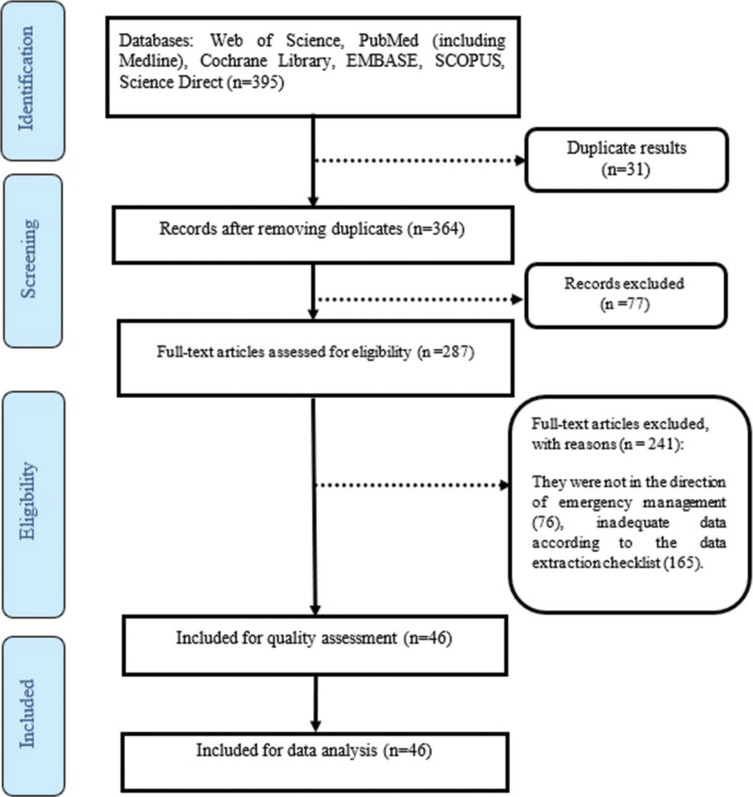
The PRISMA flow chart
Results
Of the 46 studies included in this study, among these studies, 33 studies (71.74%) had good quality and 13 studies (28.26%) had average quality, and none of them were poor.
This study was performed between 2002 and 2021, 14 studies were carried out in 2020, at the same time as the peak of the COVID-19 pandemic worldwide [Figure 2].
Figure 2.

Number of articles per year
The country was the USA (n = 39, 1%) and the most studied target groups of the studies were health professionals (n = 12, 27.3%) and students (n = 11, 25%).
The content of the courses was basically attributed to disaster preparedness and disaster training in this field (n = 18, 40.9%) as well as a biological disaster (n = 17, 38.7%). Among the biological disasters, the highest content was related to the COVID-19 pandemic (n = 12, 27.3%).
For distance learning, the most used method in these studies was simulation (n = 13, 29.6%).
The characteristics of the research papers considered in the systematic review are presented in Table 1.
Table 1.
Specifications of research papers considered in the systematic review
| Row | Author | Year | Country | Target Population | Method | Educational content | CASP |
|---|---|---|---|---|---|---|---|
| 1 | Appolloni et al.[26] | 2021 | Italy | the Italian higher education system | Disaster Medicine Online (DMO) - distance-learning course | COVID-19 outbreak | Good |
| 2 | Abou-Khalil et al.[27] | 2021 | Lebanon | students | mixed methods study according to the Moore’s interaction framework for distance education | emergency online classes in low-resource settings | Good |
| 3 | Cooper et al.[28] | 2020 | Australia | university instructors and the practitioners of emergency management | Web-based simulations (WBS) | disaster studies curriculum | Good |
| 4 | Bojović et al.[29] | 2020 | Serbia | students and teachers | distance learning model | COVID-19 outbreak | Good |
| 5 | Al Lily et al.[30] | 2020 | Saudi Arabia | Arab culture | Distance education | COVID-19 outbreak | Good |
| 6 | Gawłowski et al.[31] | 2020 | Poland | students of emergency medical services as well as professional paramedics | virtual medical simulators | COVID-19 outbreak | Average |
| 7 | Thompson et al.[32] | 2020 | USA | student | online learning | disaster preparedness | Good |
| 8 | Sindiani et al.[33] | 2020 | Jordan | undergraduate medical students at the Jordan University of Science & Technology | online learning | COVID-19 outbreak | Good |
| 9 | Ferri et al.[34] | 2020 | Italy | First step: international specialists from various sectors Second step: leaders’ opinion on the basis of secondary online sources, such as web articles, statistical data and legislation |
remote teaching | COVID-19 outbreak | Average |
| 10 | Hussein et al.[35] | 2020 | UAE | undergraduate students | online learning | COVID-19 outbreak | Average |
| 11 | Vollbrecht et al.[36] | 2020 | USA | students and teachers | Virtual learning | COVID-19 outbreak | Good |
| 12 | El-Ghandour et al.[37] | 2020 | Egypt | neurosurgeons | Virtual learning | COVID-19 outbreak | Good |
| 13 | Shelgikar[38] | 2020 | USA | sleep medicine educators | distance learning | COVID-19 outbreak | Average |
| 14 | Dushkevych et al.[39] | 2020 | Romania | students | distance learning | outbreak of pandemic | Good |
| 15 | Williamson et al.[40] | 2020 | Scotland | - | distance education | COVID-19 outbreak | Good |
| 16 | Ahmady et al.[41] | 2020 | Iran | students | virtual education | COVID-19 outbreak | Good |
| 17 | Farra et al.[42] | 2019 | USA | newborn intensive care unit (NICU) workers | virtual reality simulation (VRS) | evacuation training | Average |
| 18 | Najafi Ghezeljeh et al.[2] | 2019 | Iran | emergency nurses | virtual social networks | disaster preparedness | Good |
| 19 | Edinger et al.[43] | 2019 | USA | disaster responders and critical care transporters | online educational intervention | care for vulnerable groups after disasters and emergencies | Good |
| 20 | McCoy et al.[44] | 2019 | USA | Participants in EMS course | through utilizing tele simulation and wearable/mobile technology | MCI triage course | Average |
| 21 | Aghababaeian et al.[45] | 2019 | Iran | pre-hospital students | Web-based education -Offline audio and video podcasts | Triage | Good |
| 22 | Ferrandini Price et al.[46] | 2018 | Spain | health professionals | comparing Virtual Reality to Clinical Simulation in a Mass Casualty Incident | START (Simple Triage and Rapid Treatment) triage | Good |
| 23 | Leszczyński et al.[47] | 2018 | Poland | undergraduate students of emergency medicine and nursing | Web-based learning | e-learning course on emergency medicine | Good |
| 24 | Baytiyeh[48] | 2018 | Lebanon | students and staffs | online education | post-earthquake school closures | Good |
| 25 | Baltos et al.[49] | 2018 | Greece | - | distance and technology-based learning | disaster preparedness | Good |
| 26 | Unver et al.[4] | 2018 | Turkey | senior nursing students | simulation | disaster preparedness | Good |
| 27 | Xu et al.[50] | 2016 | China | emergency public health personnel | e-learning pilot program | disaster preparedness | Good |
| 28 | Ahmad et al.[51] | 2015 | Bangladesh | students | Open and Distance Learning (ODL) | disaster preparedness | Average |
| 29 | Molka-Danielsen et al.[52] | 2015 | Norway | interviews with two representatives of an emergency management training organization in petroleum industry | explore and discuss how a decision-making model can form the basis for a pedagogical | opportunities and challenges for applying virtual reality-based learning environments | Good |
| 30 | Shannon[53] | 2015 | USA | Baccalaureate nursing students | simulated mass casualty incident | disaster preparedness | Average |
| 31 | Farra et al.[54] | 2015 | USA | healthcare professionals | Ace Star Model | The Ace Star Model functions as a worthy framework to translate the VRS teaching methodology and ameliorate disaster training of healthcare professionals | Good |
| Aghababaeian et al.[55] | 2013 | Iran | pre-hospital staff | Web-based education -Offline educational video presentation | Triage | Average | |
| 32 | Farra et al.[56] | 2013 | USA | nursing students | virtual reality simulation | disaster training | Good |
| 33 | Farra[57] | 2012 | USA | nursing students | virtual reality simulation | disaster training | Good |
| 34 | Farra et al.[58] | 2012 | USA | healthcare workers | virtual reality simulation | disaster training | Average |
| 35 | Renda-Tanali et al.[59] | 2011 | USA | students | online scenario simulation | disaster preparedness | Average |
| 36 | Roe et al.[60] | 2010 | UK | students | e-learning | potential benefits, pitfalls and barriers to adopting e-learning in emergency medicine | Good |
| 37 | Atack et al.[61] | 2009 | Canada | Undergraduate students | eight-week online course | disaster preparedness | Good |
| 38 | Monahan et al.[3] | 2009 | USA | federal, state, and local workers as well as emergency volunteers | Virtual exercises | emergency scenarios ranging from pandemic influenza to bioterrorism and dirty bombs | Good |
| 39 | Youngblood et al.[62] | 2008 | USA | medical students’ and resident physicians | comparison of online virtual emergency department (Virtual ED) with High-fidelity patient simulators (PSs) | team training in crisis management | Average |
| 40 | Macario et al.[63] | 2007 | USA | public health nurses | distance learning | Preparing for pandemic influenza | Good |
| 41 | Casebeer et al.[64] | 2006 | USA | physicians | online bioterrorism continuing medical education (CME) | preparing physicians to better diagnose emerging rare infections | Good |
| 42 | Terndrup[65] | 2005 | USA | emergency physicians and nurses | Screensavers and Web-based education | competency and awareness with regard to responding to incidents of bioterrorism | Good |
| 43 | Haile-Mariam et al.[66] | 2005 | USA | emergency medical practitioners | Distance-based learning and telecommunications | emergency medicine training | Average |
| 44 | Lund et al.[67] | 2002 | Canada | health care professionals | Disaster Medicine Online | disaster preparedness | good |
| 45 | Granlund[68] | 2001 | Sweden | - | group distance exercise (GDE) | disaster training | good |
Discussion
As the findings of the research shows, the most studied group in these studies were students and staff working in the field of disaster services and the health sector, and the contents mostly investigated disaster preparedness and biological disasters. Simulators and, to a greater extent, virtual reality were used to teach about disasters.
Fortunately, the importance and place of risk and disaster management in Iran and other countries and the necessity of preparedness of different units have been approved.[69]
With the increase in world population as well as the development of infrastructure, the sensitivity of the world to the threats posed by disasters is increasing. In this regard, experts are requested to play a key role in reducing disaster risks and protecting communities. At the time of disasters, including pandemics, educational disruptions may be long-term and require overlapping response and recovery periods.[70] Apart from the level of economic growth and personal well-being, education helps the citizens of a country to have the flexibility to deal with future crises, as well as to learn skills to identify risks and prepare for disasters.[71]
In education and disaster management, we can say that there are three categories of audiences. These three categories can be divided into social groups, professionals in the disaster process, and policymakers and managers. The first group should be more aware of disasters, the second group provides services to people affected by disasters, and the third group deals with policy and planning for disaster management. Based on the results, the most investigated target groups of the previous studies included students and employees in the field of disasters and health professions, which are sub-categories of the first and second categories. For many students, the virtual world is fun, and some of the best teaching tools can be combined in an executable learning medium with almost unlimited capabilities.[72]
Various methods in disaster education and the advantages and disadvantages of each have been discussed in previous studies. In the present study, the most used method for virtual education is the utilization of simulation. Simulation-based training can be a valuable training modality in a variety of tasks in unique and challenging situations, as it allows opportunities to practice and prepare for high-risk and often low-frequency events.[73] A greater tendency towards this method may be the reason that simulation is a more realistic method that can simulate the real situations and problems similar to the real world. The second reason may be that by using simulators, it is possible to show various scenarios, and events and provide the necessary training in these conditions, of course, while maintaining the safety of the learner. Among simulators, virtual reality simulation has a special place.[74] Virtual reality helps learners gain a greater understanding of abstract concepts. Learners can improve their understanding of virtual environments and can visit places that are usually limited or impossible to access due to distance, time, or safety considerations. This means that learners can (a) immerse themselves in situations/events that were impossible or impractical in real life or have not yet happened, (b) experience data and objects in 3D, and (c) observe hidden phenomena. VRS has been empirically reported as a tool to help learners achieve learning outcomes.[75,76,77,78,79,80] About Participants themselves report that these environments are realistic and not difficult to use. In terms of cost-effectiveness and efficiency, this tool is a good alternative to live simulations.[75,76]
Meanwhile, studies show that virtual education can be considered a basis for disaster preparedness, although the use of simulation, especially in-person simulations, makes educational training more effective.[81] Simulation is a learning method in which learners become deeply involved in skills training by trying to solve problems in an environment similar to what they encounter in real life. Planning in simulation is a complex subject and depends on the understanding and knowledge of the designer. Depending on the design and execution skills, learners in this method can be passive or interactive. They can make mistakes in the simulation environment without endangering anyone. In this way, the effectiveness of training can be evaluated. Pitfalls of this method include the necessity for watchful selection and adaptation of trainees to the essential roles, as well as the obligation for highly experienced instructors. In addition, setting up this method can be expensive and time-consuming. Therefore, when planning for this method, one should pay attention to these advantages and disadvantages.[74]
In the present study, most of the content taught by distance learning and virtual education was related to disaster education, especially biological disasters and the COVID-19 outbreak. The reason for this can be that in outbreaks, due to some issues such as the need for isolation and the need for immediate awareness for all people in all places, these methods are suitable.
The recurrence of catastrophic events with the COVID-19 outbreak has exacerbated the need to improve knowledge, principles, and preparedness skills for disasters.[81] In the fight against the COVID-19 outbreak, nations have replaced in-person training with distance learning. Even though several countries have already been exposed to natural or man-made disasters, distance education has not been used as a solution to those crises as they are currently used in the wake of the COVID-19 pandemic. Crisis Distance Education is distinctive in its philosophies and practices and differs from conventional distance education in divergent ways. In this way, an unforeseen need encourages institutions and governments towards distance education without prior and sudden targeting.[82]
Because the COVID-19 pandemic crisis is global, distance learning is becoming internationalized, and distance learning is becoming a popular tool. In such cases, this type of education becomes public and, in a way, imposed and compulsory.[83] Distance and virtual education during a disaster may be rejected or endorsed by individuals or groups based on cultural, ideological, or prejudicial issues. Lack of knowledge about the digital world and skills to use it, and sometimes lack of proper infrastructure for learners may cause dissatisfaction and impede learning, but in this crisis, the COVID-19 pandemic proved to be one of the most successful distancing projects that were approved by the public. Therefore, there is no doubt about the application and effectiveness of distance learning in disaster education.[30]
In general, when planning to use distance and virtual training, a few special points should be considered: 1) who the target groups are, 2) what the content of the training is, 3) the facilities, resources, infrastructure, and educational goals and the advantages and disadvantages of each method, the type of method of presenting the content in a virtual way should be determined and finally 4) the educational effectiveness should be measured. Accordingly, through electronic media, the Internet, mobile phones, etc., on various platforms online and offline, distance education can provide a wide range of knowledge in the areas of causes, vulnerability, risk reduction, and management of disasters to different learners and target groups. Future studies propose to investigate the efficacy of various methods of distance learning for disaster preparedness.
Limitations of the study
Only English language studies were considered in the study and other non-English studies in this field or those lacking an English abstract were not assessed.
Conclusion
Distance education in various forms can be used for effective disaster education in different phases of the disaster cycle, depending on the available facilities and infrastructure. Since accurate information about the type, duration, and time of most disasters is not available, space and infrastructures should be well prepared to provide education at the time of disasters in a virtual way. The aftermath of the COVID-19 outbreak made this very clear to everyone. Universities and scientific institutes can make an appropriate space for education through new technologies with a forward-looking and creative approach by implementing scientific and practical solutions in pre-disaster conditions. It should not be forgotten that distance learning requires careful planning and unique design. Education plays a very important role in having a society ready to face accidents and disasters in all forms and areas.
Financial support and sponsorship
This article has a grant from Ahvaz Jundishapur University of Medical Sciences.
Conflicts of interest
There are no conflicts of interest.
Author contributions
Somaieh Bosak and Sadegh Ahmadi-Mazhin done literature search, data acquisition and data and statistical analysis. all of author are contribute for concepting, designing, definition of intellectual content, manuscript preparation, manuscript editing and manuscript review.
Acknowledgments
The authors consider it necessary to thank and appreciate all the researchers who have done research in this field, and their results were used in this research, and Dr. Mehrnoosh Khoshnoodifar for technical support.
References
- 1.CRED Disaster Year in Review 2020 Global Trends and Perspectives [Internet] 2021 [cited 2023 Feb 8] [Google Scholar]
- 2.Najafi Ghezeljeh T, Mohammad Aliha J, Haghani H, Javadi N. Effect of education using the virtual social network on the knowledge and attitude of emergency nurses of disaster preparedness: A quasi-experiment study. Nurse Educ Today. 2019;73:88–93. doi: 10.1016/j.nedt.2018.12.001. [DOI] [PubMed] [Google Scholar]
- 3.Monahan C, Ullberg L, Harvey K. 2009 IEEE/INFORMS International Conference on Service Operations, Logistics and Informatics. IEEE; 2009. Virtual emergency preparedness planning using second life; pp. 306–10. [Google Scholar]
- 4.Unver V, Basak T, Tastan S, Kok G, Guvenc G, Demirtas A, et al. Analysis of the effects of high-fidelity simulation on nursing students' perceptions of their preparedness for disasters. Int Emerg Nurs. 2018;38:3–9. doi: 10.1016/j.ienj.2018.03.002. [DOI] [PubMed] [Google Scholar]
- 5.Fujioka T. Disaster prevention education in the Japanese school curricula in recent years: Current status and future challenges. In: Shiwaku K, Sakurai A, Shaw R, editors. Disaster Resilience of Education Systems. Disaster Risk Reduction. Tokyo: Springer; 2016. pp. 39–52. [Google Scholar]
- 6.Pollard KA, Bachmann DJ, Greer M, Way DP, Kman NE. Development of a disaster preparedness curriculum for medical students: A pilot study of incorporating local events into training opportunities. Am J Disaster Med. 2015;10:51–9. doi: 10.5055/ajdm.2015.0188. [DOI] [PubMed] [Google Scholar]
- 7.Greiner-Mai T, Donner A. Data management in mass casualty incidents: The e-triage project. Inform 2010-Serv Sci-Neue Perspekt fur die Inform Beitrage der 40 Jahrestagung der Gesellschaft fur Inform eV. 2010;2:192–8. [Google Scholar]
- 8.Zieliński A. Cost analysis of adjustments of the epidemiological surveillance system to mass gatherings. Przegl Epidemiol. 2011;65:5–8. [PubMed] [Google Scholar]
- 9.Ashkenazi I, Montán KL, Lennquist S. Springer; Cham: 2020. Mass Casualties Incident: Education, Simulation, and Training; pp. 167–75. [cited 2021 Mar 3] Available from: https://link.springer.com/chapter/10.1007/978-3-319-92345-1_16 . [Google Scholar]
- 10.Shamsir MS, Krauss SE, Ismail IA, Ab Jalil H, Johar MA, Abdul Rahman I. Development of a Haddon matrix framework for higher education pandemic preparedness: Scoping review and experiences of Malaysian universities during the COVID-19 pandemic. High Educ Policy. 2022;35:439–78. doi: 10.1057/s41307-020-00221-x. [DOI] [PMC free article] [PubMed] [Google Scholar]
- 11.Liang YJ, Chen WJ, Zhou S, Wang L, Liao QY, Lu WX, et al. An innovative approach of using online problem.based learning and case-based learning in teaching disaster nursing during the COVID-19 pandemic. J Integr Nurs. 2020;2:196.. [Google Scholar]
- 12.Abd-Elhafiez WM, Amin HH. The digital transformation effects in distance education in light of the epidemics (COVID-19) in Egypt. Inf Sci Lett. 2021;10:141–52. [Google Scholar]
- 13.O. Rezvan O, L. Ilienko O, I., Zelinska O, M., Krokhmal A, M. Prykhodko A. Digital Narrative as A Method of Emergency Distance Learning. Arab World English J [Internet] 2020 Nov 15;(3):113–23. [cited 2023 Feb 8] Available from: https://papers.ssrn.com/sol3/papers.cfm?abstract_id=3735614# . [Google Scholar]
- 14.Zotti ME, Ellington SR, Perez M. CDC online course: Reproductive health in emergency preparedness and response. J Womens Health. 2016;25:861–4. doi: 10.1089/jwh.2016.5993. [DOI] [PMC free article] [PubMed] [Google Scholar]
- 15.Shubeck KT, Craig SD, Hu X. Live-action mass-casualty training and virtual world training. Proc Hum Factors Ergon Soc Annu Meet. 2016;60:2103–7. [Google Scholar]
- 16.Rovai AP, Downey JR. Why some distance education programs fail while others succeed in a global environment. Internet High Educ. 2010;13:141–7. [Google Scholar]
- 17.Anderson T, Dron J. Three generations of distance education pedagogy. Int Rev Res Open Distance Learn. 2011;12:80–97. [Google Scholar]
- 18.Nejadshafiee M, Nekoei-Moghadam M, Bahaadinbeigy K, Khankeh H, Sheikhbardsiri H. Providing telenursing care for victims: A simulated study for introducing of possibility nursing interventions in disasters. BMC Med Inform Decis Mak. 2022;22:54.. doi: 10.1186/s12911-022-01792-y. [DOI] [PMC free article] [PubMed] [Google Scholar]
- 19.Rizk S, Siam B. Effect of tele-nursing education program on nurses' compliance with standard precautions during COVID-19 pandemic. Assiut Sci Nurs J. 2021;9:10–9. [Google Scholar]
- 20.Heo H, Lee K, Jung E, Lee H. Developing the first telenursing service for COVID-19 patients: The experience of South Korea. Int J Environ Res Public Health. 2021;18:6885.. doi: 10.3390/ijerph18136885. [DOI] [PMC free article] [PubMed] [Google Scholar]
- 21.Salehinejad S, Jannati N, Sarabi RE, Bahaadinbeigy K. Use of telemedicine and e-health in disasters: A systematic review. J Emerg Pract Trauma. 2021;7:56–62. [Google Scholar]
- 22.Moher D, Shamseer L, Clarke M, Ghersi D, Liberati A, Petticrew M, et al. Preferred reporting items for systematic review and meta-analysis protocols (PRISMA-P) 2015 statement. Syst Rev [Internet] 2015 Dec 1;4(1):1. doi: 10.1186/2046-4053-4-1. [cited 2020 Sep 12] Available from: https://systematicreviewsjournal.biomedcentral.com/articles/10.1186/2046-4053-4-1 . [DOI] [PMC free article] [PubMed] [Google Scholar]
- 23.Daneshvar M. Critical appraisal of research evidence in the field of women's empowerment to participate in urban development. Women Empower Sustain Soc J. 2020;1:87–95. [Google Scholar]
- 24.Adib-Hajbaghery, Adib ME, Eshraghi Arani N. Evaluating the quality of randomized trials published in Persian nursing journals with more than 10 years of publishing using the CASP checklist. Iran J Nurs. 2017;30:1–9. [Google Scholar]
- 25.Bahri N, Roudsari RL. A critical appraisal of research evidence on Iranian women's attitude towards menopause. Iran J Obstet Gynecol Infertil. 2015;18:1–11. [Google Scholar]
- 26.Appolloni A, Colasanti N, Fantauzzi C, Fiorani G, Frondizi R. Distance learning as a resilience strategy during Covid-19: An analysis of the Italian context. Sustainability. 2021;13:1388.. [Google Scholar]
- 27.Abou-Khalil V, Helou S, Khalifé E, Chen MA, Majumdar R, Ogata H. Emergency online learning in low-resource settings: Effective student engagement strategies. Educ Sci. 2021;11:24.. [Google Scholar]
- 28.Cooper VA, Forino G, Kanjanabootra S, von Meding J. Leveraging the community of inquiry framework to support web-based simulations in disaster studies. Internet High Educ. 2020;47:100757.. [Google Scholar]
- 29.Bojović Ž, Bojović PD, Vujošević D, Šuh J. Education in times of crisis: Rapid transition to distance learning. Comput Appl Eng Educ. 2020;28:1467–89. doi: 10.1002/cae.22318. [DOI] [PMC free article] [PubMed] [Google Scholar]
- 30.Al Lily AE, Ismail AF, Abunasser FM, Alhajhoj Alqahtani RH. Distance education as a response to pandemics: Coronavirus and Arab culture. Technol Soc. 2020;63:101317.. doi: 10.1016/j.techsoc.2020.101317. [DOI] [PMC free article] [PubMed] [Google Scholar]
- 31.Gawłowski P, Nikodem J, Nikodem M, Kołcz A. Distance learning-new educational challenges in the field of emergency medicine. 9th International Workshop on Innovative Simulation for Health Care, IWISH 2020 [Internet]. CAL-TEK srl. 2020:72–6. [cited 2021 Mar 7] Available from: https://bbibliograficas.ucc.edu.co: 2153/record/display.uri?eid=2-s2.0-85097717495 and origin=resultslist and sort=plf f and src=s and nlo=and nlr=and nls=and sid=dcc2c0ab97b00a18f13a78a0923d9fcd and sot=b and sdt=b and sl=80 and s=TITLE-ABS-KEY%28disaster++or+emergency+AND+distance+education+OR+ [Google Scholar]
- 32.Thompson KM, Copeland C. Inclusive considerations for optimal online learning in times of disasters and crises. Inf Learn Sci. 2020;121:481–6. [Google Scholar]
- 33.Sindiani AM, Obeidat N, Alshdaifat E, Elsalem L, Alwani MM, Rawashdeh H, et al. Distance education during the COVID-19 outbreak: A cross-sectional study among medical students in North of Jordan. Ann Med Surg. 2020;59:186–94. doi: 10.1016/j.amsu.2020.09.036. [DOI] [PMC free article] [PubMed] [Google Scholar]
- 34.Ferri F, Grifoni P, Guzzo T. Online learning and emergency remote teaching: Opportunities and challenges in emergency situations. Societies. 2020;10:86.. [Google Scholar]
- 35.Hussein E, Daoud S, Alrabaiah H, Badawi R. Exploring undergraduate students' attitudes towards emergency online learning during COVID-19: A case from the UAE. Child Youth Serv Rev. 2020;119:105699.. [Google Scholar]
- 36.Vollbrecht PJ, Porter-Stransky KA, Lackey-Cornelison WL. Lessons learned while creating an effective emergency remote learning environment for students during the COVID-19 pandemic. Adv Physiol Educ. 2020;44:722–5. doi: 10.1152/advan.00140.2020. [DOI] [PMC free article] [PubMed] [Google Scholar]
- 37.El-Ghandour NMF, Ezzat AAM, Zaazoue MA, Gonzalez-Lopez P, Jhawar BS, Soliman MAR. Virtual learning during the COVID-19 pandemic: A turning point in neurosurgical education. Neurosurg Focus. 2020;49:E18.. doi: 10.3171/2020.9.FOCUS20634. [DOI] [PubMed] [Google Scholar]
- 38.Shelgikar AV. Optimizing virtual and distance learning during an emergency and beyond. J Clin Sleep Med. 2020;16:1929–32. doi: 10.5664/jcsm.8728. [DOI] [PMC free article] [PubMed] [Google Scholar]
- 39.Dushkevych M, Barabashchuk H, Hutsuliak N. Peculiarities of student distance learning in emergency situation condition. Rev Rom Educ Multidimens. 2020;12(1 Suppl 2):71–7. [Google Scholar]
- 40.Williamson B, Eynon R, Potter J. Pandemic politics, pedagogies and practices: Digital technologies and distance education during the coronavirus emergency. Learn Media Technol. 2020;45:107–14. [Google Scholar]
- 41.Ahmady S, Shahbazi S, Heidari M. Transition to virtual learning during the coronavirus disease-2019 crisis in Iran: Opportunity or challenge? Disaster Med Public Health Prep. 2020;14:e11–2.. doi: 10.1017/dmp.2020.142. [DOI] [PMC free article] [PubMed] [Google Scholar]
- 42.Farra S, Hodgson E, Miller ET, Timm N, Brady W, Gneuhs M, et al. Effects of virtual reality simulation on worker emergency evacuation of neonates. Disaster Med Public Health Prep. 2019;13:301–8. doi: 10.1017/dmp.2018.58. [DOI] [PMC free article] [PubMed] [Google Scholar]
- 43.Edinger ZS, Powers KA, Jordan KS, Callaway DW. Evaluation of an online educational intervention to increase knowledge and self-efficacy in disaster responders and critical care transporters caring for individuals with developmental disabilities. Disaster Med Public Health Prep. 2019;13:677–81. doi: 10.1017/dmp.2018.129. [DOI] [PubMed] [Google Scholar]
- 44.McCoy E, Alrabah R, Weichmann W, Langdorf M, Ricks C, Chakravarthy B, et al. Feasibility of telesimulation and Google Glass for mass casualty triage education and training. West J Emerg Med. 2019;20:512–9. doi: 10.5811/westjem.2019.3.40805. [DOI] [PMC free article] [PubMed] [Google Scholar]
- 45.Aghababaeian H, Araghi Ahvazi L, Moosavi A, Ahmadi Mazhin S, Tahery N, Nouri M, et al. Triage live lecture versus triage video podcast in pre-hospital students' education. Afr J Emerg Med. 2019;9:81–6. doi: 10.1016/j.afjem.2018.12.001. [DOI] [PMC free article] [PubMed] [Google Scholar]
- 46.Ferrandini Price M, Escribano Tortosa D, Nieto Fernandez-Pacheco A, Perez Alonso N, Cerón Madrigal JJ, Melendreras-Ruiz R, et al. Comparative study of a simulated incident with multiple victims and immersive virtual reality. Nurse Educ Today. 2018;71:48–53. doi: 10.1016/j.nedt.2018.09.006. [DOI] [PubMed] [Google Scholar]
- 47.Leszczyński P, Gotlib J, Kopański Z, Wejnarski A, Świezewski S, Gałazkowski R, et al. Analysis of Web-based learning methods in emergency medicine: Randomized controlled trial. Arch Med Sci. 2018;14:687–94. doi: 10.5114/aoms.2015.56422. [DOI] [PMC free article] [PubMed] [Google Scholar]
- 48.Baytiyeh H. Online learning during post-earthquake school closures. Disaster Prev Manag An Int J. 2018;27:215–27. [Google Scholar]
- 49.Baltos GC, Chomata FS, Vidakis IG, Balodis J. Modern learning and training tools which can be properly adapted and designed to reinforce specialized courses on effective crisis management. J Educ Soc Res. 2018;8:27–35. [Google Scholar]
- 50.Xu W, Jiang Q, Qin X, Fang G, Hu Z. E-learning for grass-roots emergency public health personnel: Preliminary lessons from a national program in China. Biosci Trends. 2016;10:235–9. doi: 10.5582/bst.2016.01083. [DOI] [PubMed] [Google Scholar]
- 51.Ahmad S, Numan SM. Potentiality of disaster management education through open and distance learning system in Bangladesh Open University. Turk Online J Distance Educ. 2015;16:249–60. [Google Scholar]
- 52.Molka-Danielsen J, Prasolova-Førland E, Hokstad LM, Fominykh M. Creating safe and effective learning environment for emergency management training using virtural reality. Nor Konf Organ bruk av IT. 2015;23(1) [Google Scholar]
- 53.Shannon CC. Using a simulated mass casualty incident to teach response readiness: A case study. J Nurs Educ. 2015;54:215–9. doi: 10.3928/01484834-20150318-05. [DOI] [PubMed] [Google Scholar]
- 54.Farra SL, Miller ET, Hodgson E. Virtual reality disaster training: Translation to practice. Nurse Educ Pract. 2015;15:53–7. doi: 10.1016/j.nepr.2013.08.017. [DOI] [PubMed] [Google Scholar]
- 55.Aghababaeian H, Sedaghat S, Tahery N, Moghaddam AS, Maniei M, Bahrami N, et al. A comparative study of the effect of triage training by role-playing and educational video on the knowledge and performance of emergency medical service staffs in Iran. Prehosp Disaster Med. 2013;28:605–9. doi: 10.1017/S1049023X13008911. [DOI] [PubMed] [Google Scholar]
- 56.Farra S, Miller E, Timm N, Schafer J. Improved training for disasters using 3-D virtual reality simulation. West J Nurs Res. 2013;35:655–71. doi: 10.1177/0193945912471735. [DOI] [PubMed] [Google Scholar]
- 57.Farra S. Effects of Disaster Training With and Without Virtual Simulation [Internet] 2012 Available from: https://libsecure.camosun.bc.ca: 2443/login?url=https://search.ebscohost.com/login.aspx?direct=true and db=ccm&AN=109858761&site=ehost-live. [Last accessed on 2021 Mar 03] [Google Scholar]
- 58.Farra SL, Miller ET. Integrative review: Virtual disaster training. J Nurs Educ Pract. 2012;3:93–101. [Google Scholar]
- 59.Renda-Tanali I, Abdul-Hamid H. An Assessment of the Benefits of Online Scenario Simulation Tools in Homeland Security and Emergency Management Education. J Homel Secur Emerg Manag [Internet] 2011 Jan 28;8(2) [cited 2021 Mar 7] Available from: https://www.degruyter.com/document/doi/10.2202/1547-7355.1917/html . [Google Scholar]
- 60.Roe D, Carley S, Sherratt C. Potential and limitations of e-learning in emergency medicine. Emerg Med J. 2010;27:100–4. doi: 10.1136/emj.2008.064915. [DOI] [PubMed] [Google Scholar]
- 61.Atack L, Parker K, Rocchi M, Maher J, Dryden T. The impact of an online interprofessional course in disaster management competency and attitude towards interprofessional learning. J Interprof Care. 2009;23:586–98. doi: 10.3109/13561820902886238. [DOI] [PubMed] [Google Scholar]
- 62.Youngblood P, Harter PM, Srivastava S, Moffett S, Heinrichs WL, Dev P. Design, development, and evaluation of an online virtual emergency department for training trauma teams. Simul Healthc. 2008;3:146–53. doi: 10.1097/SIH.0b013e31817bedf7. [DOI] [PubMed] [Google Scholar]
- 63.Macario E, Benton LD, Yuen J, Torres M, Macias-Reynolds V, Holsclaw P, et al. Preparing public health nurses for pandemic influenza through distance learning. Public Health Nurs. 2007;24:66–72. doi: 10.1111/j.1525-1446.2006.00609.x. [DOI] [PubMed] [Google Scholar]
- 64.Casebeer L, Andolsek K, Abdolrasulnia M, Green J, Weissman N, Pryor E, et al. Evaluation of an online bioterrorism continuing medical education course. J Contin Educ Health Prof. 2006;26:137–44. doi: 10.1002/chp.62. [DOI] [PubMed] [Google Scholar]
- 65.Terndrup T. Online bioterrorism continuing medical education: Development and preliminary testing. Acad Emerg Med. 2005;12:45–50. doi: 10.1197/j.aem.2004.08.040. [DOI] [PubMed] [Google Scholar]
- 66.Haile-Mariam T, Koffenberger W, McConnell HW, Widamayer S. Using distance-based technologies for emergency medicine training and education. Emerg Med Clin North Am. 2005;23:217–29. doi: 10.1016/j.emc.2004.09.003. [DOI] [PubMed] [Google Scholar]
- 67.Lund A, Lam K, Parks P. Disaster medicine online: Evaluation of an online, modular, interactive, asynchronous curriculum. CJEM. 2002;4:408–13. doi: 10.1017/s1481803500007910. [DOI] [PubMed] [Google Scholar]
- 68.Granlund R. Web-based micro-world simulation for emergency management training. Future Gener Comput Syst. 2001;17:561–72. [Google Scholar]
- 69.Sheikhbardsiri H, Yarmohammadian MH, Khankeh H, Khademipour G, Moradian MJ, Rastegarfar B, et al. An operational exercise for disaster assessment and emergency preparedness in south of Iran. J Public Health Manag Pract. 2020;26:451–6. doi: 10.1097/PHH.0000000000000815. [DOI] [PubMed] [Google Scholar]
- 70.Williams KM, Corwith A. Beyond Bricks and Mortar: The efficacy of online learning and community-building at College Park Academy during the COVID-19 pandemic. Educ Inf Technol. 2021;26:5055–76. doi: 10.1007/s10639-021-10516-0. [DOI] [PMC free article] [PubMed] [Google Scholar]
- 71.The World Bank What Matters Most for Teacher Policies: A Framework Paper. SABER Work Pap Ser [Internet] 2013;(4) Available from: http://bit.ly/2gnHvpZ . [Google Scholar]
- 72.Smith M, Berge ZL. Social Learning in Second Life. J Online Learn Teach. 2009;5:439–43. [Google Scholar]
- 73.Gardner AK, DeMoya MA, Tinkoff GH, Brown KM, Garcia GD, Miller GT, et al. Using simulation for disaster preparedness. Surgery (United States) 2016;160:565–70. doi: 10.1016/j.surg.2016.03.027. [DOI] [PubMed] [Google Scholar]
- 74.Khorram-Manesh A. Training in disaster medicine and emergencies : A short review. Austin J Emerg Crit Care Med. 2015;2:1–5. [Google Scholar]
- 75.Heinrichs WLR, Youngblood P, Harter PM, Dev P. Simulation for team training and assessment: Case studies of online training with virtual worlds. World J Surg. 2008;32:161–70. doi: 10.1007/s00268-007-9354-2. [DOI] [PubMed] [Google Scholar]
- 76.Heinrichs WL, Youngblood P, Harter P, Kusumoto L, Dev P. Training healthcare personnel for mass-casualty incidents in a Virtual Emergency Department: VED II. Prehosp Disaster Med. 2010;25:424–32. doi: 10.1017/s1049023x00008505. [DOI] [PubMed] [Google Scholar]
- 77.Larkin GL, Beautrais AL, Spirito A, Kirrane BM, Lippmann MJ, Milzman DP. Mental health and emergency medicine: A research agenda. Acad Emerg Med. 2009;16:1110–9. doi: 10.1111/j.1553-2712.2009.00545.x. [DOI] [PMC free article] [PubMed] [Google Scholar]
- 78.Wetsch WA, Spelten O, Hellmich M, Carlitscheck M, Padosch SA, Lier H, et al. Comparison of different video laryngoscopes for emergency intubation in a standardized airway manikin with immobilized cervical spine by experienced anaesthetists. A randomized, controlled crossover trial. Resuscitation. 2012;83:740–5. doi: 10.1016/j.resuscitation.2011.11.024. [DOI] [PubMed] [Google Scholar]
- 79.Van Der Spek ED, Wouters P, Van Oostendorp H. Code red: Triage or cognition-based design rules enhancing decisionmaking training in a game environment. Br J Educ Technol. 2011;42:441–55. [Google Scholar]
- 80.Bergeron BP. Learning and retention in adaptive serious games. Stud Health Technol Inform. 2008;132:26–30. [PubMed] [Google Scholar]
- 81.Boggs K, Goodwin T, Simpson J. Disaster Training Following COVID-19 for Pediatric Medical Residents: Demand and Format. Disaster Med Public Health Prep [Internet] 2022 Dec 18;16(6):2376–9. doi: 10.1017/dmp.2021.209. [cited 2022 Feb 21] Available from: https://www.cambridge.org/core/product/identifier/S1935789321002093/type/journal_article . [DOI] [PMC free article] [PubMed] [Google Scholar]
- 82.Rangiwai B, Chand BSK, Mataroa R. The impacts of COVID-19 on the 2020 cohort of the Master of Applied Indigenous Knowledge programme at Te Wānanga o Aotearoa in Māngere. Te Kaharoa. 2020;13(1) [Google Scholar]
- 83.Taylor D, Grant J, Hamdy H, Grant L, Marei H, Venkatramana M. Transformation to learning from a distance. MedEdPublish. 2020;9:76.. doi: 10.15694/mep.2020.000076.1. [DOI] [PMC free article] [PubMed] [Google Scholar]