



Significance
The influence of evolution on ultrafast processes inside proteins is an uncharted territory. Here, we use time-resolved infrared spectroscopy to track nanosecond protein dynamics, which form a vital link between protein structure and function. We compare fast dynamics within a protein family, whose role in apoptosis is evolutionarily conserved over nearly a billion years. Our findings reveal a remarkable degree of conservation, subtly tuned by whether a process is intricately linked to protein function or not. Introducing species-specific kinetic footprints, our research enables a comprehensive comparative analysis of species based on their distinct ultrafast protein dynamics. The approach complements established methods of molecular paleontology.
Keywords: protein dynamics, evolution, biophysics, photoswitch, transient infrared spectroscopy
Abstract
Protein dynamics form a critical bridge between protein structure and function, yet the impact of evolution on ultrafast processes inside proteins remains enigmatic. This study delves deep into nanosecond-scale protein dynamics of a structurally and functionally conserved protein across species separated by almost a billion years, investigating ten homologs in complex with their ligand. By inducing a photo-triggered destabilization of the ligand inside the binding pocket, we resolved distinct kinetic footprints for each homolog via transient infrared spectroscopy. Strikingly, we found a cascade of rearrangements within the protein complex which manifest in time points of increased dynamic activity conserved over hundreds of millions of years within a narrow window. Among these processes, one displays a subtle temporal shift correlating with evolutionary divergence, suggesting reduced selective pressure in the past. Our study not only uncovers the impact of evolution on molecular processes in a specific case, but has also the potential to initiate a field of scientific inquiry within molecular paleontology, where species are compared and classified based on the rapid pace of protein dynamic processes; a field which connects the shortest conceivable time scale in living matter (10−9 s) with the largest ones (1016 s).
Proteins exist as dynamic ensembles, rather than being rigid and static entities. They constantly undergo rearrangements, folding-, and unfolding processes on a wide range of time scales (1–4). Understanding this dynamic nature is essential to comprehending their function. As protein dynamics serve as the crucial link between structure and function (5), their experimental investigation has predominantly focused on individual protein examples, providing insights into specific (6–8), often intrinsically disordered cases (9–11). Surprisingly, protein dynamics within a group of closely related proteins, such as a family of homologs, have rarely been experimentally explored, and if so, not with the emphasis on extremely rapid fluctuations of conformational adaptations (11–13). Consequently, little is known about whether structural homologs display conserved ultrafast protein dynamics throughout evolution. How may nano-scale protein dynamics evolve over hundreds of million years within a protein family?
Revealing the rapid dynamic processes within proteins requires the use of an appropriate toolkit. Thus far, the conservation of protein structures has been primarily observed through structure comparison using X-ray crystallography (14–17). X-ray crystallography provides valuable insights with a predominantly static view of proteins, but lacks the mechanistic intricacies that define their dynamics. As an alternative approach, NMR spectroscopy excels at resolving small spatial fluctuations on a pico- and nanosecond (18, 19), and larger conformational differences and dynamics on a micro-, millisecond, and second time scale (6, 11, 20, 21). Yet it falls short in recording non-equilibrium processes, such as real-time dynamics of allosteric signaling or the stepwise adaption to structural perturbation.
In contrast, infrared spectroscopy is sensitive to subtle differences in protein conformations and is a powerful tool to temporally resolve fast dynamical processes within proteins (22, 23). In combination with a phototrigger, this technique enables the initiation and monitoring of sequential destabilization within a protein complex, with a temporal resolution as fast as a picoseconds (3, 4, 24, 25). The key challenge lies in investigating the specific time points at which certain processes occur, in order to resolve the influence of evolution on molecules that are inherently dynamic and exhibit fluent transitions between conformational states.
MCL-1: A Prime Example of Conservation
This study is concerned with the protein myeloid cell leukemia 1 (MCL-1), a member of the BCL-2 protein family, which plays a crucial role as a key regulator of apoptosis, the programmed cell death (26, 27). It is found not only in humans, but also in a diverse range of metazoan organisms (28, 29). Functioning as an anti-apoptotic protein, MCL-1 interacts promiscuously with pro-apoptotic factors through -helical domains known as BCL-2 homology domain 3 (BH3) (27, 29–31), e.g., the BH3 domain of the pro-apoptotic protein PUMA (32, 33) (Fig. 1A). Homologs of this protein family have been identified in all vertebrates and even in more distantly related species such as sponges (37) and Cnidaria (38), whose last common ancestor with Homo sapiens existed over 700 million years ago (34).
Fig. 1.
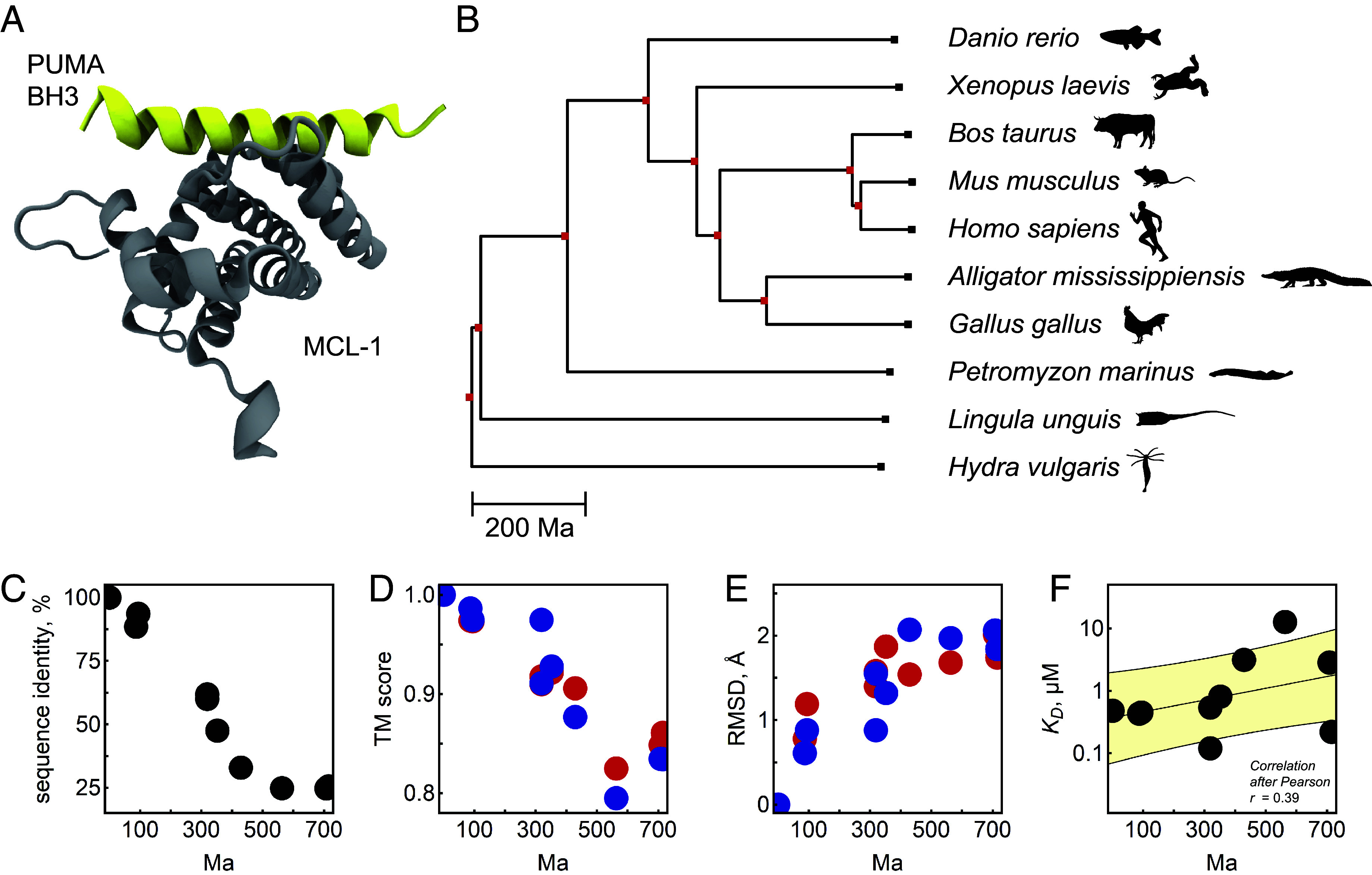
Structure and function of MCL-1 are conserved. (A) NMR structure of MCL-1 (gray) complexed with PUMA BH3 (yellow) (PDB: 2roc) (33). (B) Phylogeny of ten species whose MCL-homologs were selected for this study. The phylogeny and the corresponding evolutionary divergence time in million years (Ma) were taken from TimeTree5 and cover the current state of science (July 2023) (34). (C) Sequence identity of all investigated MCL-1 homologs (compared to H. sapiens) against evolutionary divergence time of the corresponding species. (D and E) Structural similarity between MCL-1 homologs (compared to H. sapiens), predicted with AlphaFold (35) (blue) and RosettaFold (36) (red). (F) MCL-1 homolog binding free energy for the PUMA BH3 peptide, plotted against the evolutionary divergence time. Yellow, linear fit SD. The Pearson correlation coefficient indicates that the binding free energy correlates weakly with evolutionary divergence time.
We selected ten MCL-1 homologs (Fig. 1B) from species, whose last common ancestors with Homo sapiens are distributed equidistantly on an evolutionary time axis up to a billion years from present day to the past. We opted for a horizontal approach by comparing sequences of currently living species, as opposed to a vertical approach involving the reconstruction of ancestral proteins (39, 40). The decision against the vertical approach was driven mainly by avoiding various uncertainties and phylogenetic ambiguities when generating ancestral proteins (41). For the horizontal approach, we included Homo sapiens, Mus musculus, Bos taurus, Gallus gallus, Alligator mississippiensis, Xenopus laevis, Danio rerio, a Petromyzon marinus candidate (42), Lingula unguis, and Hydra vulgaris.
Before exploring the protein dynamics for this homolog selection, our objective was to unequivocally establish the conservation of both the structure and function of MCL-1. By comparing the amino acid sequences of the homologs to their human equivalent, we found that sequence identity dramatically decreased as a function of evolutionary divergence (Fig. 1C), approaching a level of saturation at 25% where homology becomes challenging to detect (43). The conserved amino acid residues are mostly associated with the canonical binding groove (SI Appendix, Fig. S1A), consistent with the prevailing scientific perspective (44), or are localized at the hydrophobic core of the protein. As solely the human and murine homologs have experimentally acquired structures (e.g., PDB: 6QFM, 2ROC), we used two structure prediction models, AlphaFold (35) and RosettaFold (36), to compute the structures for the remaining homologs (SI Appendix, Fig. S1B). In comparison to their experimental equivalents, we found conserved topologies (TM scores 80% (45, 46), Fig. 1D) and only small spatial differences between the predicted protein backbone (RMSD 2.5 Å, Fig. 1E). A subtle correlation between inferior structural conservation and increased divergence time became visible. Nevertheless, the predictions show that, although sequences might differ strikingly, MCL-1 structure did not substantially change over a long evolutionary time scale (47).
The primary function of MCL-1, i.e., the ability to strongly bind the BH3 domain in its binding pocket, which makes it a pivotal anti-apoptotic regulator, is also conserved. We experimentally determined MCL-1’s binding affinity for a uniform PUMA BH3 ligand (bearing mutations for cross-linking, see SI Appendix, Fig. S2), with values ranging from 100 nM to 1 M for most homologs. We detected a weak correlation of , which refers to the binding free energy, with evolutionary divergence time (Fig. 1F). Notably, homologs from both Hydra vulgaris and H. sapiens, separated by an evolutionary distance of over 700 million years, bound the same ligand with comparable affinities ( = 220 nM, = 480 nM). Given its critical function as a “life/death switch” (26) in numerous animal species, this result confirms that MCL-1 indeed exhibits a high degree of structural and functional conservation, manifesting in minor differences at the molecular level.
MCL-1’s role as a prime example of structural and functional conservation raises the question of whether the dynamics of the protein are also conserved. Are the nanosecond processes occurring in human MCL-1 also present in Hydra vulgaris MCL-1?
Conservation of Protein Dynamics in MCL-1
To examine the impact of extremely slow evolutionary processes on the fast protein dynamics of MCL-1, we used transient infrared spectroscopy in combination with a photoswitchable azobenzene moiety that is covalently bound to the PUMA BH3 ligand (Fig. 2A and Materials and Methods). In its cis-state, the cross-linked photoswitch additionally stabilizes the ligand inside the binding pocket (SI Appendix, Fig. S2M). Conversely, the light-induced transition from the cis- to the trans configuration leads to a reduction in -helicity (SI Appendix, Fig. S2N), indicating a destabilization of PUMA BH3.
Fig. 2.
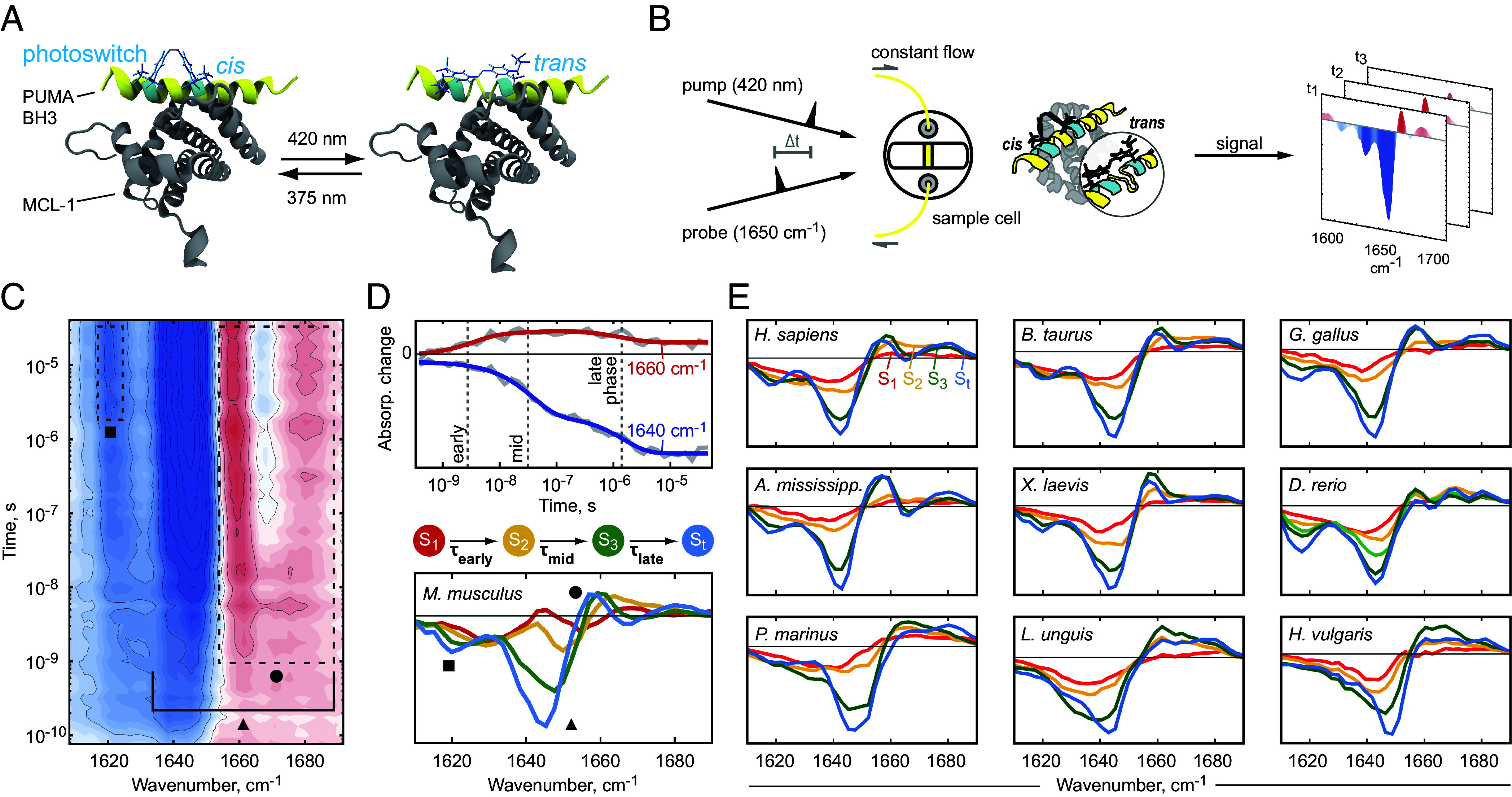
The conservation of ultrafast protein dynamics in MCL-1. (A) The protein MCL-1 in complex with the photoswitchable PUMA BH3 peptide. (B) Transient infrared spectroscopy of the photo-perturbed MCL-1/PUMA BH3 complex results in kinetic footprints for all homologs, exemplarily displayed in (C) for Mus musculus. The symbols serve as reference points for explanations in the main text. (D) Three dominating phases of increased dynamic activity are assessed (early-, mid-, late phase; dashed lines). Global multiexponential fitting with three time constants yields fits (red/blue) that cover the raw data (gray) well. Evolution-associated difference spectra (48, 49) (lower panel) were calculated for state S1 (red), S2 (yellow), S3 (green), and for St (blue) with time constants , , and . (E) The difference spectra of all homologs display a high degree of similarity.
Considering a time frame from pico- to microseconds (25), we studied the protein dynamics in a pump–probe experiment where the cis-to-trans isomerization of the photoswitch is triggered by an ultrashort UV/VIS laser pulse at 420 nm and the protein vibrational spectrum is probed in the mid infrared region around 1,650 cm−1 (Fig. 2B). In this spectral region, C=O stretch vibrations of the protein backbone can be observed. Negative (blue) and positive (red) absorption changes serve as an indicator for structural alterations (50). We obtained homolog-specific kinetic footprints for the ten investigated species (SI Appendix, Fig. S3, exemplified for M. musculus in Fig. 2C). Analogous to fossil footprints—the paleontologic counterpart—the kinetic footprints display comparable elements. All of them are similarly shaped, displaying a blue shift of a band at 1,645 cm−1, which reveals a negative bleach toward a new (positive) band at 1,675 cm−1 (Fig. 2C, triangle). The signal appears within the low nanosecond time frame for all of the homologs and can be attributed to -helix unfolding (4, 23, 51). More strikingly, the kinetic footprints exhibit diverging, species-specific details, which are particularly well visible for the spectral feature between 1,655 and 1,685 cm−1 (Fig. 2C, circle), and a late negative feature at 1,620 cm−1 forming at around 100 ns (Fig. 2C, square). The first-mentioned feature (circle) is especially pronounced for mammalian/avian/reptilian homologs (SI Appendix, Fig. S3 A–E), but loses its distinct appearance more and more for species with higher evolutionary divergence (P. marinus, L. unguis, H. vulgaris, SI Appendix, Fig. S3 H–J), displaying a solitary, less emphasized maximum at 1,660 cm−1. Furthermore, the kinetic footprints of the non-GnathostomataP. marinus, L. unguis, and H. vulgaris, lack the late negative feature at 1,620 cm−1.
All kinetic footprints are dominated by three phases of dynamic activity, an early-, mid-, and late phase, where the intensity of spectral features grows or decreases significantly (exemplified for M. musculus in Fig. 2D, for all other species in SI Appendix, Fig. S4). To fathom these three dynamic processes and their corresponding time constants, we analyzed the kinetic footprints with global multiexponential fitting (Fig. 2D, details in Materials and Methods) (4, 48, 49, 52). Our analysis demonstrates that there are four states of molecular rearrangement upon photo-perturbation, populated with time constants , , and . This finding was further validated by a supplementary lifetime analysis of the kinetic footprints (SI Appendix and Fig. S5) which also unveils three dominant phases of protein response.
The time intervals in which the three observed processes take place are very narrow for the ten homologs we investigated, evidencing that not only the structure and function of MCL-1 are conserved across a wide and diverse range of today’s living animals (Fig. 1) but also the underlying protein dynamics (Fig. 2E). This stands in stark contrast to the significant alterations that we observe for the primary structure of the protein homologs (Fig. 1C). When we plot the time constants against an evolutionary time scale (Fig. 3A), we find that the processes populated with , correlate with the evolutionary divergence. In contrast, we did not detect similar protein dynamic drifts for the other two time constants, showing an absence of correlation of early- and late protein response with evolutionary divergence. On the other hand, if the time constants are plotted in dependence of the experimental binding affinities, it becomes evident that the processes populated with are strongly correlated with the protein’s affinity (Fig. 3B).
Fig. 3.

Time constants of increased dynamic activity , , and against (A) evolutionary divergence in million years, Ma, and against (B) MCL-1’s affinity for PUMA BH3. Data in (A) and (B) are displayed with linear fits SD (yellow) and correlation coefficients (Pearson).
We specified which parts of the protein complex contribute to which process by recording kinetic footprints for 13C-15N-labeled MCL-1 of M. musculus in complex with nonlabeled PUMA BH3 (Fig. 4A). The observed isotope effect on the vibrational frequency is caused by the alteration of the reduced mass due to replacing one of the atoms with its isotope. By isolating the spectral contribution of 13C-15N-labeled MCL-1 in a double-difference spectrum (unlabeled labeled, SI Appendix, Fig. S6), we could demonstrate that time constant (= 0.9 to 3.5 ns) can be solely assigned to PUMA BH3, attributed potentially to the unfolding of the -helical peptide. Complementing NMR relaxation experiments could further illuminate this time window, deepening our understanding of rapid conformational changes on a pico- and nanosecond scale. The time constant (= 21 to 50 ns) corresponds to spectral features which shift 50 cm−1 for isotope-labeled MCL-1 (Fig. 4B). Since this marks the initial time point where the isolated protein signal is significantly enhanced (SI Appendix, Fig. S6), we infer that describes a phase in which MCL-1 rearranges to cope with the conformational destabilization originating from the binding pocket (Fig. 4C). Spectral features manifesting at the terminal time constant (= 0.7 to 3.6 s), as well as at , cannot be unequivocally separated in exclusive contributions of one of the complex partners. Hence, we assume mutual rearrangements of both, the MCL-1 protein and the PUMA BH3 peptide. The results are in line with previous observations for the isotope-labeled human MCL-1/BIM complex (4).
Fig. 4.

Isotope labeling helped to separate the signal contribution of MCL-1 and PUMA BH3 spatially and temporally. (A) Transient infrared spectroscopy with isotope-labeled MCL-1/PUMA BH3 complexes. From ten homologs, M. musculus was chosen as a representative, as 13C15N-labeling is highly cost intensive. Kinetic footprints of unlabeled samples (Upper panel), and of samples with 13C15N-labeled MCL-1 (Lower panel). The early protein response (triangle) is not shifted for the labeled sample. The mid protein response (circle) manifests in a distinct sharp feature that shifts from 1,660 to 1,610 cm−1 upon isotope labeling (dashed lines). Isotope labeling did not separate any spectral features at the late phase of the protein response. (B) Evolution-associated difference spectra (see Data analysis in the Materials and Methods) display a relatively sharp positive band in state S3 and S4 (circle). In the nonlabeled complex, the sharp maximum coincides with the broad positive band of the blue shift. For the labeled complex, it is shifted by 50 cm−1 from 1,660 to 1,610 cm−1, as expected for 13C15N-labeling (53). (C) The time constants were assigned to dynamic processes in the protein complex (schematic overview).
From our results, one might speculate whether MCL-1’s initial response () has met with less selective pressure in the past, causing it to drift. This hypothesis is supported by the absence of any discernible correlation between and the protein affinity (Fig. 3B), implying that the function of the protein is seemingly not entangled with this dynamic process. In contrast, a robust correlation between and the (Fig. 3B) indicates that the late mutual rearrangements of MCL-1 and PUMA BH3 (in the microsecond regime) are connected to the function of the protein. From our observations, it seems that the relationship between the late dynamic response and the protein affinity is conserved and cannot be inferred from the evolutionary separation of species; other factors must be at play. Irrespective of how to evaluate the given correlations, what remains truly remarkable is that our results provide an opportunity to gain insights into the speed and extent of the impact of evolution on dynamical processes.
From a paleontological standpoint, we can conjecture that the last common ancestor of BCL-2-like proteins, a primordial apoptotic regulator in an ancestral metazoan life form, must have similarly bound -helical BH3 domains, with affinities not far from what we determined in our experiments. One might speculatively suggest that the conserved dynamic properties at are essential to bind intrinsically disordered BH3 domains, allowing them to fold and restructure within the binding pocket—whether in the metazoan ancestor a billion years ago or in homologs of contemporary species. In metazoan life forms, apoptosis is vital to form and sustain tissue (54). First tissue-forming life must have been confronted with active selection pressure to develop potent strategies regulating cellular survival in multicellular individuals. Evidently, this selection resulted in the establishment of the anti-apoptotic key regulator MCL-1 and in its control by a variety of different BH3 domains, binding dynamically even under the influence of strong perturbation (31).
Conclusion
MCL-1 is a critical player in apoptosis (27), not only in human beings but also in a great variety of animals (28). By experimentally studying ten MCL-1 homologs and their interactions with a photo-switchable ligand PUMA BH3, we gained valuable insights into the dynamics of the proteins on a broader evolutionary time scale. Using time-resolved infrared spectroscopy, we successfully recorded the kinetic footprints of the MCL-1/PUMA BH3 complex and analytically compared them—similar to bones, skulls, and footprints in the classic field of paleontology (55, 56), or protein structures and genetic information in its molecular form (57–59).
Our findings reveal a remarkable degree of conservation for the protein dynamics across the homologs, highlighting the importance of these processes in preserving their anti-apoptotic function over a span of nearly a billion years. Of particular interest is the correlation we observed between one of these ultrafast processes and the evolutionary divergence among the protein homologs, a drift in protein dynamics in the nanosecond range. This finding complements the prevailing focus on resolving protein structures (17), dynamics in equilibrium (11), and analyzing genomic data (59) to understand evolution. Our work highlights the importance of considering nanosecond protein dynamics as a crucial factor in unraveling the evolutionary history of these proteins. With this approach, we build a bridge between the shortest (1 ns = 10−9 s) and the largest conceivable timescales in living matter (300 Ma 1016 s).
Overall, our study defines a starting point for exploring the dynamics of countless other proteins with varying degrees of conservation. By investigating different systems that are more or less conserved, we can gain valuable insights into the extent of evolution’s impact on nanosecond processes, and how these rapid processes translate to slow-paced protein function.
Materials and Methods
Phylogeny and Bioinformatics.
From the countless species in the tree of life, we chose ten MCL-1 homolog sequences (Fig. 1B). Alongside the Homo sapiens homolog, our selection encompasses a variety of species, including mammalian (Mus musculus, Bos taurus), avian (Gallus gallus), reptile (Alligator mississippiensis), amphibian (Xenopus laevis), bony fish (Danio rerio), and other farther related eumetazoan homologs (Petromyzon marinus, Lingula unguis). Notably, we also incorporated a homolog from Hydra vulgaris, one of the most distantly related organisms known to exhibit BCL-2 regulated apoptosis (38). The curated selection represents species whose last common ancestors existed at quasi-equidistant intervals spanning nearly a billion years of evolutionary history. To assemble our dataset, we accessed amino acid sequences from the Uniprot database. All entries shared the common identifier “MCL-1” in their title or description. The amino acid sequence for P. marinus was added to the selection with the help of Jeramiah Smith (gene on Chr52: 9161036..9167581, + strand; annotated: PMZ_0059412-RA) (42). The sequences were aligned to the human variant soluble domain, N-C aa 171–327(32) and harmonized in length (150 to 160 aa) (SI Appendix, Fig. S1A). The chosen sequences (refer to SI Appendix, Table S1) were initially controlled for by predicting their structure using AlphaFold and RosettaFold and aligning them with experimental structures from H. sapiens and M. musculus. From the sequences, we generated a multiple sequence alignment using Clustal Omega (EMBL-EBI) (60) (SI Appendix, Fig. S1A). The phylogeny in Fig. 1B was obtained from the TimeTree database (http://timetree.org) (34). It was not computed from the investigated MCL-1 sequences. In contrast, the given phylogeny was constructed from median and adjusted divergence times which were estimated by TimeTree based on values from an abundance of published studies. The divergence times, always related to H. sapiens and tabulated in SI Appendix, Table S1 alongside their corresponding confidence interval (CI), reflect the most current scientific understanding (June 2023). In figures Fig. 1C–F, and Fig. 3A, the divergence time is given in million years, Ma. The experimental structures of MCL-1/PUMA were retrieved from PDB (M. musculus: 2ROC; H. sapiens: 6QFM). In addition, we predicted the structures of all MLC-1 homologs with AlphaFold (35) and RosettaFold (36). We used ColabFold (61) to generate AlphaFold-predicted structures, and the Robetta server (36) for RosettaFold-predicted structures, both with default parameters. To estimate the structural similarity between all protein pairs, we performed an all-against-all alignment of the predicted structures and computed the TM score and RMSD of each protein pair using TM-align (45). For both AlphaFold and RosettaFold, we selected the top-ranked structure out of the five predictions for downstream analyses. We evaluated the quality of the predicted structure using AlphaFold predicted local distance difference test (pLDDT), a per-residue confidence metric which estimates how well the predicted structure would match with an experimental one and which has been shown to be well-calibrated (35). All our predicted structures have high average pLDDT values, ranging from 0.83 to 0.93, indicating good quality predictions.
Protein Preparation.
Examining protein function and dynamics, we expressed ten different MCL-1 homologs using a Escherichia coli BL21 expression strain (SI Appendix, Fig. S2A). Initially, the bacterial cells were transformed with a pET-30a(+) plasmid containing the corresponding MCL-1 homolog gene, using electroporation. Positive clones were selected through Kanamycin resistance. For standard expression, bacterial cultures were cultivated in lysogeny broth medium until reaching an optical density of OD600 = 0.6. The expression was induced by adding 700 M IPTG, followed by incubation at 30 °C for 20 h. Cell harvest was carried out through centrifugation (3,000 x g). In order to generate heavy, uniformly 13C15N-labeled MCL-1, bacterial cultures were grown in minimal medium supplemented with solely heavy carbon and nitrogen sources. The cells were cultivated to an OD600 of 0.6, induced with 1 mM IPTG, and then further incubated at 30 °C. The expression was stopped after 4 h with cell harvest as described above. Cell lysis was achieved by subjecting the harvested cells to sonication (20 kHz, 4 1 min pulses). The lysed cell suspension was purified using Ni-affinity chromatography and a His6-Tag located at the N terminus of the protein. Purification was carried out under native conditions. The N-terminal His6-Tag was removed by 3C protease cleavage. Throughout this study, all analytical procedures were performed in a sample buffer composed of 50 mM Tris (pH 8) and 125 mM NaCl. Mass spectrometry was used to assess the protein’s integrity and sample purity. For long-term storage, the samples were kept at 80 °C. In total, we could express the homologs of ten species given in the main text (SI Appendix, Fig. S7). Under identical conditions, however, we could not express Ornithorhynchus anatinus, Orchesella cincta, and Acanthaster planci homologs at adequate concentrations.
Peptide Reparation.
PUMA BH3 (EEQWAREIGAQLRCMADDLNCQYERV) was synthesized using solid-state peptide synthesis on a Liberty 1 peptide synthesizer (CEM corporation, Matthews, NC, USA). In this study, the peptide was deliberately modified by introducing two mutations—replacing Arg143 and Ala150 with Cys residues—compared to the native mammalian version. These Cys residues were incorporated distal to the hydrophobic binding interface, to enable the covalent linkage of a photoswitchable azobenzene moiety. To achieve this linkage, the water-soluble photoswitch (3,3’-bis(sulfonato)-4,4’-bis(chloroacetamido)azobenzene) (62) and the peptide with reduced Cys residues were together incubated in a 20 mM Tris (pH 8.5) at a temperature of 50 °C, under continuous stirring for a duration of 20 h. Hereafter, the reaction product underwent purification using both anion exchange and reversed-phase chromatography (C18 10 m) to isolate the successfully linked peptide. For final preparation, the buffer of the isolated linked peptide was exchanged through dialysis against the sample buffer (50 mM Tris pH 8, 125 mM NaCl). The linkage’s success, as well as the peptide’s purity and integrity, were controlled via mass spectrometry.
Circular Dichroism Spectroscopy.
The expressed MCL-1 homologs have in common that they contain eight -helical elements (32), and exhibit a circular dichroism spectrum that is typical for -helical structures (SI Appendix, Fig. S2B, yellow). In contrast, their peptide ligand PUMA BH3 is intrinsically disordered in isolation (63) (SI Appendix, Fig. S2B, gray). When in complex with MCL-1, PUMA BH3 assumes an -helical shape (SI Appendix, Fig. S2B, black).
We utilize circular dichroism spectroscopy to accomplish two distinct objectives: i) to evaluate the -helical content of the MCL-1 and PUMA BH3 complex at a constant concentration, thereby assessing whether they are correctly folded, and ii) to generate binding curves and determine dissociation constants () for all analyzed MCL-1 homologs. To record binding curves and assess the values, we exploited the nature of PUMA BH3 which is intrinsically disordered in solution and only exhibits an -helical secondary structure when bound by MCL-1’s binding groove. Hence, for an increasing concentration of bound PUMA BH3, and a constant concentration of MCL-1, the -helical content added by titration reflects the fraction of bound peptide.
For the first aspect (i), a quartz glass cuvette with a 1 mm path length was employed, and the sample concentration was maintained at 20 M. We measured the spectrum between 200 to 260 nm at room temperature. Hereby, we examined the -helical content of the MCL-1 and PUMA BH3 complex which served as a control to for their correct structural conformation (displayed in SI Appendix, Fig. S2B).
For the second aspect (ii), MCL-1 was brought to a concentration of 2 M. A quartz glass cuvette with a path length of 1 cm was used, and continuous stirring was maintained during the spectroscopic measurements at room temperature. To record the binding curves, we titrated both the linked and unlinked forms of the PUMA BH3 peptide to the MCL-1 homolog, offering a comprehensive understanding of the binding affinity of photoswitchable and non-photoswitchable complexes. The circular dichroism was recorded at 222 nm as a function of increasing PUMA BH3 concentration. In both scenarios (i) and (ii), measurements involving the photoswitchable PUMA BH3 were conducted for both the cis-state (achieved through illumination with a 375 nm laser) and the dark-adapted trans-state.
By recording the -helical content at 222 nm as a function of increasing PUMA BH3 concentration, we received binding curves for all MCL-1 homologs. In order to calculate the dissociation constant , we fitted the data to a two-state binding equilibrium (64, 65):
| [1] |
where [M] is the initial concentration of the MCL-1, [P] is the initial concentration of PUMA BH3 given to the solution, and [MP] is the concentration of the protein-peptide complex. For a constant [M] = 2 M and a variable [P], the fraction of bound peptide can be understood as:
| [2] |
The covalently bound photoswitch in the cis-state stabilizes PUMA BH3 inside the binding pocket (Fig. 1A), with significantly lower values for all of the homologs (SI Appendix, Fig. S2M). For PUMA BH3 in the cis state, H. sapiens, B. taurus, and A. mississippiensis homologs showed the highest affinities, with values in the low nanomolar regime (10 nM), a region that was classified as physiological for wild type PUMA (30). Switching the photoswitch from its cis- to its trans configuration results in a loss in -helicity (SI Appendix, Fig. S2N) and in the destabilization of PUMA BH3.
Transient Infrared Spectroscopy.
MCL-1 and PUMA BH3 were mixed in a 1:1 ratio prior to the spectroscopic experiment. To ensure high signal strength in transient infrared spectroscopy, both the protein and peptide were brought to concentrations of 600 M each in the final sample. The overall sample volume was 800 L. Considering concentrations 500 M, it is expected that the PUMA BH3 peptide will be predominantly bound within MCL-1’s binding pocket, as illustrated in SI Appendix, Fig. S2. To exclude H2O from spectroscopic experiments, the employed buffer was exchanged to a corresponding buffer containing D2O. Stringent precautions were taken to avert H2O contamination by preserving the sample within a nitrogen atmosphere devoid of water vapor.
For pump–probe measurements, a pair of electronically synchronized 2.5 kHz Ti:sapphire oscillator/regenerative amplifier femtosecond laser systems (Spectra Physics) were employed, offering a maximal delay of 45 s (25, 66). One of these laser systems, featuring frequency-doubled pulses (420 nm, 3 J per pulse, focused to an approximate beam diameter of 140 m within the sample, and stretched to 60 ps to minimize sample deposition on the sample cell windows), were used to induce the cis to trans-isomerization of the photoswitch. The second laser system was applied to generate infrared probe pulses via an optical parametric amplifier (100 fs, spot size 110 m, center wavenumber 1,660 cm−1). To ensure a consistent sample environment, the sample was continuously circulated within a closed-cycle flow cell system. This system consisted of a reservoir and a CaF2 cell featuring a 50 m optical path length. Before entering the measurement cell, the sample was irradiated in a pre-illumination step using a 375 nm continuous wave diode laser (90 mW, CrystaLaser), in order to optimally prepare the sample with 85% in the cis-state.
Data Analysis.
From time resolved infrared measurements, we obtained kinetic footprints in the form of 2D datasets as a function of probe frequency and pump–probe delay time (Fig. 2C and SI Appendix, Fig. S3). For each homolog, we subjected the 2D dataset to a global multiexponential fitting (49), operating under the premise that the investigated system can be understood as interconverting discrete states with time-invariant spectra.
We employed multiexponential functions with amplitudes and a global set of time constants for fitting the experimental data (52, 67, 68):
| [3] |
The time constants were treated as free-fitting parameters, with the constraint of a minimal number of exponential terms. Based on observations with similar systems (4, 31) we excluded data before 300 ps, to prevent the influence of the pump pulse (60 ps pulse length), which results in a strong “heat signal” at 100 ps, induced by azobenzene photoisomerization, which can be universally observed for this kind of experiment (4, 24, 31). Three time constants , , and were needed to adequately fit the data, dissecting the dynamic response in an early-, mid-, and late phase (SI Appendix, Table S2). The one exception is D. rerio, which required a fourth time constant = 300 ns to adequately fit the data.
Under the assumption of a sequential, unidirectional process with four states S1, S2, S3, St and three time constants , , connecting them, we calculated concentration profiles for each state as well the corresponding evolution-associated difference spectra (48), which are depicted in Fig. 2 D and E. Commencing with state S1, all subsequent evolution-associated difference spectra exhibited a blue shift from 1,645 cm−1 to around 1,675 cm−1. Equally to our observations for the raw data, a very distinct positive feature at 1,660 cm−1 was detected in the evolution-associated difference spectra of the latest two states (Fig. 2 D and E, green and blue).
With the help of isotope labeling (53) (Fig. 4), we could assign this distinct spectral maximum, populated with , to the initial response of MCL-1 upon photo-destabilization of its ligand. The early response at exclusively originates from the unfolding of PUMA BH3. The terminal, late response at results from mutual, heterogeneous rearrangements in MCL-1 and PUMA BH3.
Supplementary Material
Appendix 01 (PDF)
Acknowledgments
We thank Markus B. Glutz for the synthesis of the peptide and Serge Chesnov from Functional Genomics Center Zurich for their work on the mass spectrometry and amino acid analysis. We thank Jeramiah Smith, University of Kentucky, who provided us with the sequence of the Petromyzon marinus. The work has been supported by the Swiss National Science Foundation through the Sinergia grant CRSII5_213507.
Author contributions
P.J.H. designed research; P.J.H. performed biochemical research; P.J.H. and J.R. performed spectroscopic research; P.J.H. and C.R. performed bioinformatic research; P.J.H. analyzed data; P.H. designed and built the spectroscopic setup; and P.J.H. and P.H. wrote the paper.
Competing interests
The authors declare no competing interest.
Footnotes
This article is a PNAS Direct Submission. G.H. is a guest editor invited by the Editorial Board.
Data, Materials, and Software Availability
Raw data have been deposited in Zenodo (https://doi.org/10.5281/zenodo.10592705) (69).
Supporting Information
References
- 1.Boehr D. D., Nussinov R., Wright P. E., The role of dynamic conformational ensembles in biomolecular recognition. Nat. Chem. Biol. 5, 789–796 (2009). [DOI] [PMC free article] [PubMed] [Google Scholar]
- 2.Galvanetto N., et al. , Extreme dynamics in a biomolecular condensate. Nature 619, 876–883 (2023). [DOI] [PMC free article] [PubMed] [Google Scholar]
- 3.Jankovic B., et al. , Sequence of events during peptide unbinding from RNase S: A complete experimental description. J. Phys. Chem. Lett. 12, 5201–5207 (2021). [DOI] [PubMed] [Google Scholar]
- 4.Heckmeier P. J., Ruf J., Buhrke D., Janković B. G., Hamm P., Signal propagation within the MCL-1/BIM protein complex. J. Mol. Biol. 434, 167499 (2022). [DOI] [PubMed] [Google Scholar]
- 5.Karplus M., Kuriyan J., Molecular dynamics and protein function. Proc. Natl. Acad. Sci. U.S.A. 102, 6679–6685 (2005). [DOI] [PMC free article] [PubMed] [Google Scholar]
- 6.Schanda P., Brutscher B., Very fast two-dimensional NMR spectroscopy for real-time investigation of dynamic events in proteins on the time scale of seconds. J. Am. Chem. Soc. 127, 8014–8015 (2005). [DOI] [PubMed] [Google Scholar]
- 7.Pirchi M., et al. , Single-molecule fluorescence spectroscopy maps the folding landscape of a large protein. Nat. Commun. 2, 2–8 (2011). [DOI] [PMC free article] [PubMed] [Google Scholar]
- 8.Aviram H. Y., et al. , Direct observation of ultrafast large-scale dynamics of an enzyme under turnover conditions. Proc. Natl. Acad. Sci. U.S.A. 115, 3243–3248 (2018). [DOI] [PMC free article] [PubMed] [Google Scholar]
- 9.Hofmann H., et al. , Single-molecule spectroscopy of protein folding in a chaperonin cage. Proc. Natl. Acad. Sci. U.S.A. 107, 11793–11798 (2010). [DOI] [PMC free article] [PubMed] [Google Scholar]
- 10.Borgia A., et al. , Extreme disorder in an ultrahigh-affinity protein complex. Nature 555, 61–66 (2018). [DOI] [PMC free article] [PubMed] [Google Scholar]
- 11.Jemth P., et al. , Structure and dynamics conspire in the evolution of affinity between intrinsically disordered proteins. Sci. Adv. 4 (2018). [DOI] [PMC free article] [PubMed] [Google Scholar]
- 12.Karlsson E., et al. , The dynamic properties of a nuclear coactivator binding domain are evolutionarily conserved. Commun. Biol. 5, 1–11 (2022). [DOI] [PMC free article] [PubMed] [Google Scholar]
- 13.Schenkmayerova A., et al. , Engineering the protein dynamics of an ancestral luciferase. Nat. Commun. 12 (2021). [DOI] [PMC free article] [PubMed] [Google Scholar]
- 14.Ortlund E. A., Bridgham J. T., Redinbo M. R., Thornton J. W., Crystal structure of an ancient protein: Evolution by conformational epistasis. Science 317, 1544–1548 (2007). [DOI] [PMC free article] [PubMed] [Google Scholar]
- 15.Ingles-Prieto A., et al. , Conservation of protein structure over four billion years. Structure 21, 1690–1697 (2013). [DOI] [PMC free article] [PubMed] [Google Scholar]
- 16.Nguyen V., et al. , Evolutionary drivers of thermoadaptation in enzyme catalysis. Science 355, 289–294 (2017). [DOI] [PMC free article] [PubMed] [Google Scholar]
- 17.Hadzipasic A., et al. , Ancient origins of allosteric activation in a Ser-Thr kinase. Science 367, 912–917 (2020). [DOI] [PMC free article] [PubMed] [Google Scholar]
- 18.Henzler-Wildman K. A., et al. , A hierarchy of timescales in protein dynamics is linked to enzyme catalysis. Nature 450, 913–916 (2007). [DOI] [PubMed] [Google Scholar]
- 19.Stenström O., et al. , How does it really move? Recent progress in the investigation of protein nanosecond dynamics by NMR and simulation. Curr. Opin. Struct. Biol. 77, 102459 (2022). [DOI] [PubMed] [Google Scholar]
- 20.Eisenmesser E. Z., Bosco D. A., Akke M., Kern D., Enzyme dynamics during catalysis. Science 295, 1520–1523 (2002). [DOI] [PubMed] [Google Scholar]
- 21.Alderson T. R., Kay L. E., NMR spectroscopy captures the essential role of dynamics in regulating biomolecular function. Cell 184, 577–595 (2021). [DOI] [PubMed] [Google Scholar]
- 22.Lórenz-Fonfría V. A., Infrared difference spectroscopy of proteins: From bands to bonds. Chem. Rev. 120, 3466–3576 (2020). [DOI] [PubMed] [Google Scholar]
- 23.Barth A., Infrared spectroscopy of proteins. Biochim. et Biophys. Acta - Bioenerg. 1767, 1073–1101 (2007). [DOI] [PubMed] [Google Scholar]
- 24.Bozovic O., et al. , Real-time observation of ligand-induced allosteric transitions in a PDZ domain. Proc. Natl. Acad. Sci. U.S.A. 117, 26031–26039 (2020). [DOI] [PMC free article] [PubMed] [Google Scholar]
- 25.Helbing J., Hamm P., Versatile femtosecond laser synchronization for multiple-timescale transient infrared spectroscopy. J. Phys. Chem. A 127, 6347–6356 (2023). [DOI] [PubMed] [Google Scholar]
- 26.Adams J. M., Cory S., The BCL-2 apoptotic switch in cancer development and therapy. Oncogene 26, 1324–1337 (2007). [DOI] [PMC free article] [PubMed] [Google Scholar]
- 27.Youle R. J., Strasser A., The BCL-2 protein family: Opposing activities that mediate cell death. Nat. Rev. Mol. Cell Biol. 9, 47–59 (2008). [DOI] [PubMed] [Google Scholar]
- 28.Aouacheria A., Combet C., Tompa P., Hardwick J. M., Redefining the BH3 death domain as a ‘short linear motif’. Trends Biochem. Sci. 40, 736–748 (2015). [DOI] [PMC free article] [PubMed] [Google Scholar]
- 29.Sora V., Papaleo E., Structural details of BH3 motifs and BH3-mediated interactions: An updated perspective. Front. Mol. Biosci. 9, 1–20 (2022). [DOI] [PMC free article] [PubMed] [Google Scholar]
- 30.Kale J., Osterlund E. J., Andrews D. W., BCL-2 family proteins: Changing partners in the dance towards death. Cell Death Differ. 25, 65–80 (2018). [DOI] [PMC free article] [PubMed] [Google Scholar]
- 31.Heckmeier P. J., Ruf J., Janković B. G., Hamm P., MCL-1 promiscuity and the structural resilience of its binding partners. J. Chem. Phys. 158 (2023). [DOI] [PubMed] [Google Scholar]
- 32.Czabotar P. E., et al. , Structural insights into the degradation of MCL-1 induced by BH3 domains. Proc. Natl. Acad. Sci. U.S.A. 104, 6217–6222 (2007). [DOI] [PMC free article] [PubMed] [Google Scholar]
- 33.Day C. L., et al. , Structure of the BH3 domains from the p53-inducible BH3-only proteins noxa and puma in complex with MCL-1. J. Mol. Biol. 380, 958–971 (2008). [DOI] [PubMed] [Google Scholar]
- 34.Kumar S., et al. , TimeTree 5: An expanded resource for species divergence times. Mol. Biol. Evol. 39, 1–6 (2022). [DOI] [PMC free article] [PubMed] [Google Scholar]
- 35.Jumper J., et al. , Highly accurate protein structure prediction with AlphaFold. Nature 596, 583–589 (2021). [DOI] [PMC free article] [PubMed] [Google Scholar]
- 36.Baek M., et al. , Accurate prediction of protein structures and interactions using a three-track neural network. Science 373, 871–876 (2021). [DOI] [PMC free article] [PubMed] [Google Scholar]
- 37.Wiens M., Diehl-Seifert B., Müller W. E. G., Sponge BCL-2 homologous protein (BHP2-GC) confers distinct stress resistance to human HEK-293 cells. Cell Death Differ. 8, 887–898 (2001). [DOI] [PubMed] [Google Scholar]
- 38.Lasi M., et al. , The molecular cell death machinery in the simple cnidarian Hydra includes an expanded caspase family and pro- and anti-apoptotic BCL-2 proteins. Cell Res. 20, 812–825 (2010). [DOI] [PubMed] [Google Scholar]
- 39.Harms M. J., Thornton J. W., Analyzing protein structure and function using ancestral gene reconstruction. Curr. Opin. Struct. Biol. 20, 360–366 (2010). [DOI] [PMC free article] [PubMed] [Google Scholar]
- 40.Merkl R., Sterner R., Ancestral protein reconstruction: Techniques and applications. Biol. Chem. 397, 1–21 (2016). [DOI] [PubMed] [Google Scholar]
- 41.Williams P. D., Pollock D. D., Blackburne B. P., Goldstein R. A., Assessing the accuracy of ancestral protein reconstruction methods. PLoS Comput. Biol. 2, 0598–0605 (2006). [DOI] [PMC free article] [PubMed] [Google Scholar]
- 42.Timoshevskaya N., et al. , An improved germline genome assembly for the sea lamprey Petromyzon marinus illuminates the evolution of germline-specific chromosomes. Cell Rep. 42, 112263 (2023). [DOI] [PMC free article] [PubMed] [Google Scholar]
- 43.Pearson W. R., An introduction to sequence similarity (“homology”) searching. Curr. Protoc. Bioinform. (2013). [DOI] [PMC free article] [PubMed]
- 44.McGriff A., Placzek W. J., Phylogenetic analysis of the MCL1 BH3 binding groove and rBH3 sequence motifs in the p53 and INK4 protein families. PLoS One 18, 1–19 (2023). [DOI] [PMC free article] [PubMed] [Google Scholar]
- 45.Zhang Y., Skolnick J., TM-align: A protein structure alignment algorithm based on the TM-score. Nucleic Acids Res. 33, 2302–2309 (2005). [DOI] [PMC free article] [PubMed] [Google Scholar]
- 46.Xu J., Zhang Y., How significant is a protein structure similarity with TM-score = 0.5? Bioinformatics 26, 889–895 (2010). [DOI] [PMC free article] [PubMed] [Google Scholar]
- 47.Chothia C., Lesk A., The relation between the divergence of sequence and structure in proteins. EMBO J. 5, 823–826 (1986). [DOI] [PMC free article] [PubMed] [Google Scholar]
- 48.Van Stokkum I. H., Larsen D. S., Van Grondelle R., Global and target analysis of time-resolved spectra. Biochim. Biophys. Acta - Bioenerg. 1657, 82–104 (2004). [DOI] [PubMed] [Google Scholar]
- 49.Buhrke D., Oppelt K. T., Heckmeier P. J., Fernández-Terán R., Hamm P., Nanosecond protein dynamics in a red/green cyanobacteriochrome revealed by transient IR spectroscopy. J. Chem. Phys. 153, 245101-1-245101-12 (2020). [DOI] [PubMed] [Google Scholar]
- 50.Barth A., Zscherp C., What vibrations tell us about proteins. Q. Rev. Biophys. 35, 369–430 (2002). [DOI] [PubMed] [Google Scholar]
- 51.Huang C. Y., et al. , Helix formation via conformation diffusion search. Proc. Natl. Acad. Sci. U.S.A. 99, 2788–2793 (2002). [DOI] [PMC free article] [PubMed] [Google Scholar]
- 52.Lórenz-Fonfría V. A., Kandori H., Transformation of time-resolved spectra to lifetime-resolved spectra by maximum entropy inversion of the laplace transform. Appl. Spectrosc. 60, 407–417 (2006). [DOI] [PubMed] [Google Scholar]
- 53.Haris P. I., Chapman D., Robillard G. T., van Dijk A. A., Potential of carbon-13 and nitrogen-15 labeling for studying protein-protein interactions using Fourier-transform infrared spectroscopy. Biochemistry 31, 6279–6284 (1992). [DOI] [PubMed] [Google Scholar]
- 54.Kerr J. F. R., Wyllie A. H., Currie A. R., Apoptosis: A basic biological phenomenon with wideranging implications in tissue kinetics. Br. J. Cancer 26, 239–257 (1972). [DOI] [PMC free article] [PubMed] [Google Scholar]
- 55.Stern J. T., Susman R. L., The locomotor anatomy of Australopithecus afarensis. Am. J. Phys. Anthropol. 60, 279–317 (1983). [DOI] [PubMed] [Google Scholar]
- 56.Olsen P. E., Smith J. B., McDonald N. G., Type material of the type species of the classic theropod footprint genera Eubrontes, Anchisauripus, and Grallator (Early Jurassic, Hartford and Deerfield basins, Connecticut and Massachusetts, U.S.A.). J. Vertebr. Paleontol. 18, 586–601 (1998). [Google Scholar]
- 57.King M. C., Wilson A. C., Evolution at two levels in humans and chimpanzees. Science 188, 107–116 (1975). [DOI] [PubMed] [Google Scholar]
- 58.Reich D., et al. , Genetic history of an archaic hominin group from Denisova cave in Siberia. Nature 468, 1053–1060 (2010). [DOI] [PMC free article] [PubMed] [Google Scholar]
- 59.van der Valk T., et al. , Million-year-old DNA sheds light on the genomic history of mammoths. Nature 591, 265–269 (2021). [DOI] [PMC free article] [PubMed] [Google Scholar]
- 60.Sievers F., et al. , Fast, scalable generation of high-quality protein multiple sequence alignments using Clustal Omega. Mol. Syst. Biol. 7 (2011). [DOI] [PMC free article] [PubMed] [Google Scholar]
- 61.Mirdita M., et al. , Colabfold: Making protein folding accessible to all. Nat. Methods 19, 679–682 (2022). [DOI] [PMC free article] [PubMed] [Google Scholar]
- 62.Zhang Z., Burns D. C., Kumita J. R., Smart O. S., Woolley G. A., A water-soluble azobenzene cross-linker for photocontrol of peptide conformation. Bioconjug. Chem. 14, 824–829 (2003). [DOI] [PubMed] [Google Scholar]
- 63.Hinds M. G., et al. , Bim, Bad and Bmf: Intrinsically unstructured BH3-only proteins that undergo a localized conformational change upon binding to prosurvival Bcl-2 targets. Cell Death Differ. 14, 128–136 (2007). [DOI] [PubMed] [Google Scholar]
- 64.Jankovic B., et al. , Photocontrolling protein-peptide interactions: From minimal perturbation to complete unbinding. J. Am. Chem. Soc. 141, 10702–10710 (2019). [DOI] [PubMed] [Google Scholar]
- 65.Jarmoskaite I., Alsadhan I., Vaidyanathan P. P., Herschlag D., How to measure and evaluate binding affinities. Elife 9, 1–34 (2020). [DOI] [PMC free article] [PubMed] [Google Scholar]
- 66.Bredenbeck J., Helbing J., Hamm P., Continuous scanning from picoseconds to microseconds in time resolved linear and nonlinear spectroscopy. Rev. Sci. Instrum. 75, 4462–4466 (2004). [Google Scholar]
- 67.Hobson M. P., Lasenby A. N., The entropic prior for distributions with positive and negative values. Mon. Not. R. Astron. Soc. 298, 905–908 (1998). [Google Scholar]
- 68.Kumar A. T. N., Zhu L., Christian J. F., Demidov A. A., Champion P. M., On the rate distribution analysis of kinetic data using the maximum entropy method: Applications to myoglobin relaxation on the nanosecond and femtosecond timescales. J. Phys. Chem. B 105, 7847–7856 (2001). [Google Scholar]
- 69.Heckmeier P. J., A billion years of evolution manifest in nanosecond protein dynamics - DATA [Data set]. Zenodo. 10.5281/zenodo.10592705. Deposited 30 January 2024. [DOI] [PMC free article] [PubMed]
Associated Data
This section collects any data citations, data availability statements, or supplementary materials included in this article.
Supplementary Materials
Appendix 01 (PDF)
Data Availability Statement
Raw data have been deposited in Zenodo (https://doi.org/10.5281/zenodo.10592705) (69).