


Abstract
This survey study examines physician views toward private equity investment in health care.
Private equity (PE) offers clinicians an important source of capital amid market competition, financial uncertainty, and higher costs of practice.1 PE may impact workplace environment, staffing decisions,2 and administrative and management pressures, potentially affecting clinician satisfaction and longevity. How physicians view PE is important to understand, as the success of this business model relies on the continued ability of PE-owned entities to recruit and retain physicians as employees.3 While limited surveys of medical trainees have documented concerns about PE within specific subspecialties,4,5 this survey study assessed physicians more broadly about their views toward PE ownership.
Methods
Our sampling frame was the IM Insider Research Panel of the American College of Physicians (ACP). The ACP invites 1% of its members into its research panel, narrows the candidates by random sampling to ensure balance, and adds nonmember internal medicine physicians. The panel’s 1397 participants are representative of US post–medical school membership classes, gender, age, census region, and internal medicine specialties. All nontrainee panel members with an MD or DO who currently practice medicine were eligible to participate. The survey was open from January 5 to January 31, 2023, with panelists receiving up to 4 email contacts. Survey participants received points that could be redeemed for a $10 gift card. This study was approved by the Oregon Health & Science University institutional review board (protocol number 22582). Written informed consent was obtained. The study followed the AAPOR reporting guideline.
Questions were formulated using a 5-point Likert scale (“strongly positive” to “strongly negative”), focusing on PE’s perceived effects on health care access, costs, quality, and physician satisfaction. Respondents were asked to identify whether their employer or practice was acquired by PE. We assessed professional satisfaction, physician and practice characteristics, and sociodemographic characteristics. We conducted descriptive analyses using nonmissing responses for all questions, including univariable and bivariable statistics to identify preliminary statistical significance. Analysis was performed using Q Professional, version 5.
Results
Of 925 eligible panelists, 525 (56.8%) responded (171 [32.6%] female; 340 [64.8%] male). A total of 351 respondents (66.9%) were general internal medicine physicians. While 369 respondents (70.3%) were salaried employees, 115 (21.9%) were owners or partners in physician group practices. Fifty-two respondents (9.9%) reported that PE had expressed interest in purchasing their practice, while 29 (5.5%) worked for a PE-acquired health care entity. The survey sample was similar across characteristics to ACP’s general membership, although slightly younger (not statistically significant differences).
Most respondents (319 [60.8%]) viewed PE involvement in health care negatively, while 55 (10.5%) viewed it as positive or somewhat positive and 151 (28.8%) were neutral. A total of 273 respondents (52.0%) viewed PE ownership as worse or much worse compared with independent ownership; 259 (49.3%) viewed PE ownership as worse or much worse compared with not-for-profit hospital or health system ownership (Figure 1). Respondents viewed PE most unfavorably as it pertained to physician well-being (303 [57.7%]), health care prices or spending (299 [57.0%]), and health equity (269 [51.2%]) and were most likely to note health care innovation as a potential positive (Figure 2). Compared with the non-PE–employed group (n = 496), PE-employed physicians (n = 29) were less likely to report high professional satisfaction (13 [44.8%] vs 369 [74.4%] extremely or somewhat satisfied) and autonomy (14 [48.3%] vs 329 [66.3%]) compared with non-PE physicians, and fewer reported being extremely likely or somewhat likely to remain with their employer (13 [44.8%] vs 386 [77.8%]).
Figure 1. Favorability of Private Equity Ownership Compared With Other Types of Ownership.
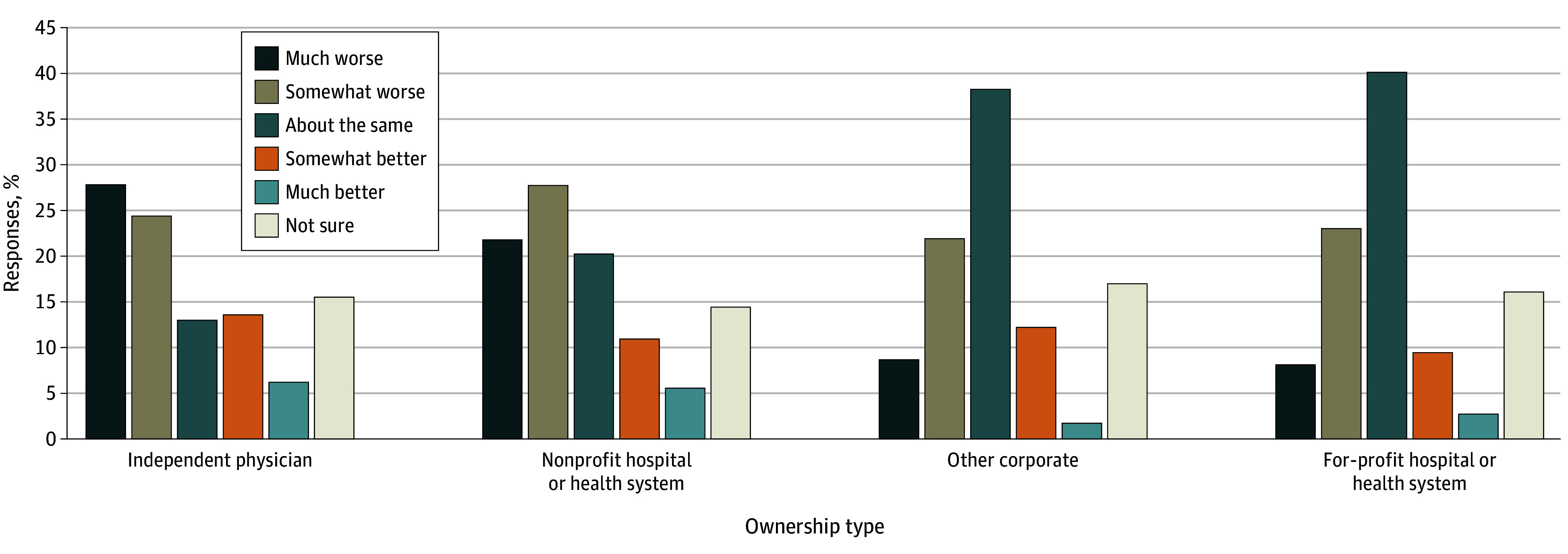
Data are from a survey of 525 actively practicing MD or DO physicians using the American College of Physicians Internal Medicine Insider Research Panel. Shown are responses to the question, “Compared to the following forms of ownership, is private equity ownership much worse, somewhat worse, about the same, somewhat better, or much better than [ownership type].”
Figure 2. Perspectives of Private Equity’s Effects on Various Health Care Dimensions.

Data are from a survey of 525 actively practicing MD or DO physicians using the American College of Physicians Internal Medicine Insider Research Panel. Shown are responses to the question, “What is your opinion of the effect of private equity involvement in the health care sector on [aspect of health care].”
Discussion
Physicians expressed largely negative views about PE’s effects on the health care system, with concerns about physician well-being, health care spending, and equity. A smaller proportion of respondents had positive views toward PE. While this survey had a limited sample size and is not generalizable to non-ACP members, our findings add to the dearth of evidence on PE’s perceived effects on physicians. Our estimates of PE-involved physicians mirror those in the literature6 and suggest new areas for inquiry around clinical practice and workplace experience.
Data Sharing Statement
References
- 1.Zhu JM, Polsky D. Private equity and physician medical practices—navigating a changing ecosystem. N Engl J Med. 2021;384(11):981-983. doi: 10.1056/NEJMp2032115 [DOI] [PubMed] [Google Scholar]
- 2.Bruch JD, Foot C, Singh Y, Song Z, Polsky D, Zhu JM. Workforce composition in private equity-acquired versus non-private equity-acquired physician practices. Health Aff (Millwood). 2023;42(1):121-129. doi: 10.1377/hlthaff.2022.00308 [DOI] [PubMed] [Google Scholar]
- 3.Shanafelt T, Goh J, Sinsky C. The business case for investing in physician well-being. JAMA Intern Med. 2017;177(12):1826-1832. doi: 10.1001/jamainternmed.2017.4340 [DOI] [PubMed] [Google Scholar]
- 4.Khan MA, Sridhar J, Kuriyan AE, Ho AC. Private equity transactions: perceptions of U.S. vitreoretinal surgery fellows. Ophthalmol Retina. 2021;5(8):832-834. doi: 10.1016/j.oret.2020.12.014 [DOI] [PubMed] [Google Scholar]
- 5.Ortiz DA, Muroff LR, Vijayasarathi A. Early-career radiologists’ perceptions of national corporations in radiology. J Am Coll Radiol. 2020;17(3):349-354. doi: 10.1016/j.jacr.2019.12.013 [DOI] [PubMed] [Google Scholar]
- 6.Singh Y, Zhu JM, Polsky D, Song Z. Geographic variation in private equity penetration across select office-based physician specialties in the US. JAMA Health Forum. 2022;3(4):e220825. doi: 10.1001/jamahealthforum.2022.0825 [DOI] [PMC free article] [PubMed] [Google Scholar]
Associated Data
This section collects any data citations, data availability statements, or supplementary materials included in this article.
Supplementary Materials
Data Sharing Statement
