



Abstract
A computed tomography (CT) image of the patient's neck after a cricothyroidotomy was performed due to upper airway obstruction. The CT revealed that the tracheostomy tube was inserted into the thyrohyoid membrane, not the cricothyroid ligament.
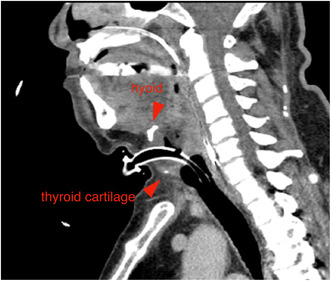
A 59‐year‐old male, with a short neck due to obesity with a body mass index of 32, presented to the emergency department with a 3‐day history of fever, sore throat, and dyspnea. The patient was breathing effortfully on inspiration, and a stridor was auscultated. Fiberoptic laryngoscopy revealed a red and swollen epiglottis, consistent with acute epiglottitis (Figure 1A). After unsuccessful attempts at oral intubation due to upper airway obstruction, an urgent cricothyrotomy was performed. Identification of the cricothyroid membrane was challenging due to the short neck and the vertical movement of the thyroid cartilage during respiration, despite extending the neck as far as possible. A 7 mm internal diameter tracheostomy tube was inserted and the upper airway obstruction was relieved. However, computed tomography after the cricothyroidotomy demonstrated that the tracheostomy tube was inserted into the thyrohyoid ligament, not the cricothyroid membrane (Figure 1B).
FIGURE 1.
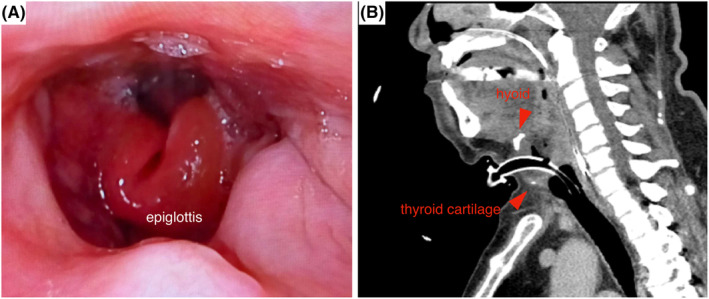
(A) Fiberoptic laryngoscopy on admission shows a red and swollen epiglottis, consistent with acute epiglottitis. (B) A computed tomography image of the patient's neck after a cricothyroidotomy reveals that the tracheostomy tube was inserted into the thyrohyoid membrane, not the cricothyroid ligament.
Cricothyroidotomy is a life‐saving procedure in the “cannot ventilate, cannot intubate” situation. 1 Tube displacement due to misidentification of the cricothyroid membrane is the most common complication, especially in obese patients. 2 Pre‐procedure ultrasonography and a vertical skin incision are useful in identifying the cricothyroid membrane. 3 , 4
CONFLICT OF INTEREST STATEMENT
Dr. Takashi Moriya is an Editorial Board member of AMS Journal and a co‐author of this article. To minimize bias, they were excluded from all editorial decision‐making related to the acceptance of this article for publication.
ETHICS STATEMENT
Approval of the research protocol: N/A.
Informed consent: Written informed consent was obtained from the patient.
Registry and the registration no. of the study/trial: N/A.
Animal studies: N/A.
Taira H, Kashiura M, Moriya T. Thyrohyoidotomy: A complication of cricothyroidotomy. Acute Med Surg. 2024;11:e937. 10.1002/ams2.937
DATA AVAILABILITY STATEMENT
Data sharing not applicable to this article as no datasets were generated or analysed during the current study.
REFERENCES
- 1. Wong DT, Lai K, Chung FF, Ho RY. Cannot intubate‐cannot ventilate and difficult intubation strategies: results of a Canadian National Survey. Anesth Analg. 2005;100(5):1439–1446. [DOI] [PubMed] [Google Scholar]
- 2. McGill J, Clinton JE, Ruiz E. Cricothyrotomy in the emergency department. Ann Emerg Med. 1982;11(7):361–364. [DOI] [PubMed] [Google Scholar]
- 3. Rai Y, You‐Ten E, Zasso F, De Castro C, Ye XY, Siddiqui N. The role of ultrasound in front‐of‐neck access for cricothyroid membrane identification: a systematic review. J Crit Care. 2020;60:161–168. [DOI] [PubMed] [Google Scholar]
- 4. Frerk C, Mitchell VS, McNarry AF, Mendonca C, Bhagrath R, Patel A, et al. Difficult Airway Society 2015 guidelines for management of unanticipated difficult intubation in adults. Br J Anaesth. 2015;115(6):827–848. [DOI] [PMC free article] [PubMed] [Google Scholar]
Associated Data
This section collects any data citations, data availability statements, or supplementary materials included in this article.
Data Availability Statement
Data sharing not applicable to this article as no datasets were generated or analysed during the current study.