



Abstract
Introduction Distal radius fractures (DRFs) are among the most common orthopaedic injuries. The prevalence of DRFs is increasing across all age groups but remains the second most common fracture in the elderly. The modified frailty index (MFI) often predicts morbidity and mortality in orthopaedic injuries. This study aims to determine the predictive value of MFI on complication rates following DRF and the patient length of stay and discharge outcomes.
Methods We utilized our MFI to perform a retrospective analysis of the American College of Surgeons National Surgical Quality Improvement Program database.
Results In a total of 22,313 patients, the average age was 46 ± 16. An increase in MFI led to an increase in the odds ratio of readmission and reoperation ( p < 0.001). MFI predicted complications, doubling the rate as the score increased from 1 to 2 ( p < 0.001). An MFI of 2 also led to a delayed hospital stay of 5 days ( p < 0.001), as well as an increase in the odds of patients not being sent home at discharge ( p < 0.001). Finally, life-threatening complications were also predicted with an increased MFI, the odds of a life-threatening complication increasing 488.20 times at an MFI of 3 ( p < 0.001).
Discussion and Conclusion While surgical decision-making for frail patients with DRFs remains contentious, this novel 8-item MFI score was significantly associated with the probability of hospital readmission/reoperation, postoperative complications, and delayed hospital length of stay. Three new parameters were incorporated into our 8-item score compared with the conventional 5; hypoalbuminemia status (< 3.5 mg/dL), previous diagnosis of osteoporosis, and severe obesity (body mass index > 35) enhancing its sensitivity. Future studies are warranted for its prospective utility in ruling out postsurgical comorbidity.
Keywords: distal radius fracture, modified frailty index, risk assessment, length of stay
Distal radius fractures (DRFs) are common orthopaedic injuries, with approximately 643,000 fractures occurring annually in the United States. Among elderly patients, fractures to the distal radius are the second most common type and the most common in the upper extremity for women over 50. The incidence rate of DRFs was found to increase with age, with elderly patients having the highest incidence. 1 Although elderly patients are highly affected by these fractures, the prevalence of DRFs is rising across all age groups. 2
Preoperative risk stratification is essential to minimize postoperative complications in the inpatient or outpatient setting. Osteoporosis, white race, bone mineral density, and female sex are all previously investigated risk factors for DRFs. 2 Frailty, a marker for a decrease in physiologic function, has shown merit in assessing risk for various fractures. 3 The modified frailty index (MFI) predicts morbidity and mortality in many orthopaedic injuries. 4 To our knowledge, the effect of frailty on DRFs has not been well characterized. In this study, we investigate the predictive value of a novel 8-component MFI on the outcomes following DRF. The primary aim of our study is to determine the predictive value of a novel MFI in predicting rates of complications, patient length of hospital stay, and discharge disposition following DRFs. We hypothesize that our MFI will be highly predictive of postoperative complications following fixation of DRFs and that increased frailty will directly correlate to increased rates of postoperative complications.
Methods
We retrospectively analyzed the American College of Surgeons (ACS) National Surgical Quality Improvement Program (NSQIP) database. The ACS NSQIP is a multi-institution and multicenter database that collects more than 270 patient variables from more than 500 hospitals. Patient variables are extracted via trained clinical reviewers who match each patient with their Current Procedural Terminology (CPT) code. The database undergoes audits and quality checks for validation. 5
We collected patient characteristics such as demographics, smoking history, American Society of Anesthesiologists (ASA) class, and medical comorbidities, including diabetes, chronic obstructive pulmonary disorder (COPD), liver disease with ascites, congestive heart failure, hypertension, and dialysis-dependent kidney disease. Body mass index (BMI) was calculated for each patient's height and weight. Inclusion criteria are as follows: patients older than 50 and undergoing open reduction internal fixation for a DRF. Patients were excluded if data fields were missing or had apparent errors.
Modified Frailty Index
The patient variables of interest selected for 8-component MFI included: severe obesity (BMI > 35), diagnosis of osteoporosis, nonindependent functional status prior to surgery, history of congestive heart failure within 30 days of surgery, hypoalbuminemia status (< 3.5), hypertension requiring medication, history of COPD or pneumonia, and diabetes mellitus (type 1 or 2) ( Table 1 ). Using our 8-component MFI, patients were classified into one of four categories, with each progressive level implying a greater degree of frailty and risk of poor patient outcomes. The frailty index assigned to each patient ranged from 0 to 3. An MFI of 0 indicates no risk factors, an MFI of 1 indicates 1 to 2 risk factors, an MFI of 2 indicates 3 or 4 risk factors, and an MFI of 3 indicates 5 or more risk factors.
Table 1. Components of the MFI-8 to be utilized for distal radius fractures.
| Modified frailty index criteria |
|---|
| Severe obesity (BMI > 35) |
| Diagnosis of osteoporosis |
| Nonindependent functional status |
| CHF within 30 days of surgery |
| Hypoalbuminemia (albumin < 3.5) |
| Hypertension requiring medication |
| History of COPD or pneumonia |
| Diabetes mellitus (type I or II) |
Abbreviations: BMI, body mass index; CHF, congestive heart failure; COPD, chronic obstructive pulmonary disorder; MFI, modified frailty index.
Outcome Data
Postoperative complications, hospital length of stay (LOS), discharge disposition, reoperation, and readmission data were collected for each patient. Complications were recorded based on five categories that can be further broken down as follows: pulmonary complications (pneumonia, pulmonary embolism, unplanned intubation, ventilator use greater than 48 hours, ventilator dependent), cardiac (cardiac arrest requiring cardiopulmonary resuscitation [CPR], myocardial infarction), wound (open or infected wound, dehiscence, contaminated or dirty wound, deep incisional surgical site infection [SSI], superficial SSI, wound disruption), hematologic (deep vein thrombosis/thrombophlebitis, bleeding transfusions), and renal (acute renal failure, progressive renal insufficiency). Clavien-Dindo IV life-threatening complication was defined as having any of the following occurrences: cardiac arrest requiring CPR, myocardial infarction, septic shock, pulmonary embolism, acute renal failure, or cerebrovascular accident/stroke with a neurological defect within 30 days of surgery. 6 Adverse discharges were counted as any patient discharged anywhere other than home. Length of hospital stay was collected as a linear variable, and categorical variable for hospital stay delayed longer than 3 days.
Statistical Analysis
The sample was split into cohorts based on MFI status as assessed by our scoring system. The International Business Machines (IBM) Statistical Package for the Social Sciences (SPSS) suite was then used to assess and analyze the data. Power calculations were formed using the University of California Los Angeles's Advanced Research Computing Statistical Methods and Data Analysis G*Power Statistics tool.
Individual levels of MFI then underwent analysis to contrast complications and means of mentioned variables. Next, data was first assessed to ensure a proper statistical assessment was selected and that the variables met the assumptions and requirements for each test. Comparisons between normally distributed data were made with independent sample t -tests. At the same time, nonnormally distributed data were assessed via Wilcoxon rank-sum test. Where appropriate, categorical variables were analyzed via Fisher's exact test or chi-square with Kendall Tau. Where necessary, residuals were assessed for normal distribution and multicollinearity. Finally, multiple logistic and linear regression models were created to demonstrate connections between MFI, various categorical and linear variables, and postoperative outcomes. Regression models are reported as odds ratios (ORs) with a p -value of 0.05 considered significant and confidence intervals set at 95% (95% CI).
Results
Demographic Information
Data were extracted from the ACS-NSQIP by querying for CPT codes for DRF; 22,313 patients were collected from the NSQIP. Demographic data for patients included: age, gender, BMI, and race. The mean age for the patients was 56 ± 16 years, and most were female (73.1%). The average BMI of the patients was 28.27 ± 6.67. Additionally, most patients were non-black (95.8%) and non-Hispanic (89.4%). A more detailed breakdown of demographics can be found in Table 2 .
Table 2. Demographics for each MFI level for patients undergoing surgical repair for distal radius fracture.
| Demographics | MFI 0 | MFI 1 | MFI 2 | MFI 3 |
|---|---|---|---|---|
| Mean ± SD | ||||
| N | 10,417 (46.7) | 10,587 (47.4) | 1,274 (5.7) | 35 (0.2) |
| Age (y) | 51.3 ± 16.6 | 60.1 ± 15.1 | 66.2 ± 10.8 | 69.0 ± 10.0 |
| Body mass index | 24.5 ± 3.1 | 30.9 +6.9 | 35.4 ± 7.5 | 35.9 +7.2 |
| N (%) | ||||
| Hispanic | 1,000 (9.6) | 1,210 (11.4) | 151 (11.9) | 3 (8.6) |
| Black gender | 323 (3.1) | 544 (5.1) | 68 (5.3) | 2 (5.7) |
| Female | 7,125 (68.9) | 8,084 (76.4) | 1,013 (79.5) | 28 (80) |
| Male | 3,242 (31.1) | 2,503 (23.6) | 261 (20.5) | 7 (20) |
Abbreviations: MFI, modified frailty index; SD, standard deviation.
The total number of patients included in each MFI category is as follows: 10,417 patients (46.7%) in MFI = 0, 10,587 patients (47.4%) in MFI = 1, 1,274 patients (5.70%) in MFI = 2, and 35 patients (0.15%) in MFI = 3.
MFI and Readmission/Reoperation
For each increment increase in MFI, the odds of readmission increased. At a MFI of 1, the odds of readmission was 2.57 (95% CI [1.94–3.41]; p < 0.001). At a MFI of 2, the odds was 8.81 (95% CI [5.79–11.56]; p < 0.001). At a MFI of 3, the odds was 25.37 (95% CI [9.56–67.34]; p < 0.001, Fig. 1 , Table 3 ).
Fig. 1.
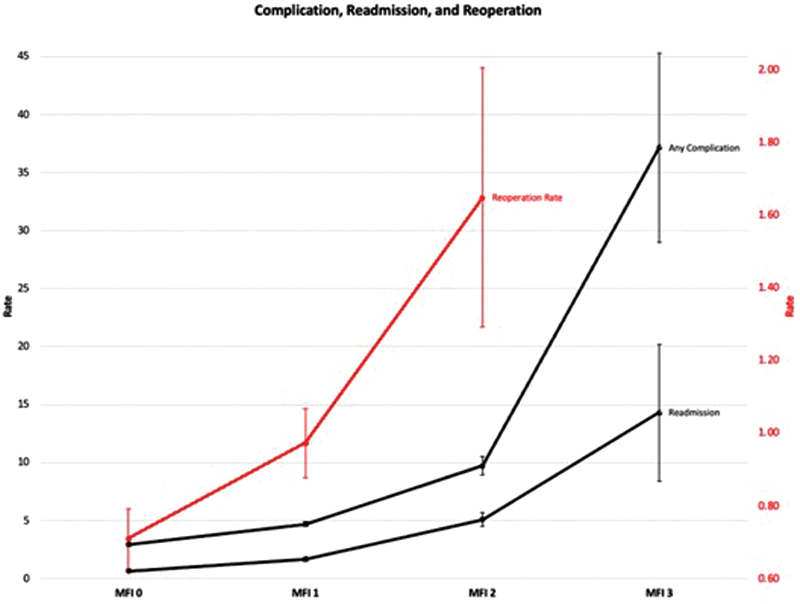
Complication, readmission, and reoperation rate with increasing modified frailty index (MFI) level.
Table 3. Postoperative outcomes for each MFI level of patients undergoing distal radius fracture repair.
| Logistic regression | Odds ratio | 95% CI | p |
|---|---|---|---|
| Complication | |||
| Readmission | |||
| MFI 1 | 2.57 | [1.94–1.3097] | < 0.001 |
| MFI 2 | 8.18 | [1.579–11.567] | < 0.001 |
| MFI 3 | 25.37 | [9.56–67.347] | < 0.001 |
| Reoperation | |||
| MFI 1 | 1.37 | [1.02–1.857] | 0.04 |
| MFI 2 | 2.34 | [1.44–3.821] | < 0.001 |
| Any complication | |||
| MFI 1 | 1.63 | [1.41–1.881] | < 0.001 |
| MFI 2 | 3.55 | [2.86–4.417] | < 0.001 |
| MFI 3 | 19.46 | [9.71–38.99] | < 0.001 |
| Delayed stay 3 d | |||
| MFI 1 | 2.23 | [1.94–2.557] | < 0.001 |
| MFI 2 | 5.21 | [4.29–6.331] | < 0.001 |
| MFI 3 | 27.18 | [13.85–53.367] | < 0.001 |
| Not sent home | |||
| MFI 1 | 2.59 | [2.16–3.12] | < 0.001 |
| MFI 2 | 7.35 | [5.81–9.35] | < 0.001 |
| MFI 3 | 66.67 | [34.48–125.007] | < 0.001 |
| Clavien-Dindo IV | |||
| MFI 1 | 13.32 | [3.17–56.017] | < 0.001 |
| MFI 2 | 41.20 | [9.02–188.24] | < 0.001 |
| MFI 3 | 488.20 | [78.90–3020.77] | < 0.001 |
| Linear regression | Impact | SE | p |
| MFI | 0.344 d | 0.02 | < 0.001 |
Abbreviations: CI, confidence interval; MFI, modified frailty index; SE, standard error.
Likewise, an increase in MFI led to a nearly two times increase in the odds of reoperation. As the MFI increased from 1 to 2, the odds of reoperation increased from 1.37 (95% CI [1.02–1.85]; p = 0.04) to 2.34 (95% CI [1.44–3.82]; p < 0.001, Fig. 1 , Table 3 ), respectively.
MFI and Any Complication
An increase in MFI led to an increase in any postoperative complication. At an MFI value of 1, the odds for postoperative complication was 1.63 (95% CI [1.41–1.88]; p < 0.001). At an MFI value of 2, the odds increased to 3.55 (95% CI [2.86–4.41]; p < 0.001). At an MFI value of 3, the OR increased to 19.46 (95% CI [9.71–38.99]; p < 0.001, Fig. 1 , Table 3 ).
MFI and Delayed Stay
Frailty and increased MFI was also associated with delayed hospital stay > 3 days, with both MFI of 2 (OR 5.21 [95% CI 4.29–6.33]; p < 0.001) and MFI of 3 (OR 27.18 [95% CI 13.85–53.36]; p < 0.001) had significantly increased rates of delayed hospital stay ( Fig. 2 , Table 3 ). Additionally, for each increase in MFI, the mean length of hospital stay increased by 0.344 (standard error 0.02, p < 0.001) days ( Fig. 2 , Table 3 ).
Fig. 2.

Delayed hospital stay and mean length of stay for each modified frailty index (MFI) level of patients undergoing repair for distal radius fracture (DRF).
MFI and Not Sent Home
Frailty also negatively impacted hospital discharge, with increased MFI resulting in patients not being sent home at discharge. Patients with an MFI value of 2 were 7.35 (95% CI [5.81–9.35]; p < 0.001) times more likely of not being sent home, and patients with an MFI value of 3 were 66.67 (95% CI [34.48–125.00]; p < 0.001) more likely of not being sent home at discharge ( Table 3 ).
MFI and Clavien-Dindo IV
Clavien-Dindo class IV complications increased with an increase in MFI. As MFI increased from 1 to 2, OR of Clavien-Dindo class IV complications increased from 13.32 (95% CI [3.17–56.01]; p < 0.001) to 41.20 (95% CI [9.02–188.24]; p < 0.001), respectively. At MFI value of 3, the OR for Clavien-Dindo class IV complications was 488.20 (95% CI [78.90–3020.77]; p < 0.001, Table 3 ).
Discussion
Our national cohort analysis of DRFs with a MFI found independent and significant associations between MFI and (1) hospital readmission/reoperation, (2) any complication, (3) wound, pulmonary, cardiac, hematologic, and renal complications, (4) delayed hospital LOS, and (5) not sent home at discharge.
Surgical decision-making for frail patients with DRFs remains contentious. 7 A prospective randomized control trial by Arora et al 8 comparing operative and nonoperative outcomes in patients > 65 years of age with DRFs ( n = 73) found that there were significantly more complications in the operative group ( p < 0.05, n = 36). Systematic review and meta-analysis in the literature highlight caution when operating on patients at risk for complications because they outweigh the benefits in this patient population. 9 Arora et al showed similar results concerning age and postsurgical complications in DRFs. 8 More emphasis has been placed on the need for standardized risk assessment tools to better inform surgical decision-making.
Evidence in the literature has refuted that MFI is predictive of postoperative complications under broad surgical circumstances. 10 In these assessments, however, other previous medical conditions that we have included as variables in our study, such as malnourishment, were independent predictors of prolonged LOS. 11 Contrary to these studies, other prospective 12 and retrospective 13 studies on spinal surgery utilizing the MFI score have found it to be an effective predictor of increased hospital LOS and hospital readmission. The MFI has been associated with a greater risk for complications in DRFs. 3 There is no consensus on the optimal parameters when assessing frailty, but most studies have overlap in what they consider. 14 In our study, we utilized three additional parameters: hypoalbuminemia status (< 3.5 mg/dL), previous diagnosis of osteoporosis, and severe obesity (BMI > 35).
Using a 5-item MFI, Wilson et al 3 report that it is predictive in identifying hospital readmission within 30 days after discharge (MFI = 2; OR = 2.67). Our 8-item MFI yielded a more significant probability, signaling that patients with an MFI = 2 are 8.18 times (95% CI = 5.79–11.56) more likely to be readmitted to the hospital ( Table 3 ). We believe that our higher probabilities in the 8-item MFI are due to our study's focus on hypoalbuminemia, previous diagnosis of osteoporosis, and severe obesity. A prospective cohort study found an inverse relationship between serum albumin and hip, humeral, and wrist fracture risk. 15 Additionally, the hypoalbuminemia state has been characterized by increased proinflammatory cytokines and acute phase proteins, leading to poor outcomes. 16 Despite some controversy, hypoalbuminemia has also been independently associated with osteoporosis. 17 Retrospective analyses in the literature show the incidence of readmission trending toward the older population. 18 19 In our study and Wilson et al, the MFI score increased with age ( p < 0.001), but age alone was not an independent predictor of postoperative complications. In a study of hypoalbuminemia in postmenopausal women, osteoporosis was not a result of the average loss of bone density in aging but independently due to hypoalbuminemia. 20 Lastly, obesity is associated with vitamin D deficiency, which impairs calcium absorption from the gut. 21 Our MFI score has been designed to encompass important wound healing characteristics not previously investigated in other MFI scores. These additional components and our higher sample size may be providing the power behind our greater OR scores.
Vu et al utilized an 11-component MFI index to predict life-threatening complications in orthopaedic patients undergoing traumatic procedures. 22 However, our MFI was a better predictor of life-threatening complications in DRFs. While the 11-component MFI had been validated in previous studies, it includes metrics that may not be a good predictor of orthopaedic outcomes.
A cost analysis study of DRFs between 2009 and 2015 found that time outside of the operating room could account for anywhere between 9 and 41% of the total cost of care. These do not specifically refer to the LOS but components involved, such as anesthesia and drugs, imaging, and therapy costs. 23 In addition to impacting cost, the hospital's LOS can expose patients to nosocomial infections. Therefore, knowledge of a patient's risk for delay in discharge can better inform patient care plans and cost transparency in the medical field.
We found that increases in MFI score correlated with an increased length of hospital stay ≥ 3 days. A typical DRF patient treated surgically is discharged from the clinic in 1 to 2 days. In some instances, a patient is discharged to a postacute care facility. Studies have identified associations to identify patients at risk for such recovery paths as anemia, preoperative complication, ASA > 2, bilateral surgery, and other parameters. 24 Our MFI score was also a significant predictor of patients' “Not Home Discharge” ( p < 0.001) and incorporates some of the same variables. Operating costs for DRFs have been cheaper in outpatient services, but complications drive these costs toward in-patient facilities. 25 The MFI can inform patients, clinicians, and even insurance companies of the potential for the financial burden .
Limitations
Inherently by design, the retrospective study is subject to multiple errors. Lemos et al notes that most studies on frailty have been associated with adverse outcomes but also have been retrospective. 14 Future studies should focus on applying these metrics prospectively. In addition, defining categories is challenging and varies across different classifications of the frailty index. Furthermore, as the categorical variable for MFI increases, specificity concerning which variables are included in the calculation of the MFI is random and masks important indices for comorbidity. Future studies could focus on analyzing which variables introduce the most considerable changes within the MFI OR. Remaining consistent with the classification of the MFI across different studies has been a challenge in the literature since the score's conception in Canada. After an optimal combination of variables for practically determined premium sensitivity, future studies should focus on a uniform classification of frailty for specific surgical circumstances. More importantly, these frailty indices should be applied prospectively. A study similar to Subramaniam et al comparing the sensitivity between the 5-item MFI and the one proposed here is warranted. 4 This increased sensitivity detected by our 8-item MFI may be due to the addition of our three additional variables or our large patient cohort.
Conclusion
Our study showed in a large sample ( n = 22,313) that the 8-item MFI correlates with readmission, reoperation, postoperative complications (wound, cardiac, pulmonary, hematologic, renal), a delayed hospital stay, and not being sent home at discharge. An MFI = 2 was most predictive of reoperation rates and complications and less predictive of hospital readmission. The sensitivity highlighted by this new 8-item MFI addresses the need for a frailty index that is precise enough to be predictive but practical enough for clinical use.
Acknowledgments
None.
Funding Statement
Funding None.
Footnotes
Conflict of Interest None Declared.
References
- 1.Nellans K W, Kowalski E, Chung K C. The epidemiology of distal radius fractures. Hand Clin. 2012;28(02):113–125. doi: 10.1016/j.hcl.2012.02.001. [DOI] [PMC free article] [PubMed] [Google Scholar]
- 2.Liporace F A, Adams M R, Capo J T, Koval K J. Distal radius fractures. J Orthop Trauma. 2009;23(10):739–748. doi: 10.1097/BOT.0b013e3181ba46d3. [DOI] [PubMed] [Google Scholar]
- 3.Wilson J M, Holzgrefe R E, Staley C A, Schenker M L, Meals C G. Use of a 5-item modified frailty index for risk stratification in patients undergoing surgical management of distal radius fractures. J Hand Surg Am. 2018;43(08):701–709. doi: 10.1016/j.jhsa.2018.05.029. [DOI] [PubMed] [Google Scholar]
- 4.Subramaniam S, Aalberg J J, Soriano R P, Divino C M. New 5-factor modified frailty index using American College of Surgeons NSQIP data. J Am Coll Surg. 2018;226(02):173–1.81E10. doi: 10.1016/j.jamcollsurg.2017.11.005. [DOI] [PubMed] [Google Scholar]
- 5.Huang C-S, Cheu Y-D, Ying J, Wei M-H. Association between provider volume and comorbidity on hospital utilization and outcomes of total hip arthroplasty among National Health Insurance enrollees. J Formos Med Assoc. 2011;110(06):401–409. doi: 10.1016/S0929-6646(11)60059-4. [DOI] [PubMed] [Google Scholar]
- 6.Clavien P A, Barkun J, de Oliveira M L et al. The Clavien-Dindo classification of surgical complications: five-year experience. Ann Surg. 2009;250(02):187–196. doi: 10.1097/SLA.0b013e3181b13ca2. [DOI] [PubMed] [Google Scholar]
- 7.Levin L S, Rozell J C, Pulos N. Distal radius fractures in the elderly. J Am Acad Orthop Surg. 2017;25(03):179–187. doi: 10.5435/JAAOS-D-15-00676. [DOI] [PubMed] [Google Scholar]
- 8.Arora R, Lutz M, Deml C, Krappinger D, Haug L, Gabl M. A prospective randomized trial comparing nonoperative treatment with volar locking plate fixation for displaced and unstable distal radial fractures in patients sixty-five years of age and older. J Bone Joint Surg Am. 2011;93(23):2146–2153. doi: 10.2106/JBJS.J.01597. [DOI] [PubMed] [Google Scholar]
- 9.Ju J-H, Jin G-Z, Li G-X, Hu H-Y, Hou R-X. Comparison of treatment outcomes between nonsurgical and surgical treatment of distal radius fracture in elderly: a systematic review and meta-analysis. Langenbecks Arch Surg. 2015;400(07):767–779. doi: 10.1007/s00423-015-1324-9. [DOI] [PubMed] [Google Scholar]
- 10.Charest-Morin R, Street J, Zhang H et al. Frailty and sarcopenia do not predict adverse events in an elderly population undergoing non-complex primary elective surgery for degenerative conditions of the lumbar spine. Spine J. 2018;18(02):245–254. doi: 10.1016/j.spinee.2017.07.003. [DOI] [PubMed] [Google Scholar]
- 11.Elsamadicy A A, Freedman I G, Koo A B et al. Modified-frailty index does not independently predict complications, hospital length of stay or 30-day readmission rates following posterior lumbar decompression and fusion for spondylolisthesis. Spine J. 2021;21(11):1812–1821. doi: 10.1016/j.spinee.2021.05.011. [DOI] [PubMed] [Google Scholar]
- 12.Agarwal N, Goldschmidt E, Taylor T et al. Impact of frailty on outcomes following spine surgery: a prospective cohort analysis of 668 patients. Neurosurgery. 2021;88(03):552–557. doi: 10.1093/neuros/nyaa468. [DOI] [PubMed] [Google Scholar]
- 13.Weaver D J, Malik A T, Jain N, Yu E, Kim J, Khan S N.The modified 5-item frailty index: a concise and useful tool for assessing the impact of frailty on postoperative morbidity following elective posterior lumbar fusions World Neurosurg 2019S1878–8750.(19)30038-5 [DOI] [PubMed] [Google Scholar]
- 14.Lemos J L, Welch J M, Xiao M, Shapiro L M, Adeli E, Kamal R N. Is frailty associated with adverse outcomes after orthopaedic surgery?: a systematic review and assessment of definitions. JBJS Rev. 2021;9(12):x. doi: 10.2106/JBJS.RVW.21.00065. [DOI] [PubMed] [Google Scholar]
- 15.Kunutsor S K, Voutilainen A, Whitehouse M R et al. Serum albumin and future risk of hip, humeral, and wrist fractures in Caucasian men: new findings from a prospective cohort study. Med Princ Pract. 2019;28(05):401–409. doi: 10.1159/000499738. [DOI] [PMC free article] [PubMed] [Google Scholar]
- 16.Fong Y, Moldawer L L, Shires G T, Lowry S F. The biologic characteristics of cytokines and their implication in surgical injury. Surg Gynecol Obstet. 1990;170(04):363–378. [PubMed] [Google Scholar]
- 17.Afshinnia F, Wong K K, Sundaram B, Ackermann R J, Pennathur S. Hypoalbuminemia and osteoporosis: reappraisal of a controversy. J Clin Endocrinol Metab. 2016;101(01):167–175. doi: 10.1210/jc.2015-3212. [DOI] [PMC free article] [PubMed] [Google Scholar]
- 18.Curtin C M, Hernandez-Boussard T. Readmissions after treatment of distal radius fractures. J Hand Surg Am. 2014;39(10):1926–1932. doi: 10.1016/j.jhsa.2014.07.041. [DOI] [PubMed] [Google Scholar]
- 19.Malpani R, John T S, Mercier M R et al. Readmissions after distal radius fracture open reduction and internal fixation: an analysis of 11,124 patients. J Am Acad Orthop Surg Glob Res Rev. 2020;4(07):e2000110. doi: 10.5435/JAAOSGlobal-D-20-00110. [DOI] [PMC free article] [PubMed] [Google Scholar]
- 20.D'Erasmo E, Pisani D, Ragno A, Raejntroph N, Letizia C, Acca M. Relationship between serum albumin and bone mineral density in postmenopausal women and in patients with hypoalbuminemia. Horm Metab Res. 1999;31(06):385–388. doi: 10.1055/s-2007-978760. [DOI] [PubMed] [Google Scholar]
- 21.Pierpont Y N, Dinh T P, Salas R E et al. Obesity and surgical wound healing: a current review. ISRN Obes. 2014;2014:638936. doi: 10.1155/2014/638936. [DOI] [PMC free article] [PubMed] [Google Scholar]
- 22.Vu C CL, Runner R P, Reisman W M, Schenker M L. The frail fail: increased mortality and post-operative complications in orthopaedic trauma patients. Injury. 2017;48(11):2443–2450. doi: 10.1016/j.injury.2017.08.026. [DOI] [PubMed] [Google Scholar]
- 23.Huetteman H E, Zhong L, Chung K C. Cost of surgical treatment for distal radius fractures and the implications of episode-based bundled payments. J Hand Surg Am. 2018;43(08):720–730. doi: 10.1016/j.jhsa.2018.05.007. [DOI] [PubMed] [Google Scholar]
- 24.Donato D P, Simpson A M, Willcockson J, Veith J, King B W, Agarwal J P.Associations with discharge to post-acute care facilities among patients undergoing open reduction internal fixation of distal radius fractures Plast Surg (Oakv) 202222925503221085082: 10.1177/22925503221085082 [DOI] [PMC free article] [PubMed] [Google Scholar]
- 25.Mather R C, III, Wysocki R W, Mack Aldridge J, III, Pietrobon R, Nunley J A. Effect of facility on the operative costs of distal radius fractures. J Hand Surg Am. 2011;36(07):1142–1148. doi: 10.1016/j.jhsa.2011.03.042. [DOI] [PubMed] [Google Scholar]