



Abstract
BACKGROUND:
Organ transplantation is an effective therapy for end-stage organ failure. However, there is a large gap between the need for and the supply of donor organs.
OBJECTIVES:
This study aimed to assess nursing students’ knowledge and attitudes about organ donation.
MATERIALS AND METHODS:
This is a descriptive cross-sectional design study. The study was conducted at four faculties of nursing, which were Baghdad, Misan, Tikrit, and Kirkuk in Iraq. The three tools included are as follows: I: Socio-Demographic Questionnaire; II: Organ-Tissue Donation and Transplantation Knowledge Scale (ODTKS); and III: Organ Donation Attitude Scale (ODAS).
RESULTS:
More than two-thirds (71%) of the studied students have an accepted level of knowledge, while 70% of the studied students had a positive attitude toward organ donation and transplantation. There were statistically significant differences (P- value <0.05) between socio-demographic characteristics and knowledge level regarding gender, marital status, and academic year. Also, there were significant differences between socio-demographic characteristics and students’ attitude levels regarding gender and academic year.
CONCLUSION:
More than two-thirds of students had a good and fair level of knowledge and a positive attitude toward organ donation and transplantation. Providing lectures within the curriculum is needed for students to raise their knowledge and attitude about organ transplantation and donation.
Keywords: Grafting, health personnel attitudes, knowledge, nursing students’, organ transplantation
Introduction
Currently, organ donation is an extremely important issue in public health. Organ donation is a complicated and multifactorial problem that involves medical, legal, ethical, and organizational.[1] It is described as an act of providing one or more organs to another individual, without compensation.[2] Living organ transplantation concerns the medical procedure that uses a living donor’s organ to replace the recipient’s failed organ.[3] Living organ transplant is valuable to patients with end-stage organ failure, which could extend their lifespan and improve the quality of their lives. In 2021, the United States performed 6541 living organ transplants.[4] The survival and life quality of patients undergoing organ transplantation have improved in recent years, due to medical and technical developments.[5] Vital organs such as the heart, pancreas, liver, kidneys, and lungs may be transplanted to those whose organs fail, and it enables many recipients to return to a normal pattern of life.[6] Organ transplantation has a tremendous positive effect on the recipient’s general health, reduces the socioeconomic burden, and has become a crucial measure to improve both quality and duration of life.[7,8] Healthcare workers play an important part in the successful organ donation process.[9] In turn, medical students are the new generation of clinicians who, in the future, will act as a link between donors and recipients. Consequently, obtaining knowledge on the attitudes of medical students concerning organ donation is considered a particularly important issue that has been investigated in the literature.[10] Organ donation is mainly influenced by three factors: knowledge, attitude, and behavior.[11] Nurses are key actors in the organ donation process, and their opinion may affect people’s decisions on organ donation. Furthermore, nurses can help in the educational programs required to promote public organ donation knowledge and attitude.[12,13] This study aimed to assess students’ knowledge and attitude toward organ donation and transplantation at selected faculties of Iraqi nursing colleges.
Materials and Methods
Design and setting
A cross-sectional study was conducted to measure the level of knowledge and attitude toward organ donation among 100 students from the third to fourth years of the undergraduate nursing program from different nursing faculties, which includes Baghdad, Misan, Tikrit, and Kirkuk. The study was conducted from December 1, 2020, to April 15, 2021.
Study participants and sampling
A stratified random sample technique was used to select four facilities of conducted study from all facilities in Iraq. The sampling was applied by dividing the university faculties into one stratum for obtaining a homogenous and sharply defined stratum, and then, using a simple randomization technique, the faculties of nursing faculties the investigator chose randomly third- and fourth-year students because they had more years of learning and are more knowledgeable about the aims of this study. The sample size was calculated using the Lawley formula,[14] which was computed as N = P × 20/100, where N = sample size and P = population.
Data collection and instrument tools
In this study, three interview questionnaires used were as follows: I: Socio-Demographic Questionnaire includes gender, age, residences, marital status, faculty of nursing, and academic year. II: Organ-Tissue Donation and Transplantation Knowledge Scale (ODTKS) adapted by Ozturk et al.[15] is translated into Arabic language by the investigator, and it consists of 17 items. On this scale, one point is given for a correct answer with a total score of 17 grades. The scoring system was classified into three categories as follows: good knowledge if the score is ≥75% (13–17 scores), fair knowledge if the score is 50 ≤75% (7–12 scores), and Poor knowledge if score <50% (<6 scores). III: Organ Donation Attitude Scale (ODAS) adapted by Sayin[16] assesses attitude regarding humanity, moral conviction, and fear of medical neglect and bodily mutilation. The scale was modified by the investigator, the investigator omitted the unnecessary items, and the scale was translated into Arabic language by the investigator. Each item was evaluated on the three-point Likert scale (i.e., 1 = strongly disagree, 2 = agree, and 3 = strongly agree). This gives possible minimum and maximum total scores of 10 and 30 for attitude. The total score of the Attitudes Rating Scale was 30 grades; the scores of the items were summed up and converted into a percentage score. The scoring system was classified into two categories as follows: positive attitude if the score is ≥70% (≥23 scores) and negative attitude if the score is <70% (<22 scores).
Data analysis
The data were analyzed using Statistical Package for Social Science (SPSS) version 24. Descriptive statistics were used in this study (e.g., mean, standard deviation, frequency, and percentage). For quantitative data correlation, the Chi-square test was employed to determine the degree and direction of the relationship between knowledge and attitude. The P- value was considered significant if it was equal to or less than 0.05.
Ethical considerations
This study was approved by the Research Ethics Committee, College of Nursing, University of Baghdad, Iraq, with an ethical approval number 25/11/2020-16105. Preceding the study, a detailed procedure of the study was explained, and each student signed a voluntary consent form.
Results
Table 1 shows that the mean age of the studied students was 22.44 ± 1.409 years. Moreover, 56% of the participants were aged 22 to 23 and 53% of them were female. Additionally, 86% lived in rural areas and 75% were single. 52% of the students were in the fourth study year.
Table 1.
Distribution of the studied students according to their socio-demographic characteristics (n=100 students)
| Variables | Groups | Frequency | Percent |
|---|---|---|---|
| Gender | Male | 47 | 47.0 |
| Female | 53 | 53.0 | |
| M±SD=22.44 (1.409) | |||
| Age (groups) | 20–21 | 29 | 29.0 |
| 22–23 | 56 | 56.0 | |
| 24 and above | 15 | 15.0 | |
| Faculty | Baghdad | 25 | 25.0 |
| Misan | 25 | 25.0 | |
| Kirkuk | 25 | 25.0 | |
| Tikrit | 25 | 25.0 | |
| Academic year | Third stage | 48 | 48.0 |
| Fourth stage | 52 | 52.0 | |
| Marital status | Single | 75 | 75.0 |
| Married | 25 | 25.0 | |
| Residence | Urban | 86 | 86.0 |
| Rural | 14 | 14.0 | |
M±SD=mean±standard deviation
Figure 1 shows that 71% of the studied students had fair knowledge, while 12% of the students had good knowledge. Additionally, 17% of the studied students had poor knowledge in all knowledge items.
Figure 1.
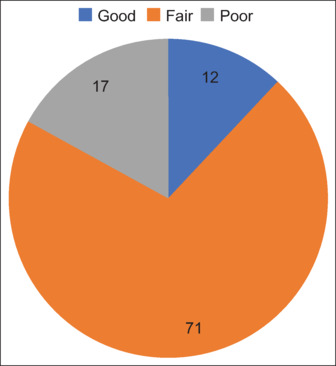
Distribution of the studied students’ total knowledge level, regarding organ donation and transplantation (N=100)
Figure 2 shows that 70% of the studied students had a positive attitude and 30% of studied students had a negative attitude.
Figure 2.
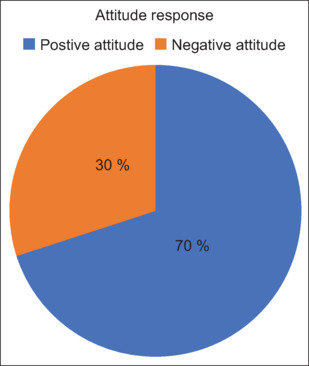
Distribution of the studied students’ total attitudes level, regarding organ donation and transplantation (N=100)
Table 2 shows statistically significant differences between socio-demographic characteristics and level of knowledge regarding gender, faculty, academic year, and marital status at a P- value <0.05.
Table 2.
Relationship between socio-demographic characteristics of the studied students and their knowledge level (n=100)
| Variables | Groups | Good (n=12) |
Fair (n=71) |
Poor (n=17) |
P | |||
|---|---|---|---|---|---|---|---|---|
| n | % | n | % | n | % | |||
| Gender | Male | 4 | 4% | 35 | 35% | 8 | 8% | 0.000** |
| Female | 8 | 8% | 36 | 36% | 9 | 9% | ||
| Age (groups) years | 20–21 | 2 | 2% | 18 | 18% | 9 | 9% | 0.154 |
| 22–23 | 8 | 8% | 42 | 42% | 6 | 6% | ||
| 24 and above | 2 | 2% | 11 | 11% | 2 | 2% | ||
| Faculty | Baghdad | 4 | 4% | 17 | 17% | 4 | 4% | 0.04* |
| Misan | 0 | 0 | 16 | 16% | 9 | 9% | ||
| Kirkuk | 3 | 3% | 19 | 19% | 3 | 3% | ||
| Tikrit | 5 | 5% | 19 | 19% | 1 | 1% | ||
| Academic year | Third stage | 4 | 4% | 33 | 33% | 11 | 11% | 0.000** |
| Fourth stage | 8 | 8% | 38 | 38% | 6 | 6% | ||
| Marital status | Single | 8 | 8% | 51 | 51% | 16 | 16% | 0.037* |
| Married | 4 | 4% | 20 | 20% | 1 | 1% | ||
| Residence | Urban | 10 | 10% | 61 | 61% | 15 | 15% | 0.707 |
| Rural | 2 | 2% | 10 | 10% | 2 | 2% | ||
n = number, % = percentage *Significant at P < 0.05; **highly significant at P < 0.01
Table 3 shows statistically significant differences between socio-demographic characteristics and attitude levels regarding gender, faculty, and academic year at a P- value <0.05.
Table 3.
Relationship between socio-demographic characteristics of the studied students and their attitude (n=100)
| Variables | Groups | Positive attitude (n=70) |
Negative attitude (n=30) |
P | ||
|---|---|---|---|---|---|---|
| n | % | n | % | |||
| Gender | Male | 33 | 33% | 14 | 14% | 0.000** |
| Female | 37 | 37% | 16 | 16% | ||
| Age (groups) years | 20–21 | 25 | 25% | 4 | 4% | 0.986 |
| 22–23 | 36 | 36% | 20 | 20% | ||
| 24 and above | 9 | 9% | 6 | 6% | ||
| Faculty | Baghdad | 25 | 25% | 0 | 0 | 0.000** |
| Misan | 25 | 25% | 0 | 0 | ||
| Kirkuk | 20 | 20% | 5 | 5% | ||
| Tikrit | 0 | 0 | 25 | 25% | ||
| Academic year | Third stage | 37 | 37% | 11 | 11% | 0.000** |
| Fourth stage | 33 | 33% | 19 | 19% | ||
| Marital status | Single | 56 | 56% | 19 | 19% | 0.966 |
| Married | 14 | 14% | 11 | 11% | ||
| Residence | Urban | 62 | 62% | 24 | 24% | 0.211 |
| Rural | 8 | 8% | 6 | 6% | ||
n=number, %=percentage. Significant at P<0.05. **highly significant at P<0.01
Discussion
Regarding students’ socio-demographic characteristics, the present study findings indicated that more than half of the respondents were female and the remainder were male. The majority of them were in the age group between 22 and 23 years, followed by 20–21 years, and the mean age of students was 22.44 ± 1.409. Study participants’ distribution in the same number for each college within 25% each. The sample consisted of a high percentage from the third class and less than half from the fourth class. Three-quarters of the study sample were single, and the remainder were married. The majority of them lived in urban areas, while the rest of the few percent lived in rural areas. This is in line with[17], who stated that the majority participated in the survey with a response rate of 89.7%. The median age of the participants was 19.6 years (ranging from 16 to 29 years). Among respondents, 44% were males and 56% were females, and more than one-third (40%) were from rural residence, while 60% of participants were from urban residence. The findings are in accordance with the results obtained from[18,19], who reported that the majority of subjects (93.3%) had an age range between 18 and 20 years followed by 3.33% who had 21–23 and 24–26 years of age. 91.6% were females, and the rest (8.33%) were males. According to their place of residence, 55% belong to rural areas and 45% belong to urban areas.
The current study showed that more than three-quarters of the students had fair and good knowledge. Additionally, less than one-quarters of students had poor knowledge regarding organ donation and transplantation. These findings agreed with many studies, which found that three-quarters of students agreed that the final decision belongs to the doctor if a deceased patient has not consented to an organ donor card. The interpretation of this result from the researcher’s point of view is that the students in the fourth year had more years of learning, so they had knowledge about the donation. These findings are in accordance with many previous studies obtained from[20,21,22,23,24,25,26,27], who reported that the studies demonstrated the final-stage nursing students had more knowledge from other stages.
The current study findings show that more than two-thirds of students had a positive attitude and one-third of students had a negative attitude. This finding supported by another study’s findings showed that students had varying options and resource regarding organ donation and transplantation, which affect the physical and psychological conditions.[28] This result was consistent with the findings of Kolagari et al.,[29] who showed that organ donor card holders had significantly better knowledge and attitude toward organ donation in comparison with those who did not. The medical community plays a significant role in the procurement of transplantation organs, and this might be attributed to the shortage of organs required for transplantation. According to numerous studies on the belief and awareness of healthcare providers regarding organ transplantation, they demonstrated a welcoming opinion toward transplants.[30,31] Knowledgeable students consider the importance of donating organs, saving the patient’s life, and reducing the death rate, and hence, they have positive trends about the importance of organ donation to save their patients’ lives.
The results of the current study indicated that there is a significant relationship between gender, faculty, academic year, and marital status with the level of knowledge. In a way that females showed higher knowledge and more positive attitudes toward organ donation than males, this result is consistent with the findings of many studies.[26,32,33] There was a highly statistically significant relationship between demographic characteristics and the type of attitude. Moreover, the present study revealed that there was a positive relationship between demographic characteristics and their attitude responses. These results agree with many results that showed a narrative review of attitudes toward organ donation of undergraduate nurse students and found statistically significant improvements in the study group regarding organ transplantation and organ donation, and more than two-thirds of students had good and fair knowledge, revealing a positive correlation between demographic characteristics and attitude among students toward organ donation and transplantation.[32] However, other studies did not confirm any significant relationship between gender, marital status, residence, and attitudes of participants about organ donation.[34,35] The researcher believes that it is not necessary to have a statistically significant relationship between students’ attitudes toward organ donation and transplantation with their demographic variables.
Limitations
The major limitation of the study included a smaller sample size, and only selected nursing colleges were included in the study sample.
Conclusions
Approximately three-quarters of nursing students from selected faculty had a fair level of knowledge about organ donation and transplantation. When it came to the attitudes of students on organ donation and transplantation, it was discovered that a high percentage of students polled had a favorable outlook. Students need more lessons throughout the semester regarding organ donation and transplants to improve their knowledge and attitudes about organ donation. We recommended engaging nursing students in continuing education program approach that should be transmitted through electronic and mass media, religious scholars, health worker’s team, and teachers to improve attitudes and beliefs of organ donation among students.
Financial support and sponsorship
Nil.
Conflicts of interest
There are no conflicts of interest.
Acknowledgement
The authors would like to thank the study participants and data collectors for their full participation.
References
- 1.Darlington D, Anitha FS, Joseph C. Study of knowledge, attitude, and practice of organ donation among medical students in a tertiary care centre in South India. Cureus. 2019;11:e4896.. doi: 10.7759/cureus.4896. [DOI] [PMC free article] [PubMed] [Google Scholar]
- 2.Darwish TH, Alwesaibi AA, Hussain A, Alonayzan A, Al-Hassan ZJ, Alansari KY, Alsaloom AM. Acceptance and awareness of Saudi population about organ donation and lung transplantation. Age. 2021;21:15–8. [Google Scholar]
- 3.Parsa P, Taheri M, Rezapur-Shahkolai F, Shirahmadi S. Attitudes of Iranian students about organ donation: A qualitative study. BMC Med Ethics. 2019;20:36.. doi: 10.1186/s12910-019-0372-z. [DOI] [PMC free article] [PubMed] [Google Scholar]
- 4.Aubert O, Yoo D, Zielinski D, Cozzi E, Cardillo M, Dürr M, et al. COVID-19 pandemic and worldwide organ transplantation: A population-based study. Lancet Public Health. 2021;6:e709–19.. doi: 10.1016/S2468-2667(21)00200-0. [DOI] [PMC free article] [PubMed] [Google Scholar]
- 5.Akbulut S, Ozer A, Firinci B, Saritas H, Demyati K, Yilmaz S. Attitudes, knowledge levels and behaviors of Islamic religious officials about organ donation in Turkey: National survey study. World J Clin Cases. 2020;8:1620–31. doi: 10.12998/wjcc.v8.i9.1620. [DOI] [PMC free article] [PubMed] [Google Scholar]
- 6.Giri PA, Yuvaraj BY, Kamble MG, Solepure AB. Organ donation and transplantation: Knowledge and attitude amongst Indian undergraduate medical students. Int J Community Med Public Health [serial online] 2017;4:4303–6. [Google Scholar]
- 7.Vanholder R, Domínguez-Gil B, Busic M, Cortez-Pinto H, Craig JC, Jager KJ, et al. Organ donation and transplantation: A multi-stakeholder call to action. Nat Rev Nephrol. 2021;17:554–68. doi: 10.1038/s41581-021-00425-3. [DOI] [PMC free article] [PubMed] [Google Scholar]
- 8.Aveiro-Róbalo TR, Paredes-González X, Recalde-Hellman C, Barboza-Molinas E, Cardozo P, Ojeda B, et al. Socio-academic factors influencing knowledge about organ donation among medical students in Paraguay, 2018. Saudi J Kidney Dis Transpl. 2021;32:137–45. doi: 10.4103/1319-2442.318515. [DOI] [PubMed] [Google Scholar]
- 9.Sharaan R, Alsulami S, Arab R, Alzeair G, Elamin N, Alsaywid B, et al. Knowledge, attitude, and willingness toward kidney donation among health sciences students at King Saud Bin Abdulaziz University. Front Public Health. 2021;9:667582.. doi: 10.3389/fpubh.2021.667582. [DOI] [PMC free article] [PubMed] [Google Scholar]
- 10.Iniesta-Sepúlveda M, López-Navas AI, Gutiérrez PR, Ramírez P, Ríos A. The willingness to donate organs in medical students from an international perspective: A meta-analysis. Transpl Int. 2022;35:10446.. doi: 10.3389/ti.2022.10446. [DOI] [PMC free article] [PubMed] [Google Scholar]
- 11.Vijayalakshmi P, Sunitha TS, Gandhi S, Thimmaiah R, Math SB. Knowledge, attitude and behaviour of the general population towards organ donation: An Indian perspective. Natl Med J India. 2016;29:257–61. [PubMed] [Google Scholar]
- 12.Akkas M, Anık EG, Demir MC, İlhan B, Akman C, Ozmen MM, et al. Changing attitudes of medical students regarding organ donation from a university medical school in Turkey. Med Sci Monit. 2018;24:6918–24. doi: 10.12659/MSM.912251. [DOI] [PMC free article] [PubMed] [Google Scholar]
- 13.Hasan H, Zehra A, Riaz L, Riaz R. Insight into the knowledge, attitude, practices, and barriers concerning organ donation amongst undergraduate students of Pakistan. Cureus. 2019;11:e5517.. doi: 10.7759/cureus.5517. [DOI] [PMC free article] [PubMed] [Google Scholar]
- 14.Lawley SD. Universal formula for extreme first passage statistics of diffusion. Phys Rev E. 2020;101:012413.. doi: 10.1103/PhysRevE.101.012413. [DOI] [PubMed] [Google Scholar]
- 15.Ozturk Emiral G, Isıktekin Atalay B, Altunok H, Gokler ME, Onsuz MF, Metintas S. Development of a reliable and valid organ tissue donation and transplantation knowledge scale. Transpl Proc. 2017;49:260–6. doi: 10.1016/j.transproceed.2016.11.036. [DOI] [PubMed] [Google Scholar]
- 16.Yazici Sayin Y. Turkish validity and reliability of Organ Donation Attitude Scale. J Clin Nurs. 2016;25:642–55. doi: 10.1111/jocn.12943. [DOI] [PubMed] [Google Scholar]
- 17.Sayin Y, Dağci M. Attitude, knowledge and donor card volunteering of nursing students regarding organ donation. Bezmialem Sci. 2022;10:512–7. [Google Scholar]
- 18.Jasim AH, Majeed HM, Mohammed TR. Knowledge and protective health behaviors concerning risk factors for coronary heart disease among Baghdad university students. Medico Legal Update. 2020;20:234–9. [Google Scholar]
- 19.Shantha SG, Sharma E. Effect of structured teaching programme regarding organ donation on knowledge and attitude among nursing students. Int J Recent Sci Res. 2016;7:12464–7. [Google Scholar]
- 20.Mane V, Markam J, William RF, Vidya DC, Naik TB. Organ donation: An assessment of knowledge, attitude and practices among medical students. Indian J Forensic Community Med. 2016;3:284–7. [Google Scholar]
- 21.Mohamed DE, Hossein YE, Eltomy EM. Students’ knowledge and attitude toward organ donation and transplantation at selected faculties of Minia university. Minia Sci Nurs J. 2022;11:32–9. [Google Scholar]
- 22.Lei L, Deng J, Zhang H, Dong H, Luo Y, Luo Y. Level of organ donation-related knowledge and attitude and willingness toward organ donation among a group of university students in Western China. Transpl Proc. 2018;50:2924–31. doi: 10.1016/j.transproceed.2018.02.095. [DOI] [PubMed] [Google Scholar]
- 23.Sebastián-Ruiz MJ, Guerra-Sáenz EK, Vargas-Yamanaka AK, Barboza-Quintana O, Ríos-Zambudio A, García-Cabello R, et al. [Knowledge and attitude towards organ donation of medicine students of a Northwestern Mexico public university] Gac Med Me×. 2017;153:430–40. doi: 10.24875/GMM.17002573. [DOI] [PubMed] [Google Scholar]
- 24.Kaistha M, Kaistha S, Mahajan A. A study of factors influencing decisions on organ donation among patient attendees in a Tertiary Care Hospital in North India. Chrismed J Health Res. 2016;3:101–5. [Google Scholar]
- 25.Hamed H, Awad ME, Youssef KN, Fouda B, Nakeeb AE, Wahab MA. Knowledge and attitudes about organ donation among medical students in Egypt: A questionnaire. J Transpl Technol Res. 2016;6:1–4. [Google Scholar]
- 26.Allahverdi TD, Allahverdi E, Akkuş Y. The knowledge of nursing students about organ donation and the effect of the relevant training on their knowledge. Transpl Proc. 2020;52:2877–82. doi: 10.1016/j.transproceed.2020.04.1815. [DOI] [PubMed] [Google Scholar]
- 27.Ghose TK, Deo J, Dutt V, Agarwal R, Patel BB, Ganesh M, et al. Knowledge and attitude towards organ donation: A study among medical and nursing students of a medical college. Int J Community Med Public Health. 2021;8:5398.. [Google Scholar]
- 28.Salinas AM, Martinez-Isasi S, Costa EF, García AF, Dios DJ, García DF. [Knowledge and attitudes toward organ donation among health professionals in a third level hospital] Rev Esp Salud Publica. 2018;92:e201804007.. [PMC free article] [PubMed] [Google Scholar]
- 29.Kolagari S, Bayei J, Asoodeh V, Rajaee S, Mehbakhsh Z, Modanloo M. Knowledge and attitude of Iranian medical university students about organ donation and transplantation: A cross-sectional study. Ethiop J Health Sci. 2022;32:127–36. doi: 10.4314/ejhs.v32i1.14. [DOI] [PMC free article] [PubMed] [Google Scholar]
- 30.Transplant International Production Office Erratum: The Willingness to Donate Organs in Medical Students from an International Perspective: A Meta-Analysis. Transpl Int. 2022;35:10820.. doi: 10.3389/ti.2022.10820. [DOI] [PMC free article] [PubMed] [Google Scholar]
- 31.Tagizadieh A, Shahsavari Nia K, Moharamzadeh P, Pouraghaei M, Ghavidel A, Parsian Z, et al. Attitude and knowledge of medical students of Tabriz university of medical sciences regarding organ donation. Transpl Proc. 2018;50:2966–70. doi: 10.1016/j.transproceed.2017.12.057. [DOI] [PubMed] [Google Scholar]
- 32.Tsubaki M, Tougo S, Kobayashi M, Arakawa S, Yoshida K. Narrative review on attitudes toward organ donation of undergraduate nurse students. Jpn J Nurs Sci. 2020;17:e12291.. doi: 10.1111/jjns.12291. [DOI] [PubMed] [Google Scholar]
- 33.Montero Salinas A, Martínez-Isasi S, Fieira Costa E, Fernández García A, Castro Dios DJ, Fernández García D. [Knowledge and attitudes toward organ donation among health professionals in a third level hospital] Rev Esp Salud Publica. 2018;92:e201804007.. [PMC free article] [PubMed] [Google Scholar]
- 34.Hassan AF, Majeed HM, and Jasim AH. Assessment of undergraduate critical care nursing students’ knowledge and attitudes toward caring of dying patients in colleges of nursing at Baghdad University. Indian J Forensic Med Toxicol. 2020;14:1142–6. [Google Scholar]
- 35.Majeed HM, Hassan AF, Abid RI. Evaluation of nurses’ knowledge and attitudes toward pain management at Baghdad Teaching Hospitals. Indian J Forensic Med Toxicol. 2020;14:1574–9. [Google Scholar]