



ABSTRACT
Purpose
The current literature proposes a probable role of Candida albicans (C. albicans) in its etiopathogenesis in early childhood caries (ECC). This study aimed to isolate C. albicans species in children with and without ECC and compare the antifungal efficacy of neem, miswak, cinnamon, clove, stevia, and ketoconazole. This study also aimed to assess and compare salivary pH in children with and without ECC.
Materials and methods
A total of 60 children were included in the study, who were divided into two groups—group I (children with ECC) and group II (children without ECC). Plaque samples were collected and streaked on Sabouraud dextrose agar (SDA). C. albicans isolates were evaluated, and their susceptibility to herbal agents was tested and compared. Saliva samples were collected, and salivary pH was tested and compared.
Results
The presence of C. albicans was significantly higher in group I (76.7%) as compared to group II (23.3%). The mean zone of inhibition for neem was 4.9 mm, whereas, for miswak, it was 4.5 mm; for cinnamon, 9.3 mm; for clove, 3.8 mm; for stevia, 10.9 mm; and for ketoconazole it was 21.09 mm. The mean salivary pH for group I was 6.7, and that for group II was 7.3.
Conclusion
Candida albicans (C. albicans) carriage in children with ECC was significantly higher than in children without ECC. All herbal agents showed significant antifungal activity, with stevia showing the highest activity. The average salivary pH of children without ECC was slightly higher than that of children with ECC.
How to cite this article
Siddaiah SB, Sinha S, BR A. Microbiological Evaluation of Herbal Extracts against Candida albicans in Early Childhood Caries Patients: An In Vitro Study. Int J Clin Pediatr Dent 2024;17(1):26–30.
Keywords: Candida albicans, Dental Caries, Early childhood caries, Herbal drugs, Salivary pH
Introduction
Early childhood caries (ECC) is a biofilm-derived form of dental caries caused by prolonged ingestion of dietary sugars.1
It has been stated that the primary organism of the caries process, with an acidogenic and aciduric character, are the Streptococci of the mutans group. Nonetheless, current research has demonstrated that the caries process is greatly aided by the aciduric oral yeasts, which are primarily of the Candida species and commonly co-habit these lesions with mutans–Streptococci.2 The synergistic interaction between Streptococcus mutans and Candida albicans (C. albicans) has been shown to promote initial biofilm structuring and subsequently exacerbate the toxicity of plaque biofilms, thereby accelerating tooth decay.1
Studies have revealed that C. albicans is able to produce extracellular hydrolases, including DNases, phospholipases, hemolysins, and acidic hydrolases, which may help break down the organic structural elements of human dentin.2 The azole drugs and their derivatives retain their dominance as the preferred antifungal agents against C. albicans. They are frequently praised for their effectiveness, although they are known to cause negative effects. Hence, new antifungal agents must be isolated, primarily from plant extracts.3
In recent years, Azadirachta indica, commonly referred to as neem, has gained popularity because of its extensive variety of medicinal properties. It displays anti-inflammatory, antihyperglycemic, antifungal, antibacterial, and cytotoxic properties.4 Miswak is deemed the first oral hygiene tool that was used by human beings as early as 5000 BC.5 It has antibacterial, antifungal, antiviral, anticarcinogenic, and antiplaque effects, according to several scientific research.6 Cinnamon is a traditionally used culinary herb in medical applications. Due to its antibacterial, antifungal, and other properties, it has potential uses in mouth rinses, toothpaste, or as a root canal irritant.7 Cloves (Syzygium aromaticum) are dried aromatic unopened floral buds with high antiseptic, anti-inflammatory, antioxidant, antifungal, antiviral, and antiparasitic properties.8Stevia rebaudiana is a medicinal plant and was used as a cure for many diseases and as a sweetener in ancient times. It can inhibit the growth of microorganisms that are responsible for dental caries.4
Due to their widespread availability and widespread acceptance by the general public, research into the bioactive compounds found in these medicinal plants may result in the creation of innovative antimicrobial treatments that are safer and more effective while also being less expensive.9
Saliva is a complex physiological fluid and is an innate defense system of the human body that protects the teeth through a variety of mechanisms, such as remineralization of dental enamel, neutralization of low plaque pH, rinsing food particles, and antibacterial capabilities.10 Since saliva affects the pH of the plaque, it plays a vital role in preventing the development of ECC.11
Thus, this study compares the salivary pH in children with ECC and without ECC and aims to establish an association between C. albicans and ECC. Moreover, the study describes and compares the antifungal efficacy of herbal extracts of neem, miswak, cinnamon, clove, stevia, and ketoconazole.
Materials and Methods
The present study was carried out on 60 children, aged 3–6 years, belonging to both sexes referred to the department. They were further split up into two groups of 30 children each. Group I consists of children with ECC, and group II consists of caries-free children. Before the investigation commenced, the parents of the eligible patients signed written informed consent after understanding the experimental strategy. Ethical clearance was obtained from the institutional review board.
Inclusion criteria for group I: Children with ECC, having healthy periodontal conditions, and more than four teeth that are decayed.
Inclusion criteria for group II: Caries-free children.
Exclusion criteria for groups I and II: The study specifically omitted children with a history of long-term treatment with antibiotics, infections caused by fungi in the mouth, chronic conditions including diabetes and allergies, or any kind of developmental anomaly.
Unstimulated whole saliva samples were collected from both groups using the direct spitting approach for assessing the pH of saliva. The pH was calculated immediately after collection using a Labman digital pH that was placed atop a stable base stand. The salivary pH was determined by submerging the electrode in the sample within a closed container, stabilizing the reading for a brief period of time, and then taking the last stable measurement.
Before being transported to the lab for microbiological analysis, plaque specimens were collected using sterile cotton swabs and swabbed throughout the buccal, lingual, proximal, and cervical areas of the teeth. Sabouraud dextrose agar (SDA) (HiMedia™ Laboratories Pvt Ltd) was utilized to streak the samples and incubated for 24 hours at 37°C in a 5% CO2-supplemented environment before being kept at room temperature for an additional 24 hours. Candida growth emerged as smooth, pasty, creamy white colonies. If there is no advancement even after 72 hours of incubation, the culture is considered negative. The germ tube test was used to identify the species.
Extract preparation: The decoction was made by combining 10 gm of the herbal agents with 100 mL of distilled water, boiling for 15–20 minutes, filtering, and collecting the mixture in sterile sample containers before allowing it to cool. The herbal agents were gathered from the local market, dried, and pounded into a fine powder using a mortar and pestle. Each extract was marked appropriately and kept apart in sterile containers.
Disk preparation: Circular disks of 6 mm diameter made from Whatman filter paper (HiMedia™ Laboratories Pvt Ltd) were taken, and neem, miswak, cinnamon, clove, and stevia extracts were applied to disks separately (4.0 μL/disk) and allowed to dry. Preformed ketoconazole disks were taken (HiMedia™ Laboratories Pvt Ltd).
Kirby–Bauer's disk diffusion technique was used to assess the antifungal efficacy of 2% ketoconazole, neem, miswak, cinnamon, clove, and stevia against C. albicans. C. albicans suspensions were produced in saline solution calibrated to 0.5 McFarland turbidity and streaked across Mueller–Hinton agar (HiMediaTM Laboratories Pvt Ltd) laced with 1% glucose equitably. Then, at equal distances, neem, miswak, cinnamon, clove, stevia, and ketoconazole disks were positioned on their surfaces. Then, the plates were incubated at 37°C for 24 hours and observed for the zone of inhibition around the disk, which was measured and compared.
Results
A total of 23 positive C. albicans isolates were identified in group I. The presence of C. albicans was significantly higher in group I (76.7%) as compared with group II (23.3%), and this difference was statistically significant at p < 0.001 (Table 1). Candida was detected by the morphological appearance of smooth, pasty, creamy convex colonies on SDA (Fig 1). The presence of C. albicans was demonstrated by the development of germ tubes and conidiospores (Fig. 2). Also, C. albicans demonstrated a distinct zone of inhibition to ketoconazole, neem, miswak, cinnamon, clove, and stevia extracts in the antifungal susceptibility test.
Table 1.
Comparison of the presence of C. albicans between groups I and II using Chi-squared test
| Variable | Category | Group I | Group II | p-value | ||
|---|---|---|---|---|---|---|
| n | % | n | % | |||
| C. Albicans | Positive | 23 | 76.7% | 7 | 23.3% | <0.001* |
| Negative | 7 | 23.3% | 23 | 76.7% | ||
*Statistically significant; the presence of C. albicans was significantly more in group I (76.7%) as compared to group II (23.3%), and this difference was statistically significant at p < 0.001
Fig. 1.
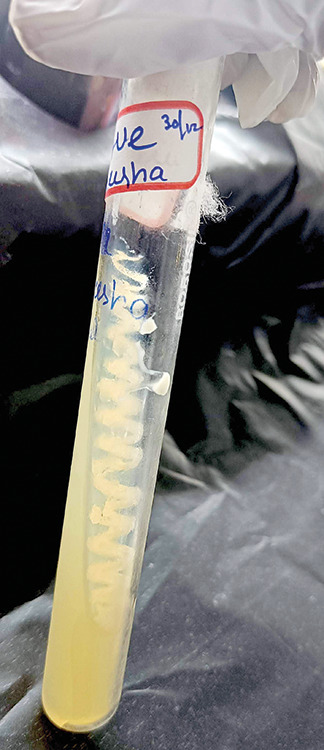
Shows growth of C. albicans and its morphological features of cream, smooth, pasty convex colonies on SDA
Fig. 2.
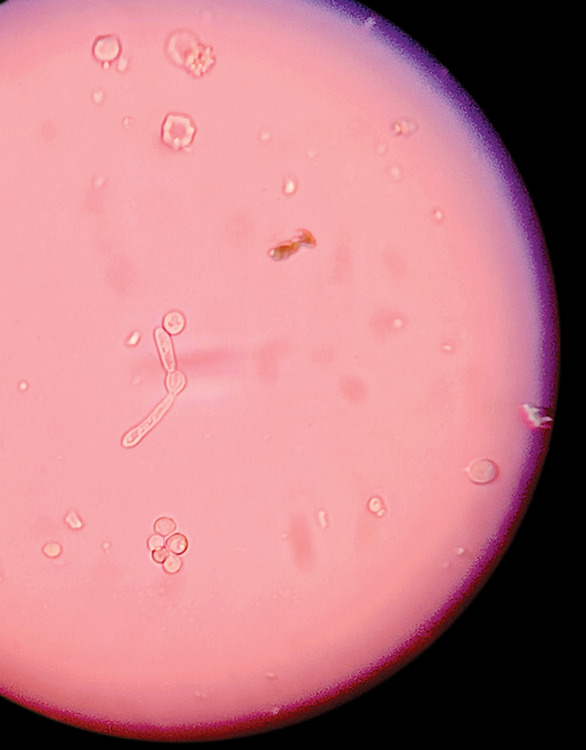
Shows species identification of C. albicans was done using the germ tube test method
The study's findings revealed that the ketoconazole group had the greatest mean zone of inhibition (Table 2) for C. albicans (21.09 mm), followed by stevia (10.9 mm), cinnamon (9.33 mm), neem (4.96 mm), miswak (4.54 mm), clove (3.80 mm). At p < 0.001, the difference between the groups was statistically significant. Multiple comparisons between groups showed that ketoconazole showed (Table 3) significantly highest mean zone of inhibition as compared to other groups at p < 0.001, which was followed next by the stevia group showing a significantly higher mean zone of inhibition as compared to other study groups at p < 0.001. This was followed by cinnamon, showing a significantly lesser mean zone of inhibition as compared to other study groups at p < 0.001, which in turn was followed by neem and miswak, which showed a significantly higher mean zone of inhibition as compared to the clove group at p < 0.001 and p = 0.04, respectively. However, no significant difference was observed for the mean zone of inhibition between the neem and miswak groups (p = 0.54).
Table 2.
Comparison of the mean zone of inhibition (in mm) between different groups for C. albicans using a one-way ANOVA test
| Groups | N | Mean | Standard deviation (SD) | Minimum | Maximum | p-value |
|---|---|---|---|---|---|---|
| Ketoconazole | 23 | 21.09 | 1.41 | 18.5 | 22.9 | <0.001* |
| Neem | 23 | 4.96 | 0.87 | 3.2 | 6.4 | |
| Miswak | 23 | 4.54 | 0.50 | 3.7 | 5.3 | |
| Cinnamon | 23 | 9.33 | 0.76 | 7.8 | 10.8 | |
| Clove | 23 | 3.80 | 0.54 | 2.6 | 4.6 | |
| Stevia | 23 | 10.90 | 0.63 | 9.7 | 11.9 |
*Statistically significant; the mean zone of inhibition for C. albicans was highest in ketoconazole group (21.09 mm), followed by stevia (10.9 mm), cinnamon (9.33 mm), neem (4.96 mm), miswak (4.54 mm), clove (3.80 mm); the difference between different groups was statistically significant at p < 0.001
Table 3.
Multiple comparisons of mean difference in zone of inhibition for C. albicans between groups using Tukey's post hoc test
| (I) Groups | (J) Groups | Mean difference (I − J) | 95% confidence interval for the difference | p-value | |
|---|---|---|---|---|---|
| Lower | Upper | ||||
| Ketoconazole | Neem | 16.13 | 15.42 | 16.86 | <0.001* |
| Miswak | 16.56 | 15.84 | 17.28 | <0.001* | |
| Cinnamon | 11.76 | 11.04 | 12.48 | <0.001* | |
| Clove | 17.29 | 16.57 | 18.01 | <0.001* | |
| Stevia | 10.19 | 9.47 | 10.91 | <0.001* | |
| Neem | Miswak | 0.42 | −0.30 | 1.14 | 0.54 |
| Cinnamon | −4.37 | −5.09 | −3.65 | <0.001* | |
| Clove | 1.16 | 0.44 | 1.88 | <0.001* | |
| Stevia | −5.94 | −6.66 | −5.22 | <0.001* | |
| Miswak | Cinnamon | −4.80 | −5.52 | −4.08 | <0.001* |
| Clove | 0.73 | 0.02 | 1.46 | 0.04* | |
| Stevia | −6.37 | −7.09 | −5.65 | <0.001* | |
| Cinnamon | Clove | 5.53 | 4.81 | 6.25 | <0.001* |
| Stevia | −1.57 | −2.29 | −0.85 | <0.001* | |
| Clove | Stevia | −7.10 | −7.82 | −6.38 | <0.001* |
*Statistically significant; multiple comparisons between groups showed that ketoconazole showed significantly highest mean zone of inhibition as compared to other groups at p < 0.001, which was followed next by the stevia group showing a significantly higher mean zone of inhibition as compared to other study groups at p < 0.001; this was followed with cinnamon showing significantly lesser mean zone of inhibition as compared to other study groups at p < 0.001, which in turn was followed by neem and miswak which showed significantly higher mean zone of inhibition as compared to clove group at p < 0.001 and p = 0.04 respectively; however, no significant difference was observed for the mean zone of inhibition between the neem and miswak groups (p = 0.54)
The mean pH value of the caries-free children group was significantly higher (7.38 ± 0.44) as compared to children with ECC (6.79 ± 0.43), and the difference in the mean pH value between the two groups was statistically significant at p < 0.001 (Table 4).
Table 4.
Comparison of mean pH values between groups I and II using independent student t-test
| Parameter | Groups | N | Mean | SD | Mean difference | p-value |
|---|---|---|---|---|---|---|
| pH | Group I | 30 | 6.79 | 0.43 | −0.59 | <0.001* |
| Group II | 30 | 7.38 | 0.44 |
*Statistically significant; the mean pH value of the caries-free children group was significantly higher (7.38 ± 0.44) as compared to children with ECC (6.79 ± 0.43), and the difference in the mean pH value between the two groups was statistically significant at p < 0.001.
Discussion
Carious teeth can provide a natural habitat for the further development and spread of C. albicans in the mouth.12 ECC is the result of changes in the oral microbial ecology to a cariogenic microflora, leading to an imbalance between the demineralization and remineralization process, favoring the demineralization of the teeth. Thus, acidity is a prerequisite, and acidogenic microflora play an important role.13
According to research by Sonesson et al., children under the age of four may still be developing their immunity, and during periods of weakened immunity, the population of Candida spp. may grow. This may have a significant role in younger children's rapid caries progression.14 In this study, C. albicans was discovered in the samples taken from the plaque of 23.3% of the cases without caries. The samples taken from caries lesions of ECC children showed 76.7% were positive for C. albicans. This was in agreement with an earlier in vitro study that showed a high association between C. albicans and ECC. Furthermore, it implies that C. albicans could be responsible for the development and progress of ECC in very young kids whose immune systems are still developing.13
The antifungal imidazole substance named ketoconazole facilitates phagocytosis and prevents C. albicans from proliferating filamentously. Therefore, in this study, additional antimicrobial drugs were evaluated against ketoconazole, which was deemed the standard antifungal agent. Herbal remedies are becoming increasingly common as they not only effectively treat pathogenic conditions but also lessen numerous of the negative effects of synthetic medications.9 Several studies have reported the antimicrobial effect of stevia extracts on fungi and various bacteria.15 With a mean zone of inhibition of 10.9 mm, the current study demonstrated strong antimicrobial efficacy against C. albicans; however, there was a statistically significant difference when compared to ketoconazole. Cinnamon has >80 compounds, which contribute to its antimicrobial efficacy.7 The antifungal activity shown by cinnamon in this study was comparable to that of stevia, with a mean zone of inhibition of 9.33 mm. Neem's main ingredient, nimbidin, is what lends it its antibacterial and anti-inflammatory properties. Isomargolonone, mahmoodin, nimbolide, margolone, etc., and other bioactive substances also contribute to neem's antiseptic and antifungal qualities.9 Research has revealed that Salvadora persica, often known as miswak, has antifungal characteristics. Studies indicate that miswak extracts may possess medicinal properties against various strains of Candida, indicating that they could be employed as therapeutic preparations.6 In this study, the sensitivity of both neem and miswak against C. albicans strain was comparable with 4.96 and 4.54 mm zone of inhibition, respectively. Dentists have utilized clove as a pain reliever for the treatment of infectious oral disorders as well as a dressing for small wounds. Furthermore, it has been applied in dentistry and health care as a general antiseptic, pain reliever, and antispasmodic.9 In this study, its antifungal action has been noteworthy with a mean zone of inhibition of 3.8 mm, which is significantly less than the other groups.
In summary, the findings of this study show that certain herbal medicines have antifungal properties. These results not only urge additional investigation of their efficacy against the management of ECC, but also their broad-spectrum impacts being investigated on various pathologic symptoms. Additionally, statistically significant variations in the salivary pH between the two groups were found in the investigation's outcomes. Bagherian and Asadikaram investigated salivary features between children with ECC and children without ECC, concluding that children without ECC had higher pH levels and improved buffer capacity.16 However, salivary pH analysis itself is not a significant tool for assessing the ECC initiation factor. As a result, more studies into the functional qualities of entire saliva and the role of its components, with age considerations, may serve as improved caries risk assessment models.
Conclusion
The following conclusions may be drawn from the study's findings:
Salivary pH levels differed significantly between children with and without ECC.
A high association was found between C. albicans and ECC, suggesting that C. albicans could potentially be held accountable for the onset and development of ECC.
Three herbal plant extracts have the potential to be used as antifungal agents with further examination of the effectiveness and quality of plant-based products for their regular use in dental hygiene products.
Declarations
Trial registration: Study is registered under the Clinical Trials Registry of India, No. CTRI/2021/12/038502.
Ethical permission: The Institutional Review Board's approval was obtained.
Consent to participate: Informed written consent was obtained.
Orcid
Shakuntala B Siddaiah https://orcid.org/0000-0002-1962-4054
Somya Sinha https://orcid.org/0000-0001-6359-2363
Archana BR https://orcid.org/0000-0002-1854-3463
Footnotes
Source of support: Nil
Conflict of interest: None
REFERENCES
- 1.Kim HE, Liu Y, Dhall A, et al. Synergism of Streptococcus mutans and Candida albicans reinforces biofilm maturation and acidogenicity in saliva: an in vitro study. Front Cell Infect Microbiol. 2020;10:623980. doi: 10.3389/fcimb.2020.623980. [DOI] [PMC free article] [PubMed] [Google Scholar]
- 2.Fakhruddin KS, Perera Samaranayake L, Egusa H, et al. Candida biome of severe early childhood caries (S-ECC) and its cariogenic virulence traits. J Oral Microbiol. 2020;12(1):1724484. doi: 10.1080/20002297.2020.1724484. [DOI] [PMC free article] [PubMed] [Google Scholar]
- 3.Agarwal V, Lal P, Pruthi V. Effect of plant oils on Candida albicans. J Microbiol Immunol Infect. 2010;43(5):447–451. doi: 10.1016/s1684-1182(10)60069-2. [DOI] [PubMed] [Google Scholar]
- 4.Maheshwaran B, Priyadharshini R, Kumar S, et al. Antimicrobial activity and cytotoxicity of mouthwash prepared from Azadirachta indica and Stevia rebaudiana extract– an in vitro study. J Pharmaceut Res Int. 2021;33(59B):96–107. doi: 10.9734/jpri/2021/v33i59b34357. [DOI] [Google Scholar]
- 5.Naseem S, Hashmi K, Fasih F, et al. In vitro evaluation of antimicrobial effect of miswak against common oral pathogens. Pak J Med Sci. 2014;30(2):398–403. doi: 10.12669/pjms.302.4284. [DOI] [PMC free article] [PubMed] [Google Scholar]
- 6.Haque MM, Alsareii SA. A review of the therapeutic effects of using miswak (Salvadora Persica) on oral health. Saudi Med J. 2015;36(5):530–543. doi: 10.15537/smj.2015.5.10785. [DOI] [PMC free article] [PubMed] [Google Scholar]
- 7.Yanakiev S. Effects of cinnamon (Cinnamomum spp.) in dentistry: a review. Molecules. 2020;25(18) doi: 10.3390/molecules25184184. [DOI] [PMC free article] [PubMed] [Google Scholar]
- 8.Lee S, Najiah M, Wendy W, et al. Chemical composition and antimicrobial activity of the essential oil of Syzygium aromaticum flower bud (clove) against fish systemic bacteria isolated from aquaculture sites. Front Agric China. 2009;3(3):332–336. doi: 10.1007/s11703-009-0052-8. [DOI] [Google Scholar]
- 9.Bansal V, Gupta M, Bhaduri T, et al. Assessment of antimicrobial effectiveness of neem and clove extract against Streptococcus mutans and Candida albicans: an in vitro study. Niger Med J. 2019;60(6):285–289. doi: 10.4103/nmj.nmj_20_19. [DOI] [PMC free article] [PubMed] [Google Scholar]
- 10.Hemadi AS, Huang R, Zhou Y, et al. Salivary proteins and microbiota as biomarkers for early childhood caries risk assessment. Int J Oral Sci. 2017;9(11):e1. doi: 10.1038/ijos.2017.35. [DOI] [PMC free article] [PubMed] [Google Scholar]
- 11.Ravikumar D, Ramani P, Gayathri R. Estimation of salivary pH, viscosity, flow rate in children with and without early childhood caries - an observational study. J Pharmaceut Res Int. 2021:54–60. doi: 10.9734/jpri/2021/v33i30a31614. [DOI] [Google Scholar]
- 12.Ghasempour M, Sefidgar SA, Eyzadian H, et al. Prevalence of Candida albicans in dental plaque and caries lesion of early childhood caries (ECC) according to sampling site. Caspian J Intern Med. 2011;2(4):304–308. [PMC free article] [PubMed] [Google Scholar]
- 13.Thomas A, Mhambrey S, Chokshi K, et al. Association of oral Candida albicans with severe early childhood caries - a pilot study. J Clin Diagn Res. 2016;10(8):ZC109–ZC112. doi: 10.7860/jcdr/2016/19387.8357. [DOI] [PMC free article] [PubMed] [Google Scholar]
- 14.Sonesson M, Eliasson L, Matsson L. Minor salivary gland secretion in children and adults. Arch Oral Biol. 2003;48(7):535–539. doi: 10.1016/s0003-9969(03)00086-4. [DOI] [PubMed] [Google Scholar]
- 15.Ajagannanavar SL, Shamarao S, Battur H, et al. Effect of aqueous and alcoholic Stevia (Stevia rebaudiana) extracts against Streptococcus mutans and Lactobacillus acidophilus in comparison to chlorhexidine: An in vitro study. J Int Soc Prev Community Dent. 2014;4(Suppl 2):S116–S121. doi: 10.4103/2231-0762.146215. [DOI] [PMC free article] [PubMed] [Google Scholar]
- 16.Bagherian A, Asadikaram G. Comparison of some salivary characteristics between children with and without early childhood caries. Indian J Dent Res. 2012;23(5):628–632. doi: 10.4103/0970-9290.107380. [DOI] [PubMed] [Google Scholar]