



Abstract
Background
Patient health data collected from a variety of nontraditional resources, commonly referred to as real-world data, can be a key information source for health and social science research. Social media platforms, such as Twitter (Twitter, Inc), offer vast amounts of real-world data. An important aspect of incorporating social media data in scientific research is identifying the demographic characteristics of the users who posted those data. Age and gender are considered key demographics for assessing the representativeness of the sample and enable researchers to study subgroups and disparities effectively. However, deciphering the age and gender of social media users poses challenges.
Objective
This scoping review aims to summarize the existing literature on the prediction of the age and gender of Twitter users and provide an overview of the methods used.
Methods
We searched 15 electronic databases and carried out reference checking to identify relevant studies that met our inclusion criteria: studies that predicted the age or gender of Twitter users using computational methods. The screening process was performed independently by 2 researchers to ensure the accuracy and reliability of the included studies.
Results
Of the initial 684 studies retrieved, 74 (10.8%) studies met our inclusion criteria. Among these 74 studies, 42 (57%) focused on predicting gender, 8 (11%) focused on predicting age, and 24 (32%) predicted a combination of both age and gender. Gender prediction was predominantly approached as a binary classification task, with the reported performance of the methods ranging from 0.58 to 0.96 F1-score or 0.51 to 0.97 accuracy. Age prediction approaches varied in terms of classification groups, with a higher range of reported performance, ranging from 0.31 to 0.94 F1-score or 0.43 to 0.86 accuracy. The heterogeneous nature of the studies and the reporting of dissimilar performance metrics made it challenging to quantitatively synthesize results and draw definitive conclusions.
Conclusions
Our review found that although automated methods for predicting the age and gender of Twitter users have evolved to incorporate techniques such as deep neural networks, a significant proportion of the attempts rely on traditional machine learning methods, suggesting that there is potential to improve the performance of these tasks by using more advanced methods. Gender prediction has generally achieved a higher reported performance than age prediction. However, the lack of standardized reporting of performance metrics or standard annotated corpora to evaluate the methods used hinders any meaningful comparison of the approaches. Potential biases stemming from the collection and labeling of data used in the studies was identified as a problem, emphasizing the need for careful consideration and mitigation of biases in future studies. This scoping review provides valuable insights into the methods used for predicting the age and gender of Twitter users, along with the challenges and considerations associated with these methods.
Keywords: social media, demographics, Twitter, age, gender, prediction, real-world data, neural network, machine learning, gender prediction, age prediction
Introduction
Background
Real-world data are data regarding patients’ health collected outside randomized controlled trials from a variety of nontraditional resources such as electronic health records, medical claims data, or data generated by patients themselves such as social media data that may be used to support study design to develop real-world evidence [1]. Real-world data from social media have been increasingly recognized as a valuable resource for gaining knowledge about and insight into a variety of health-related research topics, including disease surveillance [2,3], pharmacovigilance [4,5], and mental health [6,7]. They can also be used for the identification of cohorts for potential recruitment into traditional studies [8,9]. In short, social media can readily provide abundant personal health information in real time.
The use of data from social media platforms, particularly Twitter (Twitter, Inc), for health-related research is subject to some inherent limitations in that demographic information (with the exception of location, which is available when the user has enabled the location feature) is not explicitly available through the application programming interface (API) [10]. Demographic traits, including age, gender, race or ethnicity, location, education, and income, hold significant value in health research. Few studies based on Twitter data incorporated an assessment of Twitter user demographics into their analysis [11]. Understanding the demographic traits of Twitter users provides significant value when using the data in health research. It not only facilitates sample representativeness, which is crucial for generalizing research findings and ensuring that the conclusions drawn from Twitter data can be extrapolated to broader populations [12], but also enables subgroup analysis. It allows for the comparison of health-related behaviors, attitudes, and outcomes across different groups and enables targeted interventions and tailored health care strategies [13,14]. Moreover, demographic information is actionable and can assist in designing public health interventions and policies for specific populations based on their needs and concerns as expressed on social media.
Predicting demographic traits is complex and challenging. A user’s profile does not necessarily include such information, and researchers have used other features available in the data, such as names, content of the tweets, or the individual’s network to make predictions. A 2018 systematic review assessed the use of social media to predict demographic traits, finding successful implementation for 14 traits, including gender and age [15,16]. Although the review provided a broad overview of the state of demographic prediction using social media, the details of the machine learning (ML) methods used were not reviewed. A recent review provided insights into the methods used for predicting the race and ethnicity of Twitter users [17].
Objectives
In this study, our objective was to present a scoping review of automated methods used for predicting the age and gender of Twitter users to provide an overview of the techniques published since 2017. We focused our review on studies that used Twitter, as it is the most commonly used social media platform for this research [15]. Twitter is an attractive platform to use in research, as the terms of use for this platform are well understood by both users and researchers, it includes an API, and the data on it are abundant for health-related research [18].
Although other demographic traits such as location, education, and income can provide valuable insights, the age and gender of Twitter users present distinct advantages and considerations for health research. Given the differences in disease presentation by gender, such as with acute coronary syndrome [19], and by age, such as with COVID-19 [20], identifying the age and gender of the users included in studies using Twitter data may elicit insights into disease prevalence, patterns, and variations across different subgroups in disease presentation or treatment response [21,22]. Age and gender also play crucial roles in shaping health behaviors and attitudes. For example, studying age and gender differences in smoking habits [23], physical activity levels [24], and adherence to medical treatments [25,26] can provide insights into effective interventions and health promotion campaigns for specific groups. Although Twitter users are generally representative of the population, there is a certain degree of skew in their demographics: there is an overrepresentation of individuals aged <30 years, whereas individuals aged >65 years are underrepresented when compared with the overall demographics of the US population [27,28]. Therefore, it is important to include the age and gender of Twitter users in a study to enable the accurate reporting of findings, making them specific to certain subgroups, or to make any necessary adjustments to account for potential biases that may arise from these demographic differences.
Although studies aimed at predicting Twitter users’ gender began as early as 2011 [29-33] and efforts aimed at detecting the age of Twitter users have been made since 2013 [34-36], it is only since 2017 that the language processing community shifted its methods away from handcrafted rules and represented text documents with dense vectors to train deep neural networks (DNNs) [37,38], resulting in a noticeable increase in performance for many applications. We sought to examine whether these increases in performance were evident in the methods used for the prediction of the age and gender of Twitter users.
Methods
Overview
We report this review following the PRISMA-ScR (Preferred Reporting Items for Systematic Reviews and Meta-Analyses Extension for Scoping Reviews) [39] methodology. The completed PRISMA-ScR checklist is available in Table S1 in Multimedia Appendix 1. We searched several databases to identify studies on the prediction of Twitter users’ age or gender or both. Our database search strategy combines 3 facets: facet 1 includes terms related to Twitter, facet 2 consists of terms for age or gender, and facet 3 consists of terms for methods of prediction such as ML. The search strategy was translated as appropriate for each database. The detailed search strategy is available in Multimedia Appendix 2. The ML term facet was expanded using terms from related reviews by Hinds and Joinson [15] and Umar et al [40]. The search criteria were limited to peer-reviewed journals, conference proceedings, books, and theses.
The following databases were searched with a publication date range of 2017 or later (Textbox 1).
List of databases searched with the total number of combined facet results.
ACL (Association for Computational Linguistics) Anthology: 5080, of which the first 50 records were screened
ACM (Association for Computing Machinery) Digital Library: 23
Cumulative Index to Nursing & Allied Health (CINAHL): 57
Embase: 262
Google Scholar: 767,000, of which the first 50 records were screened
IEEE (Institute of Electrical and Electronics Engineers) Xplore: 23
Library and Information Science Abstracts: 31
Library, Information Science and Technology Abstracts: 48
Proquest Dissertations and Theses—United Kingdom and Ireland: 58
Ovid MEDLINE: 183
PsycINFO: 104
Science Citation Index, Social Science Citation Index, Conference Proceedings Citation Index—Science, and Conference Proceedings Citation Index—Social Science and Humanities: 131
Zetoc: 61
Citations were exported to a shared EndNote (Clarivate) library for deduplication. Using the Population, Intervention, Comparison, Outcomes, and Study Design (PICOS) [41] framework, we developed a list of inclusion and exclusion criteria (refer to the Inclusion and Exclusion Criteria section), and 2 screeners from the research team screened the results independently, with disputes discussed after screening and a consensus decision reached. In addition, given that search engines and unmanageable data sources are recommended to be included as secondary data sources [42-44], the first 50 records from both ACL (Association for Computational Linguistics) Anthology and Google Scholar were screened using the aforementioned methods. We set a limit on the number of results screened, as the relevance of the results is ranked by the search engines, with the most relevant results listed first [45-48].
Inclusion and Exclusion Criteria
We framed our research question using the PICOS framework. Table 1 outlines our specific inclusion and exclusion criteria. As explained in the Introduction section, we restricted the date of our search to include only publications from 2017 and beyond. No language restrictions were applied to the inclusion criteria; however, financial and logistical restraints allowed us to include only studies written in English, Spanish, Chinese, or French.
Table 1.
Inclusion and exclusion criteria, developed per the Population, Intervention, Comparison, Outcomes, and Study Design framework, for the scoping review.
| Facet | Inclusion criteria | Exclusion criteria |
| Population | Any Twitter (Twitter, Inc) data on Twitter users, such as posts, profile details, photos, or avatars | Studies evaluating prediction from data on other social media platforms, such as Facebook (Meta Platforms, Inc) or Instagram (Meta Platforms, Inc) |
| Intervention | Methods for predicting the gender or age of Twitter users; articles that used machine learning, natural language processing, human in the loop, or other computationally assisted methods to predict the gender or age of the users | Studies that contained no computation methods |
| Comparator | Any or none; we included any studies irrespective of whether they had a comparator and, if they did have a comparator, irrespective of what that was | N/Aa |
| Outcome | Gender or age prediction | Any other demographic trait prediction |
| Study design | Any type of peer-reviewed study reporting on the methods used to predict gender or age; such information must be the primary focus of the study or reported in enough detail to be reproducible | Discussion papers, commentaries, and letters |
| Date | 2017 or later | Before 2017 |
| Language | All | None |
aN/A: not applicable.
Data Extraction
From each included paper, we extracted the following data: the year of publication, publication type (journal, conference paper, book chapter, or thesis), demographic predicted (gender, age, or both), language of tweets, size of the data set, collection method for the data set, details of prediction models, features used in the models (posts, profile, and images), performance of the models, name of any software used for prediction, measures used to assess the methods and results of any evaluation, and the availability of data or code. The included papers were distributed among the authors for data extraction. The extracted data were validated by another author (KO).
Results
Overview
Our database searches resulted in 981 studies, which were retrieved and entered into an EndNote library, where duplicates were removed, leaving 684 (69.7%) studies for sifting.
After the abstract review, 172 (25.1%) of 684 studies were deemed potentially relevant by either one of the independent sifters (SG and KO). The full texts of these studies were screened independently, and disagreements were discussed, resulting in the inclusion of 74 (43%) studies [49-122] and exclusion of 98 (57%) studies (Figure 1).
Figure 1.
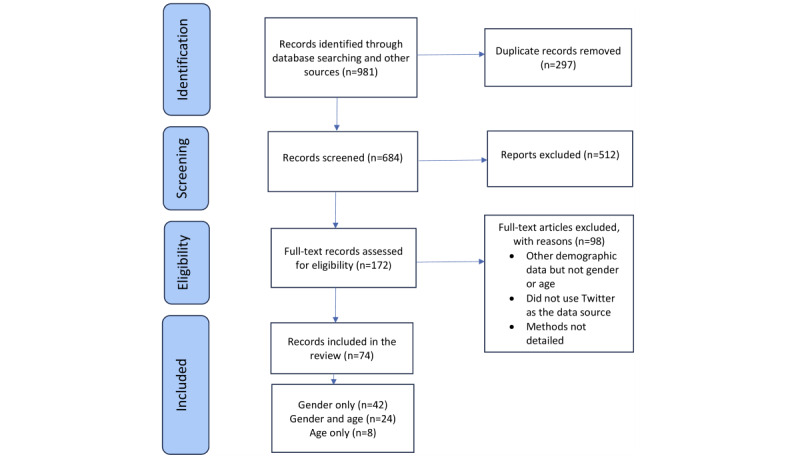
PRISMA (Preferred Reporting Items for Systematic Reviews and Meta-Analyses) flow diagram of the included studies.
Characteristics of the Included Studies
Among the 74 included studies (Multimedia Appendices 3 [49-52,54-63,65,67-72,74-89,91-93,96-99,101-122] and 4 [51,53,55,56,59,60,63-67,70,73,74,77,80,83,84,87,90,94, 95,99-101,108,110,112,116,118-120]), the majority (n=42, 57%) focused on predicting only the gender of the individual, 24 (32%) explored predicting both gender and age, and 8 (11%) focused solely on predicting age. Most of the studies were published in conference proceedings (44/74, 59%), followed by journal articles (28/74, 38%), theses (2/74, 3%), and a book chapter (1/74, 1%).
In 42 (57%) of the 74 studies, developing methods to predict Twitter users’ age or gender or both was the primary purpose. In the remaining studies (32/74, 43%), the identification of the demographic characteristics of Twitter users was secondary. Within this last group, 9 (28%) studies developed ad-hoc methods to determine age, gender, or both, whereas the others used open-source models (13/32, 41%) or off-the-shelf software (10/32, 31%).
Studies Developing Ad-Hoc Methods for Gender and Age Prediction
Gender
Overview
Of the 74 studies, 44 (59%) developed ad-hoc methods to predict the Twitter users’ gender. Of these 44 studies, 32 (73%) predicted the users’ gender alone [49,50,52,54,57,58,68,69, 71,72,75,76,79,81,82,85,86,89,92,93,96,102,104-107,111,113, 115,117,121,122], and 12 (27%) predicted gender along with age [51,55,65,70,80,83,87,101,108,110,112,116].
Most studies that developed ad-hoc methods (41/44, 93%) approached the problem of gender prediction as a binary classification task, predicting whether the label male or female applies to each user account, whereas 4% (3/44) of studies [93,112,119] added the classification of organization or brand.
We found that approaches to predict gender included tweets written in multiple languages, including English [52,82,83,92,93,115,117], German [76], Slovenian [106], Italian [49], Japanese [89], Arabic and Egyptian [57,58,79], French, Dutch, Portuguese, and Spanish, and a multilingual study assessed tweets written in 28 languages and dialects [112].
Data Sets
For the training and validation of the ad-hoc approaches for gender detection, some studies (19/44, 43%) used previously created annotated corpora, whereas others (27/44, 61%) collected data directly from Twitter. Among the 19 studies that used previously annotated data sets, 9 (47%) [55,57,58,68,70,86,87,96,121] used corpora from the PAN-Conference and Labs of the Evaluation Forum (CLEF; PAN-CLEF) author profiling tasks [123-129], whereas 10 (53%) studies [72,75,83,85,93,104,105,115,117,122] relied on data sets from other studies [113,130-136].
In the 27 (61%) studies that collected data directly from Twitter, different components of Twitter accounts were used. These components were used either for manually or semiautomatically validating the gender of a user or for computing features describing the user to train a classifier (Multimedia Appendix 5 [49-122]). Despite data limitations from the Twitter API, it was the main source of data collection, with 22 (24%) studies [49-52,54,69,71,76,79,81,89,92,101,102,106-108,110,111,116,117,121] collecting data either as a random sample from the Twitter Streaming API or based on keywords or geographic location from the Twitter Search API. Of the 5 studies not using the Twitter API, 1 (20%) [82] collected data using a scraping tool, 3 (60%) [80,112,113] used a random sample from a collection of 10% of tweets from 2014 to 2017 or the Twitter archive, and 1 (20%) did not specify its data source [65].
The 24 studies that created a labeled data set (Multimedia Appendix 6 [49,51-54,63,64,66,69,71,73,76,77,80,82,89,90,92, 106-108,110,112,113,116-118,120]) to train and test or to validate the performance of the system determined the gender of the users using multiple components of their Twitter accounts (Multimedia Appendix 5). A total of 11 (46%) studies labeled the data through manual annotation, where the annotators determined the gender using profile pictures [52,54], user names [71], profiles [89], or a combination of these [76,82,92,106,108,110,116]. There were 11 (46%) studies that automatically or semiautomatically labeled their data sets via the detection of self-reports or gender-identifying terms (eg, mother, son, and uncle) [69,80,108,110,112,117], the user’s name [49,107,113], or declarations on other linked social media [116,117]. A total of 3 (13%) studies created their labeled data sets by using the accounts of famous social media influencers [65] or using an unspecified collection of users whose gender is known [51,79]. Of the 24 studies, only 8 (33%) reported data availability. Of the 8 studies, 6 (75%) stated availability by request, and 2 (25%) had working links to the whole corpus (Multimedia Appendix 6).
Nonpersonal Accounts
A Twitter account may not be authored by or represent a single person. There are organization or company accounts as well as bot accounts. A bot is an automatic or semiautomatic user account. Some bot accounts identify themselves as such and may be used to automatically amplify news or tweets related to a certain topic. Others may emulate human accounts and be used with a more malicious intent to sow discord, manipulate public opinion, or spread misinformation. There were 9 (12%) of the 74 included studies [49,76,92,93,96,103,104,106,112] that removed nonpersonal (organization) accounts when they manually annotated their collections. Some studies (11/74, 15%) implemented heuristics to explicitly detect and remove nonpersonal accounts [49,50,59,71,81,107,113,122], bot accounts [98], or both [79,137]. Others (39/74, 53%) used previously annotated data sets consisting of only personal accounts, labeled and removed nonpersonal accounts, or collected their data sets based on self-reports of age and gender or other identifiable personal information. The remaining (15/74, 20%) studies provided no details on how or whether these accounts were removed (Multimedia Appendix 5).
Features and Models
The reviewed studies used data labeled with the user’s gender to build and evaluate classification models based on features describing the tweets (such as n-grams, word embeddings, hashtags, and URLs) [57,58,65,68-71,75,79,82,86,87,92, 96,104,109,113,121], features derived from the users’ profile metadata (such as user names, bio, followers, and users followed) [49,51,52,72,80,85,112,115,122], features derived from a combination of their profile metadata and tweets [52,54,76,83,93,107,108,110,117] or images [52,80,108,112, 116]. Of the 74 studies, 1 (3%) study from Japan included the user’s geographic information under the assumption that, culturally, a person of a certain demographic is more likely to frequent specific places [89].
Among the systems that used handcrafted features (25/44, 57%), most (13/25, 52%) achieved their best results using a support vector machine (SVM) [49,54,65,72,82,85,86,104-106, 113,116,138], whereas others (12/25, 48%) used logistic regression [87,107,110], naive Bayes [51,92], random forests [80], bag of trees [70], extreme gradient boosting [89], or ensemble approaches [76,79,107,122] (details are provided in Table 2). Other systems used deep learning methods (15/44, 34%) such as DNNs, convolutional neural networks, feed forward neural networks or recurrent neural networks [55,68,71,75,93,115,121], bidirectional long-term short-term memory [58], gated recurrent units [57], graph recursive neural networks [83], and multimodal deep learning networks [108,112].
Table 2.
Top reported system performance for studies predicting the gender of Twitter users using traditional machine learning (ML) methods. Result metrics are reflected in this table as reported in the original publications and are not necessarily comparable to each other.
| Study | Language | ML method | Reported performance | |
|
|
|
|
F1-score | Accuracy |
| Cesare et al [122], 2017 | English | Ensemble: lexical match and SVMa and DTb | 0.84 | 0.83 |
| Jurgens et al [80], 2017 | English | RFc ensemble | 0.78 | 0.80 |
| Ljubešić et al [85], 2017 | Portuguese, French, Dutch, Spanish, German, and Italian | SVM | N/Ad | 0.61-0.69 |
| Markov et al [87], 2016 | English, Spanish, Dutch, and Italian | LogRe | N/A | 0.57-0.77 |
| Mukherjee and Bala [92], 2016 | English | NBf | 0.75 | 0.71 |
| Verhoeven et al [106], 2017 | Slovenian | SVM | 0.93 | 0.93 |
| Volkova [110], 2015 | English and Spanish | LogR | N/A | 0.82 |
| Xiang et al [116], 2017 | English | SVM and PMEg | N/A | 0.76 |
| Cheng et al [65], 2018 | English, Filipino, and Taglish | SVCh with lasso | 0.84 | 0.84 |
| Emmery et al [69], 2017 | English | fastText | N/A | 0.76 |
| Giannakopoulos et al [72], 2018 | N/A | SVM PNNi | N/A | 0.87 |
| Khandelwal et al [82], 2018 | Code-mixed Hindi-English | SVM | N/A | 0.9 |
| Miura et al [89], 2018 | Japanese | XGBoostj | N/A | 0.89 |
| van der Goot et al [104], 2018 | English, Dutch, French, Portuguese, and Spanish | SVM | N/A | 0.66-0.72 |
| Alessandra et al [49], 2019 | Italian | Ensemble: lexical match and SVM | N/A | 0.75 |
| Hirt et al [76], 2019 | German | Ensemble: binary classifiers | 0.81 | N/A |
| Hussein et al [79], 2019 | Dialect Egyptian Arabic | Ensemble: RF and LinRk | NA | 0.77-0.88 |
| Vicente et al [107], 2018 | English and Portuguese | Ensemble: Face++, LinR, and SVM | N/A | 0.93-0.97 |
| Arafat et al [51], 2020 | Indonesian | Multinomial NB | N/A | 0.75 |
| Baxevanakis et al [54], 2020 | Greek | SVM | N/A | 0.7 |
| Garcia-Guzman et al [70], 2020 | English | Bag of trees | 0.64 | 0.64 |
| López-Monroy et al [86], 2020 | English and Spanish | Bag of trees | 0.64 | 0.64 |
| Pizarro [96], 2020 | English and Spanish | SVM | 0.82-0.84 | N/A |
| Vashisth and Meehan [105], 2020 | English | LogR | N/A | 0.57 |
| Wong et al [113], 2020 | English | SVM | 0.58-0.62 | 0.60 |
aSVM: support vector machine.
bDT: decision tree.
cRF: random forest.
dN/A: not applicable.
eLogR: logistic regression.
fNB: naive Bayes.
gPME: projection matrix extraction.
hSVC: support vector classifier.
iPNN: probabilistic neural network.
jXGBoost: extreme gradient boosting.
kLinR: linear regression.
One of the studies created a meta-classifier ensemble classifying users based on the predictions of multiple individual classifiers [117], including SVM, bidirectional encoder representations from transformers, and 2 existing models [112,139]. Another study created a DNN for learning with label proportion, a semisupervised approach [52]. The results of the best-performing deep learning model as reported in each study are presented in Table 3. Studies that used lexical matching (4/44, 9%) of the user’s name to a curated name dictionary [50,81,101,102] to determine gender reported no validation or performance metrics.
Table 3.
Top reported system performance for studies predicting the gender of Twitter users using deep learning machine learning (ML) methods. Result metrics are reflected in this table as reported in the original publications and are not comparable to each other.
| Study | Language | ML method | Reported performance | |
|
|
|
|
F1-score | Accuracy |
| Ardehaly and Culotta [52], 2017 | English | Deep LLPa | 0.96 | N/Ab |
| Geng et al [71], 2017 | English | Ensemble: LDAc and CNNd | N/A | 0.87 |
| Kim et al [83], 2017 | English | GRNNe | N/A | 0.68 |
| Vijayaraghavan et al [108], 2017 | English | DMTf | 0.89 | N/A |
| Wang et al [111], 2017 | N/A | CNN | 0.91 | 0.9 |
| Bayot and Goncalves [55], 2017 | English and Spanish | CNN | N/A | 0.59-0.72 |
| Bsir and Zrigui [57], 2018 | Arabic | GRUg | N/A | 0.79 |
| Wood-Doughty et al [115], 2018 | English | RNNh | 0.84 | 0.84 |
| Bsir and Zrigui [58], 2019 | Arabic | BILSTMi with attention | N/A | 0.82 |
| Hashempour [75], 2019 | Portuguese, French, Dutch, Spanish, German, and Italian | FFNNj | N/A | 0.84-0.86 |
| Wang et al [112], 2019 | Multilingual | mmDNNk | 0.92 | N/A |
| ElSayed and Farouk [68], 2020 | Egyptian and Arabic dialects | Multichannel CNN-biGRUl | N/A | 0.84-0.91 |
| Imuede et al [93], 2020 | English | DNNm | N/A | 0.68 |
| Zhao et al [121], 2020 | English | CNN | 0.80 | N/A |
| Yang et al [117], 2021 | English | Ensemble: M3n and SVMo | 0.95 | 0.94 |
aLLP: learning with label proportions.
bN/A: not applicable.
cLDA: latent Dirichlet allocation.
dCNN: convolutional neural network.
eGRNN: graph recurrent neural network.
fDMT: deep multimodal multitask.
gGRU: gated recurrent network.
hRNN: recurrent neural network.
iBILSTM: bidirectional long-term short-term memory.
jFFNN: feed forward neural network.
kmmDNN: multimodal deep neural network.
lbiGRU: bidirectional gated recurrent unit.
mDNN: deep neural network.
nM3: multimodal, multilingual, and multi-attribute system.
oSVM: support vector machine.
Performance
Performance results from the traditional ML methods cannot be directly compared against the deep learning methods used, as they were evaluated against different gold-standard corpora, and they used nonstandardized reporting metrics. However, looking at the overall results in terms of F1-score, the results of the studies using deep learning had a relatively narrower range of reported performance (0.84-0.96), with a higher minimum of 0.84 and higher maximum of 0.96, compared with the reported performance range for traditional ML methods, which spans from 0.64 to 0.93.
Age
Overview
We found 19 studies that developed ad-hoc methods to predict the Twitter user’s age, among which 7 (37%) predicted age exclusively [53,64,66,73,90,94,95]. All but 1 (5%) of the studies [80] approached the detection of Twitter users’ age as an automatic classification of predefined age groups. The number of age groups varied across the studies (Table 3), with the ages categorized into 2 [53,73,83,110,116], 3 [51,66,90, 94,95,101,108], 4 [70,112], or more [55,64,65,87] groups. The range of ages within the groups also varied across the studies; for example, across the 5 studies that took a binary classification approach, Guimaraes et al [73] used 13 to 19 years and ≥20 years as the 2 age groups, Volkova et al [110] and Kim et al [83] used 18 to 23 years or ≥25 years, Xiang et al [116] used ≤30 years or >30 years, and Ardehaly and Culotta [53] used <25 years and ≥25 years.
Except for 2 (11%) studies that did not report the language of the tweets used [51,73], all studies used English language tweets. A total of 8 (42%) studies extended their systems to include additional languages, including Spanish [55,64,87,110], Dutch [87,94,95], Filipino [65], and multiple languages [112].
Data Sets
Most studies (9/19, 47%) that developed new algorithms prepared new data sets to evaluate them with data retrieved directly using Twitter’s API [51,53,66,73,90,108] or used other sources of data for this purpose [64,80,112] (Multimedia Appendix 4). Several studies used data sets made available by other studies to train or evaluate their algorithms: among the 19 studies, 2 (11%) studies [94,95] combined data sets from Sloan et al [34], Nguyen et al [36], and Morgan-Lopez et al [90]; Kim et al [83] used the data set from Volkova et al [140]; and 3 (15%) studies [55,70,87] used data sets that were created for the PAN-CLEF author profiling shared tasks [124-126]. The studies that prepared new data sets (Multimedia Appendix 6) labeled users’ age groups by automatically or semiautomatically searching (1) for tweets that self-reported birthday announcements or age [53,80,90,108,110,112], (2) for tweets in which a user was wished a happy birthday [90], (3) for profiles that self-reported age [64,66,108,112], (4) for profiles that mentioned age-related keywords (eg, grandparent) [66,112], or (5) for manual annotation based on images or profile metadata [112,116,140] or (6) by subjectively perceiving age groups based on the content of individual tweets [73]. In 1 (5%) study [51], a mixture of self-reported information and demographic information of known individuals was used to label the data. Similar to studies on gender, the reported availability of the corpora was scarce. Only 5 (26%) studies reported that their data sets were available, 2 (40%) by request, 1 (20%) provided a link to the whole data set, and 2 (40%) provided a link to a sample of the corpus (Multimedia Appendix 6).
Features and Models
The studies used labeled age groups to evaluate classification models based on the features of the users’ profile metadata (eg, user names, bio, followers, and users followed) [51,53,64,80,112], a combination of their profile metadata and tweets (eg, n-grams, word embeddings, hashtags, and URLs) [73,83,90,94,95,108,110], tweet texts only [65,66,70,87], or images [80,108,112,116].
For automatic classification, most studies (12/19, 63%) used traditional supervised ML methods, including logistic regression [51,66,87,90,110], Bayesian probabilistic inference [64], random forests [80], bag of trees [70], or SVM [65,116], or a semisupervised approach, learning from label proportion [53]. Other studies (7/16, 37%) used deep learning methods such as convolutional neural networks [55,73,94,95], graph recursive neural networks [83], and multimodal deep learning networks [108,112]. The best-performing systems for each study are listed in Tables 4 and 5. Of the 19 studies, 1 (5%) [101] classified age based on a previously developed age lexicon and did not report any performance metrics.
Table 4.
Top reported system performance for studies predicting the age of Twitter users using traditional machine learning (ML) methods. Result metrics are reflected in this table as reported in the original publications and are not directly comparable to each other. Reviews are ordered by the number of classification groups.
| Study | Number of age groups | Age class detail (y) | Language | ML method | Reported performance | |
|
|
|
|
|
|
F1-score | Accuracy |
| Jurgens et al [80], 2017 | N/Aa | Continuous | English | RFb regression | N/A | 0.71 |
| Volkova [110], 2017 | 2 | 18-23 and 25-30 | English and Spanish | LogRc | N/A | 0.77 |
| Xiang et al [116], 2017 | 2 | ≤30 and >30 | English | CPMEd | N/A | 0.74 |
| Ardehaly and Culotta [53], 2018 | 2 | <25 and >25 | English | LLPe | N/A | 0.78 |
| Morgan-Lopez et al [90], 2017 | 3 | 13-17, 18-24, and >24 | English | LogR | 0.74 | N/A |
| Arafat et al [51], 2020 | 3 | ≤24, 25-39, and ≥40 | NRf | LogR | N/A | 0.71 |
| Cornelisse and Pillai [66], 2020 | 3 | 18-24, 25-54, and >55 | English | LogR | 0.78 | N/A |
| Markov et al [87], 2017 | 5 | 18-24, 25-34, 35-49, 50-64, and >65 | English, Spanish, Dutch, and Italian | LogR | N/A | 0.56-0.65 |
| Cheng et al [65], 2018 | 5 | 18-24, 25-34, 35-44, 45-54, and 55-64 | English, Filipino, and Taglish | SVCg | 0.61 | 0.86 |
| Garcia-Guzman et al [70], 2020 | 4 | 18-24, 25-34, 35-49, and >50 | English | Bag of trees | N/A | 0.67 |
| Chamberlain et al [64], 2017 | 10 (3 subgroups) | <12, 12-13, 14-15, 16-17, 18-24, 25-34, 35-44, 45-54, 55-64, and >64 | English, Spanish, French, and Portuguese | Bayesian probability | 0.31-0.86 (3 class) | N/A |
aN/A: not applicable.
bRF: random forest.
cLogR: logistic regression.
dCPME: coupled projection matrix extraction.
eLLP: learning with label proportions.
fNR: not reported.
gSVC: support vector classifier.
Table 5.
Top reported system performance for studies predicting the age of Twitter users using deep learning machine learning (ML) methods. Result metrics are reflected in this table as reported in the original publications and are not comparable to each other. Reviews are ordered by the number of classification groups.
| Study | Number of age groups | Age class detail (y) | Language | ML method | Reported performance | |
|
|
|
|
|
|
F1-score | Accuracy |
| Guimaraes et al [73], 2017 | 2 | 13-19 and >20 | English | CNNa | 0.94 | N/Ab |
| Kim et al [83], 2017 | 2 | Young (18-23) and old (25-30) | English | GRNNc | N/A | 0.81 |
| Vijayaraghavan et al [108], 2017 | 3 | <30, 30-60, and >60 | English | DMTd | 0.82 | N/A |
| Pandya et al [94], 2018 | 3 | Dutch: <20, 20-40, and >40; English 1: 13-17, 18-40, and >40; and English 2: 13-17, 18-24, and >25 | English and Dutch | CNN | 0.61-0.87 | N/A |
| Pandya et al [95], 2020 | 3 | Dutch: <20, 20-40, and >40; English 1: 13-17, 18-40, and >40; and English 2: 13-17, 18-24, and >25 | English and Dutch | CNN | 0.82-0.87 | N/A |
| Wang et al [112], 2019 | 4 | ≤18, 18-30, 30-40, and 40-99 | Multilingual—28 | mmDNNe | 0.52 | N/A |
| Bayot and Goncalves [55], 2017 | 5 | 18-24, 25-34, 35-49, 50-64, and ≥65 | English and Spanish | CNN | N/A | 0.43-0.55 |
aCNN: convolutional neural network.
bN/A: not applicable.
cGRNN: graph recurrent neural network.
dDMT: deep multimodal multitask.
emmDNN: multimodal deep neural network.
Performance
Assessing the performance differences between studies using traditional ML methods and those using deep learning or neural networks is challenging owing to variations in classification criteria (eg, different age groupings and different number of classification categories) and the variety of performance metrics reported. However, for both methods, higher performance was noted when the problem was framed as a binary or ternary classification than as a larger multinomial classification.
Studies Using Previously Developed Methods
Overview
Among the 74 included studies, there were 23 (31%) studies in which the detection of gender or age was secondary to their research, and previously developed methods were used to detect the demographic information of their cohort. Of the 23 studies, 13 (57%) used open-source models, and 10 (43%) used off-the-shelf software. More details about each study are given in the subsequent sections.
Open-Source Models
Of the 13 studies that used open-source models, 3 (4%) [74,99,100] drew upon an extant model [141] that used a predictive lexicon for the multiclass classification of age or gender for their applications. None of these studies created a validation corpus to assess the performance of the system, which was originally reported as 89.9% accuracy for gender and 0.84 Pearson correlation coefficient for age. One (1%) study [118] used the same text-based model [141] and an image model [142] to determine the age and gender of their cohort. When tested against their gold-standard corpus of self-reports from profile descriptions, they found that the imaging model performed best for gender (accuracy=90%-92%), whereas textual features gave the best results for age (accuracy=60%). A total of 3 (4%) studies [78,91,114] used demographer [115,139,143] for gender predictions, with 1 (33%) study [91] evaluating the performance against a set of users who had self-reported their gender in a survey, finding an F1-score of 0.869 for women and 0.770 for men. A total of 2 (3%) studies [61,62] used an ensemble classifier of previously developed models, with a reported accuracy of 0.83 and an F1-score of 0.83 [122]. Two (3%) other studies [67,120] used M3 [112] to detect gender and age, with 1 (50%) study validating the performance using a manually labeled data set, finding an accuracy of 95.9% and an F1-score of 0.957 for gender and an accuracy of 77.6% and an F1-score of 0.731 for age. One (1%) study [56] used Deep EXpectation of apparent age [144] for age and gender detection, which reported a validation error of 3.96 years for age and an 88% accuracy for gender. One (1%) study [98] used the rOPenSci gender package, and no assessment of performance was reported.
Off-the-Shelf Software
In the 10 studies that used off-the-shelf software, Face ++ was the most common software, being used in 6 (60%) studies [63,77,88,97,109,119]. The remaining studies used DemographicsPro [59,60], Microsoft Face API [84], and RapidMiner [103].
In 4 (40%) [88,97,103,109] of the 10 studies, no validation of performance was carried out, and a further 2 (20%) studies simply reported that DemographicsPro requires 95% confidence to make an estimation [59,60]. Other studies (n=4, 40%) compared with manual annotation and identified an accuracy of 82.8% for age using Face ++ [77], 68% for strict age groups, or 83% if the age groupings were relaxed [63]. The performance for age using Microsoft Face API was measured at 0.895 Gwet agreement coefficient (AC) [84], when compared with manually labeled data sets.
For gender, the studies (2/10, 20%) that measured performance against their own gold-standard labeled set of users recorded accuracies of 94.4% [77] or 88% [63] using Face ++. Other studies (3/10, 30%) [88,97,109] reported a confidence level of 95% +0.015 or –0.015 using Face ++ for gender prediction.
Only 1 (10%) [119] of the 10 studies went beyond manual annotation to create a gold standard and used multiple search techniques to manually verify age and gender, including LinkedIn profiles, electoral roll listings, personal websites, Twitter descriptions, and Twitter profile images. In this study, Face++ accuracy for age was reported as 40.4%, and Face++ accuracy for gender was reported as 44.8% (with a valid image accuracy of 32.5% for age and 87.7% for gender), and crowdsourcing annotation accuracy for age was 60.8% and for gender was 86.4% (with valid image accuracy of 56.1% for age and 93.9% for gender).
Discussion
Principal Findings
Overview
In this review, we aimed to provide an overview of recent ML methods used to predict the gender and age of Twitter users, as these are key demographics for epidemiology. Our review indicates that both tasks have been popular, but the identification of gender has received more attention than the identification of age. However, no de facto standards for research (ie, data collection and evaluation) have emerged, resulting in a large number of heterogeneous studies that are not directly comparable. Thus, it is not straightforward to conclude where the state-of-the-art stands for these tasks.
Our review found evidence of potential bias that impacts the quality and representativeness of the data used in the studies. One prevalent source of bias lies in the data collection and labeling processes. For instance, some studies may introduce systemic bias through the use of imprecise labeling methods such as name matching for labeling Twitter users’ gender. This approach can lead to mislabeling, especially for individuals with names that are culturally diverse or androgynous and introduce inaccuracies into the training data. Another problem is the introduction of sampling bias through the use of artificially balanced data sets, creating an unrepresentative sample of the Twitter population, which, in reality, has a skewed distribution, with certain age and gender groups being more prevalent than others.
It is important to address and limit these biases because when ML models are trained on biased data, they tend to replicate and amplify these biases in their predictions [145].
The prediction of demographic information is an important task to address to fully realize the potential advantages of using social media data, such as those of using Twitter data in health-related research. In the United States, the National Institute of Health has committed to including women participants in clinical studies and including sex as a biological variable, finding that the disaggregation of data by sex will allow for sex-based comparisons of results to identify any sex-based differences. A recent review [146] found that this disaggregation in the development of ML models led to the discovery of sex-based differences that improved the model performance for sex-specific cohorts. Age is also important, as it can correlate and be a factor in the course and progression of disease [146] or the effects of medication [147]. Given the significance of this information, accurate and reproducible models must be developed. One way to ensure the reproducibility of models is for researchers to make data and codes available, including annotation guidelines. In addition to model performance, studies that create annotated corpora should report annotator agreement measures to assess the quality of the corpora. Few of the included studies made their data or code available (Multimedia Appendices 3, 4, and 6).
A particular difficulty when comparing different systems comes from a lack of a gold standard that can be used to compare the systems. Some studies created their own corpora, collecting data randomly or based on keywords relevant to their studies. Others reused data sets from prior studies or shared tasks. Although outside the scope of this review, there have been shared tasks that aim to advance research through competition, focusing on gender and age prediction. A longstanding shared task focused on author profiling was hosted at the PAN workshop of CLEF [123-129]. More recently, Social Media Mining for Health (SMM4H), 2022, included 2 tasks for age detection, releasing new annotated corpora for the tasks [148]; several researchers reported using the corpora from these shared tasks. Testing and reporting performance metrics against these publicly available data sets, without alteration, would provide a comparable metric of different approaches. However, although reusing annotated corpora provides quick access to labeled data, it does have some limitations, including data loss over time as users delete their tweets, which not only reduces the size of the data but also can result in a data imbalance in the corpus.
A summary of our recommendations to reduce some potential bias in the data and improve the classification, reproducibility, and validation of the ML methods used can be found in Figure 2.
Figure 2.
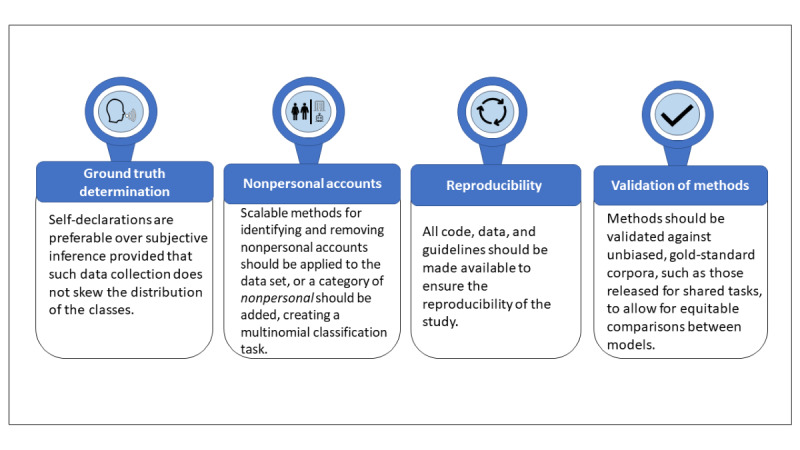
Summary of recommendations for best practices in the collection of training data, and the development and dissemination of age or gender machine learning prediction models.
Gender Prediction
Almost all the included studies approached the gender prediction task as a binary classification task, identifying a user as either male or female. We note that even when focusing on binary gender classification, which is the prevalent approach, the task of gender prediction on Twitter could be better characterized as a multinomial classification task: given a user account, the classifier should return male, female, or nonpersonal. The last label (nonpersonal) can account for Twitter users representing organizations or bots. Although some studies attempted to identify and exclude nonpersonal accounts as a preprocessing step, other studies developed their systems using previously annotated data sets that were exclusively labeled as male or female users or removed nonpersonal accounts during annotation before training and testing. It is unknown how well these systems would perform when extended to unseen data that may contain nonpersonal accounts.
Excluding nonpersonal accounts, the ratio of male users to female users in the training data set is also important, as it should mimic the natural distribution of Twitter users, estimated to be 31.5% female users and 68.5% male users as of January 2021 [149]. However, some authors biased their collections using unconventional methods of collection or using artificially balanced data sets. The most conventional method to collect a set of Twitter accounts is to query for any tweet mentioning functional words without semantic meaning such as of, the, or and from the Twitter API. Whereas collecting Twitter users using functional or neutral keywords, a given language, or geographic areas resulted in a male:female ratio close to the ratio naturally observed on Twitter, other choices resulted in collections with different ratios. Such changes in ratios could have improved (or deteriorated) the training of the authors’ classifiers and biased their evaluations, which did not reflect the performance of their approach on a random sample of Twitter users.
All studies treated gender as a binary determination of male or female. Although some referenced the limitation of this approach, they opted to use these designations given the need to align their data with outside resources, such as the US census or social security administration data. We note that gender, unlike biological sex, is not necessarily binary as it is a social construct and has been shown to influence a person’s use of health care, interactions, therapeutic responses, disease perceptions, and decision-making [150]; this underlies the importance of expanding the efforts of classification beyond binary to improve accuracy and avoid misinterpreting results.
Age Prediction
The age prediction task generally had a lower performance than the gender prediction task. This was true for studies that developed their own models as well as those that used open-source or off-the-shelf software. This may be because most studies approached age prediction as a multiclass classification task. The proxies used, such as language, names, networks, or images, may have limited predictive value for age. In addition, the distribution of Twitter users means that any data set will be inherently imbalanced, providing few training examples for age groups at the tail end of the distribution. This data imbalance may lead to too few instances of the minority classes to effectively train the classifier. For classification models based on images, poor performance for age may be unsurprising given that it can be difficult for humans to discern age from a single image. In addition, photos may be subject to photo editing or enhancement or may not be a recent photograph of the user. Because of a lack of error analysis reports in the included studies, it is difficult to determine the source of the classification difficulty for age.
Performance aside, the fact that the number and range of age groups vary across studies suggests that a classification approach is not generalizable to all research applications. Identifying the exact age, rather than age groups, can generalize to applications that do not align with predefined groupings of binary or multiclass models; however, using high-precision rules to extract self-reports of exact age from the user’s profile metadata had been shown not to scale. As we worked on this study, we noted that none of the reviewed systems opted for extracting the exact age. To test the feasibility and utility of a generalizable system that extracts the exact age from a tweet in a user’s timeline using deep learning methods, separate from this study, our group developed a classification and extraction pipeline using the RoBERTa-Large model and a rule-based extraction model [151]. The system was trained and tested on 11,000 annotated tweets. The classification of tweets mentioning an age achieved an F1-score of 0.93, and the extraction of age from these tweets achieved an F1-score of 0.86. From a collection of 245,947 users, age was extracted for 54% using REPORTage. A shared task for the classification task ran at the SMM4H 2022 workshop, and we released the annotated data set. We did not include our approach in the scoping review, as there were no comparable systems published before the release of the exact age extraction approach as part of the SMM4H 2022 shared task.
Potential Bias of Differing Methods
The limitations of using names to distinguish between genders may promote bias, particularly if the names used for training do not represent the ethnic diversity of the population, and some cultures may have more unisex names than others, which cannot be used to distinguish genders. There can be a high degree of uncertainty for many users for whom gender cannot be classified by name; estimates by Sloan et al [152] are that 52% of users will be unclassified using this method. However, studies have suggested that the classifications made may be relatively accurate given that the data from UK Twitter demonstrates a high level of agreement with the UK census data [153]. Furthermore, when used alone, this heuristic may label some organization accounts, such as PAUL_BAKERY, as a person.
Relying on self-declarations may be prone to bias as well. For example, younger people are more likely to profess their age than older adults, as age may be more important to them. With respect to gender pronouns, these may be more likely to be declared by those in some occupations or age groups. Indeed, there may also be other biases to self-declarations of data based on culture, background, social class, or country of origin or residence.
Using users’ profile images for gender and age identification is challenging. Not all Twitter users provide a picture of themselves, with many opting for pictures of their pets, objects, children, scenery, or even celebrities. Identifying the gender and age of even those with pictures of themselves can be problematic if the quality of the pictures is poor, the pictures contain more than 1 face, or the pictures are not recent, particularly for predicting age. A comparison of systems using images to predict demographics [154] measured not only the accuracy in identifying age and gender but also the percentage of images in which a face could be detected, finding that only approximately 30% of Twitter users had a single detectable face.
Methods to filter out organizations in the studies included removing accounts with a large number of followers [71] or explicitly searching for organizations by matching username terms linked to economic activities, such as restaurant and hotel [49]. These methods remove accounts that do not represent a single user. However, they do not remove bots. Although one of the studies created a classifier to detect bots, the filtering of bots was limited to those identified in manual annotation, by simple heuristics, or nonexistent in many studies (Multimedia Appendix 5).
Validation of Age and Gender Proxies
For cases where age or gender are estimated, it is necessary to conduct validation exercises whereby the data are compared with a gold-standard data set to establish accuracy levels. For example, 1 study [119] that used off-the-shelf software also created a manually annotated gold-standard data set for measuring accuracy. This study found that although the accuracy of crowdsourcing was higher than that of software, the accuracy was only approximately 60% for age. This puts into question the use of manual annotations alone as a gold standard.
The most reliable way of generating a gold standard is to obtain the information directly from the user. This may be done in the form of direct correspondence with the user, such as messaging via social media or, the other way around, requesting Twitter handles in surveys that collect demographic data. Other methods for validation, such as manual extraction, may be less rigorous. However, these methods can be improved by multiple independent annotators, using experienced teams.
External validation of the model is also a vital step to assess how the model will perform on unseen data [155,156]. In a validation on a second data set, Yang et al [117] found that performance dropped in all but 2 of their models, stressing the importance of benchmarking existing systems on a targeted corpus. This step is equally important when using existing systems, so a range of expected performances can be reported and used in any analysis of the output.
In addition to the potential biases reported earlier, predicting the age and gender of Twitter users has some potential limitations that should be considered and, when possible, addressed to limit their effects. As evidenced by the performance results of the included studies, determining the precise age or age group of Twitter users solely based on their Twitter profiles and tweet content can be challenging. Although methods to extract a user’s self-reported age can be executed with high precision [151], predicting age, especially for more specific age groups, remains a complex task. Another limitation to consider is the potential for users to misrepresent their reported age or gender, which can introduce inaccuracies and affect the reliability of predictions based on user-supplied data. This phenomenon is not unique to Twitter and has been identified in other data sources such as surveys [157,158]. Many of the included studies used self-reported data to label their training data; therefore, any potential misrepresentations could be approached as a noisy label problem. There are numerous methods that can be used to manage the effect of label noise on classification models, such as distance learning or ensemble methods [159,160]. Furthermore, it is important to effectively address potential noise and uncertainty when using the output data for secondary analysis. Statistical techniques that can handle imprecise or uncertain data, such as Bayesian inference or fuzzy logic, can be valuable in this context. Using these methods, the analysis can better account for uncertain predictions, leading to more robust and reliable results. Finally, users’ age changes over time, and their profiles may not be updated accordingly, or the age tweet may be from an earlier year and not reflect their current age. Researchers should ensure that the users’ labeled age is contemporaneous with the other data included in the prediction model. Predicting the age and gender of Twitter users provides valuable insights, and most identified limitations presented by the data can be mitigated.
Ethical Considerations
Several studies have shown that social media users generally do not have concerns about their data being used for research or even have favorable opinions about it [161,162]. However, the ethical frameworks for the use of these data are still being developed [163-165], and institutional review boards may deem the use of publicly available data, such as those collected from Twitter, as exempt from human participant research; however, it is incumbent on the researcher to consult with their institutional review boards or equivalent ethical committees to obtain such exemptions [165]. Although the data are publicly available, it is important to carefully consider potential ethical implications when predicting the age and gender of Twitter users. This process may raise privacy concerns, particularly when publishing data that may be considered sensitive, necessitating the protection of user identities and the anonymization of data to prevent reidentification [166]. Anonymizing the data may include removing user identifiers, modifying the tweet text, or generating synthetic tweets [165]. In addition, automated methods for predicting user age or gender have limitations and may result in misclassifications. Transparency regarding the limitations of the methods, algorithms, and data sources used in age and gender prediction are essential to report so that any use of these methods or data in secondary analysis can take such limitations into account. Although the prediction of age and gender may present some potential ethical concerns, it is important to recognize that there are also benefits to the use of these data for health research that can outweigh these concerns, such as eliciting insights into disease prevalence, patterns, and variations or distinguishing health behaviors and attitudes across different subgroups.
Limitations
It is unlikely that we have identified all studies using off-the-shelf software, as we did not search for specific named software, but part of our remit was to identify the array of software used. We did not limit our inclusion to only studies that developed their own software; therefore, we have included studies that used proprietary software. These software products do not publish their methodologies; therefore, we are unable to directly compare these approaches with others.
We also included studies for which the prediction of age and gender was secondary to the primary focus of their study. These studies either used proprietary software, previously developed methods, or developed limited methods to predict demographic information. In general, these studies did not report the performance of their prediction methods on their data sets. Although some reported the original performance metrics of the methods used, it cannot be assumed that these methods will perform similarly across all data.
Conclusions
The prediction of demographic data, such as age and gender, is an important step in increasing the value and application of social media data. Many methods have been reported in the literature with differing degrees of success. Although we sought to explore whether deep learning approaches would advance the performance for these tasks as they have been shown to do for other natural language processing tasks, many of the included studies used traditional ML methods. Although only explored by a handful of studies, deep learning methods appear to perform well for the prediction of a user’s gender or age. However, direct comparison of the published methods was impossible, as different test sets were used in the studies. This highlights the need for recently developed, publicly available gold-standard corpora, such as those released for shared tasks such as SMM4H or PAN-CLEF, to have unbiased data and baseline metrics to compare different approaches going forward.
Acknowledgments
This work was supported by the National Institutes of Health (NIH) National Library of Medicine (NLM) under grant NIH-NLM R01LM011176. The NIH NLM funded this research but was not involved in the design or conduct of the study; collection, management, analysis, or interpretation of the data; preparation, review, or approval of the manuscript; or the decision to submit the manuscript for publication.
Abbreviations
- API
application programming interface
- CLEF
Conference and Labs of the Evaluation Forum
- DNN
deep neural network
- ML
machine learning
- PICOS
Population, Intervention, Comparison, Outcomes, and Study Design
- PRISMA-ScR
Preferred Reporting Items for Systematic Reviews and Meta-Analyses Extension for Scoping Reviews
- SMM4H
Social Media Mining for Health
- SVM
support vector machine
PRISMA-ScR (Preferred Reporting Items for Systematic Reviews and Meta-Analyses Extension for Scoping Reviews) checklist.
Search strategies and results for individual databases.
Extracted data from the included studies predicting gender.
Extracted data from the included studies predicting age.
Information on the identification and removal of nonpersonal or bot accounts from the data set. Features used for annotation or prediction of gender or age.
Details of corpora created in the included studies and their reported availability.
Data Availability
The included studies are available on the web. The search strategy and extracted data on included studies are available in Multimedia Appendices 2-6.
Footnotes
Authors' Contributions: SG, KO, and GGH devised the study and identified data for extraction. SG created and executed the search strategy and created the initial draft of the manuscript. SG and KO were responsible for study selection. All the authors were responsible for data extraction, summarization, and discussion. KO synthesized all data and created all tables. All the authors commented on and edited the manuscript. KO provided the final version of the manuscript. All the authors contributed to the final draft of the manuscript.
Conflicts of Interest: None declared.
References
- 1.Real-world evidence. U.S. Food and Drug Administration. [2023-03-30]. https://www.fda.gov/science-research/science-and-research-special-topics/real-world-evidence .
- 2.Alessa A, Faezipour M. A review of influenza detection and prediction through social networking sites. Theor Biol Med Model. 2018 Feb 01;15(1):2. doi: 10.1186/s12976-017-0074-5. https://tbiomed.biomedcentral.com/articles/10.1186/s12976-017-0074-5 .10.1186/s12976-017-0074-5 [DOI] [PMC free article] [PubMed] [Google Scholar]
- 3.Bisanzio D, Kraemer MU, Bogoch II, Brewer T, Brownstein JS, Reithinger R. Use of Twitter social media activity as a proxy for human mobility to predict the spatiotemporal spread of COVID-19 at global scale. Geospat Health. 2020 Jun 15;15(1) doi: 10.4081/gh.2020.882. doi: 10.4081/gh.2020.882. [DOI] [PubMed] [Google Scholar]
- 4.Magge A, Tutubalina E, Miftahutdinov Z, Alimova I, Dirkson A, Verberne S, Weissenbacher D, Gonzalez-Hernandez G. DeepADEMiner: a deep learning pharmacovigilance pipeline for extraction and normalization of adverse drug event mentions on Twitter. J Am Med Inform Assoc. 2021 Sep 18;28(10):2184–92. doi: 10.1093/jamia/ocab114. https://europepmc.org/abstract/MED/34270701 .6322900 [DOI] [PMC free article] [PubMed] [Google Scholar]
- 5.Nikfarjam A, Sarker A, O'Connor K, Ginn R, Gonzalez G. Pharmacovigilance from social media: mining adverse drug reaction mentions using sequence labeling with word embedding cluster features. J Am Med Inform Assoc. 2015 May;22(3):671–81. doi: 10.1093/jamia/ocu041. https://europepmc.org/abstract/MED/25755127 .ocu041 [DOI] [PMC free article] [PubMed] [Google Scholar]
- 6.Guntuku SC, Sherman G, Stokes DC, Agarwal AK, Seltzer E, Merchant RM, Ungar LH. Tracking mental health and symptom mentions on twitter during COVID-19. J Gen Intern Med. 2020 Sep;35(9):2798–800. doi: 10.1007/s11606-020-05988-8. https://europepmc.org/abstract/MED/32638321 .10.1007/s11606-020-05988-8 [DOI] [PMC free article] [PubMed] [Google Scholar]
- 7.Ma L, Wang Y. Constructing a semantic graph with depression symptoms extraction from Twitter. Proceedings of the IEEE Conference on Computational Intelligence in Bioinformatics and Computational Biology (CIBCB); CIBCB 2019; July 9-11, 2019; Siena, Italy. [DOI] [Google Scholar]
- 8.Bauermeister JA, Zimmerman MA, Johns MM, Glowacki P, Stoddard S, Volz E. Innovative recruitment using online networks: lessons learned from an online study of alcohol and other drug use utilizing a web-based, respondent-driven sampling (webRDS) strategy. J Stud Alcohol Drugs. 2012 Sep;73(5):834–8. doi: 10.15288/jsad.2012.73.834. https://europepmc.org/abstract/MED/22846248 . [DOI] [PMC free article] [PubMed] [Google Scholar]
- 9.Weissenbacher D, Flores J, Wang Y, O'Connor K, Rawal S, Stevens R, Gonzalez-Hernandez G. Automatic cohort determination from Twitter for HIV prevention amongst Black and Hispanic men. AMIA Jt Summits Transl Sci Proc. 2022:504–13. https://europepmc.org/abstract/MED/35854738 .2315 [PMC free article] [PubMed] [Google Scholar]
- 10.Twitter API. Twitter. [2023-03-30]. https://developer.twitter.com/en/docs/twitter-api .
- 11.Sinnenberg L, Buttenheim AM, Padrez K, Mancheno C, Ungar L, Merchant RM. Twitter as a tool for health research: a systematic review. Am J Public Health. 2017 Jan;107(1):e1–8. doi: 10.2105/AJPH.2016.303512. [DOI] [PMC free article] [PubMed] [Google Scholar]
- 12.Gustafson DL, Woodworth CF. Methodological and ethical issues in research using social media: a metamethod of Human Papillomavirus vaccine studies. BMC Med Res Methodol. 2014 Dec 02;14:127. doi: 10.1186/1471-2288-14-127. https://bmcmedresmethodol.biomedcentral.com/articles/10.1186/1471-2288-14-127 .1471-2288-14-127 [DOI] [PMC free article] [PubMed] [Google Scholar]
- 13.Beck C, McSweeney JC, Richards KC, Roberson PK, Tsai PF, Souder E. Challenges in tailored intervention research. Nurs Outlook. 2010 Mar;58(2):104–10. doi: 10.1016/j.outlook.2009.10.004. https://europepmc.org/abstract/MED/20362779 .S0029-6554(09)00194-8 [DOI] [PMC free article] [PubMed] [Google Scholar]
- 14.Rimer BK, Kreuter MW. Advancing tailored health communication: a persuasion and message effects perspective. J Commun. 2006 Aug;56(s1):S184–201. doi: 10.1111/j.1460-2466.2006.00289.x. [DOI] [Google Scholar]
- 15.Hinds J, Joinson AN. What demographic attributes do our digital footprints reveal? A systematic review. PLoS One. 2018 Nov 28;13(11):e0207112. doi: 10.1371/journal.pone.0207112. https://dx.plos.org/10.1371/journal.pone.0207112 .PONE-D-17-29489 [DOI] [PMC free article] [PubMed] [Google Scholar]
- 16.Dredze M. How social media will change public health. IEEE Intell Syst. 2012 Jul;27(4):81–4. doi: 10.1109/MIS.2012.76. http://ieeexplore.ieee.org/xpls/abs_all.jsp?arnumber=6285937 . [DOI] [Google Scholar]
- 17.Golder S, Stevens R, O'Connor K, James R, Gonzalez-Hernandez G. Methods to establish race or ethnicity of twitter users: scoping review. J Med Internet Res. 2022 Apr 29;24(4):e35788. doi: 10.2196/35788. https://www.jmir.org/2022/4/e35788/ v24i4e35788 [DOI] [PMC free article] [PubMed] [Google Scholar]
- 18.Bour C, Ahne A, Schmitz S, Perchoux C, Dessenne C, Fagherazzi G. The use of social media for health research purposes: scoping review. J Med Internet Res. 2021 May 27;23(5):e25736. doi: 10.2196/25736. https://www.jmir.org/2021/5/e25736/ v23i5e25736 [DOI] [PMC free article] [PubMed] [Google Scholar]
- 19.van Oosterhout R, de Boer AR, Maas AH, Rutten FH, Bots ML, Peters SA. Sex differences in symptom presentation in acute coronary syndromes: a systematic review and meta-analysis. J Am Heart Assoc. 2020 May 05;9(9):e014733. doi: 10.1161/JAHA.119.014733. https://www.ahajournals.org/doi/10.1161/JAHA.119.014733?url_ver=Z39.88-2003&rfr_id=ori:rid:crossref.org&rfr_dat=cr_pub0pubmed . [DOI] [PMC free article] [PubMed] [Google Scholar]
- 20.Trevisan C, Noale M, Prinelli F, Maggi S, Sojic A, Di Bari M, Molinaro S, Bastiani L, Giacomelli A, Galli M, Adorni F, Antonelli Incalzi R, Pedone C, EPICOVID19 Working Group Age-related changes in clinical presentation of Covid-19: the EPICOVID19 web-based survey. Eur J Intern Med. 2021 Apr;86:41–7. doi: 10.1016/j.ejim.2021.01.028. https://air.unimi.it/handle/2434/811304 .S0953-6205(21)00034-0 [DOI] [PMC free article] [PubMed] [Google Scholar]
- 21.Brady E, Nielsen MW, Andersen JP, Oertelt-Prigione S. Lack of consideration of sex and gender in COVID-19 clinical studies. Nat Commun. 2021 Jul 06;12(1):4015. doi: 10.1038/s41467-021-24265-8. doi: 10.1038/s41467-021-24265-8.10.1038/s41467-021-24265-8 [DOI] [PMC free article] [PubMed] [Google Scholar]
- 22.Tannenbaum C, Ellis RP, Eyssel F, Zou J, Schiebinger L. Sex and gender analysis improves science and engineering. Nature. 2019 Nov;575(7781):137–46. doi: 10.1038/s41586-019-1657-6.10.1038/s41586-019-1657-6 [DOI] [PubMed] [Google Scholar]
- 23.Amiri P, Mohammadzadeh-Naziri K, Abbasi B, Cheraghi L, Jalali-Farahani S, Momenan AA, Amouzegar A, Hadaegh F, Azizi F. Smoking habits and incidence of cardiovascular diseases in men and women: findings of a 12 year follow up among an urban Eastern-Mediterranean population. BMC Public Health. 2019 Aug 05;19(1):1042. doi: 10.1186/s12889-019-7390-0. https://bmcpublichealth.biomedcentral.com/articles/10.1186/s12889-019-7390-0 .10.1186/s12889-019-7390-0 [DOI] [PMC free article] [PubMed] [Google Scholar]
- 24.Rosselli M, Ermini E, Tosi B, Boddi M, Stefani L, Toncelli L, Modesti PA. Gender differences in barriers to physical activity among adolescents. Nutr Metab Cardiovasc Dis. 2020 Aug 28;30(9):1582–9. doi: 10.1016/j.numecd.2020.05.005.S0939-4753(20)30161-7 [DOI] [PubMed] [Google Scholar]
- 25.Chen SL, Lee WL, Liang T, Liao IC. Factors associated with gender differences in medication adherence: a longitudinal study. J Adv Nurs. 2014 Sep;70(9):2031–40. doi: 10.1111/jan.12361. [DOI] [PubMed] [Google Scholar]
- 26.Krueger K, Botermann L, Schorr SG, Griese-Mammen N, Laufs U, Schulz M. Age-related medication adherence in patients with chronic heart failure: a systematic literature review. Int J Cardiol. 2015 Apr 01;184:728–35. doi: 10.1016/j.ijcard.2015.03.042.S0167-5273(15)00280-6 [DOI] [PubMed] [Google Scholar]
- 27.Auxier B, Anderson M. Social media use in 2021. Pew Research Center. 2021. Apr 7, [2021-12-09]. https://www.pewresearch.org/internet/2021/04/07/social-media-use-in-2021/
- 28.World population prospects - population division - United Nations. United Nations Department of Economic and Social Affairs Population Division. [2023-07-28]. https://population.un.org/wpp/
- 29.Mislove A, Lehmann S, Ahn YY, Onnela JP, Rosenquist J. Understanding the demographics of Twitter users. Proc Int AAAI Conf Web Soc Media. 2021 Aug 03;5(1):554–7. doi: 10.1609/icwsm.v5i1.14168. [DOI] [Google Scholar]
- 30.Fink C, Kopecky J, Morawski M. Inferring gender from the content of tweets: a region specific example. Proc Int AAAI Conf Web Soc Media. 2021 Aug 03;6(1):459–62. doi: 10.1609/icwsm.v6i1.14320. [DOI] [Google Scholar]
- 31.Alowibdi JS, Buy UA, Yu P. Language independent gender classification on Twitter. Proceedings of the 2013 IEEE/ACM International Conference on Advances in Social Networks Analysis and Mining; ASONAM '13; August 25-28, 2013; Niagara Falls, ON. [Google Scholar]
- 32.Chen L, Qian T, Zhu P, You Z. Learning user embedding representation for gender prediction. Proceedings of the IEEE 28th International Conference on Tools with Artificial Intelligence (ICTAI); ICTAI 2016; November 6-8, 2016; San Jose, CA. [DOI] [Google Scholar]
- 33.Culotta A, Ravi NK, Cutler J. Predicting the demographics of Twitter users from website traffic data. Proceedings of the Twenty-Ninth AAAI Conference on Artificial Intelligence; AAAI'15; January 25-30, 2015; Austin, TX. https://dl.acm.org/doi/abs/10.5555/2887007.2887018 . [DOI] [Google Scholar]
- 34.Sloan L, Morgan J, Burnap P, Williams M. Who tweets? Deriving the demographic characteristics of age, occupation and social class from Twitter user meta-data. PLoS One. 2015;10(3):e0115545. doi: 10.1371/journal.pone.0115545. https://dx.plos.org/10.1371/journal.pone.0115545 .PONE-D-14-36461 [DOI] [PMC free article] [PubMed] [Google Scholar]
- 35.Oktay H, Firat A, Ertem Z. Demographic breakdown of Twitter users: an analysis based on names. Proceedings of the Academy of Science and Engineering (ASE); ASE'14; September 15-19, 2014; Västerås, Sweden. https://www.researchgate.net/publication/315538705_Demographic_Breakdown_of_Twitter_Users_An_analysis_based_on_names . [Google Scholar]
- 36.Nguyen D, Gravel R, Trieschnigg D, Meder T. "How old do you think I am?" A study of language and age in Twitter. Proc Int AAAI Conf Web Soc Media. 2021 Aug 03;7(1):439–48. doi: 10.1609/icwsm.v7i1.14381. [DOI] [Google Scholar]
- 37.Mikolov T, Chen K, Corrado G, Dean J. Efficient estimation of word representations in vector space. arXiv. Preprint posted online January 16, 2013. doi: 10.48550/arXiv.1301.3781. [DOI] [Google Scholar]
- 38.Mikolov T, Sutskever I, Chen K, Corrado G, Dean J. Distributed representations of words and phrases and their compositionality. Proceedings of the 26th International Conference on Neural Information Processing Systems - Volume 2; NIPS'13; December 5-10, 2013; Lake Tahoe, Nevada. https://dl.acm.org/doi/proceedings/10.5555/2999792 . [Google Scholar]
- 39.Tricco AC, Lillie E, Zarin W, O'Brien KK, Colquhoun H, Levac D, Moher D, Peters MD, Horsley T, Weeks L, Hempel S, Akl EA, Chang C, McGowan J, Stewart L, Hartling L, Aldcroft A, Wilson MG, Garritty C, Lewin S, Godfrey CM, Macdonald MT, Langlois EV, Soares-Weiser K, Moriarty J, Clifford T, Tunçalp Özge, Straus SE. PRISMA extension for Scoping Reviews (PRISMA-ScR): checklist and explanation. Ann Intern Med. 2018 Oct 02;169(7):467–73. doi: 10.7326/M18-0850. https://www.acpjournals.org/doi/abs/10.7326/M18-0850?url_ver=Z39.88-2003&rfr_id=ori:rid:crossref.org&rfr_dat=cr_pub0pubmed .2700389 [DOI] [PubMed] [Google Scholar]
- 40.Umar A, Bashir SA, Abdullahi MB, Adebayo OS. Comparative study of various machine learning algorithms for tweet classification. i-Manager J Comput Sci. 2019;6(4):12. http://repository.futminna.edu.ng:8080/jspui/handle/123456789/7229 . [Google Scholar]
- 41.Amir-Behghadami M, Janati A. Population, Intervention, Comparison, Outcomes and Study (PICOS) design as a framework to formulate eligibility criteria in systematic reviews. Emerg Med J. 2020 Jun;37(6):387. doi: 10.1136/emermed-2020-209567.emermed-2020-209567 [DOI] [PubMed] [Google Scholar]
- 42.Bramer WM, Giustini D, Kramer BM. Comparing the coverage, recall, and precision of searches for 120 systematic reviews in Embase, MEDLINE, and Google Scholar: a prospective study. Syst Rev. 2016 Mar 01;5:39. doi: 10.1186/s13643-016-0215-7. https://systematicreviewsjournal.biomedcentral.com/articles/10.1186/s13643-016-0215-7 .10.1186/s13643-016-0215-7 [DOI] [PMC free article] [PubMed] [Google Scholar]
- 43.Kugley S, Wade A, Thomas J, Mahood Q, Jørgensen A-M, Hammerstrøm K, Sathe N. Searching for studies: a guide to information retrieval for Campbell systematic reviews. Campbell Syst Rev. 2017 Feb 13;13(1):1–73. doi: 10.4073/cmg.2016.1. [DOI] [Google Scholar]
- 44.Lefebvre C, Glanville J, Briscoe S, Littlewood A, Marshall C, Metzendorf MI, Noel-Storr A, Paynter R, Rader T, Thomas J, Wieland LS. Technical Supplement to Chapter 4: searching for and selecting studies. In: Higgins JP, Thomas J, Chandler J, Cumpston MS, Li T, Page MJ, Welch VA, editors. Cochrane Handbook for Systematic Reviews of Interventions Version 6.3. London, UK: The Cochrane Collaboration; 2022. [Google Scholar]
- 45.Booth A. How much searching is enough? Comprehensive versus optimal retrieval for technology assessments. Int J Technol Assess Health Care. 2010 Oct;26(4):431–5. doi: 10.1017/S0266462310000966.S0266462310000966 [DOI] [PubMed] [Google Scholar]
- 46.Briscoe S, Nunns M, Shaw L. How do Cochrane authors conduct web searching to identify studies? Findings from a cross-sectional sample of Cochrane Reviews. Health Info Libr J. 2020 Dec;37(4):293–318. doi: 10.1111/hir.12313. [DOI] [PubMed] [Google Scholar]
- 47.Stansfield C, Dickson K, Bangpan M. Exploring issues in the conduct of website searching and other online sources for systematic reviews: how can we be systematic? Syst Rev. 2016 Nov 15;5(1):191. doi: 10.1186/s13643-016-0371-9. https://systematicreviewsjournal.biomedcentral.com/articles/10.1186/s13643-016-0371-9 .10.1186/s13643-016-0371-9 [DOI] [PMC free article] [PubMed] [Google Scholar]
- 48.Godin K, Stapleton J, Kirkpatrick SI, Hanning RM, Leatherdale ST. Applying systematic review search methods to the grey literature: a case study examining guidelines for school-based breakfast programs in Canada. Syst Rev. 2015 Oct 22;4:138. doi: 10.1186/s13643-015-0125-0. https://systematicreviewsjournal.biomedcentral.com/articles/10.1186/s13643-015-0125-0 .10.1186/s13643-015-0125-0 [DOI] [PMC free article] [PubMed] [Google Scholar]
- 49.Alessandra R, Gentile MM, Bianco DM. Who tweets in Italian? Demographic characteristics of twitter users. In: Petrucci A, Racioppi F, Verde R, editors. New Statistical Developments in Data Science. Cham, Switzerland: Springer; 2019. Aug 21, [Google Scholar]
- 50.Alfayez A, Awwad Z, Kerr C, Alrashed N, Williams S, Al-Wabil A. Understanding gendered spaces using social media data. In: Meiselwitz G, editor. Social Computing and Social Media. Applications and Analytics. Cham, Switzerland: Springer; 2017. [Google Scholar]
- 51.Arafat TA, Budi I, Mahendra R, Salehah DA. Demographic analysis of candidates supporter in Twitter during Indonesian presidential election 2019. Proceedings of the International Conference on ICT for Smart Society (ICISS); ICISS 2020; November 19-20, 2020; Bandung, Indonesia. [DOI] [Google Scholar]
- 52.Ardehaly EM, Culotta A. Co-training for demographic classification using deep learning from label proportions. Proceedings of the IEEE International Conference on Data Mining Workshops (ICDMW); ICDMW 2017; November 18-21, 2017; New Orleans, LA. https://ieeexplore.ieee.org/document/8215778 . [DOI] [Google Scholar]
- 53.Ardehaly EM, Culotta A. Learning from noisy label proportions for classifying online social data. Soc Netw Anal Mining. 2017 Nov 27;8(1) doi: 10.1007/s13278-017-0478-6. [DOI] [Google Scholar]
- 54.Baxevanakis S, Gavras S, Mouratidis D, Kermanidis KL. A machine learning approach for gender identification of Greek tweet authors. Proceedings of the 13th ACM International Conference on PErvasive Technologies Related to Assistive Environments; PETRA '20; June 30-July 3, 2020; Corfu, Greece. https://dl-acm-org.proxy.library.upenn.edu/doi/10.1145/3389189.3397992 . [DOI] [Google Scholar]
- 55.Bayot RK, Gonçalves T. Age and gender classification of Tweets using convolutional neural networks. Proceedings of the Third International Conference, MOD 2017; MOD 2017; September 14-17, 2017; Volterra, Italy. [DOI] [Google Scholar]
- 56.Brandt J, Buckingham K, Buntain C, Anderson W, Ray S, Pool JR, Ferrari N. Identifying social media user demographics and topic diversity with computational social science: a case study of a major international policy forum. J Comput Soc Sci. 2020 Jan 07;3:167–88. doi: 10.1007/s42001-019-00061-9. [DOI] [Google Scholar]
- 57.Bsir B, Zrigui M. Enhancing deep learning gender identification with gated recurrent units architecture in social text. Computacion y Sistemas. 2018 Sep 30;22(3):757–66. doi: 10.13053/CyS-22-3-3036. [DOI] [Google Scholar]
- 58.Bsir B, Zrigui M. Document model with attention bidirectional recurrent network for gender identification. Proceedings of the 15th International Work-Conference on Artificial Neural Networks; IWANN 2019; June 12-14, 2019; Gran Canaria, Spain. [DOI] [Google Scholar]
- 59.Cavazos-Rehg PA, Zewdie K, Krauss MJ, Sowles SJ. "No high like a brownie high": a content analysis of edible marijuana tweets. Am J Health Promot. 2018 May;32(4):880–6. doi: 10.1177/0890117116686574. [DOI] [PubMed] [Google Scholar]
- 60.Cavazos-Rehg PA, Krauss MJ, Costello SJ, Kaiser N, Cahn ES, Fitzsimmons-Craft EE, Wilfley DE. "I just want to be skinny.": a content analysis of tweets expressing eating disorder symptoms. PLoS One. 2019 Jan 16;14(1):e0207506. doi: 10.1371/journal.pone.0207506. https://dx.plos.org/10.1371/journal.pone.0207506 .PONE-D-17-15569 [DOI] [PMC free article] [PubMed] [Google Scholar]
- 61.Cesare N, Dwivedi P, Nguyen Q, Nsoesie EO. Use of social media, search queries, and demographic data to assess obesity prevalence in the United States. Palgrave Commun. 2019 Sep 17;5(1):106. doi: 10.1057/s41599-019-0314-x. doi: 10.1057/s41599-019-0314-x.106 [DOI] [PMC free article] [PubMed] [Google Scholar]
- 62.Cesare N, Nguyen Q, Grant C, Nsoesie EO. Social media captures demographic and regional physical activity. BMJ Open Sport Exerc Med. 2019 Jul 14;5(1):e000567. doi: 10.1136/bmjsem-2019-000567. https://europepmc.org/abstract/MED/31423323 .bmjsem-2019-000567 [DOI] [PMC free article] [PubMed] [Google Scholar]
- 63.Chakraborty A, Messias J, Benevenuto F, Ghosh S, Ganguly N, Gummadi K. Who makes trends? Understanding demographic biases in crowdsourced recommendations. Proceedings of the International AAAI Conference on Web and Social Media; ICWSM-17; Montreal, Quebec; May 15-18, 2017. [DOI] [Google Scholar]
- 64.Chamberlain BP, Humby C, Deisenroth MP. Probabilistic inference of Twitter users’ age based on what they follow. Proceedings of the Joint European Conference on Machine Learning and Knowledge Discovery in Databases (ECML PKDD 2017); ECML PKDD 2017; September 18-22, 2017; Skopje, Macedonia. [DOI] [Google Scholar]
- 65.Cheng JK, Fernandez A, Quindoza RG, Tan S, Cheng C. Neural Information Processing. New York City, NY: Springer International Publishing; 2018. A model for age and gender profiling of social media accounts based on post contents. [Google Scholar]
- 66.Cornelisse J, Pillai RG. Age inference on Twitter using SAGE and TF-IGM. Proceedings of the 4th International Conference on Natural Language Processing and Information Retrieval; NLPIR 2020; December 18-20, 2020; Seoul, Republic of Korea. 2020. Dec, [DOI] [Google Scholar]
- 67.Duong V, Luo J, Pham P, Yang T, Wang Y. The ivory tower lost: how college students respond differently than the general public to the COVID-19 pandemic. Proceedings of the IEEE/ACM International Conference on Advances in Social Networks Analysis and Mining (ASONAM); ASONAM 2020; December 7-10, 2020; The Hague, The Netherlands. [DOI] [Google Scholar]
- 68.ElSayed S, Farouk M. Gender identification for Egyptian Arabic dialect in twitter using deep learning models. Egypt Inform J. 2020 Sep;21(3):159–67. doi: 10.1016/j.eij.2020.04.001. [DOI] [Google Scholar]
- 69.Emmery C, Chrupała G, Daelemans W. Simple queries as distant labels for predicting gender on Twitter. Proceedings of the 3rd Workshop on Noisy User-generated Text; NUT@EMNLP 2017; September 7, 2017; Copenhagen, Denmark. https://github.com/facebookresearch/ [DOI] [Google Scholar]
- 70.Garcia-Guzman R, Andrade-Ambriz YA, Ibarra-Manzano MA, Ledesma S, Gomez JC, Almanza-Ojeda DL. Trend-based categories recommendations and age-gender prediction for Pinterest and Twitter users. Appl Sci. 2020 Aug 28;10(17):5957. doi: 10.3390/app10175957. [DOI] [Google Scholar]
- 71.Geng L, Zhang K, Wei X, Feng X. Soft biometrics in online social networks: a case study on Twitter user gender recognition. Proceedings of the IEEE Winter Applications of Computer Vision Workshops (WACVW); WACVW 2017; March 24-31, 2017; Santa Rosa, CA. [DOI] [Google Scholar]
- 72.Giannakopoulos O, Kalatzis N, Roussaki I, Papavassiliou S. Gender recognition based on social networks for multimedia production. Proceedings of the IEEE 13th Image, Video, and Multidimensional Signal Processing Workshop (IVMSP); IVMSP 2018; June 10-12, 2018; Aristi Village, Greece. [DOI] [Google Scholar]
- 73.Guimaraes RG, Rosa RL, De Gaetano D, Rodriguez DZ, Bressan G. Age groups classification in social network using deep learning. IEEE Access. 2017 May 23;5:10805–16. doi: 10.1109/access.2017.2706674. [DOI] [Google Scholar]
- 74.Hasanuzzaman M, Dias G, Way A. Demographic word embeddings for racism detection on Twitter. Proceedings of the Eighth International Joint Conference on Natural Language Processing (Volume 1: Long Papers); IJCNLP 2017; November 28-30, 2017; Taipei, Taiwan. [Google Scholar]
- 75.Hashempour R. A deep learning approach to language-independent gender prediction on Twitter. Proceedings of the 2019 Workshop on Widening NLP; 2019 Workshop on Widening NLP; July 28, 2019; Florence, Italy. [DOI] [Google Scholar]
- 76.Hirt R, Kühl N, Satzger G. Cognitive computing for customer profiling: meta classification for gender prediction. Electron Mark. 2019 Feb 21;29:93–106. doi: 10.1007/s12525-019-00336-z. [DOI] [Google Scholar]
- 77.Huang X, Xing L, Dernoncourt F, Paul MJ. Multilingual Twitter corpus and baselines for evaluating demographic bias in hate speech recognition. Proceedings of the Twelfth Language Resources and Evaluation Conference; LREC 2020; May 11-16, 2020; Marseille, France. [Google Scholar]
- 78.Huang X, Smith MC, Jamison AM, Broniatowski DA, Dredze M, Quinn SC, Cai J, Paul MJ. Can online self-reports assist in real-time identification of influenza vaccination uptake? A cross-sectional study of influenza vaccine-related tweets in the USA, 2013-2017. BMJ Open. 2019 Jan 15;9(1):e024018. doi: 10.1136/bmjopen-2018-024018. https://bmjopen.bmj.com/lookup/pmidlookup?view=long&pmid=30647040 .bmjopen-2018-024018 [DOI] [PMC free article] [PubMed] [Google Scholar]
- 79.Hussein S, Farouk M, Hemayed E. Gender identification of Egyptian dialect in twitter. Egypt Inform J. 2019 Jul;20(2):109–16. doi: 10.1016/j.eij.2018.12.002. [DOI] [Google Scholar]
- 80.Jurgens D, Tsvetkov Y, Jurafsky D. Writer profiling without the writer’s text. Proceedings of the 9th International Conference, SocInfo 2017; SocInfo 2017; September 13-15, 2017; Oxford, UK. [DOI] [Google Scholar]
- 81.Kang Y, Wang Y, Zhang D, Zhou L. The public's opinions on a new school meals policy for childhood obesity prevention in the U.S.: a social media analytics approach. Int J Med Inform. 2017 Jul;103:83–8. doi: 10.1016/j.ijmedinf.2017.04.013.S1386-5056(17)30089-8 [DOI] [PubMed] [Google Scholar]
- 82.Khandelwal A, Swami S, Akhtar SS, Shrivastava M. Gender prediction in English-Hindi code-mixed social media content: corpus and baseline system. Computacion y Sistemas. 2018;22(3) doi: 10.13053/cys-22-4-3061. https://www.researchgate.net/publication/332549453_Gender_Prediction_in_English-Hindi_Code-Mixed_Social_Media_Content_Corpus_and_Baseline_System . [DOI] [Google Scholar]
- 83.Kim SM, Xu Q, Qu L, Wan S, Paris C. Demographic inference on Twitter using recursive neural networks. Proceedings of the 55th Annual Meeting of the Association for Computational Linguistics (Volume 2: Short Papers); ACL 2017; July 30-August 4, 2017; Vancouver, Canada. [DOI] [Google Scholar]
- 84.Kostakos P, Pandya A, Kyriakouli O, Oussalah M. Inferring demographic data of marginalized users in Twitter with computer vision APIs. Proceedings of the European Intelligence and Security Informatics Conference (EISIC); EISIC 2018; October 24-25, 2018; Karlskrona, Sweden. [DOI] [Google Scholar]
- 85.Ljubešić N, Fišer D, Erjavec T. Language-independent gender prediction on Twitter. Proceedings of the Second Workshop on NLP and Computational Social Science; NLP+CSS 2017; August 3, 2017; Vancouver, Canada. [DOI] [Google Scholar]
- 86.López-Monroy AP, González FA, Solorio T. Early author profiling on Twitter using profile features with multi-resolution. Expert Syst Appl. 2020 Feb;140:112909. doi: 10.1016/j.eswa.2019.112909. [DOI] [Google Scholar]
- 87.Markov I, Gómez-Adorno H, Posadas-Durán JP, Sidorov G, Gelbukh A. Author profiling with Doc2vec neural network-based document embeddings. Proceedings of the 15th Mexican International Conference on Artificial Intelligence; MICAI 2016; October 23-28, 2016; Cancún, Mexico. [DOI] [Google Scholar]
- 88.Messias J, Vikatos P, Benevenuto F. White, man, and highly followed: gender and race inequalities in Twitter. Proceedings of the International Conference on Web Intelligence; WI '17; August 23-26, 2017; Leipzig, Germany. Aug, [DOI] [Google Scholar]
- 89.Miura R, Hirota M, Kato D, Araki T, Endo M, Ishikawa H. Predicting user gender on social media sites using geographical information. Proceedings of the 10th International Conference on Management of Digital EcoSystems; MEDES '18; September 25-28, 2018; Tokyo, Japan. Sep, [DOI] [Google Scholar]
- 90.Morgan-Lopez AA, Kim AE, Chew RF, Ruddle P. Predicting age groups of Twitter users based on language and metadata features. PLoS One. 2017;12(8):e0183537. doi: 10.1371/journal.pone.0183537. https://dx.plos.org/10.1371/journal.pone.0183537 .PONE-D-16-41961 [DOI] [PMC free article] [PubMed] [Google Scholar]
- 91.Mueller A, Wood-Doughty Z, Amir S, Dredze M, Lynn Nobles A. Demographic representation and collective storytelling in the me too Twitter hashtag activism movement. Proc ACM Hum Comput Interact. 2021 Apr 22;5(CSCW1):1–28. doi: 10.1145/3449181. https://europepmc.org/abstract/MED/35295189 .107 [DOI] [PMC free article] [PubMed] [Google Scholar]
- 92.Mukherjee S, Bala PK. Gender classification of microblog text based on authorial style. Inf Syst E Bus Manage. 2016 Mar 2;15(1):117–38. doi: 10.1007/s10257-016-0312-0. [DOI] [Google Scholar]
- 93.Imuede J, Raborife M, Ranchod P. Sentiment analysis as an indicator to evaluate gender disparity on sexual violence tweets in South Africa. Proceedings of the International SAUPEC/RobMech/PRASA Conference; International SAUPEC/RobMech/PRASA Conference; January 29-31, 2020; Cape Town, South Africa. [DOI] [Google Scholar]
- 94.Pandya A, Oussalah M, Monachesi P, Kostakos P, Loven L. On the use of URLs and hashtags in age prediction of Twitter users. Proceedings of the IEEE International Conference on Information Reuse and Integration (IRI); IEEE IRI 2018; July 6-9, 2018; Salt Lake City, UT. [DOI] [Google Scholar]
- 95.Pandya A, Oussalah M, Monachesi P, Kostakos P. On the use of distributed semantics of tweet metadata for user age prediction. Future Gener Comput Syst. 2020 Jan;102:437–52. doi: 10.1016/j.future.2019.08.018. [DOI] [Google Scholar]
- 96.Pizarro J. Profiling bots and fake news spreaders at PAN’19 and PAN’20 : bots and gender profiling 2019, profiling fake news spreaders on Twitter 2020. Proceedings of the IEEE 7th International Conference on Data Science and Advanced Analytics (DSAA); DSAA 2020; October 6-9, 2020; Sydney, Australia. [DOI] [Google Scholar]
- 97.Reis JC, Kwak H, An J, Messias J, Benevenuto F. Demographics of news sharing in the U.S. Twittersphere. Proceedings of the 28th ACM Conference on Hypertext and Social Media; HT'17; July 4-7, 2017; Prague, Czech Republic. [DOI] [Google Scholar]
- 98.Serfass DG. Assessing situations on social media: temporal, demographic, and personality influences on situation experience. Florida Atlantic University . 2016. [2023-03-30]. https://www.proquest.com/openview/6a5ca1b98806d5f3a2ce7e66e2f358cd/1?pq-origsite=gscholar&cbl=18750 .
- 99.Stevens R, Bonett S, Bannon J, Chittamuru D, Slaff B, Browne SK, Huang S, Bauermeister JA. Association between HIV-related Tweets and HIV incidence in the United States: infodemiology study. J Med Internet Res. 2020 Jun 24;22(6):e17196. doi: 10.2196/17196. https://www.jmir.org/2020/6/e17196/ v22i6e17196 [DOI] [PMC free article] [PubMed] [Google Scholar]
- 100.Stevens RC, Brawner BM, Kranzler E, Giorgi S, Lazarus E, Abera M, Huang S, Ungar L. Exploring substance use Tweets of youth in the United States: mixed methods study. JMIR Public Health Surveill. 2020 Mar 26;6(1):e16191. doi: 10.2196/16191. https://publichealth.jmir.org/2020/1/e16191/ v6i1e16191 [DOI] [PMC free article] [PubMed] [Google Scholar]
- 101.Swain S, Seeja KR. TWEESENT: a web application on sentiment analysis. Proceedings of the Second International Conference on Smart Innovations in Communications and Computational Sciences; ICSICCS-2018; April 28-29, 2018; Indore, India. 2019. [DOI] [Google Scholar]
- 102.Thelwall M, Thelwall S. Covid-19 tweeting in English: gender differences. Prof De La Inf. 2020 May 04;29(3) doi: 10.3145/epi.2020.may.01. [DOI] [Google Scholar]
- 103.Udayakumar S, Senadeera DC, Yamunarani S, Cheon NJ. Demographics analysis of Twitter users who tweeted on psychological articles and tweets analysis. Procedia Comput Sci. 2018;144:96–104. doi: 10.1016/j.procs.2018.10.509. [DOI] [Google Scholar]
- 104.van der Goot R, Ljubešić N, Matroos I, Nissim M, Plank B. Bleaching text: abstract features for cross-lingual gender prediction. Proceedings of the 56th Annual Meeting of the Association for Computational Linguistics (Volume 2: Short Papers); ACL 2018; July 15-20, 2018; Melbourne, Australia. [DOI] [Google Scholar]
- 105.Vashisth P, Meehan K. Gender classification using Twitter text data. Proceedings of the 31st Irish Signals and Systems Conference (ISSC); ISSC 2020; June 11-12, 2020; Letterkenny, Ireland. [DOI] [Google Scholar]
- 106.Verhoeven B, Škrjanec I, Pollak S. Gender profiling for Slovene Twitter communication: the influence of gender marking, content and style. Proceedings of the 6th Workshop on Balto-Slavic Natural Language Processing; BSNLP 2017; April 4, 2017; Valencia, Spain. [DOI] [Google Scholar]
- 107.Vicente M, Batista F, Carvalho JP. Gender detection of Twitter users based on multiple information sources. In: Kóczy L, Medina-Moreno J, Ramírez-Poussa E, editors. Interactions Between Computational Intelligence and Mathematics Part 2. Cham, Switzerland: Springer; 2018. Nov 03, [Google Scholar]
- 108.Vijayaraghavan P, Vosoughi S, Roy D. Twitter demographic classification using deep multi-modal multi-task learning. Proceedings of the 55th Annual Meeting of the Association for Computational Linguistics (Volume 2: Short Papers); ACL 2017; July 30-August 4, 2017; Vancouver, Canada. [DOI] [Google Scholar]
- 109.Vikatos P, Messias J, Miranda M, Benevenuto F. Linguistic diversities of demographic groups in Twitter. Proceedings of the 28th ACM Conference on Hypertext and Social Media; HT'17; July 4-7, 2017; Prague, Czech Republic. [DOI] [Google Scholar]
- 110.Volkova S. Predicting demographics and affect in social networks. The Johns Hopkins University. 2015. Oct, [2023-03-30]. https://jscholarship.library.jhu.edu/bitstream/handle/1774.2/39639/VOLKOVA-DISSERTATION-2015.pdf?sequence=1&isAllowed=y .
- 111.Wang Y, Feng Y, Luo J. Gender politics in the 2016 U.S. Presidential election: a computer vision approach. Proceedings of the 10th International Conference, SBP-BRiMS 2017; SBP-BRiMS 2017; July 5-8, 2017; Washington, DC. [DOI] [Google Scholar]
- 112.Wang Z, Hale S, Adelani DI, Grabowicz P, Hartman T, Flöck F, Jurgens D. Demographic inference and representative population estimates from multilingual social media data. Proceedings of the The World Wide Web Conference; WWW '19; May 13-17, 2019; San Francisco, CA. [DOI] [Google Scholar]
- 113.Wong SC, Teh PL, Cheng CB. How different genders use profanity on Twitter?. Proceedings of the 2020 the 4th International Conference on Compute and Data Analysis; ICCDA 2020; March 9-12, 2020; Silicon Valley, CA. [DOI] [Google Scholar]
- 114.Wood-Doughty Z, Smith M, Broniatowski D, Dredze M. How does Twitter user behavior vary across demographic groups?. Proceedings of the Second Workshop on NLP and Computational Social Science; NLP+CSS 2017; August 3, 2017; Vancouver, Canada. [DOI] [Google Scholar]
- 115.Wood-Doughty Z, Andrews N, Marvin R, Dredze M. Predicting Twitter user demographics from names alone. Proceedings of the Second Workshop on Computational Modeling of People’s Opinions, Personality, and Emotions in Social Media; PEOPLES 2018; June 6, 2018; New Orleans, LA. [DOI] [Google Scholar]
- 116.Xiang L, Sang J, Xu C. Demographic attribute inference from social multimedia behaviors: a cross-OSN approach. Proceedings of the 23rd International Conference, MMM 2017; MMM 2017; January 4-6, 2017; Reykjavik, Iceland. [DOI] [Google Scholar]
- 117.Yang YC, Al-Garadi MA, Love JS, Perrone J, Sarker A. Automatic gender detection in Twitter profiles for health-related cohort studies. JAMIA Open. 2021 Jun 23;4(2):ooab042. doi: 10.1093/jamiaopen/ooab042. https://europepmc.org/abstract/MED/34169232 .ooab042 [DOI] [PMC free article] [PubMed] [Google Scholar]
- 118.Yazdavar AH, Mahdavinejad MS, Bajaj G, Romine W, Sheth A, Monadjemi AH, Thirunarayan K, Meddar JM, Myers A, Pathak J, Hitzler P. Multimodal mental health analysis in social media. PLoS One. 2020 Apr 10;15(4):e0226248. doi: 10.1371/journal.pone.0226248. https://dx.plos.org/10.1371/journal.pone.0226248 .PONE-D-19-03990 [DOI] [PMC free article] [PubMed] [Google Scholar]
- 119.Yildiz D, Munson J, Vitali A, Tinati R, Holland JA. Using Twitter data for demographic research. Demogr Res. 2017 Nov 22;37:1477–514. doi: 10.4054/demres.2017.37.46. [DOI] [Google Scholar]
- 120.Zhang C, Xu S, Li Z, Hu S. Understanding concerns, sentiments, and disparities among population groups during the COVID-19 pandemic via Twitter data mining: large-scale cross-sectional study. J Med Internet Res. 2021 Mar 05;23(3):e26482. doi: 10.2196/26482. https://www.jmir.org/2021/3/e26482/ v23i3e26482 [DOI] [PMC free article] [PubMed] [Google Scholar]
- 121.Zhao Y, Zhang H, Huo J, Guo Y, Wu Y, Prosperi M, Bian J. Mining Twitter to assess the determinants of health behavior towards palliative care in the United States. AMIA Jt Summits Transl Sci Proc. 2020:730–9. https://europepmc.org/abstract/MED/32477696 . [PMC free article] [PubMed] [Google Scholar]
- 122.Cesare N, Grant C, Hawkins JB, Brownstein JS, Nsoesie EO. Demographics in social media data for public health research: does it matter? arXiv. Preprint posted online October 30, 2017. 2023 doi: 10.48550/arXiv.1710.11048. https://arxiv.org/abs/1710.11048 . [DOI] [Google Scholar]
- 123.Rangel F, Rosso P, Koppel M, Stamatatos E, Inches G. Overview of the author profiling task at PAN 2013. Proceedings of the CLEF Conference on Multilingual and Multimodal Information Access Evaluation; CLEF 2013; September 23-26, 2013; Valencia, Spain. https://riunet.upv.es/handle/10251/46636 . [Google Scholar]
- 124.Rangel F, Rosso P, Chugur I, Potthast M, Trenkmann M, Stein B, Verhoeven B, Daelemans W. Overview of the 2nd author profiling task at pan 2014. Proceedings of the 2014 Computer Science Workshops; CEUR-WS '14; March 18, 2014; Sheffield, UK. https://ceur-ws.org/Vol-1180/CLEF2014wn-Pan-RangelEt2014.pdf . [Google Scholar]
- 125.Rangel F, Celli F, Rosso P, Potthast M, Stein B, Daelemans W. Overview of the 3rd author profiling task at PAN 2015. Proceedings of the CLEF 2015 Conference and Labs of the Evaluation Forum; CLEF 2015; September 8-11, 2015; Toulouse, France. [Google Scholar]
- 126.Rangel F, Rosso P, Verhoeven B, Daelemans W, Potthast M, Stein B. Overview of the 4th author profiling task at PAN 2016: cross-genre evaluations. Proceedings of the Conference and Labs of the Evaluation Forum; CLEF 2016; September 5-8, 2016; Evora, Portugal. [Google Scholar]
- 127.Rangel F, Rosso P, Potthast M, Stein B. Overview of the 5th author profiling task at PAN 2017: gender and language variety identification in Twitter. Proceedings of the Conference and Labs of the Evaluation Forum; CLEF 2017; September 11-14, 2017; Dublin, Ireland. [Google Scholar]
- 128.Rangel F, Rosso P, Montes-y-Gómez M, Potthast M, Stein B. Overview of the 6th author profiling task at PAN 2018: multimodal gender identification in Twitter. Proceedings of the Conference and Labs of the Evaluation Forum; CLEF 2018; September 10-14, 2018; Avignon, France. [Google Scholar]
- 129.Rangel F, Rosso P. Overview of the 7th author profiling task at PAN 2019: bots and gender profiling in Twitter. Proceedings of the Conference and Labs of the Evaluation Forum; CLEF 2019; September 9-12, 2019; Lugano, Switzerland. [Google Scholar]
- 130.Burger JD, Henderson J, Kim G, Zarrella G. Discriminating gender on Twitter. Proceedings of the 2011 Conference on Empirical Methods in Natural Language Processing; EMNLP 2011; July 27-31, 2011; Edinburgh, UK. https://aclanthology.org/D11-1120/ [Google Scholar]
- 131.Volkova S, Yarowsky D. Improving gender prediction of social media users via weighted annotator rationales. Johns Hopkins University. [2023-03-30]. https://hltcoe.jhu.edu/wp-content/uploads/2016/11/17310_slides.pdf .
- 132.Volkova S, Wilson T, Yarowsky D. Exploring demographic language variations to improve multilingual sentiment analysis in social media. Proceedings of the 2013 Conference on Empirical Methods in Natural Language Processing; EMNLP 2013; October 18-21, 2013; Seattle, WA. [Google Scholar]
- 133.Liu W, Ruths D. What’s in a name? Using first names as features for gender inference in Twitter. Proceedings of the AAAI 2013 Spring Symposium Series; AAAI 2013 Spring Symposium Series; March 25-27, 2013; Palo Alto, CA. https://aaai.org/papers/05744-whats-in-a-name-using-first-names-as-features-for-gender-inference-in-twitter/ [Google Scholar]
- 134.Plank B, Hovy D. Personality traits on Twitter—or—how to get 1,500 personality tests in a week. Proceedings of the 6th Workshop on Computational Approaches to Subjectivity, Sentiment and Social Media Analysis; WASSA 2015; September 17, 2015; Lisboa, Portugal. [DOI] [Google Scholar]
- 135.Verhoeven B, Daelemans W, Plank B. TwiSty: a multilingual twitter stylometry corpus for gender and personality profiling. Proceedings of the Tenth International Conference on Language Resources and Evaluation (LREC'16); LREC'16; May 23-28, 2016; Portorož, Slovenia. http://www.clips.uantwerpen.be/ [Google Scholar]
- 136.Chauhan A. Gender classification dataset. Kaggle. [2022-10-17]. https://www.kaggle.com/datasets/cashutosh/gender-classification-dataset .
- 137.Radford J. Piloting a theory-based approach to inferring gender in big data. Proceedings of the IEEE International Conference on Big Data (Big Data); IEEE BigData 2017; December 11-14, 2017; Boston, MA. [DOI] [Google Scholar]
- 138.Pizarro J. Using N-grams to detect Bots on Twitter Notebook for PAN at CLEF 2019. Proceedings of the Conference and Labs of the Evaluation Forum; CLEF 2019; September 9-12, 2019; Lugano, Switzerland. [Google Scholar]
- 139.Knowles R, Carroll J, Dredze M. Demographer: extremely simple name demographics. Proceedings of the First Workshop on NLP and Computational Social Science; NLP+CSS 2016; November 5, 2016; Austin, Texas. [DOI] [Google Scholar]
- 140.Volkova S, Coppersmith G, Van Durme B. Inferring user political preferences from streaming communications. Proceedings of the 52nd Annual Meeting of the Association for Computational Linguistics (Volume 1: Long Papers); ACL 2014; June 22-27, 2014; Baltimore, MD. [DOI] [Google Scholar]
- 141.Sap M, Park G, Eichstaedt JC, Kern ML, Stillwell D, Kosinski M, Ungar LH, Schwartz HA. Developing age and gender predictive lexica over social media. Proceedings of the 2014 Conference on Empirical Methods in Natural Language Processing (EMNLP); EMNLP 2014; October 25-29, 2014; Doha, Qatar. https://aclanthology.org/D14-1121.pdf . [DOI] [Google Scholar]
- 142.Zhou E, Fan H, Cao Z, Jiang Y, Yin Q. Extensive facial landmark localization with coarse-to-fine convolutional network cascade. Proceedings of the IEEE International Conference on Computer Vision Workshops; ICCV 2013; December 02-08, 2013; Sydney, Australia. https://ieeexplore.ieee.org/document/6755923 . [DOI] [Google Scholar]
- 143.Wood-Doughty Z, Xu P, Liu X, Dredze M. Using noisy self-reports to predict Twitter user demographics. arXiv. Preprint posted online May 1, 2020. 2023 doi: 10.18653/v1/2021.socialnlp-1.11. http://arxiv.org/abs/2005.00635 . [DOI] [Google Scholar]
- 144.Rothe R, Timofte R, Van Gool L. Deep expectation of real and apparent age from a single image without facial landmarks. Int J Comput Vis. 2016 Aug 10;126(2-4):144–57. doi: 10.1007/s11263-016-0940-3. [DOI] [Google Scholar]
- 145.Wang R, Chaudhari P, Davatzikos C. Bias in machine learning models can be significantly mitigated by careful training: evidence from neuroimaging studies. Proc Natl Acad Sci U S A. 2023 Feb 07;120(6):e2211613120. doi: 10.1073/pnas.2211613120. https://www.pnas.org/doi/abs/10.1073/pnas.2211613120?url_ver=Z39.88-2003&rfr_id=ori:rid:crossref.org&rfr_dat=cr_pub0pubmed . [DOI] [PMC free article] [PubMed] [Google Scholar]
- 146.Geifman N, Cohen R, Rubin E. Redefining meaningful age groups in the context of disease. Age (Dordr) 2013 Dec;35(6):2357–66. doi: 10.1007/s11357-013-9510-6. https://europepmc.org/abstract/MED/23354682 . [DOI] [PMC free article] [PubMed] [Google Scholar]
- 147.Sera LC, McPherson ML. Pharmacokinetics and pharmacodynamic changes associated with aging and implications for drug therapy. Clin Geriatr Med. 2012 May;28(2):273–86. doi: 10.1016/j.cger.2012.01.007.S0749-0690(12)00008-0 [DOI] [PubMed] [Google Scholar]
- 148.Gonzalez-Hernandez G, Weissenbacher D. Proceedings of the seventh workshop on social media mining for health applications, workshop and shared task. Proceedings of the Seventh Workshop on Social Media Mining for Health Applications, Workshop & Shared Task; SMM4H '22; October 12-17, 2022; Gyeongju, Republic of Korea. https://aclanthology.org/2022.smm4h-1.0/ [DOI] [Google Scholar]
- 149.Distribution of Twitter users worldwide as of January, 2021, by gender. Statista. https://www.statista.com/statistics/828092/distribution-of-users-on-twitter-worldwide-gender/
- 150.Mauvais-Jarvis F, Bairey Merz N, Barnes PJ, Brinton RD, Carrero J, DeMeo DL, De Vries GJ, Epperson CN, Govindan R, Klein SL, Lonardo A, Maki PM, McCullough LD, Regitz-Zagrosek V, Regensteiner JG, Rubin JB, Sandberg K, Suzuki A. Sex and gender: modifiers of health, disease, and medicine. Lancet. 2020 Aug;396(10250):565–82. doi: 10.1016/s0140-6736(20)31561-0. [DOI] [PMC free article] [PubMed] [Google Scholar]
- 151.Klein AZ, Magge A, Gonzalez-Hernandez G. ReportAGE: automatically extracting the exact age of Twitter users based on self-reports in tweets. PLoS One. 2022;17(1):e0262087. doi: 10.1371/journal.pone.0262087. https://dx.plos.org/10.1371/journal.pone.0262087 .PONE-D-21-08851 [DOI] [PMC free article] [PubMed] [Google Scholar]
- 152.Sloan L, Morgan J, Housley W, Williams M, Edwards A, Burnap P, Rana O. Knowing the tweeters: deriving sociologically relevant demographics from Twitter. Sociological Res Online. 2013 Aug 31;18(3):74–84. doi: 10.5153/sro.3001. [DOI] [Google Scholar]
- 153.Sloan L. Who tweets in the United Kingdom? Profiling the Twitter population using the British social attitudes survey 2015. Soc Media Soc. 2017 Mar 22;3(1):205630511769898. doi: 10.1177/2056305117698981. [DOI] [Google Scholar]
- 154.Jung S, An J, Kwak H, Salminen J, Jansen B. Assessing the accuracy of four popular face recognition tools for inferring gender, age, and race. Proc Int AAAI Conf Web Soc Media. 2018 Jun 15;12(1) doi: 10.1609/icwsm.v12i1.15058. https://www.aaai.org/ocs/index.php/ICWSM/ICWSM18/paper/view/17839 . [DOI] [Google Scholar]
- 155.Steyerberg EW, Harrell FE. Prediction models need appropriate internal, internal-external, and external validation. J Clin Epidemiol. 2016 Jan;69:245–7. doi: 10.1016/j.jclinepi.2015.04.005. https://europepmc.org/abstract/MED/25981519 .S0895-4356(15)00175-4 [DOI] [PMC free article] [PubMed] [Google Scholar]
- 156.Siontis GC, Ioannidis JP. Response to letter by Forike et al.: more rigorous, not less, external validation is needed. J Clin Epidemiol. 2016 Jan;69:250–1. doi: 10.1016/j.jclinepi.2015.01.021.S0895-4356(15)00053-0 [DOI] [PubMed] [Google Scholar]
- 157.Borkotoky K, Unisa S. Indicators to examine quality of large scale survey data: an example through district level household and facility survey. PLoS One. 2014;9(3):e90113. doi: 10.1371/journal.pone.0090113. https://dx.plos.org/10.1371/journal.pone.0090113 .PONE-D-13-34248 [DOI] [PMC free article] [PubMed] [Google Scholar]
- 158.Basannar DR, Singh S, Yadav J, Yadav AK. Quantifying age heaping and age misreporting in a multicentric survey. Indian J Community Med. 2022;47(1):104–6. doi: 10.4103/ijcm.ijcm_1179_21. https://europepmc.org/abstract/MED/35368490 .IJCM-47-104 [DOI] [PMC free article] [PubMed] [Google Scholar]
- 159.Gupta S, Gupta A. Dealing with noise problem in machine learning data-sets: a systematic review. Procedia Comput Sci. 2019;161:466–74. doi: 10.1016/j.procs.2019.11.146. [DOI] [Google Scholar]
- 160.Karimi D, Dou H, Warfield SK, Gholipour A. Deep learning with noisy labels: exploring techniques and remedies in medical image analysis. Med Image Anal. 2020 Oct;65:101759. doi: 10.1016/j.media.2020.101759. https://europepmc.org/abstract/MED/32623277 .S1361-8415(20)30123-7 [DOI] [PMC free article] [PubMed] [Google Scholar]
- 161.Golder S, Scantlebury A, Christmas H. Understanding public attitudes toward researchers using social media for detecting and monitoring adverse events data: multi methods study. J Med Internet Res. 2019 Aug 29;21(8):e7081. doi: 10.2196/jmir.7081. https://www.jmir.org/2019/8/e7081/ v21i8e7081 [DOI] [PMC free article] [PubMed] [Google Scholar]
- 162.Williams ML, Burnap P, Sloan L. Towards an ethical framework for publishing Twitter data in social research: taking into account users' views, online context and algorithmic estimation. Sociology. 2017 Dec 26;51(6):1149–68. doi: 10.1177/0038038517708140. https://journals.sagepub.com/doi/abs/10.1177/0038038517708140?url_ver=Z39.88-2003&rfr_id=ori:rid:crossref.org&rfr_dat=cr_pub0pubmed .10.1177_0038038517708140 [DOI] [PMC free article] [PubMed] [Google Scholar]
- 163.Singh L, Polyzou A, Wang Y, Farr J, Gresenz CR. Social media data - our ethical conundrum. Bulletin of the IEEE Computer Society Technical Committee on Data Engineerin. 2020. [2023-03-30]. http://sites.computer.org/debull/A20dec/p23.pdf .
- 164.Valdez R, Keim-Malpass J. Ethics in health research using social media. In: Bian J, Guo Y, He Z, Hu X, editors. Social Web and Health Research. Cham, Switzerland: Springer; 2019. [Google Scholar]
- 165.Benton A, Coppersmith G, Dredze M. Ethical research protocols for social media health research. Proceedings of the First ACL Workshop on Ethics in Natural Language Processing; EthNLP@EACL; April 4, 2017; Valencia, Spain. [DOI] [Google Scholar]
- 166.McKee R. Ethical issues in using social media for health and health care research. Health Policy. 2013 May;110(2-3):298–301. doi: 10.1016/j.healthpol.2013.02.006.S0168-8510(13)00046-8 [DOI] [PubMed] [Google Scholar]
Associated Data
This section collects any data citations, data availability statements, or supplementary materials included in this article.
Supplementary Materials
PRISMA-ScR (Preferred Reporting Items for Systematic Reviews and Meta-Analyses Extension for Scoping Reviews) checklist.
Search strategies and results for individual databases.
Extracted data from the included studies predicting gender.
Extracted data from the included studies predicting age.
Information on the identification and removal of nonpersonal or bot accounts from the data set. Features used for annotation or prediction of gender or age.
Details of corpora created in the included studies and their reported availability.
Data Availability Statement
The included studies are available on the web. The search strategy and extracted data on included studies are available in Multimedia Appendices 2-6.