



Abstract

An efficient anharmonic vibrational method is developed exploiting the locality of molecular vibration. Vibrational coordinates localized to a group of atoms are employed to divide the potential energy surface (PES) of a system into intra- and inter-group contributions. Then, the vibrational Schrödinger equation is solved based on a PES, in which the inter-group coupling is truncated at the harmonic level while accounting for the intra-group anharmonicity. The method is applied to a pentagonal hydrogen bond network (HBN) composed of internal water molecules and charged residues in a membrane protein, bacteriorhodopsin. The PES is calculated by the quantum mechanics/molecular mechanics (QM/MM) calculation at the level of B3LYP-D3/aug-cc-pVDZ. The infrared (IR) spectrum is computed using a set of coordinates localized to each water molecule and amino acid residue by second-order vibrational quasi-degenerate perturbation theory (VQDPT2). Benchmark calculations show that the proposed method yields the N–D/O–D stretching frequencies with an error of 7 cm–1 at the cost reduced by more than five times. In contrast, the harmonic approximation results in a severe error of 150 cm–1. Furthermore, the size of QM regions is carefully assessed to find that the QM regions should include not only the pentagonal HBN itself but also its HB partners. VQDPT2 calculations starting from transient structures obtained by molecular dynamics simulations have shown that the structural sampling has a significant impact on the calculated IR spectrum. The incorporation of anharmonicity, sufficiently large QM regions, and structural samplings are of essential importance to reproduce the experimental IR spectrum. The computational spectrum paves the way for decoding the IR signal of strong HBNs and helps elucidate their functional roles in biomolecules.
1. Introduction
Water molecules are commonly found in the interior of proteins, forming a hydrogen bond network (HBN) with hydrophilic residues. Such water molecules are crucial not only for stabilizing protein structures but also for expressing biological functions.1,2 A representative example is found in bacteriorhodopsin (BR), which transports protons against the membrane potential upon light stimuli and plays a central role in the light energy conversion. Three protons are attached in the resting state of BR (Figure 1): the proton uptake site at D96, the protonated Shiff base (PSB), where the photoreceptor, retinal, is covalently bound to K216, and the proton release group (PRG) in the vicinity of E194/204. The photoabsorption triggers an isomerization reaction of retinal from all-trans to 13-cis isomers, which further stimulates a series of proton transfer (PT) reactions between the protonation sites.2 The fabulous architecture of BR is that the PT takes place in a controlled sequence so as to prevent the backflow of protons toward the cytoplasm. Recently, time-resolved serial crystallography3−6 on the femtosecond (fs)-to-millisecond (ms) time scale has revealed coupled motions of the protein and internal water molecules, providing a dynamical view of the whole photocycle.
Figure 1.

(Middle) Overview of BR highlighting three protonation sites [D96 (green), retinal/K216 (yellow), and E194/204 (orange)] and internal water molecules (red and white spheres). (a–c) Residues and internal water molecules relevant in this study. Dotted lines represent HBs. QM atoms are in blue. Vibrational groups (G1–G5) are indicated in a dotted gray box. (a) Pentagonal HB network around the PSB. (b) Aromatic residues around retinal selected for QM atoms in QM3. (c) Extended HB network around panel (a) including the PRG.
The importance of internal, functional water molecules has been proposed in the early studies using vibrational spectroscopy.2,7−18 In particular, infrared (IR) difference spectroscopy,19,20 in which the changes in the IR spectrum are monitored by subtracting a reference spectrum, has been successfully used to probe the HBN in BR owing to the high sensitivity of IR signals to HBs and the selectivity achieved by taking proper references. Kandori and co-workers9,10 measured the IR difference spectrum in a range of N–D/O–D stretching vibrational modes (2000–2800 cm–1) between the resting and K intermediate states. [K appears a few picoseconds (ps) after the photoexcitation, where retinal is isomerized to the 13-cis form and relaxed back to the electronic ground state non-radiatively.] The spectrum featured IR bands originating from the PSB and three water molecules (Wat401, Wat402, and Wat405), which compose a pentagonal HBN with D85, D212, and R82 (Figure 1a). In particular, a pronounced negative band was detected around 2200 cm–1, indicating the loss of strong HBs after the isomerization reaction. Interestingly, comparative studies on various types of rhodopsin and their mutants have shown that the strong HBN around the PSB is crucial for the proton pump function.13 The roles of the HBN in the PRG14−16 and the proton uptake site17,18 has been extensively studied, too.
Along with the experiments, theoretical prediction is of extreme importance to clarify the origin of the observed vibrational bands and thus to elucidate the molecular mechanism for the proton pump. A number of theoretical calculations about BR have been reported,21−25 in particular, focusing on the protons at the PRG.26−34 In contrast, theoretical studies on the pentagonal HBN remain scarce. The pioneering work by Hayashi and co-workers35,36 reported the structure of the pentagonal HBN and the vibrational spectrum thereof using the hybrid quantum mechanical/molecular mechanical (QM/MM) method.37,38 Although the calculation provided an interpretation of the experimental IR spectrum, the level of calculation at that time was primitive compared to the current standards: the QM calculation was carried out at the level of Hartree-Fock, the IR spectrum was obtained by the normal-mode analysis, and BR was prepared under isolated conditions without the membrane environment.
Later, Baer et al.39 carried out molecular dynamics (MD) simulations based on the QM/MM potential. The level of MD simulations and QM calculation was much improved: BR was prepared in a lipid bilayer,29 the QM calculation was performed at the density functional theory (DFT) level, and the anharmonic and thermal effects were incorporated through MD simulations. Surprisingly, the QM/MM-MD simulation drastically changed the HB pattern, where R82 and D212 formed a salt bridge and the OH bonds between Wat401 and Wat406 were reorientated. The simulation reproduced a sharp band at 3650 cm–1 and a broad band around 2600–2900 cm–1, observed in the experiment.15 However, the rearrangement of the HBN remains unclear since the experimental IR spectrum is unavailable in a range of 2900–3600 cm–1. The QM/MM-MD simulation was performed for light hydrogen atoms and thus was not comparable with the IR spectrum by Kandori. Furthermore, recent studies40−43 have suggested that the size of QM regions needs to be carefully examined. Although the previous calculations treated the pentagonal HBN as a QM region, the effect of surrounding molecules on the calculated spectrum remains unknown, for example, aromatic residues around retinal (Figure 1b), HB partners to R82, D85, and D212 (Figure 1c), and so on.
Anharmonic quantum vibrational theory has made a great progress in recent years. The vibrational self-consistent field (VSCF)44,45 and post VSCF methods46−54 have been developed in analogy to the electronic structure theories. We have developed second-order vibrational quasi-degenerate perturbation theory (VQDPT2),55,56 which improves the VSCF solution using quasi-degenerate perturbation theory. We have also developed variationally optimized coordinates,56−58 which improve the accuracy of vibrational calculations by coordinate transformation. These methods have been implemented into a vibrational calculation program, SINDO,59 which is open to public free of charge. An application to a protonated water tetramer [H+(H2O)4] has reproduced a complex IR spectrum of hydrated protons originating not only from the fundamental transition but also from Fermi resonance and higher order couplings.60
Recently, local-mode approaches have attracted increased attention to treat large systems exploiting the locality of molecular vibration. One of the methods transforms normal coordinates to localized coordinates and utilizes them to accelerate the vibrational calculations.61−69 Other methods partition the system into a spatial region of interest and the surrounding environment. In the partial Hessian approach,70,71 the normal-mode analysis is carried out for a block of Hessian matrix spanned by a group of atoms of interest. Hanson-Heine et al.72 have employed local normal coordinates derived from the partial Hessian approach to incorporate the anharmonicity using second-order vibrational perturbation theory (VPT2). Wang and Bowman73 have proposed a vibrational method based on normal coordinates localized to a monomer of molecular clusters and applied the method to water clusters,74,75 liquid water,76 and ice.77 Very recently, Riera et al.78 have reported an application to Cs+(H2O)3. Woodcock and co-workers79,80 have extended the partial Hessian approach, incorporating the flexibility of the environment into the vibrational motion of interest. König et al.81 have proposed a general method to construct rectilinear local coordinates, the flexible adaption of local coordinates of nuclei (FALCON). FALCON can define multiple regions to localize the coordinates as in the local monomer method but also separates out the translational and rotational motion of each region. The FALCON coordinates combined with double-incremental expansion have been used to efficiently generate the anharmonic potential energy surface (PES).82−84
In this context, we have previously developed VQDPT2 based on local normal coordinates obtained from the partial Hessian approach and computed the IR spectrum of biomolecules based on QM/MM calculations.85 The method has been implemented by combining SINDO with a MD program, GENESIS, developed in our group.86−88 Despite these advances, we show that an application to BR yields insufficient results (see Section 4). This is primarily because the conventional approach incorporates the vibration around a single structure (the global minimum) but misses an ensemble average. However, the anharmonic vibrational calculations of many sampled structures require a prohibitive amount of cost.
Here, we extend the method by introducing multiple groups of atoms, where the rectilinear normal coordinates are localized. The PES of a system is divided into intra- and inter-group components. The advantage of such representation is that the inter-group components are expected to fall off rapidly due to the locality of molecular vibration. We propose a model, which truncates the inter-group coupling at the harmonic level while taking into account the intra-group anharmonicity as in the conventional approach. The method is described in detail in Section 2. A pilot application to BR is carried out to obtain the IR spectrum of the pentagonal HBN in a range of N–D/O–D stretching vibration. We specifically focus on (1) the effect of anharmonicity, (2) the accuracy of the proposed approximation to inter-group coupling, (3) the assessment on the size of QM regions, and (4) the effect of structural sampling. These points are discussed by comparing the computational results with the experimental spectrum by Kandori and co-workers.9,10
2. Methods
2.1. Vibrational Calculation of a Partial System
We have recently developed an anharmonic vibrational method for a partial system; see ref (85). for details. In this method, we select a partial system of interest, for example, solute in solvent, a ligand in protein, and so on. Let us denote the Cartesian coordinates of the selected atoms and those of other atoms as {xi} (i = 1, ..., 3N) and X, respectively, where N is the number of the selected atoms.
Given an initial structure, for example, a snapshot structure obtained from MD simulations, we minimize the energy with respect to x to find the equilibrium geometry, xeq. In this step, one may simultaneously optimize X to the equilibrium geometry (denoted as Xeq) or leave it fixed to the input geometry [X(t), where t is the simulation time of MD]. Then, we calculate a partial Hessian matrix at xeq in the space of the selected atoms
 |
1 |
where mi and V are the mass of the ith atom and the potential energy of the system, respectively. The diagonalization of the Hessian matrix yields the harmonic frequencies (ωi) and normal coordinates (Qi)
 |
2 |
 |
3 |
The vibrational Hamiltonian reads
 |
4 |
Note that the PES, V, is a function of both Q and X, but we solve the Schrödinger equation only for Q. Therefore, the resulting vibrational energy and wavefunction are implicitly dependent on X. With this in mind, we omit X in the following equations.
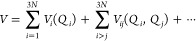
The PES is expanded in terms of mode coupling of Q as
 |
5 |
and truncated at the nth order. This so-called n-mode representation (nMR) PES89 can be generated using various techniques.82−84,90−95 We have developed a multiresolution method,96 which combines a grid PES97 with a quartic force field (QFF).98
2.2. Group-Localized Coordinates
In the present work, the atoms taken into account for the vibrational analyses are further divided into groups. The group may be defined in terms of (water) molecules, amino acid residues, functional groups, and so on. Let us denote the Cartesian coordinates of atoms in the gth group as {xgi} (i = 1, ..., 3Ng). Ng is the number of atoms in the group, such that N = ∑gNg. We rearrange the element of the Hessian matrix, eq 1, in blocks of each group as
 |
6 |
Diagonalization of h(g) gives local coordinates, {qgi}, and their associated frequencies (ωgi) for each group
 |
7 |
 |
8 |
Note that the off-diagonal block of the Hessian matrix is non-zero in terms of qgi
 |
9 |
We now describe the vibrational Hamiltonian in terms of local coordinates as follows
 |
10 |
where Ĥg and Vc denote an intra-group Hamiltonian and inter-group coupling potential, respectively
 |
11 |
 |
12 |
The intra-group potential, Vg(qg), can be generated at the anharmonic level in the same way as V(Q). Nonetheless, it is noteworthy that the cost to compute Vg(qg) is much smaller than that of V(Q) because the dimensionality is reduced from 3N to 3Ng.
The high-dimensional entity of the PES, which is costly to generate, goes to Vc. In eq 12, Vc is expanded in terms of the order of group coupling in analogy to the nMR expansion. Note that the expansion has been previously formulated by König and Christiansen.84 Here, we have specific local coordinates to represent the PES. The expansion (12) may be expected to converge rapidly, since the inter-group coupling decays as the groups are spatially separated. In this spirit, we leave only the leading, harmonic coupling (hc) terms between two groups, neglecting the higher order anharmonic coupling terms. Vc is then simplified as
 |
13 |
 |
14 |
The first and second terms in the right-hand side represent intra-group anharmonic oscillators and their coupling through harmonic terms, respectively. Note that cgig′i′ is readily obtained by a transformation of the Hessian matrix, bypassing a computationally intensive step, that is, the generation of a high-dimensional PES. We assess the validity of the approximation in Section 4.
2.3. VSCF/VQDPT2 Calculations
In the VSCF method, the total wavefunction is written as a direct product of one-mode functions
 |
15 |
 |
16 |
where n denotes the quantum number of a target vibrational state. The one-mode functions are variationally determined by solving the VSCF equation
 |
17 |
VQDPT2 improves the VSCF solution (obtained for the vibrational ground state, n = 0) using second-order quasi-degenerate perturbation theory. The effective Hamiltonian is constructed in a configuration space {p}, in which the components are energetically quasi-degenerate to the target state. The effective Hamiltonian is written up to the second order as
 |
18 |
 |
19 |
where the sum runs over non-degenerate configurations, {q}, and E(0)p is the zero-order energy
 |
20 |
The diagonalization of the effective Hamiltonian yields the VQDPT2 energy and wavefunctions.
3. Computational Details
3.1. MD Simulations
Two atomistic systems were constructed for BR based on a X-ray crystal structure (PDBID: 1M0L, resolution 1.47 Å).99 The protonation state of titratable residues under neutral pH conditions was determined based on pKa values estimated using PROPKA 3.1.100 D96, D115, and E194 were protonated, whereas other residues were kept ionized. In one system, BR was prepared in vacuum (“the isolated system”). MD simulations were carried out to relax the position of hydrogen atoms; after the energy minimization, the simulation was performed for 20 picoseconds (ps) in an NVT ensemble at 303.15 K with Cartesian coordinates of heavy-atom restraints to the crystal structure. In the other system (“the membrane system”), BR was embedded in a 1-palmitoyl-2-oleoyl-sn-glycero-3-phosphocholine (POPC) bilayer and solvated in water using CHARMM-GUI.101,102 The system was equilibrated by gradually reducing the force constants of restraints except for HBs shown in Figure 1b, which were kept with distance restraints throughout the simulation. The production NPT simulation was performed for 60 ns with the temperature and pressure controlled at 303.15 K and 1.0 atm, respectively, using Bussi’s thermostat and barostat.103 The MD simulations and the following QM/MM calculations were carried out using CHARMM36 (C36)104 and TIP3P105 as the MM force field. All MD simulations were carried out using GENESIS 1.6.86−88
3.2. QM/MM Calculations
QM/MM calculations were carried out with four different QM regions:
QM1. The first, smallest region included the pentagonal HB network, that is, R82, D85, D212, K216, retinal, and three water molecules (Wat401, Wat402, and Wat406). QM atoms are shown in blue in Figure 1a.
QM2. The second smallest region extended QM1 to include residues and water molecules that are hydrogen-bonded to QM1, specifically, Y57, T89, Y185, and two water molecules (Wat403 and Wat407); see Figure 1c.
QM3. The region added four tryptophan residues (W86, W138, W182, and W189) in the vicinity of retinal, shown in Figure 1b, to QM2.
QM4. The QM region further extended the HBN, where S193, E194, E204, and two water molecules (Wat404 and Wat405) were added to QM2; see Figure 1c.
The number of atoms in the QM calculations (QM atoms + link hydrogen atoms) was 96, 137, 201, and 164 for QM1, QM2, QM3, and QM4, respectively. The QM calculations were carried out by DFT at the level of the B3LYP106,107 hybrid functional with the D3 version of Grimm’s dispersion108 (B3LYP-D3) using Dunning’s aug-cc-pVDZ109 for the basis sets. The number of basis sets was 1408 (QM1), 2031 (QM2), 3095 (QM3), and 2430 (QM4). The QM/MM calculations were carried out using GENESIS 1.6 interfaced with TeraChem 1.94V.110,111
3.3. Vibrational Calculations
The target atoms of vibrational analyses were set to three water molecules (Wat401, Wat402, and Wat406), seven atoms around the PSB, and four atoms around the hydroxyl group of T89, thereby 20 atoms in total. The O–H and N–H groups of water molecules, PSB, and T89 were deuterated. Snapshot structures of MD trajectories were used for the initial structure of geometry optimization. In an isolated system, the final structure of the 20 ps simulation was taken, and the position of all atoms was optimized (i.e., X = Xeq). In a membrane system, 55 snapshots were taken every 1 ns between 6 and 60 ns from the MD trajectory, and only the target 20 atoms were geometry-optimized, keeping the position of other atoms fixed (X = X(t)). The partial Hessian matrix was obtained by numerical differentiations of the gradient with a step size of 0.01 Å, requiring 121 points of gradient calculations. The Hessian matrix was diagonalized in a block of each molecule [G1–G5 in Figure 1a,c] to obtain group-localized coordinates. The resulting harmonic frequencies are listed in Table S4. Note that no modes were found with imaginary frequencies. We also confirmed that G1 and G5 were sufficiently large to study the N-D and O-D stretching modes of the PSB and T89, respectively. The results obtained from a larger group are shown in Table S5.
Since we focus on the N–D/O–D stretching vibration of the PSB and internal water molecules, 16 stretching and bending coordinates, shown in Figure 2, were used as active modes for anharmonic vibrational calculations. These modes were selected by comparing the VQDPT2 frequencies obtained from full and reduced dimensional calculations for each group (see Table S6). The intra-group anharmonic PES, Vg(qg), was constructed in an isolated system by combining a grid PES97 up to the two-mode coupling (2MR-Grid PES) and a quartic force field98 up to the three-mode coupling (3MR-QFF). The QFF coefficients were obtained by numerical differentiations of the gradient, and the 2MR-Grid PES was generated using 11 grid points in each coordinate. The QFF and grid PES required 145 and 2161 points of gradient and energy calculations, respectively. For benchmark calculations, the inter-group anharmonic coupling, Vc, was also generated at the 3MR-QFF and 2MR-grid PES levels, requiring 400 points of gradient and 10,000 points of energy calculations, respectively. For the membrane system, the PES was generated by a multiresolution method,96 in which 1MR terms were Grid PES with 11 grid points, strongly coupled 2MR terms [mode coupling strength112 (MCS) > 1.0] were Grid PES with seven grid points, and other 2MR (MCS < 1.0) and 3MR terms were QFF. The generation of the multiresolution PES required 145 and 773 points of gradient and energy calculations, respectively. Note that the multiresolution PES produced comparable results to those of 2MR-Grid PES/3MR-QFF, as shown in Figure S1 of the Supporting Information. The PES generation was feasible in 61.2 h in real time on average for one snapshot structure using four nodes of cluster equipped with two CPUs (Intel Xeon Gold 6126) and four GPUs (GTX 1080Ti) per node. The dipole moment surface (DMS) was generated simultaneously by the grid method, which was used to compute the IR intensity. VSCF and VQDPT2 calculations were carried out using 11 harmonic oscillator basis functions for each coordinate. In VQDPT2, the maximum quantum number of excitations was set to 4, and the number of iterations to generate the quasi-degenerate space was set to 3. The spectrum was constructed using a Lorentz function with a width of 5 cm–1, unless noted otherwise. Anharmonic PES generation and vibrational calculations were carried out using SINDO 4.0.59
Figure 2.

Vibrational coordinates used for VSCF/VQDPT2 calculations localized to (a) PSB of retinal/K216, (b) Wat406, (c) Wat401, (d) Wat402, and (e) hydroxyl group of T89. The numbers are the label of each mode.
Further details on the computational procedure are described in the Supporting Information.
4. Results and Discussion
4.1. Isolated Systems
The pentagonal HBN optimized with QM/MM calculations is shown in Figure 3a. Eight HBs, schematically shown in Figure 3b, are well maintained in the energy-minimized structure. Table 1 lists the resulting HB distance together with that of X-ray crystal structures (PDBID: 1M0L(99) and 6G7H(4)). The calculated results are in reasonable agreement with those of the experiment. The average and maximum difference between the calculation and experiment is 0.10 and 0.20 Å, respectively, compared to that of 1M0L, and 0.04 and 0.10 Å, respectively, compared to that of 6G7H. The better agreement with 6G7H is because the HBN in 6G7H has been refined using QM/MM calculations with DFT.4
Figure 3.

(a) Pentagonal HBN of BR obtained by QM/MM calculations at the level of B3LYP-D3/aug-cc-pVDZ using QM4 for the QM region. HBs are represented by dotted lines. The hydrogen, carbon, nitrogen, and oxygen atoms are colored in white, cyan, blue, and red, respectively. Retinal/K216 is colored in yellow, and BR is represented with blue ribbons. (b) Schematic drawing of the pentagonal HBN. The numbers are labels of N–D/O–D stretching modes.
Table 1. Distance between Heavy Atoms of the HB Donor and Acceptor Obtained by QM/MM Calculations at the Level of B3LYP-D3/aug-cc-pVDZ Using QM1, QM2, QM3, and QM4 for the QM Region Together with That of the X-ray Crystal Structure (PDBID: 1M0L, 6G7H)a.
| Xtal (1M0L) | Xtal (6G7H) | QM1 | QM2 | QM3 | QM4 | |
|---|---|---|---|---|---|---|
| D85–T89 | 2.72 | 2.82 | 2.782 | 2.804 | 2.800 | 2.796 |
| (−0.08) | (0.03) | (−0.014) | (0.008) | (0.004) | ||
| D85–Wat401 | 2.77 | 2.67 | 2.642 | 2.649 | 2.653 | 2.654 |
| (0.11) | (0.02) | (−0.012) | (−0.005) | (−0.001) | ||
| D85–Wat402 | 2.54 | 2.61 | 2.622 | 2.608 | 2.602 | 2.610 |
| (−0.07) | (0.00) | (0.012) | (−0.002) | (−0.008) | ||
| Wat402–PSB | 2.94 | 2.70 | 2.684 | 2.747 | 2.753 | 2.743 |
| (0.20) | (−0.04) | (−0.059) | (0.004) | (0.010) | ||
| D212–Wat402 | 3.07 | 2.97 | 2.850 | 2.931 | 2.913 | 2.936 |
| (0.14) | (0.04) | (−0.086) | (−0.005) | (−0.023) | ||
| D212–Wat406 | 2.80 | 2.63 | 2.688 | 2.721 | 2.718 | 2.735 |
| (0.07) | (−0.10) | (−0.047) | (−0.014) | (−0.017) | ||
| Wat401–Wat406 | 2.69 | 2.83 | 2.826 | 2.795 | 2.799 | 2.792 |
| (−0.10) | (0.03) | (0.034) | (0.003) | (0.007) | ||
| Wat406–R82 | 2.74 | 2.70 | 2.746 | 2.780 | 2.800 | 2.786 |
| (−0.05) | (−0.09) | (−0.040) | (−0.006) | (0.014) |
The numbers in parentheses are the difference from QM4. Units in Å.
The harmonic spectrum obtained by QM/MM calculations is shown in Figure 4d. The peaks are assigned to the fundamental excitation of N–D/O–D stretching modes with labels m1, where m is the number of modes shown in Figure 3b. A non-hydrogen-bonded, dangling O–D group of Wat401 gives rise to a weak peak, 391, in a high-frequency end, and other O–D groups appear in a lower frequency range in the order of 481, 301, 291, 381, and 471. The result suggests that HBs of D85–Wat402 and D85–Wat401 are stronger than those of others. The tendency is also confirmed in Table 1, where the HB distance of D85–Wat402 and D85–Wat401 is shorter than that of others. These results are consistent with the previous calculation.35,36 The N-D stretching mode of the PSB gives a strong peak, 181, in a low-frequency range near 381 and 471. In fact, the normal coordinates are delocalized over the PSB, Wat402, and Wat401, as shown in Figure 5, suggesting a strong coupling between local O–D stretching modes. The harmonic frequencies are different by 10–50 cm–1 in terms of normal and local coordinates (Table S7).
Figure 4.

IR spectra obtained by VQDPT2 calculations based on a combination of 2MR-Grid PES and 3MR-QFF (a) with Vc, (b) with Vhc, and (c) without Vc. (d) IR spectrum obtained by the harmonic approximation. The labels m1 and m2 denote the fundamental and overtone bands of mode m, respectively, and the label m1n1 denotes the combination band of modes m and n. QM/MM is performed at the level of B3LYP-D3/aug-cc-pVDZ using QM1 for the QM region.
Figure 5.

Normal coordinates of mode 18, 38, and 47, which are delocalized over the PSB, Wat401, and Wat402.
Anharmonic IR spectra obtained by VQDPT2 at the various levels of PES are compared in Figure 4: panel (a) is a reference spectrum incorporating inter-group anharmonic coupling (2MR-Grid PES and 3MR-QFF), panels (b,c) are obtained with approximation, Vc ≃ Vhc and Vc = 0, respectively, and panel (d) is the harmonic spectrum. Comparison of Figure 4a,d indicates that the harmonic approximation results in a large discrepancy, exemplifying sizable anharmonic effects on the N–D/O–D stretching vibration. It is also notable that the VQDPT2 spectrum shows the overtone of water bending modes around 2400 cm–1 (282) and the combination bands of N–H bending (101111, etc.) around 2100 cm–1, all of which are missing in the harmonic spectrum. The VQDPT2 spectrum in Figure 4c is significantly improved over the harmonic one despite the neglect of Vc. The bands of weakly hydrogen-bonded (291, 301, and 481) and non-hydrogen-bonded (391) modes agree well with the reference spectrum. In contrast, the O–D stretching modes in strong HBs (381 and 471) and the N-D stretching mode of the PSB (181) are too congested compared to the reference. These results indicate that the inter-molecular coupling is important for strong HBs.
The VQDPT2 spectrum with Vhc in Figure 4b shows an excellent agreement with the reference spectrum. The frequencies are deviated by only 6.9 cm–1 on average (Table S8). The improvement is gained essentially because Vhc manifests a mixing among 181, 381, and 471. For example, the VQDPT2 wavefunction of 471 is obtained as
 |
21 |
The mixing of the wavefunction splits the energy levels and thus yields a wider spectrum around 2100 cm–1. The only notable difference is that the degeneracy of 471 and 81111 present in Figure 4b is lifted in Figure 4a. Nonetheless, it is bearable, considering that the approximation, Vc ≃ Vhc, has reduced the number of gradient and energy calculations by 300 and 10,000 points, respectively, for generating the PES. Thus, the proposed method reduces the cost of PES generation by more than five times without a significant loss of accuracy.
We next discuss the size of the QM regions. Table 2 lists the sum of ESP atomic charges for each molecule obtained by QM/MM calculations using QM1–QM4 as the respective QM region. It is notable that D85 is less negative in QM2–QM4 than in QM1 by 0.1 e. In QM2–QM4, the negative charge is delocalized over D85 and T89, indicating an electron transfer between the two residues. In QM1, T89 is not included in the QM region, and the lack of an electron transfer makes D85 more negative. A similar trend is observed in D212, where the charge varies by 0.2 e from QM1 to QM2. Note that QM2 includes Y57 and Y185 in the QM region, which are hydrogen-bonded to D212. Furthermore, Wat406, which is neutral in QM1, becomes slightly negative in QM2. On the other hand, the variation of ESP charges from QM2 to QM3 is less pronounced, although the retinal slightly changes the ESP charge from 0.35 to 0.29 e due to the interaction with aromatic residues added in QM3. The ESP charges in QM4 vary little from those in QM2, indicating that the HBN around E194/E204 has little effect on the pentagonal HBN. These results suggest that QM2 yields a converged electron density of the pentagonal HBN.
Table 2. Sum of ESP Charges for Each Residues and Water Molecules in the HBN Obtained in QM/MM Calculations Using QM1, QM2, QM3, or QM4 as the QM Region.
| R82 | D85 | T89 | D212 | PSBa | RETb | Wat401 | Wat402 | Wat406 | other | |
|---|---|---|---|---|---|---|---|---|---|---|
| QM1 | 0.98 | –0.81 | –0.91 | 0.55 | 0.33 | –0.08 | –0.05 | 0.00 | 0.00 | |
| QM2 | 0.96 | –0.71 | –0.11 | –0.68 | 0.54 | 0.35 | –0.10 | –0.04 | –0.07 | –0.15 |
| QM3 | 0.95 | –0.73 | –0.10 | –0.62 | 0.56 | 0.29 | –0.10 | –0.05 | –0.06 | –0.14 |
| QM4 | 0.98 | –0.71 | –0.11 | –0.71 | 0.54 | 0.35 | –0.09 | –0.04 | –0.05 | –1.15 |
Cγ, Cδ, Cε, Nζ, C1, and their hydrogen atoms (13 atoms).
Retinal (46 atoms).
The tendency is mirrored in the HB distance listed in Table 1. The deviation of HB distance from QM4 is 0.04 Å on average in QM1 but decreased to 0.01 Å in both QM2 and QM3. Furthermore, we have confirmed that the harmonic frequencies are converged within 10 cm–1 in QM2 and QM3 compared to those in QM4 (Table S9).
Figure 6 shows IR spectra calculated by VQDPT2 based on QM/MM calculations using QM1, QM2, and QM4 as the QM region. Comparison of QM2 and QM1 shows a prominent spectral change in all vibrational bands, reinforcing the poor convergence of QM1. It is noteworthy that 481, that is, the OD stretching mode of Wat402, undergoes a large blue shift from QM1 to QM2, in accordance with the change in the electron density of D212 (Table 2) and the elongation the HB distance between D212 and Wat402 (Table 1). In contrast, the results of QM2 and QM4 are in good match, indicating the convergence of the spectrum with respect to the size of QM regions. We conclude that the QM region should include HB partners of the pentagonal HBN, that is, Y57, T89, Y185, W403, and W407, to achieve the convergence.
Figure 6.

(a) Experimental IR difference spectrum between the ground state and K intermediate state.9,10 (b–d) IR spectra calculated by VQDPT2 based on the anharmonic PES with Vhc derived by QM/MM calculations with different QM regions. (b) QM4, (c) QM2, and (d) QM1.
The experimental IR difference spectrum is shown in Figure 6a. Note that the negative peaks, which arise from the ground state, are compared with the present calculation. Although the experiment and theory agree well in a high-frequency range (391, 481, and 591), the low-frequency range is found with a large discrepancy. In particular, the position of 471 is calculated to be 164 cm–1 lower than the experimental one. We have calculated the harmonic spectrum using the RI-MP2 method and compared the result with that of B3LYP-D3 (see Figure S2). The mean absolute error is found to be 27 cm–1, which is consistent with a report that the accuracy of hybrid DFT is around 20–50 cm–1 for vibrational calculations.49 It is notable that RI-MP2 predicted the position of 471 even lower in frequency than B3LYP-D3 by 55 cm–1. Note that the IR difference spectrum remains silent down to 1800 cm–113 and that there is no peak assignable to 471 beyond the range (<1950 cm–1) of Figure 6. We have also carried out VQDPT2 calculations for the K state based on a crystal structure, 1M0K, and found that 471 does not cancel by taking the difference between BR and K (Figure S3). Furthermore, VQDPT2 has reproduced the IR band of strong HBs in H+(H2O)4 with an error of ∼50 cm–1.60 Therefore, the quality of the electronic and vibrational structure calculation alone is unlikely to account for the observed error. In the next section, we investigate the effect of the environment on the calculation of IR spectra.
4.2. Membrane Systems
The final structure obtained by the MD simulations is shown in Figure S4a. The root-mean square displacement (rmsd) of Cα atoms and the thickness of the POPC bilayer plotted in Figure S4b show that the system is well equilibrated and kept stable during the production run.
The geometry optimization and VQDPT2 calculations have been carried out for eight snapshot structures taken every 2 ns between 6 and 20 ns of the MD trajectory using the QM/MM calculations with QM2 as the QM region. Note that the geometry of target atoms was optimized with the position of other atoms held fixed to the MD trajectory (X = X(t)). IR spectra obtained from the snapshot structures at 8, 14, 16, and 20 ns are shown in Figure 7 together with the experimental IR difference spectrum (the results of all snapshot structures are shown in Figure S5). It is notable that the band positions of 471 obtained from the snapshot structures at 8 and 20 ns are blue-shifted by ∼150 cm–1 compared to those in an isolated system (Figure 6c). The optimization of the whole protein (X = Xeq) starting from the snapshot at 8 ns yields an IR spectrum similar to that of an isolated system (see Figure S6). These results indicate that the use of transient structures leads to a better prediction of 181, 381, and 471. However, the use of transient structures at 14 and 16 ns gives rise to strong peaks around 2000–2050 cm–1, where no signal is observed in the experiment. The band positions of 181, 381, and 471 obtained from eight snapshot structures are scattered in a range of 1900–2300 cm–1 (see Figure S5), and thus, a simple average over these spectra is unlikely to yield a spectrum that agrees with the experimental one. Nonetheless, it is an important lesson that the band positions of 181, 381, and 471 are highly sensitive to the transient structures.
Figure 7.

(a) Experimental IR difference spectrum; see the caption of Figure 6a. (b–e) VQDPT2 spectra obtained from snapshot structures at 8, 14, 16, and 20 ns with X = X(t). The results of other snapshot structures are given in Figure S5. QM/MM calculations were carried out at the level of B3LYP-D3/aug-cc-pVDZ using QM2 as the QM region.
Table 3 lists the distance between deuterium and oxygen atoms of Wat402···D85, Wat401···D85, and PSB···Wat402, and r1 is defined as a sum of them
 |
22 |
Table 3. HB Distance between the Deuterium and the Oxygen (Dx···Oy, where x and y are the Residues) and r1 and r2 (Eqs 22 and 23, Respectively) Obtained from the QM/MM Geometry Optimization of Membrane Systems (8, 14, 16, and 20 ns) and an Isolated System (Xeq)a.
| DWat402···OD85 | DWat401···OD85 | DPSB···OWat402 | r1 | DT89···OD85 | DWat402···OD212 | r2 | |
|---|---|---|---|---|---|---|---|
| 20 ns | 1.63 | 1.79 | 1.72 | 5.13 | 1.75 | 2.05 | 1.33 |
| 16 ns | 1.58 | 1.74 | 1.70 | 5.02 | 2.00 | 2.35 | 0.68 |
| 14 ns | 1.60 | 1.75 | 1.69 | 5.04 | 2.12 | 2.05 | 0.87 |
| 8 ns | 1.61 | 1.67 | 1.90 | 5.18 | 1.93 | 1.92 | 1.33 |
| Xeq | 1.61 | 1.66 | 1.76 | 5.03 | 1.87 | 2.04 | 1.12 |
Units in Å.
Although the individual HB distance hardly characterizes the snapshot structures, r1 is relatively longer in the snapshot structures at 8 and 20 ns (>5.1 Å) than in others (∼5.0 Å). We have further investigated the distance of T89···D85 and Wat402···D212, and r2 is defined as
 |
23 |
As shown in Table 3, r2 clearly indicates the difference between the snapshot structures at 8 and 20 ns and others, yielding r2 ∼ 1.3 Å for the former and r2 < 1.0 Å for the latter. The result suggests that r1 and r2 correlate with the band position of 181, 381, and 471.
In order to study the correlation with sufficient statistics, geometry optimization and harmonic vibrational calculation have been carried out for snapshot structures taken every 1 ns between 6 and 30 ns of the MD trajectory. Figure 8a plots the lowest harmonic frequency (denoted ωmin) as a function of r1. A positive correlation is clearly seen between r1 and ωmin, indicating that r1 characterizes the strength of HBs of PSB–Wat402–D85–Wat401. Larger r1 weakens the HB strength and thus makes ωmin higher in frequency and vice versa.
Figure 8.

Plots of the lowest harmonic frequency among N–D/O–D stretching modes (ωmin) as a function of r1 [eq 22] and r2 [eq 23] obtained by QM/MM starting from MD snapshot structures taken every 1 ns during 6–30 ns. The values for an isolated system are also plotted. The QM level is B3LYP-D3/aug-cc-pVDZ using QM2 for the QM region.
Nevertheless, there are several cases that fall off such a tendency. Two such data points are indicated with arrows in Figure 8a, in which ωmin < 2250 cm–1 and r1 > 5.1 Å. These cases were found to have an elongated HB between T89···D85 and/or Wat402···D212. Figure 8b plots ωmin as a function of r2. The two data, again indicated with arrows, are found at r2 = 0.41 and 0.92 Å, clearly distinct from other data with r1 > 5.1 Å. The shorter r2 leads to the lower ωmin in frequency because the weakening of T89···D85 and/or Wat402···D212 strengthens the HBs in PSB–Wat402–D85–Wat401. The result is in line with that of a mutation study on T89A,10 which has observed a shift of the IR band around 2171 cm–1 in a wild type down to 2088 cm–1 in T89A, indicating that the absence of HBs between T89···D85 makes the HBN stronger.
In view of the dependency of ωmin on r1 and r2, we have selected structures that satisfy r1 > 5.1 Å and r2 > 1.2 Å for anharmonic vibrational calculations. We have performed additional QM/MM geometry optimization, starting from snapshot structures taken every 1 ns between 30 and 60 ns. As a consequence, eight structures were found to satisfy the conditions. For each structure, the anharmonic PES was generated and VQDPT2 calculations were performed to obtain the IR spectrum.
The IR spectrum averaged over the eight snapshot structures is shown in Figure 9b (IR spectra of each snapshot structure are shown in Figure S7). The band positions of 181, 381, and 471 are widely distributed in a range of 2050–2350 cm–1, yielding a broad feature in the spectrum. The band shape agrees well with the experimental one shown in Figure 9a; three pronounced peaks are seen around 2080, 2130, and 2170 cm–1, and a plateau is observed around 2300 cm–1. Therefore, the averaged spectrum shows a significant improvement over the spectra calculated for an isolated system (Figure 9c,d). The result exemplifies the importance of structural sampling to simulate the IR spectra of strongly hydrogen-bonded systems.
Figure 9.

(a) Experimental IR difference spectrum; see the caption of Figure 6a. (b) Average of VQDPT2 spectra obtained from eight snapshot structures that satisfy r1 > 5.1 Å and r2 > 1.2 Å. The spectrum was constructed using a Lorentz function with a width of 20 cm–1. The spectral components are shown in sharp peaks with the following colors: 181 (purple), 291 (dark green), 301 (light blue), 381 (orange), 391 (yellow), 471 (dark blue), 481 (red), and 591 (light green). (c) VQDPT2 and (d) harmonic spectrum calculated for an isolated system. QM/MM calculations were carried out at the level of B3LYP-D3/aug-cc-pVDZ using QM2 as the QM region.
5. Summary and Outlook
An anharmonic vibrational method based on local coordinates is developed and implemented in SINDO 4.0. Vibrational coordinates localized to a group of atoms are introduced to divide the PES into intra-group PES (Vg) and inter-group coupling terms (Vc). In the proposed method, we truncate the inter-group coupling at the harmonic level (Vc ∼ Vhc), bypassing the computational bottleneck to generate high-dimensional anharmonic terms. The vibrational Schrödinger equation in terms of group-localized coordinates is solved using VSCF and VQDPT2.
A pilot application to BR has been carried out to calculate the IR spectrum of a pentagonal HBN using the QM/MM function in GENESIS 1.6 interfaced with TeraChem 1.94V. Benchmark calculations using Vc and Vhc have shown that the approximation incurred a small error of 7 cm–1 on average, while reducing the cost by more than five times. Furthermore, the size of the QM region in QM/MM calculations has been carefully assessed to find that HB partners of the pentagonal HBN are essential in addition to the HBN itself to obtain a converged electron density. An averaged IR spectrum has been computed based on snapshot structures taken from the MD trajectory that satisfy geometric criteria, r1 > 5.1 Å and r2 > 1.2 Å. The incorporation of an accurate electronic structure calculation (B3LYP-D3/aug-cc-pVDZ), a sufficiently large QM region, anharmonic vibration, and structural sampling has been crucial to produce a computational IR spectrum of strong HBs comparable to the experimental ones. We anticipate that the synergy of computational and experimental IR spectroscopy will help reveal the structure and function of the HBN in biomolecules.
Further development is underway to generate a reliable structure of the HBN. Our preliminary MD simulations using the C36 force field found that the pentagonal HBN was hardly maintained without restraints to HB distances. QM/MM-MD based on B3LYP-D3 is accurate but computationally intensive to achieve ns-scale simulations. One of the promising directions to overcome the issue is to train the force field parameters from data of short QM/MM-MD trajectories. In another direction, seeing that the vibrational frequency is highly sensitive to HB distances, one may exploit such geometric criteria to infer the ensemble by comparing the computational and experimental spectra. These subjects will be the scope of future studies.
Acknowledgments
This research is partially supported by RIKEN Pioneering Research Projects (Dynamic Structural Biology/Glycolipidologue Initiative) (to Y.S.), RIKEN Incentive Research Project (to K.Y.), Program for Promoting Researches on the Supercomputer Fugaku (Biomolecular dynamics in a living cell/MD-driven Precision Medicine), MEXT/KAKENHI grant no. JP19H05645 (to Y.S.) and JP20H02701 (to K.Y.). We used a computer system HOKUSAI, provided by the RIKEN Information System Division, and Oakbridge-CX and Octopus, provided by the University of Tokyo and Osaka University, respectively, through the HPCI System Research Project (hp200098). We thank Dr. Yukio Kawashima for his help to set up the all-atom model of BR and comments on the QM/MM calculations.
Supporting Information Available
The Supporting Information is available free of charge at https://pubs.acs.org/doi/10.1021/acs.jctc.1c00060.
Computational details including all-atom model of BR, settings of MD simulations, QM/MM calculations, geometry optimization, and vibrational calculations, protocol of equilibration, modified CHARMM force field parameters for retinal, harmonic frequencies obtained from partial Hessian matrices, effect of the size of a group, VQDPT2 frequencies obtained by full and reduced dimensional calculations for each group, harmonic frequencies and IR intensities in terms of normal and local coordinates, vibrational frequencies and IR intensities, harmonic frequencies obtained by QM/MM calculations using QM1–QM4, IR spectra obtained by multiresolution PES and 2MR-GridPES and 3MR-QFF, IR spectra obtained by the harmonic approximation at the level of RI-MP2 and B3LYP-D3, IR difference spectrum (K-BR) calculated by VQDPT2 at the level of B3LYP-D3/aug-cc-pVDZ using an isolated system, snapshot structure of a membrane system, plots of rmsd, P–P distance as a function of simulation time, VQDPT2 spectra obtained from snapshot structures taken every 2 ns between 6 and 20 ns, VQDPT2 spectra obtained from X = X(t) and X = Xeq, and VQDPT2 spectra obtained from eight snapshot structures that satisfy r1 > 5.1 Å and r2 > 1.2 Å (PDF)
The authors declare no competing financial interest.
Notes
The data that support the findings of this study are available from the corresponding author upon reasonable request.
Supplementary Material
References
- Ernst O. P.; Lodowski D. T.; Elstner M.; Hegemann P.; Brown L. S.; Kandori H. Microbial and Animal Rhodopsins: Structures, Functions, and Molecular Mechanisms. Chem. Rev. 2014, 114, 126–163. 10.1021/cr4003769. [DOI] [PMC free article] [PubMed] [Google Scholar]
- Gerwert K.; Freier E.; Wolf S. The role of protein-bound water molecules in microbial rhodopsins. Biochim. Biophys. Acta 2014, 1837, 606–613. 10.1016/j.bbabio.2013.09.006. [DOI] [PubMed] [Google Scholar]
- Nango E.; et al. A three-dimensional movie of structural changes in bacteriorhodopsin. Science 2016, 354, 1552–1557. 10.1126/science.aah3497. [DOI] [PubMed] [Google Scholar]
- Nogly P.; et al. Retinal isomerization in bacteriorhodopsin captured by a femtosecond x-ray laser. Science 2018, 361, eaat0094 10.1126/science.aat0094. [DOI] [PubMed] [Google Scholar]
- Wickstrand C.; Nogly P.; Nango E.; Iwata S.; Standfuss J.; Neutze R. Bacteriorhodopsin: Structural Insights Revealed Using X-Ray Lasers and Synchrotron Radiation. Annu. Rev. Biochem. 2019, 88, 59–83. 10.1146/annurev-biochem-013118-111327. [DOI] [PubMed] [Google Scholar]
- Weinert T.; Skopintsev P.; James D.; Dworkowski F.; Panepucci E.; Kekilli D.; Furrer A.; Brünle S.; Mous S.; Ozerov D.; Nogly P.; Wang M.; Standfuss J. Proton uptake mechanism in bacteriorhodopsin captured by serial synchrotron crystallography. Science 2019, 365, 61–65. 10.1126/science.aaw8634. [DOI] [PubMed] [Google Scholar]
- Kandori H. Role of internal water molecules in bacteriorhodopsin. Biochim. Biophys. Acta 2000, 1460, 177–191. 10.1016/s0005-2728(00)00138-9. [DOI] [PubMed] [Google Scholar]
- Tanimoto T.; Furutani Y.; Kandori H. Structural Changes of Water in the Schiff Base Region of Bacteriorhodopsin: Proposal of a Hydration Switch Model. Biochemistry 2003, 42, 2300–2306. 10.1021/bi026990d. [DOI] [PubMed] [Google Scholar]
- Shibata M.; Tanimoto T.; Kandori H. Water molecules in the Schiff base region of bacteriorhodopsin. J. Am. Chem. Soc. 2003, 125, 13312–13313. 10.1021/ja037343s. [DOI] [PubMed] [Google Scholar]
- Shibata M.; Kandori H. FTIR Studies of Internal Water Molecules in the Schiff Base Region of Bacteriorhodopsin†. Biochemistry 2005, 44, 7406–7413. 10.1021/bi050122+. [DOI] [PubMed] [Google Scholar]
- Furutani Y.; Shibata M.; Kandori H. Strongly hydrogen-bonded water molecules in the Schiff base region of rhodopsins. Photochem. Photobiol. Sci. 2005, 4, 661. 10.1039/b416698a. [DOI] [PubMed] [Google Scholar]
- Lórenz-Fonfría V. A.; Furutani Y.; Kandori H. Active Internal Waters in the Bacteriorhodopsin Photocycle. A Comparative Study of the L and M Intermediates at Room and Cryogenic Temperatures by Infrared Spectroscopy†. Biochemistry 2008, 47, 4071–4081. 10.1021/bi7024063. [DOI] [PubMed] [Google Scholar]
- Muroda K.; Nakashima K.; Shibata M.; Demura M.; Kandori H. Protein-Bound Water as the Determinant of Asymmetric Functional Conversion between Light-Driven Proton and Chloride Pumps. Biochemistry 2012, 51, 4677–4684. 10.1021/bi300485r. [DOI] [PubMed] [Google Scholar]
- Garczarek F.; Brown L. S.; Lanyi J. K.; Gerwert K. Proton binding within a membrane protein by a protonated water cluster. Proc. Natl. Acad. Sci. U.S.A. 2005, 102, 3633–3638. 10.1073/pnas.0500421102. [DOI] [PMC free article] [PubMed] [Google Scholar]
- Garczarek F.; Gerwert K. Functional waters in intraprotein proton transfer monitored by FTIR difference spectroscopy. Nature 2006, 439, 109–112. 10.1038/nature04231. [DOI] [PubMed] [Google Scholar]
- Daldrop J. O.; Saita M.; Heyden M.; Lorenz-Fonfria V. A.; Heberle J.; Netz R. R. Orientation of non-spherical protonated water clusters revealed by infrared absorption dichroism. Nat. Commun. 2018, 9, 311. 10.1038/s41467-017-02669-9. [DOI] [PMC free article] [PubMed] [Google Scholar]
- Freier E.; Wolf S.; Gerwert K. Proton transfer via a transient linear water-molecule chain in a membrane protein. Proc. Natl. Acad. Sci. U.S.A. 2011, 108, 11435–11439. 10.1073/pnas.1104735108. [DOI] [PMC free article] [PubMed] [Google Scholar]
- Lorenz-Fonfria V. A.; Saita M.; Lazarova T.; Schlesinger R.; Heberle J. pH-sensitive vibrational probe reveals a cytoplasmic protonated cluster in bacteriorhodopsin. Proc. Natl. Acad. Sci. U.S.A. 2017, 114, E10909–E10918. 10.1073/pnas.1707993114. [DOI] [PMC free article] [PubMed] [Google Scholar]
- Kottke T.; Lórenz-Fonfría V. A.; Heberle J. The Grateful Infrared: Sequential Protein Structural Changes Resolved by Infrared Difference Spectroscopy. J. Phys. Chem. B 2017, 121, 335–350. 10.1021/acs.jpcb.6b09222. [DOI] [PubMed] [Google Scholar]
- Lorenz-Fonfria V. A. Infrared Difference Spectroscopy of Proteins: From Bands to Bonds. Chem. Rev. 2020, 120, 3466–3576. 10.1021/acs.chemrev.9b00449. [DOI] [PubMed] [Google Scholar]
- Babitzki G.; Mathias G.; Tavan P. The Infrared Spectra of the Retinal Chromophore in Bacteriorhodopsin Calculated by a DFT/MM Approach. J. Phys. Chem. B 2009, 113, 10496–10508. 10.1021/jp902432e. [DOI] [PubMed] [Google Scholar]
- Welke K.; Watanabe H. C.; Wolter T.; Gaus M.; Elstner M. QM/MM simulations of vibrational spectra of bacteriorhodopsin and channelrhodopsin-2. Phys. Chem. Chem. Phys. 2013, 15, 6651–6659. 10.1039/c3cp44181d. [DOI] [PubMed] [Google Scholar]
- Wolf S.; Freier E.; Cui Q.; Gerwert K. Infrared spectral marker bands characterizing a transient water wire inside a hydrophobic membrane protein. J. Chem. Phys. 2014, 141, 22D524. 10.1063/1.4902237. [DOI] [PubMed] [Google Scholar]
- Yu J. K.; Liang R.; Liu F.; Martínez T. J. First-Principles Characterization of the Elusive I Fluorescent State and the Structural Evolution of Retinal Protonated Schiff Base in Bacteriorhodopsin. J. Am. Chem. Soc. 2019, 141, 18193–18203. 10.1021/jacs.9b08941. [DOI] [PubMed] [Google Scholar]
- Ono J.; Imai M.; Nishimura Y.; Nakai H. Hydroxide Ion Carrier for Proton Pumps in Bacteriorhodopsin: Primary Proton Transfer. J. Phys. Chem. B 2020, 124, 8524–8539. 10.1021/acs.jpcb.0c05507. [DOI] [PubMed] [Google Scholar]
- Rousseau R.; Kleinschmidt V.; Schmitt U. W.; Marx D. Assigning Protonation Patterns in Water Networks in Bacteriorhodopsin Based on Computed IR Spectra. Angew. Chem., Int. Ed. 2004, 43, 4804–4807. 10.1002/anie.200453857. [DOI] [PubMed] [Google Scholar]
- Rousseau R.; Kleinschmidt V.; Schmitt U. W.; Marx D. Modeling protonated water networks in bacteriorhodopsin. Phys. Chem. Chem. Phys. 2004, 6, 1848–1859. 10.1039/b313220j. [DOI] [PubMed] [Google Scholar]
- Mathias G.; Marx D. Structures and spectral signatures of protonated water networks in bacteriorhodopsin. Proc. Natl. Acad. Sci. U.S.A. 2007, 104, 6980–6985. 10.1073/pnas.0609229104. [DOI] [PMC free article] [PubMed] [Google Scholar]
- Chaumont A.; Baer M.; Mathias G.; Marx D. Potential Proton-Release Channels in Bacteriorhodopsin. ChemPhysChem 2008, 9, 2751–2758. 10.1002/cphc.200800471. [DOI] [PubMed] [Google Scholar]
- Phatak P.; Ghosh N.; Yu H.; Cui Q.; Elstner M. Amino acids with an intermolecular proton bond as proton storage site in bacteriorhodopsin. Proc. Natl. Acad. Sci. U.S.A. 2008, 105, 19672–19677. 10.1073/pnas.0810712105. [DOI] [PMC free article] [PubMed] [Google Scholar]
- Goyal P.; Ghosh N.; Phatak P.; Clemens M.; Gaus M.; Elstner M.; Cui Q. Proton Storage Site in Bacteriorhodopsin: New Insights from Quantum Mechanics/Molecular Mechanics Simulations of Microscopic pKaand Infrared Spectra. J. Am. Chem. Soc. 2011, 133, 14981–14997. 10.1021/ja201568s. [DOI] [PMC free article] [PubMed] [Google Scholar]
- Clemens M.; Phatak P.; Cui Q.; Bondar A.-N.; Elstner M. Role of Arg82 in the Early Steps of the Bacteriorhodopsin Proton-Pumping Cycle. J. Phys. Chem. B 2011, 115, 7129–7135. 10.1021/jp201865k. [DOI] [PMC free article] [PubMed] [Google Scholar]
- Wolf S.; Freier E.; Gerwert K. A Delocalized Proton-Binding Site within a Membrane Protein. Biophys. J. 2014, 107, 174–184. 10.1016/j.bpj.2014.05.019. [DOI] [PMC free article] [PubMed] [Google Scholar]
- Tripathi R.; Forbert H.; Marx D. Settling the Long-Standing Debate on the Proton Storage Site of the Prototype Light-Driven Proton Pump Bacteriorhodopsin. J. Phys. Chem. B 2019, 123, 9598–9608. 10.1021/acs.jpcb.9b09608. [DOI] [PubMed] [Google Scholar]
- Hayashi S.; Tajkhorshid E.; Kandori H.; Schulten K. Role of Hydrogen-Bond Network in Energy Storage of Bacteriorhodopsin’s Light-Driven Proton Pump Revealed by ab Initio Normal-Mode Analysis. J. Am. Chem. Soc. 2004, 126, 10516–10517. 10.1021/ja047506s. [DOI] [PubMed] [Google Scholar]
- Hayashi S.; Ohmine I. Proton transfer in bacteriorhodopsin: Structure, excitation, IR spectra, and potential energy surface analyses by an ab initio QM/MM method. J. Phys. Chem. B 2000, 104, 10678–10691. 10.1021/jp001508r. [DOI] [Google Scholar]
- Warshel A.; Levitt M. Theoretical Studies of Enzymic Reactions: Dielectric, Electrostatic and Steric Stabilization of the Carbonium Ion in the Reaction of Lysozyme. J. Mol. Biol. 1976, 103, 227–249. 10.1016/0022-2836(76)90311-9. [DOI] [PubMed] [Google Scholar]
- Warshel A.; Karplus M. Calculation of Ground and Excited State Potential Surfaces of Conjugated Molecules. I. Formulation and Parametrization. J. Am. Chem. Soc. 1972, 94, 5612–5625. 10.1021/ja00771a014. [DOI] [Google Scholar]
- Baer M.; Mathias G.; Kuo I.-F. W.; Tobias D. J.; Mundy C. J.; Marx D. Spectral Signatures of the Pentagonal Water Cluster in Bacteriorhodopsin. ChemPhysChem 2008, 9, 2703–2707. 10.1002/cphc.200800473. [DOI] [PubMed] [Google Scholar]
- Kulik H. J.; Zhang J.; Klinman J. P.; Martínez T. J. How Large Should the QM Region Be in QM/MM Calculations? The Case of Catechol O-Methyltransferase. J. Phys. Chem. B 2016, 120, 11381–11394. 10.1021/acs.jpcb.6b07814. [DOI] [PMC free article] [PubMed] [Google Scholar]
- Karelina M.; Kulik H. J. Systematic Quantum Mechanical Region Determination in QM/MM Simulation. J. Chem. Theory Comput. 2017, 13, 563–576. 10.1021/acs.jctc.6b01049. [DOI] [PubMed] [Google Scholar]
- Kulik H. J. Large-scale QM/MM free energy simulations of enzyme catalysis reveal the influence of charge transfer. Phys. Chem. Chem. Phys. 2018, 20, 20650–20660. 10.1039/c8cp03871f. [DOI] [PMC free article] [PubMed] [Google Scholar]
- Mehmood R.; Kulik H. J. Both Configuration and QM Region Size Matter: Zinc Stability in QM/MM Models of DNA Methyltransferase. J. Chem. Theory Comput. 2020, 16, 3121–3134. 10.1021/acs.jctc.0c00153. [DOI] [PubMed] [Google Scholar]
- Bowman J. M. Self-consistent field energies and wavefunctions for coupled oscillators. J. Chem. Phys. 1978, 68, 608–610. 10.1063/1.435782. [DOI] [Google Scholar]
- Bowman J. M. The Self-Consistent-Field Approach to Polyatomic Vibrations. Acc. Chem. Res. 1986, 19, 202–208. 10.1021/ar00127a002. [DOI] [Google Scholar]
- Bowman J. M.; Carrington T.; Meyer H.-D. Variational quantum approaches for computing vibrational energies of polyatomic molecules. Mol. Phys. 2008, 106, 2145–2182. 10.1080/00268970802258609. [DOI] [Google Scholar]
- Christiansen O. Selected new developments in vibrational structure theory: Potential construction and vibrational wave function calculations. Phys. Chem. Chem. Phys. 2012, 14, 6672–6687. 10.1039/c2cp40090a. [DOI] [PubMed] [Google Scholar]
- Hansen M. B.; Madsen N. K.; Zoccante A.; Christiansen O. Time-dependent vibrational coupled cluster theory: Theory and implementation at the two-mode coupling level. J. Chem. Phys. 2019, 151, 154116. 10.1063/1.5117207. [DOI] [PubMed] [Google Scholar]
- Barone V.; Biczysko M.; Bloino J. Fully anharmonic IR and Raman spectra of medium-size molecular systems: accuracy and interpretation. Phys. Chem. Chem. Phys. 2014, 16, 1759–1787. 10.1039/c3cp53413h. [DOI] [PMC free article] [PubMed] [Google Scholar]
- Keçeli M.; Hirata S. Size-extensive vibrational self-consistent field method. J. Chem. Phys. 2011, 135, 134108. 10.1063/1.3644895. [DOI] [PubMed] [Google Scholar]
- Hermes M. R.; Hirata S. Second-order many-body perturbation expansions of vibrational Dyson self-energies. J. Chem. Phys. 2013, 139, 034111. 10.1063/1.4813123. [DOI] [PubMed] [Google Scholar]
- Faucheaux J. A.; Hirata S. Higher-order diagrammatic vibrational coupled-cluster theory. J. Chem. Phys. 2015, 143, 134105. 10.1063/1.4931472. [DOI] [PubMed] [Google Scholar]
- Neff M.; Rauhut G. Toward large scale vibrational configuration interaction calculations. J. Chem. Phys. 2009, 131, 124129. 10.1063/1.3243862. [DOI] [PubMed] [Google Scholar]
- Heislbetz S.; Rauhut G. Vibrational multiconfiguration self-consistent field theory: Implementation and test calculations. J. Chem. Phys. 2010, 132, 124102. 10.1063/1.3364861. [DOI] [PubMed] [Google Scholar]
- Yagi K.; Hirata S.; Hirao K. Vibrational quasi-degenerate perturbation theory: applications to fermi resonance in CO2, H2CO, and C6H6. Phys. Chem. Chem. Phys. 2008, 10, 1781–1788. 10.1039/b719093j. [DOI] [PubMed] [Google Scholar]
- Yagi K.; Otaki H. Vibrational Quasi-Degenerate Perturbation Theory with Optimized Coordinates: Applications to Ethylene and Trans-1,3-Butadiene. J. Chem. Phys. 2014, 140, 084113. 10.1063/1.4866365. [DOI] [PubMed] [Google Scholar]
- Thomsen B.; Yagi K.; Christiansen O. Optimized coordinates in vibrational coupled cluster calculations. J. Chem. Phys. 2014, 140, 154102. 10.1063/1.4870775. [DOI] [Google Scholar]
- Yagi K.; Keçeli M.; Hirata S. Optimized Coordinates for Anharmonic Vibrational Structure Theories. J. Chem. Phys. 2012, 137, 204118. 10.1063/1.4767776. [DOI] [PubMed] [Google Scholar]
- Yagi K.SINDO 4.0 Beta; RIKEN, 2020, (https://tms.riken.jp/en/research/software/sindo/).
- Yagi K.; Thomsen B. Infrared Spectra of Protonated Water Clusters, H+(H2O)4, in Eigen and Zundel Forms Studied by Vibrational Quasi-Degenerate Perturbation Theory. J. Phys. Chem. A 2017, 121, 2386–2398. 10.1021/acs.jpca.6b11189. [DOI] [PubMed] [Google Scholar]
- Jacob C. R.; Reiher M. Localizing normal modes in large molecules. J. Chem. Phys. 2009, 130, 084106. 10.1063/1.3077690. [DOI] [PubMed] [Google Scholar]
- Panek P. T.; Jacob C. R. Efficient Calculation of Anharmonic Vibrational Spectra of Large Molecules with Localized Modes. ChemPhysChem 2014, 15, 3365–3377. 10.1002/cphc.201402251. [DOI] [PubMed] [Google Scholar]
- Panek P. T.; Jacob C. R. On the benefits of localized modes in anharmonic vibrational calculations for small molecules. J. Chem. Phys. 2016, 144, 164111. 10.1063/1.4947213. [DOI] [PubMed] [Google Scholar]
- Panek P. T.; Hoeske A. A.; Jacob C. R. On the choice of coordinates in anharmonic theoretical vibrational spectroscopy: Harmonic vs. anharmonic coupling in vibrational configuration interaction. J. Chem. Phys. 2019, 150, 054107. 10.1063/1.5083186. [DOI] [PubMed] [Google Scholar]
- Ziegler B.; Rauhut G. Localized Normal Coordinates in Accurate Vibrational Structure Calculations: Benchmarks for Small Molecules. J. Chem. Theory Comput. 2019, 15, 4187–4196. 10.1021/acs.jctc.9b00381. [DOI] [PubMed] [Google Scholar]
- Mathea T.; Petrenko T.; Rauhut G. VCI Calculations Based on Canonical and Localized Normal Coordinates for Non-Abelian Molecules: Accurate Assignment of the Vibrational Overtones of Allene. J. Phys. Chem. A 2021, 125, 990–998. 10.1021/acs.jpca.0c10429. [DOI] [PubMed] [Google Scholar]
- Cheng X.; Steele R. P. Efficient anharmonic vibrational spectroscopy for large molecules using local-mode coordinates. J. Chem. Phys. 2014, 141, 104105. 10.1063/1.4894507. [DOI] [PubMed] [Google Scholar]
- Cheng X.; Talbot J. J.; Steele R. P. Tuning vibrational mode localization with frequency windowing. J. Chem. Phys. 2016, 145, 124112. 10.1063/1.4963109. [DOI] [PubMed] [Google Scholar]
- Hanson-Heine M. W. D. Examining the impact of harmonic correlation on vibrational frequencies calculated in localized coordinates. J. Chem. Phys. 2015, 143, 164104. 10.1063/1.4934234. [DOI] [PubMed] [Google Scholar]
- Head J. D. Computation of vibrational frequencies for adsorbates on surfaces. Int. J. Quantum Chem. 1997, 65, 827–838. 10.1002/(sici)1097-461x(1997)65:5<827::aid-qua47>3.0.co;2-u. [DOI] [Google Scholar]
- Besley N. A.; Metcalf K. A. Computation of the Amide I Band of Polypeptides and Proteins Using a Partial Hessian Approach. J. Chem. Phys. 2007, 126, 035101. 10.1063/1.2426344. [DOI] [PubMed] [Google Scholar]
- Hanson-Heine M. W. D.; George M. W.; Besley N. A. Rapid Anharmonic Vibrational Corrections Derived from Partial Hessian Analysis. J. Chem. Phys. 2012, 136, 224102. 10.1063/1.4727853. [DOI] [PubMed] [Google Scholar]
- Wang Y.; Bowman J. M. Towards an Ab Initio Flexible Potential for Water, and Post-Harmonic Quantum Vibrational Analysis of Water Clusters. Chem. Phys. Lett. 2010, 491, 1–10. 10.1016/j.cplett.2010.03.025. [DOI] [Google Scholar]
- Yu Q.; Bowman J. M. Tracking Hydronium/Water Stretches in Magic H3O+(H2O)20 Clusters through High-level Quantum VSCF/VCI Calculations. J. Phys. Chem. A 2020, 124, 1167–1175. 10.1021/acs.jpca.9b11983. [DOI] [PubMed] [Google Scholar]
- Wang Y.; Bowman J. M. IR Spectra of the Water Hexamer: Theory, with Inclusion of the Monomer Bend Overtone, and Experiment Are in Agreement. J. Phys. Chem. Lett. 2013, 4, 1104–1108. 10.1021/jz400414a. [DOI] [PubMed] [Google Scholar]
- Liu H.; Wang Y.; Bowman J. M. Quantum Local Monomer IR Spectrum of Liquid D2O at 300 K from 0 to 4000 cm-1 Is in Near-Quantitative Agreement with Experiment. J. Phys. Chem. B 2016, 120, 2824–2828. 10.1021/acs.jpcb.6b01722. [DOI] [PubMed] [Google Scholar]
- Liu H.; Wang Y.; Bowman J. M. Quantum Calculations of Intramolecular IR Spectra of Ice Models Using Ab Initio Potential and Dipole Moment Surfaces. J. Phys. Chem. Lett. 2012, 3, 3671–3676. 10.1021/jz3016777. [DOI] [PubMed] [Google Scholar]
- Riera M.; Talbot J. J.; Steele R. P.; Paesani F. Infrared signatures of isomer selectivity and symmetry breaking in the Cs+(H2O)3 complex using many-body potential energy functions. J. Chem. Phys. 2020, 153, 044306. 10.1063/5.0013101. [DOI] [PubMed] [Google Scholar]
- Woodcock H. L.; Zheng W.; Ghysels A.; Shao Y.; Kong J.; Brooks B. R. Vibrational subsystem analysis: A method for probing free energies and correlations in the harmonic limit. J. Chem. Phys. 2008, 129, 214109. 10.1063/1.3013558. [DOI] [PMC free article] [PubMed] [Google Scholar]
- Ghysels A.; Woodcock H. L.; Larkin J. D.; Miller B. T.; Shao Y.; Kong J.; Neck D. V.; Speybroeck V. V.; Waroquier M.; Brooks B. R. Efficient Calculation of QM/MM Frequencies with the Mobile Block Hessian. J. Chem. Theory Comput. 2011, 7, 496–514. 10.1021/ct100473f. [DOI] [PubMed] [Google Scholar]
- König C.; Hansen M. B.; Godtliebsen I. H.; Christiansen O. FALCON: A method for flexible adaptation of local coordinates of nuclei. J. Chem. Phys. 2016, 144, 074108. 10.1063/1.4941846. [DOI] [PubMed] [Google Scholar]
- Schmitz G.; Klinting E. L.; Christiansen O. A Gaussian process regression adaptive density guided approach for potential energy surface construction. J. Chem. Phys. 2020, 153, 064105. 10.1063/5.0015344. [DOI] [PubMed] [Google Scholar]
- Artiukhin D. G.; Klinting E. L.; König C.; Christiansen O. Adaptive density-guided approach to double incremental potential energy surface construction. J. Chem. Phys. 2020, 152, 194105. 10.1063/5.0004686. [DOI] [PubMed] [Google Scholar]
- König C.; Christiansen O. Linear-scaling generation of potential energy surfaces using a double incremental expansion. J. Chem. Phys. 2016, 145, 064105. 10.1063/1.4960189. [DOI] [Google Scholar]
- Yagi K.; Yamada K.; Kobayashi C.; Sugita Y. Anharmonic Vibrational Analysis of Biomolecules and Solvated Molecules Using Hybrid QM/MM Computations. J. Chem. Theory Comput. 2019, 15, 1924–1938. 10.1021/acs.jctc.8b01193. [DOI] [PMC free article] [PubMed] [Google Scholar]
- Kobayashi C.; Jung J.; Matsunaga Y.; Mori T.; Ando T.; Tamura K.; Kamiya M.; Sugita Y. GENESIS 1.1: A Hybrid-Parallel Molecular Dynamics Simulator with Enhanced Sampling Algorithms on Multiple Computational Platforms. J. Comput. Chem. 2017, 38, 2193–2206. 10.1002/jcc.24874. [DOI] [PubMed] [Google Scholar]
- Jung J.; Mori T.; Kobayashi C.; Matsunaga Y.; Yoda T.; Feig M.; Sugita Y. GENESIS: A Hybrid-Parallel and Multi-Scale Molecular Dynamics Simulator with Enhanced Sampling Algorithms for Biomolecular and Cellular Simulations. Wiley Interdiscip. Rev.: Comput. Mol. Sci. 2015, 5, 310–323. 10.1002/wcms.1220. [DOI] [PMC free article] [PubMed] [Google Scholar]
- GENESIS 1.6.0; RIKEN, 2020, (https://www.r-ccs.riken.jp/labs/cbrt/).
- Carter S.; Culik S. J.; Bowman J. M. Vibrational self-consistent field method for many-mode systems: A new approach and application to the vibrations of CO adsorbed on Cu(100). J. Chem. Phys. 1997, 107, 10458–10469. 10.1063/1.474210. [DOI] [Google Scholar]
- Rauhut G. Efficient calculation of potential energy surfaces for the generation of vibrational wave functions. J. Chem. Phys. 2004, 121, 9313–9322. 10.1063/1.1804174. [DOI] [PubMed] [Google Scholar]
- Ziegler B.; Rauhut G. Efficient generation of sum-of-products representations of high-dimensional potential energy surfaces based on multimode expansions. J. Chem. Phys. 2016, 144, 114114. 10.1063/1.4943985. [DOI] [PubMed] [Google Scholar]
- Kongsted J.; Christiansen O. Automatic generation of force fields and property surfaces for use in variational vibrational calculations of anharmonic vibrational energies and zero-point vibrational averaged properties. J. Chem. Phys. 2006, 125, 124108. 10.1063/1.2352734. [DOI] [PubMed] [Google Scholar]
- Toffoli D.; Kongsted J.; Christiansen O. Automatic generation of potential energy and property surfaces of polyatomic molecules in normal coordinates. J. Chem. Phys. 2007, 127, 204106. 10.1063/1.2805085. [DOI] [PubMed] [Google Scholar]
- Sparta M.; Toffoli D.; Christiansen O. An adaptive density-guided approach for the generation of potential energy surfaces of polyatomic molecules. Theor. Chem. Acc. 2009, 123, 413–429. 10.1007/s00214-009-0532-1. [DOI] [Google Scholar]
- Schmitz G.; Artiukhin D. G.; Christiansen O. Approximate high mode coupling potentials using Gaussian process regression and adaptive density guided sampling. J. Chem. Phys. 2019, 150, 131102. 10.1063/1.5092228. [DOI] [PubMed] [Google Scholar]
- Yagi K.; Hirata S.; Hirao K. Multiresolution Potential Energy Surfaces for Vibrational State Calculations. Theor. Chem. Acc. 2007, 118, 681–691. 10.1007/s00214-007-0363-x. [DOI] [Google Scholar]
- Yagi K.; Taketsugu T.; Hirao K.; Gordon M. S. Direct vibrational self-consistent field method: Applications to H2O and H2CO. J. Chem. Phys. 2000, 113, 1005–1017. 10.1063/1.481881. [DOI] [Google Scholar]
- Yagi K.; Hirao K.; Taketsugu T.; Schmidt M. W.; Gordon M. S. Ab initiovibrational state calculations with a quartic force field: Applications to H2CO, C2H4, CH3OH, CH3CCH, and C6H6. J. Chem. Phys. 2004, 121, 1383–1389. 10.1063/1.1764501. [DOI] [PubMed] [Google Scholar]
- Schobert B.; Cupp-Vickery J.; Hornak V.; Smith S. O.; Lanyi J. K. Crystallographic Structure of the K Intermediate of Bacteriorhodopsin: Conservation of Free Energy after Photoisomerization of the Retinal. J. Mol. Biol. 2002, 321, 715–726. 10.1016/s0022-2836(02)00681-2. [DOI] [PubMed] [Google Scholar]
- Olsson M. H. M.; Søndergaard C. R.; Rostkowski M.; Jensen J. H. PROPKA3: Consistent Treatment of Internal and Surface Residues in Empirical pKa predictions. J. Chem. Theory Comput. 2011, 7, 525–537. 10.1021/ct100578z. [DOI] [PubMed] [Google Scholar]
- Jo S.; Kim T.; Iyer V. G.; Im W. CHARMM-GUI: A web-based graphical user interface for CHARMM. J. Comput. Chem. 2008, 29, 1859–1865. 10.1002/jcc.20945. [DOI] [PubMed] [Google Scholar]
- Lee J.; Cheng X.; Swails J. M.; Yeom M. S.; Eastman P. K.; Lemkul J. A.; Wei S.; Buckner J.; Jeong J. C.; Qi Y.; Jo S.; Pande V. S.; Case D. A.; Brooks C. L.; MacKerell A. D.; Klauda J. B.; Im W. CHARMM-GUI Input Generator for NAMD, GROMACS, AMBER, OpenMM, and CHARMM/OpenMM Simulations Using the CHARMM36 Additive Force Field. J. Chem. Theory Comput. 2016, 12, 405–413. 10.1021/acs.jctc.5b00935. [DOI] [PMC free article] [PubMed] [Google Scholar]
- Bussi G.; Donadio D.; Parrinello M. Canonical sampling through velocity rescaling. J. Chem. Phys. 2007, 126, 014101. 10.1063/1.2408420. [DOI] [PubMed] [Google Scholar]
- Best R. B.; Zhu X.; Shim J.; Lopes P. E. M.; Mittal J.; Feig M.; Mackerell A. D. Optimization of the Additive CHARMM All-Atom Protein Force Field Targeting Improved Sampling of the Backbone ϕ, ψ and Side-Chain χ1 and χ2 Dihedral Angles. J. Chem. Theory Comput. 2012, 8, 3257–3273. 10.1021/ct300400x. [DOI] [PMC free article] [PubMed] [Google Scholar]
- Jorgensen W. L.; Chandrasekhar J.; Madura J. D.; Impey R. W.; Klein M. L. Comparison of simple potential functions for simulating liquid water. J. Chem. Phys. 1983, 79, 926–935. 10.1063/1.445869. [DOI] [Google Scholar]
- Becke A. D. Density-functional thermochemistry. III. The role of exact exchange. J. Chem. Phys. 1993, 98, 5648–5652. 10.1063/1.464913. [DOI] [Google Scholar]
- Lee C.; Yang W.; Parr R. G. Development of the Colle-Salvetti Correlation-Energy Formula into a Functional of the Electron Density. Phys. Rev. B: Condens. Matter Mater. Phys. 1988, 37, 785–789. 10.1103/physrevb.37.785. [DOI] [PubMed] [Google Scholar]
- Grimme S.; Antony J.; Ehrlich S.; Krieg H. A consistent and accurate ab initio parametrization of density functional dispersion correction (DFT-D) for the 94 elements H-Pu. J. Chem. Phys. 2010, 132, 154104. 10.1063/1.3382344. [DOI] [PubMed] [Google Scholar]
- Dunning T. H. Jr Gaussian basis sets for use in correlated molecular calculations. I. The atoms boron through neon and hydrogen. J. Chem. Phys. 1989, 90, 1007–1023. 10.1063/1.456153. [DOI] [Google Scholar]
- Ufimtsev I. S.; Martinez T. J. Quantum Chemistry on Graphical Processing Units. 3. Analytical Energy Gradients, Geometry Optimization, and First Principles Molecular Dynamics. J. Chem. Theory Comput. 2009, 5, 2619–2628. 10.1021/ct9003004. [DOI] [PubMed] [Google Scholar]
- TeraChem 1.94V; PetaChem, LLC, 2009, (http://www.petachem.com).
- Seidler P.; Kaga T.; Yagi K.; Christiansen O.; Hirao K. On the coupling strength in potential energy surfaces for vibrational calculations. Chem. Phys. Lett. 2009, 483, 138–142. 10.1016/j.cplett.2009.10.018. [DOI] [Google Scholar]
Associated Data
This section collects any data citations, data availability statements, or supplementary materials included in this article.