



Abstract
Objectives:
We tested whether generalized beliefs that the world is safe, abundant, pleasurable, and progressing (termed “primal world beliefs”) are associated with several objective measures of privilege.
Methods:
Three studies (N=16,547) tested multiple relationships between indicators of privilege—including socioeconomic status, health, sex, and neighborhood safety—with relevant world beliefs, as well as researcher- and laypeople’s expectations of these relationships. Samples were mostly from the USA and included general population samples (Study 2), as well as focused samples of academic researchers (Study 1) and people who had experienced serious illness or trauma (Study 3).
Results:
Studies 1–2 found mostly negligible relationships between world beliefs and indicators of privilege which were invariably lower than researcher predictions (e.g., instead of the expected r=.33, neighborhood affluence correlated with Abundant world belief at r=.01). Study 3 found that people who had experienced serious illness (cancer, cystic fibrosis) only showed modest differences in beliefs from controls.
Conclusions:
While results do not preclude that some individuals’ beliefs were meaningfully affected by life events, they imply that such changes are smaller or less uniform than is widely believed, and that knowing a person’s demographic background may tell us relatively little about their beliefs (and vice versa).
Keywords: Primal world beliefs, privilege, negative life experiences, socioeconomic status, health
“I know many of my opinions [on Abundant world belief] are biased due to growing up and currently being very poor. It has colored my perception of the world and I know of no way to change that.”
—Anonymous study participant
Despite occupying the same planet, people vary greatly in whether they see the world as good or bad, safe or dangerous, just or unfair (Altemeyer, 1988; Clifton et al, 2019; Furnham & Procter, 1989; Furnham, 2003). These generalized world beliefs—which have been named “primal world beliefs”, or primals, to distinguish these fundamental, goal-relevant world beliefs from factual, metaphysical, or incidental world beliefs (e.g., “the world contains 159 countries”)—covary strongly with personality traits, ideology, and wellbeing (Clifton et al., 2019; Clifton & Kerry, 2022; Cook et al., 2018; Miller et al, 2012; Nudelman, 2019; Schaller et al., 2003; Stahlmann & Ruch, 2022; Wolfradt & Dalbert, 2003). In much of this work, as well as in Beck’s highly influential cognitive theory of depression (e.g., 1963; 1964; 1967; 2005), world beliefs have been hypothesized to contribute causally to these outcomes (i.e., primal world beliefs→wellbeing/personality). Thus, understanding the factors underlying individual differences in primal world beliefs could be of critical importance.
Variation in primal world beliefs has received surprisingly little attention from psychologists, with the majority of research to date focusing on two specific beliefs—that the world is just (e.g., Benabou & Tirole, 2006; Lerner, 1980; Lipkus, 1991; Furnham, 2003) and dangerous (e.g., Altemeyer, 1981, 1988; Duckitt, 2001; Duckitt & Sibley, 2009). However, recent work has more fully mapped primals and their relationships with each other. Using an approach similar to the lexical analysis used to identify the Big Five personality factors (John & Srivastava, 1999), Clifton and colleagues (2019) identified a comprehensive set of possible primal world beliefs via several efforts, including analyzing >80,000 tweets and >1,700 other descriptions of the world’s general character from works of literature, religious texts, philosophy, film, and so forth. Administering hundreds of resulting items to thousands of subjects and factor analyzing responses revealed 26 normally-distributed belief dimensions that replicated across samples. These included the beliefs that the world is Abundant, Safe, Progressing, and Pleasurable (versus barren, dangerous, declining, miserable). These psychometric developments now allow a more comprehensive study of where primals come from.
One possibility is that primal world beliefs (e.g., concerning how dangerous the world is) are updated—like Bayesian priors—after experiencing that quality (e.g., by living in a dangerous neighborhood). If so, the quality being ascribed to the world (e.g., “danger”) reflects whether the person has extensively experienced that same quality in their own life. This is termed a “retrospective” account of primal world beliefs (Clifton, 2020). If retrospective accounts are generally accurate, knowing somebody’s experiences of privilege would reveal much about the way they likely see the world, and vice versa. A wealthy person, for example, might live in a safer environment with more pleasurable experiences, and more opportunities, thus viewing the world more positively than those in more difficult circumstances.
Importantly, we use the term ‘privilege’ narrowly here as shorthand for people’s health, wealth, demographics, and local surroundings and we would like to stress that this omits some important facets of privilege. For example, the term ‘privilege’ is often used in relation to (lack of) experiences of prejudice related to race, sexuality, religion, etc. Indeed, these group identities are often closely related to privileged experience, both as a consequence of direct prejudicial treatment and indirectly through socioeconomic disparities (especially in the case of race). While acknowledging this, we decided to focus here on measures of wealth, health, and safety because these are conceptually more cleanly related to specific world beliefs (e.g., the relationship between living in a safe area and seeing the world as safe) and because they are less directly culturally embedded (e.g., religious and ethnic backgrounds are to some extent directly associated with greater cultural exposure to certain worldviews).
If this simple retrospective account is true, and primal world beliefs are largely just a reflection of a person’s objective experiences, this would be unfortunate for clinicians and others exploring how these beliefs might be altered to increase wellbeing. The correlation between Good world belief and wellbeing is large, roughly the same as the correlation between planet surface temperature and distance from the equator (both about r=.60; Clifton et al, 2019; Clifton & Miendl, 2021; Meyer et al., 2001). If Good world belief is strongly tied to simply enjoying a privileged life, then, for many, positive primals might remain forever out of reach. If, however, positive primals are within reach but merely believed to be out of reach (see opening quote), this too may be detrimental to increasing wellbeing because people may be less likely to attempt change.
Thus, a key task is to ascertain the relationship between primal world beliefs and privilege. We preregistered Clifton’s (2020) 12 testable retrospective predictions that primals are shaped by experiences of privilege (see Table 1). These predictions do not cover all aspects of privilege but were selected based on a) measurability (e.g., being male or female); and b) an obvious connection between the quality being ascribed to the world and the quality of the experience. For example, being low income is by definition an experience of less abundance. Thus, for example, prediction #7 is that people who have lower incomes will see the world as less abundant. Clifton (2020) had also aimed to include some relationships for which there was little or no chance of reverse causality. For example, in prediction #1, there is no possibility that having Safe world beliefs could have caused somebody’s sex at birth.
Table 1.
Twelve Previously Published Predictions Based on the Hypothesis that Primal World Beliefs Reflect Personal Experiences.
| Primal | Experience | Retrospective Prediction | |
|---|---|---|---|
| 1 | Safe (vs. dangerous) | Sex | Being male should correlate with seeing the world as safer. |
| 2 | Neighborhood crime rates | Living in a low-crime zip code should correlate with seeing the world as safer. | |
| 3 | Childhood trauma | People who have experienced fewer traumatic events should see the world as safer. | |
| 4 | Adulthood trauma | ||
| 5 | Progressing (vs. declining) | Change in personal SES from childhood to adulthood | Experiencing improvement in personal socio-economic status (SES) from childhood to adulthood should correlate with seeing the world as getting better (i.e., progressing). |
| 6 | Change in neighborhood mean income | Living in an area that is improving economically should correlate with seeing the world as progressing. | |
| 7 | Abundant (vs. barren) | Family income | Higher family income should correlate with seeing the world as having more opportunities and resources (i.e., abundant). |
| 8 | Childhood SES | Growing up wealthy (i.e., high childhood SES) should correlate with seeing the world as more abundant. | |
| 9 | Neighborhood mean income | Living in a high-income neighborhood should correlate with seeing the world as more abundant. | |
| 10 | Pleasurable (vs. miserable) | Family income | Higher family income allows more frequent and intense pleasurable experiences. Therefore, family income should correlate with seeing the world as more pleasurable. |
| 11 | Childhood SES | Similarly, higher childhood SES should correlate with seeing the world as more pleasurable. | |
| 12 | Chronic pain | People who get to enjoy life without chronic physical pain should see the world as more pleasurable. |
Note: Table 1 is adapted from Clifton (2020).
Study 1 confirms whether these 12 retrospective predictions reflect common intuition among laypeople and psychology researchers. Study 2 tests them empirically in 8 samples, using self-report and objective zip code data. Study 3 provides a stronger, more externally valid test of retrospective predictions by examining whether four groups of people who have endured extreme life setbacks—cancer patients, cancer survivors, those with cystic fibrosis, and people who caused accidental death or injury—exhibit different primals than controls.
Study 1: Do People Expect Positive Primal World Beliefs to Reflect Privilege in These 12 Ways?
To test one of our key premises—that many people believe primals are shaped in predictable ways by privileged experiences—Study 1 explored the extent to which these 12 predictions connecting positive primal world beliefs to privilege reflect widespread expectation.
Method
Study 1 involved two samples: one of laypeople (n=494 after 19 exclusions for a failed attention check) and one of researchers (n=486 after 39 exclusions for answering that they were not psychology researchers or that they did not understand Pearson’s r effect sizes. The sample of laypeople was 50.2% female, 49.8% male; was aged 18–83 (M=38.7, SD=14.0). Ethnically, the sample was 74.1% White, 10.3% Asian, 6.5% Black/African American, 5.7% Hispanic or Latino, and 3.4% unknown, other, or not reported. The researcher sample was 59% female, 39.3% male, 2.9% intersex, and 2.9% unreported; 70.9% White, 9.5% Asian, 8.6% Hispanic or Latino, 3.6% American Indian or Alaskan Native, 2.1% Black/African American, 1.7% Middle Eastern, and 3.6% Other/prefer not to say. Researchers were aged 21–82 (M=34.7, SD=11.3) and comprised of 50% graduate students, 44.9% faculty or postdoc, 5.1% other researchers (ethnicity data were not collected for this sample).
All participants were asked to estimate the direction and strength of relationships for each of the twelve predictions listed in Table 1. Laypeople read a statement such as: “Seeing the world as abundant (as opposed to barren) means seeing the world as being full of opportunities and resources. Would the average person from the following groups see the world as more or less abundant than a person who is not in that group?”. They were given seven response options to indicate the direction and strength of the relationship: ‘much less, ‘substantially less’, ‘a little less’, ‘about the same’, ‘a little more’, ‘substantially more’, or ‘much more’.
Researchers were asked a similar question, but were given more information on the measures used and were asked to estimate exact Pearson correlations (see supplement). The researcher prediction was then calculated as the median of the absolute effect size predicted, as we were primarily interested in the strength of the expected association. We used medians rather than means is to minimize the influence of extreme answers and thus to give a more conservative estimate of predictions (means of the absolute predicted effect sizes were invariably larger than medians).
Results
For all twelve predictions, laypeople (Figure 1) and researchers (Figure 2) expected substantial associations in the hypothesized direction. For example, the majority of laypeople (84.4%) expected that those with higher family incomes would see the world as “substantially more” or “much more” abundant. Researchers predicted positive primal world beliefs to be strongly tied to having a privileged background with a mean absolute effect size of |r|=.34. Associations |r|≥.30 are typically considered a ‘strong’ association by modern standards (Funder & Ozer, 2019). Our pre-registration for the next study similarly stipulated that correlations of |r|≥.30 would be interpreted as “clearly consistent” with the hypothesis that primals reflect these indicators of privilege, with interpretations of lesser thresholds also specified.
Figure 1: Laypeople Expected Large Relationships in the Hypothesized Direction for All 12 Predictions.
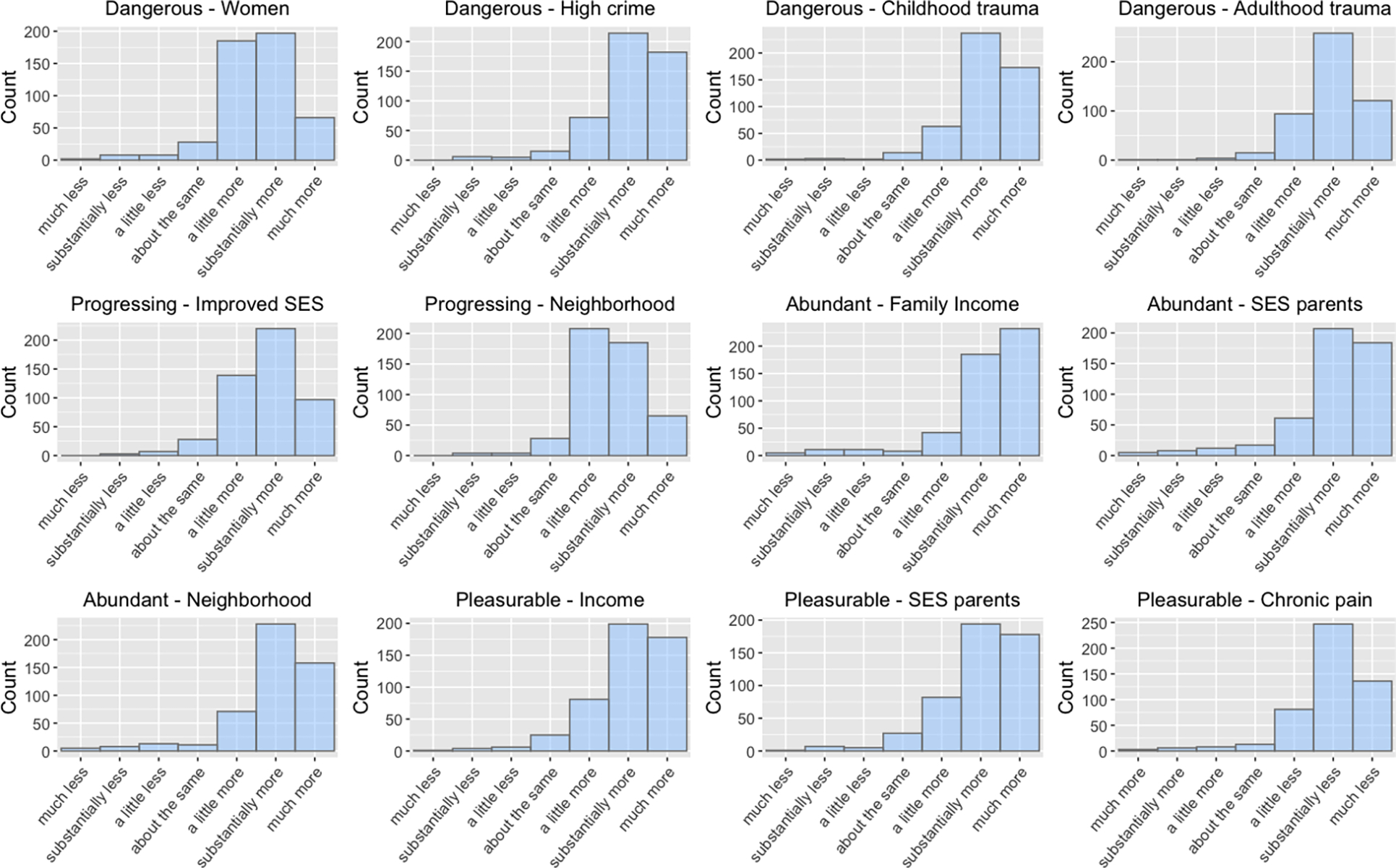
Note: In Figure 1, responses are reversed for Prediction 12 (Pleasurable-Chronic Pain) to reflect direction of the prediction.
Figure 2: Observed Effects (Study 2) Were Smaller than Median Researcher Predictions (Study 1) for All 12 Predictions.

Note: SES=socioeconomic status. Observed correlations were statistically significant (p<.05) with the exception of Predictions 2, 5, and 9. For associations relating to local crime rates and income levels, correlations at the neighborhood level are shown (since this was the level of analysis at which we asked Study 1 participants to make predictions).
Study 2: Do Positive Primal World Beliefs Actually Reflect Privilege in These 12 Ways?
Study 2 used data from 8 samples to empirically test the same 12 relationships outlined in Table 1 and predicted by researchers and laypeople in Study 1.
Method
Cross-sectional survey data from eight samples (total N=14,481) were collected online from paid participants on crowdsourcing websites (MTurk and Prolific), voluntary participants interested in psychology (Authentic Happiness), and from undergraduate students. Two samples were specifically intended to address the present research questions, while other samples were originally collected for related research and were combined to maximize power. All n’s>1030 for specific predictions, allowing 80% power to detect small effects of r ≥.09. The combined sample was 53.5% female, and the majority of participants who were asked their race (69.4%) identified as White, with 9.6% identifying as Asian, 8.0% as Latino or Hispanic, 7.7% Black or African American, with 5.3% reporting other races or mixed race (note: there was some inconsistency in response options across studies. Further, three samples, including the two largest samples from Authentic Happiness, were not asked to report their race. For more detailed demographics and information on exclusions, see supplementary Table S1).
Results in the manuscript represent meta-analyzed effect sizes (for sample-specific correlations, see supplement). Each effect was meta-analyzed separately (i.e., 12 meta-analyses were conducted), each using a two-level mixed effects model using restricted maximum likelihood estimation, conducted using the MAJOR package for Jamovi which uses the metafor package for R (Jamovi Project, 2022; R Core Team, 2021; Viechtbauer, 2010). These models weight correlations according to sample size.
Measures
Primal World Beliefs
Participants were given subscales from the Primals Inventory (Clifton et al., 2019) and rated their agreement on a 6-point scale. Items were randomized within the scale. Descriptive statistics and reliabilities by sample can be found in supplementary Table S2 (for primals, all Cronbach’s α’s >.79)
Abundant (versus Barren) World Belief.
This four-item scale measures the belief that the world is an abundant place full of opportunities. Items include “Life overflows with opportunity and abundance.”
Pleasurable (versus Miserable) World Belief.
This five-item scale includes “Life in this world is usually pain and suffering” (reversed).
Progressing (versus Declining) World Belief.
This four-item scale includes “It feels like the world is going downhill” (reversed).
Safe (versus Dangerous) World Belief.
Safe world belief is a higher-order primal, assessing people’s beliefs in the prevalence of multiple types of threat. The full version uses a 23-item scale, which includes items from the Progressing and Pleasurable scales, as well as items assessing how Just, Cooperative, and Stable, the world is. Highest loading items are those which directly assess safety or danger, e.g., ‘I tend to see the world as pretty safe’ and ‘On the whole, the world is a dangerous place (reversed)’.
Measures of Personal Circumstances and Experiences
Neighborhood Violent Crime Rates.
Statistics for neighborhood-level violent crime rates were taken by entering five-digit zip codes into the search function on crimegrade.org, a website which gives highly granular data at the neighborhood level (expressed as number of crimes per 1,000 inhabitants). State-level violent crime rates per 100,000 inhabitants were taken from the FBI data explorer (2019 figures accessed at: https://ucr.fbi.gov/crime-in-the-u.s/2019/crime-in-the-u.s.−2019/tables/expanded-homicide-data-table-3.xls).
Neighborhood Mean Income.
Mean family income data from 2019 were taken from the US census and matched to self-reported five-digit zip-codes. County-level data were also from Census data and accessed at: https://www.ers.usda.gov/data-products/county-level-data-sets/. County incomes were matched with five-digit zip codes. Some datasets asked participants only for three-digit zip codes. For zips which overlapped with more than one county, we matched to the local income for the county with the greatest percentage of population overlap with the zip code. For state-level income, participants’ state was deduced from self-reported zip codes. State-level income data was then entered from 2019 Census data.
Family Income.
A single item asked: “How much total combined money did ALL members of your household earn last year?”
Change in Neighborhood Income.
Change in income was calculated as the change between 2019 data and the most recent prior census data (2011), which were accessed at: https://data.census.gov/cedsci/table?q=income&text=income&g=0100000US%248600000&y=2011&d=ACS%205-Year%20Estimates%20Detailed%20Tables&tid=ACSDT5Y2011.B19113
Childhood SES.
Childhood SES was calculated with two self-report measures.
Parents’ Social Class.
A single item asked participants to evaluate the social class of their parents: “In terms of education and income, would you say that your parents are... (1) working class, (2) lower middle class, (3) middle class, (4) upper middle class, (5) upper class?”.
Childhood SES scale (Griskevicius et al, 2011).
Participants rated agreement (1=‘strongly disagree, 9=strongly agree) with three statements: “My family usually had enough money for things when I was growing up”, “I grew up in a relatively wealthy neighborhood”, and “I felt relatively wealthy compared to the other kids in my school”.
Change in Socioeconomic Status.
Change in SES was computed as the difference between the social class of participants’ parents (measured as above) and participants’ own self-reported reported social class now (measured using almost identical wording and options).
Childhood and Adulthood Trauma
To measure trauma experience, we used a slightly modified version of the 24-item Trauma History Questionnaire (Hooper et al., 2011), which asks participants how many times they have experienced each trauma with options ‘0’, ‘1’, ‘2’, ‘3’, ‘4’, ‘5 or more’ times. Items include crime-related trauma (e.g. “Has anyone ever tried to take something directly from you by using force or the threat of force, such as a stick-up or mugging?”), general disasters (e.g. “Have you ever had a serious accident at work, in a car, or somewhere else?”), and unwanted physical/sexual trauma (e.g. “Has anyone ever made you have intercourse or oral or anal sex against your will?”). Participants also responded to when the traumatic event had happened, enabling us to compute separate scores for childhood (before 18 years old) and adulthood (18+). Descriptive statistics for trauma history are shown in supplementary Table S3.
Additional Covariates
Positive and Negative Affect
Affect was measured using the 10-item positive and negative affect schedule (PANAS). This measure asks participants to rate how they feel “right now” across five positive (e.g., ‘active’, ‘alert’) and five negative (e.g., ‘afraid’, ‘nervous’) adjectives. Reliability was good for both the positive (α=.81) and negative (α=.84) measures.
Study 2 Results
Across all samples and the 12 predictions, positive primal world beliefs were poor reflections of privilege (Figure 2). Average correlation across the 12 predictions was |r|=.09 (1.0% shared variance), rather than the researcher prediction of |r|=.34 (9.9% variance shared). Thus, researcher-predicted effects were on average 4.3 times higher than observed effects (based on r) or 9.7 times higher (based on % shared variance, arguably a more appropriate way to compare the relative size of covarying relationships). For all twelve hypotheses, the median researcher prediction of effect size was higher than the upper extreme of the confidence interval around the observed effect. The nearest exception to this pattern was the relationship between childhood trauma and Safe, (r=−.20, or 4% shared variance; rather than the researcher prediction of r=−.38, or 14.4% shared variance). For two predictions, effects were nonsignificant despite sizeable samples, and in another case was in the opposing direction from the prediction. See supplementary Tables S4–S16 for per sample results. Heterogeneity statistics are reported for each of the main hypotheses where more than two samples were analyzed and forest plots are included for these analyses in the supplement (Figures S2–S9).
Prediction 1:
There was no evidence that women see the world as less safe than men, with a small relationship emerging in the opposite direction, r(14,479)=.04, 95%CI [.02,.06], p <.001. This relationship was similar (i.e., small and in the same direction) for US and non-US participants. A random-effect meta-regression revealed moderate heterogeneity across 8 samples (Higgins et al., 2003 suggest rule-of-thumb cut-offs for I2 such that 25% indicates low heterogeneity, 50% moderate, and 75% substantial heterogeneity): Cochran’s Q=12.56, p=.076, τ2=.001, I2=43.2%. Within-sample correlations ranged from r=−.06 to r=.11.
Prediction 2:
People living in neighborhoods (i.e., 5-digit zip code) with more violent crime did not score lower on Safe world beliefs, r(2,933)=−.03, 95%CI[−.01,.07], p=.104 (r2=.001). Heterogeneity across five samples was low, Cochran’s Q=0.30, p=.960, τ2=.000, I2=00.0%, with effects ranging from r=−.05 to r=−.02.
It is possible that testing crime rates at the neighborhood level is too granular, and that people’s wider surroundings are more influential. There are also some issues with zip code-specific estimates, as areas with high volumes of visitors (e.g., because of a tourist attraction) can show inflated per capita rates. Thus, we also examined state-level data and found that people in states with more violent crime saw the world as slightly less Safe, r(9,221)=−0.05, 95%CI [−0.07, −0.03], p < .001 (r2=.003). County-level analyses was not possible given non-equivalence of county level crime reporting (Maltz & Targonski, 2002).
Predictions 3 and 4:
There was a modest negative relationship between self-reported Safe world beliefs and childhood trauma rs(1,042)=−.20, 95%CI[−.26,−.14], p <.001 (r2=.040) and a smaller negative relationship between Safe and trauma in adulthood, rs(1,042)=−.09, 95%CI[−.15,−.03], p <.001 (r2=.008). Correlations for childhood trauma were similar in both samples. However, there was substantial heterogeneity for adulthood trauma with effect sizes of r=−.03 and r=−.15 in the two samples.
These associations were robust to controlling for positive and negative affect in the sample where affect was measured. Because trauma scores described frequencies that were not normally distributed, we used non-parametric Spearman’s rank (rs) correlations to test associations.
Prediction 5:
Change in self-reported social class across one’s lifetime was not associated with seeing the world as getting better, (i.e., Progressing world belief, r(1,929)=.04, 95%CI[−.01,.08], p=.093 (r2=.002)). Heterogeneity by sample was low, Cochran’s Q=1.65, p=.438, τ2=.000, I2=00.0%, with effects in the three samples ranging from r=.01 to r=.08.
Prediction 6:
People in neighborhoods that were getting wealthier saw the world as getting better to a very small degree (i.e., Progressing, r(2,789)=.05, 95%CI[.01,.09], p=.008 (r2=.003)). Heterogeneity across the five samples was low, Cochran’s Q=2.63, p=.453, τ2=.000, I2=00.0%, with effects ranging from r=.02 to r=.10.
Prediction 7:
People who described their parents were from a higher socioeconomic group saw the world as slightly more Abundant than average, r(3,400)=.11, 95%CI[.08,.14], p <.001 (r2=.012) based on the single-item measure. Heterogeneity across 5 studies for this main analysis was modest, Cochran’s Q=6.95, p=.138, τ2=.001, I2=39.48%, with effects ranging from r=.01 to r=.21. Meanwhile, the 3-item measure of childhood socioeconomic status (Griskevicius et al., 2011) included in one sample was uncorrelated with Abundant beliefs, r(483)=.01, 95%CI[−.08,.09], p=.826 (r2=.000).
Prediction 8:
People with higher family incomes saw the world as slightly more Abundant r(3,450)=.13, 95%CI[.10,.16], p < .001 (r2=.017). However, there was substantial heterogeneity across five samples, Cochran’s Q=15.66, p=.004, τ2=.005, I2=76.33%, with estimates varying from r=.05 to r=.19.
Prediction 9:
People currently living in wealthier neighborhoods did not score significantly higher on Abundant world belief r(2,781)=.01, 95%CI[−.10,.11], p=.904 (r2<.0001), although heterogeneity across four samples was substantial, Cochran’s Q=23.55, p < .001, τ2=.010, I2=76.7%, with sample estimates ranging from r=−.10 to r=.15. We found similar results at county- and state-level: there was no correlation between people living in wealthier counties and seeing the world as abundant, r(8,650)=−.02, 95%CI[−.07,.04], p=.510 (r2=.0004), while people living in wealthier states saw the world as very slightly more Abundant, r(8,620)=.00, 95%CI[−.06,.07], p=.927 (r2<.0001).
Prediction 10:
People with higher family incomes saw the world as slightly more Pleasurable than those with lower incomes, r(2,926)=.14, 95%CI[.10,.18], p <.001 (r2=.02). There was some substantial heterogeneity across the five meta-analyzed samples, Cochran’s Q=18.88, p < .001, τ2=.006, I2=80.34%, with effect sizes ranging from r=−.01 to r=.20. The magnitude of within-sample associations remained almost identical when controlling for age, sex, and parenthood.
Prediction 11:
Parents’ socioeconomic class was associated with seeing the world as slightly more Pleasurable based on both the 1-item measure, r(2,894)=.11, 95%CI [.07,.14], p < .001 (r2=.01) and 3-item measure, r(473)=.10, 95%CI [.01,.19], p=.029 (r2=.01). There was little heterogeneity across the four studies that included the single-item measure, Cochran’s Q=1.05, p=.788, τ2=.000, I2=0.0%, with all within-sample correlations between r=.08 and r=.13.
Prediction 12:
People who reported experiencing chronic pain saw the world as slightly less Pleasurable than those who did not, r(1,042)=−.10, 95%CI[−.16,−.04], p=.001 (r2=.01). Effect sizes in the two samples were r=.06 and r=.14.
Study 3: Do Primal World Beliefs Reflect Major Negative Life Experiences?
Study 2 found these 12 indicators of privilege were weakly related to positive primals, with the nearest exception regarding extremely negative personal life experiences. Study 3 tested whether people who have experienced extremely negative events—living with cystic fibrosis, developing cancer, and causing accidental death or injury to another person—have more negative primal world beliefs than the general population (n=1,164, data collection and measures/analyses pre-registered at https://aspredicted.org/8YS_QJZ). Note that some analyses included in the pre-registration (relating to wellbeing) were deemed beyond the scope of this paper and are reported in a separate research article.
Study 3 Method
Participants
Given that some participants provide false information in order to qualify for better paid studies (e.g., Chandler & Paolacci, 2017), we recruited voluntary samples to avoid incentivization of inaccurate information. Sample sizes were not determined a priori – we aimed to collect as much data as possible. For each group, we sent two email invitations to all eligible potential participants. No exclusions were made for any samples.
Cancer Patients and Cancer Survivors
We recruited 434 US-residents with some history of cancer (75 current patients and 359 cancer survivors), mostly through Researchmatch.org, a website designed to match researchers with participants with specific medical diagnoses. The sample was 71% female, 28% male, 1% intersex or other, was 87% White, 1.2% Asian, 5.1% Black/African American, 4.5% Latino or Hispanic, with no other racial group representing more than 1%. The sample was aged 20–91(M=62.2, SD=13.4).
Cystic Fibrosis
We recruited 117 US-resident adults with cystic fibrosis—a genetic lung disease which shortens life expectancy—via emails or notifications sent through the Cystic Fibrosis Foundation. The sample was 79.6% female, 19.3% male, 1.1% intersex or unreported, and were aged 20–88(M=47.1, SD=15.9). Ethnicity data were not collected for this sample.
Trauma Support Group
We recruited 44 US-resident volunteer participants (via the Accidental Impacts support organization) who had caused an accident resulting in death or serious injury to another person. For 88.3%, the accident led to a fatality. 34.9% had faced criminal charges as a consequence, and 41.9% had faced civil liability/lawsuits. The sample were 65.1% female, 27.9% male, and 7.0% unreported, and were aged 24–74 (M=44.2, SD=13.5). Of 43 participants who reported race, 40 (93.0%) identified as non-Hispanic White, one participant (2.3%) identified as Black, one identified as Spanish, Hispanic, or Latino, and one identified as Middle Eastern.
Control Sample
We also recruited 501 healthy US-resident volunteers via Researchmatch.org. The sample reported being 75.9% female, 23% male, 1.1% intersex or other, and were aged 20–88 (M=48.16, SD=17.24). The control sample was 77.8% White, 4.9% Asian, 4.7% Black/African American, 4.5% Latino or Hispanic, with no other racial group representing more than 1%.
Procedure
Participants completed questionnaires online and were recruited across several months (November 2021 to June 2022). The survey was randomized, such that half of participants saw questions about their health or trauma history first, followed by questions about world beliefs, while half of participants completed questions about world beliefs first. T-tests revealed no order effects (p’s>.05).
Measures
Primals World Beliefs
We measured the superordinate Good and Safe factors using the short-form PI-18 scale (Clifton & Yaden, 2021). We additionally used selected subscales from the full PI-99 scale (Clifton et al., 2019) to measure Just (e.g., “The world is a place where working hard and being nice pays off”) and Regenerative (e.g., “The usual tendency of most things and situations is to get better, not worse”) world beliefs. Reliability for all subscales was acceptable or good (all Cronbach’s α’s > .79).
Study 3 Results
Study 3 found mixed evidence for the hypothesis that primal world beliefs reflect the qualities of major negative experiences. To test differences between groups (cancer patients, cancer survivors, people living with cystic fibrosis, trauma support group members), we ran regression analyses comparing each of the three negative experience groups as the predictor of interest, first on its own and then controlling for three pre-registered covariates: sex, age, and family income. Figure 3 shows raw means and distributions, while Table 2 shows standardized regression coefficients with and without covariates.
Figure 3: Violin Plots Showing Raw Means for Primal World Beliefs by Group in Study 3.

Table 2.
Comparisons of Groups’ Primal World Beliefs Versus Controls(n=501) in Study 3.
| Group | Good | Goodcov | Safe | Safecov | Just | Justcov | Regenerative | Regenerativecov |
|---|---|---|---|---|---|---|---|---|
|
| ||||||||
| Cancer patients (n=75) | −.03 | −.09* | −.07 | −.16*** | −.06 | −.13** | −.08 | −.12** |
| Cancer survivors (n=359) | +.09** | −.04 | +.07 | −.06 | +.06 | −.03 | .01 | −.06 |
| Cystic Fibrosis (n=117) | +.09* | +.11* | −.03 | −.01 | +.02 | +.05 | +.04 | +.06 |
| Trauma support (n=44) | −.23*** | −.14** | −.26*** | −.18*** | −.21*** | −.17*** | −.18*** | −.10* |
Note: All coefficients are standardized (β). The suffix cov indicates coefficients when controlling for age, sex, and income. Positive coefficients indicate that the group scored higher than controls.
Current cancer patients scored slightly lower than controls on beliefs that the world is Good, Safe, Just, and Regenerative, although these associations only reached statistical significance when covariates (age, sex, and family income) were included in the model. Whether controlling for demographics or not, cancer survivors scored no more negatively than controls on any of the primals.
After controlling for age, sex, and income in a series of multiple regression analyses there were no significant differences between participants with cystic fibrosis and the control group in terms of Safe, Just, or Regenerative world beliefs. Belief that the world is a Good place was—counter to expectations—slightly higher than in the control group.
People in the trauma support group scored more negatively than controls on all measured primal world beliefs, with the largest difference in Safe world beliefs, β=−.26, or β=−.18 after controlling for demographics.
Exploratory analyses controlling for Big Five personality traits in addition to pre-registered covariates made little meaningful difference to the relationships between cancer patients and controls, but reduced coefficients comparing the trauma support group to controls by an average of 44% across the four primals - see supplementary Tables S18–S25).
Discussion
Contrary to popular intuition, positive primal world beliefs were poor indicators of a privileged background, at least in terms of being male and rich; avoiding cancer, chronic pain, and cystic fibrosis; growing up wealthy; seeing one’s own financial circumstances improve; and currently living in relatively safe and wealthy neighborhoods, counties, and states. Study 1 established in samples of laypeople (n=494) and researchers (n=486) the popular expectation that there should be substantial correlations between these experiences and seeing the world as Safe, Abundant, Pleasurable, and Progressing. But researcher expectations of the strength of 12 predictions linking privilege and world belief (mean 9.9% variance shared) were on average almost 10 times greater than observed associations (mean 1.0% variance shared in Study 2; N=14,481). For example, researchers thought Abundant world belief would correlate with living in wealthy neighborhoods at r=.33 when it actually correlated at r=.03. Study 3 (N=1,086) found that even cancer survivors and people living with cystic fibrosis were no more likely to see the world as bad, dangerous, or unjust than members of the wider population, while current cancer patients saw the world as only slightly worse than healthy controls.
The strongest relationship found in Study 2 was between childhood trauma and the belief the world is a dangerous place (Predictions 3 and 4). Further, Study 3 found that a sample of people who had caused an accident leading to death or serious injury saw the world as substantially worse, less safe, and less just than controls. These findings suggest there may be something qualitatively different about the experience of trauma compared to other indicators of underprivileged life circumstances measured in this study. This relationship between traumatic experience and world beliefs is also plausibly consistent with “Shattered Assumptions Theory”: that the experience of traumatic events “shatters” positive world assumptions, leading to mental health issues, such as depression (e.g., Janoff-Bulman, 1985; 1989; Schuler & Boals, 2016). However, there are important qualifications to this support. In Study 2, the relationships between traumatic experience and belief that the world is a good and safe place were modest and multiple times smaller than predicted by most researchers (4% actual covariance versus 14.4% expected for childhood trauma, and 0.8% versus 12.3% for adulthood trauma). In Study 3, participants who had caused accidental death or injury—who had substantially more negative primals than other groups—were also a non-random sample of people who had sought a support group, suggesting a possible confound (lower mental health is tied to more negative primals; Clifton & Meindl, 2021). Finally, effect sizes in most cases were still modest, indicating that many people did not experience substantial, lasting, negative shifts in their worldview.
The data presented here are descriptive, and inferences about causation should be made with caution. For example, it is possible that some or all of the relationships between wealth and abundant/pleasurable world beliefs are caused by people with more positive outlooks being more optimistic, therefore investing more effort and consequently earning more money (Clifton & Meindl, 2022). However, the lack of substantial correlations across multiple variables may be more inferentially informative. The fact that most relationships tested here showed either no correlation or negligibly small correlations suggests that personal life events either exert less influence on people’s beliefs about the world than is widely thought, or they do so less systematically. The alternative is that there are multiple unknown suppressor effects acting in the opposite direction from each of the predictions examined here.
Consistent with the hypothesis that major events do not change world beliefs in a systematic, predictable way, initial work found that primal world beliefs exhibit stability across a 19-month period that is comparable to Big Five personality traits (Clifton et al., 2019), while a recent longitudinal study found that the Covid pandemic—a time when the world became objectively more dangerous—had little or no effect on relevant world beliefs (Ludwig et al., 2022). It is worth highlighting, however, that the associations reported here pertain to average relationships across many individuals. Thus, the lack of substantial correlations across the relationships tested here does not preclude the possibility that many individuals experience meaningful changes in their worldviews as a consequence of their experiences - it simply suggests that this is not the norm, or that such effects may not be directionally consistent (perhaps as a consequence of other moderating factors).
There are also reasons that we should exercise caution in interpreting some of the effect sizes reported here. Firstly, some of the meta-analyzed effects in Study 2 showed substantial heterogeneity across sample. The presence of heterogeneity may indicate underlying moderators of the relationship that were not identified. Heterogeneity also means that we can be less certain that true population effect sizes fall within the meta-analyzed confidence intervals, since unidentified characteristics that are over-/under-represented in our samples may have introduced unintentional biases. It is worth noting, though, that for most of these hypotheses even the largest observed effect size was modest. For example, the largest absolute correlation in Study 2 for any hypothesis in any sample—among a total of 63 correlation tests—was r=−.22 (the relationship between Safe world beliefs and experience of childhood trauma), and for every hypothesis the largest observed relationship for any sample was still considerably smaller than researcher-predicted effects. Thus, it is unlikely that this heterogeneity is masking much larger effects in the wider population, but likely that effects are moderated by sample characteristics not identified here.
Secondly, when interpreting the observed effect sizes reported in this paper, it is important to note that observed effects tend to be smaller than true effects in the population (where such effects are not equal to zero) as a result of measurement error (see e.g., Trafimow, 2016). This phenomenon, called attenuation, can lead to substantial differences in cases where variables show low reliability. For some of the relationships reported here, this is unlikely to exert a strong influence on effect sizes, since the main variables are likely to have high reliability (e.g. a person’s sex or cancer history). However, it is possible that some of the variables, such as self-reported trauma history, have relatively low reliability, perhaps around 0.70 (e.g., Green et al., 1996). If we assume test-retest reliability of .90 for Safe world beliefs (corresponding to its two week within-subject stability – Clifton et al., 2019), this would lead to an attenuation ratio of around 0.79, meaning the true effect size would be 26% larger than the observed effect, increasing from r=.20 to r=.25. While this represents a meaningful difference when considering true population effects, it should also be noted that the researchers who were surveyed in Study 1 were directed to estimate measured effects rather than true population effects. Thus, true effects may be somewhat larger than those reported here
A further limitation is that the research reported here examined associations between only a handful of primal world beliefs and a limited set of indicators of privileged experience. Clearly, we do not present an exhaustive study of all potentially relevant indicators of privilege, and it is very much possible that some variables we did not test could have a stronger influence than the ones reported here. One obvious example of a demographic difference which could be meaningful is race. We did not examine race here because we did not have sufficient data from individual groups to make accurate comparisons (the majority of participants in these studies were White), and also because race covaries with multiple cultural factors which could necessitate a more focused study. Research in this area might, for example, test the hypothesis that African Americans—who are more often victims of violent crime and face considerable discrimination (FBI, 2019)—see the world as a more dangerous or less just place than White Americans, which initial evidence suggests might be the case.1 Given that racial identity and discrimination are also closely related to socioeconomic privilege, more focused work on this topic should go beyond bivariate relationships, and unpack whether and how race and other group identities might interact with more direct measures of socioeconomic privilege (such as income, neighborhood wealth, etc.) to shape beliefs. Longitudinal work is also needed to more properly test causal relationships. Thus, while we have examined a number of key indicators of privilege, much work remains to be done. Despite the narrow operationalization of privilege, though, the findings here provided a reasonable initial test of several important indicators of privilege which—as demonstrated in Study 1—many people expected to be strongly and systematically tied to worldviews.
A final caveat is that while the analyses here may represent a reasonable initial exploration of the influence of privilege on the beliefs of Americans in the 21st century, we advise against overgeneralizing. The distributions of opportunities, threats, and socioeconomic circumstances in a first-world country such as the USA are different from those in other times and places. For example, the level of danger from violent death, hunger, or drought is much lower than for most people in human history (Pinker, 2012).
If personal experiences play only a minor role in shaping world beliefs, a key goal for future research is to identify which factors do lead to the substantial variation in how people see the world. One possibility is that hereditary factors play an important role in world beliefs, as they do with many other individual differences. This is not only the case for personality traits (e.g., roughly 40% of variation in widely-studied personality traits is heritable in US samples – see Vukasović, & Bratko, 2015), but also specific social attitudes, such as political views are substantially heritable (Alford et al, 2005; Kleppestø et al, 2019; Smith et al, 2011; Wajzer & Dragan, 2021; Willoughby et al, 2021). Similarly, of course, non-biological transmission from parents could also be influential, as well as social transmission from peers or celebrities. Future research on world beliefs would do well to examine the relative influence of all these factors, as well as interactions between them.
The central finding—that the association between having a privileged life and having a positive worldview was considerably smaller than most people expected—may be a helpful insight to some. For example, learning that negative worldviews are not an inescapable destiny for people who have endured hardship could potentially be useful for increasing the efficacy of some types of therapy. A possible application might be to use the discrepancy between lay beliefs and reality as a foundation for educationally-based cognitive therapy. The opening quote of this article suggests that some individuals believe themselves “locked in” to certain beliefs about the world based on their sex, where they grew up, negative life experiences, and so forth. Learning that the way most individuals see the world is not an inevitable product of these backgrounds might increase hope in the efficacy of therapy aimed at changing perspectives on the world. In this way, because expectations of therapy success are good predictors of actual success (see, e.g., Greenberg et al., 2006; Constantino et al., 2011; 2018), therapy outcomes could improve. A useful next step for future research could therefore be to test whether interventions which challenge this meta-belief (that having a negative worldview is inevitable for people who have experienced hardship) can result in greater optimism regarding the potential efficacy of therapy.
Concluding Remarks
This article has explored whether primal world beliefs closely reflect personal experiences. We found that knowing that a person holds positive (or negative) primal world beliefs revealed little about how privileged (or underprivileged) their lives had been, at least relating to the 12 indicators we examined. This contradicted the intuitions of many researchers and laypersons, including Study 1 participants and the participant quoted at the start of this paper who was convinced that the reason they personally see the world as a barren place is because they are poor. If intuitions on how primal world beliefs arise are reliably inaccurate in this way, the pathway to a more positive worldview is perhaps not as simple as having a better life, or even making the world better. Independent efforts may be required to improve both the world we live in and our attitudes towards it.
Supplementary Material
Acknowledgments
Funding for this research was provided by the Templeton Religious Trust, Grant #0298. Laura M. Perry was supported by the NIH/NCI training grant T32CA193193.
Footnotes
De-identified data, materials, and analytic code for all studies are accessible at https://osf.io/knpgf/
The authors report no conflicts of interest.
Studies were approved by the University of Pennsylvania’s IRB.
Study 1 was not preregistered. Predictions for Study 2 (but not specifics of data collection and analysis) were pre-registered prior to data-collection at https://osf.io/gw79e/?view_only=de0b61485c4748979414e51df0af5b5d. (Note: This preregistration was part of a broader dissertation project. The relevant section is ‘Chapter 1, Study 2: Do primals reflect objective experience?’). Study 3 was preregistered (including hypotheses, data collection, and analysis) at: https://aspredicted.org/8YS_QJZ.
New unpublished data from a US sample appear to offer some mixed support for belief-differences along racial lines. In a sample of ~400 White Americans and ~400 Black Americans collected for another study while the current paper was under review, we found no evidence of differences in overall belief that the world is a Good place (d=.04 or r=.02, n.s.) but a small-to-moderate difference in Safe beliefs, such that White Americans saw the world as safer than Black Americans (d=.37 or r=.17, p< .001). Interestingly, Black participants scored considerably higher on belief that the world is Alive (versus mechanistic—a collection of beliefs that includes belief that the world is an intentional place, where everything happens for a reason, and belief that the world ‘needs me’—d=.71, p< .001). These initial findings appear consistent with the overall result of the current study: that the relationship between primal world beliefs and indicators of privilege usually exist but are often smaller than expected such that knowing one’s primals sheds little light on demographic background, and vice versa.
References
- Alford JR, Funk CL, & Hibbing JR (2005). Are political orientations genetically transmitted? American Political Science Review, 99(2), 153–167. [Google Scholar]
- Altemeyer B (1981). Right-wing authoritarianism. University of Manitoba Press. [Google Scholar]
- Altemeyer B (1988). Enemies of freedom: Understanding right-wing authoritarianism. Jossey-Bass. [Google Scholar]
- Beck AT (1963). Thinking and depression I: Idiosyncratic content and cognitive distortions. Archives of General Psychiatry, 9, 324–333. [DOI] [PubMed] [Google Scholar]
- Beck AT (1964). Thinking and depression II: theory and therapy. Archives of General Psychiatry, 10, 561–571. [DOI] [PubMed] [Google Scholar]
- Beck AT (1967). Depression: Clinical, experimental, and theoretical aspects. Philadelphia: University of Pennsylvania Press. [Google Scholar]
- Beck AT (2005). The current state of cognitive therapy: a 40-year retrospective. Archives of General Psychiatry, 62, 953–959. [DOI] [PubMed] [Google Scholar]
- Benabou R, & Tirole J (2006). Belief in a just world and redistributive politics. The Quarterly Journal of Economics, 121(2), 699–746. [Google Scholar]
- Chandler JJ, & Paolacci G (2017). Lie for a dime: When most prescreening responses are honest but most study participants are impostors. Social Psychological and Personality Science, 8(5), 500–508. [Google Scholar]
- Clifton JDW (2020). Testing if primal world beliefs reflect experiences—or at least some experiences identified ad hoc. Frontiers in Psychology, 11, 1145. [DOI] [PMC free article] [PubMed] [Google Scholar]
- Clifton JDW, Baker JD, Park CL, Yaden DB, Clifton ABW, Terni P, Miller JL, Zeng G, Giorgi S, Schwartz HA, & Seligman MEP (2019). Primal world beliefs. Psychological Assessment, 31(1), 82–99. [DOI] [PubMed] [Google Scholar]
- Clifton JDW, & Kerry N (2022). Belief in a dangerous world does not explain substantial variance in political attitudes, but other world beliefs do. Social Psychological and Personality Science, 194855062211193. [Google Scholar]
- Clifton JDW, & Meindl P (2022). Parents think—Incorrectly—That teaching their children that the world is a bad place is likely best for them. The Journal of Positive Psychology, 17(2), 182–197. [Google Scholar]
- Clifton JDW, & Yaden DB (2021). Brief measures of the four highest-order primal world beliefs. Psychological Assessment, 33(12), 1267–1273. [DOI] [PubMed] [Google Scholar]
- Constantino MJ, Arnkoff DB, Glass CR, Ametrano RM, & Smith JZ (2011). Expectations. Journal of Clinical Psychology, 67(2), 184–192. [DOI] [PubMed] [Google Scholar]
- Constantino MJ, Vîslă A, Coyne AE, & Boswell JF (2018). A meta-analysis of the association between patients’ early treatment outcome expectation and their posttreatment outcomes. Psychotherapy, 55(4), 473–485. [DOI] [PubMed] [Google Scholar]
- Cook CL, Li YJ, Newell SM, Cottrell CA, & Neel R (2018). The world is a scary place: Individual differences in belief in a dangerous world predict specific intergroup prejudices. Group Processes & Intergroup Relations, 21(4), 584–596. [Google Scholar]
- Duckitt J (2001). A dual-process cognitive-motivational theory of ideology and prejudice. In Zanna (Ed.), Advances in experimental social psychology, Vol. 33, pp. 41–113). Academic Press. [Google Scholar]
- Duckitt J, & Sibley CG (2009). A dual-process motivational model of ideology, politics, and prejudice. Psychological Inquiry, 20(2–3), 98–109. [Google Scholar]
- FBI (2019) “Expanded Homicide Data Table 3: Murder Offenders by Age, Sex, Race, and Ethnicity, 2019”. FBI.gov. 2020. Retrieved March 21, 2022. Accessed at https://ucr.fbi.gov/crime-in-the-u.s/2019/crime-in-the-u.s.-2019/tables/expanded-homicide-data-table-3.xls [Google Scholar]
- Funder DC, & Ozer DJ (2019). Evaluating effect size in psychological research: Sense and nonsense. Advances in Methods and Practices in Psychological Science, 2(2), 156–168. [Google Scholar]
- Furnham A (2003). Belief in a just world: Research progress over the past decade. Personality and Individual Differences, 34(5), 795–817. [Google Scholar]
- Furnham A, & Procter E (1989). Belief in a just world: Review and critique of the individual difference literature. British Journal of Social Psychology, 28(4), 365–384. [Google Scholar]
- Green BL (1996). Trauma History Questionnaire. In Stamm BH(Ed.), Measurement of stress, trauma, and adaptation (pp. 366–369). Lutherville, MD: Sidran Press. [Google Scholar]
- Greenberg RP, Constantino MJ, & Bruce N (2006). Are patient expectations still relevant for psychotherapy process and outcome? Clinical Psychology Review, 26(6), 657–678. [DOI] [PubMed] [Google Scholar]
- Griskevicius V, Delton AW, Robertson TE, & Tybur JM (2011). Environmental contingency in life history strategies: the influence of mortality and socioeconomic status on reproductive timing. Journal of Personality and Social Psychology, 100(2), 241. [DOI] [PMC free article] [PubMed] [Google Scholar]
- Higgins JP, Thompson SG, Deeks JJ, & Altman DG (2003). Measuring inconsistency in meta-analyses. British Medical Journal, 327(7414), 557–560. [DOI] [PMC free article] [PubMed] [Google Scholar]
- Hooper LM, Stockton P, Krupnick JL, & Green BL (2011). Development, use, and psychometric properties of the Trauma History Questionnaire. Journal of Loss and Trauma, 16(3), 258–283. [Google Scholar]
- Janoff-Bulman R (1985). The aftermath of victimization: Rebuilding shattered assumptions. Trauma and its Wake, 1, 15–35. [Google Scholar]
- Janoff-Bulman R (1989). Assumptive worlds and the stress of traumatic events: Applications of the schema construct. Social Cognition, 7(2), 113–136. [Google Scholar]
- John OP, & Srivastava S (1999). The Big Five Trait taxonomy: History, measurement, and theoretical perspectives. In Pervin LA& John OP(Eds.), Handbook of personality: Theory and research (pp. 102–138). Guilford Press. [Google Scholar]
- Kleppestø TH, Czajkowski NO, Vassend O, Røysamb E, Eftedal NH, Sheehy-Skeffington J, … & Thomsen L. (2019). Correlations between social dominance orientation and political attitudes reflect common genetic underpinnings. Proceedings of the National Academy of Sciences, 116(36), 17741–17746. [DOI] [PMC free article] [PubMed] [Google Scholar]
- Lerner MJ (1980). The Belief in a Just World. In Lerner MJ, The Belief in a Just World (S. 9–30). Springer; US. [Google Scholar]
- Lipkus I (1991). The construction and preliminary validation of a global belief in a just world scale and the exploratory analysis of the multidimensional belief in a just world scale. Personality and Individual Differences, 12(11), 1171–1178. [Google Scholar]
- Ludwig VU, Crone D, Clifton JD, Rebele RW, Schor J, & Platt ML (2022). Resilience of primal world beliefs to the initial shock of the COVID-19 pandemic. Journal of Personality. 10.1111/jopy.12780 [DOI] [PMC free article] [PubMed] [Google Scholar]
- Maltz MD, & Targonski J (2002). A note on the use of county-level UCR Data. Journal of Quantitative Criminology, 18(3), 297–318. [Google Scholar]
- Meyer GJ, Finn SE, Eyde LD, Kay GG, Moreland KL, Dies RR, … & Reed GM. (2001). Psychological testing and psychological assessment: A review of evidence and issues. American Psychologist, 56(2), 128–165. [PubMed] [Google Scholar]
- Miller SL, Zielaskowski K, & Plant EA (2012). The basis of shooter biases: Beyond cultural stereotypes. Personality and Social Psychology Bulletin, 38(10), 1358–1366. [DOI] [PubMed] [Google Scholar]
- Nudelman G (2013). The belief in a just world and personality: A meta-analysis. Social Justice Research, 26(2), 105–119. [Google Scholar]
- Pinker S (2012). The better angels of our nature: Why violence has declined. Penguin Books. [Google Scholar]
- R Core Team (2021). R: A Language and environment for statistical computing. (Version 4.1) [Computer software]. Retrieved from https://cran.r-project.org. (R packages retrieved from MRAN snapshot 2022-01-01). [Google Scholar]
- Schaller M, Park JH, Mueller A (2003). Fear of the dark: Interactive effects of beliefs about danger and ambient darkness on ethnic stereotypes. Personality and Social Psychology Bulletin, 29, 637–649. [DOI] [PubMed] [Google Scholar]
- Schuler ER, & Boals A (2016). Shattering world assumptions: A prospective view of the impact of adverse events on world assumptions. Psychological Trauma: Theory, Research, Practice, and Policy, 8(3), 259–266. [DOI] [PubMed] [Google Scholar]
- Smith KB, Oxley DR, Hibbing MV, Alford JR, & Hibbing JR (2011). Linking genetics and political attitudes: Reconceptualizing political ideology. Political Psychology, 32(3), 369–397. [Google Scholar]
- Stahlmann AG, & Ruch W (2022). Primal world beliefs correlate strongly but differentially with character strengths. The Journal of Positive Psychology, 1–11. [Google Scholar]
- The jamovi project (2022). jamovi. (Version 2.3) [Computer Software]. Retrieved from https://www.jamovi.org.
- Trafimow D (2016). The attenuation of correlation coefficients: A statistical literacy issue. Teaching Statistics, 38(1), 25–28. [Google Scholar]
- Viechtbauer W (2010). Conducting meta-analyses in R with the metafor package. Journal of Statistical Software, 36, 1–48. [Google Scholar]
- Vukasović T, & Bratko D (2015). Heritability of personality: A meta-analysis of behavior genetic studies. Psychological Bulletin, 141(4), 769. [DOI] [PubMed] [Google Scholar]
- Wajzer M, & Dragan WŁ (2021). It is not only the environment that matters: A short introduction to research on the heritability of political attitudes. Political Studies Review, 14789299211053780. [Google Scholar]
- Willoughby EA, Giannelis A, Ludeke S, Klemmensen R, Nørgaard AS, Iacono WG, … & McGue M. (2021). Parent contributions to the development of political attitudes in adoptive and biological families. Psychological Science, 32(12), 2023–2034. [DOI] [PMC free article] [PubMed] [Google Scholar]
- Wolfradt U, & Dalbert C (2003). Personality, values and belief in a just world. Personality and Individual Differences, 35(8), 1911–1918. [Google Scholar]
Associated Data
This section collects any data citations, data availability statements, or supplementary materials included in this article.