



Abstract
Aims
Percutaneous stellate ganglion block (PSGB) through single-bolus injection and thoracic epidural anaesthesia (TEA) have been proposed for the acute management of refractory ventricular arrhythmias (VAs). However, data on continuous PSGB (C-PSGB) are scant. The aim of this study is to report our dual-centre experience with C-PSGB and to perform a systematic review on C-PSGB and TEA.
Methods and results
Consecutive patients receiving C-PSGB at two centres were enrolled. The systematic literature review follows the latest Preferred Reporting Items for Systematic Reviews and Meta-Analyses (PRISMA) criteria. Our case series (26 patients, 88% male, 60 ± 16 years, all with advanced structural heart disease, left ventricular ejection fraction 23 ± 11%, 32 C-PSGBs performed, with a median duration of 3 days) shows that C-PSGB is feasible and safe and leads to complete VAs suppression in 59% and to overall clinical benefit in 94% of cases. Overall, 61 patients received 68 C-PSGBs and 22 TEA, with complete VA suppression in 63% of C-PSGBs (61% of patients). Most TEA procedures (55%) were performed on intubated patients, as opposed to 28% of C-PSGBs (P = 0.02); 63% of cases were on full anticoagulation at C-PSGB, none at TEA (P < 0.001). Ropivacaine and lidocaine were the most used drugs for C-PSGB, and the available data support a starting dose of 12 and 100 mg/h, respectively. No major complications occurred, yet TEA discontinuation rate due to side effects was higher than C-PSGB (18 vs. 1%, P = 0.01).
Conclusion
Continuous PSGB seems feasible, safe, and effective for the acute management of refractory VAs. The antiarrhythmic effect may be accomplished with less concerns for concomitant anticoagulation compared with TEA and with a lower side-effect related discontinuation rate.
Keywords: Refractory ventricular arrhythmias, Electrical storm, Cardiac arrest, Neuromodulation, Stellate ganglion block, Thoracic epidural anaesthesia
Graphical Abstract
Graphical Abstract.

What’s new?
Acute neuromodulation strategies, including percutaneous stellate ganglion block (PSGB) and thoracic epidural anaesthesia (TEA), have a strong rationale for refractory ventricular arrhythmias (VAs). Still, data on continuous PSGB (C-PSGB) and on TEA are very scant.
The present case series of C-PSGB is the largest ever described: it includes 26 patients, all with structural heart disease, for a total of 32 C-PSGBs.
The systematic review, also never performed so far, includes 61 patients undergoing 68 C-PSGBs and 22 patients undergoing TEA for refractory VAs.
Continuous PSGB and TEA are both effective in controlling VAs, but no direct efficacy comparison is currently possible due to patients’ heterogeneity; the antiarrhythmic effect of C-PSGB may be accomplished with less concerns for concomitant anticoagulation and with a lower side-effect-related discontinuation rate.
Ropivacaine and lidocaine were the most used drugs for C-PSGB, and the available data altogether support a starting dose of 12 and 100 mg/h, respectively.
Introduction
Electrical storm (ES) is a life-threatening condition defined as an incessant ventricular arrhythmia (VA) lasting more than 12 h or three or more separate episodes of VA over 24 h that require treatment, including therapies delivered by an implantable cardioverter defibrillator (ICD). Notably, a recent analysis of various combinations of clustered VA revealed that also lower event rates (i.e. two events within 3 months) carry adverse prognostic implications.1
The acute treatment options for refractory VAs at bedside encompass correction of reversible causes, ICD reprogramming, antiarrhythmic drugs (AADs), deep sedation, and percutaneous transient sympathetic block strategies,2 including percutaneous stellate ganglion block (PSGB), mostly performed as left-side-only procedure due to the asymmetric distribution of cardiac sympathetic innervation,3,4 and thoracic epidural anaesthesia (TEA).5 Notably, while TEA has only been performed invasively so far, stellate ganglion block has also been achieved non-invasively using phototherapy6 and transcutaneous magnetic stimulation.7 Of note, TEA from T1 to T4 may have a vasodepressor effect and a negative chronotropic effect, cannot be performed on patients fully anticoagulated or with ongoing dual antiplatelet therapy, and carries a low but potentially worrisome infective risk.5 On the other side, left-sided bolus PSGB, whose clinical usage is rapidly expanding,8–10 is free from the abovementioned limitations but may have a short-lasting effect and require multiple repetitions. To overcome this limitation, continuous PSGB (C-PSGB) has been proposed,11 but clinical experience is extremely limited.
This paper reports on our dual-centre experience with invasive C-PSGB and a systematic literature review on C-PSGB and TEA to assess the current usage and results of these two refractory VA management techniques.
Methods
Dual-centre case series
Patient selection, data collection, and outcome
Patients presenting with ES and/or with clustered VAs (≥2 episodes in the last 24 h) refractory to conventional management (beta-blockade, preferentially non-selective + additional AAD) and requiring treatment (internal or external shock or antitachycardia pacing) were considered for PSGB [either single-bolus or continuous infusion (CI)]. Percutaneous stellate ganglion block was always used before intubation/deep sedation [defined as a Richmond Agitation–Sedation Scale (RASS), ≤−4] for arrhythmia suppression (among patients who had not yet been intubated either before arrival at our institutions or for other reasons such as recent surgery). The present analysis was performed on consecutive patients receiving C-PSGB in either one of our two large-volume enrolling centres (Fondazione IRCCS Policlinico San Matteo, Pavia, and AOU Città della Salute e della Scienza, Turin) from March 2019 to November 2023. The study was approved by the local institutional review boards. Some patients received more than one CI during the same hospitalization due to VA recurrence after removal/displacement of the previous C-PSGB; C-PSGB was generally maintained for at least 24–48 h to allow for acute stabilization. Baseline clinical characteristics and patients’ outcome were assessed in a per-patient analysis, and procedural characteristics (including VA type and burden) and complications were assessed in a per-procedure analysis. The efficacy was assessed in both a per-procedure analysis and a per-patient analysis. Several patients (20/26, 77%) reported in this analysis were included in the recent publication of the large multi-centre study on PSGB (STAR).9 The STAR paper focused on the antiarrhythmic efficacy of PSGB, mostly performed through single-bolus injection at 1 and 12 h after the block. The current paper presents results coming from new analyses not listed among STAR study outcomes, such as the effects of C-PSGB during the entire infusion duration and the dose/response relationship according to the drug used for the CI.
Continuous percutaneous stellate ganglion block procedure
The procedures were performed by trained cardiologists or by cardiac anaesthesiologists. The technique of C-PSGB [an anterior anatomical or an ultrasound (US)-guided lateral approach] was left to the operators according to their expertise and preference. The anatomical approach consisted of a paratracheal anterior injection at the level of the Chassaignac’s tubercle.12 The needle was advanced perpendicularly to the skin up to the bone of the transverse process of C6 and then minimally retracted before the injection. For the US-guided approach, a linear transducer was used; after the identification of the main anatomical structures, a 22 G needle was advanced using an in-plane technique. Independently of the technique chosen, at first, a bolus of a short-acting and/or a long-acting anaesthetic was injected, followed by an epidural catheter placement (Figure 1). For the bolus, 5–10 mL of 2% lidocaine (100–200 mg), either alone or combined with 10 mL of 0.5% bupivacaine (50 mg) or with 5 mL of 1% ropivacaine (50 mg), was used. For the subsequent CI, we used either 0.2% ropivacaine, starting at 2–3 mL/h (4–6 mg/h) for the first patients and then at 6 mL/h (12 mg/h) for the subsequent, or 1.5–2% lidocaine, mostly starting at 100 mg/h (with an infusion volume of 5–7 mL/h of lidocaine 1.5–2% or of 25 mL/h of lidocaine 0.4%).
Figure 1.
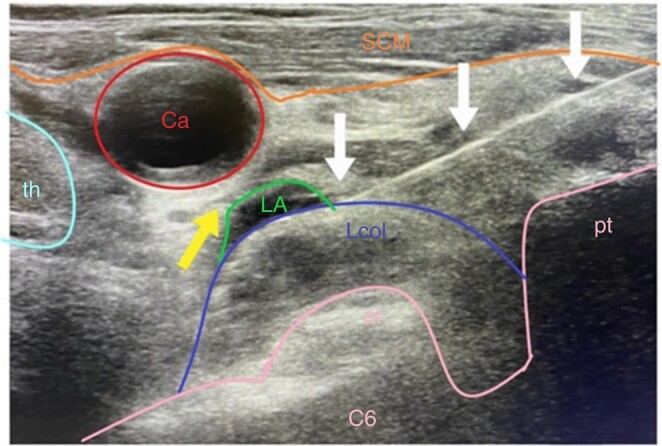
Ultrasound-guided continuous percutaneous left stellate ganglion block at C6 level. at, anterior tubercle; ca, carotid artery; LA, local anaesthetic; Lcol, longus colli muscle; pt, posterior tubercle; scm, sternocleidomastoid muscle; th, thyroid; white arrows, needle’s position; yellow arrow, target region.
Systematic review
We conducted a systematic literature review searching for invasive C-PSGB and TEA for refractory VAs, following the Preferred Reporting Items for Systematic Reviews and Meta-Analyses (PRISMA) statement. Details are reported in the Supplementary material. Baseline clinical characteristics and outcome were assessed in a per-patient analysis and procedural characteristics in a per-procedure analysis. The efficacy was assessed in both a per-procedure analysis and a per-patient analysis. A complete response was defined as no more episodes of sustained or treated VAs, while a partial response, due to the lack of specific details concerning the exact number of VAs in several of the published studies, was qualitatively defined as VA control allowing for patient’s acute stabilization (no need for further antiarrhythmic treatment). To allow for comparability, the same definitions of efficacy were also applied to patients of our dual-centre case series.
Statistical analysis
Continuous variables are presented as mean (±standard deviation) or median [inter-quartile range (IQR)] and categorical variables as percentages. Continuous variables are compared with the t-test or Mann–Whitney U test, as appropriate. Absolute and relative frequencies are reported for categorical variables and compared by the Fisher exact test or the χ2 test, as appropriate. A P-value of <0.05 was considered statistically significant. Analyses were performed with MedCalc Statistical Software (version 20, MedCalc Software Ltd, Ostend, Belgium; 2021).
Results
Baseline characteristics of our population
Twenty-six patients underwent a total of 32 C-PSGBs for refractory VAs (Table 1). Most were male (92%), with a mean age of 62 ± 12 years. The majority (54%) suffered from coronary artery disease, 10 had primary dilated cardiomyopathy (one titin-related), and two had valvular cardiomyopathy. The mean left ventricular ejection fraction (LVEF) was 23 ± 11%, 50% had an ICD (of whom 77% with cardiac resynchronization therapy), and 15% had previously undergone ≥ 1 invasive ventricular tachycardia (VT) ablation procedure. Finally, one patient (4%) had a left ventricular assist device (LVAD). Most patients (21, 81%) received only one C-PSGB, and five received more than one (four patients had two C-PSGBs and one had three C-PSGBs); the median time from admission to the first C-PSGB was 5 days (IQR 3–8). The majority (4/6, 67%) of repeated procedures was performed after catheter accidental displacement and subsequent recurrences, two after a programmed removal for lack of recurrences in one and planned ablation in the other. Single patient’s characteristics and the details of repeated C-PSGBs are reported in Supplementary material online, Tables S1 and S2 and in the Supplementary material.
Table 1.
Summary and comparison of the populations analysed, baseline characteristics, c-PSGB usage, and patients’ outcome
| Our case series of C-PSGB, n = 26 | Published C-PSGB, n = 35 | Combined population of C-PSGB, n = 61 | All published TEA, n = 22 | P-value (our case series vs. other C-PSGB) | P-value (all C-PSGB, vs. all TEA) | |
|---|---|---|---|---|---|---|
| Age | 62 ± 12 | 53 ± 19 | ||||
| Age range | 20–79 | 6–81 | 6–81 | 3–81 | ||
| Children (≤18 years) | 0, 0% | 1, 3% | 1, 2% | 1, 5% | ||
| Male | 24, 92% | 33, 94% | 57, 93% | 18, 82% | ||
| Structural heart disease | 26, 100% | 30, 86% | 56, 92% | 18, 82% | ||
| Recent acute STEMI | 1, 4% | 9, 26% | 10, 16% | 0, 0% | ||
| Non-ischaemic CMP | 12, 46% | 5, 14% | 17, 28% | 10, 45% | P < 0.01 | |
| HCM | 0, 0% | 0, 0% | 0, 0% | 1, 5% | ||
| Takotsubo CMP | 0, 0% | 1, 3% | 1, 2% | 1, 5% | ||
| LQTS | 0, 0% | 2, 6% | 2, 3% | 1, 5% | ||
| Brugada syndrome | 0, 0% | 0, 0% | 0, 0% | 1, 5% | ||
| Other cardiac disorders | 0, 0% | 1, 3% | 1, 2% | 2, 9% | ||
| LVEF, % | 23 ± 11 | NA | NA | 36 ± 16 (n = 19) | ||
| ICD | 13, 50% | 23, 66% | 36, 59% | 9/18, 50% | ||
| CRT-D | 10, 77% | 3/26, 12% | 13, 33% | NA | ||
| LVAD | 1, 4% | 3, 9% | 4, 7% | 0, 0% | ||
| C-PSGB usage | ||||||
| Acute stabilization | 16, 62% | 23, 66% | 39, 64% | 13, 59% | ||
| Bridge to OHT | 0, 0% | 1, 3% | 1, 2% | 2, 9% | ||
| Bridge to VT ablation | 7, 27% | 7, 20% | 14, 23% | 3, 14% | ||
| Bridge to CSD | 1, 4% | 4, 11% | 5, 8% | 4, 18% | ||
| Bridge to LVAD | 1, 4% | 0, 0% | 1, 2% | 0, 0% | ||
| Bridge to PTCA | 1, 4% | 0, 0% | 1, 2% | 0, 0% | ||
| Alive at discharge | 22, 85% | 26, 74% | 48, 79% | 16, 72% | ||
| Death due to refractory VAs | 1, 4% | 1, 3% | 2, 3% | 0, 0% |
Only significant P-values are reported (P < 0.05).
CKD, chronic kidney disease; C-PSGB, continuous percutaneous stellate ganglion block; CMP, cardiomyopathy; CRT-D, cardiac resynchronization therapy defibrillation; CSD, cardiac sympathetic denervation; ICD, implantable cardioverter defibrillator; LVAD, left ventricular assist device; LVEF, left ventricular ejection fraction; NA, not available; OHT, orthotopic heart transplant; PTCA, percutaneous transluminal coronary angioplasty; STEMI , ST-elevation myocardial infarction; TEA, thoracic epidural anaesthesia; VA, ventricular arrhythmias.
Procedural indications, characteristics, and complications
Most C-PSGBs were performed due to either drug-refractory monomorphic VT (MMVT) alone (56%) or a combination of MMVT and polymorphic VT/ventricular fibrillation (VF, 22%), with a mean VT cycle length of MMVTs of 353 ± 82 ms (Table 2); one patient had premature ventricular contraction-triggered VF. In half of the cases, a favouring/precipitant condition could be identified, represented in most cases by sepsis/septic shock (9, 28%) or by cardiogenic shock (5, 16%). The mean potassium levels were within the normal range (4 ± 0.1 mEq/L), and only one patient had hypokalaemia (K + ≤3.5 mEq/L). Most cases (88%) had refractory VAs despite ongoing intravenous (iv) lidocaine, including 13 (41%) with concomitant iv amiodarone, while two (6%) were on iv amiodarone only; only 20/32 (62%) were on beta-blockers (15/20, 75% non-selective) due to inotrope dependence in the rest. Notably, 50% of the cases had already received ≥1 previous PSGB bolus during the same hospitalization, with VAs recurrences once the effect of the local anaesthetic had declined. Except for one procedure, required due to several episodes of fast not-sustained VT, all the others were performed following refractory VAs requiring treatment. In only one case (3%), C-PSGB was performed on the right side due to previous left cardiac sympathetic denervation (LCSD). A minority of cases (28%) were intubated and sedated at the time of C-PSGB, mostly due to major cardiac surgery in the previous days. Concerning antithrombotic drugs, 56% of cases were on either single (34%) or dual (22%) antiplatelet regimen, and 75% were on full anticoagulation, including 12% (4/32) with a triple ongoing antithrombotic regimen. Only two cases (6%) were neither on antiplatelet drugs nor on full anticoagulation. The approach (anatomical vs. US-guided) and the anaesthetic drugs chosen for the bolus and the CI were site-dependent (details in the Supplementary material). All patients received one bolus immediately before the CI. In the whole cohort (n = 32), the mean bolus dosages were 167 ± 35 mg for lidocaine, 48 ± 5 mg for bupivacaine, and 50 ± 0 mg for ropivacaine. The median duration of C-PSGB was 3 days (IQR 1–7); the mean starting infusion rate was 110 ± 21 mg/h for lidocaine and 10.4 ± 2.9 mg/h for ropivacaine. Four (12%) minor complications occurred, all among US-guided procedures (incidence 4/18, 22%): three patients suffered left arm weakness lasting for few hours, likely related to the starting bolus, and one patient suffered from mild transient dysphonia.
Table 2.
Summary and comparison of procedural characteristics and complications
| Our case series of C-PSGB, n = 32 | Published C-PSGB, n = 36 | Combined population of C-PSGB, n = 68 | All published TEA, n = 22 | P-value (our case series vs. other C-PSGB) | P-value (all C-PSGB, vs. all TEA) | |
|---|---|---|---|---|---|---|
| MMVT only | 18, 56% | 16/26, 62% | 34/58, 59% | 12, 55% | ||
| Incessant VT | 0, 0% | 0, 0% | 0, 0% | 8, 36% | <0.001 | |
| ≥1 AAD (other than BB) before | 32, 100% | 34, 94% | 66, 97% | 20, 91% | ||
| Ongoing iv lidocaine | 28, 88% | 21/35, 60% | 49/67, 63% | 8, 36% | 0.01 | 0.004 |
| Intubated and sedated (RASS ≤−4) | 9, 28% | 10, 28% | 19, 28% | 12, 55% | 0.04 | |
| On ECMO | 0, 0% | 3, 8% | 3, 4% | 0, 0% | ||
| On IABP/Impella | 4, 13% | 3, 8% | 7, 10% | 3, 14% | ||
| Antithrombotic therapy at C-PSGB | ||||||
| DAPT | 8, 25% | 0/17, 0% | 8/49, 4% | NA | ||
| DOAC/OAT | 8, 25% | 1/17, 6% | 9/49, 18% | 0, 0% | 0.03 (DOAC/OAT + Heparin) | <0.0001 (DOAC/OAT + Heparin) |
| Heparin (full anticoagulation) | 16, 50% | 6/17, 35% | 22/49, 45% | 0, 0% | ||
| US-guided lateral approach | 18, 56% | 36, 100% | 54, 79% | 0.0001 | ||
| Left-side-only procedure | 31, 97% | 36, 100% | 67, 99% | — | ||
| CI duration (days) | 4 ± 4 (1–16) | Range 1–14 | Range 1–16 | Range 1–14 | ||
| Minor complications | ||||||
| Transient left arm weakness | 3, 9% | 1, 3% | 4, 6% | 0, 0% | ||
| Transient voice hoarseness | 1, 3% | 2, 6% | 3, 4% | 0, 0% | ||
| Complications/concerns leading to discontinuation | 0, 0% | 1, 3% | 1, 1% | 4, 18% | 0.01 | |
| Infusion rate reduction due to hypotension | 0, 0% | 0, 0% | 0, 0% | 1, 5% | ||
| Accidental catheter displacement | 4, 13% | 1, 3% | 5, 7% | 1, 5% | ||
| Miosis ± ptosis | 15, 47% | Mostly non-reported | Mostly non-reported | 0, 0% |
Only significant P-values are reported (P < 0.05).
AADs, antiarrhythmic drugs; CI, continuous infusion; C-PSGB, continuous percutaneous left stellate ganglion block; DAPT, dual antiplatelet therapy; DOAC, direct oral anticoagulant; ECMO, extracorporeal membrane oxygenation; IABP, intra-aortic balloon pump; ICD, implantable cardioverter defibrillator; MMVT, monomorphic ventricular tachycardia; OAT, oral anticoagulation therapy; TEA, thoracic epidural anaesthesia; US, ultrasound; VA, ventricular arrhythmias; VF, ventricular fibrillation; VT, ventricular tachycardia.
Impact of continuous percutaneous stellate ganglion block on ventricular arrhythmia burden, dose–response effect, and outcome
In 19/32 cases (59%), we observed a complete response, with no sustained or treated VAs during C-PSGB. Only one case (3%), despite a reduction in treated VAs after C-PSGB, required an additional urgent antiarrhythmic treatment (temporary pacemaker placement to perform overdrive suppression of recurrent, mostly non-sustained, VAs). Finally, a single patient with an ongoing ES did not experience a reduction in treated VAs in the first 12 h, leading to 2/32 procedures (6%) where C-PSGB did not lead to an acute clinical stabilization (Table 3). In the only patient who received a right C-PSGB due to previous LCSD, a complete VA suppression was observed. Notably, 2/5 (40%) of the patients who received multiple C-PSGB had a reproducible, complete VA suppression; one patient had a partial response during both C-PSGBs, and two patients experienced both partial and complete VA suppression during different C-PSGBs. Overall, when looking at the efficacy in a per-patient analysis and considering the worst response, 13/26 patients (50%) had a complete response, and an overall clinical benefit was observed in 24/26 patients (92%).
Table 3.
Local anaesthetic chosen for bolus and continuous infusion (a per-procedure analysis)
| Our case series of C-PSGB, n = 32 | Published C-PSGB, n = 36 | Combined population of C-PSGB, n = 68 | All published TEA, n = 22 | P-value (our case series vs. other C-PSGB) | P-value (all C-PSGB, vs. all TEA) | |
|---|---|---|---|---|---|---|
| Bolus injection before CI | 32, 100% | 21/35, 57% | 53/67, 79% | 19, 86% | <0.0001 | |
| Anaesthetic for the bolus | ||||||
| 5–10 mL of 0.5% ropivacaine | — | 8/21, 37% | 8/53, 15% | — | Bupivacaine vs. ropivacaine P < 0.01 | |
| 10 mL of 0.25% ropivacaine | — | 10/21, 48% | 11/53, 21% | 2/19, 11% | ||
| 1–4 mL of 0.25% bupivacaine | — | — | — | 15/19, 79% | ||
| 6–12 mL of 0.5% bupivacaine | — | 2/21, 10% | 2/53, 4% | |||
| 3 mL of 1% lidocaine | — | 1/21, 5% | 1/53, 2% | — | ||
| 1 mL of 0.25% bupivacaine + 1 mL of 2% lidocaine | — | — | — | 1/19, 5% | ||
| 5 mL of 0.25% bupivacaine + 3 mL of 2% lidocaine | 1/19, 5% | |||||
| 7.5 mL of 2% lidocaine + 5 mL of 1% ropivacaine | 15, 47% | — | 15/53, 28% | — | ||
| 10 mL of 2% lidocaine | 13, 41% | 13/53, 25% | ||||
| 5–10 mL of 2% lidocaine +10 mL of 0.5% bupivacaine | 4, 12% | 4/53, 8% | ||||
| Anaesthetics dose for bolus (mg) | ||||||
| Ropivacaine | 50 ± 0 | 25–50 mg (range) | 25–50 (range) | 25 ± 0 | ||
| Bupivacaine | 48 ± 5 | 30–60 (range) | 30–60 (range) | 2.5–12.5 (range) | ||
| Lidocaine | 167 ± 35 | 30 | 30–200 (range) | 20 and 30 | ||
| Anaesthetic for the CI | ||||||
| 0.2% ropivacaine | 14, 44% | 30/35, 85% | 44/67, 66% | 5/21, 24% | Bupivacaine vs. lidocaine vs. ropivacaine P < 0.0001 | Bupivacaine vs. lidocaine vs. ropivacaine P < 0.0001 |
| 0.1% bupivacaine | — | 1/35, 3% | 3/67, 4% | — | ||
| 0.05% bupivacaine | — | 2/35, 6% | — | — | ||
| 0.25% bupivacaine | — | — | — | 16/21,76% | ||
| 2% lidocaine | 2, 6% | — | 2/67, 3% | — | ||
| 1.5% lidocaine | 16, 50% | 1/35, 3% | 17/67, 25% | — | ||
| 0.5% lidocaine | — | 1/35, 3% | 1/67, 2% | — | ||
| CI starting infusion rate | — | |||||
| Ropivacaine ≥ 12 mg/h | 11/14, 79% | 17/30, 57% | 28/44, 64% | 0, 0% | <0.0001 | |
| Mean ropivacaine starting rate (mg/h) | 10.4 ± 2.9 | 11.5 ± 1.3 | 10.9 ± 2.0 | 7.3 ± 1.9 | 0.06 | |
| Lidocaine ≥ 100 mg/h | 17/18, 94% | 0, 0% | 17/20, 85% | — | 0.02 | |
| Mean lidocaine starting rate (mg/h) | 110 ± 21 | 10 and 10 | — | |||
| Bupivacaine ≥ 5 mg/h | — | 0/2, 0% | 0/2, 0% | 16, 100% | ||
| Mean bupivacaine starting rate (mg/h) | — | 3 and 3 | 5 and 5 | 5 ± 0 |
Only significant P-values are reported (P < 0.05).
CI, continuous infusion; C-PSGB, continuous percutaneous left stellate ganglion block; TEA, thoracic epidural anaesthesia.
Overall, the number of VAs treated with ATP or shocks was significantly reduced from a median of 6 (IQR 3–24) in the 12 h before the index procedure to a median of 0 (IQR 0–1) in the 12 h after C-PSGB (P < 0.0001) (Figure 2A); comparing the 12 h before with the entire CI duration, the number of treated VAs was still significantly reduced, with a median of 0 treated VAs after (IQR 0–2) (P < 0.0001) (Figure 2B). The median time to the first recurrence was 10 h (IQR 3–25). Concerning the dose–response effect, 3/11 (27%) of the cases in which ropivacaine CI was started at 12 mg/h suffered recurrences, as opposed to 3 over 3 of those who started at 4–6 mg/h (P = 0.05). No clear dose–response could be demonstrated for the 18 cases of CI performed with lidocaine, since in all except for one, the infusion rate was ≥100 mg/h (range 100–140 mg/h). Overall, miosis ± ptosis was observed in 47% of the procedures, with no differences according to complete (53% among those with ptosis vs. 65% among the others, P = 0.719) or complete+partial response (93% among those with ptosis vs. 94% among the others, P = 1.0). Miosis and ptosis, which are often more related to the bolus rather than the CI, were both transient and mostly resolved within 12 h.
Figure 2.

Impact of C-PSGB on VA burden in each procedure (n = 31, the only procedure performed due to several episodes of fast non-sustained VT was not included). (A) Twelve hours before vs. after C-PSGB. (B) Twelve hours before vs. the entire duration of the CI (VAs occurring in the first 12 h after C-PSGB and beyond 12 h are depicted in different colours). There was only one case with more VAs in the 12 h after compared with before C-PSGB (two after compared with one before) that both occurred during underdosed ropivacaine infusion (4 mg/h) and disappeared after increasing the infusion rate from 4 to 12 mg/h. C-PSGB, percutaneous stellate ganglion block; CI, continuous infusion; VAs, ventricular arrhythmia; VT, ventricular tachycardia.
After acute rhythm stabilization, 8/26 patients (31%) received advanced VA treatment (VT ablation in seven cases and bilateral cardiac sympathetic denervation in one), one patient received percutaneous coronary revascularization due to acute graft failure after recent surgery, and one patient received LVAD. Four patients (15%) died before discharge, three due to refractory cardiogenic shock and one due to refractory ES several days after C-PSGB removal in the setting of end-stage heart failure (HF). The remaining 12 patients (46%) received concomitant optimized medical treatment for the favouring/precipitant condition and, when appropriate, evaluation for candidacy to LVAD/transplant.
Systematic review
The literature search retrieved 137 papers. After deduplication, 50 studies were selected for full-text review. Seventeen studies11,13–17,19–29 were included in the systematic review. Two studies25,26 had a partial overlapping of four patients receiving TEA; therefore, the duplicated patients were included only once. One study from our group18 was excluded because the single patient described is also included in the current paper. The STAR study,9 published after our literature search, was also excluded because, although 20/26 patients receiving C-PSGB in that study are included in the current analysis, the paper did not report any detail of this group of patients. The PRISMA flow chart diagram is shown in Supplementary material online, Figure S1.
Study characteristics
Detailed information of the 17 individual studies is provided in Supplementary material online, Tables S3 (C-PSGB) and S4 (TEA), while Tables 1–3 provide a summary of patients’ and procedural characteristics. Most (12, 71%) are case reports, and expect for two,25,26 the rest are single-centre studies. Nine (56%) studies report on C-PSGB, two20,27 on both C-PSGB and TEA (in one case series TEA was used as a bailout strategy for non-responders to C-PSGB,27 and in one case report TEA was performed before C-PSGB20), and six on TEA alone.23–26,28,29 Overall, 35 patients received 36 C-PSGBs, while 22 patients received TEA.
Invasive continuous percutaneous stellate ganglion block: systematic review
Except for a 6-year-old patient, the rest were adults (range 22–81 years); most were male (33, 94%), and one was a 21-week gestation pregnant female. Most patients (30, 86%) suffered from structural heart disease (SHD) with reduced LVEF (including 26% with ST-elevation myocardial infarction); MMVTs were the most common VAs at presentation (16/26, 62%), and 23 patients (62%) had an ICD already in place. Compared with our population, less patients suffered non-ischaemic cardiomyopathy (14 vs. 46%, P < 0.01) and iv lidocaine usage before C-PSGB was lower (88 vs. 60%, P = 0.01). Most cases (26, 82%) were not on general anaesthesia (GA) at the time of C-PSGB, and six (16%) were on mechanical circulatory support (MCS); 41% of those with available data were on full anticoagulation at the time of C-PSGB compared with 75% in our case series (P = 0.03).
All the procedures were performed on the left side only using the US-guided approach. A bolus before CI, mostly performed with ropivacaine 25–50 mg, was reported for 21 of the 35 procedures with available data. Lidocaine was used for the bolus only in one patient, compared with all patients in our case series. The overall duration of each single C-PSGB was variable from 1 to 14 days. The local anaesthetic chosen for the CI was reported for 35 procedures: the most frequently used (30/35, 85%) was 0.2% ropivacaine at 3–12 mL/h (6–24 mg/h), with a starting dose of at least 12 mg/h in 17/30 (57%). Overall, the mean ropivacaine starting dose was 11.5 ± 1.3 mg/h, not significantly different from the mean dose in our case series. On the contrary, none of the patients with lidocaine CI had an infusion rate ≥ 100 mg/h, compared with 94% in our case series (P = 0.02).
A complete and a partial response were observed in 24 (67%) and 9 (25%) procedures, respectively, leading to an overall clinical benefit (complete plus partial response) in 33 cases (92%); the percentages were 69 and 91 in the per-patient analysis. Three cases (8%) required immediate additional therapeutic strategies, represented by TEA in two cases and by emergent caesarean delivery in one (although in the last case, the catheter was found displaced the morning of the recurrences). No major complications were reported. Three minor transient complications were observed that resolved upon C-PSGB interruption (9%): one case of transient left arm weakness and two cases of transient voice hoarseness, leading in one case (3%) to C-PSGB discontinuation. Horner’s syndrome/anisocoria development was not systematically assessed in all studies. In most cases, C-PSGB was used to achieve an acute stabilization, in the remaining as a bridge to orthotopic heart transplant (OHT, 3%), to VT ablation (19%), or to cardiac sympathetic denervation (CSD) (11%); nine patients died during the same hospital admission (26%) and only one (3%) due to refractory VAs (occurred after C-PSGB removal).
Thoracic epidural anaesthesia: systematic review
Except for a 3-year-old boy, the rest were adults (age 22–81 years); most were male, and one was a 21-week gestation pregnant female. Most patients had SHD with reduced LVEF and suffered MMVT, and 50% had an ICD. The needle was always inserted at the T1–T2 or T2–T3 epidural interspace level. For most patients (19, 86%), a bolus was reported, followed by a CI lasting from 1 to 15 days. Bupivacaine 0.25% was the most frequently used drug for both bolus (1–4 mL, 79% of cases) and infusion (2–4 mL/h, 76% of cases).
Most patients (12, 55%) were on GA for VA control at the time of TEA, and three (14%) had an intra-aortic balloon pump. The ongoing antithrombotic therapy was reported for 13 patients: 7 (54%) were on full anticoagulation that was temporarily withheld before TEA in all cases. A complete antiarrhythmic response was reported in 59% and a partial one in 18%, leading to an overall acute antiarrhythmic benefit in 17/22 patients (77%). Five patients (28%) were considered non-responders: two died with ongoing TEA, one underwent OHT, one underwent successful CSD, and one improved with AAD up-titration. TEA was used for acute stabilization in most cases (59%), as a bridge to OHT (9%), to VT ablation (14%), and to CSD (18%) in the remaining. Although no major complications were reported, TEA was discontinued in four cases (18%): in two patients due to concerns for catheter infection and in other two for preventing infections. Additionally, in one case, the infusion rate had to be reduced due to hypotension.
Analogies and differences between continuous percutaneous stellate ganglion block and thoracic epidural anaesthesia usage
Including our case series, a total of 61 patients received 68 C-PSGB procedures, while 22 patients received TEA. Most baseline characteristics were not significantly different (Tables 1 and 2) except for the prevalence of incessant VT at presentation and of procedures performed on intubated and sedated patients (RASS ≤−4), both higher in the TEA group (8/22 vs. 0/68, P < 0.001, and 12/22 vs. 19/68, P = 0.04, respectively). Notably, GA was mostly (11/12, 92%) instituted for VAs control in the TEA group, as opposed to 4/19 cases (21%) in the C-PSGB group (P < 0.001). Also, the usage of iv lidocaine was significantly higher in the C-PSGB group (63 vs. 36%, P = 0.004).
The anaesthetic used was mostly ropivacaine (for both bolus and CI) in the C-PSGB, alone or in combination with lidocaine, and bupivacaine in the TEA group (P < 0.01 for the comparison). Finally, among those with available data on the ongoing antithrombotic therapy, 31 cases (63%) were on full anticoagulation at the time of C-PSBG (including three on extracorporeal membrane oxygenation and four with LVAD), as opposed to no patients in the TEA group (P < 0.001).
A complete VAs suppression, assessed in a per-patient analysis, was observed in 61% of patients receiving C-PSGB and in 59% of those receiving TEA and an overall clinical response in 92% and 77%, respectively. In the per-procedure analysis of C-PSGBs, complete and overall clinical response occurred in 63% and 93% of cases, respectively. A direct efficacy comparison was not made due to the heterogeneity of the indications for the procedures and particularly the higher prevalence of incessant VT and of patients with refractory VAs despite ongoing GA in the TEA group.
No major complications occurred in either group, yet the side-effect-related discontinuation rate was significantly higher in the TEA group (4/22 vs. 1/68 procedures, P = 0.01). Accidental catheter displacement was observed in five C-PSGBs as opposed to none of TEA (P = ns).
Discussion
The acute management of patients with drug-refractory VAs is extremely challenging. Acutely available therapeutic strategies include sedation (from mild to deep), percutaneous neuromodulation with either PSGB or TEA, and eventually MCS.2,5,30 Several studies including not only single-centre case series,18,31 but also systematic reviews32 and multi-centre series,9,10 showed that single-injection (bolus) PSGB, mostly performed as left-side-only procedure due to the quantitative predominance of left cardiac sympathetic innervation at the left ventricular level,3,4 can be extremely effective in reducing VAs burden. This effect is independent from the substrate and the type of VAs and can be used as a bridge to recovery or to ablation/surgery.8 Yet, albeit in same cases the antiarrhythmic effect may last much longer than the duration of the local anaesthetic injected, the potential need for repeated blocks has been consistently reported when the trigger persists and/or there is no short-time definitive treatment available.9,10,18 C-PSGB may potentially overcome these limitations, leading to a prolonged antiarrhythmic effect.
Continuous percutaneous stellate ganglion block: dual-centre case series and systematic literature review
The presented case series of 26 patients (32 C-PSGB procedures), which represents the largest ever reported so far, supports the evidence that C-PSGB, performed as a left-side-only procedure, is feasible, safe, and effective for refractory VAs in the setting of SHD. Notably, most patients suffered from advanced HF and more than one-third of the procedures (12/32, 38%) were performed with ongoing inotropes for haemodynamic support. Therefore, we provided data supporting the usage of C-PSGB even in very unstable patients. In such real-life setting, the guidelines recommended2 use of propranolol at the high dosages proposed by the randomized Greek study33 was considered not feasible, and the intensivists preferred using β1 selective agents, sometime iv and with very short half-life such as esmolol, to limit the potential for peripheral vascular effects and haemodynamic deterioration,34 also taking into account the limited/absent availability of iv propranolol in Europe. Notably, the Greek study33 excluded patients with a baseline systolic blood pressure (BP) below 90 mmHg.
The mean duration of the infusion was 4 days, the longest 16 days, during which no major complications occurred; 50% of the patients had previously received at least one bolus only, left-sided PSGB, but had suffered VAs recurrences once the effect of the local anaesthetic declined. In the remaining patients, C-PSGB was chosen since the beginning over bolus because either no definitive antiarrhythmic therapies were planned (e.g. VAs complicating acute HF decompensation) or the chosen strategy could not be performed within 24–48 h. Indeed, Sanghai et al.11 suggested that compared with single-injection left-sided PSGB, CI was associated with a greater reduction in 24 h VAs burden at a similar adverse event rate, without the need for repeat procedures. Notably, in our case series and in data from the systematic review, more than half of the cases had a complete VAs suppression and more than 90% an overall clinical benefit during C-PSGB. All considering, as summarized in Figure 3, our current approach has shifted to C-PSGB as the first choice whenever a definitive antiarrhythmic strategy is not planned within 48 h and/or a clear transient/reversible trigger cannot be identified.
Figure 3.

Our current approach to acute neuromodulation for refractory VAs. AADs, antiarrhythmic drugs; ACLS, acute cardiac life support; C-PLSGB, continuous percutaneous left stellate ganglion block; LVAD, left ventricular assistance device; TEA, thoracic epidural anaesthesia; US, ultrasound; VA, ventricular arrhythmias; VF, ventricular fibrillation; VT, ventricular tachycardia.
While most published experiences reported the usage of ropivacaine,11,16,19,20,22 we used either lidocaine or ropivacaine. For ropivacaine, we observed a dose–response relationship that supports starting infusion rates of at least 12 mg/h. The infusion volume (cc/h) may also play an important role: larger volumes may help to convey the anaesthetic to neuronal fibres, particularly in the case of an anatomical approach where there is no direct visualization of the anatomical structures. When the US-guided approach is used and the location of the catheter monitored, smaller infusion volumes can be enough.35,36 Indeed, for lidocaine CI, we used an infusion volume of 5–7 mL/h with the US-guided approach and of 25 mL/h with the anatomical approach.
Concerning lidocaine CI, except for one patient, we always used dosages of at least 100 mg/h that are within the maximum lidocaine recommended doses for continuous paracervical blocks (133 mg/h)37 and proved to be safe despite ongoing iv lidocaine (20–50 µg/kg/min). Notably, unlike many published reports, we always performed a bolus injection before the CI, generally using an association between a fast-acting (lidocaine) and a longer-acting (mostly ropivacaine) anaesthetic. A bolus with a fast-acting anaesthetic has been reported previously both for VAs control17 and for other continuous sensitive or motor blocks to achieve a faster effect. For the interscalene brachial plexus block, onset times of 7 min with lidocaine and 30 min with ropivacaine were reported;38 sympathetic structures might be even more sensitive to local anaesthetics than sensory and motor structures,39 but data are very limited. In our case series, the median time to the first recurrence was 10 h (IQR 3–25), supporting the usage of a combination of local anaesthetics.
Finally, compared with the reported literature, we used both the anatomical and the US-guided lateral approaches. Notably, since the anaesthetic is injected more laterally and posteriorly with the lateral approach when compared with the anatomical approach, a higher incidence of transient left arm weakness due to transient paralysis of the left brachial plexus may occur. Ptosis ± miosis was observed in almost half of the patients, but, as already suggested,8,9,18 it was not related to C-PSGB antiarrhythmic efficacy.
Continuous percutaneous stellate ganglion block and thoracic epidural anaesthesia current usage
Theoretically, TEA should be able to provide a more extensive and more reproducible cardiac sympathetic block (bilateral, afferent and efferent, from T1 to T4) compared with left-sided C-PSGB, that only provides a left-sided afferent and efferent block at the T1 level (±C8).40 Yet, pre-clinical data showed that, despite an increased electrical stability induced by TEA, left stellate ganglion stimulation in pigs is still able to produce a significant increase in ventricular repolarization dispersion after TEA, underlying to complexity of cardiac sympathetic control.41
From a practical standpoint, C-PSGB is easier to perform in the urgency/emergency setting, because it does not require the lateral position nor the interruption of anticoagulation. Despite only providing a partial cardiac sympathetic block, the efficacy of C-PSGB was remarkable, and none of the patients required intubation for VAs control. Both GA and TEA may reduce peripheral vascular resistances, although no case of TEA discontinuation due to BP lowering has been reported in this setting. However, BP lowering and catheter infection are potential adverse events of this approach.42 Finally, TEA cannot be performed in the supine position (such as during cardiopulmonary resuscitation or temporary MCS use).
Altogether, despite no direct efficacy comparison can be made so far, the use of left-sided C-PSGB as the first strategy for patients requiring a continuous, percutaneous, cardiac sympathetic block seems very reasonable.43 Both anatomical and US-guided lateral approaches are applicable based on operator’s preference. In our experience, the US-guided approach requires 5–10 min for the bolus and an additional 5–10 min for the CI.44 Data from a large multi-centre observational study (STAR study) showed a statistically significant efficacy of PSGB (mostly performed as bolus) with both the approaches,9 and a prospective trial allowing for both types of approaches is currently ongoing in the out-of-hospital setting (LIVE study, ClinicalTrials.gov Identifier: NCT04168970).
The further management of patients with VA recurrences during C-PSGB may be challenging. Based on our data9,18 suggesting an increased efficacy of repeated left-sided PSGB, a second bolus through the catheter should be considered. A single-centre study31 of 30 patients using bolus PSGB showed that an additional right PSGB did not result in any additional benefit in controlling VAs compared with a left PSGB only (performed just once), supporting a unilateral approach. Yet, in the case of recurrences after a second left bolus, a right block might still be considered after careful exclusion of a left-sided phrenic nerve paralysis, particularly in case a negative chronotropic effect on the sinus node is also pursued45,46 and/or VAs arise from the anterior surface of the right ventricle,3,47 due to the larger right-sided sympathetic control on these structures. Figure 3 summarizes our current approach to percutaneous neuromodulation for refractory VAs. Notably, despite the current work does not specifically support the usage of TEA for patients with major recurrences during C-PSGB, pre-clinical and clinical data do suggest that a stepwise cardiac sympathetic block may be more effective than a single-site one;48,49 therefore, in our opinion TEA might be considered as the last resort after intubation and GA.
Limitations
The main limitations of the present paper, shared with most studies assessing acute treatments for refractory VAs, include its retrospective nature, the limited sample size, and the heterogeneity of the populations described. Also, partial efficacy could only be evaluated in a qualitative way because most of the published case reports and case series did not report the exact number of VAs before and during C-PSGB. Data about ICD programming were not available. Most of the patients were not administered non-selective beta-blockers, for the reasons explained in the text above.
Conclusions
Left-sided C-PSGB preceded by a single-bolus injection is safe and effective for the acute management of patients with refractory VAs. Altogether, though no direct efficacy comparison can be made so far between C-PSGB and TEA due to different patients’ characteristics, with C-PSGB the antiarrhythmic effect may be accomplished with less concerns for concomitant anticoagulation, with a lower side-effect-related discontinuation rate and no need to reduce infusion velocity to avoid hypotension. Ropivacaine and lidocaine were the most used drugs, and the available data support a starting dose of 12 and 100 mg/h, respectively.
Supplementary Material
Contributor Information
Veronica Dusi, Cardiology, Department of Medical Sciences, University of Turin, Corso Dogliotti 14, 10126 Torino, Italy; Division of Cardiology, Cardiovascular and Thoracic Department, ‘Città della Salute e della Scienza’ Hospital, Corso Bramante 88/90, 10126 Torino, Italy.
Filippo Angelini, Division of Cardiology, Cardiovascular and Thoracic Department, ‘Città della Salute e della Scienza’ Hospital, Corso Bramante 88/90, 10126 Torino, Italy.
Enrico Baldi, Arrhythmia and Electrophysiology Unit, Division of Cardiology, Fondazione IRCCS Policlinico San Matteo, Pavia, Italy.
Antonio Toscano, Department of Anaesthesia, Critical Care and Emergency, ‘Città della Salute e della Scienza’ Hospital, Torino, Italy.
Carol Gravinese, Division of Cardiology, Cardiovascular and Thoracic Department, ‘Città della Salute e della Scienza’ Hospital, Corso Bramante 88/90, 10126 Torino, Italy.
Simone Frea, Division of Cardiology, Cardiovascular and Thoracic Department, ‘Città della Salute e della Scienza’ Hospital, Corso Bramante 88/90, 10126 Torino, Italy.
Sara Compagnoni, Department of Molecular Medicine, Section of Cardiology, University of Pavia, Viale Golgi 19, 27100 Pavia, Italy.
Arianna Morena, Cardiology, Department of Medical Sciences, University of Turin, Corso Dogliotti 14, 10126 Torino, Italy; Division of Cardiology, Cardiovascular and Thoracic Department, ‘Città della Salute e della Scienza’ Hospital, Corso Bramante 88/90, 10126 Torino, Italy.
Andrea Saglietto, Division of Cardiology, Cardiovascular and Thoracic Department, ‘Città della Salute e della Scienza’ Hospital, Corso Bramante 88/90, 10126 Torino, Italy.
Eleonora Balzani, Department of Surgical Sciences, University of Turin, Torino, Italy.
Matteo Giunta, Department of Anaesthesia, Critical Care and Emergency, ‘Città della Salute e della Scienza’ Hospital, Torino, Italy.
Andrea Costamagna, Department of Anaesthesia, Critical Care and Emergency, ‘Città della Salute e della Scienza’ Hospital, Torino, Italy.
Mauro Rinaldi, Department of Surgical Sciences, University of Turin, Torino, Italy; Department of Cardiovascular and Thoracic Surgery, ‘Città della Salute e della Scienza’ Hospital, Torino, Italy.
Anna Chiara Trompeo, Department of Anaesthesia, Critical Care and Emergency, ‘Città della Salute e della Scienza’ Hospital, Torino, Italy.
Roberto Rordorf, Arrhythmia and Electrophysiology Unit, Division of Cardiology, Fondazione IRCCS Policlinico San Matteo, Pavia, Italy.
Matteo Anselmino, Cardiology, Department of Medical Sciences, University of Turin, Corso Dogliotti 14, 10126 Torino, Italy; Division of Cardiology, Cardiovascular and Thoracic Department, ‘Città della Salute e della Scienza’ Hospital, Corso Bramante 88/90, 10126 Torino, Italy.
Simone Savastano, Arrhythmia and Electrophysiology Unit, Division of Cardiology, Fondazione IRCCS Policlinico San Matteo, Pavia, Italy.
Gaetano Maria De Ferrari, Cardiology, Department of Medical Sciences, University of Turin, Corso Dogliotti 14, 10126 Torino, Italy; Division of Cardiology, Cardiovascular and Thoracic Department, ‘Città della Salute e della Scienza’ Hospital, Corso Bramante 88/90, 10126 Torino, Italy.
Supplementary material
Supplementary material is available at Europace online.
Funding
This project has received funding from the European Union's Horizon-2020 research and innovation programme under grant agreement No 945119 (STOPSTORM).
Data availability
The data that support the findings of this study are available from the corresponding author upon reasonable request.
References
- 1. Elsokkari I, Parkash R, Tang A, Wells G, Doucette S, Yetisir E et al. Mortality risk increases with clustered ventricular arrhythmias in patients with implantable cardioverter-defibrillators. JACC Clin Electrophysiol 2020;6:327–37. [DOI] [PubMed] [Google Scholar]
- 2. Zeppenfeld K, Tfelt-Hansen J, de Riva M, Winkel BG, Behr ER, Blom NA et al. 2022 ESC guidelines for the management of patients with ventricular arrhythmias and the prevention of sudden cardiac death. Eur Heart J 2022;43:3997–4126. [DOI] [PubMed] [Google Scholar]
- 3. Yanowitz F, Preston JB, Abildskov JA. Functional distribution of right and left stellate innervation to the ventricles. Production of neurogenic electrocardiographic changes by unilateral alteration of sympathetic tone. Circ Res 1966;18:416–28. [DOI] [PubMed] [Google Scholar]
- 4. Schwartz PJ, Snebold NG, Brown AM. Effects of unilateral cardiac sympathetic denervation on the ventricular fibrillation threshold. Am J Cardiol 1976;37:1034–40. [DOI] [PubMed] [Google Scholar]
- 5. Dusi V, Angelini F, Gravinese C, Frea S, De Ferrari GM. Electrical storm management in structural heart disease. Eur Heart J Suppl 2023;25:B242–8. [DOI] [PMC free article] [PubMed] [Google Scholar]
- 6. Nonoguchi NM, Adachi M, Nogami A, Komatsu Y, Sato T, Ueda A et al. Stellate ganglion phototherapy using low-level laser: a novel rescue therapy for patients with refractory ventricular arrhythmias. JACC Clin Electrophysiol 2021;7:1297–308. [DOI] [PubMed] [Google Scholar]
- 7. Markman TM, Pothineni NVK, Zghaib T, Smietana J, McBride D, Amankwah NA et al. Effect of transcutaneous magnetic stimulation in patients with ventricular tachycardia storm: a randomized clinical trial. JAMA Cardiol 2022;7:445–9. [DOI] [PMC free article] [PubMed] [Google Scholar]
- 8. Savastano S, Schwartz PJ. Blocking nerves and saving lives: left stellate ganglion block for electrical storms. Heart Rhythm 2022;9:S1547-5271(22)02695-9. [DOI] [PubMed] [Google Scholar]
- 9. Savastano S, Baldi E, Compagnoni S, Rordorf R, Sanzo A, Gentile FR et al. Electrical storm treatment by percutaneous stellate ganglion block: the STAR study. Eur Heart J 2024;45:823–33. [DOI] [PMC free article] [PubMed] [Google Scholar]
- 10. Chouairi F, Rajkumar, Benak A, Qadri Y, Piccini JP, Mathew J, et al. A multicenter study of stellate ganglion block as a temporizing treatment for refractory ventricular arrhythmias. JACC Clin Electrophysiol 2024;2:S2405-500X(24)00008-2. 10.1016/j.jacep.2023.12.012. Epub ahead of print. [DOI] [PubMed] [Google Scholar]
- 11. Sanghai S, Abbott NJ, Dewland TA, Henrikson CA, Elman MR, Wollenberg M et al. Stellate ganglion blockade with continuous infusion versus single injection for treatment of ventricular arrhythmia storm. JACC Clin Electrophysiol 2021;7:452–60. [DOI] [PubMed] [Google Scholar]
- 12. Moore DC. The anterior approach to the stellate ganglion. J Am Med Assoc 1956;160:158. [DOI] [PubMed] [Google Scholar]
- 13. Ander M. Ultrasound-guided left cervical stellate ganglion block for recurrent ventricular tachycardia (electrical storm). Reg Anaesth Pain Med 2016:41. Conference Abstract. [Google Scholar]
- 14. Bains K, Janfaza D, Flaherty D, Zeballos J, Halawa A, Tedrow U et al. Sympathetic blockade for the management of refractory ventricular tachycardia: a case report. A A Pract 2021;15:e01456. [DOI] [PubMed] [Google Scholar]
- 15. Franklin AD, Llobet JR, Sobey CM, Daniels JM, Kannankeril PJ. Stellate ganglion catheter effective for treatment of ventricular tachycardia storm in a pediatric patient on extracorporeal membrane oxygenation: a case report. A A Pract 2019;13:245–9. [DOI] [PubMed] [Google Scholar]
- 16. Hulata DF, Le-Wendling L, Boezaart AP, Hurley RW. Stellate ganglion local anesthetic blockade and neurolysis for the treatment of refractory ventricular fibrillation. A A Case Rep 2015;4:49–51. [DOI] [PubMed] [Google Scholar]
- 17. Mancuso K, Nicholas T. Continuous stellate ganglion block for incessant VT on MCS for cardiogenic shock. Crit Care Med 2022;50:209–209. [Google Scholar]
- 18. Savastano S, Dusi V, Baldi E, Rordorf R, Sanzo A, Camporotondo R et al. Anatomical-based percutaneous left stellate ganglion block in patients with drug-refractory electrical storm and structural heart disease: a single-centre case series. Europace 2021;23:581–6. [DOI] [PubMed] [Google Scholar]
- 19. Sbrocchi AJ, Hardy WA, Ghannam AD, Kilic A. Less invasive durable management of postoperative ventricular tachycardia storm after LVAD insertion. J Card Surg 2022;37:1770–2. [DOI] [PubMed] [Google Scholar]
- 20. Scalercio L, Vitter J, Elliott CE. Placement of a continuous stellate ganglion block for treatment of refractory ventricular fibrillation in the setting of known prinzmetal angina during pregnancy: a case report. A A Pract 2019;12:106–8. [DOI] [PubMed] [Google Scholar]
- 21. Smith DI, Jones C, Morris GK, Kralovic S, Massey HT, Sifain A. Trial ultrasound-guided continuous left stellate ganglion blockade before surgical gangliolysis in a patient with a left ventricular assist device and intractable ventricular tachycardia: a pain control application to a complex hemodynamic condition. ASAIO J 2015;61:104–6. [DOI] [PubMed] [Google Scholar]
- 22. Patel RA, Condrey JM, George RM, Wolf BJ, Wilson SH. Stellate ganglion block catheters for refractory electrical storm: a retrospective cohort and care pathway. Reg Anesth Pain Med 2023;48:224–8. [DOI] [PMC free article] [PubMed] [Google Scholar]
- 23. Ashwini J, Durgesh M, Girish D. Thoracic epidural blockade for ventricular tachycardia storm in patient with Takotsubo cardiomyopathy. Indian J Crit Care Med 2019;23:529–32. [DOI] [PMC free article] [PubMed] [Google Scholar]
- 24. Basantwani S, Shinde SR, Tendolkar B. Management of ventricular storm with thoracic epidural anaesthesia. Ann Card Anaesth 2019;22:439–41. [DOI] [PMC free article] [PubMed] [Google Scholar]
- 25. Bourke T, Vaseghi M, Michowitz Y, Sankhla V, Shah M, Swapna N et al. Neuraxial modulation for refractory ventricular arrhythmias: value of thoracic epidural anesthesia and surgical left cardiac sympathetic denervation. Circulation 2010;121:2255–62. [DOI] [PMC free article] [PubMed] [Google Scholar]
- 26. Do DH, Bradfield J, Ajijola OA, Vaseghi M, Le J, Rahman S et al. Thoracic epidural anaesthesia can be effective for the short-term management of ventricular tachycardia storm. J Am Heart Assoc 2017;6:e007080. [DOI] [PMC free article] [PubMed] [Google Scholar]
- 27. García-Morán E, Sliwinski-Herrera F, Cortes-Villar C, Sandín-Fuentes M, Pastor Báez G, San Román A. Refractory electrical storm: a role for transient sympathetic blockade. Rev Esp Cardiol (Engl Ed) 2016;69:76–8. [DOI] [PubMed] [Google Scholar]
- 28. Kang KW. Successful neural modulation of bedside modified thoracic epidural anaesthesia for ventricular tachycardia electrical storm. Acute Crit Care 2022; 10.4266/acc.2021.01683. Epub ahead of print. [DOI] [PMC free article] [PubMed] [Google Scholar]
- 29. Ponde VC, Bosenberg AT, Lokhandwala YY, Nagdev T, Puri K. Diagnostic and therapeutic application of thoracic epidural in a child with intractable cardiac arrhythmias: a case report. Paediatr Anaesth 2022;32:1073–5. [DOI] [PubMed] [Google Scholar]
- 30. Al-Khatib SM, Stevenson WG, Ackerman MJ, Bryant WJ, Callans DJ, Curtis AB et al. 2017 AHA/ACC/HRS guideline for management of patients with ventricular arrhythmias and the prevention of sudden cardiac death: executive summary: a report of the American College of Cardiology/American Heart Association Task Force on Clinical Practice Guidelines and the Heart Rhythm Society. Circulation 2018;138:e210–71. [DOI] [PubMed] [Google Scholar]
- 31. Tian Y, Wittwer ED, Kapa S, McLeod CJ, Xiao P, Noseworthy PA et al. Effective use of percutaneous stellate ganglion blockade in patients with electrical storm. Circ Arrhythm Electrophysiol 2019;12:e007118. [DOI] [PubMed] [Google Scholar]
- 32. Meng L, Tseng CH, Shivkumar K, Ajijola O. Efficacy of stellate ganglion blockade in managing electrical storm: a systematic review. JACC Clin Electrophysiol 2017;3:942–9. [DOI] [PMC free article] [PubMed] [Google Scholar]
- 33. Chatzidou S, Kontogiannis C, Tsilimigras DI, Georgiopoulos G, Kosmopoulos M, Papadopoulou E et al. Propranolol versus metoprolol for treatment of electrical storm in patients with implantable cardioverter-defibrillator. J Am Coll Cardiol 2018;71:1897–906. [DOI] [PubMed] [Google Scholar]
- 34. Azevedo ER, Kubo T, Mak S, Al-Hesayen A, Schofield A, Allan R et al. Nonselective versus selective beta-adrenergic receptor blockade in congestive heart failure: differential effects on sympathetic activity. Circulation 2001;104:2194–9. [DOI] [PubMed] [Google Scholar]
- 35. Latzke D, Marhofer P, Zeitlinger M, Machata A, Neumann F, Lackner E et al. Minimal local anaesthetic volumes for sciatic nerve block: evaluation of ED 99 in volunteers. Br J Anaesth 2010;104:239–44. [DOI] [PubMed] [Google Scholar]
- 36. Ilfeld BM. Continuous peripheral nerve blocks: an update of the published evidence and comparison with novel, alternative analgesic modalities. Anesth Analg 2017;124:308–35. [DOI] [PubMed] [Google Scholar]
- 37. Torp KD, Metheny E, Simon LV. Lidocaine toxicity (ed.), Statpearls. Treasure Island, FL: StatPearls Publishing; 2023. Epub ahead of print. [PubMed] [Google Scholar]
- 38. Casati A, Vinciguerra F, Scarioni M, Cappelleri G, Aldegheri G, Manzoni P et al. Lidocaine versus ropivacaine for continuous interscalene brachial plexus block after open shoulder surgery. Acta Anaesthesiol Scand 2003;47:355–60. [DOI] [PubMed] [Google Scholar]
- 39. Seow LT, Lips FJ, Cousins MJ, Mather LE. Lidocaine and bupivacaine mixtures for epidural blockade. Anesthesiology 1982;56:177–83. [DOI] [PubMed] [Google Scholar]
- 40. Dusi V, Zhu C, Ajijola OA. Neuromodulation approaches for cardiac arrhythmias: recent advances. Curr Cardiol Rep 2019;21:32. [DOI] [PMC free article] [PubMed] [Google Scholar]
- 41. Howard-Quijano K, Takamiya T, Dale EA, Yamakawa K, Zhou W, Buckley U et al. Effect of thoracic epidural anaesthesia on ventricular excitability in a porcine model. Anesthesiology 2017;126:1096–106. [DOI] [PubMed] [Google Scholar]
- 42. Kang XH, Bao FP, Xiong XX, Li M, Jin TT, Shao J et al. Major complications of epidural anaesthesia: a prospective study of 5083 cases at a single hospital. Acta Anaesthesiol Scand 2014;58:858–66. [DOI] [PubMed] [Google Scholar]
- 43. Dusi V, Vaseghi M. Neuronal sympathetic block for ventricular arrhythmias: one size may not fit all. Europace 2023;25:euad314. [DOI] [PMC free article] [PubMed] [Google Scholar]
- 44. Toscano A, Giunta M, Capuano P, Balzani E, Salonia C, Balzano S et al. Intraoperative ultrasound-guided left stellate ganglion block for postcardiotomy cardiogenic shock: a shelter from the storm. Ann Card Anaesth 2024;27:93–4. [DOI] [PMC free article] [PubMed] [Google Scholar]
- 45. Schwartz PJ, Stone HL. Effects of unilateral stellectomy upon cardiac performance during exercise in dogs. Circ Res 1979;44:637–45. [DOI] [PubMed] [Google Scholar]
- 46. Dusi V, Sorg JM, Gornbein J, Gima J, Yanagawa J, Lee JM et al. Prognostic impact of atrial rhythm and dimension in patients with structural heart disease undergoing cardiac sympathetic denervation for ventricular arrhythmias. Heart Rhythm 2020;17:714–20. [DOI] [PMC free article] [PubMed] [Google Scholar]
- 47. Vaseghi M, Yamakawa K, Sinha A, So EL, Zhou W, Ajijola OA et al. Modulation of regional dispersion of repolarization and T-peak to T-end interval by the right and left stellate ganglia. Am J Physiol Heart Circ Physiol 2013;305:H1020–30. [DOI] [PMC free article] [PubMed] [Google Scholar]
- 48. Vaseghi M, Gima J, Kanaan C, Ajijola OA, Marmureanu A, Mahajan A et al. Cardiac sympathetic denervation in patients with refractory ventricular arrhythmias or electrical storm: intermediate and long-term follow-up. Heart Rhythm 2014;11:360–6. [DOI] [PMC free article] [PubMed] [Google Scholar]
- 49. Irie T, Yamakawa K, Hamon D, Nakamura K, Shivkumar K, Vaseghi M. Cardiac sympathetic innervation via middle cervical and stellate ganglia and antiarrhythmic mechanism of bilateral stellectomy. Am J Physiol Heart Circ Physiol 2017;312:H392–405. [DOI] [PMC free article] [PubMed] [Google Scholar]
Associated Data
This section collects any data citations, data availability statements, or supplementary materials included in this article.
Supplementary Materials
Data Availability Statement
The data that support the findings of this study are available from the corresponding author upon reasonable request.