


Abstract
The equivalence of absorption rates and extents between generic drugs and their reference formulations is crucial for ensuring therapeutic comparability. Bioequivalence (BE) studies are widely utilized and play a pivotal role in substantiating the approval and promotional efforts for generic drugs. Virtual BE simulation is a valuable tool for mitigating risks and guiding clinical BE studies, thereby minimizing redundant in vivo BE assessments. Herein, we successfully developed a physiologically based absorption model for virtual BE simulations, which precisely predicts the BE of the apixaban test and reference formulations. The modeling results confirm that the test and reference formulations were bioequivalent under both fasted and fed conditions, consistent with clinical studies. This highlights the efficacy of physiologically based absorption modeling as a powerful tool for formulation screening and can be adopted as a methodological and risk assessment strategy to detect potential clinical BE risks.
Study Highlights.
WHAT IS THE CURRENT KNOWLEDGE ON THE TOPIC?
Physiology‐based absorption modeling has the potential to forecast the outcomes of bioequivalence (BE) studies for a range of BCS III compounds, showcasing the possibility of circumventing the requirement for fed BE studies, as well as the necessity for non‐qualitative similarity (Q1) and non‐quantitative similarity (Q2) assessments for BCS III drugs.
WHAT QUESTION DID THIS STUDY ADDRESS?
The present study investigated the bioequivalence of two formulations of apixaban under both fasted and fed states, employing a physiologically based absorption model and clinical trials.
WHAT DOES THIS STUDY ADD TO OUR KNOWLEDGE?
Virtual BE simulations based on an established physiologically based absorption model indicate that the two apixaban formulations were bioequivalent, consistent with clinical studies.
HOW MIGHT THIS CHANGE CLINICAL PHARMACOLOGY OR TRANSLATIONAL SCIENCE?
This present study emphasizes the utility of physiologically based absorption modeling as a robust tool for evaluating formulations and its potential application as a methodology and risk assessment tool in identifying possible clinical bioequivalence risks.
INTRODUCTION
Bioequivalence (BE) studies play a crucial role in establishing the equivalence between a generic formulation and the reference listed drug, as part of an abbreviated new drug application (ANDA) submission. 1 These studies validate the pharmacological equivalence, ensuring that the generic drug will have a similar clinical effect to the original drug. Given the pivotal role of BE studies in drug development, judicious application of physiological models for forecasting BE outcomes (i.e., virtual BE or VBE) can offer invaluable insights for advancing formulation by enhancing our mechanistic understanding of factors influencing drug absorption. This approach also facilitates streamlined product development, 2 enables efficient design of BE studies, 3 and supports the potential for utilization in biowaivers. 4 Several recent reports have highlighted successful applications of VBE trials in the evaluation of BE across various formulations. 3 , 5 Early identification and assessment of potential BE risks are vital for refining clinical pharmacology strategies and guiding study design.
Apixaban, a Class III drug in the biopharmaceutical classification system (BCS), is an oral direct factor Xa inhibitor that potently inhibits both free and clot‐bound forms of factor Xa. 6 It is approved for various thromboembolic disorders, including reducing stroke risk in non‐valvular atrial fibrillation, thromboprophylaxis after hip or knee replacement surgery, managing deep vein thrombosis or pulmonary embolism, and preventing recurrent deep vein thrombosis and pulmonary embolism. 7 The pharmacokinetic properties of apixaban have been extensively reported. 8 , 26 Apixaban is characterized by rapid absorption, with peak concentrations typically reached 3–4 h after oral administration, and has a half‐life of ~12 h. Food consumption does not affect the bioavailability of apixaban in a clinically significant manner. The prototype form of apixaban is the predominant drug‐related component in human plasma, with no active circulating metabolites detected.
To date, numerous models have been developed to explore drug–drug interactions and to assess the effects of apixaban in pediatric and renal impairment populations. 9 , 10 However, none of these models have been employed to predict the BE for various formulations of apixaban. Hence, we constructed a physiologically based model for oral absorption to forecast the BE between a test formulation and a reference formulation of apixaban, thereby offering critical guidance and risk assessment for clinical BE evaluations.
METHODS
Materials
Apixaban formulations
Apixaban tablets (2.5 mg) were obtained from Zhejiang Yongning Pharmaceutical Co., Ltd. (test formulation) and Bristol‐Myers Squibb Company (Eliquis, reference formulation).
Software
GastroPlus (version 9.8.2; Simulations Plus, Lancaster, California, USA). ADMET Predictor® (version 10.2, Simulations Plus, CA, USA), a module in GastroPlus.
Apixaban physicochemical and biopharmaceutics properties
Based on the chemical structure of apixaban, we used the ADMET prediction module in GastroPlus to predict physicochemical and biopharmaceutical parameters. The model was constructed using the following critical compound attributes: molecular weight, log P, pKa, fraction unbound in plasma (Fup), Blood‐to‐plasma ratio, intestinal effective permeability (Peff), and solubility of reference formulation.
In vitro dissolution study and dissolution data input
Agilent 708‐DS dissolution meter (paddle) was utilized for the in vitro dissolution study with the dissolution medium of 0.05% sodium dodecyl sulfate solution (pH = 4.5). The dissolution was conducted in a 900 mL medium, maintained at a consistent temperature of 37°C and with a rotational speed of 75 rpm. Samples were taken for measurement at the predetermined timepoints of 5, 10, 15, 20, 30, and 45 min. High‐performance liquid chromatography was used to analyze the concentration of apixaban in the samples. The data obtained from both test and reference formulations were simultaneously fitted to Z‐factor in GastroPlus™ for further modeling and analysis. The resulting Z‐factor vs. pH profiles for each formulation were subsequently employed in the analysis and modeling processes, utilizing solubility data gleaned from their respective dissolution profiles.
Physiology
To accurately reflect the absorption process of drugs in vivo, the default human fasted/fed physiological model (Opt logD SA/v6.1) of the advanced compartmental absorption and transit (ACAT) module in GastroPlus was employed for simulation. Some default model parameters were optimized to fit simulated plasma concentration profiles to in vivo observed data. The gastric transit time was extended from the default value of 0.3 h to 1 h during the fasted state, following a prior study. 11 In simulations conducted under the fed state, the gastric transit time was adjusted from the default value of 0.3 h to 1.3 h to reflect the observed delay of T max in fed state. Additionally, the intestinal first pass effect was estimated to be 30% under the fasted state and 40% under the fed state, based on the available human ADME and absolute bioavailability data. 12 , 13 , 14 In addition, we also considered the fact that BCS class III compounds could show a lower extent of availability with high‐fat meals due to inhibition of uptake transporters in the intestine, as suggested by the literature. 15
Pharmacokinetic (PK) parameters
The human PK parameters were estimated by fitting 2.5 mg intravenous (IV) data 13 to a three‐compartment model in the PKPlus™ module of GastroPlus software. The three‐compartment model was selected based on its superior fit to the PK profile (Figure S1), as well as the lowest AIC and SC values (Table S1). The mean PK parameters employed for the simulations were as follows: CL = 2.24 L/h, Vc = 0.057 L/kg, k12 = 3.35 1/h, k21 = 1.24 1/h, V2 = 0.15 L/kg, k13 = 0.054 1/h, k31 = 0.003 1/h and V3 = 0.95 L/kg. The single‐dose escalation studies of apixaban had shown a linear increase in AUC and C max up to 10 mg. 8 As the current BE predictions were based on a dose within the linear range, the PK parameters used were considered appropriate.
Simulations
PK simulations were performed to estimate the mean PK profiles and parameters in healthy subjects administered a 2.5 mg apixaban reference formulation and compare the predicted PK results with the observed data. The fidelity of the simulations was assessed through the calculation of the percent prediction error (%PE), which is determined by the formula: [(observed value‐predicted value)/observed value] × 100. The %PE acceptance criterion for C max, AUC0–t , and AUC0–∞ was defined as ≤15%. Subsequently, this model was employed to forecast the outcomes of pivotal BE studies conducted under both fasted and fed states, utilizing dissolution data from both test and reference products. Ten virtual trial simulations were performed with 24 randomly selected subjects in each trial to assess BE between the test and reference formulations. The sample size for these virtual BE studies was determined through statistical power calculations, which were based on the intra‐subject coefficient of variation (ISCV) of the reference apixaban formulation and expected geometric mean ratio (GMR) for both the test and reference formulation. Default population parameter values and percentage coefficient of variation (CV) in GastroPlus™ were utilized in these simulations.
Clinical BE studies
Subjects
The study enrolled healthy male and female participants aged between 18 and 45 years at the time of screening, with a body mass index from 19 to 26 kg/m2. The inclusion criteria for male subjects necessitated a minimum body weight of 50 kg, whereas females needed to weigh at least 45 kg. Additionally, all participants had to demonstrate a creatinine clearance (CLCr) 90 mL/min or higher. Essential exclusion criteria included a history of dysphagia or gastrointestinal diseases that could impact drug absorption, along with clinical manifestations of significant metabolic, hepatic, renal, hematologic, pulmonary, cardiovascular, urological, neurological, or psychiatric disorders. Furthermore, participants with any current or recent history of clinically significant conditions were excluded from the study. Additional exclusion criteria included a history of abnormal bleeding in the past 6 months, usage of medication within the last 2 weeks; blood donation or acute blood loss exceeding 400 mL in the past 3 months; a history of substance abuse; positive test results for alcohol consumption, urine drug or nicotine testing; allergic reactions to any component of the trial medication, and pregnant or lactation female participants. The study was conducted in adherence to Good Clinical Practice and the principles of the Declaration of Helsinki. The research protocol and informed consent documentation obtained clearance from the Human Research Ethics Committee of the Second Affiliated Hospital of the Zhejiang University School of Medicine (2023), LSYD No. (037). All subjects provided signed informed consent prior to their enrollment in the trials.
Study design
This study was designed as a single‐dose, randomized, open‐label, two‐period, and two‐treatment crossover trail under both fasted and fed conditions. In addition to virtual BE studies, the sample size for the clinical BE study was also determined with statistical power considerations. Anticipating potential dropouts in clinical trials, 26 participants were enrolled in each clinical study. Subjects were randomly assigned to receive either a 2.5 mg test or reference product in a 1:1 ratio and subsequent administration of the alternative products after a 7‐day washout period. By the end of the crossover, all subjects had received both formulations. Blood samples were collected prior to drug administration (0 h) and at specified time (0.25, 0.5, 1, 1.5, 2, 2.5, 3, 4, 5, 6, 8, 10, 12, 24, and 36 h post‐administration). After blood collection, the samples were gently inverted several times to ensure proper mixing with the anticoagulant. Plasma was separated by centrifugation (2000 g , 10 min, 2–8°C) within 60 min of collection and stored at −70°C for subsequent analysis. Samples were quantified by ultra‐performance liquid tandem mass spectrometry at Drug Bioanalytical Laboratory, The Second Affiliated Hospital of Zhejiang University School of Medicine.
Statistical analysis
The pharmacokinetic parameters were analyzed using Phoenix WinNonlin software (version 7.0; Certara USA). Statistical data are presented as mean ± standard deviation (SD). GMRs of the primary PK parameters, along with their 90% confidence intervals (CIs) were calculated. If the ratio falls within the BE range of 80%–125%, the products are considered bioequivalent. The results of double unilateral t‐test are provided.
RESULTS
In vitro dissolution
The dissolution profiles for the reference and test formulations in pH 4.5 media are shown in Figure 1, and results showed that the two apixaban formulations were nearly completely dissolved within 15 min (>85%).
FIGURE 1.

In vitro dissolution profiles of two apixaban formulations in acetate buffer media with 0.05% SDS (n = 12).
Modeling for prediction of PK in the reference formulation
A physiologically based oral absorption model for apixaban was developed incorporating the parameters (Table 1) and was validated against previously published in vivo data of the reference product (2.5 mg, tablet). 16 , 17 We compared the predicted and observed mean plasma concentration curves, AUC, and C max after oral administration of 2.5 mg apixaban tablet under the fasted and fed state. The results revealed that the percentage prediction error (%PE) for both the AUC and C max was consistently below 15% (Figure 2a–d and Table 2). The model exhibited a commendable degree of accuracy in forecasting human pharmacokinetic (PK) data, indicating its suitability for simulating BE studies.
TABLE 1.
Parameters used to develop physiologically based absorption modeling of apixaban.
| Parameters | Value | Data source |
|---|---|---|
| Molecular weight, g/mol | 459.5 | Drug bank |
| Log P | 1.65 | Literature value 25 |
| pKa | 15.01 (acid), 0.81 (basic) | Experimental value |
| Reference solubility (mg/mL) at pH 7.4 | 0.027 | Experimental value |
| Caco‐2 Peff (cm/s × 10−6) | 6.9 | Literature value 12 |
| Blood‐to‐plasma ratio | 0.7 | Literature value 9 |
| Fup (%) | 13 | Literature value 9 |
| Intestinal first pass extraction (%) | 30 (Fasted state); 40 (Fed state) | Optimized value |
| Compartmental model | Three‐compartmental model | Calculated by PKPlus |
| CL (L/h) | 2.2389 | |
| Vc (L/kg) | 0.0567 | |
| k12 (1/h) | 3.3485 | |
| k21 (1/h) | 1.2384 | |
| V2 (L/kg) | 0.1533 | |
| k13 (1/h) | 0.0540 | |
| k31 (1/h) | 0.0032 | |
| V3 (L/kg) | 0.9500 |
FIGURE 2.
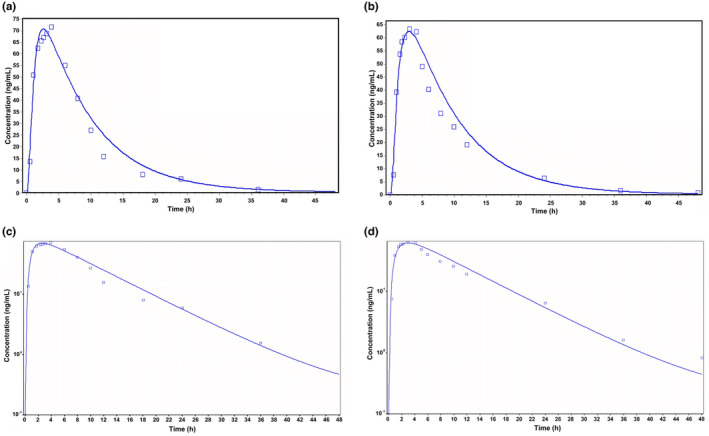
Model simulation and pharmacokinetic assessment of apixaban reference formulation: (a, c) in fasted state, (b, d) in fed state.
TABLE 2.
Simulated and observed PK parameters after orally administrating 2.5 mg apixaban reference formulation in fasted and fed states.
| Parameters | Fasted state | Fed state | ||||
|---|---|---|---|---|---|---|
| Observed | Simulated | %PE | Observed | Simulated | %PE | |
| C max (ng.mL−1) | 71.69 | 70.55 | 1.587 | 63.36 | 62.2 | 1.831 |
| AUC0–t (ng.h.mL−1) | 702.07 | 760.97 | −8.389 | 680.99 | 706.6 | −3.761 |
| AUC0–∞ (ng.h.mL−1) | 716.05 | 767.5 | −7.25 | 696.1 | 712.68 | −2.382 |
Virtual BE studies
Dissolution data for both the test and reference formulations were used to facilitate virtual BE studies. The fitted z‐factors for the dissolution profiles of the test and reference formulations were 0.089 and 0.1, respectively. Subsequently, the model was employed to conduct virtual BE studies at a dose of 2.5 mg, involving 24 subjects per trial, to simulate the outcome of pivotal BE studies under fasted and fed conditions. All simulations indicated that both test (T) and reference (R) formulation were bioequivalent in fasted and fed states, as the 90% CIs of the geometric mean T/R ratios for AUC and C max fall within the regulatory acceptance limit for BE (80%–125%) (Figure 3a,b and Table 3).
FIGURE 3.

Representative virtual BE profile of 24 subjects after oral administration of 2.5 mg apixaban reference and test formulations: (a) in fasted state, (b)in fed state.
TABLE 3.
In silico BE simulation for 10 trials and clinical BE evaluation of test and reference formulations (2.5 mg) of apixaban in fasted and fed states.
| Parameters | 90% CI | |
|---|---|---|
| In silico BE simulation (10/10) | Clinical BE | |
| Fasted state | ||
| C max (ng.mL−1) | [89.61 to 95.54]–[107.51 to 110.79] | 93.86–104.28 |
| AUC0–t (ng.h.mL−1) | [88.51 to 92.30]–[106.18 to 114.73] | 98.68–106.88 |
| AUC0–∞ (ng.h.mL−1) | [88.24 to 92.08]–[106.22 to 115.00] | 98.67–106.97 |
| Fed state | ||
| C max (ng.mL−1) | [88.61 to 92.19]–[109.21 to 112.00] | 96.26–110.05 |
| AUC0–t (ng.h.mL−1) | [88.36 to 92.89]–[108.27 to 112.90] | 99.43–107.44 |
| AUC0–∞ (ng.h.mL−1) | [88.15 to 92.75]–[108.44 to 113.31] | 99.01–107.31 |
Clinical BE studies
Following virtual BE predictions, we conducted clinical BE studies in both fasted and fed states with enrolling 52 subjects (Table S2). The mean plasma concentration profiles of the test and reference apixaban formulations are presented in Figure 4, and the mean PK parameters are detailed in Table S3. The results showed that the bioavailability of the test formulation was comparable to that of the reference formulation across both fasted and fed states. The 90% confidence intervals for GMRs of C max, AUC0–t , and AUC0–∞ remained within the regulatory acceptance range of 80%–125% under both fasted and fed conditions (Table 3). These results suggested that the two apixaban formulations were bioequivalent in both fasted and fed states.
FIGURE 4.
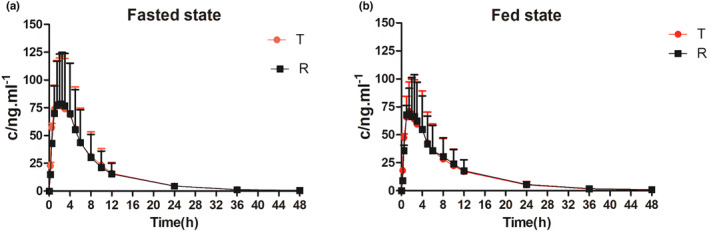
Mean plasma concentration–time curves for apixaban test and reference formulations in fasted state (a) and fed state (b). Data present mean ± standard deviation (SD). n = 26.
DISCUSSION
In recent years, physiology‐based absorption modeling has emerged as a formidable tool for predicting BE. Therefore, the efficacy of physiology‐based absorption modeling in predicting the BE of apixaban formulations under both fasted and fed conditions was investigated. Our results align with the existing body of research, reinforcing the notion that physiology‐based absorption modeling is a reliable method for accurate BE predictions. The accuracy of predicting BE via this modeling approach can be credited to its comprehensive integration of physicochemical, biopharmaceutical, and physiological factors, which provides a deeper profound mechanistic insight into the in vivo behavior of formulations.
Demonstrating BE can be challenging due to the transporters and/or binding of the drug to food components, especially for predicting fed BE of Biopharmaceutics Classification System (BCS) class III molecules. 18 , 19 Nonetheless, we have demonstrated that accurate prediction of BE under fed state is feasible for BCS class III molecules. The precision in our model's prediction was grounded in its capacity to gauge the food‐induced effects on both the reference and test drug formulations. Additionally, two other factors should be considered based on published data. 20 Firstly, apixaban exhibited a predictable, dose‐dependent linear PK profile across the 10‐mg dose range, suggesting that intestinal enzymes and transporters had a minimal impact on its absorption. Secondly, the study benefited from dependable calculations of apixaban's human PK parameters obtained from apixaban intravenous (IV) administration, as well as reliable estimates of ISCV for PK parameters from prior investigations. 6 We maintain that for class III molecules that fulfill these criteria, there exists a strong basis for confidently predicting BE in the fed state. To some extent, this demonstrates opportunities for waiving fed BE studies when accurately predicting fasted BE and food effects of reference formulation.
Additionally, Miao Lei et al. 2 suggested that modeling could act as a substitute for the conventional BE methodology to support the biowaiver for BCS class III drugs that do not meet qualitative similarity and quantitative similarity (Q1/Q2). In accordance with the BCS guidance on biowaiver, 21 BCS Class III drug products must meet the following criteria: (i) high solubility, (ii) very rapid dissolution (with more than 85% dissolution within 15 min across a physiological pH range) for both the test and reference products, (iii) qualitative similarity (Q1) and quantitative similarity (Q2) between the test product and the listed reference drug (i.e., The test formulation and the reference formulation share identical excipients, demonstrating qualitative similarity (Q1). Additionally, they demonstrate quantitative similarity (Q2) with the proportion of excipients in the test formulation lying within an acceptable range of deviation relative to that in the reference formulation.). However, meeting the Q1/Q2 recommendations for BCS Class III can become challenging, particularly when considering patent protection, manufacturing constraints, and escalating development costs. Therefore, the development of modeling to link these in vitro characteristics to in vivo BE evaluations has been encouraged. 22 Consistent with our findings, prior studies have also highlighted the value of modeling and simulation in supporting PK evaluation for BCS Class III drugs. 2 , 23 This suggests that modeling and simulation represent a viable approach to assess and mitigate risks associated with formulations that do not meet Q1/Q2 criteria.
Despite the promising results mentioned above, it is essential to recognize the limitations of modeling in forecasting BE across various formulations. The precision and trustworthiness of the predictions are greatly influenced by the accessibility and quality of the input parameters, which encompass drug physicochemical and biopharmaceutical attributes, along with physiological factors. 24 Furthermore, it is also recognized that certain aspects of these models necessitate enhancement, including the incorporation of enzymatic and transporter activities, as well as the assessment of excipient effects on dissolution and permeation.
In conclusion, our study underscores the efficacy of physiology‐based absorption modeling in informing virtual BE trials. This modeling strategy implies that model‐based virtual BE trials can function as a reliable method and risk assessment instrument for detecting potential BE concerns.
AUTHOR CONTRIBUTIONS
T.L. wrote the manuscript. B.J. designed the research. T.L., D.Y., Z.W, P.Z., and H.L. performed the research. L.W. and Z.R. analyzed the data.
FUNDING INFORMATION
This work was supported by the National Major Science and Technology projects of China (2020ZX09201022).
CONFLICT OF INTEREST STATEMENT
The authors declared no competing interests for this work.
Supporting information
Table S1.
Figure S1.
ACKNOWLEDGMENTS
We thank all participating subjects and clinical center personnel who contributed to conducting this study.
Luo T, Wang L, Ruan Z, et al. Physiologically based absorption modeling to predict the bioequivalence of two apixaban formulations. Clin Transl Sci. 2024;17:e13819. doi: 10.1111/cts.13819
REFERENCES
- 1. U.S. Department of Health and Human Services , Food and Drug Administration (FDA) , Center for Evaluation and Research (CDER) . Bioequivalence Studies with Pharmacokinetic Endpoints for Drugs Submitted Under an ANDA. Guidance for Industry; Draft guidance. https://www.fda.gov/media/87219/download. Accessed August, 2021.
- 2. Miao L, Mousa YM, Zhao L, Raines K, Seo P, Wu F. Using a physiologically based pharmacokinetic absorption model to establish dissolution bioequivalence safe space for oseltamivir in adult and pediatric populations. AAPS J. 2020;22:107. [DOI] [PubMed] [Google Scholar]
- 3. Wang L, Zhao P, Luo T, et al. Physiologically based absorption modeling to predict the bioequivalence of two cilostazol formulations. Clin Transl Sci. 2023;16:2323‐2330. [DOI] [PMC free article] [PubMed] [Google Scholar]
- 4. Wu F, Cristofoletti R, Zhao L, Rostami‐Hodjegan A. Scientific considerations to move towards biowaiver for biopharmaceutical classification system class III drugs: how modeling and simulation can help. Biopharm Drug Dispos. 2021;42:118‐127. [DOI] [PubMed] [Google Scholar]
- 5. Wang J, Chen J, Wang L, et al. Evaluating the bioequivalence of two pitavastatin calcium formulations based on IVIVC modeling and clinical study. Clin Transl Sci. 2023;16:85‐91. [DOI] [PMC free article] [PubMed] [Google Scholar]
- 6. Byon W, Garonzik S, Boyd RA, Frost CE. Apixaban: a clinical pharmacokinetic and pharmacodynamic review. Clin Pharmacokinet. 2019;58:1265‐1279. [DOI] [PMC free article] [PubMed] [Google Scholar]
- 7. Jiang X, Crain EJ, Luettgen JM, Schumacher WA, Wong PC. Apixaban, an oral direct factor Xa inhibitor, inhibits human clot‐bound factor Xa activity in vitro. Thromb Haemost. 2009;101:780‐782. [PubMed] [Google Scholar]
- 8. Frost C, Wang J, Nepal S, et al. Apixaban, an oral, direct factor Xa inhibitor: single dose safety, pharmacokinetics, pharmacodynamics and food effect in healthy subjects. Br J Clin Pharmacol. 2013;75:476‐487. [DOI] [PMC free article] [PubMed] [Google Scholar]
- 9. Xu R, Tang H, Chen L, Ge W, Yang J. Developing a physiologically based pharmacokinetic model of apixaban to predict scenarios of drug‐drug interactions, renal impairment and paediatric populations. Br J Clin Pharmacol. 2021;87:3244‐3254. [DOI] [PubMed] [Google Scholar]
- 10. Otsuka Y, Poondru S, Bonate PL, et al. Physiologically‐based pharmacokinetic modeling to predict drug–drug interaction of enzalutamide with combined P‐gp and CYP3A substrates. J Pharmacokinet Pharmacodyn. 2023;50:365‐376. [DOI] [PMC free article] [PubMed] [Google Scholar]
- 11. Abuhelwa AY, Foster D, Upton RN. A quantitative review and meta‐models of the variability and factors affecting Oral drug absorption‐part II: gastrointestinal transit time. AAPS J. 2016;18:1322‐1333. [DOI] [PubMed] [Google Scholar]
- 12. Zhang D, He K, Herbst JJ, et al. Characterization of efflux transporters involved in distribution and disposition of apixaban. Drug Metab Dispos. 2013;41:827‐835. [DOI] [PubMed] [Google Scholar]
- 13. Frost C, Garonzik S, Shenker A, Barrett YC, LaCreta F. Apixaban single‐dose pharmacokinetics, bioavailability, renal clearance, and pharmacodynamics following intravenous and Oral administration. Clin Pharmacol Drug Develop. 2021;10:974‐984. [DOI] [PubMed] [Google Scholar]
- 14. Wang L, Zhang D, Raghavan N, et al. In vitro assessment of metabolic drug‐drug interaction potential of apixaban through cytochrome P450 phenotyping, inhibition, and induction studies. Drug Metab Dispos. 2010;38:448‐458. [DOI] [PubMed] [Google Scholar]
- 15. Custodio JM, Wu CY, Benet LZ. Predicting drug disposition, absorption/elimination/transporter interplay and the role of food on drug absorption. Adv Drug Deliv Rev. 2008;60:717‐733. [DOI] [PMC free article] [PubMed] [Google Scholar]
- 16. Frost C, Shenker A, Jhee S, et al. Evaluation of the single‐dose pharmacokinetics and pharmacodynamics of apixaban in healthy Japanese and Caucasian subjects. Clin Pharmacol: Adv Appl. 2018;10:153‐163. [DOI] [PMC free article] [PubMed] [Google Scholar]
- 17. Ning X, Kuang Y, Huang J, et al. Bioequivalence of apixaban tablets in healthy Chinese subjects. Chin J Clin Pharmacol Ther. 2020;25:306‐311. [Google Scholar]
- 18. Fleisher D, Li C, Zhou Y, Heng‐Pao L, Karim A. Drug, meal and formulation interactions influencing drug absorption after Oral administration. Clin Pharmacokinet. 1999;36:233‐254. [DOI] [PubMed] [Google Scholar]
- 19. Li M, Zhao P, Pan Y, Wagner C. Predictive performance of physiologically based pharmacokinetic models for the effect of food on oral drug absorption: current status. CPT: Pharmacometrics Syst Pharmacol. 2018;7:82‐89. [DOI] [PMC free article] [PubMed] [Google Scholar]
- 20. Jereb R, Kristl A, Mitra A. Prediction of fasted and fed bioequivalence for immediate release drug products using physiologically based biopharmaceutics modeling (PBBM). Eur J Pharm Sci. 2020;155:105554. [DOI] [PubMed] [Google Scholar]
- 21. U.S. Food and Drug Administration . Guidance for industry: Waiver of in vivo bioavailability and bioequivalence studies for immediate release solid oral dosage forms based on a biopharmaceutical classification system. https://www.fda.gov/media/70963/download. Accessed December, 2017.
- 22. Zhao L, Kim MJ, Zhang L, Lionberger R. Generating model integrated evidence for generic drug development and assessment. Clin Pharmacol Ther. 2019;105:338‐349. [DOI] [PubMed] [Google Scholar]
- 23. Dong Z, Li J, Wu F, et al. Application of physiologically‐based pharmacokinetic modeling to predict gastric pH‐dependent drug–drug interactions for Weak Base drugs. CPT Pharmacometrics Syst Pharmacol. 2020;9:456‐465. [DOI] [PMC free article] [PubMed] [Google Scholar]
- 24. Kollipara S, Martins FS, Sanghavi M, Santos G, Saini A, Ahmed T. Role of physiologically based biopharmaceutics modeling (PBBM) in fed bioequivalence study waivers: regulatory outlook, case studies and future perspectives. J Pharm Sci. 2024;113:345‐358. [DOI] [PubMed] [Google Scholar]
- 25. Prabhune SS, Jaguste RS, Kondalkar PL, Pradhan NS. Stability‐indicating high‐performance liquid chromatographic determination of apixaban in the presence of degradation products. Sci Pharm. 2014;82:777‐785. [DOI] [PMC free article] [PubMed] [Google Scholar]
- 26. Frost C., Nepal S, Wang J. et al. Safety, pharmacokinetics and pharmacodynamics of multiple oral doses of apixaban, a factor Xa inhibitor, in healthy subjects. British journal of clinical pharmacology. 2013;76:776‐786. [DOI] [PMC free article] [PubMed] [Google Scholar]
Associated Data
This section collects any data citations, data availability statements, or supplementary materials included in this article.
Supplementary Materials
Table S1.
Figure S1.