



Abstract
Listeners with sensorineural hearing loss (SNHL) have substantial perceptual deficits, especially in noisy environments. Unfortunately, speech-intelligibility models have limited success in predicting performance of listeners with hearing loss. A better understanding of the various suprathreshold factors that contribute to neural-coding degradations of speech in noisy conditions will facilitate better modeling and clinical outcomes. Here, we highlight the importance of one physiological factor that has received minimal attention to date, termed distorted tonotopy, which refers to a disruption in the mapping between acoustic frequency and cochlear place that is a hallmark of normal hearing. More so than commonly assumed factors (e.g., threshold elevation, reduced frequency selectivity, diminished temporal coding), distorted tonotopy severely degrades the neural representations of speech (particularly in noise) in single- and across-fiber responses in the auditory nerve following noise-induced hearing loss. Key results include: 1) effects of distorted tonotopy depend on stimulus spectral bandwidth and timbre, 2) distorted tonotopy increases across-fiber correlation and thus reduces information capacity to brain, and 3) its effects vary across etiology, which may contribute to individual differences. These results motivate the development and testing of noninvasive measures that can assess the severity of distorted tonotopy in human listeners. Development of such noninvasive measures of distorted tonotopy would advance precision-audiological approaches to improving diagnostics and rehabilitation for listeners with SNHL.
Keywords: distorted tonotopy, speech coding, hearing loss, auditory nerve, speech intelligibility, temporal coding
1. Introduction
Sensorineural hearing loss affects the personal and professional life of many individuals. Often, these deficits are exacerbated in adverse listening conditions, such as in the presence of competing voices or background noise, which is the most common factor behind visits to the audiology clinic (Chung, 2004; Lesica, 2018). These deficits persist even after using modern hearing aids, which highlights the inadequacies of the audiogram, the clinical gold standard, which is primarily used to fit hearing aids (Woods et al., 2015). Therefore, it is important to consider other suprathreshold factors that are perceptually relevant to speech perception.
Speech intelligibility models hold great promise to objectively improving the clinical outcomes of hearing aids (Heinz, 2015; Sachs et al., 2002). The task of a speech intelligibility model is to predict speech-recognition performance of human subjects when, (1) the speech signal is manipulated, and/or (2) the auditory system of human subjects is damaged. Therefore, speech intelligibility models can be used to optimize hearing-aid processing strategies (“manipulations”) to improve the speech intelligibility of listeners with hearing impairment (HI). To predict speech intelligibility, these models rely on assumptions regarding the following two questions: (1) what are the most informative features (e.g., spectrotemporal modulation) for speech understanding? (2) what mechanisms (e.g., cochlear nonlinearities and adaption to sound statistics) in the auditory system help process these features? State-of-the-art speech intelligibility models are accurate over a wide range of speech manipulations (Relaño-Iborra et al., 2016; Taal et al., 2011), which suggests we have a reasonable understanding of key speech features at least for normal-hearing listeners (albeit several outstanding questions remain, such as the role of temporal envelope versus temporal fine structure). In contrast to the normal hearing case, extending these speech intelligibility models to predict performance of listeners with HI has had limited success, which highlights our limited understanding of the various mechanisms underlying speech-in-noise neural coding degradations following hearing loss.
Animal models, especially preclinical models of hearing loss, can help accelerate our understanding of these neural degradations (Escabi et al., 2019; Trevino et al., 2019). Animal models are beneficial because neural data from animal models incorporate the biological complexity of sound processing, and because neural data from animals with HI can capture the various effects of sensorineural hearing loss. Earlier animal studies of SNHL established the basic effects of hearing loss (primarily that of outer hair cell damage) on neural coding degradations of simple stimuli (e.g., tones) (Dallos and Harris, 1978; Liberman, 1984; Liberman and Dodds, 1984a, 1984b; Liberman and Klang, 1984). These degradations include elevated threshold in frequency tuning curves (FTC) and reduced auditory filter sharpness (typically quantified using 10-dB quality factor or ) (Fig. 1). Outer hair cell damage also leads to loss of compression (Ruggero and Rich, 1991) and diminished two-tone and side-band suppression (Miller et al., 1997; Schmiedt et al., 1990). Later studies demonstrated that inner hair cell damage can also lead to substantial neural coding deficits in AN-fiber responses, including reduced spontaneous and driven rates (Wang et al., 1997), and complex changes to response growth functions (Heinz and Young, 2004). More recently, studies have shown that noise exposure can lead to cochlear synaptopathy, which refers to the loss of synapses between inner hair cells and spiral ganglion axons. Cochlear synaptopathy accompanies temporary shifts in absolute audiometric sensitivity but may have lasting perceptual deficits (Kujawa and Liberman, 2009), and is hypothesized to influence temporal coding of complex sounds (Bharadwaj et al., 2014). Overall, these basic effects have led to hypotheses that speech-coding degradations primarily arise from elevated threshold, degraded temporal coding, reduced frequency selectivity, and cochlear synaptopathy.
Fig. 1. NIHL leads to elevated AN fiber threshold, broader tuning, and reduced tip-to-tail ratio.
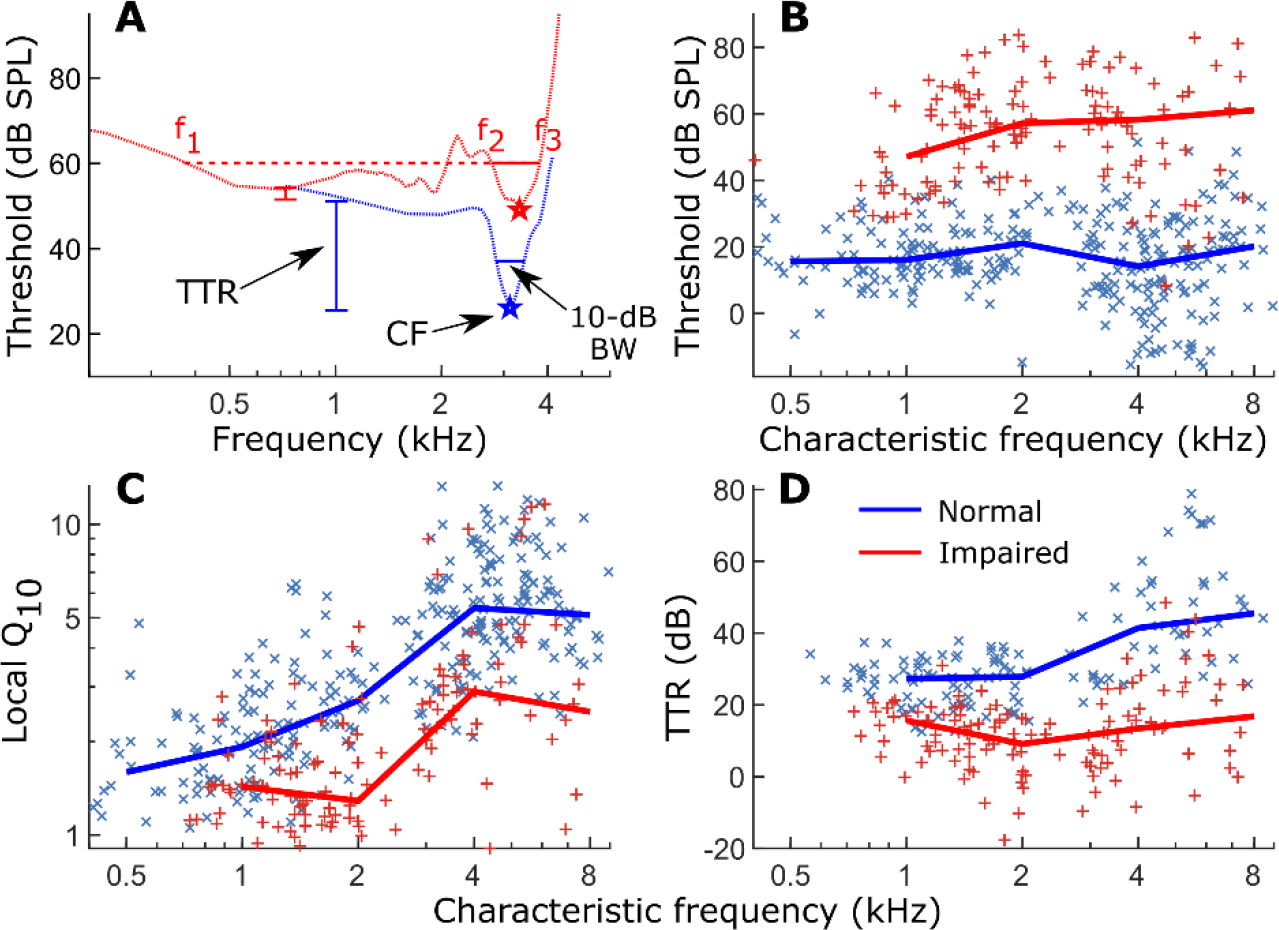
(A) Example FTCs for a normal (blue) and an impaired (red) AN fiber. CF (stars), 10-dB bandwidth (horizontal lines), and TTR (vertical bars) are indicated for both fibers. For the impaired fiber, local 10-dB bandwidth is f3-f2, whereas global 10-dB bandwidth is f3-f1. These local and global bandwidths are used to estimate local and global , respectively. (B-D) Following NIHL, AN-fiber threshold is elevated, cochlear tuning sharpness (local is reduced (i.e., broader bandwidth), and TTR is reduced. NIHL was induced with an octave-band noise centered at 500 Hz, played to male chinchillas for 2 hours at 116 dB SPL. Data in B, C, and D replotted from Parida and Heinz, 2022a. BW, bandwidth; FTC, frequency tuning curve; CF, characteristic frequency; TTR, tip-to-tail ratio.
A few studies have directly assessed speech-coding degradations following SNHL using a synthetic vowel (Miller et al., 1997; Schilling et al., 1998). In addition to elevated threshold and reduced frequency selectivity, upward spread of masking plays a key role, which leads to widespread representation of the first formant () by AN-fibers with higher characteristic frequencies (CFs) and a concomitant underrepresentation of the second and third formants, and . Similar coding deficits are also seen for concurrent synthetic vowels following outer hair cell damage (Palmer and Moorjani, 1993). While these results were informative, the generality of these results were unclear due to the limited and synthetic nature of the stimuli used.
Using system-identification approaches with a broadband noise stimulus, this upward spread of low-frequency stimulus features (e.g., ) following noise-induced hearing loss (NIHL) can be seen to arise from a general loss of tonotopicity, which is referred to as distorted tonotopy. Specifically, distorted tonotopy accompanies overrepresented low-frequency stimulus energy at the expense of stimulus energy near the CF for an AN fiber (Fig. 2). These distortions manifest as pathologically enhanced temporal fine structure (TFS) coding of low-frequency stimulus energy in AN-fiber responses, even though envelope (ENV) coding may still be tonotopic (i.e., based on stimulus energy near CF). Importantly, distorted tonotopy varies with hearing-loss etiology (e.g., noise-induced vs. metabolic, Fig. 2), and thus is expected to also vary in degree across individuals with SNHL, even those with similar degrees of hearing loss, as measured by pure-tone audiometric thresholds. Because distorted tonotopy has been shown to affect the coding of broadband sounds, it is expected to affect connected (i.e., naturally spoken) speech coding in quiet and in noise. Therefore, distorted tonotopy may be an important factor contributing to individual variability in speech intelligibility.
Fig. 2. Distorted tonotopy varies across hearing loss etiology.
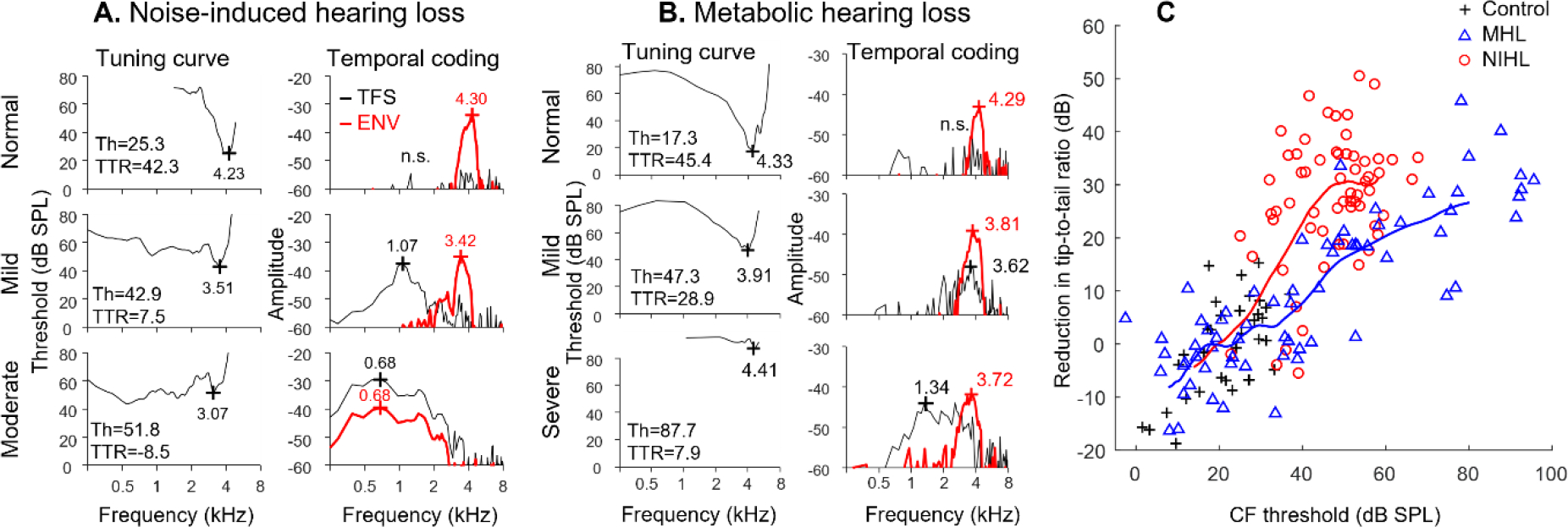
(A) Frequency tuning curve (left) and temporal coding strength of ENV and TFS (right) as a function of frequency for three exemplar AN fibers (different rows: one normal, two with NIHL of varying degrees). ENV and TFS coding were quantified using Wiener kernel analyses (Henry et al., 2019). (B) Same as A, but for metabolic hearing loss (MHL) due to reduced endocochlear potential. While distorted tonotopic TFS coding occurs even with mild NIHL, such distortions occur only after severe MHL. ENV coding is typically tonotopically distorted after moderate NIHL but may still be tonotopic even with severe MHL. (C) Tip-to-tail ratio, which is correlated with these tonotopic distortions of ENV and TFS, is more dramatically reduced for NIHL than MHL (i.e., even for a similar degree of hearing loss). Figures adapted and modified from Henry et al., 2019.
While all hypothesized effects (e.g., threshold, bandwidth, distorted tonotopy) likely affect the coding of connected speech (both vowels and consonants) in both quiet and noisy backgrounds, distorted tonotopy in particular may have especially important implications with natural background noises, such as competing voices, which typically have substantial low-frequency energy (Compton-Conley et al., 2004; Lo and McPherson, 2013). Thus, it is critical to go beyond simple synthetic speech tokens to examine the effects of NIHL on natural speech coding in noise. This review covers recent neurophysiological work examining various factors thought to affect speech coding in noise, including temporal coding, reduced frequency selectivity, and distorted tonotopy. Based on results from a NIHL chinchilla model, distorted tonotopy is shown to indeed have important effects on speech-coding in quiet, but to have especially critical implications for speech coding in noisy backgrounds.
All experimental procedures followed Public-Health-Service-issued guidelines and were approved by the Purdue Animal Care and Use Committee (Protocol No: 1111000123). Experimental and methodological details are provided in cited studies (e.g., Parida and Heinz, 2022a).
2. Divergent effects emerge for temporal-envelope and fine-structure coding of narrowband and broadband stimuli following NIHL
The temporal structure of a signal can be decomposed into two components: the slowly varying ENV and fast TFS. Such a decomposition is useful as these components often appear to contribute differentially to speech perception in different listening conditions (e.g., in quiet and in noise) and to contribute differentially to the reception of different articulatory speech features (Rosen, 1992; Shannon et al., 1995; Smith et al., 2002; Swaminathan and Heinz, 2012). Envelope coding of both narrowband and broadband sounds is generally enhanced following NIHL (Henry et al., 2016; Kale and Heinz, 2010). For example, envelope coding is enhanced for single AN-fiber responses to sinusoidally amplitude modulated (SAM) tones (Fig. 3A). The pattern holds up for connected (i.e., naturally spoken) speech (Fig. 3B). Similar enhancement in envelope coding following NIHL is also seen in human evoked responses (Goossens et al., 2018; Millman et al., 2017) as well as psychoacoustic studies (Moore et al., 1996; Wallaert et al., 2017). This envelope “enhancement” has been hypothesized to be detrimental for speech coding in noise (Moore et al., 1995), where the inherent fluctuations in the noise can actually be distracting.
Fig. 3. Observed effects of NIHL on temporal coding differ between TFS and ENV stimulus components, but in different ways for narrowband and broadband sounds due to distorted tonotopy.
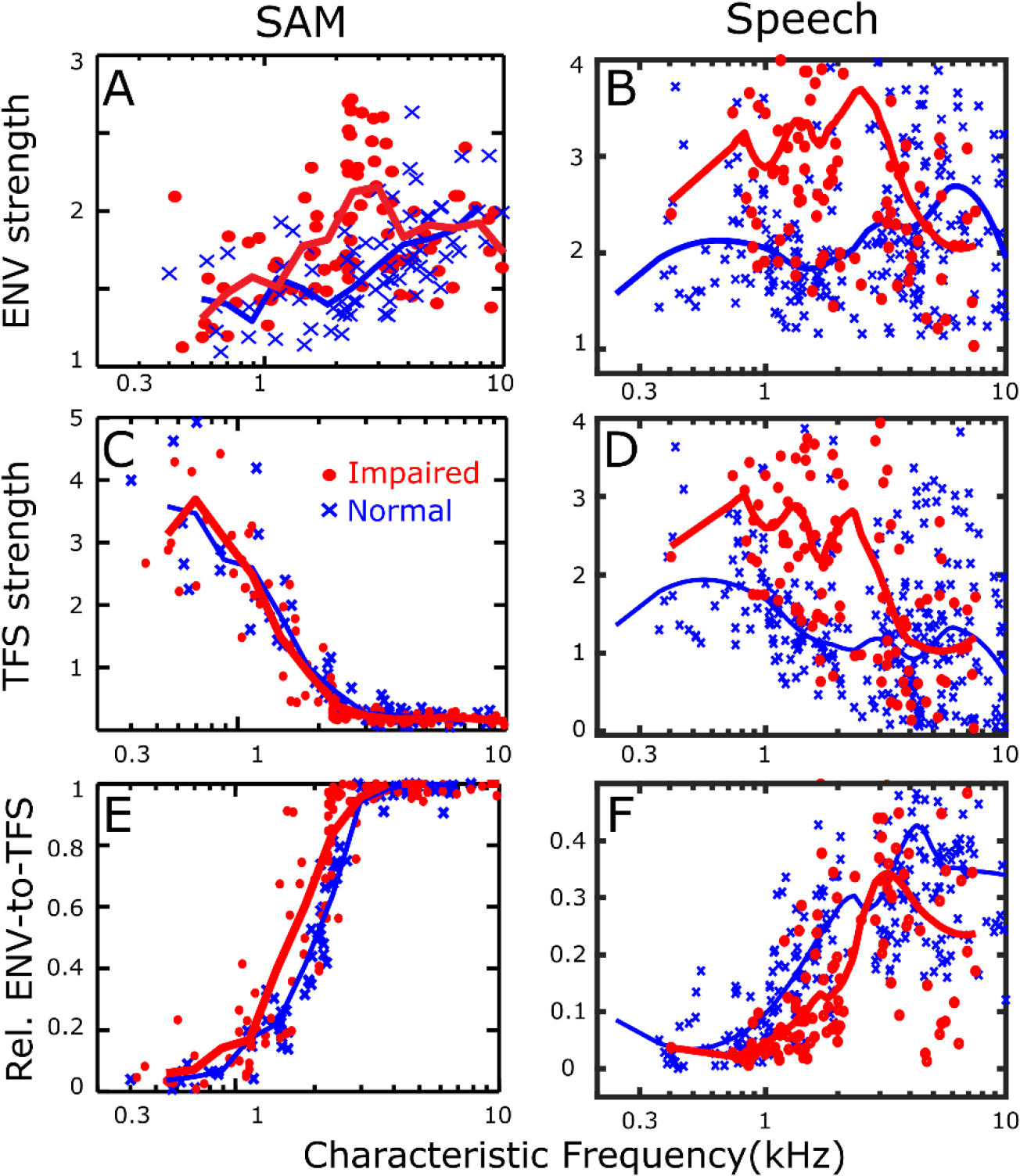
(A-B) Envelope coding strength (quantified using SUMCOR height at 0 delay) is enhanced for the impaired (red) group for both SAM tones and a natural speech stimulus. (C-D) TFS coding strength (quantified using DIFCOR height at 0 delay) is similar for the two groups for SAM-tone stimuli (suggesting no change to the fundamental ability of AN fibers to follow rapid TFS components) but is substantially enhanced (due to low-frequency encoding resulting from distorted tonotopy) for the impaired group for the broadband speech stimulus. (E-F) The relative ENV-to-TFS coding (quantified using the ratio of peaks in SCC and SAC, Louage et al., 2004; 0 indicated dominant TFS coding, 1 represents dominant ENV coding) is enhanced in the impaired group for SAM tones, but is diminished for the speech stimulus. Panels A, C, and E are adapted and modified from Kale and Heinz, 2010, with permission. Data in B, D, and F reanalyzed from Parida and Heinz, 2022a. SAM, sinusoidally amplitude modulated; SAC, shuffled auto-correlogram; SCC, shuffled cross-correlogram.
Less agreement exists on the fate of TFS coding following NIHL. Psychoacoustic studies often hypothesize that TFS coding is diminished following NIHL because listener’s ability to use TFS cues is often diminished following SNHL (e.g., Lorenzi et al., 2006; Moore, 2008). However, most neurophysiological studies assessing this deficit have not found a decrease in phase locking to simple stimuli in quiet (e.g., Harrison and Evans, 1979; Kale and Heinz, 2010; but see Woolf et al., 1981). For example, at a single AN-fiber level, TFS coding for SAM tones (centered at CF) is intact (Fig. 3C). Therefore, there seems to be no degradation in the fundamental ability of AN fibers to follow rapid fluctuations in narrowband stimuli following NIHL (relative to normal hearing) for any stimulus frequency (including high frequency). However, a significant degradation in TFS coding does emerge in the presence of background noise (Henry and Heinz, 2012). While these degradations were attributed to broader bandwidth (which can lead to more broadband noise driving impaired AN fibers than normal), distorted tonotopy might have also played a role.
In contrast to narrowband stimuli, TFS coding for broadband stimuli is generally enhanced, e.g., in response to a white Gaussian noise stimulus (Henry et al., 2016). However, this enhancement is pathological as it results from distorted tonotopic coding (see Fig. 2), where AN fibers overrespond to low-frequency stimulus energy (sometimes several octaves below CF). TFS coding for connected speech stimulus is also significantly enhanced following NIHL (Fig. 3D) for the same reason.
These changes in ENV and TFS coding lead to divergent relative ENV-to-TFS coding following NIHL for narrowband and broadband stimuli. Whereas relative ENV-to-TFS coding is enhanced (i.e., a relative-TFS deficit) for narrowband stimuli (due to enhanced ENV and intact TFS, see Fig. 3E), the same relative-coding metric is reduced for speech (Fig. 3F) due to pathologically enhanced low-frequency TFS coding despite enhanced envelope coding. Therefore, these differences for narrowband and broadband stimuli primarily stem from distorted tonotopy (rather than changes in fundamental temporal-coding ability of AN fibers), which affects broadband stimuli but not narrowband stimuli.
In summary, the fundamental ability of AN fibers to follow rapid fluctuations in the stimulus is not diminished following SNHL. Rather, deficits in TFS coding emerge for broadband stimuli as a result of other factors, such as distorted tonotopy and to some degree broader bandwidth. Therefore, distorted tonotopy can critically affect temporal coding of complex sounds following NIHL. In the following, we discuss in detail how distorted tonotopy can affect the coding of connected speech, and even more dramatically the coding of speech in noise.
3. Temporal-place representation of voiced speech is disrupted following NIHL
Speech consists of both voiced (e.g., vowels) and unvoiced (e.g., fricatives) segments. Previous AN-fiber studies in normal animals have shown robust temporal and temporal-place codes for voiced speech (Delgutte and Kiang, 1984a; Young and Sachs, 1979), whereas unvoiced speech coding is typically thought to involve a place code (Delgutte and Kiang, 1984b). Thus, it is important to look at the effects of SNHL on voiced and unvoiced speech, separately.
For voiced speech, the first three formants (, and ) carry sufficient cues to facilitate robust speech perception for humans (e.g., Peterson and Barney, 1952). Previous AN-fiber studies have shown that formants of stationary vowels typically have good temporal-place representation using analyses (e.g., the average-localized synchronized rate) appropriate for stationary vowels (Sachs et al., 1983; Young and Sachs, 1979). By using frequency-demodulation-based approaches, we extended these analyses to allow for the analysis of time-varying formant coding in connected natural speech (Parida et al., 2021).
As expected based on distorted-tonotopy effects, the temporal-place representation of voiced speech for impaired AN fibers is degraded by a severe overrepresentation of (at the expense of and ) for synthetic-vowel tokens (Miller et al., 1997). Formant-coding degradation for a connected speech sentence is similar to stationary speech for the impaired group (Parida and Heinz, 2022a), where low-frequency (<400 Hz) speech energy is overrepresented, particularly for AN fibers with CF in the second and third formant range (1 to 2.5 kHz). Specifically, based on frequency-demodulation analyses, is overrepresented across a wide range of CFs but and are severely degraded, and the peak in the temporal-place representation occurs at a CF much higher than the expected mean formant frequency for each formant (i.e., a non-tonotopic representation). Such a shift in the tonotopic peak is consistent with the lowering of AN-fiber best frequency (i.e., the sound frequency that elicits the strongest response at or above threshold level) relative to its characteristic frequency (determined based on the high-frequency slope in the frequency tuning curve) following NIHL (Liberman and Dodds, 1984b). These degradations in tonotopic coding of connected time-varying speech were much more severe (e.g., dominant frequency > 2 octaves below CF) than for a white Gaussian noise stimulus (typically, dominant frequency was ~1 octave below CF) (Henry et al., 2016). Finally, additive speech-shaped noise exacerbates the already degraded and representations in quiet, where the HI representation is more affected compared to NH (Fig. 4; see Parida and Heinz, 2022a for detailed statistics).
Fig. 4. Following NIHL, coding across a connected speech sentence is enhanced whereas the coding of and is diminished; coding of all formants is shifted up to higher-CF regions.
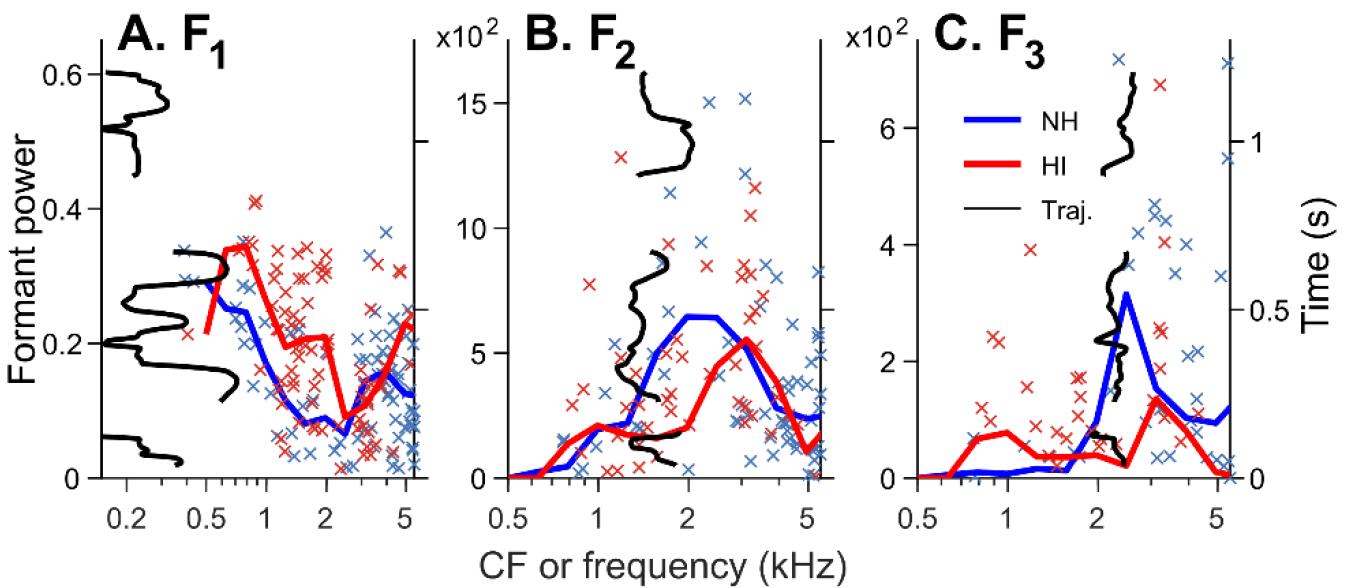
(A) Symbols indicate the coding strength for normal (blue) and impaired (red) AN fibers (left y-axis). Colored lines denote octave-band averages of formant power. Black curve represents trajectory across the sentence (time on right y-axis). (B-C) Same as A, but for and , respectively. These AN-fiber data are in response to a connected speech sentence in steady speech-shaped noise at 0 dB SNR; similar results are seen for quiet and −5 dB SNR conditions (data not shown). Reprinted from Parida and Heinz, 2022a.
4. Neural representations of consonants are disrupted following NIHL due to distorted tonotopy
As mentioned, unvoiced speech coding is typically thought to be based on a place code because 1) consonant sound levels are usually lower than vowels and as such AN fibers are typically not saturated, and 2) substantial energy in unvoiced speech is typically concentrated at high frequencies, where phase-locking strength of auditory-nerve (AN) fibers is poorer (Johnson, 1980). When unvoiced segments in the connected speech sentence were analyzed, two distinct deficits emerged (Parida and Heinz, 2022a). The first deficit is related to audibility, where impaired fibers are less driven by consonants compared to normal fibers, even though driven rates for voiced speech are similar for the two groups. The second deficit is a loss of tonotopic coding, where important stimulus spectral features are shifted up to higher CFs for the impaired group. For example, the burst components of two plosives (/d/ and /g/) have similar overall level but /d/ has more high frequency energy compared to /g/ (Fig. 5A). Comparison of the relative power spectrum (which correlates with perceptually important phonetic cues) with AN-fiber rate responses revealed less salient (lower rate differences) and tonotopically shifted (upward, due to distorted tonotopy) representations. Therefore, the effects of distorted tonotopy are not just limited to louder segments in speech (e.g., vowels), but can also be seen for segments with lower levels (e.g., plosive consonants).
Fig. 5. Distorted tonotopy also degrades the coding of consonants in quiet and in noise. (A-B) Stop-consonant coding in quiet.
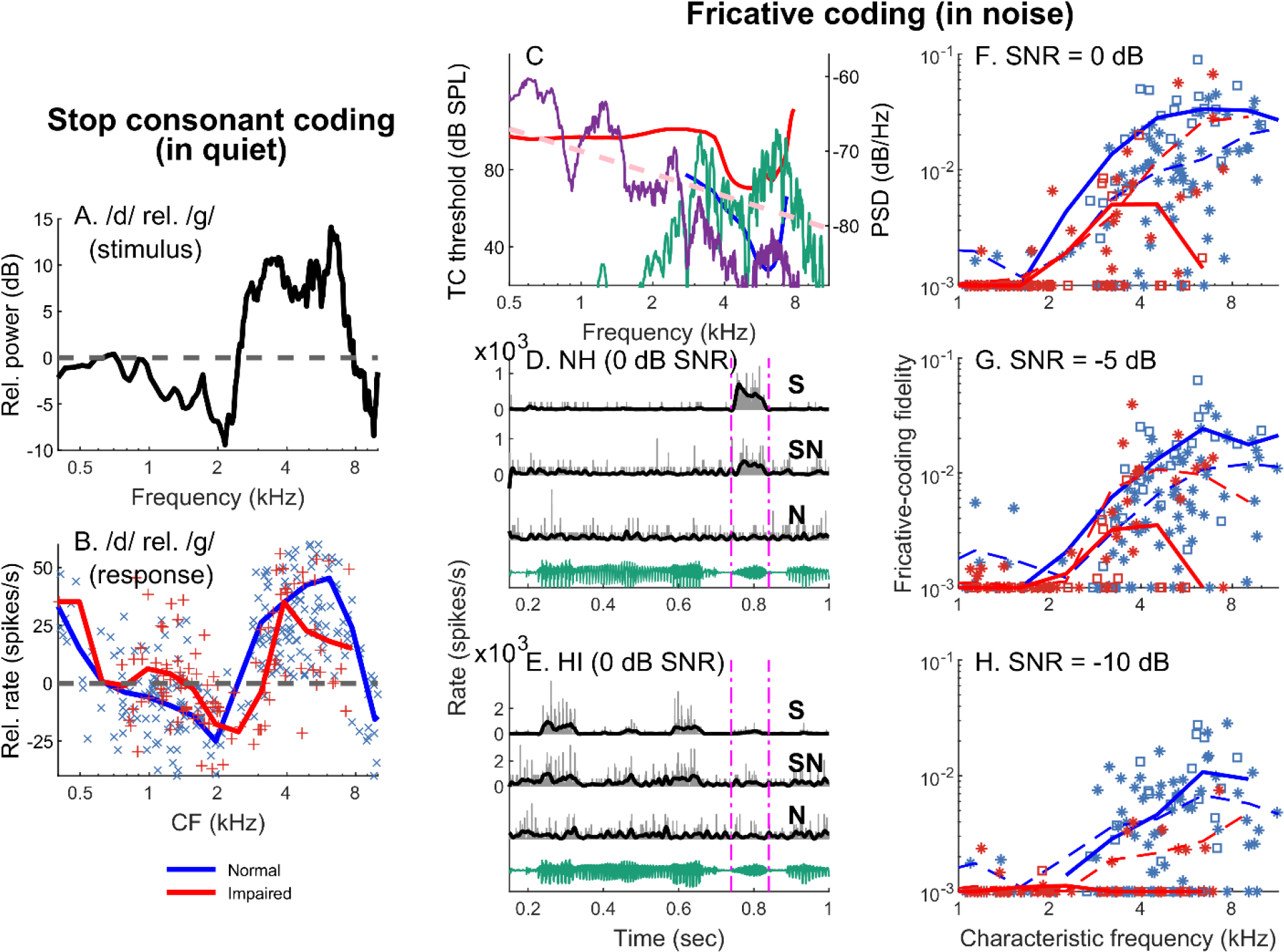
(A) Difference in power spectra of the burst portion of two stop consonants, /d/ and /g/. (B) Difference in driven rates in response to the same stimuli for normal (blue) and impaired (red) AN fibers. (C-H) Fricative coding in noise. (C) Spectra of a fricative (/s/, green) and masking noise (purple, speech-shaped spectrum). Note that the noise spectrum is steeper than an ideal pink spectrum (pink line). FTCs are also shown for two example AN fibers (blue, normal; red, impaired). (D) Peristimulus time histograms (bin width= 200 μs) and response envelopes (low-pass filtered; 32 Hz cut off; fourth order) for speech in quiet (S), noise-alone (N), and speech in noise (SN) for the normal AN fiber in C. Dashed magenta lines indicate the fricative window used for analysis in F-H. (E) Same as D, but for the impaired AN fiber in C. (F-H) Symbols indicate response correlation between SN and N (after subtracting noise floor estimated as correlation between S and N). Thick (thin) lines indicate octave band averages for low/medium (high) SR AN fibers. Normal low/medium SR fibers maintained robust coding at all SNRs tested but responses of impaired low/medium SR fibers were severely degraded. Panels adapted and modified from Parida and Heinz, 2022a. SR, spontaneous rate.
Distorted tonotopy also degrades the coding of stimuli with high-frequency energy (e.g., the fricative /s/) in the presence of speech-shaped noise (Fig. 5C–H). The noisy speech mixture, despite having an overall signal-to-noise ratio (SNR) of 0 dB, has favorable SNR at higher frequencies (~3–8 kHz) where the fricative has substantial energy (Fig. 5C). Normal AN fibers tuned to frequencies within the fricative bandwidth, particularly those with low or medium spontaneous rate (SR), robustly encode these high-SNR regions (Fig. 5D). In contrast, impaired AN fibers overrespond to low-frequency energy in both the speech and the noise (Fig. 5E). This lack of spectral specificity leads to poorer speech-coding fidelity in noise (as quantified by the correlation in responses to clean speech and noisy speech), particularly for low and medium SR AN fibers (Fig. 5F–H). Interestingly, driven rates for the two groups in response to the fricative, which has a higher level than plosive consonants, were largely comparable (Parida and Heinz, 2022a). Therefore, these deficits underlying fricative coding in noise primarily stem from distorted tonotopy and not simply from audiometric losses.
5. Distorted tonotopy is the dominant factor underlying speech-coding degradations in a chinchilla model of NIHL
To gain mechanistic insight into what physiological factors contributed to these various speech and speech-in-noise coding deficits, we constructed separate linear mixed-effects models for voiced-speech coding, dynamic formant () coding in noise, and fricative coding in noise. The predictors included FTC threshold, , and tip-to-tail ratio (TTR, a proxy for distorted tonotopy). It should be noted that traditionally, frequency tuning has been characterized only by a single parameter, e.g., , where FTC 10-dB bandwidth has often included both tip and tail effects. Here, we used a “local ” metric that only included the tip bandwidth (e.g., only narrowband at-CF aspects of broadened tuning). Our inclusion of TTR as a predictor also characterizes broadband aspects of frequency tuning (i.e., the salience of tip sensitivity relative to FTC tail sensitivity) (Parida and Heinz, 2022a).
While local- and threshold were significant factors (with moderate effect size) in a subset of models, TTR was consistently the dominant factor across all models (Fig. 6). These results underline the crucial role distorted tonotopy plays in shaping neural representations of connected speech features at a single AN-fiber level following NIHL.
Fig. 6. Tip-to-tail ratio (TTR), a proxy for quantifying distorted tonotopy, was the dominant factor underlying all speech and speech-in-noise coding degradations tested.
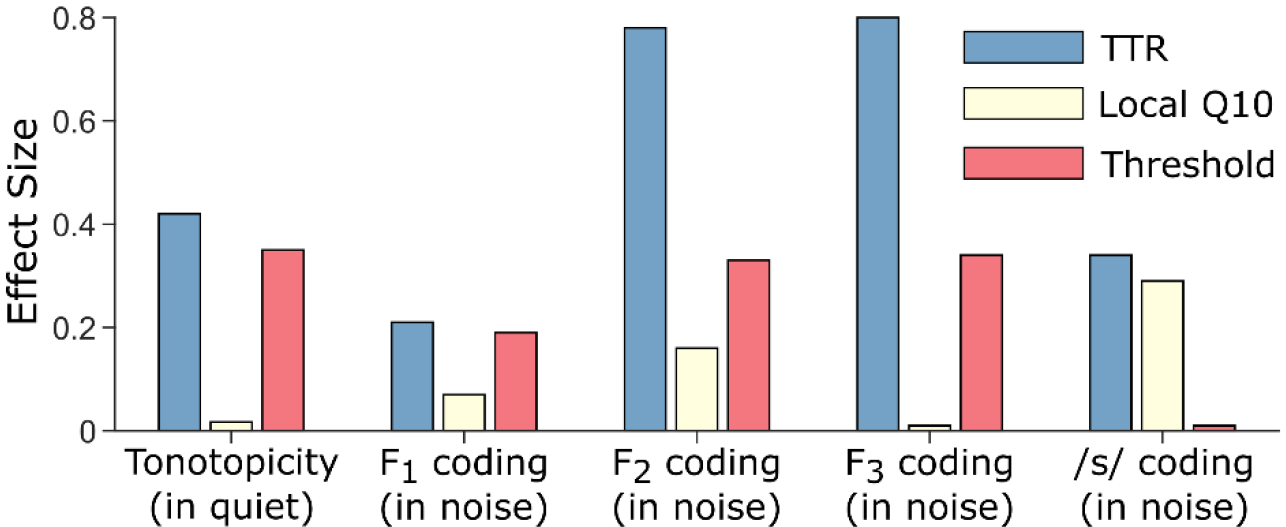
A mechanistic mixed-effect model was constructed to evaluate the contributions of three physiological factors (threshold, local , and TTR) to each of several speech-coding metrics (see Parida and Heinz, 2022a for details). These metrics include the ratio of near-CF (octave wide centered at CF) power to low-frequency (<400 Hz) power in the response spectrum for voiced speech in quiet (Tonotopicity in quiet), formant (, and ) coding (in quiet, and in 0 dB and −5 dB SNR), and fricative (/s/) coding in noise (0, −5, and −10 dB SNR, as shown in Fig. 5F–H). Effect size was estimated using the or metric (Rosenthal and Rubin, 2003), and was based on partial regression coefficients. Data summarized from Parida and Heinz, 2022a.
6. The severity of distorted-tonotopy effects depends on the short-term speech timbre
As described in Section 2, the effects of distorted tonotopy are more severe for broadband speech than for narrowband SAM tones, where relative ENV-to-TFS coding is diminished following NIHL (Fig. 3E–F). The severity of distorted tonotopy depends on the tip-to-tail ratio, which appears to interact with relative stimulus energy at high and low frequencies, i.e., the spectral timbre, based on evoked FFR responses in our NIHL chinchilla model (Parida and Heinz, 2021). Therefore, we hypothesized that, within speech where timbre varies from segment to segment, segments with a sloping spectrum would be more susceptible to distorted tonotopy in AN fibers than segments with a relatively flat spectrum.
To test this hypothesis, two segments (70-ms long) within the speech stimulus were identified that had a nearly flat or a highly sloping spectrum (Fig. 7). We employed correlogram-based analyses to quantify the strength of ENV, TFS, and relative ENV-to-TFS coding (as in Kale and Heinz, 2010). Consistent with the hypothesis, relative ENV-to-TFS coding was severely diminished for the segment with sloping spectrum (due to pathologically enhanced TFS coding as a result of distorted tonotopy) but not for the segment with flat spectrum. In summary, these results show that the degree of distorted tonotopy can vary across speech segments, and that segments with negatively sloping spectrum are highly susceptible to distorted tonotopy.
Fig. 7. Severity of distorted tonotopy depends on the spectral timbre of the stimulus and varies dynamically across the speech sentence.
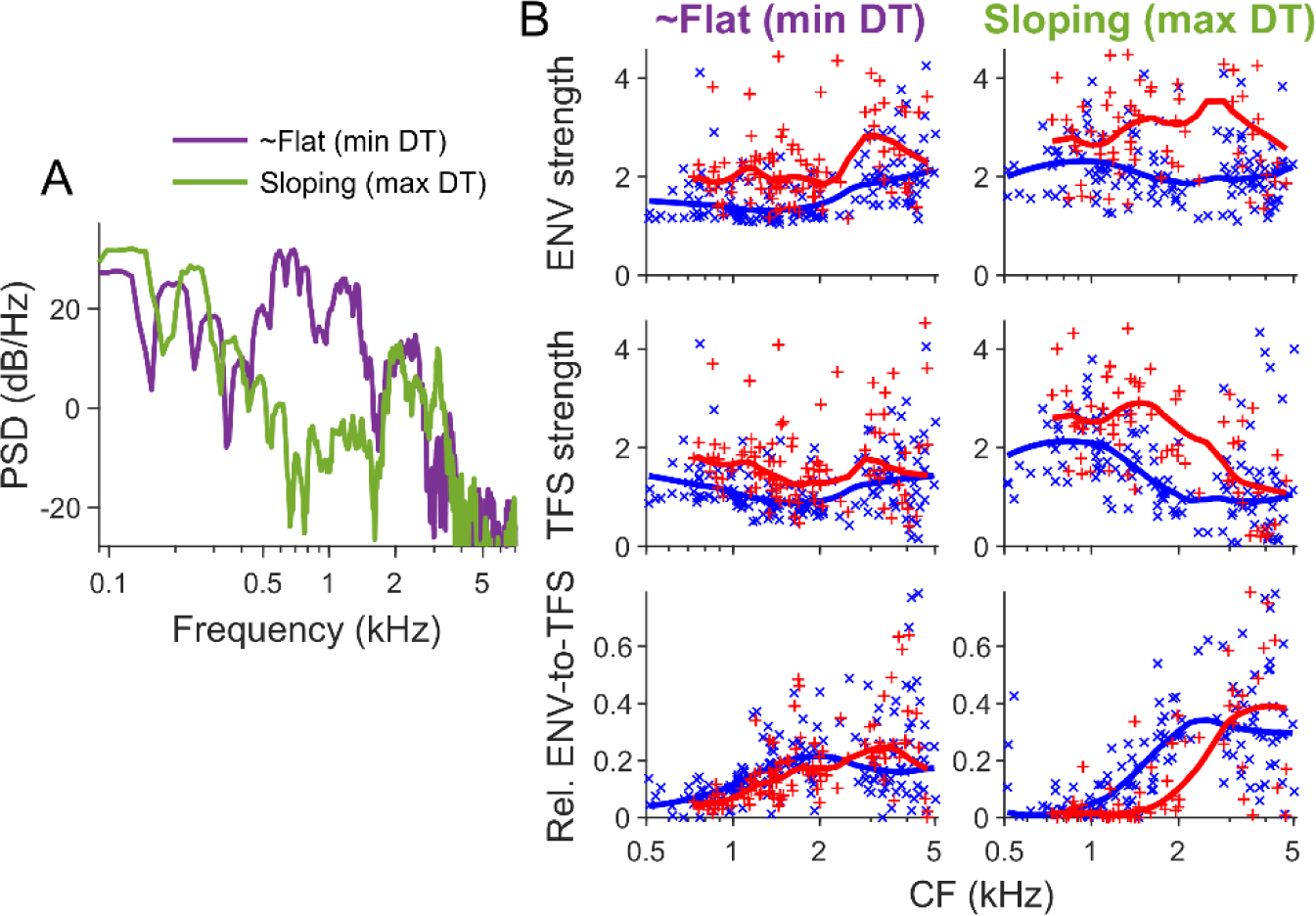
(A) Spectra of two 70-ms speech segments within the speech sentence with 1) relatively flat (up to 2 kHz, purple) and 2) downward sloping spectrum (green). These segments produced minimal and maximal distorted tonotopy, respectively, as indicated by FFRs recorded in chinchillas (Parida and Heinz 2021). (B) Strength of ENV, TFS, and relative ENV-to-TFS coding were quantified for individual AN fibers. Same format as Fig. 3. While ENV and TFS coding were similarly enhanced (similar relative ENV-to-TFS coding, SCC/SAC ratio) following NIHL for the segment with flat spectrum (left column in B), TFS was more enhanced than ENV for the sloping segment (right column in B) leading to substantially diminished relative ENV-to-TFS coding. Panel A reprinted from Parida and Heinz, 2021, with permission. Data in B reanalyzed from Parida and Heinz, 2022a.
7. Across-fiber response correlation increases following NIHL
The results discussed so far are based on single AN-fiber responses considered independently. However, there is sufficient evidence showing that across-fiber coding is important for robust neural representation of complex sounds, including speech (Crouzet and Ainsworth, 2001; Shamma and Klein, 2000; Shamma, 1985; Swaminathan and Heinz, 2011). In an information-theoretic framework, a normal-hearing auditory system has a high information (channel) capacity as a result of many narrowly tuned peripheral filters (channels). With NIHL, it is likely that the channel capacity is reduced because of broadened bandwidth and/or distorted tonotopy. We can address this question by estimating the across-fiber response correlation in both populations. We quantified correlation between responses of two AN fibers using neural correlogram-based metrics (Heinz and Swaminathan, 2009). As expected, across-fiber correlation fell off for both groups when CF-distance between fibers increased (Fig. 8A). However, this correlation decayed rather slowly for the impaired population compared to the normal population.
Fig. 8. Across-fiber response correlation increases following NIHL.
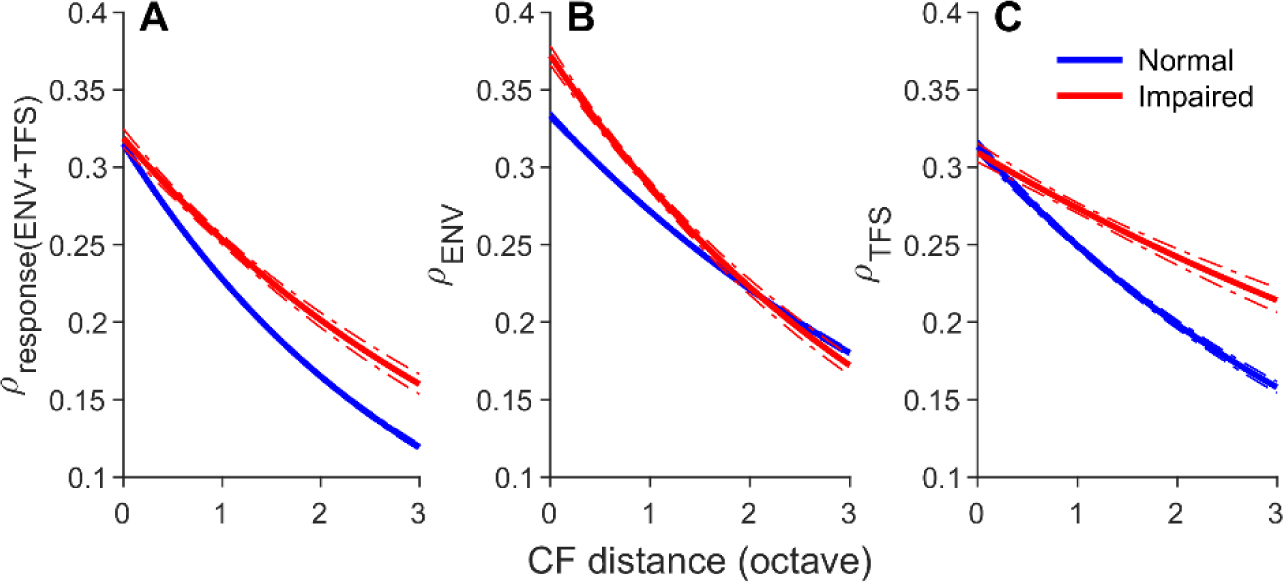
(A) Across-fiber response correlation was quantified using , where and are spike train responses of two AN fibers. (B-C) Across-fiber response ENV and TFS correlation was quantified using and , where and . See Heinz and Swaminathan, 2009 and Swaminathan and Heinz, 2011 for more details about these metrics. Mean and 95% confidence intervals are shown computed from a population of AN-fiber responses to the connected speech sentence. Data reanalyzed from Parida and Heinz, 2022a.
To make more specific predictions regarding the effects of broadened bandwidth and distorted tonotopy on across-fiber response correlation, we revisit how these factors may affect ENV and TFS coding of complex sounds. Because ENV coding is primarily determined by near-CF stimulus energy for both normal-hearing and hearing-impaired animals (Fig. 2), correlated ENV responses following NIHL should be limited to smaller CF differences (Fig. 8B). In contrast, distorted-tonotopy-driven (pathologically) enhanced TFS coding in AN fibers with high CFs is driven by very low-frequency stimulus energy (Henry et al., 2016; Parida and Heinz, 2022a). Therefore, correlated TFS coding following NIHL should extend to AN-fiber pairs even at faraway CFs. To test these hypotheses, we used and metrics that quantify across-fiber response correlation of the ENV and TFS, respectively (Heinz and Swaminathan, 2009). Consistent with these predictions, was enhanced only at moderate CF distances (< 1 octave) whereas was substantially enhanced even at distances > 2 octaves.
8. Summary, Implications, and Future Directions
The various effects of NIHL on speech coding are complex and are likely affected by several physiological factors. Traditionally, psychoacoustic studies have hypothesized elevated threshold, broader bandwidth, and temporal-processing deficits to be the key factors contributing to the speech understanding difficulties of listeners with SNHL. To directly test the contributions of these factors, we analyzed spike-train data recorded from a chinchilla model of NIHL in response to a connected speech sentence in noisy conditions with several SNRs. Threshold elevation and broadened bandwidth only played a role in speech-in-noise coding degradation in limited conditions. The fundamental ability of AN fibers to follow rapid fluctuations in the stimulus was not affected. The dominant factor contributing to neural-coding degradations of speech and speech-in-noise was distorted tonotopy, a disruption in the normal mapping of acoustic frequency to cochlear place. Here, we reviewed existing data and presented new data that highlight the various ways in which speech coding is severely degraded due to distorted tonotopy, as summarized in Fig. 9.
Fig. 9. Distorted tonotopy severely degrades speech coding in quiet and in noise.
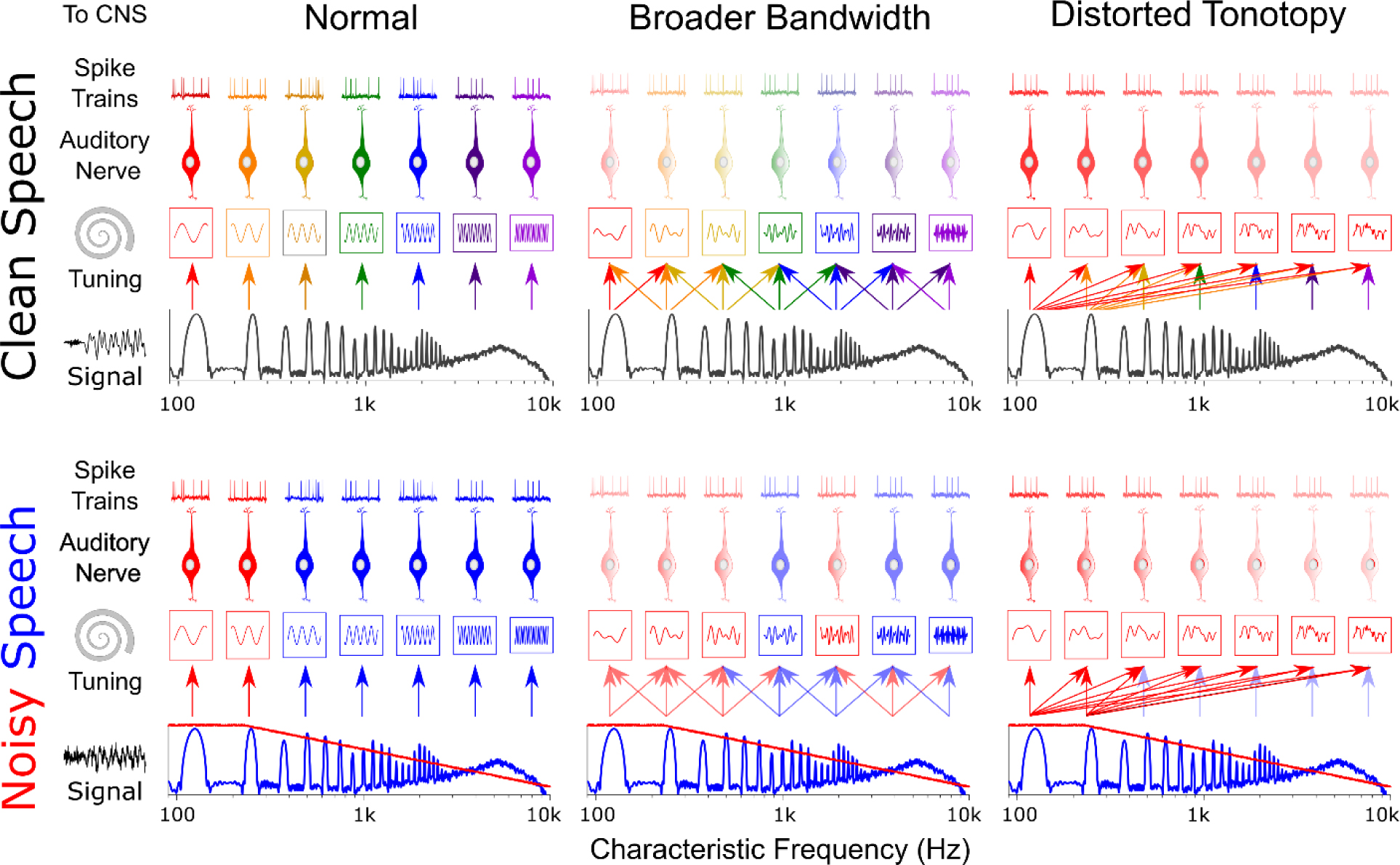
(top, right) Distorted tonotopy leads to highly correlated AN-fiber responses to speech in quiet, which are dominated by low-frequency stimulus energy, therefore leading to very low information (channel) capacity. (bottom) While normal (left) and, to a lesser extent broader-bandwidth (middle) systems can benefit from narrow spectral regions with favorable SNR in a noisy speech stimulus (noise, red; speech, blue), a system with distorted tonotopy (right) will be severely affected by the masker, especially one with negatively sloping spectrum, such as multi-talker babble.
Although distorted tonotopy can play a crucial role in neural coding of speech in speech-shaped noise following NIHL, it is not known whether humans are affected by distorted tonotopy in natural listening conditions. Evidence suggesting that distorted tonotopy may play a role in human speech intelligibility can be found in physiologically based computational modeling studies of word-recognition scores predicted from AN-fiber responses (Zilany and Bruce, 2007). These studies showed that AN models that included changes in AN tuning curves with sound level and outer-hair-cell impairment (and the resulting upward spread of excitation) could account for poorer speech intelligibility at high sound levels (i.e., the rollover effect) for normal hearing listeners as well as for listeners with hearing impairment and amplification by hearing aids (Bruce and Zilany, 2007). Moreover, although the effects of distorted tonotopy have been primarily explored for speech-coding degradations in speech-shaped noise, these results likely generalize to realistic maskers, such as single interfering talker and multi-talker babble, because these maskers contain substantial low-frequency energy (Beutelmann et al., 2010). Despite these lines of evidence, a true test of whether distorted tonotopy affects speech intelligibility in humans will require noninvasive metrics of distorted tonotopy that can be used with human listeners.
Recently, we showed evidence that frequency-following responses can provide a noninvasive metric related to distorted tonotopy (Fig. 10) in hearing-impaired chinchillas that were known to have distorted tonotopy (Parida and Heinz, 2021). This metric, called , is based on the same relation between the time-varying spectral timbre in speech and the relative ENV and TFS coding that is seen for AN-fiber responses (Fig. 7). was greater than zero for the noise-induced group, representing their susceptibility to distorted tonotopy for speech segments with steeper spectral timbre (Fig. 10B). In contrast, normal-hearing chinchillas had values near zero because they were not susceptible to distorted tonotopy across varying degrees of spectral timbre in the speech sentence (Fig. 10A). Overall, for the cohort of noise-induced chinchillas, was highly correlated with the degree of hearing loss as quantified by ABR threshold shift (Fig. 10C), because the reduction in AN-fiber TTR (a distorted-tonotopy correlate) is correlated with AN-fiber threshold shift (Fig. 2C). Future work is needed to determine whether is directly correlated with TTR in a broader group of pre-clinical animal models of SNHL (e.g., noise-induced and metabolic hearing losses), as well as in humans with varying noise-exposure histories. Two candidate noninvasive measures of TTR that could be used for such future experiments are distortion-product otoacoustic emission suppression tuning curves, which show significant tail regions in humans suggesting distorted tonotopy could be prominent in humans (Abdala et al., 1996; Gorga et al., 2011), and psychophysical tuning curves (Moore, 1978).
Fig. 10. Disruption in relative TFS-to-ENV coding can be used to identify distorted tonotopy noninvasively using the frequency-following response (FFR).
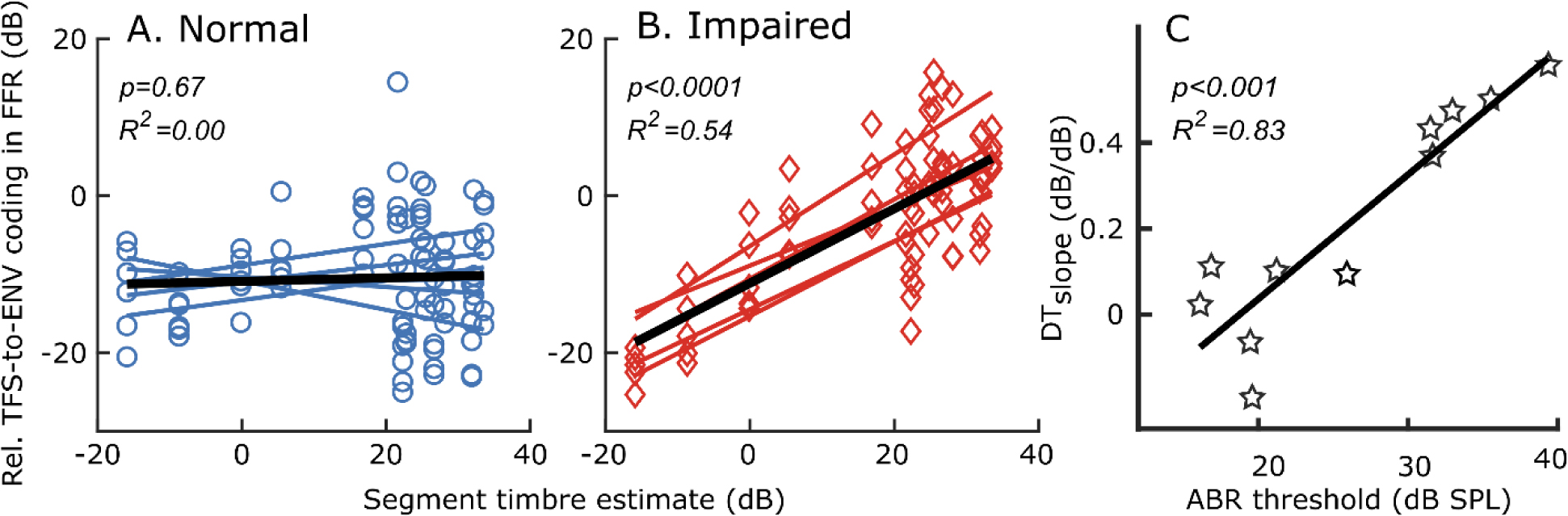
(A) The relation between relative TFS-to-ENV strength in the FFR (y-axis) and an estimate of the spectral timbre (ratio of power in low and high frequency regions, x-axis, with steeper downward timbre being to the right) was estimated across different speech segments (each symbol represents computations made within various 64-ms duration segments of the speech sentence). Thin blue lines represent individual animals. Thick black line indicates population average. (B) Same format as A but for hearing-impaired chinchillas following NIHL. While the relative power of TFS and ENV in the FFR is not related to speech spectral timbre for normal-hearing chinchillas, these response and stimulus metrics are correlated for hearing-impaired chinchillas. (C) The correlation (, in dB/dB) was greater for chinchillas with more noise-induced hearing loss (estimated using threshold of auditory brainstem responses or ABR). Panels adapted and modified from Parida and Heinz, 2021, with permission.
While distorted tonotopy severely affects speech coding following NIHL, other physiological factors most certainly also play a role. A factor that has received little attention is the distribution of AN-fiber thresholds, which expands following NIHL (Heinz et al., 2005; Parida and Heinz, 2022a). Specifically, when probability distributions of AN-fiber thresholds are constructed for normal and impaired AN fiber populations in different CF bands, the impaired distributions show greater shifts (relative to normal) in the 50th percentile than in the 10th percentile resulting in an expanded AN-fiber distribution (see Figs. 2E and 2F in Parida and Heinz, 2022a). This expansion potentially leads to a preferential audibility deficit for low-intensity consonants compared to vowels (which typically have higher sound level), as seen in psychoacoustic studies (Phatak and Grant, 2014; Shobha et al., 2008). Loss of compression and suppression (due to outer hair cell damage) are also likely to affect speech coding. While loss of compression has been hypothesized to degrade speech perception in background noise with fluctuating envelopes, e.g., due to enhanced ENV coding of a competing talker (Moore et al., 1995), recent AN-fiber data suggest that distorted tonotopy may also contribute to the reduction in fluctuating masker benefit that often occurs with SNHL (Parida, 2020; Parida and Heinz, 2022b). Future research is needed to better understand how all these suprathreshold factors affect neural coding of speech (especially in noise), and to develop noninvasive diagnostics for each of these factors. Using such a battery to establish auditory profiles for individual listeners will likely improve perceptual outcomes of hearing aids and the performance of speech-intelligibility models for listeners with hearing impairment.
Acknowledgments
This research was supported by an International Project Grant (G72) from Action on Hearing Loss (UK) and by the National Institutes of Health (R01-DC009838).
Footnotes
Declaration of Interests: The authors declare no competing interests.
References
- Abdala C, Sininger YS, Ekelid M, Zeng F-G, 1996. Distortion product otoacoustic emission suppression tuning curves in human adults and neonates. Hearing Research 98, 38–53. 10.1016/0378-5955(96)00056-1 [DOI] [PubMed] [Google Scholar]
- Beutelmann R, Brand T, Kollmeier B, 2010. Revision, extension, and evaluation of a binaural speech intelligibility model. The Journal of the Acoustical Society of America 127, 2479–2497. 10.1121/1.3295575 [DOI] [PubMed] [Google Scholar]
- Bharadwaj HM, Verhulst S, Shaheen L, Liberman MC, Shinn-Cunningham BG, 2014. Cochlear neuropathy and the coding of supra-threshold sound. Front. Syst. Neurosci. 8. 10.3389/fnsys.2014.00026 [DOI] [PMC free article] [PubMed] [Google Scholar]
- Bruce IC, Zilany MSA, 2007. Modelling the effects of cochlear impairment on the neural representation of speech in the auditory nerve and primary auditory cortex. Proceedings of the International Symposium on Auditory and Audiological Research 1, 1–10. [Google Scholar]
- Chung K, 2004. Challenges and Recent Developments in Hearing Aids: Part I. Speech Understanding in Noise, Microphone Technologies and Noise Reduction Algorithms. Trends in Amplification 8, 83–124. 10.1177/108471380400800302 [DOI] [PMC free article] [PubMed] [Google Scholar]
- Compton-Conley CL, Neuman AC, Killion MC, Levitt H, 2004. Performance of Directional Microphones for Hearing Aids: Real-World versus Simulation. J Am Acad Audiol 15, 440–455. 10.3766/jaaa.15.6.5 [DOI] [PubMed] [Google Scholar]
- Crouzet O, Ainsworth WA, 2001. On the various influences of envelope information on the perception of speech in adverse conditions: An analysis of between-channel envelope correlation, in: Workshop on Consistent and Reliable Cues for Sound Analysis. [Google Scholar]
- Dallos P, Harris D, 1978. Properties of auditory nerve responses in absence of outer hair cells. Journal of Neurophysiology 41, 365–383. 10.1152/jn.1978.41.2.365 [DOI] [PubMed] [Google Scholar]
- Delgutte B, Kiang NYS, 1984a. Speech coding in the auditory nerve: I. Vowel-like sounds. The Journal of the Acoustical Society of America 75, 866–878. 10.1121/1.390596 [DOI] [PubMed] [Google Scholar]
- Delgutte B, Kiang NYS, 1984b. Speech coding in the auditory nerve: III. Voiceless fricative consonants. The Journal of the Acoustical Society of America 75, 887–896. 10.1121/1.390598 [DOI] [PubMed] [Google Scholar]
- Escabi CD, Frye MD, Trevino M, Lobarinas E, 2019. The rat animal model for noise-induced hearing loss. The Journal of the Acoustical Society of America 146, 3692–3709. 10.1121/1.5132553 [DOI] [PMC free article] [PubMed] [Google Scholar]
- Goossens T, Vercammen C, Wouters J, van Wieringen A, 2018. Neural envelope encoding predicts speech perception performance for normal-hearing and hearing-impaired adults. Hearing Research 370, 189–200. 10.1016/j.heares.2018.07.012 [DOI] [PubMed] [Google Scholar]
- Gorga MP, Neely ST, Kopun J, Tan H, 2011. Distortion-product otoacoustic emission suppression tuning curves in humans. The Journal of the Acoustical Society of America 129, 817–827. 10.1121/1.3531864 [DOI] [PMC free article] [PubMed] [Google Scholar]
- Harrison RV, Evans EF, 1979. Some aspects of temporal coding by single cochlear fibres from regions of cochlear hair cell degeneration in the guinea pig. Arch Otorhinolaryngol 224, 71–78. 10.1007/BF00455226 [DOI] [PubMed] [Google Scholar]
- Heinz MG, 2015. Neural modelling to relate individual differences in physiological and perceptual responses with sensorineural hearing loss. 1 5, 137–148. [Google Scholar]
- Heinz MG, Issa JB, Young ED, 2005. Auditory-Nerve Rate Responses are Inconsistent with Common Hypotheses for the Neural Correlates of Loudness Recruitment. JARO 6, 91–105. 10.1007/s10162-004-5043-0 [DOI] [PMC free article] [PubMed] [Google Scholar]
- Heinz MG, Swaminathan J, 2009. Quantifying Envelope and Fine-Structure Coding in Auditory Nerve Responses to Chimaeric Speech. JARO 10, 407–423. 10.1007/s10162-009-0169-8 [DOI] [PMC free article] [PubMed] [Google Scholar]
- Heinz MG, Young ED, 2004. Response Growth With Sound Level in Auditory-Nerve Fibers After Noise-Induced Hearing Loss. J Neurophysiol 91, 784–795. 10.1152/jn.00776.2003 [DOI] [PMC free article] [PubMed] [Google Scholar]
- Henry KS, Heinz MG, 2012. Diminished temporal coding with sensorineural hearing loss emerges in background noise. Nature Neuroscience 15, 1362–1364. 10.1038/nn.3216 [DOI] [PMC free article] [PubMed] [Google Scholar]
- Henry KS, Kale S, Heinz MG, 2016. Distorted Tonotopic Coding of Temporal Envelope and Fine Structure with Noise-Induced Hearing Loss. J. Neurosci. 36, 2227–2237. 10.1523/JNEUROSCI.3944-15.2016 [DOI] [PMC free article] [PubMed] [Google Scholar]
- Henry KS, Sayles M, Hickox AE, Heinz MG, 2019. Divergent auditory-nerve encoding deficits between two common etiologies of sensorineural hearing loss. J. Neurosci. 39, 6879--6887. 10.1523/JNEUROSCI.0038-19.2019 [DOI] [PMC free article] [PubMed] [Google Scholar]
- Johnson DH, 1980. The relationship between spike rate and synchrony in responses of auditory-nerve fibers to single tones. The Journal of the Acoustical Society of America 68, 1115–1122. 10.1121/1.384982 [DOI] [PubMed] [Google Scholar]
- Kale S, Heinz MG, 2010. Envelope Coding in Auditory Nerve Fibers Following Noise-Induced Hearing Loss. JARO 11, 657–673. 10.1007/s10162-010-0223-6 [DOI] [PMC free article] [PubMed] [Google Scholar]
- Kujawa SG, Liberman MC, 2009. Adding Insult to Injury: Cochlear Nerve Degeneration after “Temporary” Noise-Induced Hearing Loss. J. Neurosci. 29, 14077–14085. 10.1523/JNEUROSCI.2845-09.2009 [DOI] [PMC free article] [PubMed] [Google Scholar]
- Lesica NA, 2018. Why Do Hearing Aids Fail to Restore Normal Auditory Perception? Trends in neurosciences. [DOI] [PMC free article] [PubMed] [Google Scholar]
- Liberman MC, 1984. Single-neuron labeling and chronic cochlear pathology. I. Threshold shift and characteristic-frequency shift. Hearing Research 16, 33–41. 10.1016/0378-5955(84)90023-6 [DOI] [PubMed] [Google Scholar]
- Liberman MC, Dodds LW, 1984a. Single-neuron labeling and chronic cochlear pathology. II. Stereocilia damage and alterations of spontaneous discharge rates. Hearing Research 16, 43–53. 10.1016/0378-5955(84)90024-8 [DOI] [PubMed] [Google Scholar]
- Liberman MC, Dodds LW, 1984b. Single-neuron labeling and chronic cochlear pathology. III. Stereocilia damage and alterations of threshold tuning curves. Hearing Research 16, 55–74. 10.1016/0378-5955(84)90025-X [DOI] [PubMed] [Google Scholar]
- Liberman MC, Klang NY-S, 1984. Single-neuron labeling and chronic cochlear pathology. IV. Stereocilia damage and alterations in rate- and phase-level functions. Hearing Research 16, 75–90. 10.1016/0378-5955(84)90026-1 [DOI] [PubMed] [Google Scholar]
- Lo AHC, McPherson B, 2013. Hearing screening for school children: utility of noise-cancelling headphones. BMC Ear Nose Throat Disord 13, 6. 10.1186/1472-6815-13-6 [DOI] [PMC free article] [PubMed] [Google Scholar]
- Lorenzi C, Gilbert G, Carn H, Garnier S, Moore BCJ, 2006. Speech perception problems of the hearing impaired reflect inability to use temporal fine structure. PNAS 103, 18866–18869. 10.1073/pnas.0607364103 [DOI] [PMC free article] [PubMed] [Google Scholar]
- Louage DHG, Heijden M. van der, Joris PX, 2004. Temporal Properties of Responses to Broadband Noise in the Auditory Nerve. Journal of Neurophysiology 91, 2051–2065. 10.1152/jn.00816.2003 [DOI] [PubMed] [Google Scholar]
- Miller RL, Schilling JR, Franck KR, Young ED, 1997. Effects of acoustic trauma on the representation of the vowel /ε/ in cat auditory nerve fibers. The Journal of the Acoustical Society of America 101, 3602–3616. 10.1121/1.418321 [DOI] [PubMed] [Google Scholar]
- Millman RE, Mattys SL, Gouws AD, Prendergast G, 2017. Magnified Neural Envelope Coding Predicts Deficits in Speech Perception in Noise. J. Neurosci. 37, 7727–7736. 10.1523/JNEUROSCI.2722-16.2017 [DOI] [PMC free article] [PubMed] [Google Scholar]
- Moore BCJ, 2008. The role of temporal fine structure processing in pitch perception, masking, and speech perception for normal-hearing and hearing-impaired people. J Assoc Res Otolaryngol 9, 399–406. [DOI] [PMC free article] [PubMed] [Google Scholar]
- Moore BCJ, 1978. Psychophysical tuning curves measured in simultaneous and forward masking. The Journal of the Acoustical Society of America 63, 524–532. 10.1121/1.381752 [DOI] [PubMed] [Google Scholar]
- Moore BCJ, Glasberg BR, Vickers DA, 1995. Simulation of the effects of loudness recruitment on the intelligibility of speech in noise. British Journal of Audiology 29, 131–143. 10.3109/03005369509086590 [DOI] [PubMed] [Google Scholar]
- Moore BCJ, Wojtczak M, Vickers DA, 1996. Effect of loudness recruitment on the perception of amplitude modulation. The Journal of the Acoustical Society of America 100, 481–489. 10.1121/1.415861 [DOI] [Google Scholar]
- Palmer AR, Moorjani PA, 1993. Responses to speech signals in the normal and pathological peripheral auditory system. Prog. Brain Res. 97, 107–115. [DOI] [PubMed] [Google Scholar]
- Parida S, 2020. Neural representations of natural speech in a chinchilla model of noise-induced hearing loss (thesis). Purdue University Graduate School. 10.25394/PGS.13365188.v1 [DOI] [Google Scholar]
- Parida S, Bharadwaj H, Heinz MG, 2021. Spectrally specific temporal analyses of spike-train responses to complex sounds: A unifying framework. PLOS Computational Biology 17, e1008155. 10.1371/journal.pcbi.1008155 [DOI] [PMC free article] [PubMed] [Google Scholar]
- Parida S, Heinz MG, 2022a. Distorted Tonotopy Severely Degrades Neural Representations of Connected Speech in Noise following Acoustic Trauma. J. Neurosci. 42, 1477–1490. 10.1523/JNEUROSCI.1268-21.2021 [DOI] [PMC free article] [PubMed] [Google Scholar]
- Parida S, Heinz MG, 2022b. Enhanced envelope coding following acoustic trauma is detrimental to neural coding of speech in noise. 10.1101/2022.03.16.484675 [DOI] [Google Scholar]
- Parida S, Heinz MG, 2021. Noninvasive Measures of Distorted Tonotopic Speech Coding Following Noise-Induced Hearing Loss. JARO. 10.1007/s10162-020-00755-2 [DOI] [PMC free article] [PubMed] [Google Scholar]
- Peterson GE, Barney HL, 1952. Control Methods Used in a Study of the Vowels. The Journal of the Acoustical Society of America 24, 175–184. 10.1121/1.1906875 [DOI] [Google Scholar]
- Phatak SA, Grant KW, 2014. Phoneme recognition in vocoded maskers by normal-hearing and aided hearing-impaired listeners. The Journal of the Acoustical Society of America 136, 859–866. 10.1121/1.4889863 [DOI] [PubMed] [Google Scholar]
- Relaño-Iborra H, May T, Zaar J, Scheidiger C, Dau T, 2016. Predicting speech intelligibility based on a correlation metric in the envelope power spectrum domain. The Journal of the Acoustical Society of America 140, 2670–2679. 10.1121/1.4964505 [DOI] [PubMed] [Google Scholar]
- Rosen S, 1992. Temporal Information in Speech: Acoustic, Auditory and Linguistic Aspects. Philosophical Transactions: Biological Sciences 336, 367–373. [DOI] [PubMed] [Google Scholar]
- Rosenthal R, Rubin DB, 2003. requivalent: A simple effect size indicator. Psychological Methods 8, 492–496. 10.1037/1082-989X.8.4.492 [DOI] [PubMed] [Google Scholar]
- Ruggero MA, Rich NC, 1991. Furosemide alters organ of corti mechanics: evidence for feedback of outer hair cells upon the basilar membrane. J. Neurosci. 11, 1057–1067. 10.1523/JNEUROSCI.11-04-01057.1991 [DOI] [PMC free article] [PubMed] [Google Scholar]
- Sachs MB, Bruce IC, Miller RL, Young ED, 2002. Biological Basis of Hearing-Aid Design. Annals of Biomedical Engineering 30, 157–168. 10.1114/1.1458592 [DOI] [PubMed] [Google Scholar]
- Sachs MB, Voigt HF, Young ED, 1983. Auditory nerve representation of vowels in background noise. Journal of Neurophysiology 50, 27–45. 10.1152/jn.1983.50.1.27 [DOI] [PubMed] [Google Scholar]
- Schilling JR, Miller RL, Sachs MB, Young ED, 1998. Frequency-shaped amplification changes the neural representation of speech with noise-induced hearing loss. Hearing Research 117, 57–70. 10.1016/S0378-5955(98)00003-3 [DOI] [PubMed] [Google Scholar]
- Schmiedt RA, Mills JH, Adams JC, 1990. Tuning and suppression in auditory nerve fibers of aged gerbils raised in quiet or noise. Hearing Research 45, 221–236. 10.1016/0378-5955(90)90122-6 [DOI] [PubMed] [Google Scholar]
- Shamma S, Klein D, 2000. The case of the missing pitch templates: How harmonic templates emerge in the early auditory system. The Journal of the Acoustical Society of America 107, 2631–2644. 10.1121/1.428649 [DOI] [PubMed] [Google Scholar]
- Shamma SA, 1985. Speech processing in the auditory system I: The representation of speech sounds in the responses of the auditory nerve. The Journal of the Acoustical Society of America 78, 1612–1621. 10.1121/1.392799 [DOI] [PubMed] [Google Scholar]
- Shannon RV, Zeng F-G, Kamath V, Wygonski J, Ekelid M, 1995. Speech Recognition with Primarily Temporal Cues. Science 270, 303–304. [DOI] [PubMed] [Google Scholar]
- Shobha NH, Thomas TG, Subbarao K, 2008. Influence of Consonant-Vowel Intensity Ratio on Speech Perception for Hearing Impaired Listeners, in: 2008 Congress on Image and Signal Processing. Presented at the 2008 Congress on Image and Signal Processing, pp. 342–346. 10.1109/CISP.2008.126 [DOI] [Google Scholar]
- Smith ZM, Delgutte B, Oxenham AJ, 2002. Chimaeric sounds reveal dichotomies in auditory perception. Nature 416, 87. 10.1038/416087a [DOI] [PMC free article] [PubMed] [Google Scholar]
- Swaminathan J, Heinz MG, 2012. Psychophysiological Analyses Demonstrate the Importance of Neural Envelope Coding for Speech Perception in Noise. J. Neurosci. 32, 1747–1756. 10.1523/JNEUROSCI.4493-11.2012 [DOI] [PMC free article] [PubMed] [Google Scholar]
- Swaminathan J, Heinz MG, 2011. Predicted effects of sensorineural hearing loss on across-fiber envelope coding in the auditory nerve. The Journal of the Acoustical Society of America 129, 4001–4013. 10.1121/1.3583502 [DOI] [PMC free article] [PubMed] [Google Scholar]
- Taal CH, Hendriks RC, Heusdens R, Jensen J, 2011. An Algorithm for Intelligibility Prediction of Time–Frequency Weighted Noisy Speech. IEEE Transactions on Audio, Speech, and Language Processing 19, 2125–2136. 10.1109/TASL.2011.2114881 [DOI] [Google Scholar]
- Trevino M, Lobarinas E, Maulden AC, Heinz MG, 2019. The chinchilla animal model for hearing science and noise-induced hearing loss. The Journal of the Acoustical Society of America NIHLNS2019, 3710–3732. 10.1121/1.5132950@jas.2019.NIHLNS2019.issue-1 [DOI] [PMC free article] [PubMed] [Google Scholar]
- Wallaert N, Moore BCJ, Ewert SD, Lorenzi C, 2017. Sensorineural hearing loss enhances auditory sensitivity and temporal integration for amplitude modulation. J Acoust Soc Am 141, 971. 10.1121/1.4976080 [DOI] [PubMed] [Google Scholar]
- Wang J, Powers NL, Hofstetter P, Trautwein P, Ding D, Salvi R, 1997. Effects of selective inner hair cell loss on auditory nerve fiber threshold, tuning and spontaneous and driven discharge rate. Hearing Research 107, 67–82. 10.1016/S0378-5955(97)00020-8 [DOI] [PubMed] [Google Scholar]
- Woods DL, Arbogast T, Doss Z, Younus M, Herron TJ, Yund EW, 2015. Aided and Unaided Speech Perception by Older Hearing Impaired Listeners. PLOS ONE 10, e0114922. 10.1371/journal.pone.0114922 [DOI] [PMC free article] [PubMed] [Google Scholar]
- Woolf NK, Ryan AF, Bone RC, 1981. Neural phase-locking properties in the absence of cochlear outer hair cells. Hearing Research 4, 335–346. 10.1016/0378-5955(81)90017-4 [DOI] [PubMed] [Google Scholar]
- Young ED, Sachs MB, 1979. Representation of steady-state vowels in the temporal aspects of the discharge patterns of populations of auditory-nerve fibers. The Journal of the Acoustical Society of America 66, 1381–1403. 10.1121/1.383532 [DOI] [PubMed] [Google Scholar]
- Zilany MSA, Bruce IC, 2007. Predictions of Speech Intelligibility with a Model of the Normal and Impaired Auditory-periphery, in: 2007 3rd International IEEE/EMBS Conference on Neural Engineering. Presented at the 2007 3rd International IEEE/EMBS Conference on Neural Engineering, pp. 481–485. 10.1109/CNE.2007.369714 [DOI] [Google Scholar]