



Abstract
This meta-analysis aims to explore the correlation between obesity and mortality in patients with sepsis. Data were gathered from various sources, including PubMed, the Cochrane Library, and Embase (no language restrictions). Clinical studies, both retrospective and prospective ones, were selected to analyze mortality due to sepsis in patients with or without obesity. The Newcastle-Ottawa Scale was used to assess the quality of the studies included. In data synthesis, odds ratio (OR) and 95% confidence interval (CI) were meta-analyzed using the DerSimonian-Laird random-effects model, followed by sensitivity and heterogeneity analyses. Two cohort studies were included to investigate survival in inpatients with obesity and sepsis, with pooled analysis indicating a lowered mortality rate (OR=0.88; 95% CI: 0.81-0.95; I2=0.00%; P=0.000). This meta-analysis lends support to the obesity paradox, suggesting a reduced mortality from sepsis in obese patients. However, further prospective trials and research on mechanisms are needed to test this hypothesis.
Keywords: Obesity, mortality, sepsis, meta-analysis, obesity paradox
Introduction
Obesity is characterized by an excessive body mass index (BMI) [1], a metric directly linked to the risk of long-term complications and inversely correlated with life expectancy [2]. Over the past three decades, there has been a steady rise in global obesity prevalence [3], making it a significant public health concern associated with escalating healthcare costs and adverse effects on both physical and mental well-being, as well as increasing the susceptibility to other illnesses [4]. In recent years, there has been increasing focus on the relationship between obesity and mortality, including meta-analyses of more than 2.3 million subjects [5,6]. Findings reveal that obesity and being overweight are associated with increased mortality risk across various diseases [7].
Despite the conventional understanding that higher BMI correlates with increased mortality, some studies have shown an association between higher BMI and higher survival rate, a phenomenon known as the obesity paradox [8]. This paradox has been extensively observed in cardiovascular diseases [9], cancers [10,11], and metabolic disorders [12]. A higher survival rate has also been found in patients with severe obesity by large-scale meta-analysis and recent experimental results [13,14]. In other words, this obesity conflict may occur in some serious chronic illness [15]. However, the underlying causes of the obesity paradox remain unclear, and explanations are subject to controversy [16,17].
Sepsis arises from an imbalanced host response to infection, manifesting as severe organ dysfunction and serving as a significant global cause of acute illness and death [18]. Recently, the number of sepsis cases and associated deaths has surpassed 48.9 million, accounting for 19.7% of all global deaths [19]. Among the severe global public health challenges, sepsis is marked by high morbidity, mortality, economic burden, and challenging treatment [20]. The existence of an obesity paradox in sepsis mortality remains unclear. A comprehensive analysis of seven studies [21], revealed conflicting evidence regarding the relationship between obesity and sepsis mortality. Subsequently, a meta-analysis [22] including six observational studies showed that among adults admitted to the ICU for sepsis-related conditions, high BMIs were associated with reduced adjusted mortality. Additionally, meta-analysis of Wang et al. indicated that individuals who are overweight, rather than obese or morbidly obese exhibited lower mortality rates in cases of sepsis [23]. These studies suggest that in patients with sepsis, those with normal BMIs exhibit significantly worse outcomes compared to obese patients. Nonetheless, the correlation of sepsis with obesity-related diseases remains poorly understood [22,23]. Recently, several studies, with a collective patient count exceeding 100,000 [24,25], have linked obesity to sepsis survival. Hence, the objective of this recent meta-analysis is to identify factors contributing to obesity in sepsis patients and assess the correlation of obesity with survival and mortality. The innovation and necessity of this study lie in its incorporation of the latest two clinical studies on obesity and sepsis, thereby updating the current evidence on obesity and sepsis mortality. Based on the latest evidence, we believe that there is a reduction in mortality in patients with sepsis and obesity. In addition, the correlation of obesity with study outcomes may be confounded [26]. However, previous meta-analyses have not conducted unbiased analyses due to insufficient inclusion of studies, leaving bias unresolved to date. Thus, an up-to-date meta-analysis, incorporating currently available prospective or retrospective studies, is conducted to summarize the most recent and comprehensive evidence.
Methods
This meta-analysis adheres to the guidelines outlined in the latest issue for the preparation of systematic reviews (PRISMA 2020) [27]. It has been registered on the PROSPERO platform under the registration number CRD42022342547.
Data sources
Thorough searches were conducted in the Cochrane Library, EMBASE, and PubMed databases, covering all records from inception to April 10, 2024, without any restrictions. Subject headings (Emtree in EMBASE and MeSH in PubMed) and corresponding keywords were utilized. These keywords included terms such as obesity, sepsis, risk factors, and their variants. Additionally, a review of the retrieved literature and previous meta-analyses was conducted to identify additional studies meeting the selection criteria. The search strategies employed are detailed in Tables 1, 2 and 3.
Table 1.
PubMed
| No. | Content | Result |
|---|---|---|
| #1 | Search: (“Adiposity”[Mesh]) OR “Obesity”[Mesh] Sort by: Most Recent | 253,217 |
| #2 | Search: ((Obesity[Title/Abstract]) OR (Adiposity[Title/Abstract])) OR (Obese[Title/Abstract]) Sort by: Most Recent | 368,310 |
| #3 | Search: ((“Adiposity”[Mesh]) OR “Obesity”[Mesh]) OR (((Obesity[Title/Abstract]) OR (Adiposity[Title/Abstract])) OR (Obese[Title/Abstract])) Sort by: Most Recent | 420,236 |
| #4 | Search: “Sepsis”[Mesh] Sort by: Most Recent | 136,303 |
| #5 | Search: ((((sepsis*[Title/Abstract]) OR (septicemia*[Title/Abstract])) OR (septic*[Title/Abstract])) OR (systemic inflammatory response syndrome[Title/Abstract])) OR (SIRS[Title/Abstract]) Sort by: Most Recent | 177,070 |
| #6 | Search: (“Sepsis”[Mesh]) OR (((((sepsis*[Title/Abstract]) OR (septicemia*[Title/Abstract])) OR (septic*[Title/Abstract])) OR (systemic inflammatory response syndrome[Title/Abstract])) OR (SIRS[Title/Abstract])) Sort by: Most Recent | 245,365 |
| #7 | Search: (((“Adiposity”[Mesh]) OR “Obesity”[Mesh]) OR (((Obesity[Title/Abstract]) OR (Adiposity[Title/Abstract])) OR (Obese[Title/Abstract]))) AND ((“Sepsis”[Mesh]) OR (((((sepsis*[Title/Abstract]) OR (septicemia*[Title/Abstract])) OR (septic*[Title/Abstract])) OR (systemic inflammatory response syndrome[Title/Abstract])) OR (SIRS[Title/Abstract]))) Sort by: Most Recent | 1,823 |
| #8 | Search: “Risk”[Mesh] Sort by: Most Recent | 1,345,064 |
| #9 | Search: (risk[Title/Abstract]) OR (“Risk”[Mesh]) Sort by: Most Recent | 3,026,429 |
| #10 | Search: ((((“Adiposity”[Mesh]) OR “Obesity”[Mesh]) OR (((Obesity[Title/Abstract]) OR (Adiposity[Title/Abstract])) OR (Obese[Title/Abstract]))) AND ((“Sepsis”[Mesh]) OR (((((sepsis*[Title/Abstract]) OR (septicemia*[Title/Abstract])) OR (septic*[Title/Abstract])) OR (systemic inflammatory response syndrome[Title/Abstract])) OR (SIRS[Title/Abstract])))) AND ((risk[Title/Abstract]) OR (“Risk”[Mesh])) Sort by: Most Recent | 774 |
Table 2.
Embase
| No. | Content | Result |
|---|---|---|
| #1 | ‘obesity’/exp | 610,573 |
| #2 | ‘obesity’/exp OR obesity OR adiposity:ab,ti OR obese:ab,ti | 757,801 |
| #3 | #1 OR #2 | 757,801 |
| #4 | ‘sepsis’/exp | 315,859 |
| #5 | sepsis:ab,ti OR septicemia*:ab,ti OR septic*:ab,ti | 249,760 |
| #6 | #4 OR #5 | 390,402 |
| #7 | #3 AND #6 | 6,310 |
| #8 | ‘risk’/exp | 2,837,731 |
| #9 | risk:ab,ti | 3,613,620 |
| #10 | #8 OR #9 | 4,444,319 |
| #11 | #7 AND #10 | 2,834 |
Table 3.
Cochran library
| No. | Content |
|---|---|
| #1 | MeSH descriptor: [Adiposity] explode all trees |
| #2 | MeSH descriptor: [Obesity] explode all trees |
| #3 | (Obesity):ti,ab,kw OR (Adiposity):ti,ab,kw OR (Obese):ti,ab,kw |
| #4 | #1 OR #2 OR #3 |
| #5 | MeSH descriptor: [Sepsis] explode all trees |
| #6 | (sepsis*):ti,ab,kw OR (septicemia*):ti,ab,kw OR (septic*):ti,ab,kw |
| #7 | #5 OR #6 |
| #8 | #4 AND #7 |
| #9 | MeSH descriptor: [Risk] explode all trees |
| #10 | (risk):ti,ab,kw |
| #11 | #9 OR #10 |
| #12 | #8 AND #11 |
Eligibility criteria
Studies were considered eligible if they met the following criteria: (a) Subjects: adult patients diagnosed with sepsis, irrespective of its cause; (b) Exposure: inclusion of individuals classified as overweight or obese based on BMI measurements; (c) Comparison: comparison with a population of normal or low weight; (d) Study design: inclusion of cohort (both prospective and retrospective), case-control, and cross-sectional studies; (e) Outcome: primary outcome focused on mortality among patients diagnosed with sepsis.
Exclusion criteria
(1) Review articles, or conference abstracts; (2) Duplicate publications; (3) Studies focused on diseases other than sepsis; (4) Studies lacking relevant outcome measures; (5) Studies involving non-septic infections; (6) Studies with incomplete data.
Research selection
Two reviewers (DJ and YL) separately reviewed the test. First of all, repetitive and irrelevant literature was removed from the title and abstract. Two reviewers carried out independent data extraction; in case of disagreement, a third reviewer (JM) participated in the discussion for decision-making.
Data extraction
Two reviewers (JM and DJ) independently performed data extraction using pre-designed forms, which included the following information: first author, year of publication, country, sample size; BMI, average baseline age, follow-up time, criteria for diagnosing sepsis, and adjusted confounding factors. The primary outcome was mortality, with preference given to intensive care unit (ICU), in-hospital, 30-day, and 1-year mortality rates, in that order. Various statistical methods were employed to assess mortality in the included studies. The secondary outcome was the prevalence of obesity.
Literature quality assessment
The Newcastle-Ottawa Clinical Trial Quality Assessment questionnaire available at (www.ohri.ca/programs/clinical_epidemiology/oxford.asp) was utilized to assess the selected studies across three dimensions. For cohort and case-control studies, scores ranged from 0 to 9, with higher scores indicating better research quality. The grading of research quality and corresponding scores were categorized as follows: excellent (7-9 points), good (4-6 points), and moderate (0-3 points). Studies assessed as moderate quality were excluded from the analysis.
Statistical analyses
The data were analyzed using STATA (version 15.1). Chi-square tests were employed for comparisons between two groups. Heterogeneity was assessed using I-squared (I2) statistics. Random-effects models were utilized in instances of high heterogeneity (I2>50%), while fixed-effects models were applied otherwise [28,29]. Odds ratios (ORs) with 95% confidence intervals (CIs) were obtained using random-effects or fixed-effects models for metaanalyses.
Results
Identification of studies
A total of 3,682 studies were initially retrieved through electronic and manual searches, with 567 duplicates removed. Following screening of titles and abstracts, 3,086 studies were excluded. After a full-text review, 29 studies were excluded based on the predefined inclusion and exclusion criteria. Ultimately, 12 studies [24,25,30-39] met the criteria and were included in this review. Please refer to Figure 1 for the study selection process.
Figure 1.
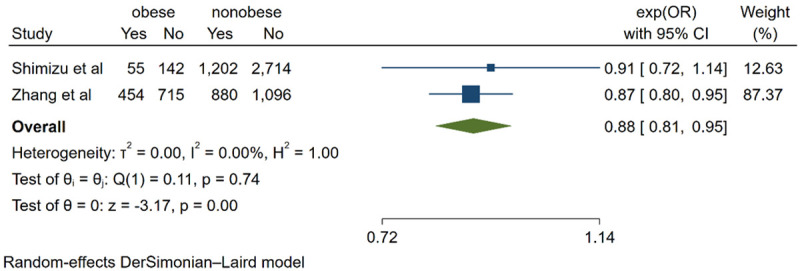
The mortality in sepsis patients with obesity.
Study characteristics
The selected papers varied in sample size, ranging from 149 to 55,038, and were published between 2007 and 2024. All studies employed clear diagnostic criteria for sepsis and included patients with sepsis, severe sepsis, and septic shock. The World Health Organization’s BMI classification was utilized as a measure of obesity across most studies. These studies were conducted in 5 countries, including 2 from China, 7 from the USA, 1 from Finland, 1 from Austria, and 1 from Japan. Although there were slight variations in the modified covariates, the revised estimates remained applicable across all studies. The characteristics of the surveys included in this article are summarized in Table 4. Additionally, we focused on studies published within the past two years, specifically one conducted by Shimizu et al. [39] and one by Zhang et al. [40].
Table 4.
Characteristics of studies included in this review
| Author | Year | Country | Study type | Sample size | Study period | Age (years) | ICU | Diagnosis of sepsis | Diagnosis of obese | Sepsis type | Confounders adjusted |
|---|---|---|---|---|---|---|---|---|---|---|---|
| Shan Lin | 2020 | China | Retrospective cohort | Total: 7,967, obese: 2,664, no obese: 5,303 | 2002-2012 | 65.92 ± 15.98 | Yes | Sepsis-3 | World Health Organization BMI classification | Sepsis | Age, sex, SOFA, mechanical ventilation on the first day, renal replacement therapy on the first day, fluid and electrolyte disorders, alcohol abuse, drug abuse, and depression. |
| Dominique J | 2019 | USA | Retrospective cohort | Total: 55,038, obese: 18,161, no obese: 36,877 | 2009-2015 | / | / | Sepsis-3 | World Health Organization BMI classification | Sepsis/Septic shock | Demographic factors, admission year, hospital level factors, infection factors, and severity of illness. |
| Yun Ji | 2017 | China | Retrospective cohort | Total: 236, obese: 110, no obese: 126 | 2012.8.1-2016.7.31 | / | Yes | American College of Chest Physicians/Society of Critical Care Medicine | Visceral obesity was defined as a visceral adipose tissue area exceeding 100 cm2 in both sexes | Severe sepsis/Septic shock | Age, use of vasopressor, mixed organism, and Acute Physiology and Chronic Health Evaluation II score. |
| Shuhe Li | 2019 | USA | Retrospective cohort | Total: 5,563, obese: 1,910, no obese: 3,653 | 2001-2012 | 66.3 (16.2) | Yes | ICD9 codes: 99591, 99592, 78552 | World Health Organization BMI classification | Sepsis/Severe sepsis/Septic shock | / |
| Hallie C Prescott | 2014 | USA | Retrospective cohort study | Total: 1,404, obese: 334, no obese: 1,070 | 1999-2005 | / | Yes | Commonly employed, validated claims-based definition of severe sepsis | World Health Organization BMI classification | Severe sepsis | Age, race, gender, marital status, wealth, acute organ dysfunctions, ICU use, mechanical ventilation use, diabetes, other co-morbidities, baseline cognitive status, and functional limitations. |
| Reetta Huttunen | 2007 | Finland | Retrospective cohort | Total: 149, obese: 27, no obese: 122 | 1999.6-2004.1 | Mean 59 | No | Blood microbiological culture finding | World Health Organization BMI classification | Bacteraemia | Alcohol abuse, age, sex and causative organism. |
| E Tay-Lasso | 2022 | USA | Retrospective cohort | Total: 1,246, obese: 680, no obese: 566 | 2017 | / | / | Sepsis plus organ dysfunction, hypotension (low blood pressure), or hypoperfusion (insufficient blood flow) to 1 or more organs | World Health Organization BMI classification | Severe sepsis | Age, alcohol use, hypertension, congestive heart failure, diabetes mellitus, injury severity score, respiratory rate, pulse rate, systolic blood pressure, intensive care unit days, Glasgow coma scale. |
| Bettina Wurzinger | 2010 | Austria | Retrospective cohort | Total: 301, obese: 66, no obese: 235 | 2003.1-2008.12 | / | Yes | The presence of arterial hypotension requiring norepinephrine infusion despite adequate fluid resuscitation in patients with infection and two or more signs of systemic inflammation | World Health Organization BMI classification | Septic shock | Admission year, sex, age, presence of heart disease or chronic renal insufficiency, the number of pre-morbidities, origin of sepsis and the simplified acute physiology score II. |
| Timothy Glen Gaulton | 2014 | USA | Retrospective cohort | Total: 1,779, obese: 573, no obese: 1,206 | 2007.3.1-2011.6.30 | / | No | ICD-9 | World Health Organization BMI classification | Sepsis | Sepsis severity. |
| Ethan F Kuperman | 2013 | USA | Retrospective cohort | Total: 792, obese: 233, no obese: 559 | 2007.7.1-2010.6.30 | 60.8 ± 14.2 | No | ICD-9 codes: 38.0-38.9 | World Health Organization BMI classification | Sepsis | Age, gender, race, severity of illness, length of stay, and comorbid conditions. |
| Zhang | 2023 | USA | Retrospective cohort | Total: 3,145, obese: 1,169, no obese: 1,976 | 2002.1.1-2011.12.30 | 65.3 ± 16.6 | Yes | Sepsis-3 | World Health Organization BMI classification | Sepsis | Age, sex, Sequential Organ Failure Assessment (SOFA), Simplified Acute Physiology Score (SAPS). |
| Shimizu | 2024 | Japan | Retrospective cohort | Total: 3,145, obese: 1,169, no obese: 1,976 | 2014.4 to 2018.3 | 73 (64-81) | Yes | Sepsis-3 | World Health Organization BMI classification | Sepsis | Age, sex, Sequential Organ Failure Assessment (SOFA), Simplified Acute Physiology Score (SAPS). |
Quality assessment
NOS assessment results regarding the quality of the studies are presented in Table 5. All included studies achieved a score of ≥8, indicating a high level of quality. Specifically, the study conducted by Shimizu et al. received a score of 9, and the study by Zhang et al. obtained a score of 8.
Table 5.
Newcastle-Ottawa Scale for quality assessment
| First author | Year | Selection | Comparability | Outcome | Overall quality score |
|---|---|---|---|---|---|
| Shimizu | 2024 | ★★★★ | ★★★ | ★★ | 9 |
| Zhang | 2023 | ★★★★ | ★★ | ★★ | 8 |
Gender distribution and statistics of obese patients
Table 6 provides detailed information on the gender distribution and the number of obese patients in both studies. In the study by Shimizu et al., there were 2,399 males and 1,517 females, resulting in a total of 197 obese patients. In the research conducted by Zhang et al., there were 1,674 males and 1,471 females, with a total of 1,169 obese patients.
Table 6.
Gender distribution and statistics of the patients
Mortality risk in patients with sepsis and obesity
As illustrated in Figures 1, 2 cohort studies examined survival among hospitalized patients with both obesity and sepsis. The pooled analysis revealed a decrease in mortality among obese patients with sepsis (OR=0.88; 95% CI: 0.81-0.95). The analysis indicated an I2-value of 0.00% and a P-value of 0.74, suggesting no significant heterogeneity between the two studies. Additionally, a test for heterogeneity was conducted, the results of which are presented in Figure 2. Sensitivity analysis was performed by systematically excluding individual studies, showing consistent and stable conclusions (Figure 3). Consequently, these findings are considered robust.
Figure 2.
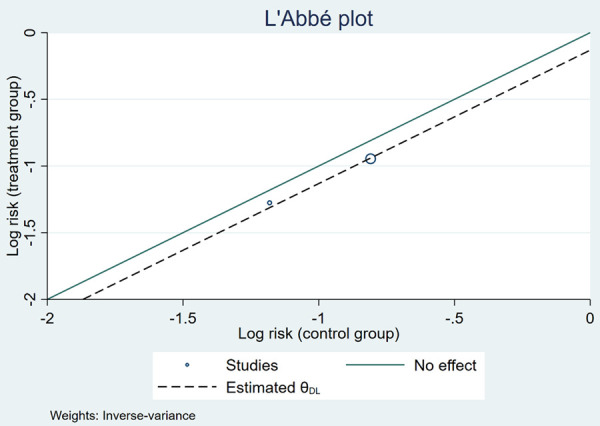
Heterogeneity analysis.
Figure 3.
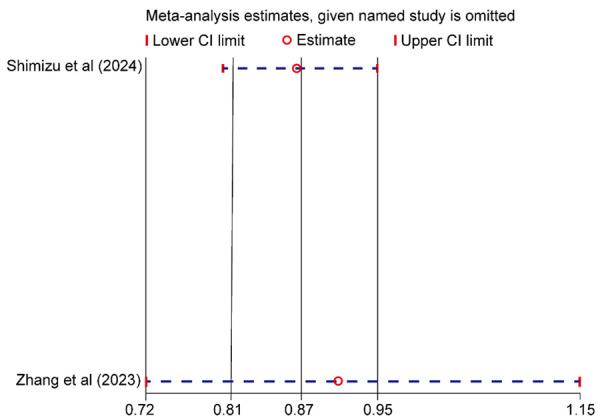
Sensitivity analysis.
Publication bias
Funnel plots were employed to assess the presence of publication bias. Visual inspection of the funnel plots revealed symmetry. Additionally, the absence of publication bias was confirmed by Egger’s test (P=0.770).
Discussion
Principal findings
Overall, patients with sepsis and obesity exhibit a mortality rate of approximately 22%. Our meta-analysis indicates a lower fatality rate among patients with sepsis and obesity compared to controls. This finding aligns with the results of the meta-analysis conducted by Pepper et al. [22], which also suggests a correlation between having an overweight and obese BMI and reduced mortality. Sepsis is a hypercatabolic acute disease wherein excess body fat serves as a source of fuel and energy [40]. Specifically, higher body weight provides a reservoir of nutrients crucial for survival during acute and life-threatening conditions. Adipose tissue stores surplus energy in the form of triglycerides and releases fuel substrates such as fatty acids and glycerol to meet the metabolic demands of other organs when necessary [23,41]. Additionally, adipose tissue plays a role in modulating immunity by secreting proteins like leptin, an anti-inflammatory adipocytokine [42]. Moreover, obese individuals typically exhibit elevated baseline levels of leptin [43].
Comparison with existing studies
Two meta-analyses addressing similar topics were published in 2016 and 2017 [14,15]. Wang et al.’s meta-analysis [23] included studies on sepsis patients but did not specifically focus on obese or morbidly obese individuals. Among the eight studies included in Wang et al.’s analysis, only four were complete cohort studies, while the remaining four were conference abstracts. Conference abstracts often lack comprehensive information due to space limitations, thus providing an incomplete picture. In contrast, our meta-analysis exclusively incorporated full-text cohort studies to minimize bias and furnish stronger evidence. Pepper et al.’s recent meta-analysis [22] concluded that for adults admitted with sepsis, severe sepsis, or septic shock, both underweight and overweight BMI categories were associated with reduced adjusted mortality. Our analysis, comprising 2 retrospective cohort studies [38,39] involving 7,061 individuals is the most recent and comprehensive compared to previous meta-analyses. Furthermore, our meta-analysis specifically examined mortality among patients with sepsis and obesity, thereby offering more extensive data and credible evidence.
Possible biological and physiological findings from this study
Previous studies have suggested several potential biological and physiological mechanisms, although further research is required to fully elucidate the underlying mechanisms. One possible explanation is that adipose tissue can be mobilized to provide additional energy reserves, supporting patients with sepsis during times of metabolic stress. Second, the increase in adipose tissue may be associated with heightened activity of the renin-angiotensin system [44], which could confer hemodynamic protection during sepsis, potentially reducing the need for fluid or vasopressor support [45]. Third, elevated levels of blood lipids and adipose tissue in patients with elevated BMIs may inhibit the production of lipopolysaccharide or other harmful microbial products associated with sepsis [46]. Fourth, obesity may enhance immune function, attributed to increased levels of tumor necrosis factor-alpha (TNF-α) [47]. Soluble TNF receptor levels may counteract the deleterious effects of excessive TNF-α production during sepsis. Moreover, studies have indicated that obesity could mitigate the release of harmful inflammatory mediators in sepsis and sepsis-related lung injury [48].
Study limitations
While this meta-analysis adheres to PROSPERO registration and PRISMA guidelines, thereby enhancing transparency and comprehensibility, several limitations should be acknowledged. Firstly, the inclusion of patients with heterogeneous disease-induced extensive sepsis may introduce variability into the results, potentially affecting the reliability of comparisons across different sepsis populations. Secondly, although obesity was assessed using BMI, variations in obesity grading and classification criteria among the original studies may contribute to clinical heterogeneity. Moreover, BMI may not accurately reflect fat mass, muscle-to-fat ratio, or body composition, thus limiting its effectiveness as an obesity indicator [49]. Lastly, despite conducting comprehensive literature searches excluding conference abstracts, the possibility of overlooking relevant studies cannot be entirely ruled out.
Conclusion
The concept of the obesity paradox appears to hold merit in patients with sepsis; however, further validation through additional prospective trials and research on mechanisms is warranted.
Acknowledgements
This work was supported by the Natural Science Foundation of Xinjiang Uygur Autonomous Region (2023D01F26), and the scientific research project of Wuxi Municipal Health Commission (Q202221).
Disclosure of conflict of interest
The authors claim no business or financial links that could be interpreted as a potential conflict of interest.
References
- 1.Donini LM, Pinto A, Giusti AM, Lenzi A, Poggiogalle E. Obesity or BMI paradox? Beneath the Tip of the Iceberg. Front Nutr. 2020;7:53. doi: 10.3389/fnut.2020.00053. [DOI] [PMC free article] [PubMed] [Google Scholar]
- 2.Harrison S, Dixon P, Jones HE, Davies AR, Howe LD, Davies NM. Long-term cost-effectiveness of interventions for obesity: a mendelian randomisation study. PLoS Med. 2021;18:e1003725. doi: 10.1371/journal.pmed.1003725. [DOI] [PMC free article] [PubMed] [Google Scholar]
- 3.Malik VS, Willet WC, Hu FB. Nearly a decade on - trends, risk factors and policy implications in global obesity. Nat Rev Endocrinol. 2020;16:615–616. doi: 10.1038/s41574-020-00411-y. [DOI] [PMC free article] [PubMed] [Google Scholar]
- 4.NCD Risk Factor Collaboration (NCD-RisC) Worldwide trends in body-mass index, underweight, overweight, and obesity from 1975 to 2016: a pooled analysis of 2416 population-based measurement studies in 128.9 million children, adolescents, and adults. Lancet. 2017;390:2627–2642. doi: 10.1016/S0140-6736(17)32129-3. [DOI] [PMC free article] [PubMed] [Google Scholar]
- 5.Poly TN, Islam MM, Yang HC, Lin MC, Jian WS, Hsu MH, Jack Li YC. Obesity and mortality among patients diagnosed with COVID-19: a systematic review and meta-analysis. Front Med (Lausanne) 2021;8:620044. doi: 10.3389/fmed.2021.620044. [DOI] [PMC free article] [PubMed] [Google Scholar]
- 6.Wiebe N, Lloyd A, Crumley ET, Tonelli M. Associations between body mass index and all-cause mortality: a systematic review and meta-analysis. Obes Rev. 2023;24:e13588. doi: 10.1111/obr.13588. [DOI] [PubMed] [Google Scholar]
- 7.Aune D, Sen A, Prasad M, Norat T, Janszky I, Tonstad S, Romundstad P, Vatten LJ. BMI and all cause mortality: systematic review and non-linear dose-response meta-analysis of 230 cohort studies with 3.74 million deaths among 30.3 million participants. BMJ. 2016;353:i2156. doi: 10.1136/bmj.i2156. [DOI] [PMC free article] [PubMed] [Google Scholar]
- 8.Hastie CE, Padmanabhan S, Slack R, Pell AC, Oldroyd KG, Flapan AD, Jennings KP, Irving J, Eteiba H, Dominiczak AF, Pell JP. Obesity paradox in a cohort of 4880 consecutive patients undergoing percutaneous coronary intervention. Eur Heart J. 2010;31:222–226. doi: 10.1093/eurheartj/ehp317. [DOI] [PubMed] [Google Scholar]
- 9.Shah R, Gayat E, Januzzi JL Jr, Sato N, Cohen-Solal A, diSomma S, Fairman E, Harjola VP, Ishihara S, Lassus J, Maggioni A, Metra M, Mueller C, Mueller T, Parenica J, Pascual-Figal D, Peacock WF, Spinar J, van Kimmenade R, Mebazaa A GREAT (Global Research on Acute Conditions Team) Network. Body mass index and mortality in acutely decompensated heart failure across the world: a global obesity paradox. J Am Coll Cardiol. 2014;63:778–785. doi: 10.1016/j.jacc.2013.09.072. [DOI] [PubMed] [Google Scholar]
- 10.Taroeno-Hariadi KW, Putra YR, Ariesta NF, Sinorita H, Hardianti MS, Widodo I, Aryandono T. The association between abdominal obesity, metabolic syndrome and survival outcomes in patients with breast cancer. Asian Pac J Cancer Prev. 2022;23:3157–3165. doi: 10.31557/APJCP.2022.23.9.3157. [DOI] [PMC free article] [PubMed] [Google Scholar]
- 11.O’Connell F, O’Sullivan J. Help or hindrance: the obesity paradox in cancer treatment response. Cancer Lett. 2021;522:269–280. doi: 10.1016/j.canlet.2021.09.021. [DOI] [PubMed] [Google Scholar]
- 12.Costanzo P, Cleland JG, Pellicori P, Clark AL, Hepburn D, Kilpatrick ES, Perrone-Filardi P, Zhang J, Atkin SL. The obesity paradox in type 2 diabetes mellitus: relationship of body mass index to prognosis: a cohort study. Ann Intern Med. 2015;162:610–618. doi: 10.7326/M14-1551. [DOI] [PubMed] [Google Scholar]
- 13.Karampela I, Chrysanthopoulou E, Christodoulatos GS, Dalamaga M. Is there an obesity paradox in critical illness? Epidemiologic and metabolic considerations. Curr Obes Rep. 2020;9:231–244. doi: 10.1007/s13679-020-00394-x. [DOI] [PubMed] [Google Scholar]
- 14.Hogue CW Jr, Stearns JD, Colantuoni E, Robinson KA, Stierer T, Mitter N, Pronovost PJ, Needham DM. The impact of obesity on outcomes after critical illness: a meta-analysis. Intensive Care Med. 2009;35:1152–1170. doi: 10.1007/s00134-009-1424-5. [DOI] [PubMed] [Google Scholar]
- 15.Mohajan D, Mohajan HK. Obesity and its related diseases: a new escalating alarming in global health. Journal of Innovations in Medical Research. 2023;2:12–23. [Google Scholar]
- 16.Tutor AW, Lavie CJ, Kachur S, Milani RV, Ventura HO. Updates on obesity and the obesity paradox in cardiovascular diseases. Prog Cardiovasc Dis. 2023;78:2–10. doi: 10.1016/j.pcad.2022.11.013. [DOI] [PubMed] [Google Scholar]
- 17.Simati S, Kokkinos A, Dalamaga M, Argyrakopoulou G. Obesity paradox: fact or fiction? Curr Obes Rep. 2023;12:75–85. doi: 10.1007/s13679-023-00497-1. [DOI] [PubMed] [Google Scholar]
- 18.Evans L, Rhodes A, Alhazzani W, Antonelli M, Coopersmith CM, French C, Machado FR, McIntyre L, Ostermann M, Prescott HC, Schorr C, Simpson S, Wiersinga WJ, Alshamsi F, Angus DC, Arabi Y, Azevedo L, Beale R, Beilman G, Belley-Cote E, Burry L, Cecconi M, Centofanti J, Coz Yataco A, De Waele J, Dellinger RP, Doi K, Du B, Estenssoro E, Ferrer R, Gomersall C, Hodgson C, Hylander Møller M, Iwashyna T, Jacob S, Kleinpell R, Klompas M, Koh Y, Kumar A, Kwizera A, Lobo S, Masur H, McGloughlin S, Mehta S, Mehta Y, Mer M, Nunnally M, Oczkowski S, Osborn T, Papathanassoglou E, Perner A, Puskarich M, Roberts J, Schweickert W, Seckel M, Sevransky J, Sprung CL, Welte T, Zimmerman J, Levy M. Surviving sepsis campaign: international guidelines for management of sepsis and septic shock 2021. Crit Care Med. 2021;49:e1063–e1143. doi: 10.1097/CCM.0000000000005337. [DOI] [PubMed] [Google Scholar]
- 19.Rudd KE, Johnson SC, Agesa KM, Shackelford KA, Tsoi D, Kievlan DR, Colombara DV, Ikuta KS, Kissoon N, Finfer S, Fleischmann-Struzek C, Machado FR, Reinhart KK, Rowan K, Seymour CW, Watson RS, West TE, Marinho F, Hay SI, Lozano R, Lopez AD, Angus DC, Murray CJL, Naghavi M. Global, regional, and national sepsis incidence and mortality, 1990-2017: analysis for the Global Burden of Disease Study. Lancet. 2020;395:200–211. doi: 10.1016/S0140-6736(19)32989-7. [DOI] [PMC free article] [PubMed] [Google Scholar]
- 20.Cavaillon JM, Singer M, Skirecki T. Sepsis therapies: learning from 30 years of failure of translational research to propose new leads. EMBO Mol Med. 2020;12:e10128. doi: 10.15252/emmm.201810128. [DOI] [PMC free article] [PubMed] [Google Scholar]
- 21.Trivedi V, Bavishi C, Jean R. Impact of obesity on sepsis mortality: a systematic review. J Crit Care. 2015;30:518–524. doi: 10.1016/j.jcrc.2014.12.007. [DOI] [PubMed] [Google Scholar]
- 22.Pepper DJ, Sun J, Welsh J, Cui X, Suffredini AF, Eichacker PQ. Increased body mass index and adjusted mortality in ICU patients with sepsis or septic shock: a systematic review and meta-analysis. Crit Care. 2016;20:181. doi: 10.1186/s13054-016-1360-z. [DOI] [PMC free article] [PubMed] [Google Scholar]
- 23.Wang S, Liu X, Chen Q, Liu C, Huang C, Fang X. The role of increased body mass index in outcomes of sepsis: a systematic review and meta-analysis. BMC Anesthesiol. 2017;17:118. doi: 10.1186/s12871-017-0405-4. [DOI] [PMC free article] [PubMed] [Google Scholar]
- 24.Pepper DJ, Demirkale CY, Sun J, Rhee C, Fram D, Eichacker P, Klompas M, Suffredini AF, Kadri SS. Does obesity protect against death in sepsis? A retrospective cohort study of 55,038 adult patients. Crit Care Med. 2019;47:643–650. doi: 10.1097/CCM.0000000000003692. [DOI] [PMC free article] [PubMed] [Google Scholar]
- 25.Li S, Hu X, Xu J, Huang F, Guo Z, Tong L, Lui KY, Cao L, Zhu Y, Yao J, Lin X, Guan X, Cai C. Increased body mass index linked to greater short- and long-term survival in sepsis patients: a retrospective analysis of a large clinical database. Int J Infect Dis. 2019;87:109–116. doi: 10.1016/j.ijid.2019.07.018. [DOI] [PubMed] [Google Scholar]
- 26.Abbate LM, Perman SM, Clambey ET, Van Pelt RE, Ginde AA. Age modifies the association between obesity and mortality in individuals hospitalized with severe sepsis. J Am Geriatr Soc. 2016;64:882–883. doi: 10.1111/jgs.14047. [DOI] [PMC free article] [PubMed] [Google Scholar]
- 27.Page MJ, McKenzie JE, Bossuyt PM, Boutron I, Hoffmann TC, Mulrow CD, Shamseer L, Tetzlaff JM, Akl EA, Brennan SE, Chou R, Glanville J, Grimshaw JM, Hróbjartsson A, Lalu MM, Li T, Loder EW, Mayo-Wilson E, McDonald S, McGuinness LA, Stewart LA, Thomas J, Tricco AC, Welch VA, Whiting P, Moher D. The PRISMA 2020 statement: an updated guideline for reporting systematic reviews. BMJ. 2021;372:n71. doi: 10.1136/bmj.n71. [DOI] [PMC free article] [PubMed] [Google Scholar]
- 28.Qu H, Yang S, Yao Z, Sun X, Chen H. Association of headache disorders and the risk of dementia: meta-analysis of cohort studies. Front Aging Neurosci. 2022;14:804341. doi: 10.3389/fnagi.2022.804341. [DOI] [PMC free article] [PubMed] [Google Scholar]
- 29.Lei S, Li X, Zhao H, Feng Z, Chun L, Xie Y, Li J. Risk of dementia or cognitive impairment in sepsis survivals: a systematic review and meta-analysis. Front Aging Neurosci. 2022;14:839472. doi: 10.3389/fnagi.2022.839472. [DOI] [PMC free article] [PubMed] [Google Scholar]
- 30.Tay-Lasso E, Grigorian A, Lekawa M, Dolich M, Schubl S, Barrios C, Nguyen N, Nahmias J. Obesity does not increase risk for mortality in severe sepsis trauma patients. Am Surg. 2023;89:4734–4739. doi: 10.1177/00031348221078986. [DOI] [PubMed] [Google Scholar]
- 31.Lin S, Ge S, He W, Zeng M. Association between body mass index and short-term clinical outcomes in critically ill patients with sepsis: a real-world study. Biomed Res Int. 2020;2020:5781913. doi: 10.1155/2020/5781913. [DOI] [PMC free article] [PubMed] [Google Scholar]
- 32.Ji Y, Cheng B, Xu Z, Ye H, Lu W, Luo X, Fu S, Fang X. Impact of sarcopenic obesity on 30-day mortality in critically ill patients with intra-abdominal sepsis. J Crit Care. 2018;46:50–54. doi: 10.1016/j.jcrc.2018.03.019. [DOI] [PubMed] [Google Scholar]
- 33.Gaulton TG, Weiner MG, Morales KH, Gaieski DF, Mehta J, Lautenbach E. The effect of obesity on clinical outcomes in presumed sepsis: a retrospective cohort study. Intern Emerg Med. 2014;9:213–221. doi: 10.1007/s11739-013-1002-2. [DOI] [PMC free article] [PubMed] [Google Scholar]
- 34.Prescott HC, Chang VW, O’Brien JM Jr, Langa KM, Iwashyna TJ. Obesity and 1-year outcomes in older Americans with severe sepsis. Crit Care Med. 2014;42:1766–1774. doi: 10.1097/CCM.0000000000000336. [DOI] [PMC free article] [PubMed] [Google Scholar]
- 35.Kuperman EF, Showalter JW, Lehman EB, Leib AE, Kraschnewski JL. The impact of obesity on sepsis mortality: a retrospective review. BMC Infect Dis. 2013;13:377. doi: 10.1186/1471-2334-13-377. [DOI] [PMC free article] [PubMed] [Google Scholar]
- 36.Wurzinger B, Dünser MW, Wohlmuth C, Deutinger MC, Ulmer H, Torgersen C, Schmittinger CA, Grander W, Hasibeder WR. The association between body-mass index and patient outcome in septic shock: a retrospective cohort study. Wien Klin Wochenschr. 2010;122:31–36. doi: 10.1007/s00508-009-1241-4. [DOI] [PubMed] [Google Scholar]
- 37.Huttunen R, Laine J, Lumio J, Vuento R, Syrjänen J. Obesity and smoking are factors associated with poor prognosis in patients with bacteraemia. BMC Infect Dis. 2007;7:13. doi: 10.1186/1471-2334-7-13. [DOI] [PMC free article] [PubMed] [Google Scholar]
- 38.Zhang L, Fang L, Lihua H, Li C. Association between obesity and 1-year mortality in septic patients: a retrospective cohort study. BMJ Open. 2023;13:e066526. doi: 10.1136/bmjopen-2022-066526. [DOI] [PMC free article] [PubMed] [Google Scholar]
- 39.Shimizu R, Nakanishi N, Ishihara M, Oto J, Kotani J. Utility of lean body mass equations and body mass index for predicting outcomes in critically ill adults with sepsis: a retrospective study. Diseases. 2024;12:30. doi: 10.3390/diseases12020030. [DOI] [PMC free article] [PubMed] [Google Scholar]
- 40.Niedziela J, Hudzik B, Niedziela N, Gąsior M, Gierlotka M, Wasilewski J, Myrda K, Lekston A, Poloński L, Rozentryt P. The obesity paradox in acute coronary syndrome: a meta-analysis. Eur J Epidemiol. 2014;29:801–812. doi: 10.1007/s10654-014-9961-9. [DOI] [PMC free article] [PubMed] [Google Scholar]
- 41.Wacharasint P, Boyd JH, Russell JA, Walley KR. One size does not fit all in severe infection: obesity alters outcome, susceptibility, treatment, and inflammatory response. Crit Care. 2013;17:R122. doi: 10.1186/cc12794. [DOI] [PMC free article] [PubMed] [Google Scholar]
- 42.Kershaw EE, Flier JS. Adipose tissue as an endocrine organ. J Clin Endocrinol Metab. 2004;89:2548–2556. doi: 10.1210/jc.2004-0395. [DOI] [PubMed] [Google Scholar]
- 43.Ambad R, Jha RK, Chandi DH, Hadke S. Association of leptin in diabetes mellitus and obesity. Research Journal of Pharmacy and Technology. 2020;13:6295–6299. [Google Scholar]
- 44.Vliora M, Ravelli C, Grillo E, Corsini M, Flouris AD, Mitola S. The impact of adipokines on vascular networks in adipose tissue. Cytokine Growth Factor Rev. 2023;69:61–72. doi: 10.1016/j.cytogfr.2022.07.008. [DOI] [PubMed] [Google Scholar]
- 45.ProCESS Investigators. Yealy DM, Kellum JA, Huang DT, Barnato AE, Weissfeld LA, Pike F, Terndrup T, Wang HE, Hou PC, LoVecchio F, Filbin MR, Shapiro NI, Angus DC. A randomized trial of protocol-based care for early septic shock. N Engl J Med. 2014;370:1683–1693. doi: 10.1056/NEJMoa1401602. [DOI] [PMC free article] [PubMed] [Google Scholar]
- 46.Wu A, Hinds CJ, Thiemermann C. High-density lipoproteins in sepsis and septic shock: metabolism, actions, and therapeutic applications. Shock. 2004;21:210–221. doi: 10.1097/01.shk.0000111661.09279.82. [DOI] [PubMed] [Google Scholar]
- 47.Winkler G, Kiss S, Keszthelyi L, Sápi Z, Ory I, Salamon F, Kovács M, Vargha P, Szekeres O, Speer G, Karádi I, Sikter M, Kaszás E, Dworak O, Gerö G, Cseh K. Expression of tumor necrosis factor (TNF)-alpha protein in the subcutaneous and visceral adipose tissue in correlation with adipocyte cell volume, serum TNF-alpha, soluble serum TNF-receptor-2 concentrations and C-peptide level. Eur J Endocrinol. 2003;149:129–135. doi: 10.1530/eje.0.1490129. [DOI] [PubMed] [Google Scholar]
- 48.Anderson MR, Ferrante AW, Baldwin MR. Body mass index and risk for intubation or death in SARS-CoV-2 infection. Ann Intern Med. 2021;174:886. doi: 10.7326/L21-0015. [DOI] [PubMed] [Google Scholar]
- 49.Christopher KB. The body mass index paradox. Crit Care Med. 2015;43:2693–2694. doi: 10.1097/CCM.0000000000001344. [DOI] [PubMed] [Google Scholar]