



Abstract
Background
Among those with heart failure (HF), women are more likely to develop depression than men. Few studies have focused on the outcomes of female patients with HF with depressive symptoms.
Methods and Results
A total of 506 female patients with HF with preserved ejection fraction were included in this secondary analysis from the TOPCAT (Treatment of Preserved Cardiac Function Heart Failure With an Aldosterone Antagonist) cohort, and 439 female patients with HF with reduced ejection fraction were included from the HF‐ACTION (Heart Failure: A Controlled Trial Investigating Outcomes of Exercise Training) cohort. Depressive symptoms were measured using the Patient Health Questionnaire‐9 and Beck Depression Inventory‐II. The depression class was categorized by severity, and the change in clinical depression class was defined as aggravated (1‐grade increase) or improved (1‐grade decrease). The prognostic value of depressive symptoms was determined by using multivariable Cox proportional hazards models. Female patients with improved depressive symptoms had worse depressive status at baseline and lower baseline Kansas City Cardiomyopathy Questionnaire scores. Depression class at the 12‐month visit and depression class change were the dominant prognostic factors for cardiovascular death in female patients with HF with preserved ejection fraction (hazard ratio [HR], 1.43 [95% CI, 1.02–2.01], P=0.036; HR, 1.71 [95% CI, 1.14–2.55], P=0.009). Among the patients with HF with reduced ejection fraction, both the depression class at baseline and depression class change had significant prognostic effects on cardiovascular death (HR, 3.30 [95% CI, 1.70–6.39], P<0.001; HR, 2.21 [95% CI, 1.28–3.80], P=0.004). However, the prognostic value of depressive assessments for hospitalization in patients with HF is unclear.
Conclusions
In female patients with HF with reduced ejection fraction, the depression class at baseline was most strongly associated with cardiovascular death, whereas in female patients with HF with preserved ejection fraction, the change in depression class exhibited a more significant prognostic trend.
Keywords: Beck Depression Inventory‐II, depression, female, HFpEF, HFrEF, Patient Health Questionnaire‐9
Subject Categories: Heart Failure
Nonstandard Abbreviations and Acronyms
- BDI‐II
Beck Depression Inventory‐II
- HFpEF
heart failure with preserved ejection fraction
- HFrEF
heart failure with reduced ejection fraction
- KCCQ
Kansas City Cardiomyopathy Questionnaire
- PHQ‐9
Patient Health Questionnaire‐9
Clinical Perspective.
What Is New?
Measuring serial depressive symptoms in female patients with heart failure (HF) can provide an important assessment of patient prognosis; specifically, in female patients with HF with reduced ejection fraction, the depression class at baseline was strongly associated with cardiovascular death, whereas in female patients with HF with preserved ejection fraction, the change in depression class exhibited a more significant prognostic trend toward cardiovascular death.
The association between depressive symptoms and hospitalization for HF in this study was inconsistent. The Kansas City Cardiomyopathy Questionnaire exhibited a greater predictive contribution to the outcome of hospitalization for patients with HF than did the depressive symptoms assessment in female patients with HF with reduced ejection fraction.
What Are the Clinical Implications?
This study indicated that clinicians need to pay more attention to changes in depressive symptoms in the clinical care of female patients with heart failure with preserved ejection fraction and to prevent the appearance of severe depressive symptoms in female patients with heart failure with reduced ejection fraction.
Depression, one of the leading causes of disease‐related disability in women, is almost twice as prevalent among women as men. 1 It is associated with a substantial reduction in lifespan, explained largely by an increased risk of suicide and vulnerability to major medical disorders, including cardiovascular disease, autoimmune disease, and diabetes. 2 , 3 Moreover, medical illnesses, such as cardiovascular disease, also increase the risk of depression. 4 Recent studies have revealed sex differences in the response to antidepressant treatment. 5 Currently, depression in female patients experiencing cardiovascular disease has received increasing attention, indicating that the influence of depression on cardiovascular disease incidence, particularly for women with depression, is critically important.
Up to one third of patients with heart failure (HF) experience depressive symptoms, 6 and patients with HF and depression are associated with increased mortality and morbidity. 7 Efforts by institutions such as the European Society of Cardiology and the American College of Cardiology/American Heart Association further underscored the importance of screening and treating depression in patients with HF. 8 , 9 In particular, among patients with HF, women are more vulnerable to developing severe depression and suffering from worse cardiovascular outcomes than men are. 10 , 11 , 12
However, few studies have focused on the outcomes of female patients with HF with depressive symptoms, especially considering that women have a greater HF symptom burden than men. 13 Predictors of change in depressive symptoms over time have not been adequately described in female patients with HF with preserved ejection fraction (HFpEF) or in those with HF with reduced ejection fraction (HFrEF). Accordingly, we sought to understand how to best leverage depressive assessments (baseline, 12‐month visit, or the change in class over time) to stratify the risk of subsequent cardiovascular death and HF hospitalizations in outpatients with HF.
METHODS
The data, analytic methods, and materials will not be made available to other researchers for purposes of reproducing the results or replicating the procedure. The TOPCAT (Treatment of Preserved Cardiac Function Heart Failure With an Aldosterone Antagonist) data and the HF‐ACTION (Heart Failure: A Controlled Trial Investigating Outcomes of Exercise Training) data are publicly available to qualified investigators.
Study Population
We accessed data from 2 clinical trials through the National Heart Lung Blood Institute Biological Specimen and Data Repository Information Coordinating Center. As described previously, TOPCAT was a multicenter, double‐blind, placebo‐controlled trial of aldosterone antagonist therapy in which 3445 adult patients aged 50 years or older with symptoms of HF and documented left ventricular ejection fraction (LVEF) ≥45% were randomized. 14 Only female patients with HFpEF, defined as an LVEF ≥50% and a complete Patient Health Questionnaire‐9 (PHQ‐9) score (including baseline PHQ‐9 scores and 12‐month follow‐up PHQ‐9 scores), were included in the study (Figure 1). All participants in the TOPCAT trial gave informed consent and the study was approved by institutional review boards at all participating institutions.
Figure 1. Study cohort.
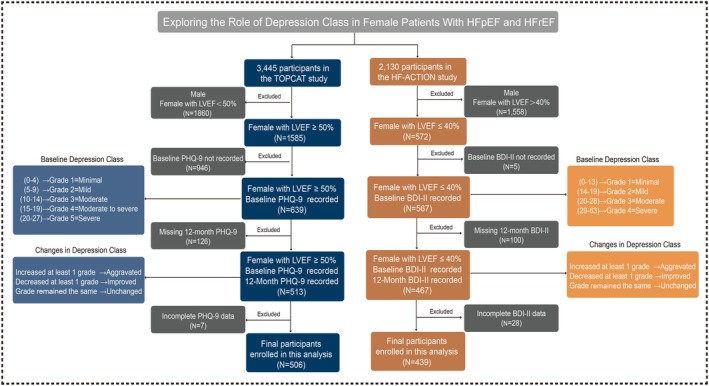
In the TOPCAT trial, only female patients with LVEF ≥50% and a complete PHQ‐9 were included in this study. In the HF‐ACTION trial, only female patients with LVEF ≤40% and a complete BDI‐II were included in this study. BDI‐II indicates Beck Depression Inventory‐II; HF‐ACTION, Heart Failure: A Controlled Trial Investigating Outcomes of Exercise Training; HFpEF, heart failure with preserved ejection fraction; HFrEF, heart failure with reduced ejection fraction; LVEF, left ventricular ejection fraction; PHQ‐9, Patient Health Questionnaire‐9; and TOPCAT, Treatment of Preserved Cardiac Function Heart Failure With an Aldosterone Antagonist.
The HF‐ACTION trial was a multicenter, randomized controlled trial of exercise training versus usual care in patients with LVEF ≤35% and New York Heart Association class II to IV symptoms that randomized 2331 medically stable outpatients with HFrEF. 15 For the present analysis, we included 2130 patients whose data were available from the Biological Specimen and Data Repository Information Coordinating Center. Only female patients with HFrEF, defined as an LVEF ≤40% and a complete Beck Depression Inventory‐II (BDI‐II) score (including baseline BDI‐II scores and 12‐month follow‐up BDI‐II scores) were included in the study (Figure 1). All participants in the HF‐ACTION trial gave informed consent and ethics approval for this analysis was obtained from the local institutional review boards.
Depressive Symptoms
In the TOPCAT trial, depressive symptoms were measured using the PHQ‐9 instrument, a 9‐item self‐administered questionnaire that explored depressive symptoms during the previous 2 weeks. The scores for each PHQ‐9 item ranged from 0 (not at all) to 1 (several days), 2 (more than half of the days) and 3 (nearly every day), and the summed scores ranged from 0 to 27. In this study, we classified the PHQ‐9 sum scores into 5 grades according to severity: 0 to 4=minimal; 5 to 9=mild; 10 to 14=moderate; 15 to 19=moderately severe; and 20 to 27=severe. 16 A total of 506 female patients with HFpEF (LVEF ≥50%) with both baseline PHQ‐9 scores and 12‐month follow‐up PHQ‐9 scores were included in this analysis. The time origin of calculating change in the depressive symptom used in subsequent survival analysis was the baseline depression grading. An improvement in the PHQ‐9 score was defined as a decrease of at least 1 grade, and aggravation was defined as an increase of at least 1 grade.
In the HF‐ACTION trial, depressive symptoms were examined with the 21‐item BDI‐II, and patients were asked to rate the severity of each symptom on an ordinal scale from 0 to 3. Similarly, we grouped the BDI‐II total scores into 4 grades by severity, from 0 to 13 (minimum), 14 to 19 (minimum), 20 to 28 (moderate) and 29 to 63 (severe). 17 A total of 439 female patients with HFrEF (LVEF ≤40%) who had both baseline BDI‐II scores and 12‐month follow‐up BDI‐II scores were included in this analysis. The time origin of calculating change in depressive symptom used in subsequent survival analysis was the baseline depression grading. BDI‐II improvement was defined as a decrease of at least 1 grade, and aggravation was defined as an increase of at least 1 grade. All grades of depressive symptom changes were assessed at 12 months of follow‐up versus baseline.
Clinical Outcomes
The clinical outcomes of interest in this study were cardiovascular death and hospitalization for HF. The criteria for these events are described in previous reports. 14 , 18
Statistical Analysis
All analyses were performed on patients with HFpEF (TOPCAT) and HFrEF (HF‐ACTION). The baseline characteristics of the patients are presented based on the categories of depressive symptom changes. Continuous characteristic data are presented as the means±SDs. Categorical characteristics are presented as frequencies and percentages. The chi‐square test or Fisher's exact test was used for categorical variables, and 1‐way ANOVA was used for continuous variables.
In the primary analyses, we adopted an unadjusted model to examine the prognostic importance of the following assessments: (1) baseline PHQ‐9 or BDI‐II grade, (2) 12‐month visit PHQ‐9 or BDI‐II grade, and (3) change in PHQ‐9 or BDI‐II grade to explore the contribution of these assessments to subsequent cardiovascular death and HF hospitalization. Kaplan–Meier curves were generated by the PHQ‐9 or BDI‐II variation grading tool, and log‐rank tests were used to test the differences in the Kaplan–Meier curves among strata. Moreover, to determine the prognostic value of depressive symptoms, we also constructed multivariable Cox proportional hazards models for secondary analyses. The baseline characteristics of the covariates in the secondary analyses are displayed in Table 1 and 2. The prognostic importance of the depressive symptoms in multivariable Cox models was assessed in terms of (1) baseline PHQ‐9 or BDI‐II grade, (2) 12‐month visit PHQ‐9 or BDI‐II grade, and (3) change from baseline PHQ‐9 or BDI‐II grade to 12‐month visit PHQ‐9 or BDI‐II grade. All the depressive symptoms evaluated by PHQ‐9 or BDI‐II were included as categorized variables in the unadjusted or adjusted models.
Table 1.
Baseline Characteristics in TOPCAT
| Overall N=506 | PHQ‐9 change at 12‐month follow‐up visit | P value | |||
|---|---|---|---|---|---|
| Aggravated N=101 (20.0%) | Unchanged N=254 (50.2%) | Improved N=151 (29.8%) | |||
| Age, y | 73.0±9.9 | 72.4±10.4 | 74.2±9.3 | 71.2±10.1 | 0.009* |
| Body mass index, kg/m2 | 34.8±9.1 | 35.0±8.8 | 33.8±8.4 | 36.3±10.1 | 0.024* |
| Heart rate, bpm | 68.9±11.5 | 69.0±11.0 | 68.9±11.7 | 68.6±11.5 | 0.965 |
| Systolic blood pressure, mm Hg | 128.5±16.1 | 125.6±15.8 | 129.2±15.2 | 129.2±17.0 | 0.128 |
| Diastolic blood pressure, mm Hg | 70.0±11.1 | 69.4±10.9 | 70.0±10.6 | 70.5±12.1 | 0.738 |
| Race, Black | 379 (74.9%) | 79 (78.2%) | 200 (78.7%) | 100 (66.2%) | 0.01* |
| Left ventricular ejection fraction, % | 60.7±7.1 | 60.9±6.4 | 60.5±7.4 | 61.0±0 | 0.734 |
| Spironolactone | 244 (48.2%) | 44 (43.6%) | 127 (50.0%) | 73 (48.3%) | 0.549 |
| PHQ‐9: Grade 4 and 5 | 57 (11.3%) | 1 (1.0%) | 17 (6.7%) | 39 (25.9%) | 0.000* |
| Previous hospitalization for cardiac heart failure | 268 (53%) | 53 (52.5%) | 130 (51.2%) | 85 (56.3%) | 0.605 |
| Previous myocardial infarction | 85 (16.8%) | 17 (16.8%) | 44 (17.3%) | 24 (15.9%) | 0.933 |
| Coronary artery bypass graft surgery | 63 (12.5%) | 16 (15.8%) | 31 (12.2%) | 16 (10.6%) | 0.459 |
| Stroke | 49 (9.7%) | 10 (9.9%) | 20 (7.9%) | 19 (12.6%) | 0.300 |
| Percutaneous coronary revascularization | 99 (19.6%) | 25 (24.8%) | 50 (19.7%) | 24 (15.9%) | 0.221 |
| Angina | 137 (27.1%) | 30 (29.7%) | 74 (29.1%) | 33 (21.9%) | 0.225 |
| Chronic obstructive pulmonary disease | 75 (14.8%) | 18 (17.8%) | 34 (13.4%) | 23 (15.2%) | 0.561 |
| Asthma | 73 (14.4%) | 9 (8.9%) | 32 (12.6%) | 32 (21.2%) | 0.012* |
| Hypertension | 465 (91.9%) | 89 (88.1%) | 234 (92.1%) | 142 (94%) | 0.236 |
| Peripheral arterial disease | 62 (12.3%) | 12 (11.9%) | 29 (11.4%) | 21 (13.9%) | 0.755 |
| Pacemaker | 73 (14.4%) | 15 (14.9%) | 34 (13.4%) | 24 (15.9%) | 0.778 |
| Atrial fibrillation | 224 (44.3%) | 44 (43.6%) | 117 (46.1%) | 63 (41.97) | 0.688 |
| Thyroid disease | 152 (30%) | 27 (26.7%) | 87 (34.3%) | 38 (25.2%) | 0.112 |
| Diabetes | 204 (40.3%) | 44 (43.6%) | 94 (37.0%) | 66 (43.7%) | 0.313 |
| Fracture | 113 (22.3%) | 30 (29.7%) | 52 (20.5%) | 31 (20.5%) | 0.139 |
| Smoking | 19 (3.8%) | 7 (6.9%) | 6 (2.4%) | 6 (4.0%) | 0.036* |
| Alcohol: Class 3 and 4 | 28 (5.5%) | 5 (5.0%) | 15 (5.9%) | 8 (5.3%) | 0.928 |
| New York Heart Association: Class 3 and 4 | 203 (40.1%) | 42 (41.6%) | 102 (40.2%) | 59 (39.1%) | 0.923 |
| Angiotensin‐converting enzyme inhibitor | 217 (42.9%) | 46 (45.5%) | 108 (42.5%) | 63 (41.7%) | 0.823 |
| Angiotensin receptor blocker | 184 (36.4%) | 32 (31.7%) | 91 (35.8%) | 61 (40.4%) | 0.359 |
| Beta blocker | 397 (78.5%) | 83 (82.2%) | 199 (78.3%) | 115 (76.2%) | 0.522 |
| Calcium channel blocker | 222 (43.9%) | 36 (35.6%) | 119 (46.9%) | 67 (44.4%) | 0.157 |
| Diuretic | 451 (89.1%) | 91 (90.1%) | 229 (90.2%) | 131 (86.8%) | 0.534 |
| Aspirin | 268 (53.0%) | 60 (59.4%) | 136 (53.5%) | 72 (47.7%) | 0.182 |
| Nitrate | 100 (19.8%) | 22 (21.8%) | 50 (19.7%) | 28 (18.5%) | 0.818 |
| Statin | 329 (38.3%) | 76 (75.2%) | 163 (64.2%) | 90 (59.6%) | 0.036* |
| Warfarin | 194 (38.3%) | 38 (37.6%) | 102 (40.2%) | 54 (35.8%) | 0.670 |
| Lipid lowering | 67 (13.2%) | 11 (10.9%) | 32 (12.6%) | 24 (15.9%) | 0.470 |
| Kansas City Cardiomyopathy Questionnaire overall summary score | 57.1±22.5 | 55.7±22.5 | 64.0±21.7 | 46.5±21.0 | 0.000* |
PHQ‐9 indicates Patient Health Questionnaire‐9; and TOPCAT, Treatment of Preserved Cardiac Function Heart Failure With an Aldosterone Antagonist.
Indicates P<0.05.
Table 2.
Baseline Characteristics in HF‐ACTION
| Overall N=439 | BDI‐II change at 12‐month follow‐up visit | P value | |||
|---|---|---|---|---|---|
| Aggravated N=55 (12.5%) | Unchanged N=319 (72.7%) | Improved N=65 (14.8%) | |||
| Age, y | 56.8±12.1 | 54.1±13.3 | 57.6±11.9 | 55.2±11.8 | 0.069 |
| BMI, kg/m2 | 31.4±8.0 | 32.3±7.3 | 31.2±8.1 | 31.7±7.8 | 0.582 |
| Heart rate, bpm | 71.2±11.4 | 72.3±10.0 | 70.9±11.4 | 72.0±12.3 | 0.594 |
| Systolic blood pressure, mm Hg | 113.6±17.8 | 107.5±17.8 | 114.3±18.0 | 115.4±16.1 | 0.020* |
| Diastolic blood pressure, mm Hg | 70.3±11.1 | 67.4±10.3 | 70.1±11.0 | 72.1±12.0 | 0.063 |
| New York Heart Assocation: Class 3 and 4 | 164 (37.4%) | 24 (43.6%) | 107 (33.5%) | 33 (50.8%) | 0.019* |
| Angina | 98 (22.3%) | 17 (30.9%) | 62 (19.4%) | 19 (29.2%) | 0.059 |
| Previous myocardial infarction | 105 (23.9%) | 15 (27.3%) | 75 (23.5%) | 15 (23.1%) | 0.821 |
| Peripheral vascular disease | 8 (1.8%) | 1 (1.8%) | 4 (1.3%) | 3 (4.6%) | 0.182 |
| Stroke | 47 (10.7%) | 7 (12.7%) | 33 (10.3%) | 7 (10.8%) | 0.870 |
| Six‐minute walk: able to walk? | 429 (97.7%) | 54 (98.2%) | 310 (97.2%) | 65 (100%) | 0.179 |
| Race, Black | 191 (43.5%) | 24 (43.6%) | 133 (41.7%) | 34 (52.3%) | 0.293 |
| Smoking | 214 (48.7%) | 30 (54.6%) | 146 (45.8%) | 38 (58.5%) | 0.115 |
| Left ventricular ejection fraction, % | 25.1±7.1 | 24.4±6.6 | 25.2±7.2 | 25.5±7.3 | 0.677 |
| BDI‐II: Grade 3 and 4 | 62 (14.1%) | 5 (9.1%) | 21 (6.5%) | 36 (55.4%) | 0.000* |
| Kansas City Cardiomyopathy Questionnaire overall summary score | 66.5±21.1 | 55.4±18.8 | 71.3±19.8 | 52.2±19.1 | 0.000* |
| Hypertension | 230 (52.4%) | 24 (43.6%) | 171 (53.6%) | 35 (53.8%) | 0.380 |
| Pacemaker | 56 (12.8%) | 9 (16.4%) | 38 (11.9%) | 9 (13.8%) | 0.632 |
| Coronary artery bypass graft surgery | 37 (8.4%) | 5 (9.1%) | 25 (7.8%) | 7 (10.8%) | 0.727 |
| Valve surgery | 18 (4.1%) | 1 (1.8%) | 13 (4.1%) | 4 (6.2%) | 0.490 |
| Percutaneous coronary revascularization | 65 (14.8%) | 10 (18.2%) | 45 (14.1%) | 10 (15.4%) | 0.727 |
| Revascularization | 86 (19.6%) | 12 (21.8%) | 60 (18.8%) | 14 (21.5%) | 0.797 |
| Chronic obstructive pulmonary disease | 38 (8.7%) | 6 (10.9%) | 22 (6.9%) | 10 (15.4%) | 0.070 |
| Diabetes | 117 (26.7%) | 14 (25.5%) | 82 (25.7%) | 21 (32.3%) | 0.535 |
| Ischemic or nonischemic cause | 298 (67.9%) | 36 (65.5%) | 221 (69.3%) | 41 (63.1%) | 0.570 |
| Angiotensin‐converting enzyme inhibitor | 313 (71.3%) | 34 (61.8%) | 230 (72.1%) | 49 (75.4%) | 0.218 |
| Angiotensin receptor blocker | 127 (28.9%) | 18 (32.7%) | 93 (29.2%) | 16 (24.6%) | 0.612 |
| Beta blocker | 420 (95.7%) | 51 (92.7%) | 307 (96.2%) | 62 (95.4%) | 0.494 |
| Loop diuretic | 337 (76.8%) | 45 (81.8%) | 240 (75.2%) | 52 (80.0%) | 0.452 |
| Nitrate | 104 (23.7%) | 14 (25.5%) | 73 (22.9%) | 17 (26.2%) | 0.807 |
| Calcium channel blocker | 22 (5%) | 2 (3.6%) | 18 (5.6%) | 2 (3.1%) | 0.608 |
| Spironolactone | 211 (48.1%) | 33 (60.0%) | 148 (46.4%) | 30 (46.2%) | 0.166 |
| Digoxin | 200 (45.6%) | 26 (47.3%) | 146 (45.8%) | 28 (43.1%) | 0.890 |
| Atrial fibrillation or flutter | 54 (12.3%) | 12 (21.8%) | 37 (11.6%) | 5 (7.7%) | 0.049* |
BDI‐II indicates Beck Depression Inventory‐II; and HF‐ACTION, Heart Failure: A Controlled Trial Investigating Outcomes of Exercise Training.
Indicates P<0.05.
Three sensitivity analyses were also conducted in the present study. First, to rule out the possibility of reverse causation, participants who died or had an HF hospitalization event within the 12‐month follow‐up were removed. Second, considering that the Kansas City Cardiomyopathy Questionnaire overall summary (KCCQ‐os) score, which can assess health‐related quality of life, 19 could be a confounding factor for the prognostic significance of depressive assessments on HF outcome, we removed the KCCQ‐os score from the adjusted model. Third, we used the Fine and Gray subdistribution hazard model, which also was used to account for competing risks of mortality, to further explore the association between depression and cardiovascular events.
Missing data were addressed using missForest imputation. 20 Analyses were performed using R version 4.0.4 (R Foundation for Statistical Computing, Vienna, Austria). A 2‐sided P value <0.05 was considered to indicate statistical significance.
RESULTS
Patient Characteristics
A total of 506 female patients with HFpEF (LVEF ≥50%) from the TOPCAT cohort and 439 female patients with HFrEF (LVEF ≤40%) from the HF‐ACTION cohort were included in this analysis (Figure 1). In both cohorts, patients with improved depressive symptoms were more likely to have a worse depressive status at baseline and at a lower baseline KCCQ‐os score. In the HFpEF cohort, patients with depressive symptoms that improved (PHQ‐9 decreased by at least 1 grade) over 12 months were younger, had a higher body mass index and a history of asthma and were less likely to be Black than were those in the aggravated or unchanged groups. However, smoking and statin usage were more prevalent in the aggravated group (for which the PHQ‐9 increased by at least 1 grade) of patients with HFpEF (Table 1). Among the patients with HFrEF, those who had improved depressive symptoms (BDI‐II decreased by at least 1 grade) were more likely to have a higher New York Heart Association class and systolic blood pressure (Table 2).
Associations of Depressive Symptoms With Cardiovascular Death or HF Hospitalization
The associations of depressive symptom assessments with cardiovascular death or HF hospitalization in patients with HFpEF and HFrEF are shown in Table 3. For patients with HFpEF, no statistically significant associations were observed between the baseline PHQ‐9 score and either cardiovascular death or hospitalization due to HF. However, the opposite results were observed in patients with HFrEF. In the cohort with HFrEF, a higher baseline BDI‐II score was associated with a greater risk of cardiovascular death or hospitalization (hazard ratio [HR], 1.52 [95% CI, 1.06–2.17]; P=0.024; HR, 1.38 [95% CI, 1.13–1.68]; P=0.001). Both PHQ‐9 change and BDI‐II change were significant predictors in patients with HFpEF and HFrEF, respectively. According to the depression assessment at the 12‐month follow‐up, for patients with HFpEF, a higher PHQ‐9 grade was associated with a greater risk of cardiovascular death or HF hospitalization (HR, 1.29 [95% CI, 1.00–1.66]; P=0.049 and HR, 1.19 [95% CI, 1.01–1.41]; P=0.038), whereas for patients with HFrEF, only the outcome of HF hospitalization was significantly related to the BDI‐II at the 12‐month follow‐up (HR, 1.24 [95% CI, 1.01–1.41]; P=0.043).
Table 3.
Univariate Analysis of the Associations of Depressive Symptoms Assessments With Cardiovascular Death or HF Hospitalization in Patients With HFpEF and HFrEF
| Unadjusted models | |||
|---|---|---|---|
| HR | 95% CI | P value | |
| Cardiovascular death (TOPCAT) | |||
| PHQ‐9‐base | 1.07 | 0.823–1.388 | 0.6173 |
| PHQ‐9‐visit 12‐month | 1.29 | 1.001–1.663 | 0.0494* |
| PHQ‐9‐change | 1.64 | 1.148–2.338 | 0.0065* |
| HF hospitalization (TOPCAT) | |||
| PHQ‐9‐base | 1.08 | 0.917–1.262 | 0.3725 |
| PHQ‐9‐visit 12‐month | 1.19 | 1.010–1.406 | 0.0382* |
| PHQ‐9‐change | 1.28 | 1.017–1.604 | 0.0357* |
| Cardiovascular death (HF‐ACTION) | |||
| BDI‐base | 1.52 | 1.057–2.174 | 0.0238* |
| BDI‐visit 12‐month | 1.30 | 0.874–1.927 | 0.1961 |
| BDI‐change | 1.81 | 1.175–2.782 | 0.0071* |
| HF hospitalization (HF‐ACTION) | |||
| BDI‐base | 1.38 | 1.134–1.679 | 0.0013* |
| BDI‐visit 12‐month | 1.24 | 1.007–1.526 | 0.0432* |
| BDI‐change | 1.39 | 1.095‐1.766 | 0.0069* |
BDI‐II indicates Beck Depression Inventory‐II; HF, heart failure; HF‐ACTION, Heart Failure: A Controlled Trial Investigating Outcomes of Exercise Training; HFpEF, heart failure with preserved ejection fraction; HFrEF, heart failure with reduced ejection fraction; HR, hazard ratio; PHQ‐9, Patient Health Questionnaire‐9; and TOPCAT, Treatment of Preserved Cardiac Function Heart Failure With an Aldosterone Antagonist.
Indicates P<0.05.
Independent Prognosis of Depressive Symptoms for Cardiovascular Death or HF Hospitalization
To determine the independent prognostic value of depressive symptom assessments, we next constructed multivariable Cox proportional hazards models. The covariates of HFpEF and HFrEF, included in the adjusted models, are shown in Tables 1 and 2, respectively. The results of the adjusted models are shown in Table 4. According to our secondary analysis, the baseline PHQ‐9 score was not significantly associated with cardiovascular death or hospitalization in patients with HFpEF. Neither the PHQ‐9 at the 12‐month follow‐up nor the change in the PHQ‐9 were significantly associated with hospitalization for HF but were indicated as significant predictors of cardiovascular death (HR, 1.43 [95% CI, 1.02–2.01]; P=0.036; HR, 1.71 [95% CI, 1.14–2.55]; P=0.009).
Table 4.
Multivariable Analysis of the Independent Prognostic of Depressive Symptoms With Cardiovascular Death or HF Hospitalization in Patients With HFpEF and HFrEF
| Adjusted models | |||
|---|---|---|---|
| HR | 95% CI | P value | |
| Cardiovascular death (TOPCAT) with KCCQ‐os | |||
| PHQ‐9‐base | 1.08 | 0.720–1.613 | 0.7164 |
| PHQ‐9‐visit 12‐month | 1.43 | 1.023–2.008 | 0.0363* |
| PHQ‐9‐change | 1.71 | 1.141–2.554 | 0.0093* |
| HF hospitalization (TOPCAT) with KCCQ‐os | |||
| PHQ‐9‐base | 0.90 | 0.721–1.131 | 0.3747 |
| PHQ‐9‐visit 12‐month | 1.10 | 0.904–1.334 | 0.3471 |
| PHQ‐9‐change | 1.19 | 0.936–1.524 | 0.1529 |
| Cardiovascular death (HF‐ACTION) with KCCQ‐os | |||
| BDI‐base | 3.30 | 1.701–6.387 | 0.0004* |
| BDI‐visit 12‐month | 1.88 | 1.064–3.327 | 0.0297* |
| BDI‐change | 2.21 | 1.280‐3.804 | 0.0044* |
| HF hospitalization (HF‐ACTION) with KCCQ‐os | |||
| BDI‐base | 1.17 | 0.899–1.533 | 0.2390 |
| BDI‐visit 12‐month | 0.94 | 0.709–1.248 | 0.6712 |
| BDI‐change | 1.27 | 0.965–1.683 | 0.0875 |
In the TOPCAT cohort, adjusted for age at cohort entry, BMI, heart rate, SBP, DBP, Black race, LVEF, spironolactone, PHQ‐9 grade, previous hospitalization for cardiac heart failure, MI, CABG, stroke, PCI, angina, COPD, asthma, hypertension, peripheral arterial disease, pacemaker, atrial fibrillation, thyroid disease, diabetes, fracture, smoking, alcohol grade, NYHA grade, ACEI, ARB, BB, CCB, diuretic, aspirin, nitrate, statin, warfarin, lipid lowering, and KCCQ‐os. In the HF‐ACTION cohort, adjusted for age at cohort entry, BMI, heart rate, SBP, DBP, NYHA grade, angina, MI, PVD, stroke, 6‐minute walk: able to walk?, Black race, smoke, LVEF, BDI‐II grade, KCCQ‐os, hypertension, pacemaker, CABG, valve surgery, PCI, prior revascularization, COPD, diabetes, ischemic or nonischemic cause, ACEI, ARB, BB, loop diuretic, nitrate, CCB, spironolactone, digoxin, and atrial fibrillation or flutter. ACEI indicates angiotensin‐converting enzyme inhibitor; ARB, angiotensin receptor blocker; BB, beta blocker; BDI‐II, Beck Depression Inventory‐II; BMI, body mass index; CABG, coronary artery bypass graft; CCB, calcium channel blocker; COPD, chronic obstructive pulmonary disease; DBP, diastolic blood pressure; HF, heart failure; HF‐ACTION, Heart Failure: A Controlled Trial Investigating Outcomes of Exercise Training; HFpEF, heart failure with preserved ejection fraction; HFrEF, heart failure with reduced ejection fraction; HR, hazard ratio; KCCQ‐os, Kansas City Cardiomyopathy Questionnaire overall summary score; LVEF, left ventricular ejection fraction; MI, previous myocardial infarction; NYHA, New York Heart Association; PCI, percutaneous coronary intervention; PHQ‐9, Patient Health Questionnaire‐9; SBP, systolic blood pressure; and TOPCAT, Treatment of Preserved Cardiac Function Heart Failure With an Aldosterone Antagonist.
Indicates P<0.05.
For the patients with HFrEF, there was no significant association between depressive symptoms and hospitalization for HF, but baseline BDI‐II and BDI‐II change were still associated with cardiovascular death (HR, 3.30 [95% CI, 1.70–6.39]; P<0.001; HR, 2.21 [95% CI, 1.28–3.80]; P=0.004).
Sensitivity Analyses
In the former adjusted models, we included the variable KCCQ‐os, although KCCQ‐os is commonly used to measure health‐related quality of life, which could be associated with depressive symptom assessment. Therefore, we removed the KCCQ‐os score from the former adjusted model. Excluding the variable KCCQ‐os yielded the same results for patients with HFpEF, as shown in Table 4 (Table S1). However, for patients with HFrEF, baseline BDI‐II and BDI‐II changes were significantly associated with hospitalization for HF (HR, 1.34 [95% CI, 1.07–1.68]; P=0.012 and HR, 1.40 [95% CI, 1.08–1.83]; P=0.012). When the KCCQ‐os was removed, the BDI‐II at the 12‐month follow‐up was no longer associated with cardiovascular death compared with the included KCCQ‐os (Table S1). The contribution of KCCQ‐os to the adjusted models is shown in Table S2.
When participants who died or had an HF hospitalization event within the 12‐month follow‐up were removed, the results were consistent with the previous results in Table 4 (Table S2). In the Fine and Gray competing models, we found that the performance of depression symptoms in predicting cardiovascular death was consistent with that in the multivariable Cox model, indicating that the association between depression and cardiovascular events was stable (Table S3).
DISCUSSION
Depression is a poor prognostic indicator among patients with HF and is related to increased frequency of rehospitalization and cardiovascular events. 21 Given that women are more susceptible to suffering from depression, it is essential for clinicians to use and interpret these depressive symptom measures in female patients with HF. In this study, we found that the baseline depression grade was an important prognostic factor for the outcome of cardiovascular death only in patients with HFrEF, whereas the 12‐month visit depression grade was an important prognostic factor for cardiovascular death only in patients with HFpEF. However, a change in depression grade was verified to be a strong predictor of cardiovascular death in both patients with HFrEF and HFpEF (as shown in Figure 2).
Figure 2.
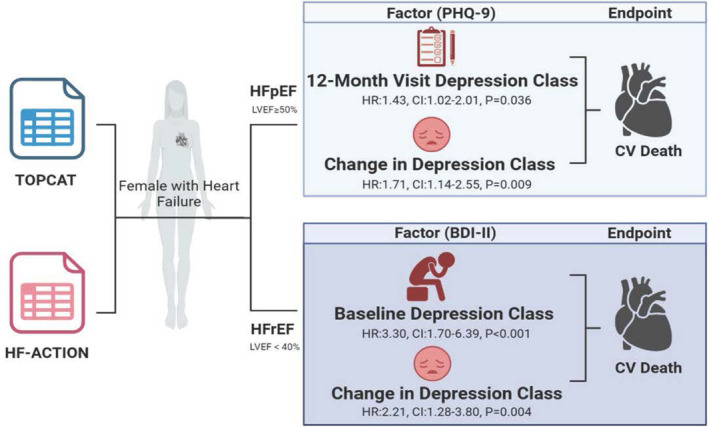
The prognostic value of depressive symptoms for cardiovascular death in female patients with HFpEF and HFrEF. Female patients with HFpEF from TOPCAT and with HFrEF from HF‐ACTION were included in this secondary analysis. For the outcome of cardiovascular death, both depression class at the 12‐month visit and depression class change were the dominant prognostic factors in female HFpEF patients. In female HFrEF patients, depression class at baseline and depression class change showed a significant prognostic effect on cardiovascular death. HF‐ACTION indicates Heart Failure: A Controlled Trial Investigating Outcomes of Exercise Training; HFrEF, heart failure with reduced ejection fraction; HFpEF, heart failure with preserved ejection fraction; and TOPCAT, Treatment of Preserved Cardiac Function Heart Failure with an Aldosterone Antagonist.
The present study builds upon prior work describing the association between depressive symptoms and other clinical outcomes. Although women are at high risk for depression in populations with HF, 22 , 23 relatively few studies have specifically focused on the association of depressive symptoms with clinical outcomes in women with HF, especially the incremental prognostic significance of the change in depressive symptoms over time. In this study, our results showed that the prognostic value of depressive assessments for the outcome of cardiovascular death was stable.
In the population with HFpEF, emotion management has been considered a promising strategy for improving outcomes, and our study confirmed that a change in depression class was a more significant prognostic factor for cardiovascular death than was depression class at 12 months (PHQ‐9 change HR, 1.71, P=0.009 versus PHQ‐9 visit 12‐month HR, 1.43, P=0.036). This association may be due to symptom overlap between depressive symptom changes and HF symptom changes. Compared with patients who are not depressed, those with depressive symptoms are more likely to develop habits that overlap with cardiovascular risk factors, such as unhealthy diet, sleep deprivation, physical inactivity, and even poor adherence to medication. 24 Moreover, previous studies have suggested that major depression is a predictor of all‐cause mortality in patients with HF, but minor depression is not. 25 Consistently, our study confirmed this phenomenon; in the population with HFpEF, the depression class at baseline had a stronger prognostic trend toward cardiovascular death than did the depression class change (BDI‐II base HR, 3.30, P<0.001 versus BDI‐II change HR, 2.21, P=0.004), and patients with severe depressive status at baseline had worse outcomes. These results suggested the role of depressive assessments in the outcome of cardiovascular death in populations with different types of HF. However, for the outcome of hospitalization for patients with HF, all 3 depressive assessments exhibited inconsistent prognostic significance in the primary and secondary analyses.
The present study is consistent with a previous report showing no statistically significant association between depression and the risk of rehospitalization in female patients with HFrEF. 11 Moreover, another study conducted by Wang et al. reported that different types of changes in depressive symptoms were inconsistent in predicting hospitalization in patients with HF. 26 This is most likely due to the delayed onset of symptoms of HF to hospitalization for participants with depressive symptoms. 27
In both the TOPCAT and HF‐ACTION cohorts, the factors associated with improved depressive symptoms included baseline depressive status and baseline KCCQ‐os score. Specifically, the improvement in depressive symptoms over 12 months was related to a worse baseline depressive status and a lower KCCQ‐os score, which was consistent with the findings of previous studies. 16 , 28 Previous studies have reported that health status, measured with the KCCQ, was an independent predictor of developing depressive symptoms in outpatients with HFrEF. 28 However, in our sensitivity analysis, we found that when the KCCQ‐os was removed, the predictive power of previous assessments of depressive symptoms for HF rehospitalization changed, particularly for patients with HFrEF, whose baseline depressive class and change in depressive class showed a significant association with HF hospitalization after excluding the KCCQ‐os. This may be due to the greater predictive contribution of the KCCQ‐os score for the outcomes of hospitalization in patients with HF than in depressive symptom assessments (Table S4). This change could be attributable to the greater relationship between health‐related quality of life and hospitalization for HF.
Pokharel et al. demonstrated that the KCCQ score, especially the most recent KCCQ score, was significantly associated with cardiovascular death and cardiovascular hospitalization in patients with HFpEF and HFrEF. 29 Another study also noted that KCCQ‐os was a strong predictor of the outcome of HF hospitalization in patients with HFpEF. However, neither of these studies detected an association between depressive symptoms and cardiovascular death or HF hospitalization. Importantly, the present study revealed differences in the ability of depressive symptoms and KCCQ scores to predict hospitalization in patients with HFpEF and in those with HFrEF.
In addition, compared with the improvement in depressive symptoms in female patients with HFrEF, the greater percentage of surviving patients who died of cardiovascular disease with aggravated depressive symptoms might be the reason for the worse depressive status at baseline in the improved group. However, for patients with HFpEF, the Kaplan–Meier curves revealed a trend toward better survival in the improved depressive symptoms group than in the aggravated depressive symptoms group (Figure S1). Therefore, our study demonstrated that, in female patients with HFrEF, depression at baseline was strongly associated with cardiovascular death, whereas in female patients with HFpEF, a change in depression exhibited a more significant prognostic trend. These findings suggested that clinicians need to be more attentive to changes in depressive symptoms in the clinical care of female patients with HFpEF and to prevent the appearance of severe depressive symptoms in female patients with HFrEF.
This study has several limitations. First, female patients with HF were selected from 2 trials, and depressive symptoms were measured by using the PHQ‐9 in the population with HFpEF and the BDI‐II in patients with HFrEF, which might have caused sample heterogeneity to some extent. Although previous studies have demonstrated that both the PHQ‐9 and BDI‐II have adequate reliability and convergent/discriminant validity and that the PHQ‐9 could be an alternative tool to the BDI‐II in screening for depression, 30 , 31 differences exist in the classification of severity and the smallest reduction in depressive symptoms. 31 , 32 However, whether these differences exist in populations with HF remains unclear. For this reason, we defined the change in depressive symptom scores as a categorical variable to standardize these differences. Second, the small sample size is an important limitation of this study; in the HF‐ACTION cohort, only 28% of the women were included in the trial, whereas in the TOPCAT cohort, only participants from the United States and Canada completed the PHQ‐9 questionnaire. It needs to be mentioned that the limited sample sizes are not sufficient for an analysis of other clinical outcomes, such as aborted cardiac arrest, myocardial infarction, or stroke. Therefore, the findings in this study need to be validated with additional clinical outcomes in larger cohorts. In addition, we selected only depressive symptoms at the 12‐month follow‐up, and the associations between depressive symptoms at longer follow‐up periods and clinical outcomes were not examined. In further studies, a longer follow‐up period will be needed to explore the changes in depressive symptom trajectories, which could provide improved prognostic value.
CONCLUSIONS
In female patients with HFrEF, the depression class at baseline was most strongly associated with cardiovascular death, whereas in female patients with HFpEF, the change in depression class exhibited a more significant prognostic trend. Compared with depressive symptom assessments, the KCCQ may be more strongly related to hospitalization in female patients with HFrEF.
Sources of Funding
This work was supported by the National Science Foundation of China (No. 82070254, 82200325, 82300277), Guangdong Basic and Applied Basic Research Foundation (No. 2023A1515010201, 2022A1515012522, 2022A1515012175, 2021A1515220122), Guangzhou Science and Technology Project (No. 202201011627) and High‐level Hospital Construction Project of Guangdong Provincial People's Hospital (DFJHBF202102, DFJH201902).
Disclosures
None.
Supporting information
Table S1–S4.
Figure S1.
Acknowledgments
We thank HF‐ACTION and TOPCAT trial investigators for conducting these trials, making these data available. We thank BioLINCC for approving our permissions for these 2 trials. Hengli Zhao and Zhixin Shan contributed to the article design. Hengli Zhao, Jiaxue Jiang, Guoheng Zhong, Yihong Wen, Yu Liang, and You Peng searched and collected the relative literature. Hengli Zhao, Guoheng Zhong, and You Peng wrote the original article. Hengli Zhao and Zhixin Shan revised and finalized the article.
This article was sent to Tiffany M. Powell‐Wiley, MD, MPH, Associate Editor, for review by expert referees, editorial decision, and final disposition.
Supplemental Material is available at https://www.ahajournals.org/doi/suppl/10.1161/JAHA.123.032961
For Sources of Funding and Disclosures, see page 9.
References
- 1. Sassarini DJ. Depression in midlife women. Maturitas. 2016;94:149–154. doi: 10.1016/j.maturitas.2016.09.004 [DOI] [PubMed] [Google Scholar]
- 2. Windle M, Windle RC. Recurrent depression, cardiovascular disease, and diabetes among middle‐aged and older adult women. J Affect Disord. 2013;150:895–902. doi: 10.1016/j.jad.2013.05.008 [DOI] [PMC free article] [PubMed] [Google Scholar]
- 3. Benros ME, Waltoft BL, Nordentoft M, Ostergaard SD, Eaton WW, Krogh J, Mortensen PB. Autoimmune diseases and severe infections as risk factors for mood disorders: a nationwide study. JAMA Psychiatry. 2013;70:812–820. doi: 10.1001/jamapsychiatry.2013.1111 [DOI] [PubMed] [Google Scholar]
- 4. Beurel E, Toups M, Nemeroff CB. The bidirectional relationship of depression and inflammation: double trouble. Neuron. 2020;107:234–256. doi: 10.1016/j.neuron.2020.06.002 [DOI] [PMC free article] [PubMed] [Google Scholar]
- 5. Sramek JJ, Murphy MF, Cutler NR. Sex differences in the psychopharmacological treatment of depression. Dialogues Clin Neurosci. 2016;18:447–457. doi: 10.31887/DCNS.2016.18.4/ncutler [DOI] [PMC free article] [PubMed] [Google Scholar]
- 6. Basile C, Parlati ALM, Paolillo S, Marzano F, Nardi E, Chirico A, Buonocore D, Colella A, Fontanarosa S, Cotticelli C, et al. Depression in heart failure with reduced ejection fraction, an undervalued comorbidity: an up‐to‐date review. Medicina (Kaunas). 2023;59:948. doi: 10.3390/medicina59050948 [DOI] [PMC free article] [PubMed] [Google Scholar]
- 7. Sbolli M, Fiuzat M, Cani D, O'Connor CM. Depression and heart failure: the lonely comorbidity. Eur J Heart Fail. 2020;22:2007–2017. doi: 10.1002/ejhf.1865 [DOI] [PubMed] [Google Scholar]
- 8. Ponikowski P, Voors AA, Anker SD, Bueno H, Cleland JGF, Coats AJS, Falk V, González‐Juanatey JR, Harjola VP, Jankowska EA, et al. 2016 ESC guidelines for the diagnosis and treatment of acute and chronic heart failure: the task force for the diagnosis and treatment of acute and chronic heart failure of the European Society of Cardiology (ESC). Developed with the special contribution of the heart failure association (HFA) of the ESC. Eur J Heart Fail. 2016;18:891–975. doi: 10.1002/ejhf.592 [DOI] [PubMed] [Google Scholar]
- 9. Writing Committee Members , Yancy CW, Jessup M, Bozkurt B, Butler J, Casey DE Jr, Drazner MH, Fonarow GC, Geraci SA, Horwich T, et al. 2013 ACCF/AHA guideline for the management of heart failure: a report of the American College of Cardiology Foundation/American Heart Association task force on practice guidelines. Circulation. 2013;15:e240–e327. doi: 10.1161/CIR.0b013e31829e8776 [DOI] [PubMed] [Google Scholar]
- 10. Gaffey AE, Cavanagh CE, Rosman L, Wang K, Deng Y, Sims M, O'Brien EC, Chamberlain AM, Mentz RJ, Glover LM, et al. Depressive symptoms and incident heart failure in the jackson heart study: differential risk among black men and women. J Am Heart Assoc. 2022;11:e022514. doi: 10.1161/JAHA.121.022514 [DOI] [PMC free article] [PubMed] [Google Scholar]
- 11. Piepenburg SM, Faller H, Störk S, Ertl G, Angermann CE. Symptom patterns and clinical outcomes in women versus men with systolic heart failure and depression. Clin Res Cardiol. 2019;108:244–253. doi: 10.1007/s00392-018-1348-6 [DOI] [PubMed] [Google Scholar]
- 12. Mehta LS. Cardiovascular disease and depression in women. Heart Fail Clin. 2011;7:39–45. doi: 10.1016/j.hfc.2010.08.005 [DOI] [PubMed] [Google Scholar]
- 13. Seckin M, Johnston B, Petrie MC, Stewart S, Chan YK. Characteristics of symptoms and symptom change across different heart failure subtypes: a sex‐stratified analysis. Eur J Cardiovasc Nurs. 2023;22:690–700. doi: 10.1093/eurjcn/zvac099 [DOI] [PubMed] [Google Scholar]
- 14. Pitt B, Pfeffer MA, Assmann SF, Boineau R, Anand IS, Claggett B, Clausell N, Desai AS, Diaz R, Fleg JL, et al. Spironolactone for heart failure with preserved ejection fraction. N Engl J Med. 2014;370:1383–1392. doi: 10.1056/NEJMoa1313731 [DOI] [PubMed] [Google Scholar]
- 15. O'Connor CM, Whellan DJ, Lee KL, Keteyian SJ, Cooper LS, Ellis SJ, Leifer ES, Kraus WE, Kitzman DW, Blumenthal JA, et al. Efficacy and safety of exercise training in patients with chronic heart failure: HF‐ACTION randomized controlled trial. JAMA. 2009;301:1439–1450. doi: 10.1001/jama.2009.454 [DOI] [PMC free article] [PubMed] [Google Scholar]
- 16. Chandra A, Alcala MAD, Claggett B, Desai AS, Fang JC, Heitner JF, Liu J, Pitt B, Solomon SD, Pfeffer MA, et al. Associations between depressive symptoms and HFpEF‐related outcomes. JACC Heart Fail. 2020;8:1009–1020. doi: 10.1016/j.jchf.2020.06.010 [DOI] [PubMed] [Google Scholar]
- 17. Moitra E, Anderson BJ, Stein MD. Reductions in cannabis use are associated with mood improvement in female emerging adults. Depress Anxiety. 2016;33:332–338. doi: 10.1002/da.22460 [DOI] [PubMed] [Google Scholar]
- 18. Whellan DJ, O'Connor CM, Lee KL, Keteyian SJ, Cooper LS, Ellis SJ, Leifer ES, Kraus WE, Kitzman DW, Blumenthal JA, et al. Heart failure and a controlled trial investigating outcomes of exercise training (HF‐ACTION): design and rationale. Am Heart J. 2007;153:201–211. doi: 10.1016/j.ahj.2006.11.007 [DOI] [PubMed] [Google Scholar]
- 19. Green CP, Porter CB, Bresnahan DR, Spertus JA. Development and evaluation of the Kansas City cardiomyopathy questionnaire: a new health status measure for heart failure. J Am Coll Cardiol. 2000;35:1245–1255. doi: 10.1016/S0735-1097(00)00531-3 [DOI] [PubMed] [Google Scholar]
- 20. Stekhoven DJ, Buhlmann P. MissForest—non‐parametric missing value imputation for mixed‐type data. Bioinformatics. 2012;28:112–118. doi: 10.1093/bioinformatics/btr597 [DOI] [PubMed] [Google Scholar]
- 21. Jiang W, Alexander J, Christopher E, Kuchibhatla M, Gaulden LH, Cuffe MS, Blazing MA, Davenport C, Califf RM, Krishnan RR, et al. Relationship of depression to increased risk of mortality and rehospitalization in patients with congestive heart failure. Arch Intern Med. 2001;161:1849–1856. doi: 10.1001/archinte.161.15.1849 [DOI] [PubMed] [Google Scholar]
- 22. Stewart GC, Cascino T, Richards B, Khalatbari S, Mann DL, Taddei‐Peters WC, Baldwin JT, Jeffries NO, Spino C, Stevenson LW, et al. Ambulatory advanced heart failure in women: a report from the REVIVAL registry. JACC Heart Fail. 2019;7:602–611. doi: 10.1016/j.jchf.2019.02.007 [DOI] [PMC free article] [PubMed] [Google Scholar]
- 23. Moradi M, Doostkami M, Behnamfar N, Rafiemanesh H, Behzadmehr R. Global prevalence of depression among heart failure patients: a systematic review and meta‐analysis. Curr Probl Cardiol. 2022;47:100848. doi: 10.1016/j.cpcardiol.2021.100848 [DOI] [PubMed] [Google Scholar]
- 24. Bucciarelli V, Caterino AL, Bianco F, Caputi CG, Salerni S, Sciomer S, Maffei S, Gallina S. Depression and cardiovascular disease: the deep blue sea of women's heart. Trends Cardiovasc Med. 2020;30:170–176. doi: 10.1016/j.tcm.2019.05.001 [DOI] [PubMed] [Google Scholar]
- 25. Fan H, Yu W, Zhang Q, Cao H, Li J, Wang J, Shao Y, Hu X. Depression after heart failure and risk of cardiovascular and all‐cause mortality: a meta‐analysis. Prev Med. 2014;63:36–42. doi: 10.1016/j.ypmed.2014.03.007 [DOI] [PubMed] [Google Scholar]
- 26. Wang B, Lei L, Zhang H, Miao F, Zhang L, Tian A, Li J. Change in depressive symptoms during the first month of discharge and 1‐year clinical outcomes in patients hospitalized for heart failure. J Am Heart Assoc. 2022;11:e027438. doi: 10.1161/JAHA.122.027438 [DOI] [PMC free article] [PubMed] [Google Scholar]
- 27. Khodneva Y, Goyal P, Levitan EB, Jackson EA, Oparil S, Sterling MR, Cherrington AL, Durant R, Safford MM. Depressive symptoms and incident hospitalization for heart failure: findings from the REGARDS study. J Am Heart Assoc. 2022;11:e022818. doi: 10.1161/JAHA.121.022818 [DOI] [PMC free article] [PubMed] [Google Scholar]
- 28. Havranek EP, Spertus JA, Masoudi FA, Jones PG, Rumsfeld JS. Predictors of the onset of depressive symptoms in patients with heart failure. J Am Coll Cardiol. 2004;44:2333–2338. doi: 10.1016/j.jacc.2004.09.034 [DOI] [PubMed] [Google Scholar]
- 29. Pokharel Y, Khariton Y, Tang Y, Nassif ME, Chan PS, Arnold SV, Jones PG, Spertus JA. Association of serial kansas city cardiomyopathy questionnaire assessments with death and hospitalization in patients with heart failure with preserved and reduced ejection fraction: a secondary analysis of 2 randomized clinical trials. JAMA Cardiol. 2017;2:1315–1321. doi: 10.1001/jamacardio.2017.3983 [DOI] [PMC free article] [PubMed] [Google Scholar]
- 30. Schutt PE, Kung S, Clark MM, Koball AM, Grothe KB. Comparing the beck depression inventory‐II (BDI‐II) and patient health questionnaire (PHQ‐9) depression measures in an outpatient bariatric clinic. Obes Surg. 2016;26:1274–1278. doi: 10.1007/s11695-015-1877-2 [DOI] [PubMed] [Google Scholar]
- 31. Titov N, Dear BF, McMillan D, Anderson T, Zou J, Sunderland M. Psychometric comparison of the PHQ‐9 and BDI‐II for measuring response during treatment of depression. Cogn Behav Ther. 2011;40:126–136. doi: 10.1080/16506073.2010.550059 [DOI] [PubMed] [Google Scholar]
- 32. Kounali D, Button KS, Lewis G, Gilbody S, Kessler D, Araya R, Duffy L, Lanham P, Peters TJ, Wiles N, et al. How much change is enough? Evidence from a longitudinal study on depression in UK primary care. Psychol Med. 2022;52:1875–1882. doi: 10.1017/S0033291720003700 [DOI] [PMC free article] [PubMed] [Google Scholar]
Associated Data
This section collects any data citations, data availability statements, or supplementary materials included in this article.
Supplementary Materials
Table S1–S4.
Figure S1.