. 2024 Jun 17;132(6):067004. doi: 10.1289/EHP13947

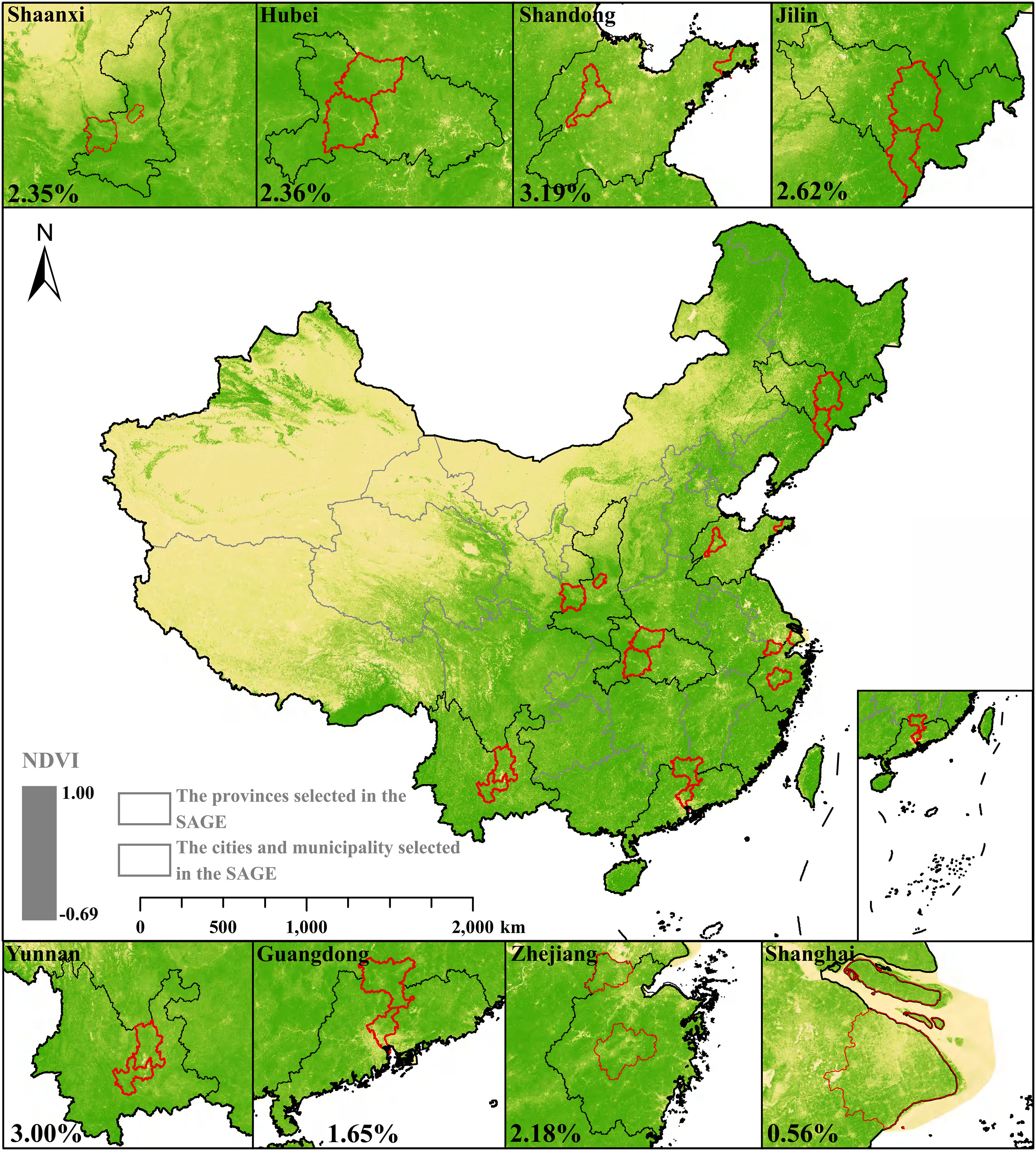
Figure 1.

Figure 1 is a map of China. At the center, the map depicts the annual average maximum normalized difference vegetation index during the Study on Global Ageing and Adult Health study period, including provinces where the study was conducted and cities and municipalities where the study was conducted. A scale depicts maximum normalized difference vegetation index ranges from negative 0.69 to 1.00 in increments of 1.31. A scale depicts the kilometer ranges from 0 to 1,000 in increments of 500 and 1,000 to 2,000 in increments of 1,000. On the top and bottom, there are four maps that display the percentage of each chosen province or municipality that represents the incidence rate of depression throughout the research period. The provinces are: Shaanxi with 2.35 percent, Hubei with 2.36 percent, Shandong with 3.19 percent, Jilin with 2.62 percent, Yunnan with 3.00 percent, Guangdong with 1.65 percent, Zhejiang with 2.18 percent, and Shanghai with 0.56 percent.

Annual average maximum NDVI across China during the SAGE study period (2007–2018). In the figure, the color shades of yellow and green represent the NDVI, the black ranges represent the provinces where the study was conducted, and the red ranges represent the cities and municipality where the study was conducted. The percentage in each selected province/municipality indicates the incidence rate of depression during the study period. The figure was produced using R software based on the background map (https://www.resdc.cn), NDVI data (http://www.nesdc.org.cn), and results from the study. Note: NDVI, normalized difference vegetation index; SAGE, Study on Global Ageing and Adult Health.