



Abstract
Objective
This study aims to examine how variation in physicians' treatment decisions for newborn deliveries responds to changes in the hospital‐level norms for obstetric clinical decision‐making.
Data Sources
All hospital‐based births in Florida from 2003 through 2017.
Study Design
Difference‐in‐differences approach is adopted that leverages obstetric unit closures as the source of identifying variation to exogenously shift obstetricians to a new, nearby hospital with different propensities to approach newborn deliveries less intensively.
Data Extraction
Births attributed to physicians continuously observed 2 years before the closure event and 2 years after the closure event (treatment group physicians) or for identical time periods around a randomly assigned placebo closure date (control group physicians).
Principal Findings
All of the physicians meeting our inclusion criteria shifted their births to a new hospital less than 20 miles from the hospital shuttering its obstetric unit. The new hospitals approached newborn births more conservatively, and treatment group physicians sharply became less aggressive in their newborn birth clinical management (e.g., use of C‐section). The immediate 11‐percentage point (33%) increase in delivering newborns without any procedure behavior change is statistically significant (p value <0.01) and persistent after the closure event; however, the physicians' payer and patient mix are unchanged.
Conclusions
Obstetric physician behavior change appears highly malleable and sensitive to the practice patterns of other physicians delivering newborns at the same hospital. Incentives and policies that encourage more appropriate clinical care norms hospital‐wide could sharply improve physician treatment decisions, with benefits for maternal and infant outcomes.
Keywords: newborn deliveries, obstetric unit closures, obstetrics, physician practice patterns
What is known on this topic
Wide variation in approaches to newborn deliveries, especially use of C‐section
Limited understanding of what drives these stark differences in physician practice patterns
Under‐explored influence is the surrounding clinical norms existing within a given physician's care environment
What this study adds
Leveraging a unique study design, hospital environment causally impacts physician treatment intensity
Moving physicians into a more conservative practice environment, sharply and persistently reduces their procedural interventions for newborn mothers
Physician behavior changes appear driven by environment, as opposed to payer or patient mix shifts
1. INTRODUCTION
The formation and evolution of physician practice styles are areas of long‐standing research interest—including whether a given physician's treatment approach diverges across patients with different insurance status. 1 , 2 , 3 , 4 , 5 , 6 , 7 , 8 , 9 , 10 , 11 Importantly, recent studies have highlighted the profound influence of the healthcare environment on physician practice patterns, which can substantively shape overall medical utilization and spending levels in a given area. 5 , 12 , 13 , 14 , 15
We build on these existing ideas and empirical findings by leveraging a unique clinical context and source of identifying variation. Regarding the former, we narrow our focus to physician decision‐making around birth delivery options—namely whether to opt for a normal, vaginal delivery versus a more intensive (i.e., procedural intervention) approach. Births are one of the most common reasons for hospitalization, and associated maternal health outcomes, including gaping disparities across patient populations, remain key problems for the US healthcare system. 16 Cesarean section (“c‐section”) procedure use, in particular, demonstrates striking variation across and within healthcare markets that is difficult to explain and often attributed to physician practice style. 3 , 17 , 18 It is also generally believed that too many c‐section deliveries take place in the United States, and overuse (i.e., not medically indicated) of the procedure can drive up medical expenditures as well as lead to negative downstream health consequences for mothers and newborns. 18 , 19 , 20
Related literature suggests that a physician's propensity to rely on more treatment‐intensive birth deliveries is shaped by external influences, which include prevailing financial incentives as well as malpractice liability risks. 21 , 22 , 23 , 24 , 25 , 26 , 27 , 28 , 29 Physician‐specific exposures, such as previous experience with patient complications and malpractice cases also seem to matter. 30 , 31 , 32 , 33 Yet, these estimates generally portray small‐to‐modest effects that are sometimes short‐lived. Moreover, plausibly influential periods of human capital accumulation appear to have minimal bearing on a given obstetrician's practice style. For example, Epstein and Nicholson 3 find that residency training accounts for a vanishingly small amount of variation in physicians' c‐section proclivities. Likewise, Epstein, Nicholson, and Asch 34 show that own experience and observable initial skill explain only a small fraction of the variance in obstetrician performance. Taken together, much of physicians' widely differing treatment styles and outcomes for newborn deliveries remain poorly understood.
We consequently take a different approach and ask whether physicians' immediate clinical surroundings (i.e., the group of other obstetricians working in the same hospital) shape their approach in the delivery room. To motivate this empirical inquiry, we show in Figure 1 the relationship between each individual physician's non‐intensive delivery rate relative to their peers working in the same hospital. The scatter plot suggests that physician practice patterns are strongly correlated with average facility practice patterns, observed by the clustering of dots along the 45‐degree line (correlation coefficient = 0.513). In other words, physicians who tend to deliver babies more conservatively also tend to work in facilities where their peers demonstrate a similar practice style.
FIGURE 1.
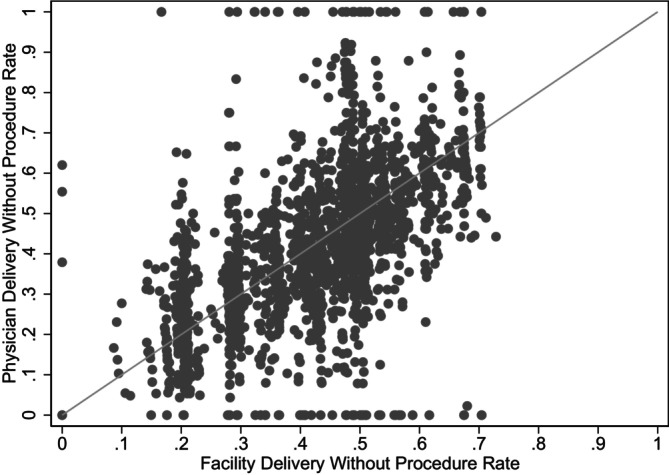
Scatter plot of physician delivery treatment intensity versus peer physician treatment intensity at the same hospital. Each dot represents a physician who performed deliveries at a Florida hospital in 2010 and that physician's matched hospital‐based obstetric unit. The “deliveries without procedures rate” is calculated as the number of deliveries where no additional procedure was performed (e.g., no c‐section, vacuum, forceps, or other procedure) divided by all deliveries performed. The physician's rate is based on all facilities at which the physician performed deliveries in 2010. The corresponding facility rate is based on all other physicians' rates, excluding the “own” physician's rate, during 2010. Correlation coefficient is 0.513. The slope for the line of best fit is 0.791 (SE = 0.029).
An obvious challenge to establishing a causal connection is the underlying selection process for where physicians choose to perform their medical duties, or in this context, deliver newborns. We address this empirical difficulty by exploiting a contemporary health policy issue that is also highly relevant to our physicians of interest: obstetrics (i.e., labor and delivery) unit closures. A growing wave of hospital obstetrics unit closures has taken place throughout the US healthcare system, especially in areas challenged by deteriorating hospital finances and staffing shortages. 35 , 36 , 37 , 38 , 39 , 40 , 41 , 42 We leverage observed market exits in our analytic data as an exogenous shock to the chosen hospital utilized by affected physicians. Put differently, we use the closure event as a forced relocation that shifts the physician into a new obstetrics setting to test if preexisting practice patterns persist or subsequently conform to the new clinical surroundings.
Our source of identifying variation is similar in spirit to recent related work and offers additional advantages. Previous studies have used variation in the healthcare environment due to patients' or physicians' migration patterns across different geographies. 5 , 12 , 15 While the approach benefits from the widely varying practice styles and market structures across the US healthcare system, as Badinski et al. 15 and others have noted, such moves can be correlated with both supply and demand factors—including underlying and unobservable patient or physician preferences. In our setting, physician relocation is predicated by a hospital‐level business decision that necessitates a physician move—akin to recent empirical work using market exits to study the functioning of US health insurance programs. 43 , 44 Moreover, in our setting, all physicians reallocating deliveries from one closing obstetric unit to another obstetrics unit do so within a 20‐mile radius. The proximity of the destination facility results in arguably limited‐to‐no change in patient demand, and the hospital‐imposed action to close the obstetrics unit reduces concerns over the underlying selection into practice relocation. These unique analytic features can subsequently strengthen our inferences regarding the direct impact of practice environment on individual physician treatment intensity, which speaks to the malleability of physician practice style and incentive structures that could help drive better medical decision‐making and population health outcomes.
2. DATA AND METHODS
2.1. Data
We use data provided by the Florida Agency for Healthcare Administration (AHCA), which contains the all hospital discharges from Florida. This quarterly data spans a full decade and a half (from 2003 to 2017) and includes information on hospital identifiers, physician identifiers, patient characteristics, all diagnosis codes, and all procedure codes for each hospital discharge taking place in the state and belonging to any payer group (including the uninsured). Of note, this dataset offers several key advantages. Because we observe the all hospital deliveries that a physician clinically manages, we can create accurate measures of physician‐specific treatment behavior across all relevant patients—and hence capture a complete and accurate representation of true treatment intensity and how it evolves over time. In comparison, HCUP State Inpatient Databases do not contain needed provider identifiers that would facilitate similar analyses. Commercial claims databases that follow a select number of insurers risk conflating changes in obstetrics care with changes in network design and inherently have an incomplete view of a given physician's practice patterns—which can even vary within the commercial payer subset of a physician's practice (i.e., across the different private insurers, and hence incentive structures, that contract with the relevant physician). While Medicaid administrative claims could theoretically offer a wider geographic scope of data, the necessary data rest with Medicaid managed care insurers that can also differ across states and typically do not make such data readily available to researchers. Additionally, southern US states, including Florida, demonstrate some of the highest c‐section rates in the country. 20 For example, in 2021, Florida had a 54% higher c‐section delivery rate compared to the US state with the lowest c‐section rate. 45 Thus, even beyond serving as a rare source of the necessary and comprehensive clinical data, examining the specific impact of forced relocations on newborn delivery procedural intensity in Florida can provide needed insight into factors that affect physicians' decision‐making in particularly important clinical and health policy settings.
Using the patient's primary procedure International Classification of Disease (ICD) code (ICD‐9 until the data admnistrators transitioned to ICD‐10 starting in 2015 and beyond) for our universe of Florida hospital‐based births, we identify the type of delivery and classify it into one of three mutually exclusive groups: delivery without any procedure, delivery relying on a c‐section procedure, or delivery relying on another (non‐cesarean section) obstetric procedure(s) as detailed in Appendix Table A1. We then leverage our discharge records to identify the specific timing of obstetric unit market exits between 2003 and 2017 among hospitals that otherwise remain in operation. The latter restriction ensures that we can isolate the effects of a targeted unit closure affecting our physicians of interest from broader implications following a full hospital closure. 46
We consider an obstetric unit operational (i.e., open) as long as it carries out at least one delivery in a given quarter‐year and closed otherwise. We then focus on units that remained continuously closed for more than two quarters and were previously continuously open for at least 3 years (12 quarters) immediately before the quarter‐year of market exit. The former restriction aims to avoid temporary shutdowns and/or slow business quarters—especially among low‐volume hospitals. The latter restriction serves two purposes. It ensures that the obstetric unit was a relevant market participant (i.e., providers and mothers regularly received maternal and neonatal care at the location), and it guarantees sufficient pre‐closure data to capture physician behavior well before any forced relocations occur. We ultimately observe four closures in total, which take place in four separate counties that span from the northern to the southern edge of the state. To illustrate the “shock” nature of the observed closures, Appendix Figure A1 displays the number of births over time for each closing obstetric unit. Rather than a shallow decline over time, the birth volumes precipitously drop in the months immediately preceding closure (Panel A). Panel B in Appendix Figure A1 also demonstrates that the treatment intensity style of each unit is roughly constant over time.
2.2. Stacked difference‐in‐differences analyses
To empirically identify the effects of changing obstetricians' delivery environment (i.e., the peer providers and hospital clinical norms that they are exposed to), we take advantage of the observed unit closures noted above to generate a difference‐in‐differences (DiD) empirical strategy based on the presence or absence of forced relocations for the relevant Florida physicians. Our treatment group physicians deliver newborns at an obstetric unit in the quarter before the unit shuts down, according to the previously stated closure definition requirements. Our control group physicians are those who only perform deliveries at obstetric units that remained continuously open for our entire analytic time frame (i.e., incumbent and stable hospital labor and delivery units from 2003 through 2017). We then compare physician behavior across these two groups for 2 years before and 2 years after the obstetric unit closure events of interest.
Given that there is no natural counterfactual “treatment” date to apply to our control group and to circumvent known challenges with differential (i.e., “staggered”) timing in treatment, we ultimately employ a “stacked” DiD strategy—a causal inference approach that protects against inappropriate comparisons in a two‐way fixed effects DiD setup with heterogeneous treatment timing, which has been leveraged in a variety of contemporary analyses, including those focused on healthcare specific contexts. 47 , 48 , 49 Using a uniform distribution, we randomly select a treatment date between the third quarter of 2008 (our earliest obstetric unit closure) and the first quarter of 2014 (our latest obstetric unit closure) and randomly assign an anchor date (i.e., an artificial treatment date) to each potential control group physician. We then restrict all included treatment and control group physicians to those continuously present in our dataset eight quarters before and eight quarters after their true treatment date or randomly assigned anchor date. Doing so provides a balanced panel of physicians, with equal contributions of pre‐ and post‐period data for each observational unit.
Our resulting analytic sample consists of a treatment group of 20 physicians experiencing an obstetric unit closing—and hence a forced practice relocation—from one of four different hospitals between 2008 and 2014. Notably, this group of physicians represents the vast majority of physicians exposed to the unit closures—specifically, 79% of relevant obstetricians remain in the Florida dataset after their previous obstetric unit exits the market. The residual 21% of physicians, who are no longer present in the discharge records, either ceased hospital‐based deliveries (e.g., shifted exclusively to stand‐alone birthing centers), migrated out of state, or retired from clinical practice involving maternal deliveries and newborn care. To illustrate the impact of closure on these physicians, in Appendix Figure A2, we plot the percentage of births that treated physicians perform at their closing units over time. On average, 70%–80% of births take place at the closing unit until one quarter prior to shut down—at which point some, but not all, births shift to other facilities. We also note that the destination obstetric units (i.e., the units the physicians shift deliveries to post‐closure) are uniformly higher birth volume hospitals.
The control, comparison group is made up of 654 unique physicians who deliver newborns at one or more of the 89 obstetric units that remain consistently open for the full study period. Of note, 91 unique OB units were consistently in operation from 2003 through 2017. However, two of them do not contribute any physicians that can satisfy the inclusion criteria for the analytic sample—specifically the balanced panel requirement for an observed physician.
We analyze several physician behavior margins of interest at the quarterly level. Specifically, we examine changes in the number of hospitals at which the physician performs deliveries, the total number of deliveries performed, the rates of specific delivery approaches (i.e., our three mutually exclusive classifications according to procedural intensity listed in the Data section and fully detailed in Appendix Table A1), and the characteristics of the birthing mothers the physician serves.
Our stacked DiD specification is given by:
| (1) |
The treat variable equals one for our treatment group physicians and zero otherwise. The binary post variable takes the value of “1” for all quarters including and after the obstetric unit closure or randomly assigned anchor date in the stacked analytic sample. We include quarterly fixed effects (), which span (−8, +8) quarters around the treatment (anchor) dates, and physician fixed effects ().
We also employ an event study specification to assess additional nuances of the impact of forced relocations as well as assess the common trends assumption for the stacked DiD research design. Our event study estimation is as follows:
| (2) |
In this specification, captures our event time difference‐in‐differences parameters, and and capture the vectors of quarterly and physician fixed effects, defined just as before in Equation (1). Well‐behaved pre‐period coefficients near zero and lacking statistical significance would validate the common trends assumption and suggest that the control group physicians are providing reasonable counterfactuals for our treated obstetricians who are ultimately forced to provide birth‐related medical care in a new hospital environment. Moreover, the event study results can illuminate the sharpness and persistency of any physician behavior changes, which helps to disentangle care disruption effects from clinical environment effects. The former should be transient while the latter should demonstrate persistency over time. Standard errors are clustered at the physician level throughout our estimations.
3. RESULTS
Within Table 1, we first compare and contrast the four observed obstetric unit closures against the 91 hospitals offering labor and delivery services uninterrupted over the 2003–2017 period. We then examine our analytic sample physicians (i.e., those who experienced a closure event and those who did not).
TABLE 1.
Facility and physician‐level quarterly summary statistics.
| Characteristics of OB units | Characteristics of physicians | |||
|---|---|---|---|---|
| OB units prior to closure | OB units consistently open | Treated physicians for stacked DiD | Randomly chosen control group for stacked DiD | |
| (1) | (2) | (3) | (4) | |
| No. OB units | 4 | 91 | — | — |
| No. OBGYNs per facility | 7 | 18.4 | — | — |
| No. births per facility | 160.8 | 471.5 | — | — |
| Total no. OBGYNs | — | — | 20 | 654 |
| No. facilities per OBGYN | — | — | 1.5 | 1.3 |
| No. births per OBGYN | — | — | 35.3 | 38.0 |
| Patient mix | Mean (SD) | Mean (SD) | Mean (SD) | Mean (SD) |
|---|---|---|---|---|
| Age | 28.4 (1.5) | 27.5 (1.5) | 28.6 (2.3) | 28.5 (2.6) |
| (%) | (%) | (%) | (%) | |
|---|---|---|---|---|
| White | 55.5 | 43.3 | 39.8 | 46.4 |
| Medicaid insurance | 43.8 | 53.7 | 37.5 | 40.1 |
| Private insurance | 48.4 | 38.4 | 54.8 | 52.9 |
| Other insurance categories | 7.8 | 7.9 | 7.7 | 7.0 |
| Hypertension | 9.6 | 10.2 | 10.6 | 10.7 |
| Overweight/Obese | 1.9 | 3.1 | 1.7 | 3.2 |
| Procedure mix | (%) | (%) | (%) | (%) |
|---|---|---|---|---|
| Delivery without procedure | 34.8 | 46.3 | 34.6 | 40.5 |
| C‐Section | 48.4 | 40.9 | 49.1 | 47.7 |
| Other obstetric procedures (excluding c‐section) | 16.8 | 12.8 | 16.2 | 11.8 |
Note: Analytic data are at the quarterly level and include the universe of obstetrics and gynecology (OBGYN) physicians delivering newborns in a hospital setting in Florida. Columns (1) and (2) show characteristics of OB units calculated across all physicians working in those facilities. Statistics reflect either the fourth quarter (i.e., 1 year) prior to the OB unit's closure (column [1]) or the average across all time periods of our data from the first quarter of 2003 to the fourth quarter of 2017 for consistently open OB units (column [2]). Column (3) and (4) show characteristics of our treated and control physicians (defined in the Data and Methods section). Statistics reflect data in the fourth quarter prior to either the OB unit's closure for treated physicians (column [3]) or the randomly assigned anchor date for control physicians (column [4]). Additionally, the number of physicians is restricted to those who were present 2 years before and 2 years after the obstetric (OB) unit closure (treatment group) or a randomly assigned anchor date among physicians performing deliveries at consistently open OB units (control group). The other insurance categories include the uninsured, TRICARE, and Medicare among others. Obstetrical procedures include forceps and vacuum among others.
Prior to closure, the affected obstetric units are responsible for 66% fewer births than the consistently open obstetric units—though the ratio of births per OBGYN is nearly identical across the two types of units. Their payer mix is also more tilted toward privately insured mothers, and mothers' health risk characteristics are either the same or somewhat more favorable than those that never exit the market. Importantly, some of the starkest differences are related to the treatment style for a given birth. Specifically, the obstetric units that eventually shut down tended to be more intensive in their approach at baseline. For example, a birth taking place in a unit that will eventually shutter is 25% less likely to be a low‐intensity delivery (i.e., a delivery absent any formal medical procedure for the mother). Likewise, when comparing physicians from our two stacked DiD analytic groups, the observable characteristics tend to align, except for the summary statistics tied to birth procedure rates. Treatment group physicians are more intensive before they experience the loss of their obstetric unit. Of note, Battaglia 40 and Fischer, Royer, and White 42 also find that areas experiencing obstetric unit closures were typically more aggressive with clinical interventions, especially the use of C‐section, when examining national birthing records. This implies that our Florida setting is at least plausibly representative of broader healthcare market environments across the United States.
Figure 2 contains our key DiD event study findings. Panel A shows clear and unsurprising anticipatory behavior during the one quarter before the obstetric unit's market exit. Specifically, affected physicians, on average, find a substitute hospital to divert their deliveries, which aligns with the pattern belonging to Appendix Figure A2. Sixteen of the 20 treatment group physicians begin using a new facility for births while the remaining four do not shift births to a novel facility post‐closure, but instead, reallocate births to an obstetrics unit they previously used. Once the closure is complete (t = 0 and beyond in Panel A), the average number of unique obstetric units the physician relies upon returns to its pre‐closure trend. Importantly, 100% of the physician‐new facility pairs we observe occur within 20 miles of the closed obstetrics unit—indicating modest relocation changes in terms of distance and market geography.
FIGURE 2.
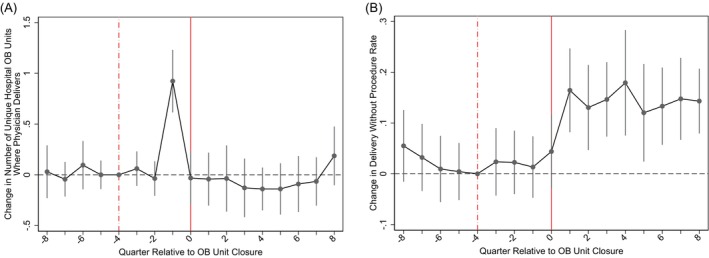
Event study estimates for obstetrics (OB) unit closure effect. Panel A: Number of unique hospital OB units where physician delivers. Panel B: Rate of delivery with no procedure. In Panel A, the outcome variable is determined by the unique number of hospital facility identifiers at which a physician performs deliveries. In Panel B, the “deliveries without procedures rate” is calculated as the number of deliveries where no additional procedure was performed (e.g., no c‐section, vacuum, forceps, or other procedure) divided by all deliveries performed. All stacked DiD estimations include physician fixed effects. Vertical bars represent the 95% confidence intervals. Standard errors are clustered at the physician level.
Panel B captures changes in the physicians' low‐intensity (i.e., procedure‐less) birth rate. The treatment and control group physicians track each other well prior to the closure event (t—8 through t—1), but then there is a sharp increase in the share of births that do not involve any procedural interventions for the mother. The full effect occurs within the first quarter following their previous obstetric unit's closure, and the effect's magnitude is large. Specifically, the affected obstetricians increase their delivery rates without any procedures by 11 percentage points, translating to a 33% increase in the likelihood of opting for a low‐intensity birth approach compared to their baseline propensity to do so (Table 1). The physician behavior changes also persist over subsequent years following the forced practice relocation, which is inconsistent with changes due to care delivery disruptions but supportive of a clinical care environment effect interpretation.
Table 2 demonstrates that the increase in low‐intensity births comes from nearly equal reductions in c‐section deliveries (5.6 percentage points) and non‐cesarean procedural approaches (5.8 percentage points). These magnitudes translate to an 11% reduction in C‐section and a 36% reduction in the use of other non‐cesarean obstetric procedures for affected physicians. There is no detectable effect on the total number of deliveries the physician is responsible for after experiencing the unit closure. The corresponding event study plots in Appendix Figure A3 also show parallel pre‐trends and a sharp dip within the first quarter following the obstetric unit's closure for the c‐section and other procedure outcomes. Appendix Table A2 breaks out the other procedure composite category and provides summary statistics paralleling Table 1. Appendix Table A3 offers accompanying DiD estimates for each specific procedure, which are all negatively signed and statistically significant for three out of the four procedure types.
TABLE 2.
Difference‐in‐difference estimates for obstetrics unit closure effect.
| Deliveries without procedure rate | C‐Section rate | Other obstetrical procedure rate | Total deliveries | Deliveries without procedure rate | |
|---|---|---|---|---|---|
| (1) | (2) | (3) | (4) | (5) | |
| Treat × Post | 0.114*** (0.0229) | −0.0563*** (0.0164) | −0.0580*** (0.0128) | 4.776 (4.052) | |
| Facility difference × Post | 0.811*** (0.112) | ||||
| Observations (N) | 11,458 | 11,458 | 11,458 | 11,458 | 11,458 |
Note: “Treat” refers to physicians who experienced the closure of an OB unit where they performed deliveries. The control group consists of physicians who did not experience an OB unit closure and were present for 2 years before and after their randomly assigned treatment dates. Each estimation uses the stacked DiD analytic data with physician fixed effects. There are 674 unique physicians belonging to the analytic data. Standard errors clustered at the physician level. In Column (5), we calculated the difference in the facility delivery without procedure rate between the subsequent obstetric unit and the closing obstetric unit (also displayed in Appendix Figure A5). For four physicians who moved to more than one subsequent facility, we calculated their weighted average facility rate. The facility difference measure for the control group is zero. We then show the interacted difference‐in‐difference result. *** p value < 0.01 ** p value < 0.05.
Within Table 3, it is evident that the health risks belonging to the mother—as measured by age, race, hypertension status, and overweight or obese status—and the physician's payer mix—as measured by the share of mothers with private versus Medicaid insurance—are not differentially affected by the loss of the obstetric unit. In other words, adopting a more conservative (i.e., less intensive) practice style does not coincide with a different mix of pregnancy patients cared for by the obstetrician. These results align with findings from Shurtz 32 that show obstetricians persistently adjusting their c‐section tendencies after experiencing a personal malpractice event, despite their patient composition holding constant and no change in the number of patients seen (as demonstrated in Table 2). We also examined in‐hospital maternal mortality in our stacked DiD setup; however, this outcome is extremely rare in the data, and there are no appreciable changes after the physicians' forced relocations (results available by request).
TABLE 3.
Obstetrics unit closure effects on patient and payer mix.
| Panel A: All deliveries | ||||||
|---|---|---|---|---|---|---|
| Age | White | Hyperten‐sion | Overwt./Obese | Private insurance | Medicaid insurance | |
| (1) | (2) | (3) | (4) | (5) | (6) | |
| Treat × Post | −0.270 (0.256) | 0.00576 (0.0224) | 0.0141 (0.00819) | 0.0177 (0.0112) | −0.00880 (0.0316) | 0.0122 (0.0317) |
| Observations (N) | 11,458 | 11,458 | 11,458 | 11,458 | 11,458 | 11,458 |
| Panel B: Deliveries without procedures | ||||||
|---|---|---|---|---|---|---|
| Age | White | Hyperten‐sion | Overwt./Obese | Private insurance | Medicaid insurance | |
| (7) | (8) | (9) | (10) | (11) | (12) | |
| Treat × Post | −0.239 (0.395) | 0.00993 (0.0232) | 0.0141 (0.0127) | 0.00960 (0.00667) | 0.0236 (0.0363) | −0.0189 (0.0386) |
| Observations (N) | 11,223 | 11,215 | 11,223 | 11,223 | 11,223 | 11,223 |
Note: “Treat” refers to physicians who experienced the closure of an OB unit where they performed deliveries. The control group consists of physicians who did not experience an OB unit closure and were present for 2 years before and after their randomly assigned treatment dates. Each estimation uses the stacked DiD analytic data with physician fixed effects. Standard errors clustered at the physician level. *** p value < 0.01 ** p value < 0.05.
Appendix Figure A4 illustrates a plausible mechanism for the previously observed provider behavior changes. We narrow our focus to the pre‐match and post‐match delivery approaches between our treatment group physicians and their matched hospital obstetric units where they practiced. For each physician, we calculate facility delivery rates across all other obstetricians in the facility, excluding the physician's own practice behavior. In Panel A, we examine each treated physician's delivery rate without procedures in the 2 years prior to their original obstetric unit closing relative to their closing facility's delivery rate without procedures.
Consistent with Figure 1, we see the general tendency for physicians to mirror the prevailing practice style of the hospital where they perform deliveries at baseline. Physicians approach deliveries more intensively within hospitals that, in the aggregate, have more procedure‐intensive births. However, in Panel B, there is a clear disconnect between the physician's baseline delivery style and the delivery style in the obstetric unit where they will eventually reallocate births to once their previous unit has shuttered. Among the physician and “eventual new facility” pairs, 85% of physicians have a pre‐closure low‐intensity (i.e., procedure‐less) delivery rate that is lower than the corresponding rate at the new facility where they will ultimately migrate deliveries. Put differently, as our summary statistics alluded to, our treatment group physicians overwhelmingly transitioned to hospitals that approach births more conservatively, with respect to procedural interventions for birthing mothers. The practice style discrepancy is largely erased once the transition has taken place. Depicted in Appendix Figure A4 (Panel C), in the 2 years following their previous obstetric units' closures, physician practice styles converge toward their new facilities' rates. Consistent with the DiD results presented in Figure 2 (Panel B), the obstetricians adopt the aggregate delivery approach of their new hospitals' obstetric units—even though their patients' payer status and observable health risk status are unchanged (Table 3).
To further underscore the role of facility‐level practice norms, we conducted a supplementary DD analysis that replaced the “treat” indicator in Equation (1) with a continuous variable that measures the difference between each physician's facility pre‐ and post‐closure share of births that are low‐intensity (i.e., procedure‐free) and hence transformed the estimating equation into a “treatment intensity” DD approach. For the four treatment group physicians that moved to more than one subsequent facility, we calculated their post‐closure facility share as the weighted average across facilities. Physicians who did not experience a closure (i.e., our control group) had a zero value for this measure.
As our previous statistics demonstrated (Appendix Figure 4), the distribution in facility‐level changes among treated physicians (Appendix Figure A5) were skewed toward physicians moving from more procedure‐intensive birthing facilities to less procedure‐intensive facilities, though three physicians experienced the opposite. The DD coefficient interpretation belonging to Table 2, Column (5) implies that when physicians move from a closing facility with no procedure‐free deliveries (share = 0.0) to a subsequent facility where all deliveries are procedure‐free (share = 1.0), their own rate of deliveries without procedures would increase by 81 percentage points. Although this is an out‐of‐sample prediction (Appendix Figure A5), it provides additional supporting evidence that the degree of disconnect between physicians' prior treatment patterns and their new delivery location drives the amount of physician behavior change observed once the affected physicians have reallocated their patients to a new obstetrics unit.
4. DISCUSSION
A shrinking supply of labor and delivery units is a known and concerning trend across the United States. Earlier evidence indicated negative health consequences for mothers and infants following the loss of a local obstetrics unit. 50 , 51 However, recent studies find that while travel distances do increase, obstetric unit closures do not appear to harm infant or maternal health in the aggregate—though heterogeneity may exist. 40 , 42 , 52
We show another downstream effect of obstetric unit market exits: improved physician behavior. Estimates from our difference‐in‐differences strategy reveal that obstetricians' practice style is heavily influenced by their hospital environment. Within the first few months of delivering at a new and nearby hospital, physician behavior sharply adjusts to mirror the clinical norms within the obstetric unit they switch into. Because closing obstetric units and the physicians practicing there tended to be more aggressive with procedural interventions at baseline, the forced relocation leads to a substantial and persistent reduction in higher intensity deliveries for the affected physicians. In fact, these physicians become 33% more likely to deliver a newborn without relying on any c‐section or non‐cesarean procedure for the mother—despite their delivery volume, payer mix, and patient health‐risk composition remaining unchanged after the closure. These findings align well with Molitor 5 and Badinski et al. 15 in terms of the speed of physician behavior change after relocation.
Across the United States, hospital‐level c‐section rates range from single digits to over 50% of births. 18 In our data, the units closing tended to be more intensive than their surrounding hospital peers. The forced relocations for affected physicians cause them to adopt less intensive practice patterns, and the effects are large. For comparison, an extensive, multipronged, and statewide initiative in California took 5 years (i.e., 2014–2019) to lower the overall c‐section rate by three percentage points. 53 Fischer, Royer, and White find that residing in a county experiencing an obstetric unit closure leads to a one percentage point reduction in the likelihood of receiving a c‐section delivery.
Our findings point to the importance of the immediate clinical surroundings (i.e., hospital norms) in shaping provider behavior and are consistent with other results from the existing literature. For instance, Fischer, Royer, and White 42 find that mothers now giving birth in an outside county post‐closure are doing so at hospitals that are better resourced, have higher quality, and have a lower risk‐adjusted c‐section rate. Coupled with our results, the hospital environment appears to significantly matter, and payers and policymakers should consider ways to incentivize hospitals to establish more optimal maternal care norms (i.e., push the laggards toward the care delivery leaders)—especially when public payers have significant market clout. 54 , 55
Supporting information
Data S1. Supporting information.
ACKNOWLEDGMENTS
The authors thank the Florida Agency for Healthcare Administration (AHCA) for providing valuable data resources. AHCA was not responsible for any data analyses or interpretations. Richards and Shriver are also grateful for Baylor University's support of this research and her dissertation work. All opinions and remaining errors belong solely to the authors.
Chen AJ, Richards MR, Shriver R. Fitting in? Physician practice style after forced relocation. Health Serv Res. 2024;59(4):e14340. doi: 10.1111/1475-6773.14340
Authors listed in alphabetical order to signify equal contributions to the research work.
Contributor Information
Alice J. Chen, Email: alicejc@usc.edu.
Michael R. Richards, Email: michael.richards@cornell.edu.
REFERENCES
- 1. Phelps CE. Information diffusion and best practice adoption. In: Culyer AJ, Newhouse JP, eds. Handbook of Health Economics. Vol 1A. Elsevier Science B.V.; 2000:223‐264. [Google Scholar]
- 2. Grytten J, Sørensen R. Practice variation and physician‐specific effects. J Health Econ. 2003;22(3):403‐418. doi: 10.1016/s0167-6296(02)00105-4 [DOI] [PubMed] [Google Scholar]
- 3. Epstein AJ, Nicholson S. The formation and evolution of physician treatment styles: an application to cesarean sections. J Health Econ. 2009;28(6):1126‐1140. doi: 10.1016/j.jhealeco.2009.08.003 [DOI] [PubMed] [Google Scholar]
- 4. Currie J, MacLeod WB, Parys JV. Provider practice style and patient health outcomes: the case of heart attacks. J Health Econ. 2016;47:64‐80. doi: 10.1016/j.jhealeco.2016.01.013 [DOI] [PMC free article] [PubMed] [Google Scholar]
- 5. Molitor D. The evolution of physician practice style: evidence from cardiologist migration. Am Econ J Econ Pol. 2018;10(1):326‐356. doi: 10.1257/pol.20160319 [DOI] [PMC free article] [PubMed] [Google Scholar]
- 6. Cutler D, Skinner JS, Stern AD, Wennberg D. Physician beliefs and patient preferences: a new look at regional variation in health care spending. Am Econ J Econ Pol. 2019;11(1):192‐221. doi: 10.1257/pol.20150421 [DOI] [PMC free article] [PubMed] [Google Scholar]
- 7. Newhouse JP, Marquis MS. The norms hypothesis and the demand for medical care. J Hum Resour. 1978;13(suppl):159‐182. doi: 10.2307/145251 [DOI] [PubMed] [Google Scholar]
- 8. Glied S, Zivin JG. How do doctors behave when some (but not all) of their patients are in managed care? J Health Econ. 2002;21:337‐353. doi: 10.1016/s0167-6296(01)00131-x [DOI] [PubMed] [Google Scholar]
- 9. Frank RG, Zeckhauser RJ. Custom‐made versus ready‐to‐wear treatments: behavioral propensities in physicians' choices. J Health Econ. 2007;26:1101‐1127. doi: 10.1016/j.jhealeco.2007.08.002 [DOI] [PubMed] [Google Scholar]
- 10. Chen AJ, Lakdawalla DN. Healing the poor: the influence of patient socioeconomic status on physician supply responses. J Health Econ. 2019;64:43‐54. doi: 10.1016/j.jhealeco.2019.02.001 [DOI] [PMC free article] [PubMed] [Google Scholar]
- 11. Geruso M, Richards MR. Trading spaces: Medicare's regulatory spillovers on treatment setting for non‐Medicare patients. J Health Econ. 2022;84:102624. doi: 10.1016/j.jhealeco.2022.102624 [DOI] [PMC free article] [PubMed] [Google Scholar]
- 12. Finkelstein A, Gentzkow M, Williams H. Sources of geographic variation in health care: evidence from patient migration. Q J Econ. 2016;131(4):1681‐1726. doi: 10.1093/qje/qjw023 [DOI] [PMC free article] [PubMed] [Google Scholar]
- 13. Agha L, Frandsen B, Rebitzer JB. Fragmented division of labor and healthcare costs: evidence from moves across regions. J Public Econ. 2019;169:144‐159. doi: 10.1016/j.jpubeco.2018.11.001 [DOI] [Google Scholar]
- 14. Agha L, Ericson KM, Zhao X. The impact of organizational boundaries on healthcare coordination and utilization. Am Econ J Econ Pol. 2023;15(3):184‐214. doi: 10.1257/pol.20200841 [DOI] [PMC free article] [PubMed] [Google Scholar]
- 15. Badinski I, Finkelstein A, Gentzkow M, Hull P. Geographic Variation in Healthcare Utilization: The Role of Physicians. National Bureau of Economic Research; 2023. doi: 10.3386/w31749 [DOI] [Google Scholar]
- 16. O'Neil S, Platt I, Vohra D, et al. The High Costs of Maternal Morbidity Show Why We Need Greater Investment in Maternal Health. Commonwealth Fund; 2021. Accessed November 2021. doi: 10.26099/nz8s-4708 [DOI] [Google Scholar]
- 17. Baicker K, Buckles KS, Chandra A. Geographic variation in the appropriate use of cesarean delivery. Health Aff. 2006;25(suppl):w355‐w367. doi: 10.1377/hlthaff.25.w355 [DOI] [PubMed] [Google Scholar]
- 18. Gillespie L. Hospitals vary widely in reducing c‐section rates, but some progress in other maternal health metrics. Mod Healthc. 2021. Accessed April 8, 2021. https://www.modernhealthcare.com [Google Scholar]
- 19. Costa‐Ramón AM, Rodríguez‐González A, Serra‐Burriel M, Campillo‐Artero C. It's about time: cesarean sections and neonatal health. J Health Econ. 2018;59:46‐59. doi: 10.1016/j.jhealeco.2018.03.004 [DOI] [PubMed] [Google Scholar]
- 20. Sausser L. Persistent problem: high c‐section rates plague the south. KFF Health News 2022. https://kffhealthnews.org/news/article/high-cesarean-section-rates-plague-the-south/
- 21. Gruber J, Owings M. Physician financial incentives and cesarean section delivery. Rand J Econ. 1996;27(1):99‐123. [PubMed] [Google Scholar]
- 22. Gruber J, Kim J, Mayzlin D. Physician fees and procedure intensity: the case of cesarean delivery. J Health Econ. 1999;18(4):473‐490. doi: 10.1016/s0167-6296(99)00009-0 [DOI] [PubMed] [Google Scholar]
- 23. Johnson EM, Rehavi MM. Physicians treating physicians: information and incentives in childbirth. Am Econ J Econ Pol. 2016;8(1):115‐141. doi: 10.1257/pol.20140160 [DOI] [Google Scholar]
- 24. Foo PK, Lee RS, Fong K. Physician prices, hospital prices, and treatment choice in labor and delivery. Am J Health Econ. 2017;3(3):422‐453. doi: 10.1162/ajhe_a_00083 [DOI] [Google Scholar]
- 25. de Elejalde R, Giolito E. A demand‐smoothing incentive for cesarean deliveries. J Health Econ. 2021;75:102411. doi: 10.1016/j.jhealeco.2020.102411 [DOI] [PubMed] [Google Scholar]
- 26. Yang YT, Mello MM, Subramanian SV, Studdert DM. Relationship between malpractice litigation pressure and rates of cesarean section and vaginal birth after cesarean section. Med Care. 2009;47(2):234‐242. doi: 10.1097/mlr.0b013e31818475de [DOI] [PMC free article] [PubMed] [Google Scholar]
- 27. Shurtz I. Malpractice law, physicians' financial incentives, and medical treatment: how do they interact? J Law Econ. 2014;57(1):1‐29. doi: 10.1086/674408 [DOI] [Google Scholar]
- 28. Bertoli P, Grembi V. Malpractice risk and medical treatment selection. J Public Econ. 2019;174:22‐35. doi: 10.1016/j.jpubeco.2019.03.010 [DOI] [Google Scholar]
- 29. Frakes M, Gruber J. Defensive medicine and obstetric practices: evidence from the military health system. J Empir Leg Stud. 2020;17(1):4‐37. doi: 10.1111/jels.12241 [DOI] [Google Scholar]
- 30. Grant D, McInnes MM. Malpractice experience and the incidence of cesarean delivery: physician‐level longitudinal analysis. Inquiry. 2004;41:170‐188. doi: 10.5034/inquiryjrnl_41.2.170 [DOI] [PubMed] [Google Scholar]
- 31. Dranove D, Watanabe Y. Influence and deterrence: how obstetricians respond to litigation against themselves and their colleagues. Am Law Econ Rev. 2010;12(1):69‐94. doi: 10.1093/aler/ahp016 [DOI] [Google Scholar]
- 32. Shurtz I. The impact of medical errors on physician behavior: evidence from malpractice litigation. J Health Econ. 2013;32:331‐340. doi: 10.1016/j.jhealeco.2012.11.011 [DOI] [PubMed] [Google Scholar]
- 33. Singh M. Heuristics in the delivery room. Science. 2021;374:324‐329. doi: 10.1126/science.abc9818 [DOI] [PubMed] [Google Scholar]
- 34. Epstein AJ, Nicholson S, Asch DA. The production of and market for new physicians' skill. Am J Health Econ. 2016;2(1):41‐65. doi: 10.1162/ajhe_a_00033 [DOI] [Google Scholar]
- 35. Cohen D, Coco A. Declining trends in the provision of prenatal care visits by family physicians. Ann Fam Med. 2009;7(2):128‐133. doi: 10.1370/afm.916 [DOI] [PMC free article] [PubMed] [Google Scholar]
- 36. Tong ST, Makaroff LA, Xierali IM, Puffer JC, Newton WP, Bazemore AW. Family physicians in the maternity care workforce: factors influencing declining trends. Matern Child Health J. 2013;17(9):1576‐1581. doi: 10.1007/s10995-012-1159-8 [DOI] [PubMed] [Google Scholar]
- 37. Hung P, Kozhimannil KB, Casey MM, Moscovice IS. Why are obstetric units in rural hospitals closing their doors? Health Serv Res. 2016;51(4):1546‐1560. doi: 10.1111/1475-6773.12441 [DOI] [PMC free article] [PubMed] [Google Scholar]
- 38. Hung P, Henning‐Smith CE, Casey MM, Kozhimannil KB. Access to obstetric services in rural counties still declining, with 9 percent losing services, 2004–2014. Health Aff. 2017;36(9):1663‐1671. doi: 10.1377/hlthaff.2017.0338 [DOI] [PubMed] [Google Scholar]
- 39. The rural maternity care crisis . The Commonwealth Fund. 2019. Technical Report, Commonwealth Fund.
- 40. Battaglia E. The effect of hospital maternity ward closures on maternal and infant health. Am J Health Econ. 2023. Published online ahead of print. https://www.journals.uchicago.edu/doi/abs/10.1086/727738?journalCode=ajhe [Google Scholar]
- 41. Condon A. Maternity care deserts a growing concern: 9 hospitals ending services. Becker's Hospital Review 2023. Accessed March 21, 2023 https://www.beckershospitalreview.com/finance/maternity‐care‐deserts‐a‐growing‐concern‐9‐hospitals‐ending‐services.html
- 42. Fischer SJ, Royer H, White CD. Health care centralization: the health impacts of obstetric unit closures in the US. Am Econ J Appl Econ. 2023; Forthcoming. https://www.aeaweb.org/articles?id=10.1257/app.20220341 [Google Scholar]
- 43. Duggan M, Gruber J, Vabson B. The consequences of health care privatization: evidence from Medicare advantage exits. Am Econ J Econ pol. 2018;10(1):153‐186. doi: 10.1257/pol.20160068 [DOI] [Google Scholar]
- 44. Abaluck J, Bravo MC, Hull P, Starc A. Mortality effects and choice across private health insurance plans. Q J Econ. 2021;136(3):1557‐1610. doi: 10.1093/qje/qjab017 [DOI] [PMC free article] [PubMed] [Google Scholar]
- 45. Centers for Disease Control and Prevention . Cesarean delivery rate by state. 2021. Accessed October 2023 https://www.cdc.gov/nchs/pressroom/sosmap/cesarean_births/cesareans.htm
- 46. Alexander D, Richards MR. Economic consequences of hospital closures. J Public Econ. 2023;221:104821. doi: 10.1016/j.jpubeco.2023.104821 [DOI] [Google Scholar]
- 47. Cengiz D, Dube A, Lindner A, Zipperer B. The effect of minimum wages on low‐wage jobs. Q J Econ. 2019;134(3):1405‐1454. doi: 10.1093/qje/qjz014 [DOI] [Google Scholar]
- 48. Chen AJ, Munnich EL, Parente ST, Richards MR. Provider turf wars and Medicare payment rules. J Public Econ. 2023;218:104812. doi: 10.1016/j.jpubeco.2022.104812 [DOI] [Google Scholar]
- 49. Lin H, Munnich EL, Richards MR, Whaley CM, Zhao X. Private equity and healthcare firm behavior: evidence from ambulatory surgery centers. J Health Econ. 2023;91:102801. doi: 10.1016/j.jhealeco.2023.102801 [DOI] [PMC free article] [PubMed] [Google Scholar]
- 50. Lorch SA, Srinivas SK, Ahlberg C, Small DS. The impact of obstetric unit closures on maternal and infant pregnancy outcomes. Health Serv Res. 2013;48:455‐475. doi: 10.1111/j.1475-6773.2012.01455.x [DOI] [PMC free article] [PubMed] [Google Scholar]
- 51. Kozhimannil KB, Hung P, Henning‐Smith C, Casey MM, Prasad S. Association between loss of hospital‐based obstetric services and birth outcomes in rural counties in the United States. JAMA. 2018;319(12):1239‐1247. doi: 10.1001/jama.2018.1830 [DOI] [PMC free article] [PubMed] [Google Scholar]
- 52. Chatterji P, Ho CY, Wu X. Obstetric Unit Closures and Racial/Ethnic Disparities in Health. National Bureau of Economic Research; 2023. doi: 10.3386/w30986 [DOI] [Google Scholar]
- 53. Rosenstein MG, Chang SC, Sakowski C, et al. Hospital quality improvement interventions, statewide policy initiatives, and rates of cesarean delivery for nulliparous, term, singleton, vertex births in California. JAMA. 2021;326(16):1631‐1639. doi: 10.1001/jama.2021.3816 [DOI] [PMC free article] [PubMed] [Google Scholar]
- 54. Carroll C, Chernew M, Fendrick AM, Thompson J, Rose S. Effects of episode‐based payment on health care spending and utilization: evidence from perinatal care in Arkansas. J Health Econ. 2018;61:47‐62. doi: 10.1016/j.jhealeco.2018.06.010 [DOI] [PubMed] [Google Scholar]
- 55. Chen AJ, Richards MR, Whaley CM, Zhao X. The extent of externalities from Medicare payment policy. Am J Health Econ. 2022;8(2):181‐215. doi: 10.1086/718769 [DOI] [Google Scholar]
Associated Data
This section collects any data citations, data availability statements, or supplementary materials included in this article.
Supplementary Materials
Data S1. Supporting information.