



Abstract

Van der Waals (vdW) magnets both allow exploration of fundamental 2D physics and offer a route toward exploiting magnetism in next generation information technology, but vdW magnets with complex, noncollinear spin textures are currently rare. We report here the syntheses, crystal structures, magnetic properties and magnetic ground states of four bulk vdW metal–organic magnets (MOMs): FeCl2(pym), FeCl2(btd), NiCl2(pym), and NiCl2(btd), pym = pyrimidine and btd = 2,1,3-benzothiadiazole. Using a combination of neutron diffraction and bulk magnetometry we show that these materials are noncollinear magnets. Although only NiCl2(btd) has a ferromagnetic ground state, we demonstrate that low-field hysteretic metamagnetic transitions produce states with net magnetization in zero-field and high coercivities for FeCl2(pym) and NiCl2(pym). By combining our bulk magnetic data with diffuse scattering analysis and broken-symmetry density-functional calculations, we probe the magnetic superexchange interactions, which when combined with symmetry analysis allow us to suggest design principles for future noncollinear vdW MOMs. These materials, if delaminated, would prove an interesting new family of 2D magnets.
Introduction
The first reports of single layer ferromagnetism in the van der Waals (vdW) materials CrI31 and Cr2Ge2Te62 have sparked intensive efforts to realize the potential offered by two-dimensional magnetic materials for both the exploration of fundamental physics and the creation of new modalities for information technology.3 The most widely studied families of vdW magnets are highly symmetric and as such typically possess collinear orderings.1,4 The ability of more complex noncollinear magnetic order to generate new functional properties5 is demonstrated by one of the few exceptions to this, NiI2, for which there is evidence of spin-texture induced electrical polarization6 and predictions of skyrmion phases.7
Rational design of these complex, noncollinear spin textures in vdW magnets remains an open challenge. Current strategies for inducing noncollinearity includes desymmetrization through Moiré twisting, e.g. noncollinear spin textures in four-layer CrI3 stacks,8 enhancing higher-order spin–orbit derived magnetic interactions,9 and using lower-symmetry crystal structures. Extensive computational and theoretical searches for low-symmetry inorganic vdW materials have uncovered a handful of compounds which could host these states, such as the 1D type ordering in orthorhombic CrSBr10,11 and noncollinear helical edge states in candidate Weyl semimetal WTe2.12−14
Focusing solely on inorganic materials however overlooks one of the largest classes of known noncollinear magnets: coordination frameworks containing molecular ligands.15 The use of molecular ligands typically lowers the structural symmetry, and hence permits the interactions required for noncollinearity, such as antisymmetric Dzyaloshinskii-Moriya interactions (DMI) or canting of the local single-ion anisotropy axes. There are now a number of vdW coordination frameworks with noncollinear magnetic structures;16−20 however, their structural complexity also typically inhibits rational design or tuning of the magnetic interactions. Indeed, even in the highly tunable vdW metal imidazolates, MUV-1X(M) and MUV-8X(M), the deviations from collinearity cannot be readily controlled and are small.21−23
Metal dihalide N-heterocycles MX2L are a modular family of materials, in which the organic ligand, L, and metal, M, can be varied while retaining the structural connectivity: metal halide chains connected by organic ligands into 2D rectangular layers (Figure 1a,b).24−34 These materials are typically collinear antiferromagnets with the strongest superexchange interaction being along the MX2 chain. The sign of the interaction depends most strongly on the metal: Ni, Co and Fe form ferromagnetic chains28 and Cu and Cr form antiferromagnetic chains26,30 The spatial relationship between MX2 chains is dictated by the organic ligand: the distance between chains is determined by ligand length25 and the angle is controlled by the bonding geometry of the ligand (as in supramolecular cage chemistry).31,35,36 The controllable nature of the structure means they are an ideal family to realize targetted magnetic phases: for example both CuCl2(btd) and CrCl2(pym) have proven ripe for investigations of 1D quantum magnetism.26,31
Figure 1.

Crystal structure of MCl2(pym) viewed along the (a) c-axis and (c) a-axis and MCl2(btd) viewed along the (b) c-axis and (d) a-axis. The hydrogen atoms are omitted for clarity. (e) Oak Ridge Thermal Ellipsoid Plot (ORTEP) of FeCl2(pym) showing the coordination environment.
In this paper we report four noncollinear bulk van der Waals magnets, MCl2L, where M = Ni and Fe, L = pyrimidine (pym) and 2,1,3-benzothiadiazole (btd). In each compound the noncollinearity leads to a net weak ferromagnetic moment within the layer with either a very large canting angle or large coercive field. We target these noncollinear states by connecting ferromagnetic MCl2 chains with strong local anisotropy28 using organic ligands with non 180° binding angles, thereby inducing interchain DMI interactions and ensuring the local single-ion anisotropy axes canted. We solve their structures using a combination of single-crystal X-ray diffraction (SCXRD), powder X-ray diffraction (PXRD) and powder neutron diffraction (PND), uncovering a low temperature structural phase transition in FeCl2(pym). Using bulk magnetic measurements and low temperature PND we determine their noncollinear magnetic ground states, showing that all four compounds possess weak ferromagnetic layers. These layers order antiferromagnetically in FeCl2(pym), FeCl2(btd) and NiCl2(pym), producing a fully compensated antiferromagnetic ground state, and order ferromagnetically in NiCl2(btd), producing a ferromagnetic ground state. Measurement of the magnetization as a function of field uncovers that all the antiferromagnetic compounds show low-field metamagnetic transitions, and both Ni compounds have very large hysteresis (μ0Hc > 1T, see Figure 4c,d, S13, S14) with FeCl2(pym) showing soft magnetic behavior, despite the antiferromagnetic ground state. Density-functional theory (DFT) calculations and diffuse scattering analysis allow us, together with symmetry arguments, to establish a hierarchy of interactions in these compounds thus rationalize their magnetic functions as arising from the competition between Heisenberg antiferromagnetic interchain exchange and spin–orbit coupling derived interactions. This allows us to suggest design rules for targetting noncollinear states in metal–organic layered magnets.
Figure 4.

Isothermal magnetization measurements, M(H), for (a) FeCl2(pym) at 1.8 K between −2.6 T to 2.6 T, (b) FeCl2(btd) at 1.8 K between −0.3 T to 0.3T, (c) NiCl2(pym) at 3 K between −11 T to 11 T and (d) NiCl2(btd) at 1.8 K between −7 T to 7 T.
Results
Synthesis
Phase pure microcrystalline bulk samples of NiCl2(btd) and FeCl2(btd) were synthesized by reacting MCl2·nH2O (n = 4 or 6 for M = Fe or Ni, respectively) and btd without solvent in a PTFE-lined autoclave at 200 °C for 72 h. Phase pure microcrystalline bulk samples of NiCl2(pym) and FeCl2(pym) were synthesized by mixing alcoholic solutions of MCl2·nH2O and pym. We found that less polar solvents favored the formation of the monopyrimidine MCl2(pym) phase over the bispyrimidine MCl2(pym)237,38 for both the Fe and Ni analogues. Aqueous synthesis produces the bispyrimidine phases,37 whereas FeCl2(pym) can be readily synthesized in methanol and NiCl2(pym) in 2:1 ethanol-diethyl ether mixtures. Single crystals suitable for X-ray diffraction of FeCl2(pym) were grown by the slow diffusion of pym into a methanolic solution of FeCl2·4H2O, but we were unable to grow single crystals of the other analogues.
Crystal Structures
Having grown diffraction-quality crystals of FeCl2(pym), we determined its high temperature orthorhombic structure by SCXRD at T = 120 K and the phase purity of the bulk microcrystalline sample was confirmed by PXRD at ambient temperature (Figure 1, S2, Table S2, S3). The low temperature monoclinic structure of FeCl2(pym) was determined by Rietveld refinement of PND data at T = 12.5K (Figure 2, Table S4). In the absence of crystals suitable for SCXRD measurements, the structure of NiCl2(pym) was determined by Rietveld refinement against PXRD data, using the structure of FeCl2(pym) as a starting model, as determined by SCXRD (Figure 1, S4). The monoclinic structures of FeCl2(btd) and NiCl2(btd) were determined by Rietveld refinement against PND data using DFT-optimized structures as a starting models (Figure 2, 1b and c). Simultaneous refinement of the nuclear and magnetic structure was undertaken for FeCl2(pym) and FeCl2(btd–d4) against data collected at T = 2K. However, the same analysis was not performed for NiCl2(pym) and NiCl2(btd–d4) as the signal-to-noise ratio of the magnetic Bragg peaks was not sufficient to constrain the model. We first describe the general features of the structures, before going on to describe the crystal structure and refinements in detail.
Figure 2.

Rietveld refinement of the nuclear structures against powder neutron diffraction data. The measurement temperature for each data set is at FeCl2(pym), T = 12.5 K; FeCl2(btd), T = 5 K; NiCl2(pym), T = 2 K and NiCl2(btd) T = 2 K. For NiCl2(pym) the first magnetic Bragg peak (Q = 0.70 Å–1) was omitted and magnetic Bragg intensity at higher Q was negligible. For NiCl2(btd) the magnetic Bragg intensity was fixed to values determined from magnetic Rietveld refinement (see Figure 6).
FeCl2(pym), FeCl2(btd), NiCl2(pym) and NiCl2(btd) all share a structural topology and have similar crystal structures. The M2+ (M = Fe, Ni) ions are coordinated by four Cl– ligands and two N atoms from the pym and btd ligands, which form distorted MCl4N2 octahedra (Figure 1). The M octahedra edge-share through the Cl– forming MCl2 chains. At ambient temperature the asymmetric units of FeCl2(pym) and NiCl2(pym) contain only one Cl–, so all four M– Cl bonds are equal in length, dNi–Cl = 2.458(2) Å and dFe–Cl = 2.492(5)Å (Table S2, S3). In the low temperature monoclinic phase of FeCl2(pym) the pyrimidine molecules are rotated about the b-direction, away from the bc-mirror plane, breaking the symmetry. This is accompanied by a small increase in the β-angle, 90° to 90.886(8)°, and a small rhombic distortion to the coordination octahedra (Figure S6). Hence, the asymmetric unit of the low temperature FeCl2(pym) phase contains two distinct Cl–, so there are two M– Cl bonds with differing lengths, dFe–Cl1 = 2.447(5)Å, dFe–Cl2 = 2.450(5)Å. The asymmetric units of FeCl2(btd) and NiCl2(btd) also contain two distinct Cl– and two M–Cl bonds with differing lengths, dFe–Cl1 = 2.463(8)Å, dFe–Cl2 = 2.554(8)Å, dNi–Cl1 = 2.441(6)Å and dNi–Cl2 = 2.528(6)Å (Table S3). Both of the Fe compounds show a larger distortion of the M– Cl bonds than their Ni analogues, suggesting that this distortion may be driven or enhanced by a weak Jahn–Teller distortion. The MCl2 chains are connected into layers along the b-axis by μ-1,3-pym and μ-1,3-btd, but the bent ligands produce tilt angles between neighboring MCl2 chains of 117(1)° through pym and 132(2)° through btd (Figure 1c and d). The orientations of the pym and btd alternate up-and-down along the b-axis (Figure 1c and d). The corrugated vdW layers stack on top of each other along c (Figure 1c and d). We have chosen the space group settings so that the a, b and c lattice parameters correspond to the equivalent chemical directions in these four new compounds and previously reported analogues:26 the MCl2 chains lying along the a, the btd or pym ligands along b and the vdW layers along c.
The structure of FeCl2(pym) determined from SCXD data collected at T = 120 K and Rietveld refinement against PXRD data collected at ambient temperature shows it crystallizes in the orthorhombic space group Pmmb (Table S2, Figure S2). However, refinement of the nuclear structure against PND data collected at T = 1.5, 12.5, and 25 K reveals that FeCl2(pym) is in the monoclinic P21/m space group at these temperatures (Figure 2, S2, Table S4). This structural phase transition can be seen in peak splitting of the peak at Q = 3.66 Å–1 and was confirmed by Rietveld refinement, where the monoclinic structure has a significantly improved fit and the cell angle refines away from 90°, β = 90.920(9)° (Rwp = 2.930, vs Rwp = 3.854 for β = 90°). We allowed the orientation of the pym to refine while keeping it as a rigid body. Our single crystal structure of FeCl2(pym) was then used as a starting model for Rietveld refinement of the structure of NiCl2(pym), initially against laboratory PXRD data (Figure S4), and then against PND data at T = 25 K. We found no evidence of a structural transition in NiCl2(pym) down to 2 K.
The structures of FeCl2(btd) and NiCl2(btd) were determined by Rietveld refinement against PND data, using the DFT-optimized structures as a starting model (Figure S3 and S5). The DFT structures were produced by geometry-optimizing models derived from the previously reported structure of CoCl2(btd).32 In our refinements, in addition to the metal and halide, we were able to refine the position of the btd ligand as a rigid body, which rotates 2.9(1)° about the b-axis in FeCl2(btd) and 1.3(1)° in NiCl2(btd). The structure deviation from orthorhombic is much larger in these compounds than in low temperature FeCl2(pym), with a markedly larger β angle, and the btd lies further from the bc-plane (Table S4, S5).
Magnetometry
Having synthesized bulk samples and determined the structure of these four vdW MOMs, we sought to understand their bulk magnetic properties. The variable-temperature susceptibility, χ(T), for each sample was measured under field cooled (FC) and zero-field cooled (ZFC) conditions in a 0.01 T dc field from 2 to 300 K, and the isothermal magnetization, M(H), was measured at a range of temperatures between −5 T and 5 T for M = Fe and −14 T and 14 T for M = Ni.
Susceptibility
The χ(T) data
for FeCl2(pym), FeCl2(btd) and NiCl2(pym) show sharp cusps at 10.5(5) K, 3.8(2) K and 15.8(7) K respectively,
which are characteristic of a transition to a long-range ordered antiferromagnetic
state (Figure 3). In
contrast, NiCl2(btd) shows a bifurcation between the ZFC
and FC χ(T) data at T = 17.5(5)
K, indicative of ferromagnetic ordering (Figure 3d). The  data show discontinuities at these temperatures,
providing further evidence of magnetic order (Figure S7d–S10d).
data show discontinuities at these temperatures,
providing further evidence of magnetic order (Figure S7d–S10d).
Figure 3.

Magnetic susceptibility, χ(T), measurements in zero-field cooled (ZFC) and field cooled (FC) conditions from 2–300 K under a 0.01 T dc field for (a) FeCl2(pym), (b) FeCl2(btd), (c) NiCl2(pym) and (d) NiCl2(btd).
Fitting χ–1(T) data of FeCl2(pym) and FeCl2(btd) each at T >100 K using the Curie–Weiss law gave effective moments of μeff = 5.9(2) μB for FeCl2(pym) and μeff = 5.4(2) μB for FeCl2(btd), consistent with high-spin S = 2 Fe2+ and unquenched orbital angular momentum (Table 1).39−41 The Curie–Weiss temperatures were θCW = −2(1) K for FeCl2(pym) and θCW = −1(3) K for FeCl2(btd), indicating very small net antiferromagnetic interactions (Table 1, Figure S7c–S8c). χ–1(T) was nonlinear for FeCl2(btd) over the whole measured range and it was necessary to include an additional constant susceptibility term, χ0 = 0.008(1) emu mol–1, in the Curie–Weiss fit (Figure S8c).
Table 1. Magnetic Property Parameters Determined from Magnetic Susceptibility Measurementsa.
| FeCl2(pym) | FeCl2(btd) | NiCl2(pym) | NiCl2(btd) | |
|---|---|---|---|---|
| Tc (K) | 10.5(5) | 3.8(2) | 15.8(7) | 17.5(5) |
| C (emu K mol–1) | 4.3(1) | 3.6(2) | 1.47(9) | 1.39(2) |
| θCW (K) | –2(1) | –1(3) | 9(4) | 22(2) |
| μeff (μB) | 5.9(2) | 5.4(2) | 3.43(15) | 3.32(16) |
| g | 2.40(8) | 2.7(3) | 2.42(5) | 2.36(4) |
| Mr (μB) | 0.28(1)* | – | 0.127(5)† | 0.088(2)† |
| HC (T) | 0.2(1)* | – | 1.8(1)† | 1.0(1)† |
| Hc1 (T) | 0.2(1)* | 0.04(1)* | 3.8(4)† | – |
| Hc2 (T) | 1.2(2)* | 0.8(1)* | 6.8(2)† | 8.3(2)† |
| γMH (deg) | 16.0(6) | – | 9.1(4) | 6.4(3) |
Mr and HC were determined from data collected at (*) 2 K and (†) 1.8 K.
Similarly, Curie–Weiss fitting to data measured above T >150 K gave an effective moment of μeff = 3.43(15) μB for NiCl2(pym) and μeff = 3.32(16) μB for NiCl2(btd) consistent with S = 1 Ni2+ (Table 1). Both Ni(II) materials had a positive Curie–Weiss temperatures indicative of net ferromagnetic exchange, θCW = 9(4) K for NiCl2(pym) and θCW = 22(2) K, for NiCl2(btd), although NiCl2(pym) is an antiferromagnet (Figure S9c, S10c). In all cases the presence of significant single-ion effects means that the Curie–Weiss temperature must be treated with caution.
Isothermal Magnetization
Our low temperature isothermal magnetization measurements in the ordered phases showed field-induced transitions in all samples and hysteresis in all but FeCl2(btd) (Figure 4). In addition to a high field transition, an additional low field metamagnetic transition occurs in antiferromagnetic FeCl2(pym), FeCl2(btd) and NiCl2(pym), but not in ferromagnetic NiCl2(btd) (Table 1, Figure S13, S14).
The isothermal magnetization measurements of NiCl2(pym) and FeCl2(pym) have analogous shapes, though with features at very different fields. On the initial sweep from zero-field M(H) increases linearly in the low field region with near constant susceptibility as expected for an antiferromagnet (Figure 4a and c). A sharp metamagnetic transition to a weak ferromagnetic state then occurs, Hc1 = 0.2(1) T for FeCl2(pym) and Hc1 = 3.8(4) T for NiCl2(pym). Finally a high field transition, likely to be a field polarized state, occurs at Hc2 = 1.2(2) T for FeCl2(pym) and Hc2 = 6.8(2) T for NiCl2(pym) (Figure S11c–e and S13c–e). There is considerable hysteresis in these transitions and the transition back to the antiferromagnetic state Hc1 does not occur, leading to significant remnant magnetization: Mr = 0.28(1) μB for FeCl2(pym) and Mr = 0.127(5) μB for NiCl2(pym). This metamagnetic state has a considerable coercive field, HC = 0.2(1) T for FeCl2(pym) and HC = 1.8(1) T for NiCl2(pym) (Table 1, Figure 4a, S11a,b and S13a,b).
FeCl2(btd) shares the initial metamagnetic transition Hc1 = 0.04(1) T and high field
transition Hc2 = 0.8(1)
T, which are accompanied by discontinuities in  (Figure S12c–e). However, we were not able to measure any hysteresis associated
with either transition. As such, there is no remnant magnetization
or coercive field, and the antiferromagnetic state can be easily reached
by removing the applied field.
(Figure S12c–e). However, we were not able to measure any hysteresis associated
with either transition. As such, there is no remnant magnetization
or coercive field, and the antiferromagnetic state can be easily reached
by removing the applied field.
The ferromagnetic NiCl2(btd) lacks the initial metamagnetic transition, but does show the high temperature field-polarized transition Hc2 = 8 T (Figure S14c–e). It has a smaller hysteresis and remnant magnetization than the nominally antiferromagnetic NiCl2(pym), Mr = 0.088(2) μB and HC = 1.0(1) T at T = 1.8 K (Figure 4d, Figure S13, S14).
In no sample is saturation reached, strongly suggesting a noncollinear
ground state. The angle between the spins and the averaged collinear
axis is the canting angle, γ, which can be approximately determined
from M(H) data, γMH (Figure 5). Assuming
a coplanar structure and a uniaxial ferromagnetic component, the measured
powder-average of the remnant magnetization can be approximated by  , where M⊥ = 0.37,42 Hence, Mr can be multiplied by a factor of 3 to obtain the ferromagnetic
moment along this axis, M∥ = 3Mr. Accordingly, the canting
angle γ is
, where M⊥ = 0.37,42 Hence, Mr can be multiplied by a factor of 3 to obtain the ferromagnetic
moment along this axis, M∥ = 3Mr. Accordingly, the canting
angle γ is
 |
1 |
where Ms is the saturation magnetization (Figure 5). The saturation magnetization was determined using the g-factor from Curie–Weiss analysis Ms = gSμB (Table 1). Calculating the canting angle from the directly measured Mr gives γMH = 9.1(4)° for NiCl2(pym) and 6.4(3)° for NiCl2(btd). However, for FeCl2(pym) the small coercive field means that nonlinear demagnetization, characteristic of domain structure, occurs rather than the linear dependence characteristic of continuous rotation of a canted spin. The directly measured value would therefore provide an underestimate of canting angle. To characterize just the intrinsic moment without contributions from domain structure, we determine a magnetization due to weak ferromagnetism by the extrapolation of the linear region of the hysteresis loop43 from M(μ0H = 0.1) to zero field Mw = 0.44(1) μB, giving γ = 16.0(6)°. As there is no stable state for FeCl2(btd) with a net moment, we are unable to carry out equivalent analysis.
Figure 5.
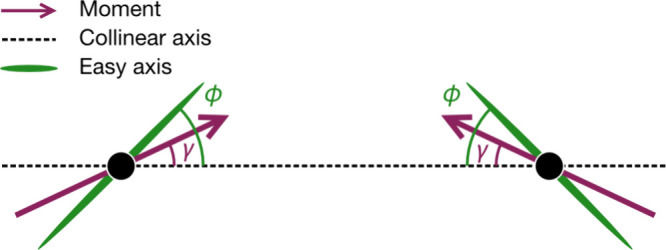
Definition of the canting angle γ and angle between the local easy-axes, ϕ and the collinear direction.
Magnetic Diffraction
Our bulk magnetic measurements show strong evidence of long-range ordered magnetic ground states in all four compounds and so to determine the magnetic structure and correlations in their ground states, we carried out PND measurements using the HB-2A diffractometer at HFIR (ORNL). The magnetic structures were determined by refinement against data from which background and nuclear Bragg peaks were removed by subtraction of high temperature data in the paramagnetic regime. The magnetic Bragg peaks were indexed to determine the magnetic propagation vector and the possible irreducible representations (irreps) were determined using symmetry-mode analysis in the ISODISTORT software suite44 which are denoted below in Miller and Love’s notation.45 Our Rietveld refinement of nuclear structures gave us the scale factor, which we then fixed for our Rietveld refinement of the magnetic structure using each irrep against the temperature subtracted data set. Having determined the magnetic structure using temperature-subtracted data, we were then able to carry out a joint magnetic and nuclear refinement for FeCl2(pym) and FeCl2(btd) (Table S5).
On cooling
below TC we find magnetic
Bragg peaks for FeCl2(pym) at TN = 10.5(5) K, FeCl2(btd) at TN = 3.8(2) K, NiCl2(pym) at TN = 15.8(7) K and NiCl2(btd) at TC = 17.5(5) K (Figure S15). In the
subtracted data sets we were able to isolate and index the magnetic
Bragg peaks with propagation vectors, with the three antiferromagnets
having a propagation vector  and the ferromagnetic NiCl2(btd)
having k = 000, confirming its ferromagnetic ground state
(Figure 6, Table 2). We identified the possible irreps in each case and carried out
Rietveld refinement of the magnetic structures using every irrep for
each material. We found that only one irrep was consistent with the
experimental data for each material: mB+1 for both FeCl2(pym) and FeCl2(btd); mZ–1 for NiCl2(pym); and mΓ+2 for NiCl2(btd). We note that
the observed magnetic structure for FeCl2(pym) would require
two different magnetic irreps were the high temperature orthorhombic
phase used as the parent paramagnetic phase rather than the correct
monoclinic phase (ESI Sec. S1.2).
and the ferromagnetic NiCl2(btd)
having k = 000, confirming its ferromagnetic ground state
(Figure 6, Table 2). We identified the possible irreps in each case and carried out
Rietveld refinement of the magnetic structures using every irrep for
each material. We found that only one irrep was consistent with the
experimental data for each material: mB+1 for both FeCl2(pym) and FeCl2(btd); mZ–1 for NiCl2(pym); and mΓ+2 for NiCl2(btd). We note that
the observed magnetic structure for FeCl2(pym) would require
two different magnetic irreps were the high temperature orthorhombic
phase used as the parent paramagnetic phase rather than the correct
monoclinic phase (ESI Sec. S1.2).
Figure 6.

Rietveld refinement of the magnetic ground states against temperature subtracted neutron diffraction data. FeCl2(pym): The model was refined against the I1.5 K – I12.5 K data set over 0.36 < Q < 2.37 Å–1. FeCl2(btd): The model was refined against the I1.5 K – I5 K data set over 0.26 < Q < 1.98 Å–1. Data at 0.82 < Q < 0.09 Å–1 were omitted due to incomplete peak subtraction caused by thermal expansion. NiCl2(pym): The model was refined against the I2 K – I30 K data set over 0.29 < Q < 2.61 Å–1. Data at 1.97 < Q < 2.04 Å–1 were omitted due to incomplete peak subtraction caused by thermal expansion. NiCl2(btd): The model was refined against the I1.5 K – I30 K data set over 0.59 < Q < 1.61 Å–1. Data outside this range were omitted due to the absence of magnetic Bragg peaks and the presences of features arising from incomplete subtraction of structural Bragg peaks due to thermal expansion.
Table 2. Refined Magnetic Parameters from PND Analysis of the Magnetic Diffractiona.
| FeCl2(pym) | FeCl2(btd) | NiCl2(pym) | NiCl2(btd) | ||||
|---|---|---|---|---|---|---|---|
| Crystal system | Monoclinic | Monoclinic | Orthorhombic | Monoclinic | |||
| Magnetic space group (BNS) | Pa21/m | Pa21/m | Pccca | P2′1/m′ | |||
| k-vector |
|
|
|
000 | |||
| Mx (μB) | –3.096(65) | –3.434(30) | 0* | 0† | |||
| My (μB) | 1.249(41) | 1.643(22) | –2.012(70) | 1.67(12) | |||
| Mz (μB) | 1.653(19) | –1.103(19) | 0† | 0† | |||
| M0 (μB) | 3.726(99) | 3.866(46) | 2.012(70) | 1.67(12) | |||
| γND (deg) | 19.6(5) | 25.2(3) | ≤30 | ≤23 | |||
| CCl | FM | FM | FM | FM | |||
| Cpym/btd | ncAFM | ncAFM | (nc)AFM | (nc)AFM | |||
| CvdW | AFM | AFM | AFM | AFM | |||
| T (K) | 1.5 | 1.5 | 2 | 1.5 | |||
| Rwp | 29.303 | 14.320 | 65.703 | 63.114 | |||
| GOF | 0.905 | 0.806 | 0.473 | 5.892 | |||
| λ (Å) | 2.41 | 2.41 | 2.41 | 2.41 |


The ordered moment is given in the Cartesian axes: x = anuc., y = bnuc., z = cnuc. × sin β. *Components prohibited by symmetry. †Components fixed to zero as no magnetic intensity detected in relevant reflections.
We were able to refine the moment directions and magnitudes freely for both iron compounds, but the lower signal-to-noise due to the smaller moment for nickel meant that we were only able to put an upper limit on the noncollinear component in the ordered moment for NiCl2(pym) of M ≤ 1 μB and for NiCl2(btd) of M ≤ 0.7 μB. A canting angle of γ ≤ 30° for NiCl2(pym) γ ≤ 23° for NiCl2(btd) would be therefore challenging to detect in our neutron measurements. In particular, the additional peaks that would be a signature of this noncollinearity were too small to detect. For NiCl2(pym) a noncollinear component along c is symmetry permitted and would produce Bragg intensity for 021mag.. For NiCl2(btd) a noncollinear component in the ac-plane is symmetry permitted and could produce Bragg intensity for the 001mag., 020mag. and 021mag. peak positions. We therefore constrained the moment to lie along the b-direction in NiCl2(pym) and NiCl2(btd). These refinements produced ordered moments in good agreement with those expected: M0 = 3.726(99) μB for FeCl2(pym), 3.866(46) μB for FeCl2(btd), 2.012(70) μB for NiCl2(pym) and 1.67(12) μB for NiCl2(btd).
All four compounds have similar magnetic structures, with ferromagnetic correlations along the MCl2 chains and primarily antiferromagnetic correlations along the b-direction. The interlayer correlations are antiferromagnetic, except for NiCl2(btd). In the Ni compounds, the refined moments lie along the b-direction, though the canting is anticipated to occur along the c axis as this is allowed by symmetry. For FeCl2(pym) and FeCl2(btd) the moments primarily point along the a direction, but cant toward the b axis producing a net intralayer moment in this direction. This net moment is compensated for by the antiferromagnetic alignment with neighboring vdW layer (Figure 7a and b). A canting angle, γ ND can be determined from the Rietveld refined structures:
 |
2 |
yielding γND = 19.6(5)° for FeCl2(pym) and 25.2(3)° for FeCl2(btd).
Figure 7.

Schematic representation of the magnetic ground states of (a) FeCl2(pym), (b) FeCl2(btd), (c) NiCl2(pym) and (d) NiCl2(btd).
We were also able to measure the paramagnetic diffuse scattering for FeCl2(btd) at 5 and 10 K by subtracting data measured at 30 K (>6TN) to account for structural scattering (Figure 8). By fitting this scattering using an effective-field model46 we were able to extract superexchange interactions in the Heisenberg approximation, with the Hamiltonian
 |
3 |
where Jij is isotropic superexchange for nearest neighbor, JCl, and next-nearest-neighbor, Jbtd interactions, and  , and using a constant term to account for
temperature dependent background scattering. The fit to these parameters
show that JCl = 1.6(4) K is strongest
and ferromagnetic, whereas the superexchange through the ligand, Jbtd = −0.51(5) K is weaker and antiferromagnetic.
Fitting with additional Heisenberg interaction terms, including JvdW, J2Cl (i.e.,
the next-nearest neighbor superexchange along the FeCl2 chain), did not improve the quality of the fit and the refined values
of these additional values were an order of magnitude smaller and
zero within error. Refinement of a model with Ising spin degrees of
freedom (moment directions fixed to those determined from refinement
of the ground state) produced a less physical scale factor. The limited
data quality means our measurements are only weakly sensitive to the
single ion anisotropy and other spin–orbit derived interactions,
and unfortunately prevented us from carrying out similar analysis
for FeCl2(pym) and the Ni(II) containing compounds.
, and using a constant term to account for
temperature dependent background scattering. The fit to these parameters
show that JCl = 1.6(4) K is strongest
and ferromagnetic, whereas the superexchange through the ligand, Jbtd = −0.51(5) K is weaker and antiferromagnetic.
Fitting with additional Heisenberg interaction terms, including JvdW, J2Cl (i.e.,
the next-nearest neighbor superexchange along the FeCl2 chain), did not improve the quality of the fit and the refined values
of these additional values were an order of magnitude smaller and
zero within error. Refinement of a model with Ising spin degrees of
freedom (moment directions fixed to those determined from refinement
of the ground state) produced a less physical scale factor. The limited
data quality means our measurements are only weakly sensitive to the
single ion anisotropy and other spin–orbit derived interactions,
and unfortunately prevented us from carrying out similar analysis
for FeCl2(pym) and the Ni(II) containing compounds.
Figure 8.

Magnetic diffuse scattering of FeCl2(btd) fit using an effective field model.46 Data obtained by temperature subtraction of data measured at 30 K.
Density-Functional Theory
To get a deeper insight into the magnetic interactions in these materials we carried out first-principles DFT calculations. For each compound we relaxed the structure, using a primitive two atom cell, and calculated the exchange energies using the broken-symmetry approach.47 The electronic structure and exchange energies were calculated using a collinear spin-polarized DFT Hamiltonian including a Hubbard U term using CASTEP,48 including the MBD* dispersion correction.49 We investigated using relativistic noncollinear DFT to prove the noncollinear magnetism found in these vdW MOMs (ESI Sec. S6.5), however these calculations were unable to provide any additional insight, due to the small energy-scales.
Geometry optimization of the primitive structures derived from single crystal X-ray diffraction data, FeCl2(pym) and CoCl2(btd)32 with the transition metal substituted as appropriate, produced structures consistent with those obtained by Rietveld refinement: with typical mismatches of less than 1%, and the largest deviations of 3% found for NiCl2(pym) (ESI Table S6). These calculations also found a small monoclinic distortion in FeCl2(pym), as found in our low temperature Rietveld refinement of neutron diffraction data. Examination of the electronic structure, including density of states and band structure, revealed that the inclusion of a U parameter was essential to avoid unphysically delocalized states. We explored a range of U values from U = 0 to 10 eV for both systems,50−52 determining that U = 2 eV for Fe and U = 6 eV for Ni were most appropriate. This correctly captured the experimentally observed insulating states for FeCl2(pym) (Eg = 1.30 eV), NiCl2(pym) (Eg = 2.48 eV) and NiCl2(btd) (Eg = 1.52 eV), though we found that a metallic state results for FeCl2(btd), likely due to strong electronic correlations on Fe(II). Our calculations for the Fe(II) compounds were very sensitive to U and did not reliably converge, particularly for FeCl2(btd), and hence we have restricted our analysis of these calculations to structural features (additional calculations in ESI S6). We note that the chain like structure appears to afford significant delocalization along the a direction, particularly for btd containing compounds.
We created 2 × 1 × 2 supercells from the primitive cells to allow either configurations with either FM or AFM ordering along each of the three principal directions: M-Cl-M, M-organic-M, and M interlayer. We then calculated the energies of the eight possible magnetic configurations from these supercells and fitted their magnetic superexchange interactions to the magnetic Hamiltonian (eq 3, Table 3). We found that the superexchange was very sensitive to a U, with too small U producing unphysically large exchange.
Table 3. Calculated Magnetic Superexchange from Collinear PBE+MBD+U for NiCl2(pym) and NiCl(btd) with U = 6 eV.
| NiCl2(pym) | NiCl2(btd) | |
|---|---|---|
| JCl (K) | 29.5(4) | 29.2(1) |
| JL (K) | –29.0(4) | –9.7(1) |
| JvdW (K) | –0.6(4) | 0.0(1) |
We found that NiCl2(pym) and NiCl2(btd) both had ferromagnetic JCl and antiferromagnetic JL consistent with our experimental ground states, bearing in mind the nonrelativistic nature of these calculations. Surprisingly, considering the experimental ground state, we found that FeCl2(pym) consistently had antiferromagnetic exchange in both directions. This provides further evidence that the level of theory we are using to probe the electronic states of these Fe(II) compounds is not sufficient to accurately characterize the physics of these systems, perhaps due to the unquenched orbital moment in octahedral high spin Fe(II) and the relevance of both t2g and eg orbitals (which will have different localization but are treated with a single U in our calculations). Further details on our calculations on the iron compounds can be found in the ESI (Sec. S6). In all cases the interlayer interactions were zero within error. Focusing now on the Ni(II) compounds, we find that the interactions through pym are much more antiferromagnetic than through btd. This is consistent with the experimental Curie–Weiss temperatures, which are much less positive for NiCl2(pym) (θCW = +9(4) K) than for NiCl2(btd) (θCW = +22(2) K), though the presence of non-Heisenberg interactions prevents detailed quantitative comparison. Examination of the spin-density reveals that for both Ni(II) compounds eg-type d-orbitals predominate, as predicted, and the ligand spin-density primarily lies within the σ-type orbitals, for Cl–, pym and btd (Figure S25, S26).
Discussion
The lattice parameters and bond lengths in these compounds follow the expected trends. The a- and b-parameters are larger for the iron compounds than the nickel, in accordance with the ionic radii, and the a-parameter is also slightly larger for btd containing materials than the pym compounds due to a small induced distortion in the edge-sharing MCl2 bridge. The b-parameter is significantly larger for the btd compounds than the pym compounds (≈7%) due to the μ-1,3-ligand being a five-membered ring in btd and a six-membered ring in pym. The c-parameter is significantly larger in the btd compounds than the pym, as the larger btd ligand separates the layers. The M– Cl– M bond angle is a key parameter in predicting JCl,53 and is approximately 94° in these compounds: 93.5° for FeCl2(pym), 93.9° for FeCl2(btd), 93.6° for NiCl2(pym) and 94.9° for NiCl2(btd). We see a decrease in the angle for FeCl2(pym) in the high temperature phase to 91.6°, suggesting perhaps JCl also changes, though we find no evidence of this in our bulk magnetic data. These angles are broadly consistent with the binary halides FeCl2 (92.2°54) and NiCl2 (91.6°55), which also have nearest-neighbor ferromagnetic superexchange.56,57
Our neutron diffraction measurements, in combination with the bulk magnetometry, allow us to ascertain the magnetic ground state (Figure 7). We find that in all cases the moments are ferromagnetically correlated along the MCl2 chains, which is consistent with the only magnetic structure of Ni(II) or Fe(II) MCl2L analogues, NiCl2(4,4′-bipyridine),27 and as predicted by the Goodenough-Kamenari-Anderson rules.58−60 Our PND measurements are sensitive to the canting angle γ, which are 19.6(5)° and 25.2(3)° for FeCl2(pym) and FeCl2(btd) (Table 2). For the Ni(II) compounds the small moment size means that we were only able to measure the most intense magnetic peaks, and so our neutron measurements instead put an effective ceiling on the canting angle. These values can be directly compared with those determined from the remnant magnetization, and are broadly consistent. The size of the canting angles for FeCl2(pym) and FeCl2(btd) is very large15 and is comparable with some of the largest known canting angles.37 This noncollinear magnetic order implies the presence of multiple competing interactions (as discussed below). The magnetic neutron diffraction also clearly establishes that although in all cases there is a (potential) net moment within the layers, only NiCl2(btd) has ferromagnetic order, as the layers in FeCl2(btd), FeCl2(pym) and NiCl2(pym) are antiferromagnetically coupled. NiCl2(btd), FeCl2(pym) and NiCl2(pym) all show characteristics of ferromagnetism in applied field with significantly reduced Ms and Mr, which, together with magnetic ground state symmetries that permits noncollinearity, strongly suggests noncollinear ferromagnetism.
The compounds reported this manuscript are unusual vdW magnets as most are inorganic and collinear including ferromagnetic CrI3,1 CrBr3,61 CrGeTe3,2 and the antiferromagnetic CrCl3,62 MPS3 (M = Mn, Fe, and Ni).63−65 While inorganic ligands provide pathways for strong superexchange, their spherical symmetry also disfavors low symmetry structures that can produce noncollinear spin textures. The potential for low symmetry organic ligands to produce spin canting in vdW MOMs is clearly demonstrated by both these compounds and the MUV-1X(M) family of MOFs.21−23 Many vdW magnets can be delaminated down to few layer form and this can lead to significant changes in their magnetic properties, including switching between ferro- and antiferromagnetic behavior.1 If MLCl2 can be delaminated into few- or monolayer form, we might anticipate similarities, as there appears to be a fine balance between interlayer ferromagnetism and antiferromagnetism.
FeCl2(pym) and NiCl2(pym) have the unusual combination of an antiferromagnetic ground state and magnetic hysteresis leading to remnant magnetism and a metastable zero-field ferromagnetic state. The presence of hysteresis is well-known around the metamagnetic transition, including even in canonical metamagnet FeCl266 and in the related collinear NiCl2L,25 however the presence of metamagnetic hysteresis significant enough that the ferromagnetic state is stable without field is very rare, having been previously reported for two layered brucite cobalt hydroxides, Co2(OH)3(NO3) and Co4(OH)2(O2CC6H4CO2)3·(NH3)1.5(H2O)2.5.67
The coercive fields of NiCl2(pym) (in its ferromagnetic phase) and NiCl2(btd) are very large, both compared to other compounds and FeCl2(pym). Indeed, HC = 1.8 T at 2 K for NiCl2(pym) is much larger than other vdW ferromagnets, even hard ferromagnets such as VI3 (HC = 0.9T).68−70 The origin of this lies both with single-ion anisotropy and the magnetocrystalline anisotropy (MCA). As discussed below, Ni(II) is likely to have easy-axis, and Fe(II) easy-plane anisotropy, which suggests that the single-ion anisotropy contribution to coercivity will be larger for Ni(II). In addition, the net moment is out of plane for NiCl2(pym) and NiCl2(btd) and so will produce a larger MCA than the in plane net moment found for the Fe(II) compounds. This together likely explains the much larger coercive fields. It is notable that the related thiocyanate compound, Ni(NCS)2(pym)2 which has only M-pym-M connectivity, is also a weak ferromagnet with smaller, but still large HC = 0.9T.71,72 The direct analogues Ni(NCS)2(pym) and Fe(NCS)2(pym) are antiferromagnets, as the M(NCS)2 chains are antiferromagnetic unlike the MCl2 chains.71,72
The large canting found in FeCl2(pym) parallels the compositionally similar (indeed, FeCl2(pym) was found to be a common impurity) but structurally distinct FeCl2(pym)2, which has only Fe-pym-Fe connections and adopts a 3D diamondoid structure.37 Despite the large differences in structure, these two compounds have similar magnetic properties, with Mr = 0.28(1)μB for FeCl2(pym)2 and Mr = 0.31(1)μB for FeCl2(pym), suggesting that care is required in the analysis of magnetic susceptibility data to ensure purity. FeCl2(pym) does however have an order of magnitude larger hysteresis, HC = 0.2(1) T vs HC = 0.015 T and a 2-fold larger magnetic ordering temperature, TN = 10.5(5) K vs TN = 6.5 K. The analogous diamondoid nickel compound NiCl2(pym)2 again has a slightly lower ordering temperature, TN = 14.7(5) K, but is a collinear magnet with pseudo easy-axis anisotropy, as the easy-plane anisotropies of the NiN4Cl2 octahedra have a shared axis.73
The Curie–Weiss fitting and magnetic ordering temperature show interactions are stronger for NiCl2L than FeCl2L. The limitations of powder susceptibility measurements mean that we are unable to disentangle robustly the three nearest neighbor Heisenberg interactions JCl, JL and JvdW) and spin–orbit derived terms (D, DMI interactions) through fitting of susceptibility data. For these layered materials, considering first Heisenberg superexchange only, Tc will depend most critically on the strongest two superexchange interactions (≈JCl+JL),26 and the Curie–Weiss temperature on the mean interaction (≈JCl+JL+Jvdw), and so Tc and θ are expected to be similar. The single-ion anisotropy will have a complex effect, but typically leads to a reduction in θ and increase in Tc, explaining to some extent the observed discrepancies. Comparison with related compounds finds that both magnetic interactions tend to be stronger for Ni in both frameworks with only metal–ligand–metal connectivity38 and frameworks with only metal-chloride-metal connectivity.74,75
The expected hierarchy of interactions predicts that superexchange through the MCl2 chain is stronger than through the organic linker, which in turn is much stronger than between the layers, i.e., JCl > Jpym ≈ Jbtd ≫ JvdW. This ordering was observed in our previous quantitative inelastic neutron scattering investigations of the related CrCl2(pym), where we found an order of magnitude separation between interactions.26 Fitting of magnetic diffuse scattering does confirm this picture for FeCl2(btd), with Jbtd ≈ JCl/3. Our DFT calculations suggest that the separation is less clear-cut for Ni(II) compounds, with Jpym ≈ JCl and Jbtd ≈ JCl/2.
Focusing on superexchange gives
only a partial picture, as Heisenberg
interactions alone will produce collinear order in a nonfrustrated
magnet. Our preliminary DFT+U calculations including
spin–orbit coupling were unable to shed significant extra light
on the magnitude or directions of the key terms: however, we can produce
simple guidelines from the model Hamiltonian, where we abstract away
the strongest (Cl–) and weakest interactions (vdW)
to leave a 1D metal–ligand–metal chain. The two key
interactions along this chain are the single ion anisotropy and the
DMI, and this model has been studied extensively for single chain
magnets.76 In this case, as the true behavior
is three-dimensional, we consider only the simplified static case.
Both interactions, as they arise from spin–orbit coupling,
are expected to be proportional to  . The observed structures require the competition
between multiple different interactions, both Heisenberg and relatistivistic.
. The observed structures require the competition
between multiple different interactions, both Heisenberg and relatistivistic.
The DMI vector, V, which favors a pair of spins being
perpendicular to both it and each other, for NiCl2(pym)
is normal to the pyrimidine ring by symmetry. This symmetry is broken
in the monoclinic structures and instead is merely confined to the
plane normal to the M–M vector. Nevertheless, as this symmetry
breaking is not large, we can assume as a first approximation that
the component of V within the ligand plane is small and
that V lies along the plane normal. Within this approximation,
the canting angle in the ordered ground state will be  . In this model, the DMI would be approximately
30% the size of superexchange for Ni and roughly equal to J in size for Fe if the canting is driven by DMI alone.
These would be large values for the DMI interaction compared to other
known compounds.77
. In this model, the DMI would be approximately
30% the size of superexchange for Ni and roughly equal to J in size for Fe if the canting is driven by DMI alone.
These would be large values for the DMI interaction compared to other
known compounds.77
Both Ni(II) and
Fe(II) are expected to have significant single-ion
anisotropy. In both cases the local ligand field environment can be
thought of as “compressed” as the four weaker-field
π-donor Cl– ions lie in the equatorial plane,
and the σ-donor N-heterocycles are axial. The use of the term
compressed is by analogy with homoleptic complexes, where compression
of two bonds relative to the others will cause a similar splitting
of the d orbital levels, and does not imply anything about the relative
bond lengths. For d8 Ni(II) this leads to a strong easy-axis
(Ising) type anisotropy,42,78−81 and for d6 Fe(II) this tends to produce an easy-plane
(XY) type anisotropy.78,82 As the true symmetry is below
tetragonal, there will be additional small rhombic anisotropy, E, neglected in this approximate treatment. There are two
key parameters: the angle between the easy-axis and the M–M
vector, ϕ, and the strength of the single ion anisotropy D (Figure 5). ϕ = 0 and 90° corresponds to collinear anisotropy and
hence will produce a collinear ground state, and ϕ = 45°
favors a maximally canted state, which unusually has four degenerate
ordered ground states.83 For NiCl2(btd), assuming the easy-axis is coincident with the N-M-N axis gives
ϕ = 22.0(5)° and for NiCl2(pym) this gives ϕ
= 31.1(5)° due to the larger angle between the coordinating nitrogens
in pym and btd. The derived canting angles are γ = 6.4(3)°
for NiCl2(btd) and γ = 9.1(3)° for NiCl2(pym) (Table 1). These values rely on the validity of the assumptions made, and
more accurate values could be obtained through single crystal magnetometry.
Considering a Hamiltonian only containing single-ion anisotropy and
Heisenberg AFM interactions for the Ni– L– Ni chain,
analogous to that used in Pianet et al.,83 gives  . Using the experimental values this implies
that D/JL = 0.85(4) for
NiCl2(btd) and D/JL = 0.90(3) for NiCl2(pym), broadly consistent with D observed in similar materials.79,80,84 The DMI and single-ion anisotropy terms
will act cooperatively, and so the determined parameters thus correspond
to estimates of the maxima rather than the central values. Our DFT
calculations and Curie–Weiss analysis suggest that Jpym is significantly larger than Jbtd, which would reduce the observed canting, suggesting
that the noncollinear interactions (D and V) are in fact smaller for NiCl2(btd).
. Using the experimental values this implies
that D/JL = 0.85(4) for
NiCl2(btd) and D/JL = 0.90(3) for NiCl2(pym), broadly consistent with D observed in similar materials.79,80,84 The DMI and single-ion anisotropy terms
will act cooperatively, and so the determined parameters thus correspond
to estimates of the maxima rather than the central values. Our DFT
calculations and Curie–Weiss analysis suggest that Jpym is significantly larger than Jbtd, which would reduce the observed canting, suggesting
that the noncollinear interactions (D and V) are in fact smaller for NiCl2(btd).
The combination of easy-plane anisotropy and Heisenberg superexchange alone cannot produce spin canting in this model, and would instead select a unique spin direction: the intersection between the two staggered easy-planes. In these structures, the selected direction would correspond (assuming the easy-planes are oriented normal to the N-M-N axes) to spins oriented along the MCl2 chain normal to the plane of the organic ligand. Indeed, the spins do largely lie on this direction for both FeCl2(pym) and FeCl2(btd). The deviation of the moment direction from this axis must arise from DMI interactions, rhombic anisotropy or higher order interactions neglected in this analysis.
Our estimates of the interactions creating the noncollinear spin structures only provide an initial understanding. Future measurements will give access to more precise quantification of the underlying origin of this phenomenon: allowing us to measure the relevant higher-order interactions directly. Inelastic neutron scattering measurements, whether on single crystals or powders, would provide precise measurements of the magnetic excitations and hence JCl, JL, JvdW and D, together with indications of deviations from these terms. High field EPR and single-crystal magnetometry measurements would accurately measure D and E. Calculations using dynamical mean-field theory (DMFT) and multiconfigurational methods (e.g., CASSCF) would allow for appropriate treatment of the electron correlation and spin–orbit contributions (respectively). Our model suggests that the noncollinearity in these materials can be enhanced through further desymmetrisation of the ligand field environment: replacing the N-heterocycle with a stronger field ligand or the bridging halide with a weaker field should increase the canting angle. Equally, the geometry of the organic ligand can be used to control the noncollinearity, and a ligand that tilts the metal halide chains more would produce a larger canting angle. In particular, we note that the tilt angle for pym is 32°: if this angle can be increased to ϕ = 45°, perhaps through using more bent ligands such as 3,6-diazacarbazole or 1-alkylpyrazolo[4,3-b]pyridine, a tetrastable state would be realizable.83 This strategy for realizing noncollinear magnetism can be generalized to other metal–organic magnets where single ion anisotropy orientation can be anticipated.
Conclusion
We report here the syntheses, crystal structures, bulk magnetic properties and magnetic ground states of four vdW layered MOMs: FeCl2(pym), FeCl2(btd), NiCl2(pym) and NiCl2(btd). We show they all have noncollinear ground states with large canting and net magnetic moments within each layers, and that three of these materials have significant remnant magnetization. We use density-functional calculations together with consideration of model Hamiltonians to rationalize the magnetic properties of these materials, providing a framework for the design of new noncollinear vdW MOMs.
Although we show that the choice of transition metal is the key factor determining the magnetic character of these frameworks, we also demonstrate that the organic ligand has a key influence over the resulting properties. Substituting pym for btd changes the tilt-angle between MCl2 chains, altering the tilt angles between chains and hence single-ion anisotropy axes, although the increased exchange in pym analogues partially counteracts this, the net result is an increased canting angle. The increased interlayer separation in btd analogues also reduces the transition magnetic fields. This suggests that the possibilities for chemical control available in MOMs will allow for tuning of spin texture, and hence potentially realizing functional properties such as magnetoelectricity6 or skyrmion phases.7
This work suggests a few clear directions forward for these materials. Our results thus far, and their limitations, suggest that a deeper understanding of the spin–orbit derived interactions will be essential to further noncollinear vdW materials design. This spans both theory, including both higher level theoretical calculations (e.g., CASSCF or dynamical mean field theory) to understand in more detail the origin of the behavior, and experimental spectroscopic characterization of the behavior, including both inelastic neutron scattering and high field EPR investigations of the magnetic excitations. The promise of these materials in bulk crystalline form also prompts us to explore whether their properties can be maintained on few- or even monolayer scale and hence toward deeper integration of these materials into 2D devices.
Experimental Section
Synthesis
FeCl2(pym)
The reaction of FeCl2·4H2O (3.0 g, 15 mmol; Acros Organics, ≥99%) and pyrimidine (1.2 g, 15 mmol; Sigma-Aldrich, ≥98.0%) in 50 mL methanol (MeOH) rapidly precipitates an orange-brown microcrystalline powder. The FeCl2(pym) product was then dried in vacuo giving a ca. 90% total yield. Crystals of sufficient size for X-ray diffraction studies (76 × 72 × 42 μm) were grown by vapor diffusion of pyrimidine (150 mg, 1.25 mmol; Sigma-Aldrich, ≥98.0%) into a concentrated solution of FeCl2 in 1 mL MeOH (20 mg, 0.16 mmol; Acros Organics, 97%). The yield was 85%. The measured (calculated) elemental composition was C, 23.03% (23.2%); H, 1.98% (1.9%); and N, 13.01% (13.4%).
FeCl2(btd)
A PTFE-lined stainless-steel autoclave was charged with FeCl2·4H2O (795 mg, 4.00 mmol; Acros Organics, ≥99%) and 2,1,3-benzothiadiazole (579 mg, 4.25 mmol; Acros Organics, 98.0%) in the solid state. The autoclave was sealed and heated solvent-free in an oven at 200 °C for 72 h. Once heating was ceased, the reaction mixture was allowed to cool gradually to room temperature. This procedure, with 2,1,3-benzothiadiazole-d4 (600 mg, 4.25 mmol; Sec.), was used to produce deuterated samples for neutron scattering studies. The yield was 93%. The measured (calculated) elemental composition was C, 25.20% (27.4%); H, 1.63% (1.5%); and N, 9.52% (10.6%).
NiCl2(pym)
The reaction of NiCl2·6H2O (173.2 mg, 0.729 mmol; Alfa Aesar, 98%) and pyrimidine (57.1 mg, 0.713 mmol; Sigma-Aldrich, ≥98.0%) in 30 mL ethanol (EtOH) rapidly precipitates a green microcrystalline powder. The NiCl2(pym) product was washed in 3 × 20 mL EtOH and dried in vacuo giving a 91% total yield. The sample used for neutron-scattering measurements was synthesized by diffusion of pyrimidine (2.0 g, 25 mmol) into a solution of NiCl2·6H2O (5.9 g, 25 mmol) in 100 mL 2:1 EtOH-diethyl ether mix. The yield was 75%. The measured (calculated) elemental composition was C, 19.63% (22.9%); H, 2.00% (1.9%); and N, 11.11% (13.4%).
NiCl2(btd)
A PTFE-lined stainless-steel autoclave was charged with NiCl2·6H2O (951 mg, 4.00 mmol; Alfa Aesar, 98%) and 2,1,3-benzothiadiazole (579 mg, 4.25 mmol; Acros Organics, 98.0%) in the solid state. The autoclave was sealed and heated solvent-free in an oven at 200 °C for 72 h. Once heating was ceased, the reaction mixture was allowed to cool gradually to room temperature. This procedure, with 2,1,3-benzothiadiazole-d4 (600 mg, 4.25 mmol; Sec.), was used to produce deuterated samples for neutron scattering studies. The yield was ca. 92%. The measured (calculated) elemental composition was C, 23.16% (27.1%); H, 3.60% (1.5%); and N, 9.22% (10.5%).
2,1,3-Benzothiadiazole-d4
o-Phenylenediamine (2.0 g, 18.5 mmol; Sigma-Aldrich, >99%) and 20 wt % DCl/D2O (0.40 g, Sigma-Aldrich, ≥99.5 atom % D) were refluxed in D2O (50.0 g; Sigma-Aldrich, 99 atom % D) under N2 atmosphere for 24 h. The reaction mixture was shielded from light while being heated. After cooling, the reaction mixture was extracted with dichloromethane (3 × 50 mL). The combined organic phases were dried over MgSO4, filtered and concentrated in vacuo. The concentrated product, o-phenylenediamine-d8 (1.70 g, 14.6 mmol) and triethylamine (6.36 g, 58.4 mmol) were stirred to dissolution in 50 mL dichloromethane. Thionyl chloride in dichloromethane (1 M concentration, 29.2 mL) was added dropwise to the solution at 0 °C under N2 atmosphere in a foil wrapped flask. The solution was refluxed for 4 h under N2 atmosphere and concentrated in vacuo. 2,1,3-benzothiadiazole-d4 was purified by direct steam-distillation following addition of D2O acidified to pH 1 with 20 wt % DCl/D2O. The steam-distilled mixture was extracted with dichloromethane (3 × 50 mL) dried over MgSO4 and filtered. Solvent was removed in vacuo, affording 2,1,3-benzothiadiazole-d4 at 62% yield with 75% deuteration (1.27g, 9.05 mmol).
1H NMR (400 MHz, CDCl3, ppm, dioxane as an internal standard): δH 8.04–7.98 (m, 0.23H), 7.62–7.56 (m, 0.27H); 13C NMR (101 MHz, CDCl3, ppm): δC 154.78 (d, J = 5.5 Hz), 129.19 (dd, J = 12.5, 9.1 Hz), 121.50 (d, J = 11.2 Hz).
Powder X-ray Diffraction
PXRD data were collected using a PANalytical X’Pert Pro diffractometer equipped with monochromated Cu Kα1 radiation (λ = 1.5406 Å). The tube voltage and current were 40 kV and 40 mA, respectively. Scans were performed from 2° to 80° on a zero background silicon crystal plate. Peak fitting, Pawley and Rietveld refinement were performed using Topas Academic v6.85
Single Crystal X-ray Diffraction
A diffraction-quality single crystal of FeCl2(pym) was mounted on a polymer-tipped MiTeGen MicroMountTM using Fomblin (YR-1800 perfluoropolyether oil). The sample was cooled rapidly to 120 K in a stream of cold N2 gas, using a Oxford Cryosystems open flow cryostat. Diffraction data were collected on an Oxford Diffraction GV1000 (TitanS2 CCD area detector, mirror-monochromated Cu–Kα radiation source; λ = 1.54184 Å, ω scans). Cell parameters were refined from the observed positions of all strong reflections and absorption corrections were applied using a Gaussian numerical method with beam profile correction (CrysAlisPro). The structure was solved and refined in Olex286 using SHELXT87 and SHELXL,88 respectively.
Magnetic Susceptibility
Magnetic property measurements were first carried out on a Quantum Design MPMS superconducting quantum interference device (SQUID; School of Chemistry, University of Nottingham, a). Additional isothermal magnetization measurements were carried out on a Quantum Design Dynacool Physical Property Measurement system (PPMS; Cavendish Lab, University of Cambridge, b). Data were corrected for the diamagnetism of the sample using Pascal’s constants.89
FeCl2(pym)
a: A polycrystalline sample of FeCl2(pym) (4.5 mg) was immobilized in eicosane (5.9 mg) and sealed in a gelatin capsule. Magnetic susceptibility measurements were performed under field cooled (FC) and zero-field cooled (ZFC) conditions in a 0.01 T dc field from 2 to 300 K. Isothermal magnetization measurements were performed at 2 K from 0 to 5 T to −5 to 5 T.
FeCl2(btd-d4)
a: A polycrystalline sample of FeCl2(btd) (18.82 mg) was immobilized in eicosane (14.73 mg) and sealed in a gelatin capsule. Magnetic susceptibility measurements were performed under field cooled (FC) and zero-field cooled (ZFC) conditions in a 0.01 and 2 T dc field from 2 to 300 K. Isothermal magnetization measurements were performed at 2 K from 0 to 5 T to −5 to 5 T.
NiCl2(pym)
a: A polycrystalline sample of NiCl2(pym) (12.3 mg) was immobilized in eicosane (10.7 mg) and sealed in a gelatin capsule. Magnetic susceptibility measurements were performed under field cooled (FC) and zero-field cooled (ZFC) conditions in a 0.01 T dc field from 2 to 300 K.
b: A polycrystalline sample of NiCl2(pym) (17.2 mg) was immobilized in cling film (7.3 mg). Isothermal magnetization measurements were performed at 1.8, 3, 4, and 8 K from 0 to 14 T to −14 to 14 T.
NiCl2(btd-d4)
a: A polycrystalline sample of NiCl2(btd) (8.63 mg) was immobilized in eicosane (9.22 mg) and sealed in a gelatin capsule. Magnetic susceptibility measurements were performed under field cooled (FC) and zero-field cooled (ZFC) conditions in a 0.01 T dc field from 2 to 300 K.
b: A polycrystalline sample of NiCl2(btd) (22.1 mg) was immobilized in cling film (4.8 mg). Isothermal magnetization measurements were performed at 1.8, 3, 4, 8, 16, and 32 K from 0 to 14 T to −14 to 14 T.
Powder Neutron Diffraction
Powder neutron diffraction measurements were carried out on the HB-2A neutron diffractometer at the High Flux Isotope Reactor (HFIR), Oak Ridge National Laboratory (ORNL).90,91 A germanium monochromator was used to select λ = 2.41 Å from the Ge(113) reflection and λ = 1.54 Å from the Ge(115) reflection. The premono, presample, and predetector collimation was open-21‘-12‘. A pyrolytic graphite (PG) filter was placed before the sample to remove higher order reflections for λ = 2.41 Å. The samples were contained in a 6 mm diameter vanadium can and cooled in a liquid 4He cryostat with an in situ 3-sample changer stick in the temperature range 1.5 to 300 K. The diffraction patterns were collected by scanning a 120° bank of 44 3He detectors in 0.05° steps to give 2θ coverage from 5° to 130°. The magnetic structures were determined by refinement against data from which background and nuclear Bragg peaks were removed by subtraction of data collected at T > TN from those collected at T = 1.5 or 2 K. The magnetic Bragg peaks were indexed to determine the magnetic propagation vector and then the allowed magnetic irreducible representations were determined using symmetry-mode analysis on the ISODISTORT software.44 Using the scale factor determined from Rietveld refinement of the nuclear structure, and peak parameters determined from Pawley refinement of the nuclear structure, the direction and magnitude of the ordered moment for the subtracted data set were refined using TOPAS-ACADEMIC 6.0.85
FeCl2(pym)
Diffraction patterns were collected at T = 1.5, 12.5, and 25 K with λ = 2.41 Å for 4 h, 4h and 2h, respectively, and at T = 1.5 and 12.5 K with λ = 1.54 Å for 4 h each. Additional patterns were collected for 1 h at λ = 2.41 Å at intermediate temperature points T = 5, 6, 7, 8, 9, 9.5, 10, 10.5, 11, 12, 13, 14, and 15 K.
FeCl2(btd-d4)
Diffraction patterns were collected at T = 1.5, 5, 10, and 30 K with λ = 2.41 Å for 3 h each. Additional data were collected with λ = 2.41 Å at Q = 0.60 Å––1 from T = 1.5 to 10 K in 0.5 K increments.
NiCl2(pym)
Diffraction patterns were collected at T = 2 and 30 K with λ = 2.41 Å for 3 h each. Additional data were collected with λ = 2.41 Å at Q = 0.68 Å––1 from T = 2 to 30 K in 3 K increments.
NiCl2(btd-d4)
Diffraction patterns were collected at T = 1.5 and 30 K with λ = 2.41 Å for 3 h each. Additional data were collected with λ = 2.41 Å at Q = 0.87 Å––1 from T = 2 to 26 K in 1 K increments.
DFT Calculations
Calculations were carried out using the plane-wave density-functional theory code CASTEP version 23.1.48 The PBE general gradient approximation exchange-correlation functional was used92 with norm-conserving pseudopotentials from the built-in NCP19 library. Calculated exchange interactions were robust to changes in plane-wave cutoff energy for the basis set. van der Waals forces between each layer were described using the many-body semiemprical dispersion correction MBD*.49 An effective on-site interaction parameter, Ueff = U – J, was necessary to impose a strong localization on the Fe and Ni d-states, where U is the on-site Coulomb term and J is the site exchange term. Ueff is applied as a correction to the total energy of the system,
 |
4 |
where nIσm are localized orbital occupation numbers with atomic site index I, state index m, and spin σ.93nIσm is calculated as the projection of occupied Kohn–Sham DFT orbitals on a localized basis set. Ueff is set in CASTEP as a parameter that applies to all the orbitals within a given subshell (e.g., d-subshell).
A Monkhorst–Pack grid of k-points was used to integrate the Brillouin zone, with a k-point spacing finer than 2π × 0.03 Å–1 and with a plane-wave basis comprising plane-waves with energy up to 1500 eV. During the electronic minimization process a Gaussian smearing scheme was used with a smearing width of 0.2 eV. The geometry was optimized until forces were less than 0.05 eV/Å. The OptaDOS code in combination with the Matador high-throughput environment were used to generate the electronic band structures and density of states.94−97 The C2X visualization tool was used to obtain the spin-density representations.98
Acknowledgments
M.J.C. and J.P. acknowledge funding from EPSRC Grant No. EP/X042782/1. High field magnetometry measurements were carried out using the Advanced Materials Characterisation Suite, funded by EPSRC Strategic Equipment Grant EP/M000524/1EPSRC. Computing resources were provided by the University of Birmingham’s BlueBEAR HPC service and the Sulis Tier 2 HPC platform (EP/T022108/1), with networking support by CCP-NC (EP/T026642/1), CCP9 (EP/T026375/1), and UKCP (EP/X035891/1). A portion of this research used resources at the High Flux Isotope Reactor, a DOE Office of Science User Facility operated by the Oak Ridge National Laboratory. Andrew Jones is thanked for assistance with UV–visible spectroscopy measurements.
Data Availability Statement
Additional research data for this article may be accessed at no charge and under CC-BY license at the University of Nottingham Research Data Management Repository (DOI: 10.17639/nott.7395).
Supporting Information Available
The Supporting Information is available free of charge at https://pubs.acs.org/doi/10.1021/jacs.4c04102.
Magnetic crystal structural information files (ZIP)
Discussion on the susceptibility of FeCl2(btd) and magnetic symmetry analysis of FeCl2(pym); additional powder X-ray and neutron diffraction data, refined lattice parameters, isothermal magnetization measurements, magnetic susceptibility analysis, refined magnetic ground states, UV–vis spectroscopy, additional details of DFT calculations (PDF)
The authors declare no competing financial interest.
Supplementary Material
References
- Huang B.; Clark G.; Navarro-Moratalla E.; Klein D. R.; Cheng R.; Seyler K. L.; Zhong D.; Schmidgall E.; McGuire M. A.; Cobden D. H.; Yao W.; Xiao D.; Jarillo-Herrero P.; Xu X. Layer-Dependent Ferromagnetism in a van Der Waals Crystal down to the Monolayer Limit. Nature 2017, 546, 270–273. 10.1038/nature22391. [DOI] [PubMed] [Google Scholar]
- Gong C.; Li L.; Li Z.; Ji H.; Stern A.; Xia Y.; Cao T.; Bao W.; Wang C.; Wang Y.; Qiu Z. Q.; Cava R. J.; Louie S. G.; Xia J.; Zhang X. Discovery of Intrinsic Ferromagnetism in Two-Dimensional van Der Waals Crystals. Nature 2017, 546, 265–269. 10.1038/nature22060. [DOI] [PubMed] [Google Scholar]
- Wang Q. H.; et al. The Magnetic Genome of Two-Dimensional van Der Waals Materials. ACS Nano 2022, 16, 6960–7079. 10.1021/acsnano.1c09150. [DOI] [PMC free article] [PubMed] [Google Scholar]
- McGuire M. A. Crystal and Magnetic Structures in Layered, Transition Metal Dihalides and Trihalides. Crystals 2017, 7, 121. 10.3390/cryst7050121. [DOI] [Google Scholar]
- Kurebayashi H.; Garcia J. H.; Khan S.; Sinova J.; Roche S. Magnetism, Symmetry and Spin Transport in van Der Waals Layered Systems. Nat. Rev. Phys. 2022, 4, 150–166. 10.1038/s42254-021-00403-5. [DOI] [Google Scholar]
- Song Q.; Occhialini C. A.; Ergeçen E.; Ilyas B.; Amoroso D.; Barone P.; Kapeghian J.; Watanabe K.; Taniguchi T.; Botana A. S.; Picozzi S.; Gedik N.; Comin R. Evidence for a Single-Layer van Der Waals Multiferroic. Nature 2022, 602, 601–605. 10.1038/s41586-021-04337-x. [DOI] [PubMed] [Google Scholar]
- Amoroso D.; Barone P.; Picozzi S. Spontaneous Skyrmionic Lattice from Anisotropic Symmetric Exchange in a Ni-halide Monolayer. Nat. Commun. 2020, 11, 5784. 10.1038/s41467-020-19535-w. [DOI] [PMC free article] [PubMed] [Google Scholar]
- Xie H.; Luo X.; Ye Z.; Sun Z.; Ye G.; Sung S. H.; Ge H.; Yan S.; Fu Y.; Tian S.; Lei H.; Sun K.; Hovden R.; He R.; Zhao L. Evidence of Non-Collinear Spin Texture in Magnetic Moiré Superlattices. Nat. Phys. 2023, 19, 1150–1155. 10.1038/s41567-023-02061-z. [DOI] [Google Scholar]
- Kim C.; Kim S.; Park P.; Kim T.; Jeong J.; Ohira-Kawamura S.; Murai N.; Nakajima K.; Chernyshev A. L.; Mourigal M.; Kim S.-J.; Park J.-G. Bond-Dependent Anisotropy and Magnon Decay in Cobalt-Based Kitaev Triangular Antiferromagnet. Nat. Phys. 2023, 19, 1624–1629. 10.1038/s41567-023-02180-7. [DOI] [Google Scholar]
- López-Paz S. A.; Guguchia Z.; Pomjakushin V. Y.; Witteveen C.; Cervellino A.; Luetkens H.; Casati N.; Morpurgo A. F.; von Rohr F. O. Dynamic Magnetic Crossover at the Origin of the Hidden-Order in van Der Waals Antiferromagnet CrSBr. Nat. Commun. 2022, 13, 4745. 10.1038/s41467-022-32290-4. [DOI] [PMC free article] [PubMed] [Google Scholar]
- Lee K.; Dismukes A. H.; Telford E. J.; Wiscons R. A.; Wang J.; Xu X.; Nuckolls C.; Dean C. R.; Roy X.; Zhu X. Magnetic Order and Symmetry in the 2D Semiconductor CrSBr. Nano Lett. 2021, 21, 3511–3517. 10.1021/acs.nanolett.1c00219. [DOI] [PubMed] [Google Scholar]
- Garcia J. H.; Vila M.; Hsu C.-H.; Waintal X.; Pereira V. M.; Roche S. Canted Persistent Spin Texture and Quantum Spin Hall Effect in WTe2. Phys. Rev. Lett. 2020, 125, 256603. 10.1103/PhysRevLett.125.256603. [DOI] [PubMed] [Google Scholar]
- Tan C.; Deng M.-X.; Zheng G.; Xiang F.; Albarakati S.; Algarni M.; Farrar L.; Alzahrani S.; Partridge J.; Yi J. B.; Hamilton A. R.; Wang R.-Q.; Wang L. Spin-Momentum Locking Induced Anisotropic Magnetoresistance in Monolayer WTe2. Nano Lett. 2021, 21, 9005–9011. 10.1021/acs.nanolett.1c02329. [DOI] [PubMed] [Google Scholar]
- Zhao W.; Runburg E.; Fei Z.; Mutch J.; Malinowski P.; Sun B.; Huang X.; Pesin D.; Cui Y.-T.; Xu X.; Chu J.-H.; Cobden D. H. Determination of the Spin Axis in Quantum Spin Hall Insulator Candidate Monolayer WTe2. Phys. Rev. X 2021, 11, 041034. 10.1103/PhysRevX.11.041034. [DOI] [Google Scholar]
- Weng D.-F.; Wang Z.-M.; Gao S. Framework-Structured Weak Ferromagnets. Chem. Soc. Rev. 2011, 40, 3157–3181. 10.1039/c0cs00093k. [DOI] [PubMed] [Google Scholar]
- Rettig S. J.; Thompson R. C.; Trotter J.; Xia S. Crystal Structure and Magnetic Properties of Polybis(Formamide)Bis(μ-Formato)Cobalt(II): An Extended Two-Dimensional Square Lattice Material Which Exhibits Spontaneous Magnetization below 9 K. Inorg. Chem. 1999, 38, 1360–1363. 10.1021/ic980742h. [DOI] [PubMed] [Google Scholar]
- Kawano S.; Nakai Y.; Matsugaki N.; Achiwa N.; Yamagata K. Magnetic Structure of Monoclinic Co(HCOO)2· 2(NH2)2CO. Physica B: Condensed Matter 1995, 213-214, 265–267. 10.1016/0921-4526(95)00125-S. [DOI] [Google Scholar]
- Weng Z.; Chen Z.; Liang F. Glycine-Templated Manganese Sulfate with New Topology and Canted Antiferromagnetism. Inorg. Chem. 2009, 48, 8703–8708. 10.1021/ic9006444. [DOI] [PubMed] [Google Scholar]
- Wang X.-Y.; Wang L.; Wang Z.-M.; Gao S. Solvent-Tuned Azido-Bridged Co2+ Layers: Square, Honeycomb, and Kagomé. J. Am. Chem. Soc. 2006, 128, 674–675. 10.1021/ja055725n. [DOI] [PubMed] [Google Scholar]
- Zheng Y.-Z.; Xue W.; Tong M.-L.; Chen X.-M.; Grandjean F.; Long G. J. A Two-Dimensional Iron(II) Carboxylate Linear Chain Polymer That Exhibits a Metamagnetic Spin-Canted Antiferromagnetic to Single-Chain Magnetic Transition. Inorg. Chem. 2008, 47, 4077–4087. 10.1021/ic701879y. [DOI] [PubMed] [Google Scholar]
- López-Cabrelles J.; Mañas-Valero S.; Vitórica-Yrezábal I. J.; Bereciartua P. J.; Rodríguez-Velamazán J. A.; Waerenborgh J. C.; Vieira B. J. C.; Davidovikj D.; Steeneken P. G.; van der Zant H. S. J.; Mínguez Espallargas G.; Coronado E. Isoreticular Two-Dimensional Magnetic Coordination Polymers Prepared through Pre-Synthetic Ligand Functionalization. Nat. Chem. 2018, 10, 1001–1007. 10.1038/s41557-018-0113-9. [DOI] [PubMed] [Google Scholar]
- López-Cabrelles J.; Mañas-Valero S.; Vitórica-Yrezábal I. J.; Šiškins M.; Lee M.; Steeneken P. G.; van der Zant H. S. J.; Mínguez Espallargas G.; Coronado E. Chemical Design and Magnetic Ordering in Thin Layers of 2D Metal-Organic Frameworks (MOFs). J. Am. Chem. Soc. 2021, 143, 18502–18510. 10.1021/jacs.1c07802. [DOI] [PMC free article] [PubMed] [Google Scholar]
- López-Cabrelles J.; Mañas-Valero S.; Vitórica-Yrezábal I. J.; Bereciartua P. J.; Coronado E.; Espallargas G. M. A Fluorinated 2D Magnetic Coordination Polymer. Dalton Trans. 2022, 51, 1861–1865. 10.1039/D1DT03734J. [DOI] [PubMed] [Google Scholar]
- Otieno T.; Thompson R. C. Antiferromagnetism and Metamagnetism in 1,4-Diazine and Pyridine Complexes of Nickel(II). Can. J. Chem. 1995, 73, 275–283. 10.1139/v95-037. [DOI] [Google Scholar]
- Cortijo M.; Herrero S.; Jiménez-Aparicio R.; Matesanz E. Modulation of the Magnetic Properties of Two-Dimensional Compounds [NiX2(N-N)] by Tailoring Their Crystal Structure. Inorg. Chem. 2013, 52, 7087–7093. 10.1021/ic400632c. [DOI] [PubMed] [Google Scholar]
- Pitcairn J.; Iliceto A.; Cañadillas-Delgado L.; Fabelo O.; Liu C.; Balz C.; Weilhard A.; Argent S. P.; Morris A. J.; Cliffe M. J. Low-Dimensional Metal–Organic Magnets as a Route toward the S = 2 Haldane Phase. J. Am. Chem. Soc. 2023, 145, 1783–1792. 10.1021/jacs.2c10916. [DOI] [PMC free article] [PubMed] [Google Scholar]
- Feyerherm R.; Loose A.; Lawandy M.; Li J. Crystal and Magnetic Structure of the Two-Dimensional Coordination Polymers CoCl2(bpy-d8) and NiCl2(bpy-d8). Applied Physics A: Materials Science & Processing 2002, 74, s778–s780. 10.1007/s003390101150. [DOI] [Google Scholar]
- Lawandy M. A.; Huang X.; Wang R.-J.; Li J.; Lu J. Y.; Yuen T.; Lin C. L. Two-Dimensional Coordination Polymers with One-Dimensional Magnetic Chains: Hydrothermal Synthesis, Crystal Structure, and Magnetic and Thermal Properties of [MCl2(4,4′-bipyridine)] (M = Fe, Co, Ni, Co/Ni). Inorg. Chem. 1999, 38, 5410–5414. 10.1021/ic990286c. [DOI] [Google Scholar]
- de Campos E. A.; Silva N. J. O.; Shi F.-N.; Rocha J. Cobalt(II)-Pyrazine-Chloride Coordination Polymers: Synthesis, Reactivity and Magnetic Properties. CrystEngComm 2014, 16, 10439–10444. 10.1039/C4CE01413H. [DOI] [Google Scholar]
- Butcher R. T.; Landee C. P.; Turnbull M. M.; Xiao F. Rectangular Two-Dimensional Antiferromagnetic Systems: Analysis of Copper(II) Pyrazine Dibromide and Dichloride. Inorg. Chim. Acta 2008, 361, 3654–3658. 10.1016/j.ica.2008.03.090. [DOI] [Google Scholar]
- Papaefstathiou G. S.; Tsohos A.; Raptopoulou C. P.; Terzis A.; Psycharis V.; Gatteschi D.; Perlepes S. P. Crystal Engineering: Stacking Interactions Control the Crystal Structures of Benzothiadiazole (btd) and its Complexes with Copper(II) and Copper(I) Chlorides. Cryst. Grow. Des. 2001, 1, 191–194. 10.1021/cg010284e. [DOI] [Google Scholar]
- Papaefstathiou G. S.; Perlepes S. P.; Escuer A.; Vicente R.; Gantis A.; Raptopoulou C. P.; Tsohos A.; Psycharis V.; Terzis A.; Bakalbassis E. G. Topological Control in Two-Dimensional Cobalt(II) Coordination Polymers by π-π Stacking Interactions: Synthesis, Spectroscopic Characterization, Crystal Structure, and Magnetic Properties. J. Solid State Chem. 2001, 159, 371–378. 10.1006/jssc.2001.9167. [DOI] [Google Scholar]
- Haynes J. S.; Sams J. R.; Thompson R. C. Magnetic and Spectroscopic Study of Pyrazine-Bridged Iron(II) Halide Complexes. Inorg. Chem. 1986, 25, 3740–3744. 10.1021/ic00241a006. [DOI] [Google Scholar]
- Ferraro J. R.; Zipper J.; Wozniak W. Transition Metal(II) Complexes of the Azines. Appl. Spectrosc. 1969, 23, 160–164. 10.1366/000370269774381120. [DOI] [Google Scholar]
- Maurizot V.; Yoshizawa M.; Kawano M.; Fujita M. Control of Molecular Interactions by the Hollow of Coordination Cages. Dalton Trans. 2006, 0, 2750–2756. 10.1039/b516548m. [DOI] [PubMed] [Google Scholar]
- Zusai K.; Kusaka T.; Ishida T.; Feyerherm R.; Steiner M.; Nogami T. Magnetism of Pyrimidine-Bridged Metal(II) Halide Complexes. Molecular Crystals and Liquid Crystals Science and Technology. Section A. Molecular Crystals and Liquid Crystals 2000, 343, 127–132. 10.1080/10587250008023514. [DOI] [Google Scholar]
- Feyerherm R.; Loose A.; Ishida T.; Nogami T.; Kreitlow J.; Baabe D.; Litterst F. J.; Süllow S.; Klauss H.-H.; Doll K. Weak Ferromagnetism with Very Large Canting in a Chiral Lattice: Fe(Pyrimidine)2Cl2. Phys. Rev. B 2004, 69, 134427. 10.1103/PhysRevB.69.134427. [DOI] [Google Scholar]
- Kreitlow J.; Menzel D.; Wolter A. U. B.; Schoenes J.; Süllow S.; Feyerherm R.; Doll K. Pressure Dependence of C4N2H4-Mediated Superexchange in XCl2(C4N2H4)2 (X = Fe, Co, Ni). Phys. Rev. B 2005, 72, 134418. 10.1103/PhysRevB.72.134418. [DOI] [Google Scholar]
- Kettle S. F. A.Physical Inorganic Chemistry: A Coordination Chemistry Approach; WHFreeman: New York, 1996. [Google Scholar]
- Parks G. A.; Akhtar S. Magnetic Moment of Fe2+ in Paramagnetic Minerals. Am. Mineral. 1968, 53, 406–415. [Google Scholar]
- Figgis B. N.; Lewis J.; Mabbs F. E.; Webb G. A. The Magnetic Behaviour of Cubic Field 5T2g Terms in Lower Symmetry. J. Chem. Soc. A 1967, 442–447. 10.1039/j19670000442. [DOI] [Google Scholar]
- Blackmore W. J. A.; et al. Determining the Anisotropy and Exchange Parameters of Polycrystalline Spin-1 Magnets. New J. Phys. 2019, 21, 093025. 10.1088/1367-2630/ab3dba. [DOI] [Google Scholar]
- Gao E.-Q.; Liu P.-P.; Wang Y.-Q.; Yue Q.; Wang Q.-L. Complex Long-Range Magnetic Ordering Behaviors in Anisotropic Cobalt(II)–Azide Multilayer Systems. Chem. Eur. J. 2009, 15, 1217–1226. 10.1002/chem.200801732. [DOI] [PubMed] [Google Scholar]
- Campbell B. J.; Stokes H. T.; Tanner D. E.; Hatch D. M. ISODISPLACE: A Web-Based Tool for Exploring Structural Distortions. J. Appl. Crystallogr. 2006, 39, 607–614. 10.1107/S0021889806014075. [DOI] [Google Scholar]
- Cracknell A. P.; Davies B.; Miller S. C.; Love W. F.. Kronecker Product Tables; IFI/Plenum: New York, 1979; Vol. 1. [Google Scholar]
- Paddison J. A. M. Spinteract: A Program to Refine Magnetic Interactions to Diffuse Scattering Data. J. Phys.: Condens. Matter 2023, 35, 495802. 10.1088/1361-648X/acf261. [DOI] [PubMed] [Google Scholar]
- Ciofini I.; Daul C. A. DFT Calculations of Molecular Magnetic Properties of Coordination Compounds. Coord. Chem. Rev. 2003, 238–239, 187–209. 10.1016/S0010-8545(02)00330-2. [DOI] [Google Scholar]
- Clark S. J.; Segall M. D.; Pickard C. J.; Hasnip P. J.; Probert M. I. J.; Refson K.; Payne M. C. First Principles Methods Using CASTEP. Z. Krist - Cryst. Mater. 2005, 220, 567–570. 10.1524/zkri.220.5.567.65075. [DOI] [Google Scholar]
- Tkatchenko A.; DiStasio R. A.; Car R.; Scheffler M. Accurate and Efficient Method for Many-Body van Der Waals Interactions. Phys. Rev. Lett. 2012, 108, 236402. 10.1103/PhysRevLett.108.236402. [DOI] [PubMed] [Google Scholar]
- Mariano L. A.; Vlaisavljevich B.; Poloni R. Biased Spin-State Energetics of Fe(II) Molecular Complexes within Density-Functional Theory and the Linear-Response Hubbard U Correction. J. Chem. Theory Comput. 2020, 16, 6755–6762. 10.1021/acs.jctc.0c00628. [DOI] [PubMed] [Google Scholar]
- Lu M.; Yao Q.; Xiao C.; Huang C.; Kan E. Mechanical, Electronic, and Magnetic Properties of NiX2 (X = Cl, Br, I) Layers. ACS Omega 2019, 4, 5714–5721. 10.1021/acsomega.9b00056. [DOI] [PMC free article] [PubMed] [Google Scholar]
- Li X.; Zhang Z.; Zhang H. High Throughput Study on Magnetic Ground States with Hubbard U Corrections in Transition Metal Dihalide Monolayers. Nanoscale Adv. 2020, 2, 495–501. 10.1039/C9NA00588A. [DOI] [PMC free article] [PubMed] [Google Scholar]
- Hatfield W. E. Effect of Bridge Geometry on Exchange Coupling in Ligand-Bridged Copper(II) Dimers and Chains. Comment. Inorg. Chem. 1981, 1, 105–121. 10.1080/02603598108078084. [DOI] [Google Scholar]
- Vettier C.; Yelon W. B. The Structure of FeCl2 at High Pressures. J. Phys. Chem. Solids 1975, 36, 401–405. 10.1016/0022-3697(75)90065-7. [DOI] [Google Scholar]
- Ferrari A.; Braibanti A.; Bigliardi G. Refinement of the Crystal Structure of NiCl2 and of Unit-Cell Parameters of Some Anhydrous Chlorides of Divalent Metals. Acta Crystallogr. 1963, 16, 846–847. 10.1107/S0365110X6300222X. [DOI] [Google Scholar]
- Birgeneau R. J.; Yelon W. B.; Cohen E.; Makovsky J. Magnetic Properties of FeCl2 in Zero Field. I. Excitations. Phys. Rev. B 1972, 5, 2607–2615. 10.1103/PhysRevB.5.2607. [DOI] [Google Scholar]
- Lindgard P. A.; Birgeneau R. J.; Guggenheim H. J.; Als-Nielsen J. Spin-Wave Dispersion and Sublattice Magnetization in NiCl2. J. Phys. C: Solid State Phys. 1975, 8, 1059. 10.1088/0022-3719/8/7/021. [DOI] [Google Scholar]
- Goodenough J. B.Magnetism and the Chemical Bond; Interscience Publishers John Wiley & Sons: New York, London, 1963. [Google Scholar]
- Kanamori J. Superexchange Interaction and Symmetry Properties of Electron Orbitals. J. Phys. Chem. Solids 1959, 10, 87–98. 10.1016/0022-3697(59)90061-7. [DOI] [Google Scholar]
- Anderson P. W. New Approach to the Theory of Superexchange Interactions. Phys. Rev. 1959, 115, 2–13. 10.1103/PhysRev.115.2. [DOI] [Google Scholar]
- Tsubokawa I. On the Magnetic Properties of a CrBr3 Single Crystal. J. Phys. Soc. Jpn. 1960, 15, 1664–1668. 10.1143/JPSJ.15.1664. [DOI] [Google Scholar]
- McGuire M. A.; Clark G.; Kc S.; Chance W. M.; Jellison G. E.; Cooper V. R.; Xu X.; Sales B. C. Magnetic Behavior and Spin-Lattice Coupling in Cleavable van Der Waals Layered CrCl3 Crystals. Phys. Rev. Materials 2017, 1, 014001. 10.1103/PhysRevMaterials.1.014001. [DOI] [Google Scholar]
- Long G.; Henck H.; Gibertini M.; Dumcenco D.; Wang Z.; Taniguchi T.; Watanabe K.; Giannini E.; Morpurgo A. F. Persistence of Magnetism in Atomically Thin MnPS3 Crystals. Nano Lett. 2020, 20, 2452–2459. 10.1021/acs.nanolett.9b05165. [DOI] [PubMed] [Google Scholar]
- Lançon D.; Walker H. C.; Ressouche E.; Ouladdiaf B.; Rule K. C.; McIntyre G. J.; Hicks T. J.; Rønnow H. M.; Wildes A. R. Magnetic Structure and Magnon Dynamics of the Quasi-Two-Dimensional Antiferromagnet FePS3. Phys. Rev. B 2016, 94, 214407. 10.1103/PhysRevB.94.214407. [DOI] [Google Scholar]
- Wildes A. R.; Stewart J. R.; Le M. D.; Ewings R. A.; Rule K. C.; Deng G.; Anand K. Magnetic Dynamics of NiPS3. Phys. Rev. B 2022, 106, 174422. 10.1103/PhysRevB.106.174422. [DOI] [Google Scholar]
- Chen E. Y.; Dillon Jr J. F.; Guggenheim H. J. Magneto-Optical Studies of Metamagnetic Phase Transitions in FeCl2. AIP Conf. Proc. 1974, 18, 329–333. [Google Scholar]
- Kurmoo M. Ferrimagnetic and Metamagnetic Layered Cobalt (II)–Hydroxides: First Observation of a Coercive Field Greater than 5 T. Philos. Trans. R. Soc. A 1999, 357, 3041–3061. 10.1098/rsta.1999.0480. [DOI] [Google Scholar]
- Tian S.; Zhang J.-F.; Li C.; Ying T.; Li S.; Zhang X.; Liu K.; Lei H. Ferromagnetic van Der Waals Crystal VI3. J. Am. Chem. Soc. 2019, 141, 5326–5333. 10.1021/jacs.8b13584. [DOI] [PubMed] [Google Scholar]
- Kong T.; Stolze K.; Timmons E. I.; Tao J.; Ni D.; Guo S.; Yang Z.; Prozorov R.; Cava R. J. VI3—a New Layered Ferromagnetic Semiconductor. Adv. Mater. 2019, 31, 1808074. 10.1002/adma.201808074. [DOI] [PubMed] [Google Scholar]
- Son S.; Coak M. J.; Lee N.; Kim J.; Kim T. Y.; Hamidov H.; Cho H.; Liu C.; Jarvis D. M.; Brown P. A. C.; Kim J. H.; Park C.-H.; Khomskii D. I.; Saxena S. S.; Park J.-G. Bulk Properties of the van Der Waals Hard Ferromagnet VI3. Phys. Rev. B 2019, 99, 041402. 10.1103/PhysRevB.99.041402. [DOI] [Google Scholar]
- Wriedt M.; Sellmer S.; Näther C. Thermal Decomposition Reactions as Tool for the Synthesis of New Metal Thiocyanate Diazine Coordination Polymers with Cooperative Magnetic Phenomena. Inorg. Chem. 2009, 48, 6896–6903. 10.1021/ic9002498. [DOI] [PubMed] [Google Scholar]
- Wriedt M.; Nather C. Synthesis, Crystal Structure, and Thermal, Magnetic and Spectroscopic Properties of New Thiocyanato Transition Metal Coordination Polymers Based on Pyrimidine as Ligand. Z. Anorg. Allg. Chem. 2010, 636, 569–575. 10.1002/zaac.200900346. [DOI] [Google Scholar]
- Vaidya S.; Hernández-Melián A.; Tidey J. P.; Curley S. P. M.; Sharma S.; Manuel P.; Wang C.; Hannaford G. L.; Blundell S. J.; Manson Z. E.; Manson J. L.; Singleton J.; Lancaster T.; Johnson R. D.; Goddard P. A.. Pseudo-easy-axis anisotropy in antiferromagnetic S = 1 diamond-lattice systems. arXiv, May 24, 2024. 10.48550/arXiv.2405.15623. [DOI]
- Pokhodnya K. I.; Bonner M.; DiPasquale A. G.; Rheingold A. L.; Her J.-H.; Stephens P. W.; Park J.-W.; Kennon B. S.; Arif A. M.; Miller J. S. Structural and Magnetic Properties of MCl2 (M = Fe, Mn, Co): Acetonitrile Solvates. Inorg. Chem. 2007, 46, 2471–2477. 10.1021/ic061877n. [DOI] [PubMed] [Google Scholar]
- Witteveen H. T.; Rutten W. L. C.; Reedijk J. Susceptibility Measurements on the Linear-Chain Compounds NiX2L2 with X = Cl, Br and L = Pyrazole, Pyridine. J. Inorg. Nucl. Chem. 1975, 37, 913–919. 10.1016/0022-1902(75)80672-5. [DOI] [Google Scholar]
- Pandit R.; Tannous C.; Krumhansl J. A. Statistical Mechanics of a Classical One-Dimensional Canted Antiferromagnet. II. Solitons. Phys. Rev. B 1983, 28, 289–299. 10.1103/PhysRevB.28.289. [DOI] [Google Scholar]
- Huang H.; Affleck I. Susceptibility and Dzyaloshinskii-Moriya Interaction in the Haldane-gap Compound Ni(C2H8N2)2NO2(ClO4). Phys. Rev. B 2004, 69, 184414. 10.1103/PhysRevB.69.184414. [DOI] [Google Scholar]
- Oshio H.; Nakano M. High-Spin Molecules with Magnetic Anisotropy toward Single-Molecule Magnets. Chemistry 2005, 11, 5178–5185. 10.1002/chem.200401100. [DOI] [PubMed] [Google Scholar]
- Curley S. P. M.; Scatena R.; Williams R. C.; Goddard P. A.; Macchi P.; Hicken T. J.; Lancaster T.; Xiao F.; Blundell S. J.; Zapf V.; Eckert J. C.; Krenkel E. H.; Villa J. A.; Rhodehouse M. L.; Manson J. L. Magnetic Ground State of the One-Dimensional Ferromagnetic Chain Compounds M(NCS)2(Thiourea)2 (M = Ni,Co). Phys. Rev. Materials 2021, 5, 034401. 10.1103/PhysRevMaterials.5.034401. [DOI] [Google Scholar]
- Manson J. L.; et al. Spatially Anisotropic S = 1 Square-Lattice Antiferromagnet with Single-Ion Anisotropy Realized in a Ni(II) Pyrazine-N,N′-Dioxide Coordination Polymer. Phys. Rev. B 2023, 108, 094425. 10.1103/PhysRevB.108.094425. [DOI] [Google Scholar]
- Wojnar M. K.; Kundu K.; Kairalapova A.; Wang X.; Ozarowski A.; Berkelbach T. C.; Hill S.; Freedman D. E. Field Design Enables Quantum Manipulation of Spins in Ni2+ Complexes. Chem. Sci. 2024, 15, 1374–1383. 10.1039/D3SC04919A. [DOI] [PMC free article] [PubMed] [Google Scholar]
- Rusbridge E. K.; Peng Y.; Powell A. K.; Robinson D.; Fitzpatrick A. J. An Octahedral Tetrachlorido Fe(II) Complex with Aminopyrazinium Ligands from a Serendipitous Redox Synthesis Exhibiting Magnetic Exchange through Non-Covalent 3-D Architectures. Dalton Trans. 2018, 47, 7644–7648. 10.1039/C8DT01401A. [DOI] [PubMed] [Google Scholar]
- Pianet V.; Urdampilleta M.; Colin T.; Clérac R.; Coulon C. Magnetic Tetrastability in a Spin Chain. Phys. Rev. B 2016, 94, 054431. 10.1103/PhysRevB.94.054431. [DOI] [Google Scholar]
- Blackmore W. J. A.; et al. Magneto-Structural Correlations in Ni2+–Halide···Halide–Ni2+ Chains. Inorg. Chem. 2022, 61, 141–153. 10.1021/acs.inorgchem.1c02483. [DOI] [PMC free article] [PubMed] [Google Scholar]
- Coelho A. A. TOPAS and TOPAS-Academic: An Optimization Program Integrating Computer Algebra and Crystallographic Objects Written in C++. J. Appl. Crystallogr. 2018, 51, 210–218. 10.1107/S1600576718000183. [DOI] [Google Scholar]
- Dolomanov O. V.; Bourhis L. J.; Gildea R. J.; Howard J. a. K.; Puschmann H. OLEX2: A Complete Structure Solution, Refinement and Analysis Program. J. Appl. Crystallogr. 2009, 42, 339–341. 10.1107/S0021889808042726. [DOI] [Google Scholar]
- Sheldrick G. M. SHELXT – Integrated Space-Group and Crystal-Structure Determination. Acta Cryst. A 2015, 71, 3–8. 10.1107/S2053273314026370. [DOI] [PMC free article] [PubMed] [Google Scholar]
- Sheldrick G. M. Crystal Structure Refinement with SHELXL. Acta Crystallogr. 2015, C71, 3–8. 10.1107/S2053229614024218. [DOI] [PMC free article] [PubMed] [Google Scholar]
- Bain G. A.; Berry J. F. Diamagnetic Corrections and Pascal’s Constants. J. Chem. Educ. 2008, 85, 532. 10.1021/ed085p532. [DOI] [Google Scholar]
- Garlea V. O.; Chakoumakos B. C.; Moore S. A.; Taylor G. B.; Chae T.; Maples R. G.; Riedel R. A.; Lynn G. W.; Selby D. L. The High-Resolution Powder Diffractometer at the High Flux Isotope Reactor. Appl. Phys. A: Mater. Sci. Process. 2010, 99, 531–535. 10.1007/s00339-010-5603-6. [DOI] [Google Scholar]
- Calder S.; et al. A Suite-Level Review of the Neutron Powder Diffraction Instruments at Oak Ridge National Laboratory. Rev. Sci. Instrum. 2018, 89, 092701. 10.1063/1.5033906. [DOI] [PubMed] [Google Scholar]
- Perdew J. P.; Burke K.; Ernzerhof M. Generalized Gradient Approximation Made Simple. Phys. Rev. Lett. 1996, 77, 3865–3868. 10.1103/PhysRevLett.77.3865. [DOI] [PubMed] [Google Scholar]
- Tolba S. A.; Gameel K. M.; Ali B. A.; A Almossalami H.; Allam N. K.; Tolba S. A.; Gameel K. M.; Ali B. A.; A.Almossalami H.; Allam N. K.. Density Functional Calculations—Recent Progresses of Theory and Application; IntechOpen, 2018. [Google Scholar]
- Morris A. J.; Nicholls R. J.; Pickard C. J.; Yates J. R. OptaDOS: A Tool for Obtaining Density of States, Core-Level and Optical Spectra from Electronic Structure Codes. Comput. Phys. Commun. 2014, 185, 1477–1485. 10.1016/j.cpc.2014.02.013. [DOI] [Google Scholar]
- Nicholls R. J.; Morris A. J.; Pickard C. J.; Yates J. R. OptaDOS - a New Tool for EELS Calculations. J. Phys.: Conf. Ser. 2012, 371, 012062. 10.1088/1742-6596/371/1/012062. [DOI] [Google Scholar]
- Yates J. R.; Wang X.; Vanderbilt D.; Souza I. Spectral and Fermi Surface Properties from Wannier Interpolation. Phys. Rev. B 2007, 75, 195121. 10.1103/PhysRevB.75.195121. [DOI] [Google Scholar]
- Evans M. L.; Morris A. J. Matador: A Python Library for Analysing, Curating and Performing High-Throughput Density-Functional Theory Calculations. J. Open Source Softw. 2020, 5, 2563. 10.21105/joss.02563. [DOI] [Google Scholar]
- Rutter M. J. C2x: A Tool for Visualisation and Input Preparation for Castep and Other Electronic Structure Codes. Comput. Phys. Commun. 2018, 225, 174–179. 10.1016/j.cpc.2017.12.008. [DOI] [Google Scholar]
Associated Data
This section collects any data citations, data availability statements, or supplementary materials included in this article.
Supplementary Materials
Data Availability Statement
Additional research data for this article may be accessed at no charge and under CC-BY license at the University of Nottingham Research Data Management Repository (DOI: 10.17639/nott.7395).