



Abstract
Idiopathic hirsutism (IH) is a common clinical condition with multiple diagnostic and therapeutic uncertainties. There are no clear recommendations for the diagnosis and management of the condition. This practice update was developed to guide the primary care physicians and the specialists in better and more systematic management of IH particularly in the Indian context. Twelve experienced members consisting of eminent endocrinologists, physicians, a dermatologist, a gynaecologist and a psychiatrist were invited by the Integrated Diabetes and Endocrine Academy (IDEA). A literature search was performed using online databases from PubMed, Cochrane Library and Google Scholar. Published articles from peer-reviewed indexed journals, with a preference for meta-analyses and randomized controlled trials, were selected. A meeting took place with all the 12 members individually giving their opinions on predetermined questions of interest. After the initial meeting during IDEACON 2023, two more meetings were held and the practice update was formulated after voting. Practice updates were made on important areas such as the cut-off for modified Ferriman-Gallwey Score for the Indian population, conditions to be excluded before diagnosing IH, when to refer to specialists, investigations in a suspected case of IH and choice of therapies for its management.
Keywords: Hyperandrogenism, ferriman-gallwey score, polycystic ovary syndrome
INTRODUCTION
Hirsutism is a common clinical condition affecting around 5–10% of women of childbearing age[1] and is characterized by excess terminal hairs in a male distribution pattern. Hirsutism occurs classically due to excess androgens but many cases have no clinical evidence of any hyperandrogenic disorders and present with normal ovulatory cycles (cyclic, periodic and predictable cycles). Such cases fall into the category of ‘Idiopathic Hirsutism’.
The normal hair cycle has three phases – anagen, catagen and telogen [summarized in Figure 1].[2] The anagen phase is approximately 4 months for facial hairs and hence once the pharmacological therapy for hirsutism is started, it takes around 6–7 months to show obvious effects.[3] Vellus hairs are fine, short, non-pigmented and non-medullated hairs that are usually less than 2 mm in length and 0.03 mm in diameter and are androgen-independent while terminal hairs are coarse, longer, pigmented, medullated hairs and are dependent on androgens.[4]
Figure 1.
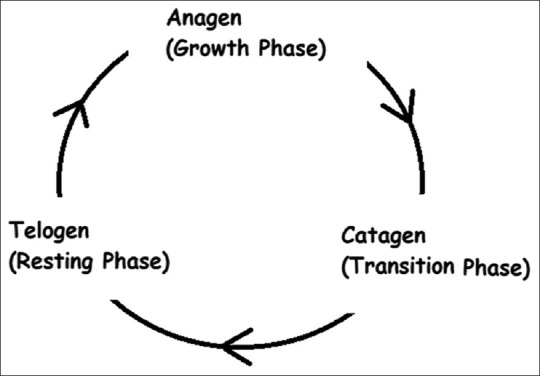
Phases of hair cycle[2]
The enzyme 5α-reductase converts testosterone to a more potent androgen, dihydrotestosterone (DHT). DHT is responsible for the development of terminal hairs by the differentiation of the vellus hairs and also by prolonging the anagen phase thereby leading to thicker longer hairs.[4]
Hirsutism is a common clinical entity and can be physically and psychologically distressing, especially to young females. Management of hirsutism in polycystic ovary syndrome (PCOS) and other hyperandrogenic disorders has been well discussed in various published guidelines. Conversely, for the management of idiopathic hirsutism (IH) there are no clear recommendations and many uncertainties persist. This practise update is an effort to guide the primary care physicians and the specialists in better and systematic management of IH.
METHODS
The expert group, selected by Integrated Diabetes and Endocrine Academy (IDEA), consisted of 12 experienced clinicians and pioneers in their fields consisting of endocrinologists, physicians, a dermatologist, a gynaecologist and a psychiatrist. A literature search was performed using online databases from PubMed, Cochrane Library and Google Scholar. Published articles from peer-reviewed indexed journals, with a preference for meta-analyses and randomized controlled trials, were selected. The selected articles were given to all panel members before the meeting with a focus on important areas such as the cut-off of modified Ferriman–Gallwey score for the Indian population, conditions to be excluded before labelling IH, when to refer to specialists, how far and what to investigate in a suspected case of IH and choice of therapies for its management.
A meeting took place with all the 12 members individually giving their opinions on these predetermined questions of interest. After the initial discussion, two more meetings were held and the final practice update statement was formulated after voting.
DEFINITIONS
Hirsutism
Hirsutism is defined as the growth of excessive terminal hairs at sites that are typically seen in men and are androgen-dependent. These primarily include the face, chest, back, abdomen, upper arms and thighs. It is different from hypertrichosis, which is the generalized excessive growth of hairs, typically vellus hairs, in areas that are non-androgen dependent.[3]
Idiopathic hirsutism
Idiopathic hirsutism is defined as a type of hirsutism in women with normal ovulatory function and menstrual cycles without any other evidence of hyperandrogenism or any hyperandrogenic disorder. These women, therefore, have eumenorrhea and normal serum androgen levels.[3,5] Idiopathic hyperandrogenism is a different entity and is defined as a condition in which patients have biochemical hyperandrogenism with normal ovulatory cycles and ovarian morphology.[2]
EPIDEMIOLOGY
Around 5–10% of reproductive-aged females are affected with hirsutism.[1] Of these, more than 80% of the cases are because of excess biochemically provable hyperandrogenic state. The most common cause of hirsutism is polycystic ovary syndrome (PCOS), accounting for around 70–80% of cases among the hirsute women. IH is seen in around 5–20% of cases of hirsutism while among those women with mild hirsutism (i.e., a Ferriman-Gallwey score of 8–15), IH is the cause in around 50% of the cases.[3,6]
Since IH is a diagnosis of exclusion and PCOS is most common among androgen-excess disorders, therefore the prevalence of IH largely depends on the diagnostic criteria being followed for PCOS. The National Institutes of Health (NIH) criteria for diagnosis of PCOS, does not involve assessing the morphology of the ovaries by ultrasonography while it forms an essential part of the workup if we use the Rotterdam criteria. Thus, there could be misclassification of the patients. It was seen in a meta-analysis that the prevalence of IH was 7.2% when NIH criteria was used as compared to 13% if the PCOS was diagnosed using the Rotterdam Criteria implying that at times a diagnosis of IH may result from inadequacies in the diagnostic criteria used for PCOS[7] Another criteria for PCOS diagnosis is that given by the Androgen Excess Society in 2006. Recently published International Evidence-based Guidelines for the Assessment and Management of Polycystic Ovary Syndrome 2023, recommend that the presence of both irregular menstrual cycles and hyperandrogenism are enough to make the diagnosis of PCOS, and ultrasound may not be required in many of the cases.[8]
IH is also common among certain ethnicities like the women of the Mediterranean region. Asian women have lower levels of enzymatic activity of 5α-reductase which probably is the reason for the lower prevalence of hirsutism in them.[9] Earlier, it was thought that IH was actually ‘familial hirsutism’, occurring in the offspring due to some genetic inheritance. Later, it was found that IH is a separate entity and many of the diseases associated with hirsutism have familial components and thus can be seen in successive generations.[10]
In a recently published meta-analysis on IH, the pooled prevalence of IH was estimated to be 7.7%, independent of ethnicity and the criteria employed to diagnose PCOS.[7]
Not much data are available regarding the epidemiological aspects of IH in India. Different studies show great variability in the prevalence of IH. In a retrospective cross-sectional study with a small sample size at a centre in Maharashtra, it was seen that IH was the most common cause of hirsutism (40%).[11] Again, in a study done to assess the prevalence and etiology of hirsutism in Kashmiri women, it was found that the prevalence of hirsutism in women aged 15–75 years was 10.5% and IH was the commonest cause comprising 38.7% of the total hirsute cases.[12] In a study from Himachal Pradesh, around 10.7% of the women with hirsutism aged 14–45 years hadIH,[13] while a cross-sectional study from Haryana showed that around 4.2% in the age group 16–45 years had PCOS.[14] Such disparities in the prevalence when compared to the Western data could be explained by the differences in study population, sample size, ethnicity and use of abdominopelvic ultrasonography instead of trans-vaginal to diagnose PCOS. Because of the multi-ethnic population in India with varied perceptions of body hairs, problems may arise if a uniform yardstick for hirsutism diagnosis is employed in our country.
PATHOPHYSIOLOGY OF IDIOPATHIC HIRSUTISM – IS IT ACTUALLY IDIOPATHIC?
The pilosebaceous unit contains all the necessary enzymatic machinery required for the synthesis of androgens. Therefore, the circulating levels of androgens may not directly correlate with the levels present at the level of the pilosebaceous unit. Hirsutism results from the interplay of serum and local androgen concentrations, 5α-reductase activity and sensitivity of androgen receptors present in the hair follicles. Hence, the severity of hirsutism is not directly proportional to the serum androgen levels.[2]
IH was initially considered as ‘hirsutism without any known cause’ irrespective of the levels of serum androgens. However, with diagnostic advancements, it was redefined as a type of hirsutism with normal serum androgen levels and normal ovulatory cycles and no clinical or biochemical evidence of any hyperandrogenic disorder.[15] Hirsutism is one of the common manifestations of hyperandrogenism and if the serum androgen levels are normal in IH, what then is leading to hirsutism? Is it actually idiopathic?
Some of the probable mechanisms involved in the pathophysiology of IH have been summarized in Figure 2.[5]
Figure 2.
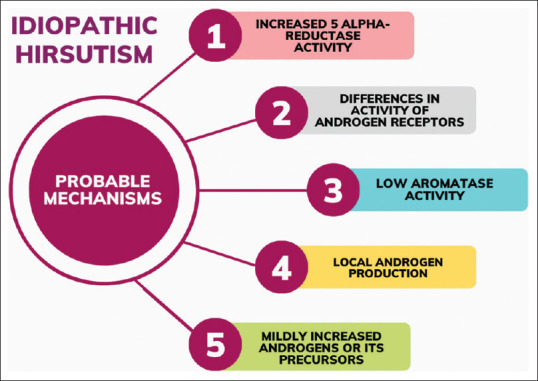
Probable mechanisms involved in the pathophysiology of idiopathic hirsutism[5]
At present, IH is considered to be ‘idiopathic’ because of the limited knowledge regarding its pathophysiology, diagnostic limitations and lack of sensitivities of the assays currently available. IH can actually be the initial stage of some other disorder which it may or may not later develop into. Because of these complexities and limitations, the expert panel cannot decide whether IH is actually ‘idiopathic’ or not.
Practise Point 1
Because of the complex proposed pathophysiological processes that might be involved in Idiopathic Hirsutism, the expert group cannot decide whether Idiopathic Hirsutism is truly ‘idiopathic’ or not. However, for operational convenience hirsutism without any other clinical or biochemical evidence of hyperandrogenism and with normal menstrual cycles can be considered as Idiopathic Hirsutism
DIAGNOSIS
IH is diagnosed in women having hirsutism with normal ovulatory cycles and no other clinical or biochemical evidence of hyperandrogenism. Thus, it is more of a diagnosis of exclusion wherein we have to rule out all the important disorders associated with androgen excess.[5]
The modified Ferriman–Gallwey Score and its applicability to Indians
Hirsutism is commonly diagnosed with the help of a modified Ferriman–Gallwey (mFG) score. In 1961, Ferriman and Gallwey devised a score for the quantification of hirsutism considering 11 androgen-dependent sites.[16] Later, Hatch et al.[17] proposed the modified Ferriman–Gallwey score and incorporated nine androgen-dependent areas. Each area is assigned with a score ranging from 0 to 4 depending on the extent of hairs present[2]:
| Score | Description |
|---|---|
| 0 | No terminal hair growth |
| 1 | Terminal hair growth which is minimally visible |
| 2 | Terminal hair growth which is more than minimal but less than that of an adult male |
| 3 | Terminal hair growth similar to not a very hairy male |
| 4 | Terminal hair growth similar to a well-virilized healthy adult male |
As there is a significant effect of ethnicity on hirsutism, different cut-offs have been proposed for different geographical regions, and as such there cannot be a universal cutoff. These cut-offs correspond to the 95th percentile for that population. The most commonly used cut-off worldwide is ≥8, which is actually based on the general US population.[3] Even various regions within India have quantitative differences in hair distribution, suggesting that even within India, cut-offs may vary for different regions. Various Asian studies have chosen different cut-offs for people from different ethnicities: ≥7 for Southern Chinese women and ≥2 Han Chinese women.[2,18]
There is no published normative data for mFG score for Indian population. Most Indian studies have used ≥8 for diagnosing hirsutism.[11,19,20] Few studies have used an mFG score of ≥6 as a cutoff for hirsutism.[11,21] One study tried to simplify the problem of examining nine areas and recommends the evaluation of only four areas—upper lip, chin, lower abdomen and thigh and using a cutoff of ≥8 after calculating a score based on the formula[22]:
Upper lip × 0.15 + Chin × 0.32 + Lower abdomen × 0.178 + Thigh × 0.146 – 0.172
To find an ideal cutoff for Indian women, a large population study should be done but is a difficult task due to the extensive geographical distribution and variation in ethnicities.
The mFG score has various other limitations. In a busy OPD or a clinic with limited privacy detailed inspection of the body parts to assess the mFG score may not be a practical convenience. Certain androgen-sensitive areas have not been considered in the mFG score such as the buttocks and sides of the face (sideburns).[2,3,23] Growth of terminal hairs over the abdomen, back or thighs might not be as distressing when compared to hair growth on the face. A higher mFG score, meeting the cut-off, might not compel the lady to seek treatment while even a slight growth on the face (with an mFG score below the cut-off) might be significantly distressing. Facial hirsutism might sometimes lead to the perception of body dysmorphism, especially in younger females due to peer environment. Thus, instead of keeping a strict cut-off of mFG for diagnosing hirsutism, it is advisable to look for patient-important hirsutism (any degree of hirsutism leading to distress in women enforcing her to pursue treatment) and also regional hirsutism, especially facial hairs.
The estimation of mFG could also be difficult and erroneous in situations where the patient may have taken physical or cosmetic measures for hair removal before attending a physician. It is thus advised to request the patient to avoid laser or electrolysis for at least 3 months, to avoid depilation and waxing for at least 4 weeks and not to shave for at least 5 days before visiting the physician.[24]
Practise Point 2
Considering the fallacies and impracticalities of the modified Ferriman–Gallwey score, the expert group suggests to give preference to patient-important hirsutism, distress and also regional hirsutism especially facial hairs, instead of being overdependent on the mFG scoring system and following a strict cut-off therefrom for diagnosis and follow-up of hirsutism in Indian context
Practise Point 3
For accurate clinical evaluation of Idiopathic Hirsutism with or without calculating the mFG score, the expert group opines that the patient should be advised to avoid laser or electrolysis for at least 3 months, depilation and waxing for at least 4 weeks and not to shave for at least 5 days before visiting the physician
What and when to investigate
Since IH is essentially a diagnosis of exclusion, other causes of hyperandrogenism should be ruled out first. These have been summarized in Table 1 and Figure 3.[3,6,25,26,27,28] The importance of this lies in the fact that many of these disorders are acceptably common, treatable and have cardiometabolic implications.
Table 1.
| Disease Entity | Contribution to total cases of Hirsutism (%) |
|---|---|
| PCOS | 70–80 |
| Idiopathic hirsutism | 5–10 |
| NC-CAH | 3 |
| Cushing’s syndrome | <1 |
| Androgen secreting tumours | 0.2–0.3 |
(PCOS=Polycystic ovary syndrome, NCCAH=Non-classical congenital adrenal hyperplasia)
Figure 3.
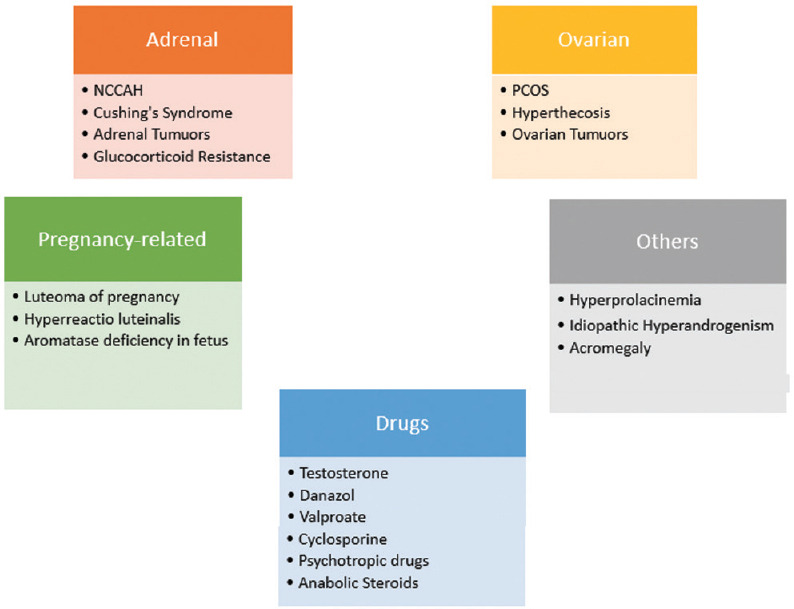
Causes of hyperandrogenism to be ruled out before diagnosing idiopathic hirsutism.[3,25]
The importance of evaluating a patient suspected to have IH is exemplified by the fact that it can mimic many other hyperandrogenic disorders and that the severity of hirsutism has no correlation with the magnitude of hyperandrogenism such that a woman with a very mild degree of hirsutism can even have an underlying androgen-secreting tumour.[6]
All women presenting with hirsutism should face detailed history and questions to get clues regarding the diagnosis. Questions should include the onset and progression of hirsutism, a detailed menstrual history, other symptoms of androgen excess, a history of intake of relevant drugs, a past history of any treatment obtained for hirsutism and a family history of related symptoms and disorders.
Around 54–68% of the testosterone is bound to albumin, 30–44% to sex hormone binding globulin (SHBG) and 0.5–3% is free (unbound). The testosterone that is bound to albumin is easily dissociable and thus can act on target tissues while that bound to SHBG cannot dissociate easily. Bioavailable testosterone, therefore, comprises the free as well as albumin-bound fraction and is available for action on target tissues.[29] Free testosterone levels are ideally measured by equilibrium dialysis but are not widely available and are also expensive. Measurements of free testosterone with an immunoassay are not standardized and also not reliable. Total testosterone can be measured by immunoassays but some societies recommend measuring it via liquid chromatography with mass spectrometry (LC-MS/MS). Moreover, at lower levels of testosterone (<50 ng/dL), which we normally expect in these females, the performance of immunoassay declines and thus becomes less reliable. However, the LC-MS/MS method is scarcely available and expensive. Many chemiluminescence immunoassays/electro-chemiluminescence immunoassays (CLIA/ECLIA) measuring total testosterone have similar functional sensitivities to that of LC-MS/MS and many studies have shown that currently available LC-MS/MS-based methods may not be superior to direct immunoassays. So instead of measuring free testosterone, we suggest measuring total testosterone ideally by LC-MS/MS but testosterone measured with a reliable immunoassay is also reasonable.[2,30] Another issue is the lack of normative data on testosterone levels in Indian women. In 2023, the ICMR-PCOS task force study outcome published normative ranges of various hormones in Indian females, with testosterone ranging from 6 ng/dL to 68 ng/dL.[31] Certain drugs are known to affect testosterone levels or interfere with various assays and could lead to false results—glucocorticoids, mifepristone, abiraterone, danazol, opioids among others. Clinicians should keep in mind while ordering a test for androgens.[32]
As per the definition of IH, serum androgen levels are expected to be normal in these patients. Testing for serum testosterone is important to rule out other causes of androgen excess. So, we advise testing serum total testosterone at least once in all patients presenting with patient-important hirsutism using a reliable assay. Ideally, this should be done before starting the treatment as the serum androgen levels may be affected with certain treatment modalities. Measuring SHBG levels for calculating the Free Androgen Index (FAI) is not suggested as the test is not widely available, costly and would not provide any additional information about total testosterone that would help in our diagnosis. As already discussed, serum androgen levels have a poor correlation with the severity of hirsutism.[1]
Other causes of hirsutism that need exclusion include:
Polycystic ovary syndrome (PCOS) is the most common cause of hirsutism.[3] These patients usually have other signs or symptoms of hyperandrogenism along with irregular menstrual cycles. Features associated with insulin resistance like central obesity, acanthosis nigricans, dyslipidemia, etc., are commonly present. Imaging is suggestive of polycystic ovary morphology. Also because of the increasing incidences of obesity, diabetes and hypertension, it is suggested to do a basic metabolic workup comprising blood pressure measurement, lipid profile and an oral glucose tolerance test in all the patients.[33]
Non-classic congenital adrenal hyperplasia (NC-CAH) is another important disorder to be considered. It is classically due to 21-hydroxylase deficiency leading to elevated 17-hydroxyprogesterone levels (17-OHP). 17-OHP should ideally be measured in the follicular phase. The expert group suggests measuring 17-OHP levels, especially if the DHEAS levels are found to be elevated. The main objective of diagnosing NC-CAH is an early diagnosis of the entity and provision of genetic counselling to the family, as in this disorder, having an autosomal recessive inheritance, there is an increased prevalence of CAH in the offspring, be it classical or the non-classical variety.[34]
Cushing’s syndrome, not an uncommon cause of hirsutism, can present without discriminatory signs or symptoms. It has serious long-term cardiovascular, metabolic, neurocognitive and musculoskeletal complications if left untreated.[35] Screening for Cushing’s syndrome in patients with discriminatory features is a simple and cost-effective method to screen the patients for the disease.
Being a very common endocrine disorder and also one of the rare causes of hirsutism, hypothyroidism can be associated with menstrual irregularities and polycystic changes in the ovary. Hence, we suggest opportunistic testing for thyroid function status.
Androgen secreting neoplasms are rare (0.2%), but because of their solemn consequences, if not managed timely, they should always be considered while evaluating a hirsute patient.[27] They usually, but not always, are associated with markedly elevated levels of testosterone or DHEAS depending on their anatomical and functional properties. A testosterone level of >200 ng/dL is suggestive of a virilizing tumour and should enforce an evaluation for the same and DHEAS >700 μg/dL indicates the probable presence of an adrenal tumour[36]
Hirsutism can rarely be caused by hyperprolactinemia too. If there are associated features of galactorrhea and/or menstrual irregularities, serum prolactin levels should be measured.
Imaging of the ovaries for follicle number and ovarian volume is an important component of the Rotterdam criteria used for the diagnosis of PCOS. All the guidelines recommend transvaginal sonography over transabdominal ultrasound for diagnosing PCOS and other pelvic pathology.[37] Doing transvaginal sonography is not acceptable to most unmarried females and is thus a limitation. If conducting a transabdominal sonography, the ovarian volume is more reliable than the follicle number.[38] Sonography might also help detect an ovarian or an adrenal neoplasm. So the expert panel opines to go for an ultrasound in all suspected patients of IH as it is essentially a diagnosis of exclusion. It depends on the physician’s discretion to conduct a transvaginal or transabdominal sonography, as indicated clinically.
Practise Point 4
4.1 - Females presenting with hirsutism should be evaluated with a focused history, extensive clinical examination and relevant laboratory investigations
4.2 – Serum total testosterone should be measured at least once in all the patients prior to starting any treatment
4.3 - Total Testosterone should ideally be measured by LC-MS/MS but measuring it with a reliable immunoassay is also reasonably acceptable
4.4 – If clinically suspected, screening for Cushing’s syndrome may be conducted as per established guidelines
4.5 - DHEAS levels should be measured in all the cases to look for adrenal hyperandrogenism
4.6 – 17-hydroxyprogesterone (17-OHP) levels should be measured in the follicular phase, especially if the DHEAS is found to be elevated
4.7 - Serum Prolactin levels should be measured if there is associated galactorrhea and/or menstrual irregularities
4.8 - Opportunistic testing for thyroid function status should be done
4.9 - Routine testing of SHBG levels in all the patients is not advised
4.10 – Considering the prevalence and close similarity of PCOS with IH and increasing incidences of obesity, diabetes and hypertension all the patients should undergo a basic metabolic workup comprising blood pressure measurement, lipid profile and an oral glucose tolerance test
4.11 – It is suggested to go for an ultrasound in all suspected patients of Idiopathic Hirsutism as it is essentially a diagnosis of exclusion. It depends on the physician’s discretion to conduct a transvaginal or a transabdominal sonography, as indicated clinically
IMPLICATIONS
Apparently, a benign entity, whether IH has metabolic, reproductive or psychiatric implications is a matter of controversy.
Metabolic
Polycystic ovary syndrome (PCOS) is well known to be associated with metabolic abnormalities like diabetes mellitus, hypertension, obesity, insulin resistance, dyslipidemia and non-alcoholic fatty liver disease (NAFLD).[39,40] The pathophysiology here is attributed to many factors which have an interplay in the development of these cardiometabolic disorders. These include an excess of androgens, sympathetic nervous system dysfunction, lower anti-inflammatory and higher pro-inflammatory markers, to name a few. The most important of these is the effect of hyperandrogenism on peripheral as well as central tissues.[41] Excess of androgens, through its effect on adipose tissue, liver, skeletal muscles and brain leads to increased adiposity, insulin resistance and a decrease in leptin-mediated thermogenesis.[39]
In the case of IH, since the serum androgen levels are normal, it is expected that the harmful effects of hyperandrogenism would not be seen. But as already discussed in IH, there may be cutaneous hyperandrogenism leading to increased androgen levels and receptor sensitivity at the level of the pilosebaceous unit. It is uncertain whether this peripheral hyperandrogenism would have an effect on the body’s metabolism, particularly insulin resistance. There are some studies, with small sample sizes, which show that there is an increase in insulin resistance in patients of IH, while many studies failed to find this association.[42,43,44] These contradictory results can be because of the small sample size, difference in study design and non-consideration of various confounding factors such as age and body mass index (BMI).
In a study done in Iran, 101 subjects of IH from the participants of the Iranian PCOS prevalence study were taken and compared with 423 healthy controls. It was found that the age and BMI-adjusted prevalence of metabolic syndrome and insulin resistance was similar in both groups and thus there was no association of IH with insulin resistance and metabolic syndrome.[44]
A systemic review and meta-analysis including 12 studies and 3913 participants was done to evaluate the lipid parameters in patients of IH compared to those of healthy controls and also to PCOS patients. It was found that there was no significant difference in the majority of the lipid parameters in patients of IH as compared with those of the healthy and PCOS controls.[7]
Practise Point 5
The expert group concludes that there is a lack of association of various metabolic parameters with Idiopathic Hirsutism at present and it may be left to physician’s discretion to decide upon further cardio-metabolic work-up
Psychiatric
Hirsutism leads to stress, anxiety, depression and low self-esteem especially in young women as facial and body hairlessness, in most societies, is viewed as the norm of femininity.
Hirsutism has a significant impact on the quality of life. In a multicentric prospective study with 393 subjects of PCOS, it was seen that hirsutism was the second most important predictor (obesity being the first) of health-related quality of life.[45] Hair removal amounts to a significant time emotional and financial burden for these patients.[46] In a study done by Ekback et al., it was found that hirsutism adversely affected the health-related quality of life (HRQoL) and had a severe negative effect on the perceived mental health of the patients. This study assessed an instrument known as the Dermatology Life Quality Index (DLQI), which actually measures the extent to which any dermatologic disease affects the quality of life. It was seen that DLQI in patients with hirsutism was almost equivalent to that in patients with skin diseases like psoriasis and atopic dermatitis. Higher levels of Ferriman–Gallwey score had a higher impact on the mental health of the women.[47] But as already described, consideration should be given to patient-important hirsutism implying that the extent of distress is subjective and might not be related to the degree of hirsutism. The acceptability of the extent of the amount of hairs present on the body differs in various societies, cultures and ethnic backgrounds and this should also be taken into account while considering patient-important hirsutism.
Practise Point 6
The physicians should be aware of the psychiatric consequences of Idiopathic Hirsutism and its adverse effects on the perceived mental health and should evaluate and screen the patient accordingly, if needed, in consultation with a psychiatrist
Reproductive
Considering the pathophysiology and nature of the disease it is expected that IH will not lead to ovulatory defects, subfertility or infertility and endometrial hyperplasia or carcinoma. However, as there is a very thin line of diagnostic demarcation between IH and PCOS, long-term studies are needed for assessment of the reproductive complications of IH.
When to refer to specialists
There are certain circumstances that warrant referral to an endocrinologist or a psychiatrist for further evaluation and management of complex situations. These include:
Recent onset and rapidly progressing hair growth
Serum DHEAS levels >700 μg/dL or a serum testosterone level >200 ng/dL.
Presence of a co-existent metabolic syndrome
Associated psychiatric disorders with clinical suggestions of depression, anxiety or body dysmorphic disorder or the presence of suicidal thoughts
Failure to respond to treatment
MANAGEMENT
All patients of IH might not require treatment. It is important to take into consideration the severity of hirsutism which the patient perceives, known as ‘patient-important hirsutism’, implying that hirsutism with a lower mFG score might be distressing to some patients while hirsutism with a higher mFG score might not be troublesome to some.[3] So, all the available treatment modalities should be explained to the patient, and then her preference should be taken into consideration while deciding on the treatment modality. It should be well explained in the beginning that pharmacological treatment will take time to show its effect and will slow the hair growth decreasing the need for frequent hair removal rather than completely removing the hair.
Endocrine
As already discussed, all the probable mechanisms involved in the pathophysiology of IH are either because of increased local androgen production or exaggerated androgen action. So, the basic endocrine treatment for IH would be to decrease androgens or to block its action.
The drugs that are currently in use are the combined estrogen-progestin contraceptives, anti-androgens, insulin-sensitizing agents, a few topical drugs and some other uncommonly used agents.[4]
1. Oral Combined Estrogen-Progestin Contraceptives (OCs)
Most OCs used in the treatment of IH contain synthetic estrogen in the form of ethinyl estradiol along with progestin. There are various mechanisms by which OCs may act and help in the management of IH. These have been summarized in Figure 4.[3,4,25,48]
Figure 4.
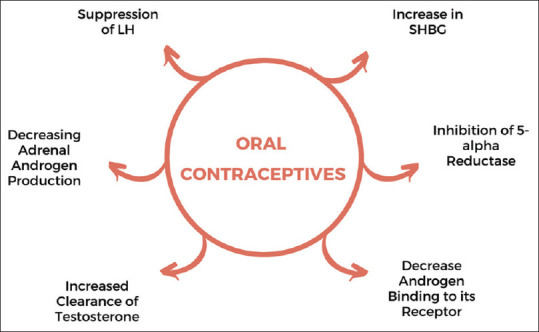
Mechanisms of action of oral contraceptives (OCs) in ameliorating idiopathic hirsutism.[3,4,25,48]
Different progestins have different levels of androgenicity and some have anti-androgenic action and thus can be chosen accordingly. This has been summarized in Table 3. But various studies have shown that OCs containing the anti-androgenic progestins do not have much clinically significant difference in the mFG score reduction over the OCs containing the androgenic progestins. In a recent review and meta-analysis, it was seen that OCs with anti-androgenic progestins like cyproterone acetate (CPA) and drosperinone (DSP) reduced the mFG score by 2.86 more than that by other OCs which is not much clinically significant. Thus, we do not suggest one OC over the other for the management of IH.[3,49]
Table 3.
Progestins and their androgenicity
| Androgenicity | Progestin |
|---|---|
| High | • Levonorgestrel |
| • Norgestrel | |
| Medium | • Norethindrone |
| Low | • Norgestimate |
| • Desogestrel | |
| • Gestodene | |
| Anti-androgenic | • Cyproterone Acetate (CPA) |
| • Drosperinone (DSP) |
Table 2.
| Etiology | Associated features |
|---|---|
| Acromegaly | • Acral enlargement |
| • Coarse facial features | |
| • Hyperhidrosis | |
| • Headache, visual field defects | |
| Hyperprolactinemia | • Galactorrhea |
| • Menstrual irregularities | |
| • Headache, visual field defects | |
| Cushing’s syndrome | • Discriminant features—stria, easy bruisability, proximal muscle weakness, facial plethora. |
| • Hypertension | |
| • Dysglycemia | |
| Nonclassic congenital adrenal hyperplasia (NC-CAH) | • Autosomal Recessive inheritance |
| • Has genetic implications for women desirous of fertility. | |
| • Family history may be present. | |
| • Elevated 17-OHP levels | |
| Glucocorticoid resistance | • Other signs of hyperandrogenism |
| • Can be associated with mineralocorticoid excess | |
| • Hyperpigmentation may be seen | |
| Androgen secreting neoplasms | • Rapid onset of symptoms of hyperandrogenism/virilization |
| • Markedly elevated levels of testosterone/DHEAS | |
| • Palpable mass | |
| Polycystic ovary syndrome (PCOS) | • Oligomenorrhea or amenorrhea |
| • Frequent presence of insulin resistance, obesity, acanthosis nigricans, central obesity | |
| • Polycystic ovary morphology on ultrasonography | |
| Ovarian Hyperthecosis | • Hirsutism is accompanied by other signs of hyperandrogenism and virilization |
| • Primarily seen in post-menopausal women | |
| Idiopathic Hyperandrogenism | • Elevated levels of androgens |
| • Normal menses | |
| • Normal ovarian morphology on imaging |
(NCCAH=Non-classical congenital adrenal hyperplasia, PCOS=Polycystic ovary syndrome)
The use of OCs increases the risk of venous thromboembolism (VTE) in the users. The progestins with low androgenic and anti-androgenic effects increase the chances of VTE by around 1.5–2 times as compared with other progestins like levonorgestrel. But overall, the absolute risk remains low and much less than that seen in pregnancy. Obesity and increasing age further increase the risk of VTE.[3]
2. Anti-androgens
These drugs act either by decreasing the production of androgens or by blocking their action. All the anti-androgens carry a risk of teratogenicity in the form of feminization of a male fetus especially if used early in the pregnancy and thus are not preferred as the first choice of hormonal therapy. The important anti-androgens are:
Spironolactone—It is a competitive inhibitor of the androgen receptor and also inhibits of 5α-reductase enzyme.[50] A dose of 100–200 mg/d in divided doses is advised. Menstrual irregularities can occur which can be managed by the addition of an OC if not being taken already. Taking OCs along with spironolactone also helps in preventing an unwanted pregnancy in a sexually active woman.[1] Hyperkalemia is uncommon except in patients with renal impairment in whom spironolactone should be avoided.[3] Blood pressure and serum potassium should be evaluated after 2–3 weeks of the start of therapy.[51]
Finasteride and Dutasteride—Finasteride acts by inhibiting the 5α-reductase type 2 enzyme. It is less effective than other anti-androgens as both type 1 and type 2 5α-reductase enzymes are involved in the pathophysiology of hirsutism. It is given at a dose of 2.5–5 mg/day and has a very safe side effect profile. Dutasteride inhibits both type 1 and 2 5α-reductase enzymes and thus theoretically seems to be a better option than Finasteride. But there is no data supporting its use in the management of hirsutism and moreover, the cost of dutasteride is much higher than that of finasteride.[4]
Flutamide – Flutamide acts by blocking the androgen receptor. It can be given at a dose from 62.5 up to 500 mg/d but because of its potential hepatotoxicity, it is not advised to use flutamide for the management of hirsutism due to the availability of other effective and much safer alternatives.[3]
Cyproterone Acetate—Structurally, it is a progestin and thus inhibits LH and consequently testosterone and other androgens. Moreover, it also inhibits 5α-reductase and androgen receptor activity and thus has anti-androgenic actions.[52]
Various drugs used for the treatment of IH and their percentage reduction in Ferriman–Gallwey score have been summarized in Table 4.[53]
Table 4.
Percentage reduction in Ferriman-Gallwey Score by various drugs used for the management of Idiopathic Hirsutism[53]
| Drug | Percentage reduction in Ferriman-Gallwey Score |
|---|---|
| Oral contraceptives | 27% |
| Spironolactone | 38% |
| Finasteride | 20% |
| Flutamide | 41% |
3. Topical Treatment
Eflornithine hydrochloride cream can be used to decrease facial hair growth. It acts by inhibiting L-ornithine decarboxylase in an irreversible manner. This enzyme is involved in the synthesis of polyamines involved in the proper development and differentiation of hair follicles. It is available as a 13.9% cream. The patient should be counseled that eflornithine reduces hair growth but does not remove previously existing hairs.[54]
4. Insulin Sensitizers or Insulin-lowering agents
Drugs such as Metformin, Lobeglitazone and Pioglitazone are not suggested for the management of hirsutism with a few meta-analyses of these drugs showing no benefit of using them[55] and thus we suggest against the use of these drugs.
Physical/Mechanical methods of management [Figure 5]
Figure 5.
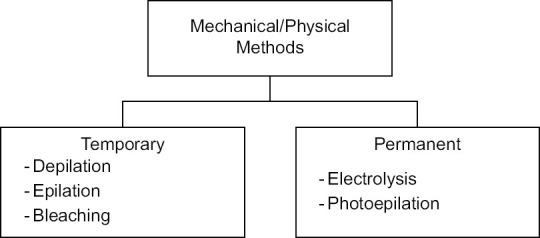
Types of mechanical/physical methods of hair removal
Temporary methods
Depilation is the removal of hair above the surface of the skin while epilation is the removal of the hair from above the hair bulb.
Depilation can be performed mechanically by shaving, trimming or using chemical depilatory agents which mostly contain thioglycolate. After shaving, the tip of the hair becomes blunt as a result of which the hair might appear thicker. Thioglycolate might lead to skin irritation and dermatitis and also has poor odour.[4]
Temporary epilation can be done by waxing, plucking or threading. This might be associated with folliculitis, scarring, hyperpigmentation, and is painful.[3]
Bleaching actually does not remove hair. It helps in concealing the hair by causing depigmentation of the hairs. Again, it can lead to skin irritation and dermatitis.
Permanent Methods
Photoepilation is based on the principle of ‘selective photothermolysis’. This means that the light is absorbed by certain selective tissues which leads to their destruction. In this case, the light is selectively absorbed by the melanin pigment present in the hair and skin. As a result of which, only the pigmented terminal hairs are targeted. The heat from the shaft diffuses into the hair follicle and damages it. Photoepilation can be done with lasers and intense pulsed light (IPL) sources. Lasers with wavelengths in the range of 300–1200 nm can be used to treat hirsutism as this is the range of light that the melanin absorbs. Types of lasers available for photoepilation include—alexandrite, diode, ruby and Nd: YAG lasers.[56] Various studies comparing the efficacy of lasers and IPL have found similar efficacy in the reduction of hairs. These can be used on large areas at a time.[57] Multiple sessions are required to increase the efficacy of treatment. The net reduction of hair ranges from around 40 to 80% depending on the type of laser used, the number of treatment cycles provided and the pigmentation of the hair.[58] Hairs that are white or blonde have very less amount of melanin and thus are not treatable with photoepilation. Lasers with a longer wavelength should be used as they penetrate deeper reaching more up to the hair follicles and thus reducing the chances of getting absorbed by the melanin pigment of the skin and causing burn injuries. Thus the risk of side effects is higher with IPL and ruby laser (694 nm) while lesser with Nd: YAG laser (1064 nm). Laser photoepilation has become the preferred modality of choice for the permanent physical removal of hairs.
Electrolysis works by passing current into individual hair follicles with the help of an electrode which leads to the damage of the hair follicle. It is a very time-consuming process as each hair follicle has to be individually treated. Unlike photoepilation, it works on hair of any color.
Concomitant use of oral hormonal therapies and topical eflornithine helps to increase the efficacy, rapidity and decrease the chances of regrowth of hairs.[59]
Approach to pharmacotherapy (Practise Point 7)
7.1 Combination oral contraceptives (OCs) should be used as the first line endocrine therapy for the management of Idiopathic Hirsutism in most of the patients
7.2 Preference of one OCs over the other for management of Idiopathic Hirsutism is not suggested; however, a progestin with low androgenicity or one with anti-androgenic property may be preferred
7.3 If after treatment with an OCs for a minimum of 6 months, there is no improvement in patient-important hirsutism, it is suggested to add an anti-androgen to the OCs being taken
7.4 Among the available anti-androgens, spironolactone should be used as the initial agent of choice followed by Finasteride
7.5 Flutamide should not be used for the management of Idiopathic Hirsutism in view of its potential hepatotoxicity and the availability of other safer and effective alternatives
7.6 Insulin sensitizers or insulin lowering agents like Metformin, Pioglitazone or Lobeglitazone should not be used for the management of Idiopathic Hirsutism
Topical pharmacotherapy (Practise Point 8)
8.1 Topical eflornithine could be used as the initial line of management as monotherapy in cases of mild idiopathic hirsutism or concomitantly with other drugs in rest of the cases
8.2 For permanent mechanical removal of hairs, photoepilation using laser with longer wavelength such as Nd:YAG or diode laser should be used as the preferred modality
COUNSELLING
Counselling the patient is an important, often ignored, aspect of the management ofIH. The patient should be informed that it would take around 6–7 months for any obvious response to appear. Pharmacological treatments are expected to slow the hair growth rather than completely stopping or removing the hairs. If and when required the patient should be referred to a psychiatrist for seeking appropriate management and counselling.
CONCLUSION
Idiopathic Hirsutism is, thus, a complex entity wherein the symptom (hirsutism) that is pathophysiologically attributable to increased androgen levels is not evident biochemically. So, it is possible that ‘Idiopathic Hirsutism’ might be a misnomer. Instead, it could be a nascent stage of some other hyperandrogenic disorder. So, a continuous follow-up of these patients is very crucial. Future studies are needed for a better understanding of the pathophysiology and management of IH. Oral contraceptives with or without anti-androgens form the mainstay of endocrine therapy for patient-important hirsutism while photoepilation is the most favoured physical method of hair removal.
Authors’ contribution
Conceptualization – Binayak Sinha, Anirban Majumder
Writing original draft – Vibhu Ranjan Khare, Nilanjan Sengupta
Writing review/editing– Debasish Maji, Supratik Bhattacharyya, Soumyabrata R. Chaudhuri, Masood Batin
Supervision- Binayak Sinha, Nilanjan Sengupta
Writing psychiatric aspects – Prathama Guha
Writing gynaecological aspects – Sujata Datta
Writing dermatological aspects –Dinesh K. Hawelia
Financial support and sponsorship
Nil.
Conflicts of interest
There are no conflicts of interest.
Acknowledgment
The authors would like to acknowledge Integrated Diabetes and Endocrine Academy for facilitating this manuscript.
REFERENCES
- 1.Liu K, Motan T, Claman P. No. 350-Hirsutism: Evaluation and treatment. J Obstet Gynaecol Can. 2017;39:1054–68. doi: 10.1016/j.jogc.2017.05.022. [DOI] [PubMed] [Google Scholar]
- 2.Escobar-Morreale HF, Carmina E, Dewailly D, Gambineri A, Kelestimur F, Moghetti P, et al. Epidemiology, diagnosis and management of hirsutism: a consensus statement by the Androgen Excess and Polycystic Ovary Syndrome Society. Hum Reprod Update. 2012;18:146–70. doi: 10.1093/humupd/dmr042. [DOI] [PubMed] [Google Scholar]
- 3.Martin KA, Anderson RR, Chang RJ, Ehrmann DA, Lobo RA, Murad MH, et al. Evaluation and treatment of hirsutism in premenopausal women: An endocrine society clinical practice guideline. J Clin Endocrinol Metab. 2018;103:1233–57. doi: 10.1210/jc.2018-00241. [DOI] [PubMed] [Google Scholar]
- 4.Agrawal NK. Management of hirsutism. Indian J Endocrinol Metab. 2013;17(Suppl 1):S77–82. doi: 10.4103/2230-8210.119511. [DOI] [PMC free article] [PubMed] [Google Scholar]
- 5.Unluhizarci K, Hacioglu A, Taheri S, Karaca Z, Kelestimur F. Idiopathic hirsutism: Is it really idiopathic or is it misnomer? World J Clin Cases. 2023;11:292–8. doi: 10.12998/wjcc.v11.i2.292. [DOI] [PMC free article] [PubMed] [Google Scholar]
- 6.Reingold SB, Rosenfield RL. The relationship of mild hirsutism or acne in women to androgens. Arch Dermatol. 1987;123:209–12. [PubMed] [Google Scholar]
- 7.Amiri M, Fallahzadeh A, Sheidaei A, Mahboobifard F, Ramezani Tehrani F. Prevalence of idiopathic hirsutism: A systematic review and meta-analysis. J Cosmet Dermatol. 2022;21:1419–27. doi: 10.1111/jocd.14313. [DOI] [PubMed] [Google Scholar]
- 8.Teede HJ, Tay CT, Laven JJE, Dokras A, Moran LJ, Piltonen TT, et al. Recommendations From the 2023 International Evidence-based Guideline for the Assessment and Management of Polycystic Ovary Syndrome. J Clin Endocrinol Metab. 2023;108:2447–69. doi: 10.1210/clinem/dgad463. [DOI] [PMC free article] [PubMed] [Google Scholar]
- 9.Lookingbill DP, Demers LM, Wang C, Leung A, Rittmaster RS, Santen RJ. Clinical and biochemical parameters of androgen action in normal healthy Caucasian versus Chinese subjects. J Clin Endocrinol Metab. 1991;72:1242–8. doi: 10.1210/jcem-72-6-1242. [DOI] [PubMed] [Google Scholar]
- 10.Gass M, Rebar R. Glob. libr. women's med., (ISSN: 1756-2228) 2008 Doi: 10.3843/GLOWM.10079. [Google Scholar]
- 11.Wankhade VH, Shah VH, Tomar SS, Singh RP. Clinical and investigative study of hirsutism. J Clin of Diagn Res. 2019;13:WC01–6. [Google Scholar]
- 12.Zargar AH, Wani AI, Masoodi SR, Laway BA, Bashir MI, Salahuddin M. Epidemiologic and etiologic aspects of hirsutism in Kashmiri women in the Indian subcontinent. Fertil Steril. 2002;77:674–8. doi: 10.1016/s0015-0282(01)03241-1. [DOI] [PubMed] [Google Scholar]
- 13.Mahajan VK, Singh Chauhan P, Chandel M, Singh Mehta K, Karan Singh V, Sharma A, et al. Clinico-investigative attributes of 122 patients with hirsutism: A 5-year retrospective study from India. Int J Womens Dermatol. 2020;7:237–42. doi: 10.1016/j.ijwd.2020.11.007. [DOI] [PMC free article] [PubMed] [Google Scholar]
- 14.Deswal R, Nanda S, Ghalaut VS, Roy PS, Dang AS. Cross-sectional study of the prevalence of polycystic ovary syndrome in rural and urban populations. Int J Gynaecol Obstet. 2019;146:370–9. doi: 10.1002/ijgo.12893. [DOI] [PubMed] [Google Scholar]
- 15.Kirschner MA, Zucker IR, Jespersen D. Idiopathic hirsutism--An ovarian abnormality. N Engl J Med. 1976;294:637–40. doi: 10.1056/NEJM197603182941204. [DOI] [PubMed] [Google Scholar]
- 16.Ferriman D, Gallwey JD. Clinical assessment of body hair growth in women. J Clin Endocrinol Metab. 1961;21:1440–7. doi: 10.1210/jcem-21-11-1440. [DOI] [PubMed] [Google Scholar]
- 17.Hatch R, Rosenfield RL, Kim MH, Tredway D. Hirsutism: Implications, etiology, and management. Am J Obstet Gynecol. 1981;140:815–30. doi: 10.1016/0002-9378(81)90746-8. [DOI] [PubMed] [Google Scholar]
- 18.Zhao X, Ni R, Li L, Mo Y, Huang J, Huang M, et al. Defining hirsutism in Chinese women: A cross-sectional study. Fertil Steril. 2011;96:792–6. doi: 10.1016/j.fertnstert.2011.06.040. [DOI] [PubMed] [Google Scholar]
- 19.Mandrelle K, Kamath MS, Bondu DJ, Chandy A, Aleyamma T, George K. Prevalence of metabolic syndrome in women with polycystic ovary syndrome attending an infertility clinic in a tertiary care hospital in south India. J Hum Reprod Sci. 2012;5:26–31. doi: 10.4103/0974-1208.97791. [DOI] [PMC free article] [PubMed] [Google Scholar]
- 20.Sharma D, Shanker V, Tegta G, Gupta M, Verma GK. Clinico-investigative Profile of Patients of Hirsutism in a Tertiary Level Institution. Int J Trichology. 2012;4:69–74. doi: 10.4103/0974-7753.96904. [DOI] [PMC free article] [PubMed] [Google Scholar]
- 21.Nidhi R, Padmalatha V, Nagarathna R, Amritanshu R. Prevalence of polycystic ovarian syndrome in Indian adolescents. J Pediatr Adolesc Gynecol. 2011;24:223–7. doi: 10.1016/j.jpag.2011.03.002. [DOI] [PubMed] [Google Scholar]
- 22.Madeswaran I, Maharajan S. Validation of newly developed and simplified scoring methods of Hirsutism. IJPHRD. 2019;10:160. [Google Scholar]
- 23.Sharma NL, Mahajan VK, Jindal R, Gupta M, Lath A. Hirsutism: Clinico-investigative profile of 50 Indian patients. Indian J Dermatol. 2008;53:111–4. doi: 10.4103/0019-5154.42387. [DOI] [PMC free article] [PubMed] [Google Scholar]
- 24.Yildiz BO, Bolour S, Woods K, Moore A, Azziz R. Visually scoring hirsutism. Hum Reprod Update. 2010;16:51–64. doi: 10.1093/humupd/dmp024. [DOI] [PMC free article] [PubMed] [Google Scholar]
- 25.Mihailidis J, Dermesropian R, Taxel P, Luthra P, Grant-Kels JM. Endocrine evaluation of hirsutism. Int J Womens Dermatol. 2017;3(Suppl 1):S6–10. doi: 10.1016/j.ijwd.2017.02.007. [DOI] [PMC free article] [PubMed] [Google Scholar]
- 26.Matheson E, Bain J. Hirsutism in women. Am Fam Physician. 2019;100:168–75. [PubMed] [Google Scholar]
- 27.Tewary S, Davies R, Prakash A. Hirsutism. Obstet Gynaecol Reprod Med. 2021;31:103–8. [Google Scholar]
- 28.Idkowiak J, Elhassan YS, Mannion P, Smith K, Webster R, Saraff V, et al. Causes, patterns and severity of androgen excess in 487 consecutively recruited pre- and post-pubertal children. Eur J Endocrinol. 2019;180:213–21. doi: 10.1530/EJE-18-0854. [DOI] [PMC free article] [PubMed] [Google Scholar]
- 29.Vermeulen A. Physiology of the testosterone-binding globulin in man. Ann N Y Acad Sci. 1988;538:103–11. doi: 10.1111/j.1749-6632.1988.tb48855.x. [DOI] [PubMed] [Google Scholar]
- 30.Legro RS, Schlaff WD, Diamond MP, Coutifaris C, Casson PR, Brzyski RG, et al. Total testosterone assays in women with polycystic ovary syndrome: Precision and correlation with hirsutism. J Clin Endocrinol Metab. 2010;95:5305–13. doi: 10.1210/jc.2010-1123. [DOI] [PMC free article] [PubMed] [Google Scholar]
- 31.Ganie MA, Chowdhury S, Suri V, Joshi B, Bhattacharya PK, Agrawal S, et al. Normative range of various serum hormonal parameters among Indian women of reproductive age: ICMR-PCOS task force study outcome. Lancet Reg Health Southeast Asia. 2023;15:100226. doi: 10.1016/j.lansea.2023.100226. [DOI] [PMC free article] [PubMed] [Google Scholar]
- 32.Zhang W, Zhang Y, Xie E, Ma J, Xu H, Pan S. False high testosterone of unknown reason in a clinically inconspicuous female. J Lab Med. 2019;43:41–3. [Google Scholar]
- 33.Christ JP, Cedars MI. Current Guidelines for Diagnosing PCOS. Diagnostics (Basel) 2023;13:1113. doi: 10.3390/diagnostics13061113. [DOI] [PMC free article] [PubMed] [Google Scholar]
- 34.Moran C, Azziz R, Weintrob N, Witchel SF, Rohmer V, Dewailly D, et al. Reproductive outcome of women with 21-hydroxylase-deficient nonclassic adrenal hyperplasia. J Clin Endocrinol Metab. 2006;91:3451–6. doi: 10.1210/jc.2006-0062. [DOI] [PubMed] [Google Scholar]
- 35.Pivonello R, Isidori AM, De Martino MC, Newell-Price J, Biller BM, Colao A. Complications of Cushing's syndrome: State of the art. Lancet Diabetes Endocrinol. 2016;4:611–29. doi: 10.1016/S2213-8587(16)00086-3. [DOI] [PubMed] [Google Scholar]
- 36.Rosenfield RL. The Diagnosis of polycystic ovary syndrome in adolescents. Pediatrics. 2015;136:1154–65. doi: 10.1542/peds.2015-1430. [DOI] [PMC free article] [PubMed] [Google Scholar]
- 37.Qureshi IA, Ullah H, Akram MH, Ashfaq S, Nayyar S. Transvaginal versus transabdominal sonography in the evaluation of pelvic pathology. J Coll Physicians Surg Pak. 2004;14:390–3. [PubMed] [Google Scholar]
- 38.Teede HJ, Misso ML, Costello MF, Dokras A, Laven J, Moran L, et al. Recommendations from the international evidence-based guideline for the assessment and management of polycystic ovary syndrome. Hum Reprod. 2018;33:1602–18. doi: 10.1093/humrep/dey256. [DOI] [PMC free article] [PubMed] [Google Scholar]
- 39.Sanchez-Garrido MA, Tena-Sempere M. Metabolic dysfunction in polycystic ovary syndrome: Pathogenic role of androgen excess and potential therapeutic strategies. Mol Metab. 2020;35:100937. doi: 10.1016/j.molmet.2020.01.001. [DOI] [PMC free article] [PubMed] [Google Scholar]
- 40.Setji TL, Brown AJ. Metabolic complications of polycystic ovary syndrome. In: Feinglos MN, Bethel MA, editors. Type 2 Diabetes Mellitus. Contemporary Endocrinology. Humana Press; 2008. [Google Scholar]
- 41.Chiu WL, Boyle J, Vincent A, Teede H, Moran LJ. Cardiometabolic risks in polycystic ovary syndrome: Non-traditional risk factors and the impact of obesity. Neuroendocrinology. 2017;104:412–24. doi: 10.1159/000455233. [DOI] [PubMed] [Google Scholar]
- 42.Ucak S, Basat O, Satir E, Altuntas Y. Evaluation of various insulin sensitivity indices in lean idiopathic hirsutism patients. Endocr J. 2012;59:291–6. doi: 10.1507/endocrj.ej11-0101. [DOI] [PubMed] [Google Scholar]
- 43.Abdel Fattah NS, Darwish YW. Is there a role for insulin resistance in nonobese patients with idiopathic hirsutism? Br J Dermatol. 2009;160:1011–5. doi: 10.1111/j.1365-2133.2009.09078.x. [DOI] [PubMed] [Google Scholar]
- 44.Sadat Hosseini M, Ramezani Tehrani F, Azizi F. The lack of association between idiopathic hirsutism and metabolic disturbances: Iranian PCOS prevalence study. Gynecol Endocrinol. 2013;29:821–5. doi: 10.3109/09513590.2013.797399. [DOI] [PubMed] [Google Scholar]
- 45.Guyatt G, Weaver B, Cronin L, Dooley JA, Azziz R. Health-related quality of life in women with polycystic ovary syndrome, A self-administered questionnaire, was validated. J Clin Epidemiol. 2004;57:1279–87. doi: 10.1016/j.jclinepi.2003.10.018. [DOI] [PubMed] [Google Scholar]
- 46.Lipton MG, Sherr L, Elford J, Rustin MH, Clayton WJ. Women living with facial hair: The psychological and behavioral burden. J Psychosom Res. 2006;61:161–8. doi: 10.1016/j.jpsychores.2006.01.016. [DOI] [PubMed] [Google Scholar]
- 47.Ekbäck MP, Lindberg M, Benzein E, Årestedt K. Health-related quality of life, depression and anxiety correlate with the degree of hirsutism. Dermatology. 2013;227:278–84. doi: 10.1159/000355356. [DOI] [PubMed] [Google Scholar]
- 48.Gordon GG, Southren AL, Tochimoto S, Olivo J, Altman K, Rand J, et al. Effect of medroxyprogesterone acetate (Provera) on the metabolism and biological activity of testosterone. J Clin Endocrinol Metab. 1970;30:449–56. doi: 10.1210/jcem-30-4-449. [DOI] [PubMed] [Google Scholar]
- 49.Barrionuevo P, Nabhan M, Altayar O, Wang Z, Erwin PG, Asi N, et al. Treatment options for hirsutism: A systematic review and network meta-analysis. J Clin Endocrinol Metab. 2018;103:1258–64. doi: 10.1210/jc.2017-02052. [DOI] [PubMed] [Google Scholar]
- 50.Lobo RA, Shoupe D, Serafini P, Brinton D, Horton R. The effects of two doses of spironolactone on serum androgens and anagen hair in hirsute women. Fertil Steril. 1985;43:200–5. doi: 10.1016/s0015-0282(16)48373-1. [DOI] [PubMed] [Google Scholar]
- 51.Spritzer PM, Lisboa KO, Mattiello S, Lhullier F. Spironolactone as a single agent for long-term therapy of hirsute patients. Clin Endocrinol (Oxf) 2000;52:587–94. doi: 10.1046/j.1365-2265.2000.00982.x. [DOI] [PubMed] [Google Scholar]
- 52.Mowszowicz I, Wright F, Vincens M, Rigaud C, Nahoul K, Mavier P, et al. Androgen metabolism in hirsute patients treated with cyproterone acetate. J Steroid Biochem. 1984;20:757–61. doi: 10.1016/0022-4731(84)90081-5. [DOI] [PubMed] [Google Scholar]
- 53.Koulouri O, Conway GS. A systematic review of commonly used medical treatments for hirsutism in women. Clin Endocrinol (Oxf) 2008;68:800–5. doi: 10.1111/j.1365-2265.2007.03105.x. [DOI] [PubMed] [Google Scholar]
- 54.Wolf JE, Jr, Shander D, Huber F, Jackson J, Lin CS, Mathes BM, et al. Eflornithine HCl Study Group. Randomized, doubleblind clinical evaluation of the efficacy and safety of topical eflornithine HCl 13.9% cream in the treatment of women with facial hair. Int J Dermatol. 2007;46:94–8. doi: 10.1111/j.1365-4632.2006.03079.x. [DOI] [PubMed] [Google Scholar]
- 55.van Zuuren EJ, Fedorowicz Z, Carter B, Pandis N. Interventions for Hirsutism (Excluding Laser and Photoepilation Therapy Alone): Cochrane Database of Systematic Reviews. Hoboken, NJ: Wiley-Blackwell; 2015. [DOI] [PMC free article] [PubMed] [Google Scholar]
- 56.Vaidya T, Hohman MH, Kumar D D. StatPearls. Treasure Island (FL): StatPearls Publishing; 2023. Laser Hair Removal. Updated 2023 Mar 1. [PubMed] [Google Scholar]
- 57.Anderson RR, Parrish JA. Selective photothermolysis: Precise microsurgery by selective absorption of pulsed radiation. Science. 1983;220:524–7. doi: 10.1126/science.6836297. [DOI] [PubMed] [Google Scholar]
- 58.Sadighha A, Mohaghegh Zahed G. Meta-analysis of hair removal laser trials. Lasers Med Sci. 2009;24:21–5. doi: 10.1007/s10103-007-0515-1. [DOI] [PubMed] [Google Scholar]
- 59.Smith SR, Piacquadio DJ, Beger B, Littler C. Eflornithine cream combined with laser therapy in the management of unwanted facial hair growth in women: A randomized trial. Dermatol Surg. 2006;32:1237–43. doi: 10.1111/j.1524-4725.2006.32282.x. [DOI] [PubMed] [Google Scholar]