



Abstract
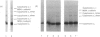
The quinoprotein methanol dehydrogenase (MDH) of Acetobacter methanolicus has an alpha 2 beta 2 structure. By contrast with other MDHs, the beta-subunit (approx. 8.5 kDa) does not contain the five lysine residues previously proposed to be involved in ionic interactions with the electron acceptor cytochrome cL. That electrostatic interactions are involved was confirmed by the demonstration that methanol:cytochrome cL oxidoreductase activity was inhibited by high ionic strength (I), the strength of interaction being inversely related to the square root of I. Specific modifiers of arginine residues on MDH inhibited this reaction but not the dye-linked MDH activity. Modification of lysine residues on MDH that altered its charge had no effect on the dye-linked activity but inhibited reaction with cytochrome cL. When the charge was retained on modification of lysine residues, little effect on either activity was observed. Cross-linking experiments confirmed that lysine residues on the alpha-subunit, but not the beta-subunit, are involved in the 'docking' process between the proteins.
Full text
PDF


Images in this article
Selected References
These references are in PubMed. This may not be the complete list of references from this article.
- Anderson G. P., Sanderson D. G., Lee C. H., Durell S., Anderson L. B., Gross E. L. The effect of ethylenediamine chemical modification of plastocyanin on the rate of cytochrome f oxidation and P-700+ reduction. Biochim Biophys Acta. 1987 Dec 17;894(3):386–398. doi: 10.1016/0005-2728(87)90117-4. [DOI] [PubMed] [Google Scholar]
- Anthony C. Bacterial oxidation of methane and methanol. Adv Microb Physiol. 1986;27:113–210. doi: 10.1016/s0065-2911(08)60305-7. [DOI] [PubMed] [Google Scholar]
- Anthony C. The microbial metabolism of C1 compounds. The cytochromes of Pseudomaonas AM1. Biochem J. 1975 Feb;146(2):289–298. doi: 10.1042/bj1460289. [DOI] [PMC free article] [PubMed] [Google Scholar]
- Anthony C. The oxidation of methanol in gram-negative bacteria. FEMS Microbiol Rev. 1990 Dec;7(3-4):209–214. doi: 10.1111/j.1574-6968.1990.tb04914.x. [DOI] [PubMed] [Google Scholar]
- Anthony C., Zatman L. J. The microbial oxidation of methanol. 2. The methanol-oxidizing enzyme of Pseudomonas sp. M 27. Biochem J. 1964 Sep;92(3):614–621. doi: 10.1042/bj0920614. [DOI] [PMC free article] [PubMed] [Google Scholar]
- Anthony C., Zatman L. J. The microbial oxidation of methanol. Purification and properties of the alcohol dehydrogenase of Pseudomonas sp. M27. Biochem J. 1967 Sep;104(3):953–959. doi: 10.1042/bj1040953. [DOI] [PMC free article] [PubMed] [Google Scholar]
- Anthony C., Zatman L. J. The microbial oxidation of methanol. The prosthetic group of the alcohol dehydrogenase of Pseudomonas sp. M27: a new oxidoreductase prosthetic group. Biochem J. 1967 Sep;104(3):960–969. doi: 10.1042/bj1040960. [DOI] [PMC free article] [PubMed] [Google Scholar]
- Burkey K. O., Gross E. L. Effect of carboxyl group modification on redox properties and electron donation capability of spinach plastocyanin. Biochemistry. 1981 Sep 15;20(19):5495–5499. doi: 10.1021/bi00522a023. [DOI] [PubMed] [Google Scholar]
- Carver M. A., Humphrey K. M., Patchett R. A., Jones C. W. The effect of EDTA and related chelating agents on the oxidation of methanol by the methylotrophic bacterium, Methylophilus methylotrophus. Eur J Biochem. 1984 Feb 1;138(3):611–615. doi: 10.1111/j.1432-1033.1984.tb07958.x. [DOI] [PubMed] [Google Scholar]
- Cheung S. T., Fonda M. L. Reaction of phenylglyoxal with arginine. The effect of buffers and pH. Biochem Biophys Res Commun. 1979 Oct 12;90(3):940–947. doi: 10.1016/0006-291x(79)91918-1. [DOI] [PubMed] [Google Scholar]
- Davidson V. L., Jones L. H., Kumar M. A. pH-dependent semiquinone formation by methylamine dehydrogenase from Paracoccus denitrificans. Evidence for intermolecular electron transfer between quinone cofactors. Biochemistry. 1990 Dec 4;29(48):10786–10791. doi: 10.1021/bi00500a010. [DOI] [PubMed] [Google Scholar]
- Ferguson-Miller S., Brautigan D. L., Margoliash E. Correlation of the kinetics of electron transfer activity of various eukaryotic cytochromes c with binding to mitochondrial cytochrome c oxidase. J Biol Chem. 1976 Feb 25;251(4):1104–1115. [PubMed] [Google Scholar]
- GROSS E., WITKOP B. Nonenzymatic cleavage of peptide bonds: the methionine residues in bovine pancreatic ribonuclease. J Biol Chem. 1962 Jun;237:1856–1860. [PubMed] [Google Scholar]
- Grabarek Z., Gergely J. Zero-length crosslinking procedure with the use of active esters. Anal Biochem. 1990 Feb 15;185(1):131–135. doi: 10.1016/0003-2697(90)90267-d. [DOI] [PubMed] [Google Scholar]
- Harms N., de Vries G. E., Maurer K., Hoogendijk J., Stouthamer A. H. Isolation and nucleotide sequence of the methanol dehydrogenase structural gene from Paracoccus denitrificans. J Bacteriol. 1987 Sep;169(9):3969–3975. doi: 10.1128/jb.169.9.3969-3975.1987. [DOI] [PMC free article] [PubMed] [Google Scholar]
- Inoue T., Sunagawa M., Mori A., Imai C., Fukuda M., Takagi M., Yano K. Cloning and sequencing of the gene encoding the 72-kilodalton dehydrogenase subunit of alcohol dehydrogenase from Acetobacter aceti. J Bacteriol. 1989 Jun;171(6):3115–3122. doi: 10.1128/jb.171.6.3115-3122.1989. [DOI] [PMC free article] [PubMed] [Google Scholar]
- Johnson S. C., Bailey T., Becker R. R., Cardenas J. M. Isolation and sequence determination of a peptide located in or near the active site of bovine muscle pyruvate kinase. Biochem Biophys Res Commun. 1979 Sep 27;90(2):525–530. doi: 10.1016/0006-291x(79)91267-1. [DOI] [PubMed] [Google Scholar]
- Lomant A. J., Fairbanks G. Chemical probes of extended biological structures: synthesis and properties of the cleavable protein cross-linking reagent [35S]dithiobis(succinimidyl propionate). J Mol Biol. 1976 Jun 14;104(1):243–261. doi: 10.1016/0022-2836(76)90011-5. [DOI] [PubMed] [Google Scholar]
- Machlin S. M., Hanson R. S. Nucleotide sequence and transcriptional start site of the Methylobacterium organophilum XX methanol dehydrogenase structural gene. J Bacteriol. 1988 Oct;170(10):4739–4747. doi: 10.1128/jb.170.10.4739-4747.1988. [DOI] [PMC free article] [PubMed] [Google Scholar]
- Nunn D. N., Anthony C. The nucleotide sequence and deduced amino acid sequence of the cytochrome cL gene of Methylobacterium extorquens AM1, a novel class of c-type cytochrome. Biochem J. 1988 Dec 1;256(2):673–676. doi: 10.1042/bj2560673. [DOI] [PMC free article] [PubMed] [Google Scholar]
- Nunn D. N., Day D., Anthony C. The second subunit of methanol dehydrogenase of Methylobacterium extorquens AM1. Biochem J. 1989 Jun 15;260(3):857–862. doi: 10.1042/bj2600857. [DOI] [PMC free article] [PubMed] [Google Scholar]
- Sinha U., Brewer J. M. A spectrophotometric method for quantitation of carboxyl group modification of proteins using Woodward's Reagent K. Anal Biochem. 1985 Dec;151(2):327–333. doi: 10.1016/0003-2697(85)90183-6. [DOI] [PubMed] [Google Scholar]
- Smith M. B., Stonehuerner J., Ahmed A. J., Staudenmayer N., Millett F. Use of specific trifluoroacetylation of lysine residues in cytochrome c to study the reaction with cytochrome b5, cytochrome c1, and cytochrome oxidase. Biochim Biophys Acta. 1980 Sep 5;592(2):303–313. doi: 10.1016/0005-2728(80)90191-7. [DOI] [PubMed] [Google Scholar]
- Smith P. K., Krohn R. I., Hermanson G. T., Mallia A. K., Gartner F. H., Provenzano M. D., Fujimoto E. K., Goeke N. M., Olson B. J., Klenk D. C. Measurement of protein using bicinchoninic acid. Anal Biochem. 1985 Oct;150(1):76–85. doi: 10.1016/0003-2697(85)90442-7. [DOI] [PubMed] [Google Scholar]
- Steenkamp D. J. Cross-linking of the electron-transfer flavoprotein to electron-transfer flavoprotein-ubiquinone oxidoreductase with heterobifunctional reagents. Biochem J. 1988 Nov 1;255(3):869–876. doi: 10.1042/bj2550869. [DOI] [PMC free article] [PubMed] [Google Scholar]
- Yamasaki R. B., Vega A., Feeney R. E. Modification of available arginine residues in proteins by p-hydroxyphenylglyoxal. Anal Biochem. 1980 Nov 15;109(1):32–40. doi: 10.1016/0003-2697(80)90006-8. [DOI] [PubMed] [Google Scholar]