



Abstract
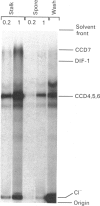
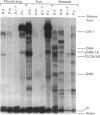
DIF-1 [Differentiation-Inducing Factor 1; 1-(3,5-dichloro-2,6-dihydroxy-4-methoxyphenyl)hexan-1-one] is a novel chlorinated signal molecule that induces stalk-cell differentiation during development of Dictyostelium discoideum. Here we introduce the use of the radioisotope 36Cl to label DIF-1 and other low-Mr chlorinated compounds produced during development. H.p.l.c. and t.l.c. were used to resolve the labelled compounds. We find the following. (1) At least 14 dialysable 36Cl-labelled compounds are released into the medium by cells labelled continuously through development with Na36Cl. (2) The compounds can be classified into two major groups according to their times of accumulation in development. The early group of compounds starts accumulating at the end of aggregation, co-ordinately with DIF-1; the late group is only made at the end of development, by mature fruiting bodies. There may also be an intermediate group made during culmination. (3) The early group of compounds has been identified as comprising DIF-1 and seven of its metabolites by co-chromatography with the authentic compounds. These metabolites had previously only been recognized in suspensions of living cells incubated with exogenous DIF-1. Their detection here, from cells undergoing normal development, suggests that endogenous DIF-1 is metabolized in normal development in much the same way as is DIF-1 added to cells in suspension. (4) The intermediate and late groups of compounds are not obvious DIF-1 metabolites. They may have some role unconnected with DIF signalling. (5) A group of 36Cl-labelled late compounds remain cell-associated after washing of the fruiting bodies, and these are greatly enriched in stalk, compared with spore, cells. (6) Other slime-mould species were labelled with 36Cl. All three tested, namely D. mucoroides, D. vinaceo-fuscum and P. violaceum, also produced chloro compounds. D. mucoroides produced DIF-1 by the criterion of h.p.l.c. co-elution with authentic DIF-1. A developmentally regulated metabolism of chlorinated compounds may therefore be widespread amongst slime moulds. To our knowledge, labelling with 36Cl in vivo has not been reported before and provides a powerful general method for investigating chlorinated compounds in diverse organisms.
Full text
PDF


Images in this article
Selected References
These references are in PubMed. This may not be the complete list of references from this article.
- BLIGH E. G., DYER W. J. A rapid method of total lipid extraction and purification. Can J Biochem Physiol. 1959 Aug;37(8):911–917. doi: 10.1139/o59-099. [DOI] [PubMed] [Google Scholar]
- Brookman J. J., Town C. D., Jermyn K. A., Kay R. R. Developmental regulation of a stalk cell differentiation-inducing factor in Dictyostelium discoideum. Dev Biol. 1982 May;91(1):191–196. doi: 10.1016/0012-1606(82)90022-7. [DOI] [PubMed] [Google Scholar]
- Gerisch G. Cyclic AMP and other signals controlling cell development and differentiation in Dictyostelium. Annu Rev Biochem. 1987;56:853–879. doi: 10.1146/annurev.bi.56.070187.004225. [DOI] [PubMed] [Google Scholar]
- Hager L. P., Morris D. R., Brown F. S., Eberwein H. Chloroperoxidase. II. Utilization of halogen anions. J Biol Chem. 1966 Apr 25;241(8):1769–1777. [PubMed] [Google Scholar]
- Insall R., Kay R. R. A specific DIF binding protein in Dictyostelium. EMBO J. 1990 Oct;9(10):3323–3328. doi: 10.1002/j.1460-2075.1990.tb07532.x. [DOI] [PMC free article] [PubMed] [Google Scholar]
- Kay R. R., Dhokia B., Jermyn K. A. Purification of stalk-cell-inducing morphogens from Dictyostelium discoideum. Eur J Biochem. 1983 Oct 17;136(1):51–56. doi: 10.1111/j.1432-1033.1983.tb07703.x. [DOI] [PubMed] [Google Scholar]
- Kay R. R. Gene expression in Dictyostelium discoidium: mutually antagonistic roles of cyclic-AMP and ammonia. J Embryol Exp Morphol. 1979 Aug;52:171–182. [PubMed] [Google Scholar]
- Kopachik W., Oohata A., Dhokia B., Brookman J. J., Kay R. R. Dictyostelium mutants lacking DIF, a putative morphogen. Cell. 1983 Jun;33(2):397–403. doi: 10.1016/0092-8674(83)90421-x. [DOI] [PubMed] [Google Scholar]
- Masento M. S., Morris H. R., Taylor G. W., Johnson S. J., Skapski A. C., Kay R. R. Differentiation-inducing factor from the slime mould Dictyostelium discoideum and its analogues. Synthesis, structure and biological activity. Biochem J. 1988 Nov 15;256(1):23–28. doi: 10.1042/bj2560023. [DOI] [PMC free article] [PubMed] [Google Scholar]
- Morris H. R., Masento M. S., Taylor G. W., Jermyn K. A., Kay R. R. Structure elucidation of two differentiation inducing factors (DIF-2 and DIF-3) from the cellular slime mould Dictyostelium discoideum. Biochem J. 1988 Feb 1;249(3):903–906. doi: 10.1042/bj2490903. [DOI] [PMC free article] [PubMed] [Google Scholar]
- Morris H. R., Taylor G. W., Masento M. S., Jermyn K. A., Kay R. R. Chemical structure of the morphogen differentiation inducing factor from Dictyostelium discoideum. 1987 Aug 27-Sep 2Nature. 328(6133):811–814. doi: 10.1038/328811a0. [DOI] [PubMed] [Google Scholar]
- Siuda J. F., DeBernardis J. F. Naturally occurring halogenated organic compounds. Lloydia. 1973 Jun;36(2):107–143. [PubMed] [Google Scholar]
- Town C. D., Gross J. D., Kay R. R. Cell differentiation without morphogenesis in Dictyostelium discoideum. Nature. 1976 Aug 19;262(5570):717–719. doi: 10.1038/262717a0. [DOI] [PubMed] [Google Scholar]
- Town C., Stanford E. An oligosaccharide-containing factor that induces cell differentiation in Dictyostelium discoideum. Proc Natl Acad Sci U S A. 1979 Jan;76(1):308–312. doi: 10.1073/pnas.76.1.308. [DOI] [PMC free article] [PubMed] [Google Scholar]
- Traynor D., Kay R. R. The DIF-1 signaling system in Dictyostelium. Metabolism of the signal. J Biol Chem. 1991 Mar 15;266(8):5291–5297. [PubMed] [Google Scholar]
- Watts D. J., Ashworth J. M. Growth of myxameobae of the cellular slime mould Dictyostelium discoideum in axenic culture. Biochem J. 1970 Sep;119(2):171–174. doi: 10.1042/bj1190171. [DOI] [PMC free article] [PubMed] [Google Scholar]
- Williams J. G., Ceccarelli A., McRobbie S., Mahbubani H., Kay R. R., Early A., Berks M., Jermyn K. A. Direct induction of Dictyostelium prestalk gene expression by DIF provides evidence that DIF is a morphogen. Cell. 1987 Apr 24;49(2):185–192. doi: 10.1016/0092-8674(87)90559-9. [DOI] [PubMed] [Google Scholar]
- Williams J. G. The role of diffusible molecules in regulating the cellular differentiation of Dictyostelium discoideum. Development. 1988 May;103(1):1–16. [PubMed] [Google Scholar]