



Abstract
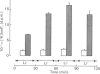
In human HeLa carcinoma cells, histamine causes a dose-dependent formation of inositol phosphates, production of diacylglycerol and a transient rise in intracellular [Ca2+]. These responses are completely blocked by the H1-receptor antagonist pyrilamine. In streptolysin-O-permeabilized cells, formation of inositol phosphates by histamine is strongly potentiated by guanosine 5'-[gamma-thio]triphosphate and inhibited by guanosine 5'-[beta-thio]diphosphate, suggesting the involvement of a GTP-binding protein. Histamine stimulates the rapid but transient formation of Ins(1,4,5)P3, Ins(1,3,4)P3 and InsP4. InsP accumulates in a much more persistent manner, lasting for at least 30 min. Studies with streptolysin-O-permeabilized cells indicate that InsP accumulation results from dephosphorylation of Ins(1,4,5)P3, rather than direct hydrolysis of PtdIns. The rise in intracellular [Ca2+] is biphasic, with a very fast release of Ca2+ from intracellular stores, that parallels the Ins(1,4,5)P3 time course, followed by a more prolonged phase of Ca2+ influx. In individual cells, histamine causes a rapid initial hyperpolarization of the plasma membrane, which can be mimicked by microinjected Ins(1,4,5)P3. Histamine-induced hyperpolarization is followed by long-lasting oscillations in membrane potential, apparently owing to periodic activation of Ca2+-dependent K+ channels. These membrane-potential oscillations can be mimicked by microinjection of guanosine 5'-[gamma-thio]triphosphate, but are not observed after microinjection of Ins(1,4,5)P3. We conclude that H1-receptors in HeLa cells activate a PtdInsP2-specific phospholipase C through participation of a specific G-protein, resulting in long-lasting oscillations of cytoplasmic free Ca2+.
Full text
PDF


Images in this article
Selected References
These references are in PubMed. This may not be the complete list of references from this article.
- Ambler S. K., Poenie M., Tsien R. Y., Taylor P. Agonist-stimulated oscillations and cycling of intracellular free calcium in individual cultured muscle cells. J Biol Chem. 1988 Feb 5;263(4):1952–1959. [PubMed] [Google Scholar]
- Arrang J. M., Garbarg M., Lancelot J. C., Lecomte J. M., Pollard H., Robba M., Schunack W., Schwartz J. C. Highly potent and selective ligands for histamine H3-receptors. Nature. 1987 May 14;327(6118):117–123. doi: 10.1038/327117a0. [DOI] [PubMed] [Google Scholar]
- Arrang J. M., Garbarg M., Schwartz J. C. Auto-inhibition of brain histamine release mediated by a novel class (H3) of histamine receptor. Nature. 1983 Apr 28;302(5911):832–837. doi: 10.1038/302832a0. [DOI] [PubMed] [Google Scholar]
- BLIGH E. G., DYER W. J. A rapid method of total lipid extraction and purification. Can J Biochem Physiol. 1959 Aug;37(8):911–917. doi: 10.1139/o59-099. [DOI] [PubMed] [Google Scholar]
- Batty I. R., Nahorski S. R., Irvine R. F. Rapid formation of inositol 1,3,4,5-tetrakisphosphate following muscarinic receptor stimulation of rat cerebral cortical slices. Biochem J. 1985 Nov 15;232(1):211–215. doi: 10.1042/bj2320211. [DOI] [PMC free article] [PubMed] [Google Scholar]
- Bigay J., Deterre P., Pfister C., Chabre M. Fluoroaluminates activate transducin-GDP by mimicking the gamma-phosphate of GTP in its binding site. FEBS Lett. 1985 Oct 28;191(2):181–185. doi: 10.1016/0014-5793(85)80004-1. [DOI] [PubMed] [Google Scholar]
- Black J. W., Duncan W. A., Durant C. J., Ganellin C. R., Parsons E. M. Definition and antagonism of histamine H 2 -receptors. Nature. 1972 Apr 21;236(5347):385–390. doi: 10.1038/236385a0. [DOI] [PubMed] [Google Scholar]
- Brock T. A., Rittenhouse S. E., Powers C. W., Ekstein L. S., Gimbrone M. A., Jr, Alexander R. W. Phorbol ester and 1-oleoyl-2-acetylglycerol inhibit angiotensin activation of phospholipase C in cultured vascular smooth muscle cells. J Biol Chem. 1985 Nov 15;260(26):14158–14162. [PubMed] [Google Scholar]
- Claro E., García A., Picatoste F. Histamine-stimulated phosphoinositide hydrolysis in developing rat brain. Mol Pharmacol. 1987 Sep;32(3):384–390. [PubMed] [Google Scholar]
- Daum P. R., Downes C. P., Young J. M. Histamine stimulation of inositol 1-phosphate accumulation in lithium-treated slices from regions of guinea pig brain. J Neurochem. 1984 Jul;43(1):25–32. doi: 10.1111/j.1471-4159.1984.tb06674.x. [DOI] [PubMed] [Google Scholar]
- Grynkiewicz G., Poenie M., Tsien R. Y. A new generation of Ca2+ indicators with greatly improved fluorescence properties. J Biol Chem. 1985 Mar 25;260(6):3440–3450. [PubMed] [Google Scholar]
- Hansen C. A., Mah S., Williamson J. R. Formation and metabolism of inositol 1,3,4,5-tetrakisphosphate in liver. J Biol Chem. 1986 Jun 25;261(18):8100–8103. [PubMed] [Google Scholar]
- Hazama A., Yada T., Okada Y. HeLa cells have histamine H1-receptors which mediate activation of the K+ conductance. Biochim Biophys Acta. 1985 May 30;845(2):249–253. doi: 10.1016/0167-4889(85)90183-1. [DOI] [PubMed] [Google Scholar]
- Hegstrand L. R., Kanof P. D., Greengard P. Histamine-sensitive adenylate cyclase in mammalian brain. Nature. 1976 Mar 11;260(5547):163–165. doi: 10.1038/260163a0. [DOI] [PubMed] [Google Scholar]
- Hepler J. R., Nakahata N., Lovenberg T. W., DiGuiseppi J., Herman B., Earp H. S., Harden T. K. Epidermal growth factor stimulates the rapid accumulation of inositol (1,4,5)-trisphosphate and a rise in cytosolic calcium mobilized from intracellular stores in A431 cells. J Biol Chem. 1987 Mar 5;262(7):2951–2956. [PubMed] [Google Scholar]
- Hill S. J. Histamine receptors branch out. Nature. 1987 May 14;327(6118):104–105. doi: 10.1038/327104a0. [DOI] [PubMed] [Google Scholar]
- Howell T. W., Gomperts B. D. Rat mast cells permeabilised with streptolysin O secrete histamine in response to Ca2+ at concentrations buffered in the micromolar range. Biochim Biophys Acta. 1987 Feb 18;927(2):177–183. doi: 10.1016/0167-4889(87)90132-7. [DOI] [PubMed] [Google Scholar]
- Irvine R. F., Moor R. M. Micro-injection of inositol 1,3,4,5-tetrakisphosphate activates sea urchin eggs by a mechanism dependent on external Ca2+. Biochem J. 1986 Dec 15;240(3):917–920. doi: 10.1042/bj2400917. [DOI] [PMC free article] [PubMed] [Google Scholar]
- Ishikawa S., Sperelakis N. A novel class (H3) of histamine receptors on perivascular nerve terminals. Nature. 1987 May 14;327(6118):158–160. doi: 10.1038/327158a0. [DOI] [PubMed] [Google Scholar]
- Jackson T. R., Hallam T. J., Downes C. P., Hanley M. R. Receptor coupled events in bradykinin action: rapid production of inositol phosphates and regulation of cytosolic free Ca2+ in a neural cell line. EMBO J. 1987 Jan;6(1):49–54. doi: 10.1002/j.1460-2075.1987.tb04717.x. [DOI] [PMC free article] [PubMed] [Google Scholar]
- Jacob R., Merritt J. E., Hallam T. J., Rink T. J. Repetitive spikes in cytoplasmic calcium evoked by histamine in human endothelial cells. Nature. 1988 Sep 1;335(6185):40–45. doi: 10.1038/335040a0. [DOI] [PubMed] [Google Scholar]
- Katada T., Bokoch G. M., Smigel M. D., Ui M., Gilman A. G. The inhibitory guanine nucleotide-binding regulatory component of adenylate cyclase. Subunit dissociation and the inhibition of adenylate cyclase in S49 lymphoma cyc- and wild type membranes. J Biol Chem. 1984 Mar 25;259(6):3586–3595. [PubMed] [Google Scholar]
- Leeb-Lundberg L. M., Cotecchia S., Lomasney J. W., DeBernardis J. F., Lefkowitz R. J., Caron M. G. Phorbol esters promote alpha 1-adrenergic receptor phosphorylation and receptor uncoupling from inositol phospholipid metabolism. Proc Natl Acad Sci U S A. 1985 Sep;82(17):5651–5655. doi: 10.1073/pnas.82.17.5651. [DOI] [PMC free article] [PubMed] [Google Scholar]
- Lipscombe D., Madison D. V., Poenie M., Reuter H., Tsien R. Y., Tsien R. W. Spatial distribution of calcium channels and cytosolic calcium transients in growth cones and cell bodies of sympathetic neurons. Proc Natl Acad Sci U S A. 1988 Apr;85(7):2398–2402. doi: 10.1073/pnas.85.7.2398. [DOI] [PMC free article] [PubMed] [Google Scholar]
- Moolenaar W. H., Aerts R. J., Tertoolen L. G., de Laat S. W. The epidermal growth factor-induced calcium signal in A431 cells. J Biol Chem. 1986 Jan 5;261(1):279–284. [PubMed] [Google Scholar]
- Morris A. P., Gallacher D. V., Irvine R. F., Petersen O. H. Synergism of inositol trisphosphate and tetrakisphosphate in activating Ca2+-dependent K+ channels. Nature. 1987 Dec 17;330(6149):653–655. doi: 10.1038/330653a0. [DOI] [PubMed] [Google Scholar]
- Nakahata N., Harden T. K. Regulation of inositol trisphosphate accumulation by muscarinic cholinergic and H1-histamine receptors on human astrocytoma cells. Differential induction of desensitization by agonists. Biochem J. 1987 Jan 15;241(2):337–344. doi: 10.1042/bj2410337. [DOI] [PMC free article] [PubMed] [Google Scholar]
- Nakahata N., Martin M. W., Hughes A. R., Hepler J. R., Harden T. K. H1-histamine receptors on human astrocytoma cells. Mol Pharmacol. 1986 Feb;29(2):188–195. [PubMed] [Google Scholar]
- Northup J. K., Smigel M. D., Sternweis P. C., Gilman A. G. The subunits of the stimulatory regulatory component of adenylate cyclase. Resolution of the activated 45,000-dalton (alpha) subunit. J Biol Chem. 1983 Sep 25;258(18):11369–11376. [PubMed] [Google Scholar]
- Orellana S. A., Solski P. A., Brown J. H. Phorbol ester inhibits phosphoinositide hydrolysis and calcium mobilization in cultured astrocytoma cells. J Biol Chem. 1985 May 10;260(9):5236–5239. [PubMed] [Google Scholar]
- Pike L. J., Eakes A. T. Epidermal growth factor stimulates the production of phosphatidylinositol monophosphate and the breakdown of polyphosphoinositides in A431 cells. J Biol Chem. 1987 Feb 5;262(4):1644–1651. [PubMed] [Google Scholar]
- Pounder R. E. Histamine H2-receptor antagonists and gastric acid secretion. Pharmacol Ther. 1984;26(2):221–234. doi: 10.1016/0163-7258(84)90018-4. [DOI] [PubMed] [Google Scholar]
- Sauvé R., Simoneau C., Parent L., Monette R., Roy G. Oscillatory activation of calcium-dependent potassium channels in HeLa cells induced by histamine H1 receptor stimulation: a single-channel study. J Membr Biol. 1987;96(3):199–208. doi: 10.1007/BF01869302. [DOI] [PubMed] [Google Scholar]
- Sternweis P. C., Gilman A. G. Aluminum: a requirement for activation of the regulatory component of adenylate cyclase by fluoride. Proc Natl Acad Sci U S A. 1982 Aug;79(16):4888–4891. doi: 10.1073/pnas.79.16.4888. [DOI] [PMC free article] [PubMed] [Google Scholar]
- Tertoolen L. G., Tilly B. C., Irvine R. F., Moolenaar W. H. Electrophysiological responses to bradykinin and microinjected inositol polyphosphates in neuroblastoma cells. Possible role of inositol 1,3,4-trisphosphate in altering membrane potential. FEBS Lett. 1987 Apr 20;214(2):365–369. doi: 10.1016/0014-5793(87)80089-3. [DOI] [PubMed] [Google Scholar]
- Tilly B. C., van Paridon P. A., Verlaan I., Wirtz K. W., de Laat S. W., Moolenaar W. H. Inositol phosphate metabolism in bradykinin-stimulated human A431 carcinoma cells. Relationship to calcium signalling. Biochem J. 1987 May 15;244(1):129–135. doi: 10.1042/bj2440129. [DOI] [PMC free article] [PubMed] [Google Scholar]
- Tilly B. C., van Paridon P. A., Verlaan I., de Laat S. W., Moolenaar W. H. Epidermal-growth-factor-induced formation of inositol phosphates in human A431 cells. Differences from the effect of bradykinin. Biochem J. 1988 Jun 15;252(3):857–863. doi: 10.1042/bj2520857. [DOI] [PMC free article] [PubMed] [Google Scholar]
- Wakui M., Potter B. V., Petersen O. H. Pulsatile intracellular calcium release does not depend on fluctuations in inositol trisphosphate concentration. Nature. 1989 May 25;339(6222):317–320. doi: 10.1038/339317a0. [DOI] [PubMed] [Google Scholar]
- Woods N. M., Cuthbertson K. S., Cobbold P. H. Repetitive transient rises in cytoplasmic free calcium in hormone-stimulated hepatocytes. Nature. 1986 Feb 13;319(6054):600–602. doi: 10.1038/319600a0. [DOI] [PubMed] [Google Scholar]
- Yada T., Okada Y. Electrical activity of an intestinal epithelial cell line: hyperpolarizing responses to intestinal secretagogues. J Membr Biol. 1984;77(1):33–44. doi: 10.1007/BF01871098. [DOI] [PubMed] [Google Scholar]