



Abstract
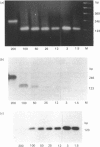
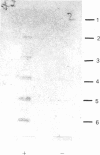
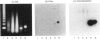
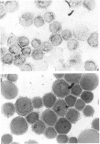
The polymerase chain reaction (PCR) has been used to incorporate biotinylated deoxynucleotide triphosphate analogues into a 120 bp sequence from the E6 region of human papilloma virus type 16 (HPV 16). No loss of amplification efficiency is observed utilizing concentrations of up to 200 microM-biotin-11-dUTP, or 180 microM-biotin-7-dATP and -biotin-16-dUTP (where the numbers refer to the number of carbon atoms in the spacer arms). Internally biotinylated PCR products can be detected following slot-blot or vacuum transfer to mitrocellulose or nylon filters without prior electrophoretic separation of the reactants, since unincorporated biotinylated analogues pass through the filter. Internally biotinylated PCR products can also be applied as hybridization probes in Southern blot analysis or in situ hybridization. This system enables detection of PCR products or target sequences at levels below that for 5'-biotinylated probes and can be applied in an 'open sandwich assay' without the need for a separate labelled probe currently required in conventional sandwich assays. However, as hybridization probes, sensitivity may be limited by the steric hindrance of strand hybridization possibly due to the spacer arms linking the nucleotides to the biotin molecule.
Full text
PDF


Images in this article
Selected References
These references are in PubMed. This may not be the complete list of references from this article.
- Beaudenon S., Kremsdorf D., Croissant O., Jablonska S., Wain-Hobson S., Orth G. A novel type of human papillomavirus associated with genital neoplasias. Nature. 1986 May 15;321(6067):246–249. doi: 10.1038/321246a0. [DOI] [PubMed] [Google Scholar]
- Boshart M., Gissmann L., Ikenberg H., Kleinheinz A., Scheurlen W., zur Hausen H. A new type of papillomavirus DNA, its presence in genital cancer biopsies and in cell lines derived from cervical cancer. EMBO J. 1984 May;3(5):1151–1157. doi: 10.1002/j.1460-2075.1984.tb01944.x. [DOI] [PMC free article] [PubMed] [Google Scholar]
- Burns J., Chan V. T., Jonasson J. A., Fleming K. A., Taylor S., McGee J. O. Sensitive system for visualising biotinylated DNA probes hybridised in situ: rapid sex determination of intact cells. J Clin Pathol. 1985 Oct;38(10):1085–1092. doi: 10.1136/jcp.38.10.1085. [DOI] [PMC free article] [PubMed] [Google Scholar]
- Cox M. F., Meanwell C. A., Maitland N. J., Blackledge G., Scully C., Jordan J. A. Human papillomavirus type-16 homologous DNA in normal human ectocervix. Lancet. 1986 Jul 19;2(8499):157–158. doi: 10.1016/s0140-6736(86)91965-3. [DOI] [PubMed] [Google Scholar]
- Draper D. E., Gold L. A method for linking fluorescent labels to polynucleotides: application to studies of ribosome-ribonucleic acid interactions. Biochemistry. 1980 Apr 29;19(9):1774–1781. doi: 10.1021/bi00550a008. [DOI] [PubMed] [Google Scholar]
- Forster A. C., McInnes J. L., Skingle D. C., Symons R. H. Non-radioactive hybridization probes prepared by the chemical labelling of DNA and RNA with a novel reagent, photobiotin. Nucleic Acids Res. 1985 Feb 11;13(3):745–761. doi: 10.1093/nar/13.3.745. [DOI] [PMC free article] [PubMed] [Google Scholar]
- Gergely L., Czeglédy J., Hernády Z. Human papillomavirus frequency in normal cervical tissue. Lancet. 1987 Aug 29;2(8557):513–513. doi: 10.1016/s0140-6736(87)91824-1. [DOI] [PubMed] [Google Scholar]
- Jablonski E., Moomaw E. W., Tullis R. H., Ruth J. L. Preparation of oligodeoxynucleotide-alkaline phosphatase conjugates and their use as hybridization probes. Nucleic Acids Res. 1986 Aug 11;14(15):6115–6128. doi: 10.1093/nar/14.15.6115. [DOI] [PMC free article] [PubMed] [Google Scholar]
- Li P., Medon P. P., Skingle D. C., Lanser J. A., Symons R. H. Enzyme-linked synthetic oligonucleotide probes: non-radioactive detection of enterotoxigenic Escherichia coli in faecal specimens. Nucleic Acids Res. 1987 Jul 10;15(13):5275–5287. doi: 10.1093/nar/15.13.5275. [DOI] [PMC free article] [PubMed] [Google Scholar]
- Lo Y. M., Mehal W. Z., Fleming K. A. Rapid production of vector-free biotinylated probes using the polymerase chain reaction. Nucleic Acids Res. 1988 Sep 12;16(17):8719–8719. doi: 10.1093/nar/16.17.8719. [DOI] [PMC free article] [PubMed] [Google Scholar]
- Lorincz A. T., Quinn A. P., Lancaster W. D., Temple G. F. A new type of papillomavirus associated with cancer of the uterine cervix. Virology. 1987 Jul;159(1):187–190. doi: 10.1016/0042-6822(87)90366-7. [DOI] [PubMed] [Google Scholar]
- Matthews J. A., Kricka L. J. Analytical strategies for the use of DNA probes. Anal Biochem. 1988 Feb 15;169(1):1–25. doi: 10.1016/0003-2697(88)90251-5. [DOI] [PubMed] [Google Scholar]
- Niedobitek G., Finn T., Herbst H., Bornhöft G., Gerdes J., Stein H. Detection of viral DNA by in situ hybridization using bromodeoxyuridine-labeled DNA probes. Am J Pathol. 1988 Apr;131(1):1–4. [PMC free article] [PubMed] [Google Scholar]
- Renz M., Kurz C. A colorimetric method for DNA hybridization. Nucleic Acids Res. 1984 Apr 25;12(8):3435–3444. doi: 10.1093/nar/12.8.3435. [DOI] [PMC free article] [PubMed] [Google Scholar]
- Richardson R. W., Gumport R. I. Biotin and fluorescent labeling of RNA using T4 RNA ligase. Nucleic Acids Res. 1983 Sep 24;11(18):6167–6184. doi: 10.1093/nar/11.18.6167. [DOI] [PMC free article] [PubMed] [Google Scholar]
- Rigby P. W., Dieckmann M., Rhodes C., Berg P. Labeling deoxyribonucleic acid to high specific activity in vitro by nick translation with DNA polymerase I. J Mol Biol. 1977 Jun 15;113(1):237–251. doi: 10.1016/0022-2836(77)90052-3. [DOI] [PubMed] [Google Scholar]
- Saiki R. K., Gelfand D. H., Stoffel S., Scharf S. J., Higuchi R., Horn G. T., Mullis K. B., Erlich H. A. Primer-directed enzymatic amplification of DNA with a thermostable DNA polymerase. Science. 1988 Jan 29;239(4839):487–491. doi: 10.1126/science.2448875. [DOI] [PubMed] [Google Scholar]
- Syvänen A. C., Alanen M., Söderlund H. A complex of single-strand binding protein and M13 DNA as hybridization probe. Nucleic Acids Res. 1985 Apr 25;13(8):2789–2802. doi: 10.1093/nar/13.8.2789. [DOI] [PMC free article] [PubMed] [Google Scholar]
- Toon P. G., Arrand J. R., Wilson L. P., Sharp D. S. Human papillomavirus infection of the uterine cervix of women without cytological signs of neoplasia. Br Med J (Clin Res Ed) 1986 Nov 15;293(6557):1261–1264. doi: 10.1136/bmj.293.6557.1261. [DOI] [PMC free article] [PubMed] [Google Scholar]
- Urdea M. S., Warner B. D., Running J. A., Stempien M., Clyne J., Horn T. A comparison of non-radioisotopic hybridization assay methods using fluorescent, chemiluminescent and enzyme labeled synthetic oligodeoxyribonucleotide probes. Nucleic Acids Res. 1988 Jun 10;16(11):4937–4956. doi: 10.1093/nar/16.11.4937. [DOI] [PMC free article] [PubMed] [Google Scholar]
- Walker P. G., Singer A., Dyson J. L., Shah K. V., To A., Coleman D. V. The prevalence of human papillomavirus antigen in patients with cervical intraepithelial neoplasia. Br J Cancer. 1983 Jul;48(1):99–101. doi: 10.1038/bjc.1983.163. [DOI] [PMC free article] [PubMed] [Google Scholar]
- Young L. S., Bevan I. S., Johnson M. A., Blomfield P. I., Bromidge T., Maitland N. J., Woodman C. B. The polymerase chain reaction: a new epidemiological tool for investigating cervical human papillomavirus infection. BMJ. 1989 Jan 7;298(6665):14–18. doi: 10.1136/bmj.298.6665.14. [DOI] [PMC free article] [PubMed] [Google Scholar]
- de Villiers E. M., Wagner D., Schneider A., Wesch H., Miklaw H., Wahrendorf J., Papendick U., zur Hausen H. Human papillomavirus infections in women with and without abnormal cervical cytology. Lancet. 1987 Sep 26;2(8561):703–706. doi: 10.1016/s0140-6736(87)91072-5. [DOI] [PubMed] [Google Scholar]