



Abstract
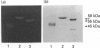
Following our studies on the identification of a calsequestrin-like protein (CSLP) from sea-urchin eggs [Oberdorf, Lebeche, Head & Kaminer (1988) J. Biol Chem. 263, 6806-6809], we have characterized its Ca(2+)-binding properties and identified it as a glycoprotein. The molecule binds 23 mol of Ca2+/mol of protein, as determined by equilibrium dialysis. This is in the range reported for cardiac calsequestrin but is about half the binding capacity of striated muscle calsequestrin. The affinities of the CSLP for Ca2+ are decreased by increasing KCl concentrations (20-250 mM) and the presence of Mg2+ (3 mM) in the medium: the half-maximal binding values varied from 1.62 to 5.77 mM. Hill coefficients indicated mild co-operativity in the Ca2+ binding. Ca2+ (1-8 mM)-induced u.v. difference spectra and intrinsic fluorescence changes suggest a net exposure of aromatic residues to an aqueous environment. C.d. measurements showed minor Ca(2+)-induced changes in alpha-helical and beta-sheet content of less than 10%. These spectral changes are distinctly different from those found in muscle calsequestrin. Immunoblotting studies showed that the CSLP is distinct from calreticulin, a low-affinity Ca(2+)-binding protein.
Full text
PDF


Images in this article
Selected References
These references are in PubMed. This may not be the complete list of references from this article.
- Aaron B. M., Oikawa K., Reithmeier R. A., Sykes B. D. Characterization of skeletal muscle calsequestrin by 1H NMR spectroscopy. J Biol Chem. 1984 Oct 10;259(19):11876–11881. [PubMed] [Google Scholar]
- Berridge M. J. Inositol trisphosphate and diacylglycerol: two interacting second messengers. Annu Rev Biochem. 1987;56:159–193. doi: 10.1146/annurev.bi.56.070187.001111. [DOI] [PubMed] [Google Scholar]
- Berridge M. J., Irvine R. F. Inositol trisphosphate, a novel second messenger in cellular signal transduction. Nature. 1984 Nov 22;312(5992):315–321. doi: 10.1038/312315a0. [DOI] [PubMed] [Google Scholar]
- Campbell K. P., MacLennan D. H., Jorgensen A. O., Mintzer M. C. Purification and characterization of calsequestrin from canine cardiac sarcoplasmic reticulum and identification of the 53,000 dalton glycoprotein. J Biol Chem. 1983 Jan 25;258(2):1197–1204. [PubMed] [Google Scholar]
- Charbonneau H., Cormier M. J. Purification of plant calmodulin by fluphenazine-Sepharose affinity chromatography. Biochem Biophys Res Commun. 1979 Oct 12;90(3):1039–1047. doi: 10.1016/0006-291x(79)91931-4. [DOI] [PubMed] [Google Scholar]
- Choi E. S., Clegg D. O. Identification and developmental expression of a chicken calsequestrin homolog. Dev Biol. 1990 Nov;142(1):169–177. doi: 10.1016/0012-1606(90)90160-k. [DOI] [PubMed] [Google Scholar]
- Clapper D. L., Lee H. C. Inositol trisphosphate induces calcium release from nonmitochondrial stores i sea urchin egg homogenates. J Biol Chem. 1985 Nov 15;260(26):13947–13954. [PubMed] [Google Scholar]
- Cozens B., Reithmeier R. A. Size and shape of rabbit skeletal muscle calsequestrin. J Biol Chem. 1984 May 25;259(10):6248–6252. [PubMed] [Google Scholar]
- Damiani E., Heilmann C., Salvatori S., Margreth A. Characterization of high-capacity low-affinity calcium binding protein of liver endoplasmic reticulum: calsequestrin-like and divergent properties. Biochem Biophys Res Commun. 1989 Dec 29;165(3):973–980. doi: 10.1016/0006-291x(89)92698-3. [DOI] [PubMed] [Google Scholar]
- Damiani E., Spamer C., Heilmann C., Salvatori S., Margreth A. Endoplasmic reticulum of rat liver contains two proteins closely related to skeletal sarcoplasmic reticulum Ca-ATPase and calsequestrin. J Biol Chem. 1988 Jan 5;263(1):340–343. [PubMed] [Google Scholar]
- Dargie P. J., Agre M. C., Lee H. C. Comparison of Ca2+ mobilizing activities of cyclic ADP-ribose and inositol trisphosphate. Cell Regul. 1990 Feb;1(3):279–290. doi: 10.1091/mbc.1.3.279. [DOI] [PMC free article] [PubMed] [Google Scholar]
- Ebashi S., Endo M., Otsuki I. Control of muscle contraction. Q Rev Biophys. 1969 Nov;2(4):351–384. doi: 10.1017/s0033583500001190. [DOI] [PubMed] [Google Scholar]
- Eckhardt A. E., Hayes C. E., Goldstein I. J. A sensitive fluorescent method for the detection of glycoproteins in polyacrylamide gels. Anal Biochem. 1976 May 21;73(1):192–197. doi: 10.1016/0003-2697(76)90154-8. [DOI] [PubMed] [Google Scholar]
- Eisen A., Kiehart D. P., Wieland S. J., Reynolds G. T. Temporal sequence and spatial distribution of early events of fertilization in single sea urchin eggs. J Cell Biol. 1984 Nov;99(5):1647–1654. doi: 10.1083/jcb.99.5.1647. [DOI] [PMC free article] [PubMed] [Google Scholar]
- Fliegel L., Burns K., MacLennan D. H., Reithmeier R. A., Michalak M. Molecular cloning of the high affinity calcium-binding protein (calreticulin) of skeletal muscle sarcoplasmic reticulum. J Biol Chem. 1989 Dec 25;264(36):21522–21528. [PubMed] [Google Scholar]
- Fliegel L., Ohnishi M., Carpenter M. R., Khanna V. K., Reithmeier R. A., MacLennan D. H. Amino acid sequence of rabbit fast-twitch skeletal muscle calsequestrin deduced from cDNA and peptide sequencing. Proc Natl Acad Sci U S A. 1987 Mar;84(5):1167–1171. doi: 10.1073/pnas.84.5.1167. [DOI] [PMC free article] [PubMed] [Google Scholar]
- Franzini-Armstrong C., Kenney L. J., Varriano-Marston E. The structure of calsequestrin in triads of vertebrate skeletal muscle: a deep-etch study. J Cell Biol. 1987 Jul;105(1):49–56. doi: 10.1083/jcb.105.1.49. [DOI] [PMC free article] [PubMed] [Google Scholar]
- Gilkey J. C., Jaffe L. F., Ridgway E. B., Reynolds G. T. A free calcium wave traverses the activating egg of the medaka, Oryzias latipes. J Cell Biol. 1978 Feb;76(2):448–466. doi: 10.1083/jcb.76.2.448. [DOI] [PMC free article] [PubMed] [Google Scholar]
- Gopalakrishna R., Anderson W. B. Calmodulin interacts with cyclic nucleotide phosphodiesterase and calcineurin by binding to a metal ion-independent hydrophobic region on these proteins. J Biol Chem. 1983 Feb 25;258(4):2405–2409. [PubMed] [Google Scholar]
- Hashimoto S., Bruno B., Lew D. P., Pozzan T., Volpe P., Meldolesi J. Immunocytochemistry of calciosomes in liver and pancreas. J Cell Biol. 1988 Dec;107(6 Pt 2):2523–2531. doi: 10.1083/jcb.107.6.2523. [DOI] [PMC free article] [PubMed] [Google Scholar]
- Henson J. H., Beaulieu S. M., Kaminer B., Begg D. A. Differentiation of a calsequestrin-containing endoplasmic reticulum during sea urchin oogenesis. Dev Biol. 1990 Dec;142(2):255–269. doi: 10.1016/0012-1606(90)90347-l. [DOI] [PubMed] [Google Scholar]
- Henson J. H., Begg D. A., Beaulieu S. M., Fishkind D. J., Bonder E. M., Terasaki M., Lebeche D., Kaminer B. A calsequestrin-like protein in the endoplasmic reticulum of the sea urchin: localization and dynamics in the egg and first cell cycle embryo. J Cell Biol. 1989 Jul;109(1):149–161. doi: 10.1083/jcb.109.1.149. [DOI] [PMC free article] [PubMed] [Google Scholar]
- Hess D., Ohishi H., Skinner M., Cohen A. S., Schmid K. The carbohydrate composition of human serum amyloid P component. Clin Chim Acta. 1988 Apr 29;173(3):331–335. doi: 10.1016/0009-8981(88)90022-8. [DOI] [PubMed] [Google Scholar]
- Ikemoto N., Bhatnagar G. M., Nagy B., Gergely J. Interaction of divalent cations with the 55,000-dalton protein component of the sarcoplasmic reticulum. Studies of fluorescence and circular dichroism. J Biol Chem. 1972 Dec 10;247(23):7835–7837. [PubMed] [Google Scholar]
- Ikemoto N., Nagy B., Bhatnagar G. M., Gergely J. Studies on a metal-binding protein of the sarcoplasmic reticulum. J Biol Chem. 1974 Apr 25;249(8):2357–2365. [PubMed] [Google Scholar]
- Imagawa T., Smith J. S., Coronado R., Campbell K. P. Purified ryanodine receptor from skeletal muscle sarcoplasmic reticulum is the Ca2+-permeable pore of the calcium release channel. J Biol Chem. 1987 Dec 5;262(34):16636–16643. [PubMed] [Google Scholar]
- Inoue H., Yoshioka T. Comparison of Ca2+ uptake characteristics of microsomal fractions isolated from unfertilized and fertilized sea urchin eggs. Exp Cell Res. 1982 Aug;140(2):283–288. doi: 10.1016/0014-4827(82)90116-1. [DOI] [PubMed] [Google Scholar]
- Jaffe L. F. Sources of calcium in egg activation: a review and hypothesis. Dev Biol. 1983 Oct;99(2):265–276. doi: 10.1016/0012-1606(83)90276-2. [DOI] [PubMed] [Google Scholar]
- Krause K. H., Chou M., Thomas M. A., Sjolund R. D., Campbell K. P. Plant cells contain calsequestrin. J Biol Chem. 1989 Mar 15;264(8):4269–4272. [PubMed] [Google Scholar]
- Krause K. H., Simmerman H. K., Jones L. R., Campbell K. P. Sequence similarity of calreticulin with a Ca2(+)-binding protein that co-purifies with an Ins(1,4,5)P3-sensitive Ca2+ store in HL-60 cells. Biochem J. 1990 Sep 1;270(2):545–548. doi: 10.1042/bj2700545. [DOI] [PMC free article] [PubMed] [Google Scholar]
- Laemmli U. K. Cleavage of structural proteins during the assembly of the head of bacteriophage T4. Nature. 1970 Aug 15;227(5259):680–685. doi: 10.1038/227680a0. [DOI] [PubMed] [Google Scholar]
- Lai F. A., Misra M., Xu L., Smith H. A., Meissner G. The ryanodine receptor-Ca2+ release channel complex of skeletal muscle sarcoplasmic reticulum. Evidence for a cooperatively coupled, negatively charged homotetramer. J Biol Chem. 1989 Oct 5;264(28):16776–16785. [PubMed] [Google Scholar]
- MacLennan D. H., Brandl C. J., Korczak B., Green N. M. Amino-acid sequence of a Ca2+ + Mg2+-dependent ATPase from rabbit muscle sarcoplasmic reticulum, deduced from its complementary DNA sequence. Nature. 1985 Aug 22;316(6030):696–700. doi: 10.1038/316696a0. [DOI] [PubMed] [Google Scholar]
- Matsudaira P. Sequence from picomole quantities of proteins electroblotted onto polyvinylidene difluoride membranes. J Biol Chem. 1987 Jul 25;262(21):10035–10038. [PubMed] [Google Scholar]
- Milner R. E., Baksh S., Shemanko C., Carpenter M. R., Smillie L., Vance J. E., Opas M., Michalak M. Calreticulin, and not calsequestrin, is the major calcium binding protein of smooth muscle sarcoplasmic reticulum and liver endoplasmic reticulum. J Biol Chem. 1991 Apr 15;266(11):7155–7165. [PubMed] [Google Scholar]
- Mitchell R. D., Simmerman H. K., Jones L. R. Ca2+ binding effects on protein conformation and protein interactions of canine cardiac calsequestrin. J Biol Chem. 1988 Jan 25;263(3):1376–1381. [PubMed] [Google Scholar]
- Oberdorf J. A., Head J. F., Kaminer B. Calcium uptake and release by isolated cortices and microsomes from the unfertilized egg of the sea urchin Strongylocentrotus droebachiensis. J Cell Biol. 1986 Jun;102(6):2205–2210. doi: 10.1083/jcb.102.6.2205. [DOI] [PMC free article] [PubMed] [Google Scholar]
- Oberdorf J. A., Lebeche D., Head J. F., Kaminer B. Identification of a calsequestrin-like protein from sea urchin eggs. J Biol Chem. 1988 May 15;263(14):6806–6809. [PubMed] [Google Scholar]
- Ohnishi M., Reithmeier R. A. Fragmentation of rabbit skeletal muscle calsequestrin: spectral and ion binding properties of the carboxyl-terminal region. Biochemistry. 1987 Nov 17;26(23):7458–7465. doi: 10.1021/bi00397a039. [DOI] [PubMed] [Google Scholar]
- Ostwald T. J., MacLennan D. H., Dorrington K. J. Effects of cation binding on the conformation of calsequestrin and the high affinity calcium-binding protein of sarcoplasmic reticulum. J Biol Chem. 1974 Sep 25;249(18):5867–5871. [PubMed] [Google Scholar]
- Payan P., Girard J. P., Sardet C., Whitaker M., Zimmerberg J. Uptake and release of calcium by isolated egg cortices of the sea urchin Paracentrotus lividus. Biol Cell. 1986;58(1):87–90. doi: 10.1111/j.1768-322x.1986.tb00490.x. [DOI] [PubMed] [Google Scholar]
- Poenie M., Alderton J., Tsien R. Y., Steinhardt R. A. Changes of free calcium levels with stages of the cell division cycle. Nature. 1985 May 9;315(6015):147–149. doi: 10.1038/315147a0. [DOI] [PubMed] [Google Scholar]
- Scott B. T., Simmerman H. K., Collins J. H., Nadal-Ginard B., Jones L. R. Complete amino acid sequence of canine cardiac calsequestrin deduced by cDNA cloning. J Biol Chem. 1988 Jun 25;263(18):8958–8964. [PubMed] [Google Scholar]
- Sheldon A., Head J. F. Calcium-binding properties of two high affinity calcium-binding proteins from squid optic lobe. J Biol Chem. 1988 Oct 5;263(28):14384–14389. [PubMed] [Google Scholar]
- Siegel J. B., Steinmetz W. E., Long G. L. A computer-assisted model for estimating protein secondary structure from circular dichroic spectra: comparison of animal lactate dehydrogenases. Anal Biochem. 1980 May 1;104(1):160–167. doi: 10.1016/0003-2697(80)90292-4. [DOI] [PubMed] [Google Scholar]
- Slupsky J. R., Ohnishi M., Carpenter M. R., Reithmeier R. A. Characterization of cardiac calsequestrin. Biochemistry. 1987 Oct 6;26(20):6539–6544. doi: 10.1021/bi00394a038. [DOI] [PubMed] [Google Scholar]
- Smith M. J., Koch G. L. Multiple zones in the sequence of calreticulin (CRP55, calregulin, HACBP), a major calcium binding ER/SR protein. EMBO J. 1989 Dec 1;8(12):3581–3586. doi: 10.1002/j.1460-2075.1989.tb08530.x. [DOI] [PMC free article] [PubMed] [Google Scholar]
- Smith P. K., Krohn R. I., Hermanson G. T., Mallia A. K., Gartner F. H., Provenzano M. D., Fujimoto E. K., Goeke N. M., Olson B. J., Klenk D. C. Measurement of protein using bicinchoninic acid. Anal Biochem. 1985 Oct;150(1):76–85. doi: 10.1016/0003-2697(85)90442-7. [DOI] [PubMed] [Google Scholar]
- Steinhardt R., Zucker R., Schatten G. Intracellular calcium release at fertilization in the sea urchin egg. Dev Biol. 1977 Jul 1;58(1):185–196. doi: 10.1016/0012-1606(77)90084-7. [DOI] [PMC free article] [PubMed] [Google Scholar]
- Streb H., Bayerdörffer E., Haase W., Irvine R. F., Schulz I. Effect of inositol-1,4,5-trisphosphate on isolated subcellular fractions of rat pancreas. J Membr Biol. 1984;81(3):241–253. doi: 10.1007/BF01868717. [DOI] [PubMed] [Google Scholar]
- Takeshima H., Nishimura S., Matsumoto T., Ishida H., Kangawa K., Minamino N., Matsuo H., Ueda M., Hanaoka M., Hirose T. Primary structure and expression from complementary DNA of skeletal muscle ryanodine receptor. Nature. 1989 Jun 8;339(6224):439–445. doi: 10.1038/339439a0. [DOI] [PubMed] [Google Scholar]
- Treves S., De Mattei M., Landfredi M., Villa A., Green N. M., MacLennan D. H., Meldolesi J., Pozzan T. Calreticulin is a candidate for a calsequestrin-like function in Ca2(+)-storage compartments (calciosomes) of liver and brain. Biochem J. 1990 Oct 15;271(2):473–480. doi: 10.1042/bj2710473. [DOI] [PMC free article] [PubMed] [Google Scholar]
- Trimble R. B., Maley F. Optimizing hydrolysis of N-linked high-mannose oligosaccharides by endo-beta-N-acetylglucosaminidase H. Anal Biochem. 1984 Sep;141(2):515–522. doi: 10.1016/0003-2697(84)90080-0. [DOI] [PubMed] [Google Scholar]
- Turner P. R., Jaffe L. A., Primakoff P. A cholera toxin-sensitive G-protein stimulates exocytosis in sea urchin eggs. Dev Biol. 1987 Apr;120(2):577–583. doi: 10.1016/0012-1606(87)90260-0. [DOI] [PubMed] [Google Scholar]
- Volpe P., Krause K. H., Hashimoto S., Zorzato F., Pozzan T., Meldolesi J., Lew D. P. "Calciosome," a cytoplasmic organelle: the inositol 1,4,5-trisphosphate-sensitive Ca2+ store of nonmuscle cells? Proc Natl Acad Sci U S A. 1988 Feb;85(4):1091–1095. doi: 10.1073/pnas.85.4.1091. [DOI] [PMC free article] [PubMed] [Google Scholar]
- Wagenknecht T., Grassucci R., Frank J., Saito A., Inui M., Fleischer S. Three-dimensional architecture of the calcium channel/foot structure of sarcoplasmic reticulum. Nature. 1989 Mar 9;338(6211):167–170. doi: 10.1038/338167a0. [DOI] [PubMed] [Google Scholar]
- Waisman D. M., Salimath B. P., Anderson M. J. Isolation and characterization of CAB-63, a novel calcium-binding protein. J Biol Chem. 1985 Feb 10;260(3):1652–1660. [PubMed] [Google Scholar]